MULTIMEDIA
FORMATS IN
INTERPRETING
LITERARY TEXT
Watch the video of a
group of students
interpreting the song of
Levi Celerio, “Ang Pipit.”
Have you found studying literature more exciting
with multimedia supports where you can actively
and collaboratively build knowledge structures
using technology? Evidently, most of the learners
like you have realized the huge impact of the use
of multimedia in studying literature. It provides
opportunities for learners like you to construct
and reconstruct your ideas in audio and visual
formats. Through multimedia platforms, you can
apply a wide range of strategies to understand,
•Marshall (2001) defined multimedia as
computer-controlled integration of text,
graphics, drawings, still and moving images
(video), animation, audio, and any other
media where every type of information can
be represented, stored, transmitted and
processed digitally.
•Here are some of the multimedia formats
that you can use to creatively interpret
1. Blog or a “weblog” is a website
containing informational articles
about a person’s own opinions,
interests and experiences. These
are usually changed regularly
(DepEd 2013, 9).
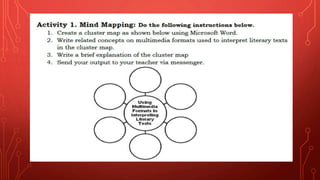
2. Mind mapping is a graphical technique
to visualize connections of ideas and
pieces of information. This tool
structures information to better analyze,
comprehend, synthesize, recall and
generate new ideas. You can use
Microsoft Word or online mind mapping
tools in creating a mind map (Pasuello
3. Mobile
phone text tula is a traditional Filipino
poem. A particular example of this
poem is a tanaga that consists of 4 lines
with 7 syllables each with the same
rhyme at the end of each line. (DepEd
2013, 8).
4. Slideshow presentation is created
with the use of Microsoft PowerPoint.
It contains series of pictures or pages
of information (slides) arranged in
sequence and often displayed on a
large screen using a video projector
(Computer Hope 2018).
5. Tag cloud is a visual, stylized
arrangement of words or tags
within a textual content such as
websites, articles, speeches and
databases (Techopedia 2020).
6. Video is an electronic
device used to record, copy,
playback, broadcast, and
display moving visual media
(Lexico 2020).
THANK YOU FOR
LISTENING!

21st Century Multimedia Formats.pptx

  • 1.
  • 2.
    Watch the videoof a group of students interpreting the song of Levi Celerio, “Ang Pipit.”
  • 3.
    Have you foundstudying literature more exciting with multimedia supports where you can actively and collaboratively build knowledge structures using technology? Evidently, most of the learners like you have realized the huge impact of the use of multimedia in studying literature. It provides opportunities for learners like you to construct and reconstruct your ideas in audio and visual formats. Through multimedia platforms, you can apply a wide range of strategies to understand,
  • 4.
    •Marshall (2001) definedmultimedia as computer-controlled integration of text, graphics, drawings, still and moving images (video), animation, audio, and any other media where every type of information can be represented, stored, transmitted and processed digitally. •Here are some of the multimedia formats that you can use to creatively interpret
  • 5.
    1. Blog ora “weblog” is a website containing informational articles about a person’s own opinions, interests and experiences. These are usually changed regularly (DepEd 2013, 9).
  • 7.
    2. Mind mappingis a graphical technique to visualize connections of ideas and pieces of information. This tool structures information to better analyze, comprehend, synthesize, recall and generate new ideas. You can use Microsoft Word or online mind mapping tools in creating a mind map (Pasuello
  • 9.
    3. Mobile phone texttula is a traditional Filipino poem. A particular example of this poem is a tanaga that consists of 4 lines with 7 syllables each with the same rhyme at the end of each line. (DepEd 2013, 8).
  • 10.
    4. Slideshow presentationis created with the use of Microsoft PowerPoint. It contains series of pictures or pages of information (slides) arranged in sequence and often displayed on a large screen using a video projector (Computer Hope 2018).
  • 11.
    5. Tag cloudis a visual, stylized arrangement of words or tags within a textual content such as websites, articles, speeches and databases (Techopedia 2020).
  • 12.
    6. Video isan electronic device used to record, copy, playback, broadcast, and display moving visual media (Lexico 2020).
  • 14.