A QualityDialogue-
         From Inspection to
            Inspiration

              Ingeborg Bø,
                 Norway
European Foundation for Quality in E-learning

                                                1
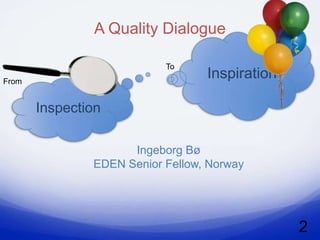
A Quality Dialogue

                           To
From
                                  Inspiration

       Inspection

                     Ingeborg Bø
               EDEN Senior Fellow, Norway


                                                2
I shallspeakabout:
Quality through dialogue


The context within which we are operating


Models for quality assurance


A case study from Norway


Thoughts at the end


                                            3
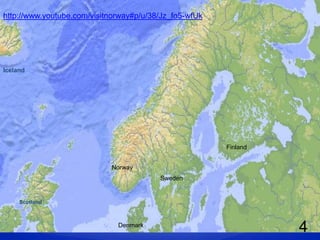
http://www.youtube.com/visitnorway#p/u/38/Jz_fo5-wfUk


Iceland


                                                        Finland


                            Norway
                                         Sweden


     Scotland


                              Denmark
                                                                  4
6
7
My golden learningperspectives
- after 40 years


                                 8
My golden learning
  perspectivesafter 40 years
         in distanceeducation:

  alwayskeepthestudent´sneedsin mind
  usetechnology to thebenefitoflearningand
  make it accessible
  ensurehighqualitythrough a qualityculture


                                              9
My referencepoints

 NADE - Norwegian Association for Distance and
  Flexible Education www.nade-nff.no

 EDEN – European Distance and E-learning Network
  http://www.eden-online.org

 ICDE – International Council for Open and Distance
  Education www.icde.org

 EFQUEL – European Foundation for Quality in
E-learninghttp://www.qualityfoundation.org
                                                       10
EuroeanFoundationforQuality in E-Learning
                   EFQUEL
                  http://www.qualityfoundation.org/


A membership organisation, 100 members
EFQUEL enhances
 the quality of eLearning in Europe by
       providing services for members
       and support for all stakeholders
Networking: Innovation Forum 14 -16 Sept.2011, Oeiras,
       Portugal


                                                          11
Themefor this seminar:

Higher Education
 Rankings
and e-learning

                           12
Have fun


           13
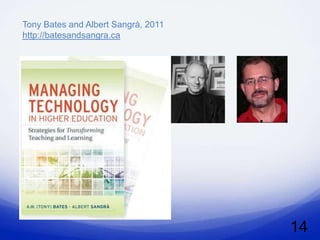
Tony Bates and Albert Sangrà, 2011
http://batesandsangra.ca


                                     14
Qualityassurance and evaluation (Chapter 6)Bates and Sangrà
(2011)

Qualityassurancemethodsarevaluable for
  accreditationagenciesconcernedaboutinstitutionsusinge-
  learning to cut corners or reducecostswithoutmaintaining
  standards.
Theycan be useful for providinginstructorsnew to
  teachingwithtechnology, or strugglingwithitsuse, withmodelsof
  best practice to follow.
However, the best guaranteesofquality in e-learningare a
  commitment by theleadership to supportinginnovation in
  teaching, instructorswelltrained in bothpedagogy and
  theuseoftechnology for teaching, highlyqualified and
  professionallearningtechnology support
  staff, adequateresources
  (especiallyregardinginstructor:studentratios), appropriatemetho
  dsofworking (teamwork, projectmanagement), and
  systematicevaluation.
Generally, the same standards thatapply to online
  learningshouldalsoapply to face-to-faceteaching.                15
Recommendation9
              (Bates and Sangrà)
Use standard methodsof program approval, review and
  evaluation, slightlyadapted for
  thespecialcircumstancesof online learning.
Ensurethatlearner support is provided in suitableways for
  off-campus students.
Use a team approach, withinstructional designers and web
  support staff, and best practice in online course
  design, for hybrid and distancecourses.
Ensurethatthecourse design is adapted to
  meettheneedsofoff-campuslearners.
Beginapplyingsomeofthesetechniques to there-designof
  large face-to-faceclasses.


                                                        16
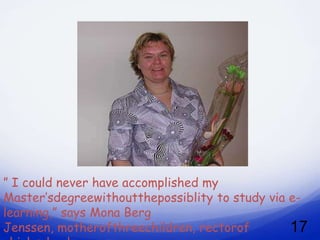
” I could never have accomplished my
Master’sdegreewithoutthepossiblity to study via e-
learning,” says Mona Berg
Jenssen, motherofthreechildren, rectorof        17
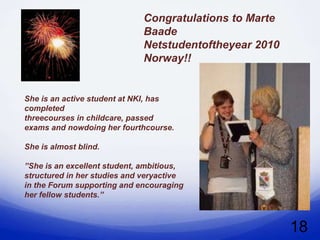
Congratulations to Marte
                             Baade
                             Netstudentoftheyear 2010
                             Norway!!


She is an active student at NKI, has
completed
threecourses in childcare, passed
exams and nowdoing her fourthcourse.

She is almost blind.

”She is an excellent student, ambitious,
structured in her studies and veryactive
in the Forum supporting and encouraging
her fellow students.”


                                                        18
 http://gfx.nrk.no/vewStzq0
                                     dLU3qr-
                                     PsB61HQ4kKgZbPvcLU
                                     SAUW9o5pssw.jpg


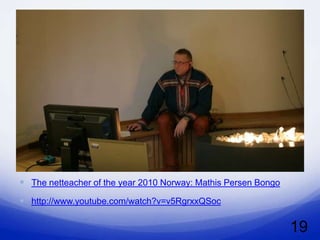
 The netteacher of the year 2010 Norway: Mathis Persen Bongo
 http://www.youtube.com/watch?v=v5RgrxxQSoc

                                                                19
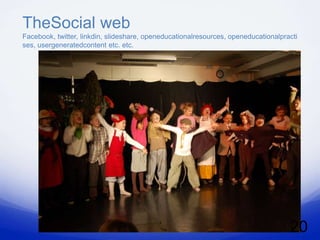
TheSocial web
Facebook, twitter, linkdin, slideshare, openeducationalresources, openeducationalpracti
ses, usergeneratedcontent etc. etc.


                                                                                    20
OECD-CERI
      Qualityassurance in Tertiary Education:
       CurrentPractises in OECD Countries.
              Viktoria Kis, August 2005
            www.oecd.org/edu/tertiary/review

Qualityassuranceprocedurescan serve two
 major purposes:
improvement and accountability.
There is an uneasybalancebetweenboth
  purposes, whichfrequentlyraisesthequestio
  nofincompatibility (Vroeijenstijn, 1995a).


                                                21
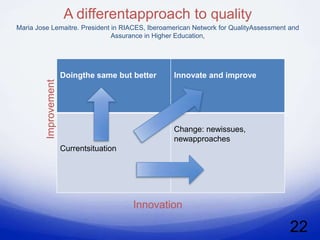
A differentapproach to quality
Maria Jose Lemaitre. President in RIACES, Iberoamerican Network for QualityAssessment and
                               Assurance in Higher Education,


                       Doingthe same but better   Innovate and improve
         Improvement


                                                  Change: newissues,
                                                  newapproaches
                       Currentsituation


                                          Innovation

                                                                                      22
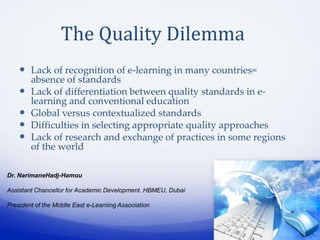
The Quality Dilemma
     Lack of recognition of e-learning in many countries=
        absence of standards
       Lack of differentiation between quality standards in e-
        learning and conventional education
       Global versus contextualized standards
       Difficulties in selecting appropriate quality approaches
       Lack of research and exchange of practices in some regions
        of the world

Dr. NarimaneHadj-Hamou

Assistant Chancellor for Academic Development. HBMEU, Dubai

President of the Middle East e-Learning Association
The context
              24
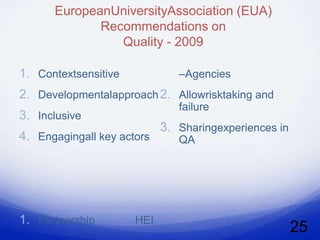
EuropeanUniversityAssociation (EUA)
             Recommendations on
                Quality - 2009

1. Contextsensitive            –Agencies
2. Developmentalapproach 2. Allowrisktaking and
                               failure
3. Inclusive
                            3. Sharingexperiences in
4. Engagingall key actors      QA


1. Partnership        HEI
                                                       25
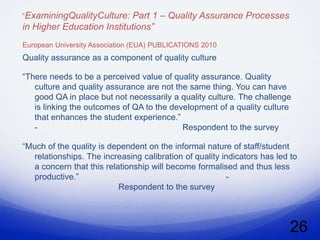
”ExaminingQualityCulture:  Part 1 – Quality Assurance Processes
in Higher Education Institutions”
European University Association (EUA) PUBLICATIONS 2010
Quality assurance as a component of quality culture

“There needs to be a perceived value of quality assurance. Quality
   culture and quality assurance are not the same thing. You can have
   good QA in place but not necessarily a quality culture. The challenge
   is linking the outcomes of QA to the development of a quality culture
   that enhances the student experience.”
   -                                       Respondent to the survey

“Much of the quality is dependent on the informal nature of staff/student
   relationships. The increasing calibration of quality indicators has led to
   a concern that this relationship will become formalised and thus less
   productive.”                                          -
                           Respondent to the survey


                                                                           26
Quality assurance as a component of
                 quality culture (EUA)
“…quality culture refers to an organisational culture that
  intends to enhance quality permanently and is
  characterised by two distinct elements:
on the one hand, a cultural/psychological element of
  shared values, beliefs, expectations and commitment
  towards quality and,
on the other hand, a structural/ managerial element with
  defined processes that enhance quality and aim at
  coordinating individual efforts. “
(EUA 2006: 10)


                                                             27
European FederationforQuality in E-learning
http://www.qualityfoundation.org

The Foundation (2005) undertakesactivities to:
 contribute to thequalityofe-learning in Europe
   and providesleadership in thisfield
 promotethe European
   diversityofqualityapproaches and services in
   thefieldoflearning, education and training
 broadenthediscussion and
   discourseoneLearningquality
 provide a single entrypoint for eLearningquality.


                                                   28
The OPAL Vision
        Unesco, ICDE, EFQUEL, Open Univeristy
        UK, AaltoUniveristy, UniversidadeCatólicaPortugese, University Duisburg-Essen


            Focusonthepractisesof OER
  ratherthantheresources. Better understanding
willlead to improvements in thequalityof OER and
                 more innovation.


   Open EducationalResourcePractise (OEP)
               constitutethe range
     ofpractisesaroundthecreation, use and
      managementof OER withtheintent to
    improvequality and innovative education.


                                                                                        29
EFQUEL Innovation Forum
         2010

Innovation Forum 2010

”What are
thequalityimplic
ations in an
increasingly
open context?”

                          30
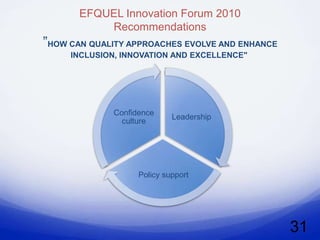
EFQUEL Innovation Forum 2010
           Recommendations
”HOW CAN QUALITY APPROACHES EVOLVE AND ENHANCE
     INCLUSION, INNOVATION AND EXCELLENCE"


              Confidence
                             Leadership
                culture


                    Policy support


                                                 31
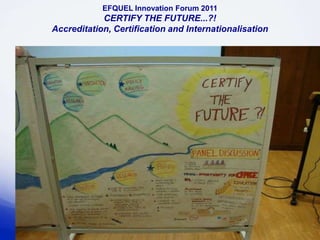
EFQUEL Innovation Forum 2011
            CERTIFY THE FUTURE...?!
Accreditation, Certification and Internationalisation


                                                        32
Models for
       EUROPEAN DISTANCE AND E-LEARNING NETWORK

QualityA NETWORK AND MEETING PLACE FOR
       THE OPEN, DISTANCE AND E-LEARNING COMMUNITY IN EUROPE
Assurance


                                                               33
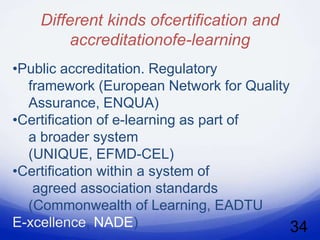
Different kinds ofcertification and
         accreditationofe-learning
•Public accreditation. Regulatory
  framework (European Network for Quality
  Assurance, ENQUA)
•Certification of e-learning as part of
  a broader system
  (UNIQUE, EFMD-CEL)
•Certification within a system of
   agreed association standards
  (Commonwealth of Learning, EADTU
E-xcellence, NADE)                        34
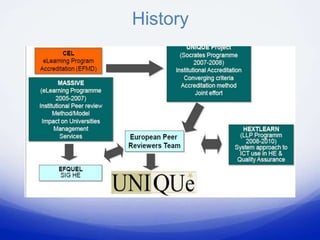
The UNIQUe Certification
History
UNIQUe Value Proposition


     A methodology for implementing
quality Technology Enhanced Learning(TEL)
   system-wide throughout an institution
UNIQUe Value Proposition


Access to world class expertise in the
field of TEL quality management and
           implementation
UNIQUe Value Proposition


Sustained support and continuous
        engagement with
 quality improvement processes
UNIQUe Value Proposition


        Approach enhances
entire institutional innovation policy
UNIQUe Value Proposition


Continually evolving criteria and
           standards
UNIQUe Value Proposition


A clear, standardised and transparent
              system for
    recognition and certification
A Methodology for
System-Wide TEL
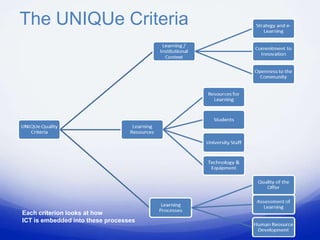
The UNIQUe Criteria


Each criterion looks at how
ICT is embedded into these processes
1. Application
 Formal process
 Submission of Application Data Form:
  Short questionnaire
  Factual information
  English
  Allows preliminary formal assessment of the university’s quality in
     comparison with the UNIQUE quality criteria
  Two types of institutions: universities or independent institutions
     within university (schools, faculties,…)
2. Eligibility
 Formal acceptance of application
  Start of process for quality improvement & accreditation

 UNIQUe supervising body
 No guarantee
 Introductory briefing session f2f/by phone
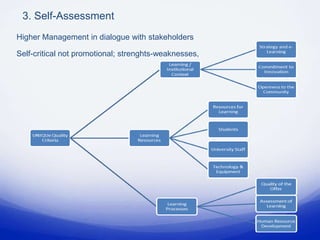
3. Self-Assessment
Higher Management in dialogue with stakeholders

Self-critical not promotional; strenghts-weaknesses,
4. Peer-Review
 Pool of independent peer-reviewers: experts in
  HE, eLearning, Quality, University Management
 Teams of 3 experts / trained reviewers
   Guidebook & tools (open questionnaires,...)
   Review of SAR and questionnaire results from staff and
      students & background info
     Communicate list of persons they wish to interview & schedule
     Preparatory meeting reviewers
     Peer review visit (2-3 days): interviews with higher
      management & other stakeholders (students, tutors,...)
     Preliminary conclusions & feedback establish agreed upon
      developments

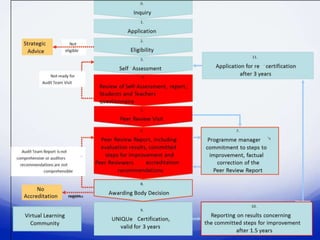
  REPORT Peer-review report incl. Steps for future development
     Agreed upon developments – check after 1.5 years
     Ratings
     Recommendations
5. Awarding Body Decision
            Chair + 4 expert members

                  Final decision

      Recommendations from the reviewers

               Certification 3 years
       (with reporting of progress at 1.5 years)


    Candidate certification: 1 year improvement

           Non certification: -> 3 years
6. Continuous Improvement

Development RoR = Report on Results after 18 months


Based on the steps for improvement the Peer Review
  Team had recommended
EUROPEAN DISTANCE AND E-LEARNING NETWORK
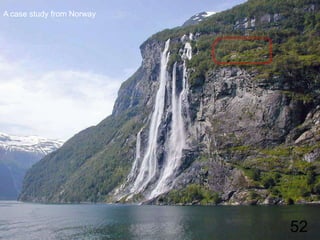
A case study from Norway
            A NETWORK AND MEETING PLACE FOR
            THE OPEN, DISTANCE AND E-LEARNING COMMUNITY IN EUROPE


                                                                    52
Norwegian Association for Distance and Flexible Education

NADE, a member organisation, founded in 1968
Formulated “Code of good practice for distance education”
Law regulating the activities from 1948 with an external
  agency for quality control
New law 1993 introducing internal quality assurance
Quality guidelines developed in 1993
  (Ljoså, Rekkedalet.al), revised several times, latest 2010
NADE´s standing committee on quality since 1993
NOKUT: National agency for quality assurance regulates
  tertiary education according to ENQUA´s Guidelines
  (ESG)


                                                                  53
Norwegian Association for Distance and Flexible Education

Quality guidelines
 Regulated by law
 Institutions accredited by the Ministry of
  Education
 Requires that the institutions have a system
  for quality assurance
 The responsibility for quality guidelines lies
  with NADE


                                                                 54
NADE´sQuality guidelines 2011
A new structure with more focus on quality culture:

1. Quality management and quality work
2. Organisational issues
3. Course development
4. Information and counselling
5. Study-process (enrolment, administration and
   information, tutors´ contract, tutoring, evaluation and
   documentation)

                                                             55
56
Thoughts at the end
 Let us move from inspection to inspiration
  and stimulate the development of a quality
  culture
 Encourage dialogue between accreditation
  bodies and distance education
  practitioners
 Distance education must be accepted as
  an integral part of the ordinary educational
  system
 Put more focusonquality in thesocial web

                                        57
My golden learning
  perspectivesafter 40 years
         in distanceeducation:

  alwayskeepthestudent´sneedsin mind
  usetechnology to thebenefitoflearningand
  make it accessible
  ensurehighqualitythrough a qualityculture


                                              58
Thankyou!
ingebob@online.no
Slides at
http://www.slideshare.net/IngeborgBoe/


                                         59

Ingeborg bo uoc

  • 1.
    A QualityDialogue- From Inspection to Inspiration Ingeborg Bø, Norway European Foundation for Quality in E-learning 1
  • 2.
    A Quality Dialogue To From Inspiration Inspection Ingeborg Bø EDEN Senior Fellow, Norway 2
  • 3.
    I shallspeakabout: Quality throughdialogue The context within which we are operating Models for quality assurance A case study from Norway Thoughts at the end 3
  • 4.
  • 6.
  • 7.
  • 8.
  • 9.
    My golden learning perspectivesafter 40 years in distanceeducation: alwayskeepthestudent´sneedsin mind usetechnology to thebenefitoflearningand make it accessible ensurehighqualitythrough a qualityculture 9
  • 10.
    My referencepoints  NADE- Norwegian Association for Distance and Flexible Education www.nade-nff.no  EDEN – European Distance and E-learning Network http://www.eden-online.org  ICDE – International Council for Open and Distance Education www.icde.org  EFQUEL – European Foundation for Quality in E-learninghttp://www.qualityfoundation.org 10
  • 11.
    EuroeanFoundationforQuality in E-Learning EFQUEL http://www.qualityfoundation.org/ A membership organisation, 100 members EFQUEL enhances the quality of eLearning in Europe by providing services for members and support for all stakeholders Networking: Innovation Forum 14 -16 Sept.2011, Oeiras, Portugal 11
  • 12.
    Themefor this seminar: HigherEducation Rankings and e-learning 12
  • 13.
  • 14.
    Tony Bates andAlbert Sangrà, 2011 http://batesandsangra.ca 14
  • 15.
    Qualityassurance and evaluation(Chapter 6)Bates and Sangrà (2011) Qualityassurancemethodsarevaluable for accreditationagenciesconcernedaboutinstitutionsusinge- learning to cut corners or reducecostswithoutmaintaining standards. Theycan be useful for providinginstructorsnew to teachingwithtechnology, or strugglingwithitsuse, withmodelsof best practice to follow. However, the best guaranteesofquality in e-learningare a commitment by theleadership to supportinginnovation in teaching, instructorswelltrained in bothpedagogy and theuseoftechnology for teaching, highlyqualified and professionallearningtechnology support staff, adequateresources (especiallyregardinginstructor:studentratios), appropriatemetho dsofworking (teamwork, projectmanagement), and systematicevaluation. Generally, the same standards thatapply to online learningshouldalsoapply to face-to-faceteaching. 15
  • 16.
    Recommendation9 (Bates and Sangrà) Use standard methodsof program approval, review and evaluation, slightlyadapted for thespecialcircumstancesof online learning. Ensurethatlearner support is provided in suitableways for off-campus students. Use a team approach, withinstructional designers and web support staff, and best practice in online course design, for hybrid and distancecourses. Ensurethatthecourse design is adapted to meettheneedsofoff-campuslearners. Beginapplyingsomeofthesetechniques to there-designof large face-to-faceclasses. 16
  • 17.
    ” I couldnever have accomplished my Master’sdegreewithoutthepossiblity to study via e- learning,” says Mona Berg Jenssen, motherofthreechildren, rectorof 17
  • 18.
    Congratulations to Marte Baade Netstudentoftheyear 2010 Norway!! She is an active student at NKI, has completed threecourses in childcare, passed exams and nowdoing her fourthcourse. She is almost blind. ”She is an excellent student, ambitious, structured in her studies and veryactive in the Forum supporting and encouraging her fellow students.” 18
  • 19.
     http://gfx.nrk.no/vewStzq0 dLU3qr- PsB61HQ4kKgZbPvcLU SAUW9o5pssw.jpg  The netteacher of the year 2010 Norway: Mathis Persen Bongo  http://www.youtube.com/watch?v=v5RgrxxQSoc 19
  • 20.
    TheSocial web Facebook, twitter,linkdin, slideshare, openeducationalresources, openeducationalpracti ses, usergeneratedcontent etc. etc. 20
  • 21.
    OECD-CERI Qualityassurance in Tertiary Education: CurrentPractises in OECD Countries. Viktoria Kis, August 2005 www.oecd.org/edu/tertiary/review Qualityassuranceprocedurescan serve two major purposes: improvement and accountability. There is an uneasybalancebetweenboth purposes, whichfrequentlyraisesthequestio nofincompatibility (Vroeijenstijn, 1995a). 21
  • 22.
    A differentapproach toquality Maria Jose Lemaitre. President in RIACES, Iberoamerican Network for QualityAssessment and Assurance in Higher Education, Doingthe same but better Innovate and improve Improvement Change: newissues, newapproaches Currentsituation Innovation 22
  • 23.
    The Quality Dilemma  Lack of recognition of e-learning in many countries= absence of standards  Lack of differentiation between quality standards in e- learning and conventional education  Global versus contextualized standards  Difficulties in selecting appropriate quality approaches  Lack of research and exchange of practices in some regions of the world Dr. NarimaneHadj-Hamou Assistant Chancellor for Academic Development. HBMEU, Dubai President of the Middle East e-Learning Association
  • 24.
  • 25.
    EuropeanUniversityAssociation (EUA) Recommendations on Quality - 2009 1. Contextsensitive –Agencies 2. Developmentalapproach 2. Allowrisktaking and failure 3. Inclusive 3. Sharingexperiences in 4. Engagingall key actors QA 1. Partnership HEI 25
  • 26.
    ”ExaminingQualityCulture: Part1 – Quality Assurance Processes in Higher Education Institutions” European University Association (EUA) PUBLICATIONS 2010 Quality assurance as a component of quality culture “There needs to be a perceived value of quality assurance. Quality culture and quality assurance are not the same thing. You can have good QA in place but not necessarily a quality culture. The challenge is linking the outcomes of QA to the development of a quality culture that enhances the student experience.” - Respondent to the survey “Much of the quality is dependent on the informal nature of staff/student relationships. The increasing calibration of quality indicators has led to a concern that this relationship will become formalised and thus less productive.” - Respondent to the survey 26
  • 27.
    Quality assurance asa component of quality culture (EUA) “…quality culture refers to an organisational culture that intends to enhance quality permanently and is characterised by two distinct elements: on the one hand, a cultural/psychological element of shared values, beliefs, expectations and commitment towards quality and, on the other hand, a structural/ managerial element with defined processes that enhance quality and aim at coordinating individual efforts. “ (EUA 2006: 10) 27
  • 28.
    European FederationforQuality inE-learning http://www.qualityfoundation.org The Foundation (2005) undertakesactivities to:  contribute to thequalityofe-learning in Europe and providesleadership in thisfield  promotethe European diversityofqualityapproaches and services in thefieldoflearning, education and training  broadenthediscussion and discourseoneLearningquality  provide a single entrypoint for eLearningquality. 28
  • 29.
    The OPAL Vision Unesco, ICDE, EFQUEL, Open Univeristy UK, AaltoUniveristy, UniversidadeCatólicaPortugese, University Duisburg-Essen Focusonthepractisesof OER ratherthantheresources. Better understanding willlead to improvements in thequalityof OER and more innovation. Open EducationalResourcePractise (OEP) constitutethe range ofpractisesaroundthecreation, use and managementof OER withtheintent to improvequality and innovative education. 29
  • 30.
    EFQUEL Innovation Forum 2010 Innovation Forum 2010 ”What are thequalityimplic ations in an increasingly open context?” 30
  • 31.
    EFQUEL Innovation Forum2010 Recommendations ”HOW CAN QUALITY APPROACHES EVOLVE AND ENHANCE INCLUSION, INNOVATION AND EXCELLENCE" Confidence Leadership culture Policy support 31
  • 32.
    EFQUEL Innovation Forum2011 CERTIFY THE FUTURE...?! Accreditation, Certification and Internationalisation 32
  • 33.
    Models for EUROPEAN DISTANCE AND E-LEARNING NETWORK QualityA NETWORK AND MEETING PLACE FOR THE OPEN, DISTANCE AND E-LEARNING COMMUNITY IN EUROPE Assurance 33
  • 34.
    Different kinds ofcertificationand accreditationofe-learning •Public accreditation. Regulatory framework (European Network for Quality Assurance, ENQUA) •Certification of e-learning as part of a broader system (UNIQUE, EFMD-CEL) •Certification within a system of agreed association standards (Commonwealth of Learning, EADTU E-xcellence, NADE) 34
  • 35.
  • 36.
  • 37.
    UNIQUe Value Proposition A methodology for implementing quality Technology Enhanced Learning(TEL) system-wide throughout an institution
  • 38.
    UNIQUe Value Proposition Accessto world class expertise in the field of TEL quality management and implementation
  • 39.
    UNIQUe Value Proposition Sustainedsupport and continuous engagement with quality improvement processes
  • 40.
    UNIQUe Value Proposition Approach enhances entire institutional innovation policy
  • 41.
    UNIQUe Value Proposition Continuallyevolving criteria and standards
  • 42.
    UNIQUe Value Proposition Aclear, standardised and transparent system for recognition and certification
  • 43.
  • 45.
    The UNIQUe Criteria Eachcriterion looks at how ICT is embedded into these processes
  • 46.
    1. Application  Formalprocess  Submission of Application Data Form: Short questionnaire Factual information English Allows preliminary formal assessment of the university’s quality in comparison with the UNIQUE quality criteria Two types of institutions: universities or independent institutions within university (schools, faculties,…)
  • 47.
    2. Eligibility  Formalacceptance of application Start of process for quality improvement & accreditation  UNIQUe supervising body  No guarantee  Introductory briefing session f2f/by phone
  • 48.
    3. Self-Assessment Higher Managementin dialogue with stakeholders Self-critical not promotional; strenghts-weaknesses,
  • 49.
    4. Peer-Review  Poolof independent peer-reviewers: experts in HE, eLearning, Quality, University Management  Teams of 3 experts / trained reviewers  Guidebook & tools (open questionnaires,...)  Review of SAR and questionnaire results from staff and students & background info  Communicate list of persons they wish to interview & schedule  Preparatory meeting reviewers  Peer review visit (2-3 days): interviews with higher management & other stakeholders (students, tutors,...)  Preliminary conclusions & feedback establish agreed upon developments REPORT Peer-review report incl. Steps for future development  Agreed upon developments – check after 1.5 years  Ratings  Recommendations
  • 50.
    5. Awarding BodyDecision Chair + 4 expert members Final decision Recommendations from the reviewers Certification 3 years (with reporting of progress at 1.5 years) Candidate certification: 1 year improvement Non certification: -> 3 years
  • 51.
    6. Continuous Improvement DevelopmentRoR = Report on Results after 18 months Based on the steps for improvement the Peer Review Team had recommended
  • 52.
    EUROPEAN DISTANCE ANDE-LEARNING NETWORK A case study from Norway A NETWORK AND MEETING PLACE FOR THE OPEN, DISTANCE AND E-LEARNING COMMUNITY IN EUROPE 52
  • 53.
    Norwegian Association forDistance and Flexible Education NADE, a member organisation, founded in 1968 Formulated “Code of good practice for distance education” Law regulating the activities from 1948 with an external agency for quality control New law 1993 introducing internal quality assurance Quality guidelines developed in 1993 (Ljoså, Rekkedalet.al), revised several times, latest 2010 NADE´s standing committee on quality since 1993 NOKUT: National agency for quality assurance regulates tertiary education according to ENQUA´s Guidelines (ESG) 53
  • 54.
    Norwegian Association forDistance and Flexible Education Quality guidelines  Regulated by law  Institutions accredited by the Ministry of Education  Requires that the institutions have a system for quality assurance  The responsibility for quality guidelines lies with NADE 54
  • 55.
    NADE´sQuality guidelines 2011 Anew structure with more focus on quality culture: 1. Quality management and quality work 2. Organisational issues 3. Course development 4. Information and counselling 5. Study-process (enrolment, administration and information, tutors´ contract, tutoring, evaluation and documentation) 55
  • 56.
  • 57.
    Thoughts at theend  Let us move from inspection to inspiration and stimulate the development of a quality culture  Encourage dialogue between accreditation bodies and distance education practitioners  Distance education must be accepted as an integral part of the ordinary educational system  Put more focusonquality in thesocial web 57
  • 58.
    My golden learning perspectivesafter 40 years in distanceeducation: alwayskeepthestudent´sneedsin mind usetechnology to thebenefitoflearningand make it accessible ensurehighqualitythrough a qualityculture 58
  • 59.