Formats for Exchanging Archival
             Data
  An Introduction to EAD, EAC-
   CPF, and Archival Metadata
           Standards

   VII International Seminar of
  Archives from Iberian Tradition
Michael Rush
        Accessioning Archivist / EAD
               Coordinator,
    Beinecke Rare Book and Manuscript
          Library, Yale University

    Co-Chair, Technical Subcommittee
2   for Encoded Archival Description,
Assumptions and Definitions


3
Assumptions
     Familiarity with some ICA standards - ISAD (G),
      ISAAR (CPF), ISDF, or ISDIAH
     Awareness of EAD, but little of no experience with
      it
     Little or no experience with XML


4
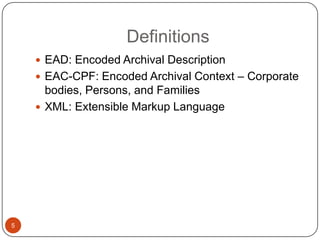
Definitions
     EAD: Encoded Archival Description
     EAC-CPF: Encoded Archival Context – Corporate
      bodies, Persons, and Families
     XML: Extensible Markup Language


5
Development History


6
EAD Development History
     Berkeley Finding Aid Project (1993-1995)
     EAD Alpha (1996)
     EAD Beta (1996)
     EAD 1.0 (1998)
     EAD 2002 (2002)
     EAD 2002 Schema (2007)
     EAD 2013?


7
EAC-CPF Development History
     Meeting at Yale University (1998)
     Meeting at University of Toronto (2001)
     EAC Beta (2004)
     EAC-CPF (2010)


8
Governance and Maintenance


9
Governance and Maintenance
      EAD
       EAD Working Group (1995-2010)
       Technical Subcommittee for EAD (2010- )


      EAC-CPF
       Ad hoc working group (2001-2004)
       EAC Working Group (2007-2011)
       Technical Subcommittee for EAC-CPF (2011- )


      Schema Development Team (2010- )

10
Design Goals and Applications


11
EAD Design Goals
      Represent hierarchical structure of finding aids
      SGML, then XML
      Flexibility, to encourage adoption.
      Compatibility with ISAD (G)


12
EAD Applications
      Delivery
      Standardization
      Sharing
      Transmission/Communication
      Repurposing


13
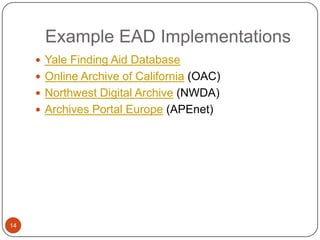
Example EAD Implementations
      Yale Finding Aid Database
      Online Archive of California (OAC)
      Northwest Digital Archive (NWDA)
      Archives Portal Europe (APEnet)


14
EAC-CPF Design Goals
      Close compatibility with ISAAR (CPF)
        A change from EAC Beta to current schema
      XML
      Philosophical neutrality
      Relatively simple and straightforward
      Extensible design
      Adaptability to relational database structures


15
EAC-CPF Applications
      Identity/Authority
      Description
      Relationships
      Aggregation
      Transmission/Communication


16
Oral history
                interview with
                Terry Sanford
                 UNC SOHP


                  Terry
                                   Terry Sanford
Terry Sanford
papers, 1946-   Sanford             records and
                                   papers, 1945-
    1993
                                       1998
UNC (#3531)      (EAC-            Duke University
                  CPF)


                Terry Sanford’s
                  Governor’s
                 papers, 1959-
                     1965
                   NC State
                   Archives
Example EAC-CPF
                Implementation
      The Social Networks and Archival Context Project
      (SNAC)


18
Challenges


19
Challenges
      Data migration and/or creation
      Establishing encoding best
       practices
      Delivery
        Indexing and search
        Display
      Data maintenance
      Sharing
20
Data migration/creation
      Methods
        Hand encoding
        Templates
        Scripting
        Outsourcing
        Export from databases (Archivists’ Toolkit, Archon,
        ICA AtoM)
      Costs
        Staff time
        Staff training
        Consultant or outsourcing fees
21
        Software
Encoding Best Practices
      Local
       Yale EAD Encoding Best Practice
         Guidelines [EAD]
      Consortial
        Northwest Digital Archives Best
         Practice Guidelines [EAD]
        RLG Best Practice Guidelines for
         Encoded Archival Description [EAD]

22
Delivery
      Indexing and search
        No single solution
        Popular tools include :
         XTF (eXtensible Text Framework)
         Fedora Commons Repository Software
      Display
        Transformation via XSLT (Exstensible
        Stylesheet Language – Transformations)
         XML --> HTML
         XML --> PDF
23
XML


            HTML
     XSLT
                   CSS
24
Data Maintenance
      File management
      Version control
      Link maintenance


25
Sharing
      Consortia
      Bulk Aggregators
       ArchiveGrid
      Topical Aggregators
       U.S. National Library of Medicine,
       History of Medicine Finding Aids
       Consortium

26
Related Standards


27
Related Description Standards
      ICA standards:
        ISAD(G): General International Standard Archival
         Description - Second edition
        ISAAR(CPF): International Standard Archival
         Authority Record for Corporate Bodies, Persons
         and Families, 2nd Edition
        ISDF: International Standard for Describing
         Functions
        ISDIAH: International Standard for Describing
         Institutions with Archival Holdings
      National Description Standards
        DACS: Describing Archives: A Content Standard
28      (USA)
EAD Data Structure


29
EAD: Basic Structure
     <ead>*
     <eadheader>*
     <archdesc>*
      <dsc>


30
EAD Header
     <eadheader>*
      <eadid>*
      <filedesc>*
      <profiledesc>
      <revisiondesc>


31
File Description
     <filedesc>*
      <titlestmt>*
       <titleproper>*
       <author>
      <publicationstmt>
       <publisher>
32
Profile Description
     <profiledesc>
      <creation> - Creation
      <langusage> - Language
      Usage
      <descrules> - Descriptive
      Rules
33
Revision Description
     <revisiondesc>
      <change> - Change
       <date> - Date
       <item> - Item


34
EAD: Basic Structure
     <ead>*
     <eadheader>*
     <archdesc>*
      <dsc>


35
Hierarchical Encoding
      <archdesc>
       Top level of description.
      <dsc>
       Optional child of <archdesc>
       Consists of nested components


36
Components
      <c> - Component
       (Unnumbered)
      Or
      <c01> - Component (First
       Level)
       <c02> - Component (Second
        Level)
37      Through <c12> - Component
Levels of Description
      @level
      [ISAD(G) 3.1.4]         subseries
       collection            file
       fonds                 item
       class                 Otherlevel
       recordgrp
       series              <archdesc
       subfonds             level=“fonds”>
       subgrp              <c level=“series”>


38
Descriptive Elements
      Valid as at all levels of description
      <did> is required at each level of
      description.


39
Descriptive Identification
      <did>*
       Always the first child of
        <archdesc> and the component
        elements.
       Wrapper element containing
        elements with basic identifying
        information.
       Must have one child element.
40
<did> Children
      <unitid> - Unit Identification
       [ISAD(G) 3.1.1]
      <unittitle> - Unit Title
       [ISAD(G) 3.1.2]


41
<did> Children (continued)
      <unitdate> - Unit Date
       [ISAD(G) 3.1.3]
      <physdesc> - Physical
       Description
       [ISAD(G) 3.1.5]


42
<did> Children (continued)
     <origination> - Origination
      [ISAD(G) 3.2.1]
     <langmaterial> - Language
      of the Material [ISAD(G)
      3.4.3]

43
<did> Children (continued)
      <note> - Note [ISAD(G) 3.6.1]
      <abstract> - Abstract
      <physloc> - Physical Location
      <materialspec> - Material
       Specific Details
      <repository> - Repository

44
<did> Children (continued)
     <did>
      <container> - Container
      <dao> - Digital Archival
       Object
      <daogroup> - Digital
       Archival Object Group
45
<did> Siblings
      <bioghist> - Biography or History
       [ISAD(G) 3.2.2]
      <custodhist> - Custodial History
       [ISAD(G) 3.2.3]
      <acqinfo> - Acquisition Information
       [ISAD(G) 3.2.3]


46
<did> Siblings
      <scopecontent> - Scope and
       Content
       [ISAD(G) 3.3.1]
      <accruals> - Accruals
       [ISAD(G) 3.3.2]
      <appraisal> - Appraisal
       [ISAD(G) 3.3.3]
      <arrangement> - Arrangement
47     [ISAD(G) 3.3.4]
<did> Siblings (continued)
      <accessrestrict> - Conditions
       Governing Access [ISAD(G) 3.4.1]
      <userestrict> - Conditions
       Governing Use
       [ISAD(G) 3.4.2]
      <phystech> - Physical
       Characteristics and Technical
       Requirements [ISAD(G) 3.4.4]
48    <otherfindaid> - Other Finding Aid
<did> Siblings (continued)
      <originalsloc> - Location of
       Originals
      [ISAD(G) 3.5.1]
      <altformavail> - Alternative Form
       Available
       [ISAD(G) 3.5.2]
      <relatedmaterial> - Related
       Material
49     [ISAD(G) 3.5.3]
<did> Siblings (continued)
      <bibliography> - Bibliography
       [ISAD(G) 3.5.4]
      <note> - Note
       [ISAD(G) 3.6.1]
      <odd> - Other Descriptive Data
       [ISAD(G) 3.6.1]
      <processinfo> - Processing
       Information
50     [ISAD(G) 3.7.1]
<did> Siblings (continued)
      <prefercite> - Preferred Citation
      <controlaccess> - Control Access
      <fileplan> - File Plan
      <index> - Index


51
EAC-CPF Data Structure


52
EAC-CPF Concepts
   SINGLE IDENTITY: one person (or corporate body or family) with a single identity
     represented in one EAC-CPF instance. (Most common.)

   MULTIPLE IDENTITY-MANY IN ONE: two or more identities (including official identities)
     with each represented by distinct descriptions within one EAC-CPF instance. Can be
     programmatically converted into Multiple Identity-One in Many. (Less common though
     not
     rare.)

   MULTIPLE IDENTITY-ONE IN MANY: two or more identities (including official identities)
     each represented in two or more interrelated EAC-CPF instances. Can be
     programmatically
     converted into Multiple Identity-Many in One. (Less common though not rare.)

   ALTERNATIVE SET: derived EAC-CPF instance that is based on and incorporates two
     or more
     alternative EAC-CPF instances for the same entity. To be used by a consortia or a
     utility
     providing union access to authority records maintained in two or more systems by
     two or more agencies. Alternative EAC-CPF instances may be in different languages
     or in the same
53   language.
Basic structure
      <eac-cpf>*
      <control>*
      <cpfDescription>
       <identity>
       <description>
       <relations>

54
Basic Structure
     <control>: identity, creation, maintenance, status,
      rules and authorities, and sources used to
      generate the EAC-CPF instance.

     <cpfDescription>: description of the EAC-CPF
      entity
        <identity>: names
        <description>: formal and informal descriptive elements
        <relations>: relationships to other entities, resources
        and function descriptions
55
Philosophical neutrality (1)
     <eac-cpf>
       <control></control>
       <cpfDescription>
           <identity></identity>
           <description></description>
           <relations>
                   <cpfRelation></cpfRelation>
                   <cpfRelation></cpfRelation>
           </relations>
       </cpfDescription>
     </eac-cpf>

56
Philosophical neutrality (2)
     <eac-cpf>
       <control></control>
       <multipleIdentities>
                  <cpfDescription></cpfDescription>
                  <cpfDescription></cpfDescription>
                  <cpfDescription></cpfDescription>
       </multipleIdentities>
     </eac-cpf>


57
<control>
      <recordId>*
      <maintenanceAgency>*
      <maintenanceStatus>*
      <maintenanceHistory>*
      <publicationStatus>
      <languageDeclaration>*
      <sources>*
      <conventionDeclaration>
      <otherRecordId>
      <localControl>
      <localTypeDeclaration>

58
<cpfDescription>/<identity>
      <entityType>*
      <nameEntry>**
      <nameEntryParallel>**
      <entityId>
      <descriptiveNote>


59
Basic Name Models
     <nameEntry>
         <part></part>
         <useDates></useDates>
     </nameEntry>

     <nameEntryParallel>
         <nameEntry></nameEntry>
         <nameEntry></nameEntry>
     </nameEntryParallel>
60
<cpfDescription>/<description>
      <existDates>
      <function>
      <generalContext>
      <legalStatus>
      <languageUsed>
      <mandate>
      <occupation>
      <place>
      <biogHist>
      <structureOrGenealogy>
      <localDescription>

61
<cpfDescription>/<relations>
      <cpfRelation>
      <functionRelation>
      <resourceRelation>

       ◦   @*RelationType
       ◦   <relationEntry>
       ◦   <objectBinWrap>
       ◦   <objectXMLWrap>
       ◦   <date>, <dateRange>, <dateSet>
       ◦   <place>
       ◦   <descriptiveNote>

62
<cpfRelation>: relation types
      @cpfRelationType
       identity
       hierarchical
       hierarchical-parent
       hierarchical-child
       temporal
       temporal-earlier
       temporal-later
       family
       associative


63
<resourceRelation>: relation
                  types
      @resourceRelationType
       creatorOf
       subjectOf
       other


64
<functionRelation>: relation types
      @functionRelationType
       controls
       owns
       performs


65
Future Development


66
EAD Revision Timeline
      Comment period complete (October 2010 –
         February 2011)
        EAD Revision Forum (SAA Annual Meeting,
         August 2011)
        TS-EAD Working Meeting (March 2012)
        Release draft schema (Fall 2012)
        Second comment period (Winter 2013)
        Finalize schema and documentation (Spring
         2013)
        Release revised schema (August 2013)

67
EAD Revision Goals
      Clarify relationship with EAC-CPF
      Improve interoperability with databases
        Reconsider finding aids as documents or data
      Simplification
        To eliminate unnecessary complexity
        To make implementation easier
      Improve usability
      Enable profiles (schema subsets)
        Data-friendly
        Implementation-friendly (may or may not be the
        same as data-friendly)
68
Future EAC Development
      EAC-CPF Implementation
      Review by 2016
      Companion EAC standards?
       EAC-Functions (EAC-F)?
       EAC-Institutions with Archival
       Holdings (EAC-IAH)?


69
EAC-
           CPF


                  EAC-
     EAD   EAD     IAH


           EAC-
            F
70
EAD


            EAC-
            CPF
     EAC-          EAC-
      F            CPF
71
EAC-
            F


           EAC-
            F
                  EAC-
     EAD
                  CPF
72
Questions?

      michael.rush@yale.edu

     http://twitter.com/mike_rush

73

Formats for Exchanging Archival Data: An Introduction to EAD, EAC-CPF, and Archival Metadata Standards

  • 1.
    Formats for ExchangingArchival Data An Introduction to EAD, EAC- CPF, and Archival Metadata Standards VII International Seminar of Archives from Iberian Tradition
  • 2.
    Michael Rush Accessioning Archivist / EAD Coordinator, Beinecke Rare Book and Manuscript Library, Yale University Co-Chair, Technical Subcommittee 2 for Encoded Archival Description,
  • 3.
  • 4.
    Assumptions  Familiarity with some ICA standards - ISAD (G), ISAAR (CPF), ISDF, or ISDIAH  Awareness of EAD, but little of no experience with it  Little or no experience with XML 4
  • 5.
    Definitions  EAD: Encoded Archival Description  EAC-CPF: Encoded Archival Context – Corporate bodies, Persons, and Families  XML: Extensible Markup Language 5
  • 6.
  • 7.
    EAD Development History  Berkeley Finding Aid Project (1993-1995)  EAD Alpha (1996)  EAD Beta (1996)  EAD 1.0 (1998)  EAD 2002 (2002)  EAD 2002 Schema (2007)  EAD 2013? 7
  • 8.
    EAC-CPF Development History  Meeting at Yale University (1998)  Meeting at University of Toronto (2001)  EAC Beta (2004)  EAC-CPF (2010) 8
  • 9.
  • 10.
    Governance and Maintenance  EAD  EAD Working Group (1995-2010)  Technical Subcommittee for EAD (2010- )  EAC-CPF  Ad hoc working group (2001-2004)  EAC Working Group (2007-2011)  Technical Subcommittee for EAC-CPF (2011- )  Schema Development Team (2010- ) 10
  • 11.
    Design Goals andApplications 11
  • 12.
    EAD Design Goals  Represent hierarchical structure of finding aids  SGML, then XML  Flexibility, to encourage adoption.  Compatibility with ISAD (G) 12
  • 13.
    EAD Applications  Delivery  Standardization  Sharing  Transmission/Communication  Repurposing 13
  • 14.
    Example EAD Implementations  Yale Finding Aid Database  Online Archive of California (OAC)  Northwest Digital Archive (NWDA)  Archives Portal Europe (APEnet) 14
  • 15.
    EAC-CPF Design Goals  Close compatibility with ISAAR (CPF)  A change from EAC Beta to current schema  XML  Philosophical neutrality  Relatively simple and straightforward  Extensible design  Adaptability to relational database structures 15
  • 16.
    EAC-CPF Applications  Identity/Authority  Description  Relationships  Aggregation  Transmission/Communication 16
  • 17.
    Oral history interview with Terry Sanford UNC SOHP Terry Terry Sanford Terry Sanford papers, 1946- Sanford records and papers, 1945- 1993 1998 UNC (#3531) (EAC- Duke University CPF) Terry Sanford’s Governor’s papers, 1959- 1965 NC State Archives
  • 18.
    Example EAC-CPF Implementation  The Social Networks and Archival Context Project (SNAC) 18
  • 19.
  • 20.
    Challenges  Data migration and/or creation  Establishing encoding best practices  Delivery  Indexing and search  Display  Data maintenance  Sharing 20
  • 21.
    Data migration/creation  Methods  Hand encoding  Templates  Scripting  Outsourcing  Export from databases (Archivists’ Toolkit, Archon, ICA AtoM)  Costs  Staff time  Staff training  Consultant or outsourcing fees 21  Software
  • 22.
    Encoding Best Practices  Local  Yale EAD Encoding Best Practice Guidelines [EAD]  Consortial  Northwest Digital Archives Best Practice Guidelines [EAD]  RLG Best Practice Guidelines for Encoded Archival Description [EAD] 22
  • 23.
    Delivery  Indexing and search  No single solution  Popular tools include :  XTF (eXtensible Text Framework)  Fedora Commons Repository Software  Display  Transformation via XSLT (Exstensible Stylesheet Language – Transformations)  XML --> HTML  XML --> PDF 23
  • 24.
    XML HTML XSLT CSS 24
  • 25.
    Data Maintenance  File management  Version control  Link maintenance 25
  • 26.
    Sharing  Consortia  Bulk Aggregators  ArchiveGrid  Topical Aggregators  U.S. National Library of Medicine, History of Medicine Finding Aids Consortium 26
  • 27.
  • 28.
    Related Description Standards  ICA standards:  ISAD(G): General International Standard Archival Description - Second edition  ISAAR(CPF): International Standard Archival Authority Record for Corporate Bodies, Persons and Families, 2nd Edition  ISDF: International Standard for Describing Functions  ISDIAH: International Standard for Describing Institutions with Archival Holdings  National Description Standards  DACS: Describing Archives: A Content Standard 28 (USA)
  • 29.
  • 30.
    EAD: Basic Structure <ead>* <eadheader>* <archdesc>* <dsc> 30
  • 31.
    EAD Header <eadheader>* <eadid>* <filedesc>* <profiledesc> <revisiondesc> 31
  • 32.
    File Description <filedesc>* <titlestmt>* <titleproper>* <author> <publicationstmt> <publisher> 32
  • 33.
    Profile Description <profiledesc> <creation> - Creation <langusage> - Language Usage <descrules> - Descriptive Rules 33
  • 34.
    Revision Description <revisiondesc> <change> - Change <date> - Date <item> - Item 34
  • 35.
    EAD: Basic Structure <ead>* <eadheader>* <archdesc>* <dsc> 35
  • 36.
    Hierarchical Encoding  <archdesc>  Top level of description.  <dsc>  Optional child of <archdesc>  Consists of nested components 36
  • 37.
    Components  <c> - Component (Unnumbered)  Or  <c01> - Component (First Level) <c02> - Component (Second Level) 37 Through <c12> - Component
  • 38.
    Levels of Description  @level [ISAD(G) 3.1.4]  subseries  collection  file  fonds  item  class  Otherlevel  recordgrp  series  <archdesc  subfonds level=“fonds”>  subgrp  <c level=“series”> 38
  • 39.
    Descriptive Elements  Valid as at all levels of description  <did> is required at each level of description. 39
  • 40.
    Descriptive Identification  <did>*  Always the first child of <archdesc> and the component elements.  Wrapper element containing elements with basic identifying information.  Must have one child element. 40
  • 41.
    <did> Children  <unitid> - Unit Identification [ISAD(G) 3.1.1]  <unittitle> - Unit Title [ISAD(G) 3.1.2] 41
  • 42.
    <did> Children (continued)  <unitdate> - Unit Date [ISAD(G) 3.1.3]  <physdesc> - Physical Description [ISAD(G) 3.1.5] 42
  • 43.
    <did> Children (continued) <origination> - Origination [ISAD(G) 3.2.1] <langmaterial> - Language of the Material [ISAD(G) 3.4.3] 43
  • 44.
    <did> Children (continued)  <note> - Note [ISAD(G) 3.6.1]  <abstract> - Abstract  <physloc> - Physical Location  <materialspec> - Material Specific Details  <repository> - Repository 44
  • 45.
    <did> Children (continued) <did> <container> - Container <dao> - Digital Archival Object <daogroup> - Digital Archival Object Group 45
  • 46.
    <did> Siblings  <bioghist> - Biography or History [ISAD(G) 3.2.2]  <custodhist> - Custodial History [ISAD(G) 3.2.3]  <acqinfo> - Acquisition Information [ISAD(G) 3.2.3] 46
  • 47.
    <did> Siblings  <scopecontent> - Scope and Content [ISAD(G) 3.3.1]  <accruals> - Accruals [ISAD(G) 3.3.2]  <appraisal> - Appraisal [ISAD(G) 3.3.3]  <arrangement> - Arrangement 47 [ISAD(G) 3.3.4]
  • 48.
    <did> Siblings (continued)  <accessrestrict> - Conditions Governing Access [ISAD(G) 3.4.1]  <userestrict> - Conditions Governing Use [ISAD(G) 3.4.2]  <phystech> - Physical Characteristics and Technical Requirements [ISAD(G) 3.4.4] 48  <otherfindaid> - Other Finding Aid
  • 49.
    <did> Siblings (continued)  <originalsloc> - Location of Originals  [ISAD(G) 3.5.1]  <altformavail> - Alternative Form Available [ISAD(G) 3.5.2]  <relatedmaterial> - Related Material 49 [ISAD(G) 3.5.3]
  • 50.
    <did> Siblings (continued)  <bibliography> - Bibliography [ISAD(G) 3.5.4]  <note> - Note [ISAD(G) 3.6.1]  <odd> - Other Descriptive Data [ISAD(G) 3.6.1]  <processinfo> - Processing Information 50 [ISAD(G) 3.7.1]
  • 51.
    <did> Siblings (continued)  <prefercite> - Preferred Citation  <controlaccess> - Control Access  <fileplan> - File Plan  <index> - Index 51
  • 52.
  • 53.
    EAC-CPF Concepts SINGLE IDENTITY: one person (or corporate body or family) with a single identity represented in one EAC-CPF instance. (Most common.) MULTIPLE IDENTITY-MANY IN ONE: two or more identities (including official identities) with each represented by distinct descriptions within one EAC-CPF instance. Can be programmatically converted into Multiple Identity-One in Many. (Less common though not rare.) MULTIPLE IDENTITY-ONE IN MANY: two or more identities (including official identities) each represented in two or more interrelated EAC-CPF instances. Can be programmatically converted into Multiple Identity-Many in One. (Less common though not rare.) ALTERNATIVE SET: derived EAC-CPF instance that is based on and incorporates two or more alternative EAC-CPF instances for the same entity. To be used by a consortia or a utility providing union access to authority records maintained in two or more systems by two or more agencies. Alternative EAC-CPF instances may be in different languages or in the same 53 language.
  • 54.
    Basic structure  <eac-cpf>* <control>* <cpfDescription> <identity> <description> <relations> 54
  • 55.
    Basic Structure <control>: identity, creation, maintenance, status, rules and authorities, and sources used to generate the EAC-CPF instance. <cpfDescription>: description of the EAC-CPF entity  <identity>: names  <description>: formal and informal descriptive elements  <relations>: relationships to other entities, resources and function descriptions 55
  • 56.
    Philosophical neutrality (1) <eac-cpf> <control></control> <cpfDescription> <identity></identity> <description></description> <relations> <cpfRelation></cpfRelation> <cpfRelation></cpfRelation> </relations> </cpfDescription> </eac-cpf> 56
  • 57.
    Philosophical neutrality (2) <eac-cpf> <control></control> <multipleIdentities> <cpfDescription></cpfDescription> <cpfDescription></cpfDescription> <cpfDescription></cpfDescription> </multipleIdentities> </eac-cpf> 57
  • 58.
    <control>  <recordId>*  <maintenanceAgency>*  <maintenanceStatus>*  <maintenanceHistory>*  <publicationStatus>  <languageDeclaration>*  <sources>*  <conventionDeclaration>  <otherRecordId>  <localControl>  <localTypeDeclaration> 58
  • 59.
    <cpfDescription>/<identity>  <entityType>*  <nameEntry>**  <nameEntryParallel>**  <entityId>  <descriptiveNote> 59
  • 60.
    Basic Name Models <nameEntry> <part></part> <useDates></useDates> </nameEntry> <nameEntryParallel> <nameEntry></nameEntry> <nameEntry></nameEntry> </nameEntryParallel> 60
  • 61.
    <cpfDescription>/<description>  <existDates>  <function>  <generalContext>  <legalStatus>  <languageUsed>  <mandate>  <occupation>  <place>  <biogHist>  <structureOrGenealogy>  <localDescription> 61
  • 62.
    <cpfDescription>/<relations>  <cpfRelation>  <functionRelation>  <resourceRelation> ◦ @*RelationType ◦ <relationEntry> ◦ <objectBinWrap> ◦ <objectXMLWrap> ◦ <date>, <dateRange>, <dateSet> ◦ <place> ◦ <descriptiveNote> 62
  • 63.
    <cpfRelation>: relation types  @cpfRelationType  identity  hierarchical  hierarchical-parent  hierarchical-child  temporal  temporal-earlier  temporal-later  family  associative 63
  • 64.
    <resourceRelation>: relation types  @resourceRelationType  creatorOf  subjectOf  other 64
  • 65.
    <functionRelation>: relation types  @functionRelationType  controls  owns  performs 65
  • 66.
  • 67.
    EAD Revision Timeline  Comment period complete (October 2010 – February 2011)  EAD Revision Forum (SAA Annual Meeting, August 2011)  TS-EAD Working Meeting (March 2012)  Release draft schema (Fall 2012)  Second comment period (Winter 2013)  Finalize schema and documentation (Spring 2013)  Release revised schema (August 2013) 67
  • 68.
    EAD Revision Goals  Clarify relationship with EAC-CPF  Improve interoperability with databases  Reconsider finding aids as documents or data  Simplification  To eliminate unnecessary complexity  To make implementation easier  Improve usability  Enable profiles (schema subsets)  Data-friendly  Implementation-friendly (may or may not be the same as data-friendly) 68
  • 69.
    Future EAC Development  EAC-CPF Implementation  Review by 2016  Companion EAC standards?  EAC-Functions (EAC-F)?  EAC-Institutions with Archival Holdings (EAC-IAH)? 69
  • 70.
    EAC- CPF EAC- EAD EAD IAH EAC- F 70
  • 71.
    EAD EAC- CPF EAC- EAC- F CPF 71
  • 72.
    EAC- F EAC- F EAC- EAD CPF 72
  • 73.
    Questions? michael.rush@yale.edu http://twitter.com/mike_rush 73

Editor's Notes

  • #11 International, process in place for regular review, turnoverNo representation from Central or South America – something I would welcome
  • #21 -Best practices less critical for EAC-CPF, still necessary for local documentation
  • #25 CSSS=Cascading Style Sheets
  • #30 Disclaimer: Not cover all EAD elements.* Indicates required elements
  • #60 ** Choice of one or the other