Entity Relationship Models

    Sumant Kulkarni, Yogalakshmi
{sumant.kulkarni, j.yogalakshmi}@iiitb.org


                                             1 / 27
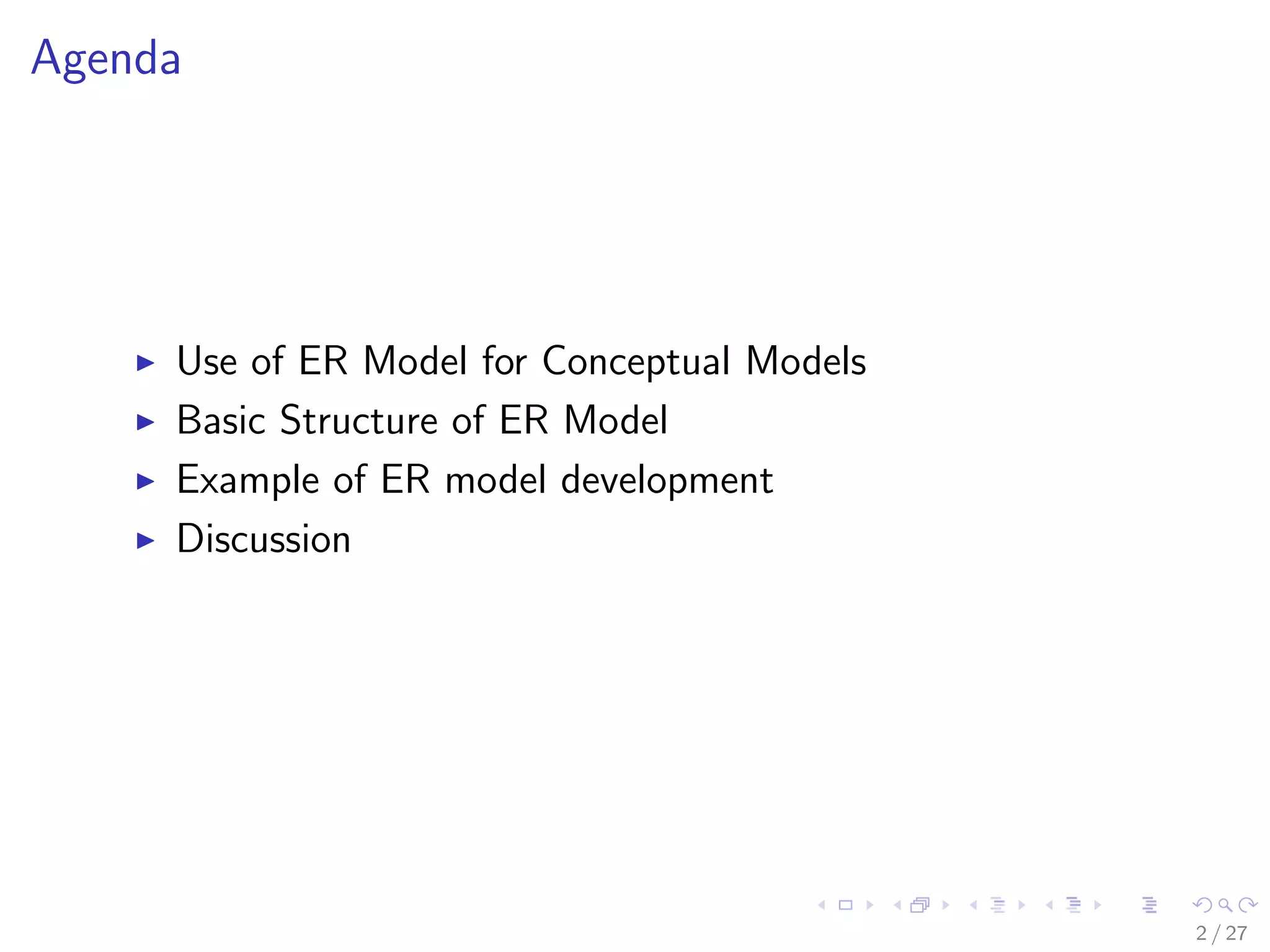
Agenda


     Use of ER Model for Conceptual Models
     Basic Structure of ER Model
     Example of ER model development
     Discussion


                                             2 / 27
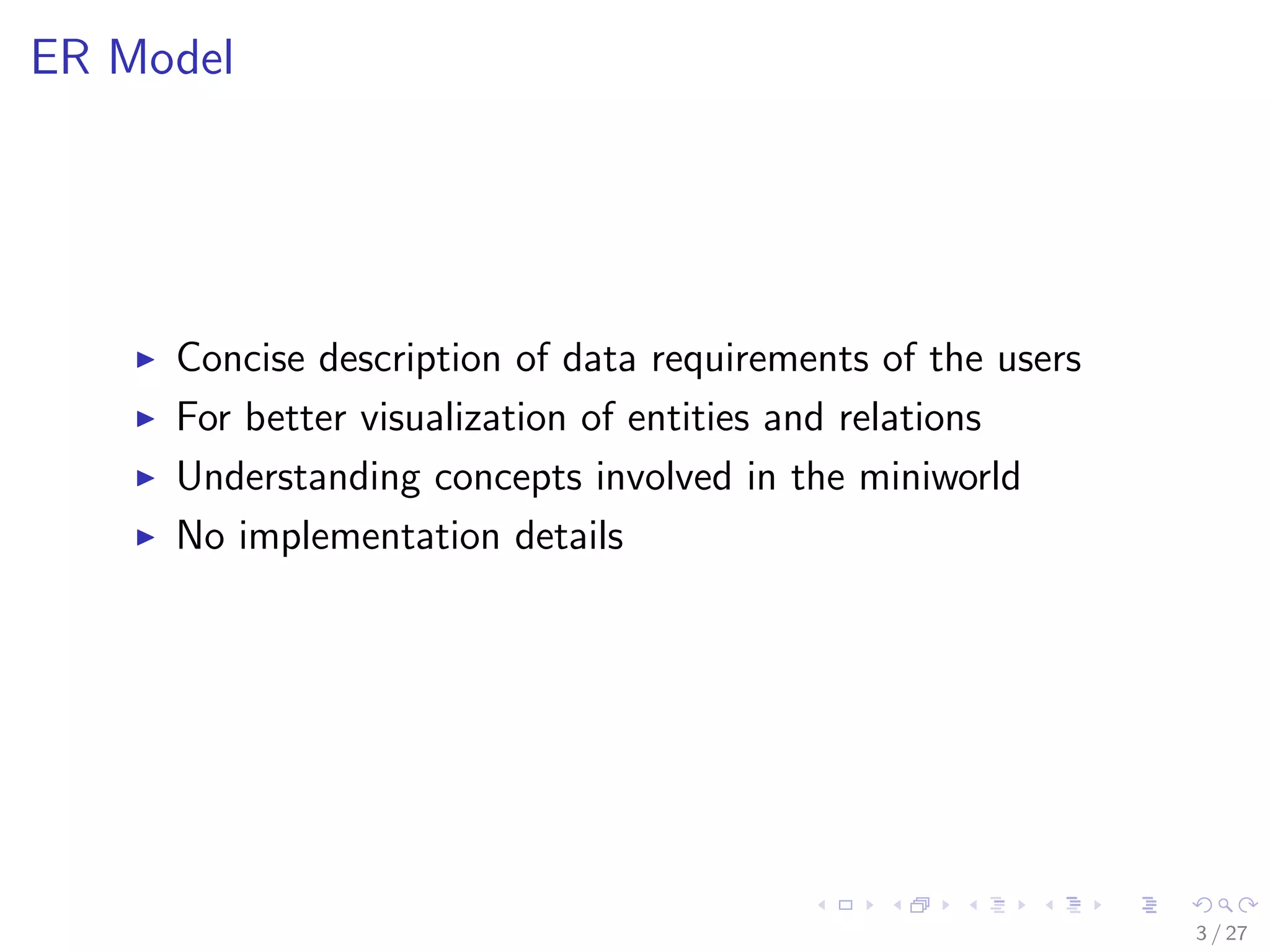
ER Model


     Concise description of data requirements of the users
     For better visualization of entities and relations
     Understanding concepts involved in the miniworld
     No implementation details


                                                             3 / 27
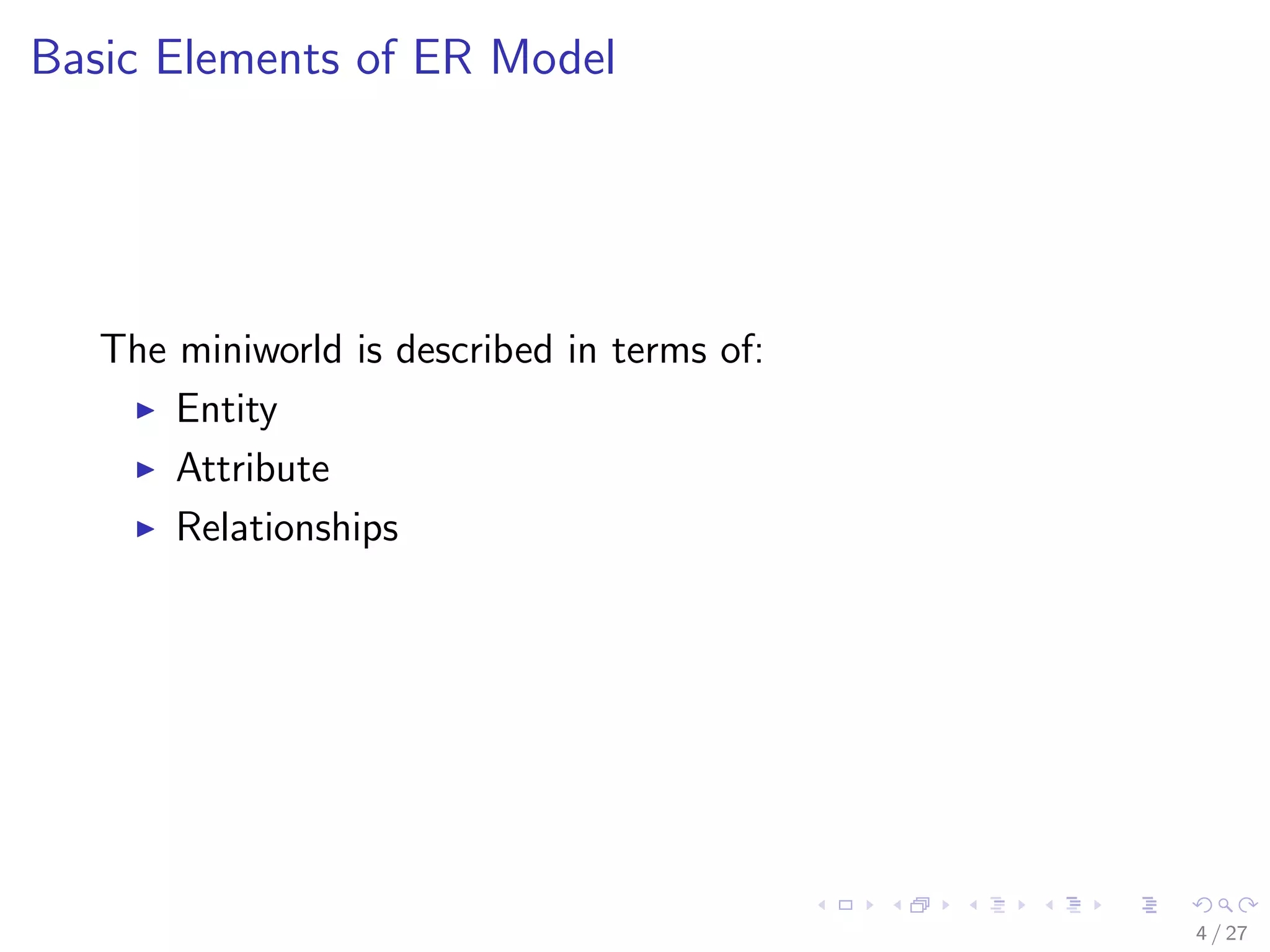
Basic Elements of ER Model


   The miniworld is described in terms of:
       Entity
       Attribute
       Relationships


                                             4 / 27
Description of an Example of a miniworld


   Every student is identified by his student number. The system
   also knows about his Date of Birth, current and permanent
   addresses, and his joining date. Every student registers for
   some courses or works for projects or does both. Student can
   either audit the course or take it for credit. He obtains grades
   for the courses he takes on credit. These grades are available
   for all the subjects the student has taken on credit till now.
   These credits decide whether he has passed or failed in the
   subject.


                                                                      5 / 27
Description of an Example of a miniworld


   Every course is offered by one or more professors (combined).
   So, each faculty member spends a specific number of hours on
   the course he offers. A professor can be involved in offering
   many courses. Every course belongs to a stream. It also has a
   name, unique course number. There are some credit
   associated with the course.


                                                                   6 / 27
Description of an Example of a miniworld


   Professor may be in-charges of a lab. A lab can have one or
   more in-charges. A lab can have multiple projects running
   under it from specific start dates. If a student opts to work for
   a projects, then depending upon the need of the project, he
   has to spend some know amount of time on the project.
   Similar to the student id, there will be unique identification
   numbers for every faculty member, lab and project.


                                                                      7 / 27
Elements of ER Model


      Entity
      Attribute
          Composite versus Simple (Atomic) Attributes
          Single-Valued versus Multivalued Attributes
          Stored versus Derived Attributes
          Null Attributes (NA)


                                                        8 / 27
Elements of ER Model


      Entity Set
      Key Attributes of an Entity Type (uniqueness constraint)
      Value Sets (Domains) of Attributes.
      Value Set of composite attribute.
      V = P(V 1)XP(V 2)X ...XP(Vn)
      where P(Vi) is the powerset of Vi.


                                                                 9 / 27
Exploring Relationships


       What is Relationship?
       Relationship Types
       Relationship Instances
       Relationship Sets
       Participation


                                10 / 27
Exploring Relationships


       Relationship Degree (unary, binary, ternary)
       Relationship as Attributes
       Role Names and Recursive Relationships


                                                      11 / 27
Constraints on Relationship Types


      Cardinality Ratios for Binary Relationships
      Total participation (existence dependency)
      Partial participation


                                                    12 / 27
Attributes of Relationship Types


   Migration of Attributes from Relationship Types
       Migration in 1:1 Relationship type
       Migration in 1:N Relationship type.
       Migration in M:N Relationship type


                                                     13 / 27
Weak Entity Types


      Owner (identifying) entity type
      Identifying relationship
      A weak entity type always has a total participation constraint.
      A weak entity type normally has Partial key


                                                                        14 / 27
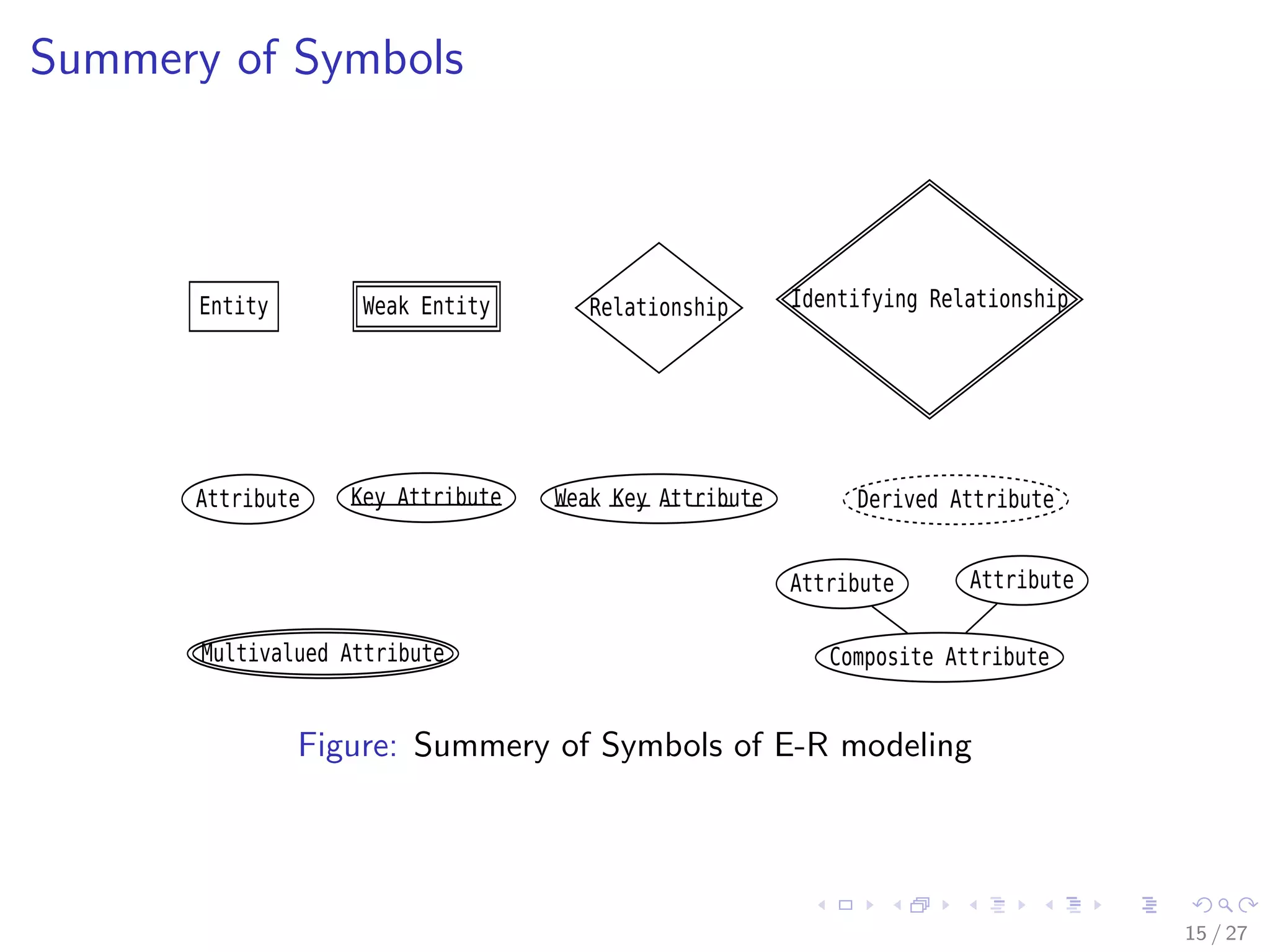
Summery of Symbols


           Figure: Summery of Symbols of E-R modeling


                                                        15 / 27
Student Academic Information System as ER Model


   Let us list all the entities from the description given....


                                                                 16 / 27
Relations between Entities


   Let us List down....


                             17 / 27
References


      Elmasri, R. and Navathe, S.B. Fundamentals Of Database
      Systems. Pearson Education
      Chen, P.P. The Entity Relationship Model - Towards a Unified
      View of Data. ACM Transactions on Database Systems. 1976


                                                                    18 / 27
Any Questions/Inputs/Suggestions?


                                    19 / 27

E r model

  • 1.
    Entity Relationship Models Sumant Kulkarni, Yogalakshmi {sumant.kulkarni, j.yogalakshmi}@iiitb.org 1 / 27
  • 2.
    Agenda Use of ER Model for Conceptual Models Basic Structure of ER Model Example of ER model development Discussion 2 / 27
  • 3.
    ER Model Concise description of data requirements of the users For better visualization of entities and relations Understanding concepts involved in the miniworld No implementation details 3 / 27
  • 4.
    Basic Elements ofER Model The miniworld is described in terms of: Entity Attribute Relationships 4 / 27
  • 5.
    Description of anExample of a miniworld Every student is identified by his student number. The system also knows about his Date of Birth, current and permanent addresses, and his joining date. Every student registers for some courses or works for projects or does both. Student can either audit the course or take it for credit. He obtains grades for the courses he takes on credit. These grades are available for all the subjects the student has taken on credit till now. These credits decide whether he has passed or failed in the subject. 5 / 27
  • 6.
    Description of anExample of a miniworld Every course is offered by one or more professors (combined). So, each faculty member spends a specific number of hours on the course he offers. A professor can be involved in offering many courses. Every course belongs to a stream. It also has a name, unique course number. There are some credit associated with the course. 6 / 27
  • 7.
    Description of anExample of a miniworld Professor may be in-charges of a lab. A lab can have one or more in-charges. A lab can have multiple projects running under it from specific start dates. If a student opts to work for a projects, then depending upon the need of the project, he has to spend some know amount of time on the project. Similar to the student id, there will be unique identification numbers for every faculty member, lab and project. 7 / 27
  • 8.
    Elements of ERModel Entity Attribute Composite versus Simple (Atomic) Attributes Single-Valued versus Multivalued Attributes Stored versus Derived Attributes Null Attributes (NA) 8 / 27
  • 9.
    Elements of ERModel Entity Set Key Attributes of an Entity Type (uniqueness constraint) Value Sets (Domains) of Attributes. Value Set of composite attribute. V = P(V 1)XP(V 2)X ...XP(Vn) where P(Vi) is the powerset of Vi. 9 / 27
  • 10.
    Exploring Relationships What is Relationship? Relationship Types Relationship Instances Relationship Sets Participation 10 / 27
  • 11.
    Exploring Relationships Relationship Degree (unary, binary, ternary) Relationship as Attributes Role Names and Recursive Relationships 11 / 27
  • 12.
    Constraints on RelationshipTypes Cardinality Ratios for Binary Relationships Total participation (existence dependency) Partial participation 12 / 27
  • 13.
    Attributes of RelationshipTypes Migration of Attributes from Relationship Types Migration in 1:1 Relationship type Migration in 1:N Relationship type. Migration in M:N Relationship type 13 / 27
  • 14.
    Weak Entity Types Owner (identifying) entity type Identifying relationship A weak entity type always has a total participation constraint. A weak entity type normally has Partial key 14 / 27
  • 15.
    Summery of Symbols Figure: Summery of Symbols of E-R modeling 15 / 27
  • 16.
    Student Academic InformationSystem as ER Model Let us list all the entities from the description given.... 16 / 27
  • 17.
    Relations between Entities Let us List down.... 17 / 27
  • 18.
    References Elmasri, R. and Navathe, S.B. Fundamentals Of Database Systems. Pearson Education Chen, P.P. The Entity Relationship Model - Towards a Unified View of Data. ACM Transactions on Database Systems. 1976 18 / 27
  • 19.