eMedicine Amy Biondi COM 300, Winter 2007
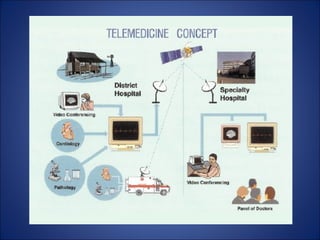
Telemedicine “ Telemedicine is the ability to provide interactive healthcare utilizing modern technology and telecommunications.” Basically, Telemedicine allows patients to visit with physicians live over video for immediate care or capture video/still images and patient data are stored and sent to physicians for diagnosis and follow-up treatment at a later time. Whether you live in the center of Los Angeles or deep in the Brazilian Amazon, Telemedicine is an invaluable tool in Healthcare.”  – www.telemedicine.com
 
An example of telemedicine… http://www.wiredred.com/images/video-telemedicine.jpg
How do you feel about the idea of  telemedicine? Would you use it? Why or why not? Now let’s look at how technology and the Internet have allowed  a specific area of medicine to be shared on a global scale…
Scenario:   A person is having chest pains and is rushed to the Emergency  Room.  An MRI needs to be done, but there isn’t a radiologist in the hospital to read the images… This problem can be solved!!!
Teleradiology Refers to the electronic transmission of radiological images such as x-rays, computed tomograms (CT’s) and magnetic resonance images (MRI’s) across geographical locations for the purposes of interpretation and consultation. Digital radiological images are transmitted using standard telephone lines, satellite connections, or wide area networks (WANs). http://www.filmdigitizer.com/products/sierraplus/images/teleradiology.gif  http://www.insiteconsultancy.com/Teleradiology.jpg
Teleradiology, cont… Teleradiology is a very powerful form of technology because it allows a single radiologist to simultaneously provide services to several hospitals..around the world. Ensures that radiologist will give a clear, accurate reading. (Day shift to night shift) Images can be sent to radiologist’s home via Internet  (cost-effective for hospitals)
Allows physicians to stay near patients  Subspecialty consultations if physician needs further expertise in specific area (i.e. Traumatic Brain Injuries, cardiovascular problems, etc.) Surgeons can “sit in” on surgeries in other parts of the world Allows physicians to discuss various forms of treatment Technical requirements for teleradiology: Picture archiving and communication system Radiology information system Reliable and secure high-speed connectivity between the remote sites
Some examples… NightHawk Radiology Services UCLA radiologists & Siemens Medical Solutions
Other Online Medical Resources… Online Patient Resources www.webmd.com  ,  www.mayoclinic.com
Questions What are the benefits of telemedicine/ teleradiology? Why might these forms of technology cause problems for patients? Do you think that telemedicine will be as helpful to patients as physically going to a doctor would be? Why or why not?

E Medicine

  • 1.
    eMedicine Amy BiondiCOM 300, Winter 2007
  • 2.
    Telemedicine “ Telemedicineis the ability to provide interactive healthcare utilizing modern technology and telecommunications.” Basically, Telemedicine allows patients to visit with physicians live over video for immediate care or capture video/still images and patient data are stored and sent to physicians for diagnosis and follow-up treatment at a later time. Whether you live in the center of Los Angeles or deep in the Brazilian Amazon, Telemedicine is an invaluable tool in Healthcare.” – www.telemedicine.com
  • 3.
  • 4.
    An example oftelemedicine… http://www.wiredred.com/images/video-telemedicine.jpg
  • 5.
    How do youfeel about the idea of telemedicine? Would you use it? Why or why not? Now let’s look at how technology and the Internet have allowed a specific area of medicine to be shared on a global scale…
  • 6.
    Scenario: A person is having chest pains and is rushed to the Emergency Room. An MRI needs to be done, but there isn’t a radiologist in the hospital to read the images… This problem can be solved!!!
  • 7.
    Teleradiology Refers tothe electronic transmission of radiological images such as x-rays, computed tomograms (CT’s) and magnetic resonance images (MRI’s) across geographical locations for the purposes of interpretation and consultation. Digital radiological images are transmitted using standard telephone lines, satellite connections, or wide area networks (WANs). http://www.filmdigitizer.com/products/sierraplus/images/teleradiology.gif http://www.insiteconsultancy.com/Teleradiology.jpg
  • 8.
    Teleradiology, cont… Teleradiologyis a very powerful form of technology because it allows a single radiologist to simultaneously provide services to several hospitals..around the world. Ensures that radiologist will give a clear, accurate reading. (Day shift to night shift) Images can be sent to radiologist’s home via Internet (cost-effective for hospitals)
  • 9.
    Allows physicians tostay near patients Subspecialty consultations if physician needs further expertise in specific area (i.e. Traumatic Brain Injuries, cardiovascular problems, etc.) Surgeons can “sit in” on surgeries in other parts of the world Allows physicians to discuss various forms of treatment Technical requirements for teleradiology: Picture archiving and communication system Radiology information system Reliable and secure high-speed connectivity between the remote sites
  • 10.
    Some examples… NightHawkRadiology Services UCLA radiologists & Siemens Medical Solutions
  • 11.
    Other Online MedicalResources… Online Patient Resources www.webmd.com , www.mayoclinic.com
  • 12.
    Questions What arethe benefits of telemedicine/ teleradiology? Why might these forms of technology cause problems for patients? Do you think that telemedicine will be as helpful to patients as physically going to a doctor would be? Why or why not?