Earning formal academic credit through a citizen’s
viral and OER learning: What are the implications
for mobile, hybrid and online learning?

eLmL 2013, The Fifth International Conference on Mobile, Hybrid,
and On-line Learning, February 24, 2013 to March 1, 2013 - Nice,
France.

Merilyn Childs & Regine Wagner, Flexible Learning Institute
Charles Sturt University, Australia.
The context


http://www.flickr.com/photos/duncan/478984969/sizes/m/
The status quo
The research consistently indicates
  that recognition of prior
  learning in Australia is poor
  (for example, Pitman 2012).


Policy has largely failed to generate
   change (See AQF)


Open educational practices that
  value user-generated learning
  (Ehlers 2011) remain marginal
  and distant from the core
  business of learning, teaching and
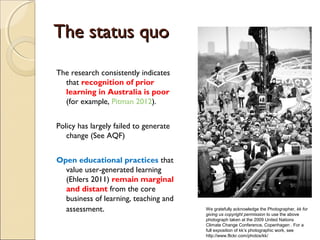
  assessment.                           We gratefully acknowledge the Photographer, kk for
                                        giving us copyright permission to use the above
                                        photograph taken at the 2009 United Nations
                                        Climate Change Conference, Copenhagen . For a
                                        full exposition of kk’s photographic work, see
                                        http://www.flickr.com/photos/kk/
   Developments such as
    those explored via the
    European OERtest project
    have yet to gain a
    foothold in the Australian
    HE context.
The problem
   A traditional view that
    non-institutional learning
    is ipso facto of less
    value and that criticality
    and complexity are only
    possible through
    institutional learning

   This traditional view is
    out-of-place in a digital
    age characterized by
    personalized,
    hybridized and
    mobilized learning


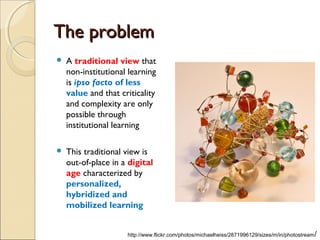
                     http://www.flickr.com/photos/michaelheiss/2871996129/sizes/m/in/photostream /
Proposition I

   Quality learning
    can and will
    happen through
    the planned and
    accidental agency
    of citizens who
    may at some time
    become students


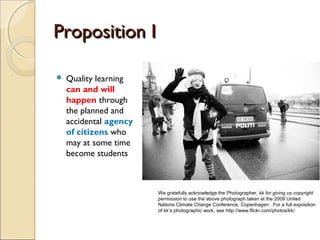
                        We gratefully acknowledge the Photographer, kk for giving us copyright
                        permission to use the above photograph taken at the 2009 United
                        Nations Climate Change Conference, Copenhagen . For a full exposition
                        of kk’s photographic work, see http://www.flickr.com/photos/kk/
Proposition II -
   The relationships
    that are possible
    between a citizen’s
    learning and
    universities can be
    substantially
    rethought as the
    basis for
    transformational
    change.


                          http://www.flickr.com/photos/plmccordj/56729378/sizes/z/in/photostream/
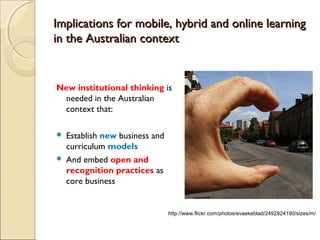
Implications for mobile, hybrid and online learning
in the Australian context


New institutional thinking is
 needed in the Australian
 context that:

 Establish new business and
  curriculum models
 And embed open and
  recognition practices as
  core business


                               http://www.flickr.com/photos/evaekeblad/2492824190/sizes/m/
Thankyou and questions

We  welcome further contact at
 mchilds@csu.edu.au and
 rwagner@csu.edu.au
Thankyou and questions

We  welcome further contact at
 mchilds@csu.edu.au and
 rwagner@csu.edu.au

Earning formal academic credit. Also see http://slidesha.re/WdsKqb:

  • 1.
    Earning formal academiccredit through a citizen’s viral and OER learning: What are the implications for mobile, hybrid and online learning? eLmL 2013, The Fifth International Conference on Mobile, Hybrid, and On-line Learning, February 24, 2013 to March 1, 2013 - Nice, France. Merilyn Childs & Regine Wagner, Flexible Learning Institute Charles Sturt University, Australia.
  • 2.
  • 3.
    The status quo Theresearch consistently indicates that recognition of prior learning in Australia is poor (for example, Pitman 2012). Policy has largely failed to generate change (See AQF) Open educational practices that value user-generated learning (Ehlers 2011) remain marginal and distant from the core business of learning, teaching and assessment. We gratefully acknowledge the Photographer, kk for giving us copyright permission to use the above photograph taken at the 2009 United Nations Climate Change Conference, Copenhagen . For a full exposition of kk’s photographic work, see http://www.flickr.com/photos/kk/
  • 4.
    Developments such as those explored via the European OERtest project have yet to gain a foothold in the Australian HE context.
  • 5.
    The problem  A traditional view that non-institutional learning is ipso facto of less value and that criticality and complexity are only possible through institutional learning  This traditional view is out-of-place in a digital age characterized by personalized, hybridized and mobilized learning http://www.flickr.com/photos/michaelheiss/2871996129/sizes/m/in/photostream /
  • 6.
    Proposition I  Quality learning can and will happen through the planned and accidental agency of citizens who may at some time become students We gratefully acknowledge the Photographer, kk for giving us copyright permission to use the above photograph taken at the 2009 United Nations Climate Change Conference, Copenhagen . For a full exposition of kk’s photographic work, see http://www.flickr.com/photos/kk/
  • 7.
    Proposition II -  The relationships that are possible between a citizen’s learning and universities can be substantially rethought as the basis for transformational change. http://www.flickr.com/photos/plmccordj/56729378/sizes/z/in/photostream/
  • 8.
    Implications for mobile,hybrid and online learning in the Australian context New institutional thinking is needed in the Australian context that:  Establish new business and curriculum models  And embed open and recognition practices as core business http://www.flickr.com/photos/evaekeblad/2492824190/sizes/m/
  • 9.
    Thankyou and questions We welcome further contact at mchilds@csu.edu.au and rwagner@csu.edu.au
  • 10.
    Thankyou and questions We welcome further contact at mchilds@csu.edu.au and rwagner@csu.edu.au