1
SAINIK SCHOOL, KAPURTHALA
11/12/2022
What is E – Classroom ?
E-Classroom is a new concept where student will be present
with their teacher and fellow learners in a classroom however,
they will not be present physically in the classroom but
connected to the classroom through Internet.
E-classroom is a form of online learning, offering various
educational programs in an online form. This multimedia
classroom technology provides a unique learning experience. It
uses various educational platforms and communication tools to
simplify the process.
PRESENTATION BY SAINIK SCHOOL KAPURTHALA
Engaging learners in your online learning program is one of the
keys to ensuring they learn effectively and get the most out of
what they are doing. One of the most effective ways to make
learners more engaged in what they are doing it to make it
interactive. With interactive online learning experiences,
learners have no option other than to get involved and take an
active role in their learning. Here are five simple ways to engage
your learners by making your online learning program more
interactive.
1. Incorporate Active Learning :
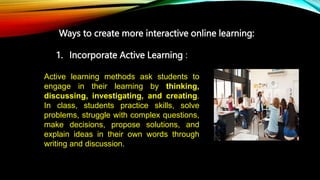
Active learning methods ask students to
engage in their learning by thinking,
discussing, investigating, and creating.
In class, students practice skills, solve
problems, struggle with complex questions,
make decisions, propose solutions, and
explain ideas in their own words through
writing and discussion.
Ways to create more interactive online learning:
2. Combine different media types into engaging learning
scenarios :
St To ensure they’re engaging with your content, try adding
notes, links, or voice explanations directly to images. These
interactive elements guide the learner and help them pay
attention to the material we want to highlight.
3. Try running a cohort-based course
A cohort-based course is a program of learning that’s
organized according to a syllabus (usually in sections)
and is taken by a group of students (a cohort) at the
same time. Cohort-based courses can take place
online, in a virtual space, or in a physical classroom.
4. Incorporate live lessons
Sit & talk with peers nearby.
Prompt about a concept or topic.
Give students 1-2 minutes to think
about the prompt on their own.
Facilitate a whole group discussion.
Listen to their responses.
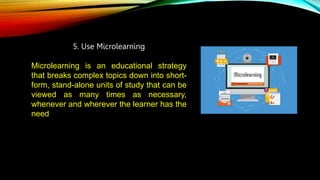
5. Use Microlearning
Microlearning is an educational strategy
that breaks complex topics down into short-
form, stand-alone units of study that can be
viewed as many times as necessary,
whenever and wherever the learner has the
need.
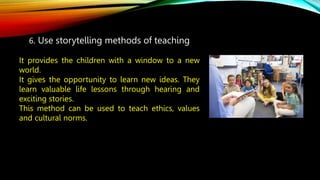
6. Use storytelling methods of teaching
It provides the children with a window to a new
world.
It gives the opportunity to learn new ideas. They
learn valuable life lessons through hearing and
exciting stories.
This method can be used to teach ethics, values
and cultural norms.
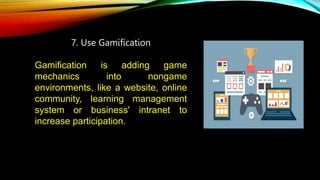
7. Use Gamification
Gamification is adding game
mechanics into nongame
environments, like a website, online
community, learning management
system or business' intranet to
increase participation.
8. Pause for questions and answer live chats
You can take this element from teaching in-person, where
students can ask questions when the teacher is lecturing and
bring it to your online courses.
9. GeoGebra :
GeoGebra is a dynamic mathematics
software for all levels of education that
brings together geometry, algebra,
spreadsheets, graphing, statistics and
calculus in one engine. In addition,
GeoGebra offers an online platform with
over 1 million free classroom resources
created by our multilingual community.
(NPTEL, MOOC, SWAYAM)
P
10. Invite learners to contribute
Having the learners contribute their knowledge by
making resources or hosting online group study sessions
is another way to empower them. Task-based learning
can provide the learners with a real, relevant outcome
which can be shared with other learners who are earlier
in their learner journey to inspire them and help with their
studies.
11. Encourage peer evaluation
A classic classroom technique that works a
treat online. Enabling learners to review each
other’s work reinforces their understanding of
what they are doing and encourages a culture
of sharing which can be valuable in spreading
best-practice.
12. Ask for feedback
Any chance the learners have to leave feedback
is a great opportunity for interaction. How we
respond to the feedback can also have other
advantages for streamlining programs and
making them more relevant.
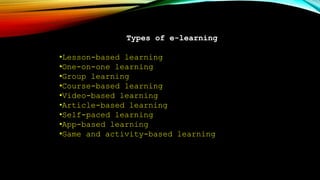
Types of e-learning
•Lesson-based learning
•One-on-one learning
•Group learning
•Course-based learning
•Video-based learning
•Article-based learning
•Self-paced learning
•App-based learning
•Game and activity-based learning
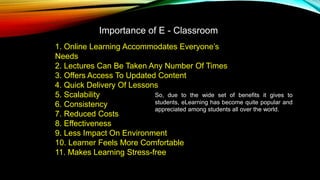
Importance of E - Classroom
1. Online Learning Accommodates Everyone’s
Needs
2. Lectures Can Be Taken Any Number Of Times
3. Offers Access To Updated Content
4. Quick Delivery Of Lessons
5. Scalability
6. Consistency
7. Reduced Costs
8. Effectiveness
9. Less Impact On Environment
10. Learner Feels More Comfortable
11. Makes Learning Stress-free
So, due to the wide set of benefits it gives to
students, eLearning has become quite popular and
appreciated among students all over the world.
E class room.pptx

E class room.pptx

  • 1.
  • 2.
    What is E– Classroom ? E-Classroom is a new concept where student will be present with their teacher and fellow learners in a classroom however, they will not be present physically in the classroom but connected to the classroom through Internet. E-classroom is a form of online learning, offering various educational programs in an online form. This multimedia classroom technology provides a unique learning experience. It uses various educational platforms and communication tools to simplify the process. PRESENTATION BY SAINIK SCHOOL KAPURTHALA
  • 3.
    Engaging learners inyour online learning program is one of the keys to ensuring they learn effectively and get the most out of what they are doing. One of the most effective ways to make learners more engaged in what they are doing it to make it interactive. With interactive online learning experiences, learners have no option other than to get involved and take an active role in their learning. Here are five simple ways to engage your learners by making your online learning program more interactive.
  • 4.
    1. Incorporate ActiveLearning : Active learning methods ask students to engage in their learning by thinking, discussing, investigating, and creating. In class, students practice skills, solve problems, struggle with complex questions, make decisions, propose solutions, and explain ideas in their own words through writing and discussion. Ways to create more interactive online learning:
  • 5.
    2. Combine differentmedia types into engaging learning scenarios : St To ensure they’re engaging with your content, try adding notes, links, or voice explanations directly to images. These interactive elements guide the learner and help them pay attention to the material we want to highlight.
  • 6.
    3. Try runninga cohort-based course A cohort-based course is a program of learning that’s organized according to a syllabus (usually in sections) and is taken by a group of students (a cohort) at the same time. Cohort-based courses can take place online, in a virtual space, or in a physical classroom.
  • 7.
    4. Incorporate livelessons Sit & talk with peers nearby. Prompt about a concept or topic. Give students 1-2 minutes to think about the prompt on their own. Facilitate a whole group discussion. Listen to their responses.
  • 8.
    5. Use Microlearning Microlearningis an educational strategy that breaks complex topics down into short- form, stand-alone units of study that can be viewed as many times as necessary, whenever and wherever the learner has the need.
  • 9.
    6. Use storytellingmethods of teaching It provides the children with a window to a new world. It gives the opportunity to learn new ideas. They learn valuable life lessons through hearing and exciting stories. This method can be used to teach ethics, values and cultural norms.
  • 10.
    7. Use Gamification Gamificationis adding game mechanics into nongame environments, like a website, online community, learning management system or business' intranet to increase participation.
  • 11.
    8. Pause forquestions and answer live chats You can take this element from teaching in-person, where students can ask questions when the teacher is lecturing and bring it to your online courses.
  • 12.
    9. GeoGebra : GeoGebrais a dynamic mathematics software for all levels of education that brings together geometry, algebra, spreadsheets, graphing, statistics and calculus in one engine. In addition, GeoGebra offers an online platform with over 1 million free classroom resources created by our multilingual community. (NPTEL, MOOC, SWAYAM) P
  • 13.
    10. Invite learnersto contribute Having the learners contribute their knowledge by making resources or hosting online group study sessions is another way to empower them. Task-based learning can provide the learners with a real, relevant outcome which can be shared with other learners who are earlier in their learner journey to inspire them and help with their studies.
  • 14.
    11. Encourage peerevaluation A classic classroom technique that works a treat online. Enabling learners to review each other’s work reinforces their understanding of what they are doing and encourages a culture of sharing which can be valuable in spreading best-practice.
  • 15.
    12. Ask forfeedback Any chance the learners have to leave feedback is a great opportunity for interaction. How we respond to the feedback can also have other advantages for streamlining programs and making them more relevant.
  • 16.
    Types of e-learning •Lesson-basedlearning •One-on-one learning •Group learning •Course-based learning •Video-based learning •Article-based learning •Self-paced learning •App-based learning •Game and activity-based learning
  • 17.
    Importance of E- Classroom 1. Online Learning Accommodates Everyone’s Needs 2. Lectures Can Be Taken Any Number Of Times 3. Offers Access To Updated Content 4. Quick Delivery Of Lessons 5. Scalability 6. Consistency 7. Reduced Costs 8. Effectiveness 9. Less Impact On Environment 10. Learner Feels More Comfortable 11. Makes Learning Stress-free So, due to the wide set of benefits it gives to students, eLearning has become quite popular and appreciated among students all over the world.