e-AMEDIAR Programe, a School
 Mediation Service at Padre Piquer Family
             Support Center
1.   INTRODUCTION
2.   THEORETICAL BASES
3.   OBJECTIVES
4.   METHODOLOGY
5.   THEORETICAL CONTENTS
6.   TIMING, SESSIONS, PARTICIPANTS, PLACE
7.   MATERIAL & HUMAN RESOURCES
8.   CONCLUSIONS
1. Introduction
• The school peer mediation program e-AMEDIAR, is an
  educational tool based on a innovative proposal of
  activities developed from scientific and pedagogical
  aspects, and combine elements of four successful
  School Mediation Programs
• The main objective is to implement a prosocial and
  emotional education as a way of further good
  interpersonal relationship among members of the
  educational community to improve the climate of
  coexistence
• It is an educational project of 3 multiple intelligences,
  which develop three skills
• The school mediation program has been developed
  at Padre Piquer Formation Center since 2003. It´s
  developed from the School Mediation Service of
  the Family Support Centre (FSC) of this center.
• The FSC was founded in 2000 as a partnership
  between Padre Piquer Formation Center and the
  Universitary Family Institute of Pontificia Comillas
  Madrid University
• It has formed more than 100 school mediators, and
  300 students in smart conflict resolution within the
  Citizenship Education area.
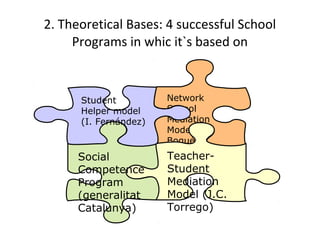
2. Theoretical Bases: 4 successful School
     Programs in whic it`s based on


      Student          Network
      Helper model     School
      (I. Fernández)   Mediation
                       Model (C.
                       Boqué)
      Social           Teacher-
      Competence       Student
      Program          Mediation
      (generalitat     Model (J.C.
      Catalunya)       Torrego)
2. Theoretical Bases: 4 successful School
        Programs in whic it`s based on

• "Model student helper" by Isabel Fernández.
• In this program, we extract the idea that older
  students already trained to mediate and help
  children
• Bibliography: EL ALUMNO AYUDANTE. Ed. Catarata
  2002.
2. Theoretical Bases: 4 successful School
         Programs in whic it`s based on

• "Mediation Network Model" Carme Boqué.
• From this program we take the idea of creating a
  network of mediators in the center, working in
  various fields of education of each school network.
• Bibliography: Boqué Torremorell, M.C. TIEMPO DE
  MEDIACIÓN. Ediciones Ceac, 2005.
2. Theoretical Bases: 4 successful School
         Programs in whic it`s based on
• "Mediation Model of teacher-pupil" of Juan Carlos Torrego.
  This author was one of the first people to introduce school
  mediation programs in Spain. The book cited in footnote on
  page number three was the first to clearly explain how to
  train students, parents, teachers and school mediation PAS.
  Give us the importance of creating a permanent School
  Mediation Service involving persons serving on the school and
  not to people outside the center, as a way to preserve,
  publicize and expand mediation culture in schools.
• Bibliography: Torrego Seijo, J. C. MEDIACIÓN DE CONFLICTOS
  EN INSTITUCIONES EDUCATIVAS. Ed. Narcea, 2000.
2. Theoretical Bases: 4 successful School
          Programs in whic it`s based on
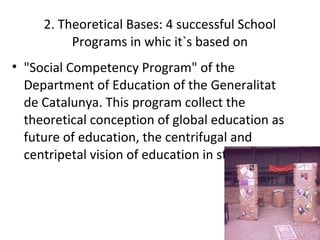
• "Social Competency Program" of the
  Department of Education of the Generalitat
  de Catalunya. This program collect the
  theoretical conception of global education as
  future of education, the centrifugal and
  centripetal vision of education in students.
2. Theoretical Bases
• Implement prosocial and emotional education as a way of good
  interpersonal relationship among members of the educational
  community
• Through 3 multiple intelligences: Interpersonal, intrapersonal and
  emotional
• Which are developed through three competencies: cognitive
  (interpersonal intelligence), emotional (emotional intelligence) and
  moral development (intrapersonal intelligence)
• Cognitive: the 5 thinkings (Spivack and Shure): casual, consequential,
  empathetic, projective, alternative
• Emotional: the 5 progressive subcompetences: Self-awareness, self-
  control, self-motivation, empathy, emotional interaction
• Moral development: the development of the 6 stages of evolutionary
  growth in moral reasoning (Kholberg & Piaget): heteronomy, mutual
  selfishness, interpersonal expectations, responsibility and
  commitment, we all have rights, we are all equal
Pro-social Intelligence
• Prosocial intelligence is developed by this project to
                             ​
  combine multiple values and essential attitudes to be
  taught to the mediators and helper student .
• Prosocial actions are behaviors that, without seeking
  material rewards, favorice :
• a) to other individuals or groups based on these
  criteria,
• b) to positive social goals, and to increase the
  likelihood of generating a quality positive reciprocity
  in social relationships or consequential, improving
  identity, creativity and initiative of individuals or
  groups involved (Roche, R., 2004, " prosocial
  intelligence ", col. material. Autonomous University of
Pro-social Actions
• 1. Physical help. Nonverbal behavior that seeks
  to assist others to accomplish a specific goal,
  and that has the approval of the rest.
• 2. Physical Service: Conduct which eliminates
  the need to receptors of action to intervene
  physically in fulfilling a task or tasks, and
  concludes with approval or satisfaction.
• 3. Giving and sharing: Deliver objects, food, or
  other possessions lost property or use.
Pro-social Actions
• 4. Help verbal explanation or verbal instruction
  or share ideas or life experiences that are
  useful and desirable to other people or groups
  in achieving a goal.
• 5. Consuelo verbal verbal expressions to reduce
  sadness or distressed persons in distress and
  increase their profit.
Prosocial Actions
• 6. Confirmación y valorización positiva del otro:
  Expresiones verbales para confirmar el valor de
  otras personas o aumentar la autoestima de las
  mismas, incluso ante terceros. (Interpretar
  positivamente conductas de otros, disculpar,
  interceder, mediante palabras de
  simpatía,alabanza o elogio).
• 7. Escucha profunda: Conductas metaverbales y
  actitudes de atención que expresan acogida
  paciente pero activamente orientada a los
  contenidos expresados por el interlocutor en
  una conversación.
Prosocial Actions
• 8. Empatía: Conductas verbales que, partiendo de un vaciado
  voluntario de contenidos propios, expresan comprensión
  cognitiva de los pensamientos del interlocutor o emoción de
  estar experimentando sentimientos similares a los de éste.
• 9. Solidaridad: Conductas físicas o verbales que expresan
  aceptación voluntaria de compartir las consecuencias,
  especialmente penosas, de la condición, estatus, situación o
  fortuna desgraciadas de otras personas, grupos o países.
• 10. Presencia positiva y unidad: Presencia personal que expresa
  actitudes de proximidad psicológica, atención, escucha
  profunda, empatía, disponibilidad para el servicio, la ayuda y la
  solidaridad para con otras personas y que contribuye al clima
  psicológico de bienestar, paz,concordia, reciprocidad y unidad
  en un grupo o reunión de dos o más personas.
3. Objectives
-General: Implement prosocial and emotional
education as a way of improving good interpersonal
relationship among members of the educational
community, to improve the climate of coexistence at
school

-Train mediator students: knowing how to help to
resolve conflicts in formal and informal mediation,
                  ​
living the values of solidarity,
respect and learn to live with others
in groups, how to interpretate
the complexity and interdependence
of relationships between members
of the educational community and between groups,
3. Objectives
-Train students and the educational
community: how to analyze and manage
conflicts, to deal with and respond to the
conflicts that occur at school and around
themshelves.

- Improving the climate of cooperation in the
school center, spread the culture of non-
violence and non-violent resolution of
conflicts and culture of mediation
4. Methodology
- games and dynamics
- Individual, group and asambleary Work
- Theoretical concepts transmission
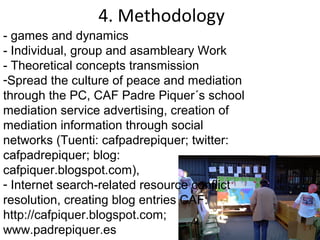
-Spread the culture of peace and mediation
through the PC, CAF Padre Piquer´s school
mediation service advertising, creation of
mediation information through social
networks (Tuenti: cafpadrepiquer; twitter:
cafpadrepiquer; blog:
cafpiquer.blogspot.com),
- Internet search-related resource conflict
resolution, creating blog entries CAF:
http://cafpiquer.blogspot.com;
www.padrepiquer.es
4. Methodology
- Real Co-mediation between members of
the educational community
- Activities by age groups
- School Mediation Service maintenance
- Publicity and spread out of the School
Mediation Service through individual and
group activities
- Awareness activities on mediation and
conflict resolution.
5. Theoretical content
- Like the competence training program
social of the Generalitat de Catalunya, which
proposes to improve coexistence in the
College among students facilitating the
existence of good relationships that prevent
social and interpersonal problems,

- we believe that the three factors necessary
for good interpersonal relationship are:
cognitive (cognitive skills),
moral (moral growth)
and emotional control (social skills).
5. Theoretical content
- In e-AMEDIAR programme we bet for this line,
we want students when they finish their training
tour of the school, be aware of their inner and
their outer world, to know their SPHD: your
feeling (emotional intelligence, emotions
enhanced and not limited), their thinking (teach
them to think, to have sufficient cognitive skills,
discover their limiting beliefs and transform them
into enhancers), and their conduct, you see, that
must be shaped by the values moral acquired by
moral reasoning that makes the child feel that will
shape their thinking and to acquire a final form
completed with say, a limiting or enhancing
communication.
5. Contenidos teóricos
•   Al igual que el Programa de formación en competencia social1 de la Generalitat de
    Catalunya, que propone que para mejorar la convivencia en el Colegio entre los
    propios alumnos se ha de favorecer la existencia de unas buenas relaciones
    interpersonales que prevengan problemas sociales e interpersonales, creemos que
    los tres factores indispensables para una buena relación interpersonal son: el
    cognitivo (las habilidades cognitivas), el moral (el crecimiento moral) y el control
    emocional (las habilidades sociales).
•   En el programa e-AMEDIAR trabajamos en esas líneas, queremos que los alumnos
    cuando terminen su periplo formativo por el centro escolar, sean conscientes de
    su mundo interno y de su mundo externo, de su SPHD: de su sentir (control
    emocional, emociones potenciadoras y no limitantes), de su pensar (enseñarles a
    pensar, a tener las suficientes habilidades cognitivas, descubrir sus creencias
    limitantes y transformarlas en potenciadoras), y de su conducta final, exterior, la
    que se ve, que deberá estar conformada por los valores morales que hayan
    adquirido, por los razonamientos morales que haga el niño y que moldearán su
    sentir y su pensar para adquirir una forma final completada con un Decir, una
    comunicación limitante o potenciadora.
•   1 Basado en el Programa de Competencia Social del Departamento de Enseñanza
    de la Generalitat de Cataluña.
5. Theoretical
                                         contents

• Training prosociality developing three factors:
   • the cognitive: cognitive, 7 Gardner's multiple intelligences
   • The moral: The 6 stages of evolutionary growth in moral
      reasoning
   • emotional control: emotional intelligence, sentience, executive,
      social skills
• Prevention of social and interpersonal problems
• Conflict Theory
• Human Communication Theory
• Concepts of NLP, Coaching, mindfulness
• Mediation and the Mediator
5. Theoretical
•                                            Contents
    Can analyze conflicts, elements of the conflict, the 5 ways to react
    to the conflict and Thomas Khilman
• Conscious and effective communication. The 3 types of
  interpersonal relationship
• Cognitive Skills: 7 Gardner's multiple intelligences
• Interpersonal intelligence, the 5 Spivack thoughts i Shure: causal
  thinking, alternative thinking, Consequential Thinking, Thinking
  Perspective, Thinking of means and ends
• Zubiri sentient Intelligence, Daniel Goleman's emotional
  intelligence, intelligence executive J. A. Marina,
• Social skills training Goldstein
• The 6 stages of evolutionary growth in moral reasoning:
• 1. heteronomy 2. mutual selfishness; 3. interpersonal expectations
  4. responsibility and commitment; 5. all have rights; 6. all are
  equal
• Concepts of NLP, Coaching, mindfulness
• The 4 stages of conflict resolution, the 3 stages of mediation,
5. Theoretical content every Course
1 º ESO (12-13 years old): Social Skills Workshop
2 º ESO: Workshop 5 hour
sessions weekly Course Intelligent
Resolution Conflict RIC all students of 2nd ESO
3 º ESO: 8 training sessions as school mediators, for one
hour,weekly, to groups of 10
students, Coexistence Observatory school and world
4th year: Mediation and Recreation intelligent student
assistants
1º Bachillerato: Mediations, Coexistence Observatory (blog,
magazine infopiquer, social networks), Student Assistant
2º Bachillerato: Mediations, Coexistence Observatory (blog,
magazine infopiquer, social networks)
5. Methodology of formative training sessions 3 º
ESO (3rd year of secondary, 14-15 years old) students


                          • 1) Coexistence
                            Observatory of the
                            school and the world
                          • 2 º) Dynamic on Theme
                            to work
                          • 3rd) What do I take
                            today as a conclusion
5. Theoretical content every Course
In the second and subsequent years until
they complete the educational process at
school there are two activities:
1) a monthly meeting at
recess educational staged for mediation,moti
vation organizing activities or conduct mediati
on role playingsand
2) Co-mediation by mediators of actual
cases that arise during the school
year. Teamwork way mirror behind the group
of mediators.
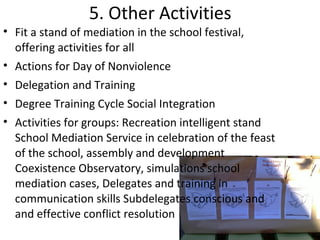
5. Other Activities
• Fit a stand of mediation in the school festival,
  offering activities for all
• Actions for Day of Nonviolence
• Delegation and Training
• Degree Training Cycle Social Integration
• Activities for groups: Recreation intelligent stand
  School Mediation Service in celebration of the feast
  of the school, assembly and development
  Coexistence Observatory, simulations school
  mediation cases, Delegates and training in
  communication skills Subdelegates conscious and
  and effective conflict resolution
7. Resources needed
- It requires a Mediator / a Teacher
- material resources needed are a computer
   with Internet access, a small notebook per
   student, pens, photocopies of materials,
   computer speakers, pens and cards, flipchart
   and flipchart pad and colored pens, printer,
   Board of School Mediation Service, etc
Co-existence Observatory
• Each week we Coexistence Observatory's school making them
  journalists who help us to gauge the reality that surrounds us, the
  Centre and the world we live insert.
• Each week we choose several responsible for collecting all
  information related to the positive news and conflict and conflict
  resolution to occur, each responsible for weekly news summary
  takes a positive and World Center, a summary of conflicts and ways
  to solve a DAME to give me a detected conflict and provides a
  motivating phrase for the week.
• To spread the culture of peace and mediation boarded the blog
  each week (www.cafpiquer.blogspot.com) and Tuenti (Caf Father
  Piquer) highlight and print the weekly motivational phrase, the
  good news and the DAME and hung in the information panel CAF.
8. Conclusions
• A greater involvement of the management team a better
  result
• Activities for all grade levels helps to globalize the Mediation
  Service
• Synergy: join forces with educational departments, Pastoral
  Counseling, human formation, etc ...
• Adaptable to any age School level, not only Secondary
  Compulsory Education
• Experiential and practical learning much more effective and
  easier than the theoretical and pragmatic training
• Time is the principle obstacle: be creative and flexible, take
  profit of it (school events, spare time, recreation, lunch time,
  etc.)
8. 10 years of Growth
1. We went from starting in 2003 training 20 students
   biweekly, with a support with a counselor in a
   classroom, groups of 10 people per week in the CAF

2. We have gone from the room using only CAF to use
   both rooms at the same time

3. We have moved to form only 10 pupils each round, to
   train 100 students at 2nd ESO

4. We went from asking people to use the CAF to take the
   CAF to the classroom
8. Conclusions
5. We've gone from learning only mediators who came to
receive formation to the CAF to share what we learned on
the public board we created

6. Have passed from waiting people to come to us to go to
classrooms presenting them to use our mediation service

7. We have moved from introducing the CAF in the Mother
of Light at School Day to getting into class with a group of
mediators presenting the mediation service

8. We've gone from doing diplomas to recient formed
mediators to create mediators cards for use in or out of
school
8. Conclusions
9. We have gone from doing mediations at the CAF to
mediate in every part of the school or even around it

10. We've been giving away a pen and notepad to each
mediator to meeting more than 100 mediators to eat at the
end of course of 2012

11. We've gone from waiting for persons to arrive to school
mediadtion service to practice dramas with formed
mediators to keep updated and prepared to urgencys

12. We have moved to formal mediation in the CAF to
conduct informal mediation in the yard and around the
school
8. Conclusions
13. We've been thinking about how to create a Coexistence
Observatory, with weekly motivational phrase, the positive
news weekly and DAME one dame, a weekly observed
conflicts

14. we have gone from the internal mediators formation to
journalist mediators and student assistants

15. We went from mediating to create the e-AMEDIAR
programme

16. We passed the School, well we've had and we've
passed this challenge
Thank you for
                      your attention
                        E-mail: caf@padrepiquer.net
                   Blog: http://cafpiquer.blogspot.com/
                         Tuenti: Caf Padre Piquer
                          twitter: cafpadrepiquer
               E-mail: santiagomiranzo@cymaconsultores.es


INSTITUTO UNIVERSITARIO DE LA FAMILIA
                                                  CAJA
  UNIVERSIDAD PONTIFICIA COMILLAS                 MADRID
                                                  OBRA
                                                  SOCIAL

e-AMEDIAR school mediation program. Programa de Mediación Escolar e-AMEDIAR

  • 1.
    e-AMEDIAR Programe, aSchool Mediation Service at Padre Piquer Family Support Center 1. INTRODUCTION 2. THEORETICAL BASES 3. OBJECTIVES 4. METHODOLOGY 5. THEORETICAL CONTENTS 6. TIMING, SESSIONS, PARTICIPANTS, PLACE 7. MATERIAL & HUMAN RESOURCES 8. CONCLUSIONS
  • 2.
    1. Introduction • Theschool peer mediation program e-AMEDIAR, is an educational tool based on a innovative proposal of activities developed from scientific and pedagogical aspects, and combine elements of four successful School Mediation Programs • The main objective is to implement a prosocial and emotional education as a way of further good interpersonal relationship among members of the educational community to improve the climate of coexistence • It is an educational project of 3 multiple intelligences, which develop three skills
  • 3.
    • The schoolmediation program has been developed at Padre Piquer Formation Center since 2003. It´s developed from the School Mediation Service of the Family Support Centre (FSC) of this center. • The FSC was founded in 2000 as a partnership between Padre Piquer Formation Center and the Universitary Family Institute of Pontificia Comillas Madrid University • It has formed more than 100 school mediators, and 300 students in smart conflict resolution within the Citizenship Education area.
  • 4.
    2. Theoretical Bases:4 successful School Programs in whic it`s based on Student Network Helper model School (I. Fernández) Mediation Model (C. Boqué) Social Teacher- Competence Student Program Mediation (generalitat Model (J.C. Catalunya) Torrego)
  • 5.
    2. Theoretical Bases:4 successful School Programs in whic it`s based on • "Model student helper" by Isabel Fernández. • In this program, we extract the idea that older students already trained to mediate and help children • Bibliography: EL ALUMNO AYUDANTE. Ed. Catarata 2002.
  • 6.
    2. Theoretical Bases:4 successful School Programs in whic it`s based on • "Mediation Network Model" Carme Boqué. • From this program we take the idea of creating a network of mediators in the center, working in various fields of education of each school network. • Bibliography: Boqué Torremorell, M.C. TIEMPO DE MEDIACIÓN. Ediciones Ceac, 2005.
  • 7.
    2. Theoretical Bases:4 successful School Programs in whic it`s based on • "Mediation Model of teacher-pupil" of Juan Carlos Torrego. This author was one of the first people to introduce school mediation programs in Spain. The book cited in footnote on page number three was the first to clearly explain how to train students, parents, teachers and school mediation PAS. Give us the importance of creating a permanent School Mediation Service involving persons serving on the school and not to people outside the center, as a way to preserve, publicize and expand mediation culture in schools. • Bibliography: Torrego Seijo, J. C. MEDIACIÓN DE CONFLICTOS EN INSTITUCIONES EDUCATIVAS. Ed. Narcea, 2000.
  • 8.
    2. Theoretical Bases:4 successful School Programs in whic it`s based on • "Social Competency Program" of the Department of Education of the Generalitat de Catalunya. This program collect the theoretical conception of global education as future of education, the centrifugal and centripetal vision of education in students.
  • 9.
    2. Theoretical Bases •Implement prosocial and emotional education as a way of good interpersonal relationship among members of the educational community • Through 3 multiple intelligences: Interpersonal, intrapersonal and emotional • Which are developed through three competencies: cognitive (interpersonal intelligence), emotional (emotional intelligence) and moral development (intrapersonal intelligence) • Cognitive: the 5 thinkings (Spivack and Shure): casual, consequential, empathetic, projective, alternative • Emotional: the 5 progressive subcompetences: Self-awareness, self- control, self-motivation, empathy, emotional interaction • Moral development: the development of the 6 stages of evolutionary growth in moral reasoning (Kholberg & Piaget): heteronomy, mutual selfishness, interpersonal expectations, responsibility and commitment, we all have rights, we are all equal
  • 10.
    Pro-social Intelligence • Prosocialintelligence is developed by this project to ​ combine multiple values and essential attitudes to be taught to the mediators and helper student . • Prosocial actions are behaviors that, without seeking material rewards, favorice : • a) to other individuals or groups based on these criteria, • b) to positive social goals, and to increase the likelihood of generating a quality positive reciprocity in social relationships or consequential, improving identity, creativity and initiative of individuals or groups involved (Roche, R., 2004, " prosocial intelligence ", col. material. Autonomous University of
  • 11.
    Pro-social Actions • 1.Physical help. Nonverbal behavior that seeks to assist others to accomplish a specific goal, and that has the approval of the rest. • 2. Physical Service: Conduct which eliminates the need to receptors of action to intervene physically in fulfilling a task or tasks, and concludes with approval or satisfaction. • 3. Giving and sharing: Deliver objects, food, or other possessions lost property or use.
  • 12.
    Pro-social Actions • 4.Help verbal explanation or verbal instruction or share ideas or life experiences that are useful and desirable to other people or groups in achieving a goal. • 5. Consuelo verbal verbal expressions to reduce sadness or distressed persons in distress and increase their profit.
  • 13.
    Prosocial Actions • 6.Confirmación y valorización positiva del otro: Expresiones verbales para confirmar el valor de otras personas o aumentar la autoestima de las mismas, incluso ante terceros. (Interpretar positivamente conductas de otros, disculpar, interceder, mediante palabras de simpatía,alabanza o elogio). • 7. Escucha profunda: Conductas metaverbales y actitudes de atención que expresan acogida paciente pero activamente orientada a los contenidos expresados por el interlocutor en una conversación.
  • 14.
    Prosocial Actions • 8.Empatía: Conductas verbales que, partiendo de un vaciado voluntario de contenidos propios, expresan comprensión cognitiva de los pensamientos del interlocutor o emoción de estar experimentando sentimientos similares a los de éste. • 9. Solidaridad: Conductas físicas o verbales que expresan aceptación voluntaria de compartir las consecuencias, especialmente penosas, de la condición, estatus, situación o fortuna desgraciadas de otras personas, grupos o países. • 10. Presencia positiva y unidad: Presencia personal que expresa actitudes de proximidad psicológica, atención, escucha profunda, empatía, disponibilidad para el servicio, la ayuda y la solidaridad para con otras personas y que contribuye al clima psicológico de bienestar, paz,concordia, reciprocidad y unidad en un grupo o reunión de dos o más personas.
  • 15.
    3. Objectives -General: Implementprosocial and emotional education as a way of improving good interpersonal relationship among members of the educational community, to improve the climate of coexistence at school -Train mediator students: knowing how to help to resolve conflicts in formal and informal mediation, ​ living the values of solidarity, respect and learn to live with others in groups, how to interpretate the complexity and interdependence of relationships between members of the educational community and between groups,
  • 16.
    3. Objectives -Train studentsand the educational community: how to analyze and manage conflicts, to deal with and respond to the conflicts that occur at school and around themshelves. - Improving the climate of cooperation in the school center, spread the culture of non- violence and non-violent resolution of conflicts and culture of mediation
  • 17.
    4. Methodology - gamesand dynamics - Individual, group and asambleary Work - Theoretical concepts transmission -Spread the culture of peace and mediation through the PC, CAF Padre Piquer´s school mediation service advertising, creation of mediation information through social networks (Tuenti: cafpadrepiquer; twitter: cafpadrepiquer; blog: cafpiquer.blogspot.com), - Internet search-related resource conflict resolution, creating blog entries CAF: http://cafpiquer.blogspot.com; www.padrepiquer.es
  • 18.
    4. Methodology - RealCo-mediation between members of the educational community - Activities by age groups - School Mediation Service maintenance - Publicity and spread out of the School Mediation Service through individual and group activities - Awareness activities on mediation and conflict resolution.
  • 19.
    5. Theoretical content -Like the competence training program social of the Generalitat de Catalunya, which proposes to improve coexistence in the College among students facilitating the existence of good relationships that prevent social and interpersonal problems, - we believe that the three factors necessary for good interpersonal relationship are: cognitive (cognitive skills), moral (moral growth) and emotional control (social skills).
  • 20.
    5. Theoretical content -In e-AMEDIAR programme we bet for this line, we want students when they finish their training tour of the school, be aware of their inner and their outer world, to know their SPHD: your feeling (emotional intelligence, emotions enhanced and not limited), their thinking (teach them to think, to have sufficient cognitive skills, discover their limiting beliefs and transform them into enhancers), and their conduct, you see, that must be shaped by the values moral acquired by moral reasoning that makes the child feel that will shape their thinking and to acquire a final form completed with say, a limiting or enhancing communication.
  • 21.
    5. Contenidos teóricos • Al igual que el Programa de formación en competencia social1 de la Generalitat de Catalunya, que propone que para mejorar la convivencia en el Colegio entre los propios alumnos se ha de favorecer la existencia de unas buenas relaciones interpersonales que prevengan problemas sociales e interpersonales, creemos que los tres factores indispensables para una buena relación interpersonal son: el cognitivo (las habilidades cognitivas), el moral (el crecimiento moral) y el control emocional (las habilidades sociales). • En el programa e-AMEDIAR trabajamos en esas líneas, queremos que los alumnos cuando terminen su periplo formativo por el centro escolar, sean conscientes de su mundo interno y de su mundo externo, de su SPHD: de su sentir (control emocional, emociones potenciadoras y no limitantes), de su pensar (enseñarles a pensar, a tener las suficientes habilidades cognitivas, descubrir sus creencias limitantes y transformarlas en potenciadoras), y de su conducta final, exterior, la que se ve, que deberá estar conformada por los valores morales que hayan adquirido, por los razonamientos morales que haga el niño y que moldearán su sentir y su pensar para adquirir una forma final completada con un Decir, una comunicación limitante o potenciadora. • 1 Basado en el Programa de Competencia Social del Departamento de Enseñanza de la Generalitat de Cataluña.
  • 22.
    5. Theoretical contents • Training prosociality developing three factors: • the cognitive: cognitive, 7 Gardner's multiple intelligences • The moral: The 6 stages of evolutionary growth in moral reasoning • emotional control: emotional intelligence, sentience, executive, social skills • Prevention of social and interpersonal problems • Conflict Theory • Human Communication Theory • Concepts of NLP, Coaching, mindfulness • Mediation and the Mediator
  • 23.
    5. Theoretical • Contents Can analyze conflicts, elements of the conflict, the 5 ways to react to the conflict and Thomas Khilman • Conscious and effective communication. The 3 types of interpersonal relationship • Cognitive Skills: 7 Gardner's multiple intelligences • Interpersonal intelligence, the 5 Spivack thoughts i Shure: causal thinking, alternative thinking, Consequential Thinking, Thinking Perspective, Thinking of means and ends • Zubiri sentient Intelligence, Daniel Goleman's emotional intelligence, intelligence executive J. A. Marina, • Social skills training Goldstein • The 6 stages of evolutionary growth in moral reasoning: • 1. heteronomy 2. mutual selfishness; 3. interpersonal expectations 4. responsibility and commitment; 5. all have rights; 6. all are equal • Concepts of NLP, Coaching, mindfulness • The 4 stages of conflict resolution, the 3 stages of mediation,
  • 24.
    5. Theoretical contentevery Course 1 º ESO (12-13 years old): Social Skills Workshop 2 º ESO: Workshop 5 hour sessions weekly Course Intelligent Resolution Conflict RIC all students of 2nd ESO 3 º ESO: 8 training sessions as school mediators, for one hour,weekly, to groups of 10 students, Coexistence Observatory school and world 4th year: Mediation and Recreation intelligent student assistants 1º Bachillerato: Mediations, Coexistence Observatory (blog, magazine infopiquer, social networks), Student Assistant 2º Bachillerato: Mediations, Coexistence Observatory (blog, magazine infopiquer, social networks)
  • 25.
    5. Methodology offormative training sessions 3 º ESO (3rd year of secondary, 14-15 years old) students • 1) Coexistence Observatory of the school and the world • 2 º) Dynamic on Theme to work • 3rd) What do I take today as a conclusion
  • 26.
    5. Theoretical contentevery Course In the second and subsequent years until they complete the educational process at school there are two activities: 1) a monthly meeting at recess educational staged for mediation,moti vation organizing activities or conduct mediati on role playingsand 2) Co-mediation by mediators of actual cases that arise during the school year. Teamwork way mirror behind the group of mediators.
  • 27.
    5. Other Activities •Fit a stand of mediation in the school festival, offering activities for all • Actions for Day of Nonviolence • Delegation and Training • Degree Training Cycle Social Integration • Activities for groups: Recreation intelligent stand School Mediation Service in celebration of the feast of the school, assembly and development Coexistence Observatory, simulations school mediation cases, Delegates and training in communication skills Subdelegates conscious and and effective conflict resolution
  • 28.
    7. Resources needed -It requires a Mediator / a Teacher - material resources needed are a computer with Internet access, a small notebook per student, pens, photocopies of materials, computer speakers, pens and cards, flipchart and flipchart pad and colored pens, printer, Board of School Mediation Service, etc
  • 29.
    Co-existence Observatory • Eachweek we Coexistence Observatory's school making them journalists who help us to gauge the reality that surrounds us, the Centre and the world we live insert. • Each week we choose several responsible for collecting all information related to the positive news and conflict and conflict resolution to occur, each responsible for weekly news summary takes a positive and World Center, a summary of conflicts and ways to solve a DAME to give me a detected conflict and provides a motivating phrase for the week. • To spread the culture of peace and mediation boarded the blog each week (www.cafpiquer.blogspot.com) and Tuenti (Caf Father Piquer) highlight and print the weekly motivational phrase, the good news and the DAME and hung in the information panel CAF.
  • 30.
    8. Conclusions • Agreater involvement of the management team a better result • Activities for all grade levels helps to globalize the Mediation Service • Synergy: join forces with educational departments, Pastoral Counseling, human formation, etc ... • Adaptable to any age School level, not only Secondary Compulsory Education • Experiential and practical learning much more effective and easier than the theoretical and pragmatic training • Time is the principle obstacle: be creative and flexible, take profit of it (school events, spare time, recreation, lunch time, etc.)
  • 31.
    8. 10 yearsof Growth 1. We went from starting in 2003 training 20 students biweekly, with a support with a counselor in a classroom, groups of 10 people per week in the CAF 2. We have gone from the room using only CAF to use both rooms at the same time 3. We have moved to form only 10 pupils each round, to train 100 students at 2nd ESO 4. We went from asking people to use the CAF to take the CAF to the classroom
  • 32.
    8. Conclusions 5. We'vegone from learning only mediators who came to receive formation to the CAF to share what we learned on the public board we created 6. Have passed from waiting people to come to us to go to classrooms presenting them to use our mediation service 7. We have moved from introducing the CAF in the Mother of Light at School Day to getting into class with a group of mediators presenting the mediation service 8. We've gone from doing diplomas to recient formed mediators to create mediators cards for use in or out of school
  • 33.
    8. Conclusions 9. Wehave gone from doing mediations at the CAF to mediate in every part of the school or even around it 10. We've been giving away a pen and notepad to each mediator to meeting more than 100 mediators to eat at the end of course of 2012 11. We've gone from waiting for persons to arrive to school mediadtion service to practice dramas with formed mediators to keep updated and prepared to urgencys 12. We have moved to formal mediation in the CAF to conduct informal mediation in the yard and around the school
  • 34.
    8. Conclusions 13. We'vebeen thinking about how to create a Coexistence Observatory, with weekly motivational phrase, the positive news weekly and DAME one dame, a weekly observed conflicts 14. we have gone from the internal mediators formation to journalist mediators and student assistants 15. We went from mediating to create the e-AMEDIAR programme 16. We passed the School, well we've had and we've passed this challenge
  • 35.
    Thank you for your attention E-mail: caf@padrepiquer.net Blog: http://cafpiquer.blogspot.com/ Tuenti: Caf Padre Piquer twitter: cafpadrepiquer E-mail: santiagomiranzo@cymaconsultores.es INSTITUTO UNIVERSITARIO DE LA FAMILIA CAJA UNIVERSIDAD PONTIFICIA COMILLAS MADRID OBRA SOCIAL