Students and Alumni from CPED
programs PLEASE sit together
Student and Alumni Learning
Communities in the CPED
Consortium
Dr. Debby Zambo, Carnegie Project on the Education Doctorate
and
Dr. Audrey Hovannesian, California State University, San Bernardino
Exchange Overview
• Provide information on the benefits of Learning
Communities (LCs)/Network Improvement
Communities (NICs)
• Consider the challenges to building these communities
across faculty, students, alumni, and programs
• Develop an aim statement and action plan to get
Student, Alumni Faculty Learning Communities into
CPED
In 2012 Tony Bryke Posed
These Questions:
1. What if cadres of EdD candidates across
multiple institutions were working on a
problem, or parts of a problem, in a
Networked Improvement Community?
2. What if CPED institutions served as
supporting NICs while also developing
human and social capacity for this work to
grow?
We want to make these ideas a reality because
learning communities have the potential to...
• Encourage and build capacity for innovation and
change
• Tap the “wisdom of crowds”
• Build on existing strengths
• Encourage collaboration, respect, and equitable
partnerships that are far reaching and sustain
• Support students and graduates
• Enrich faculty’s experiences in EdD programs
CID Intellectual Communities
and PhD Students
• Promote creativity, culture, identity, purpose,
and respect
• Provide opportunities to hear a range of
opinions
• Expose students to diverse mentors
• Prepare students for future work
• Expand responsibility - community-wide
commitment to help students develop and
succeed
Group Discussion
• Can you think of more benefits? What would happen if
cadres of EdD students, alumni, and faculty across
multiple institutions formed a learning community and
worked together on a problem, or parts of a problem?
• What benefits could a Learning Community bring to
CPED, you, your students, your alumni, your
program, education, etc..?
How to create
Intellectual Communities
• Set a clear purpose
• Engage students fully (respect their views welcome their
diversity - age gender culture, prior knowledge)
• Share responsibility for all students
• Share resources (generosity)
• Open program doors
• Allow risk and failure
• Create space
• Have social events
What might be our aim?
Increase from ___% to ___% the percentage
of EdD students, alumni, and faculty across
institutions working on a common problem
of practice by _____.
What is a possible EdD Learning Community participation goal (percentage)in
what time period?
Share Collaborate
Activity 1: (ROOT CAUSES) To Create Learning
Communities Consortium Members Need to Get
to the Root of the Problem – why are we not
doing it?
Take a systems approach (challenges to faculty,
students, alumni, programs, CPED, etc...)
Students and Alumni do their bones
Others choose
11
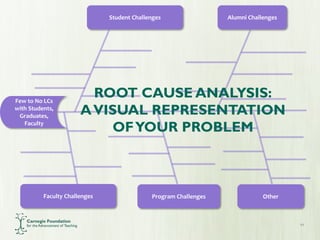
Few to No LCs
with Students,
Graduates,
Faculty
Student Challenges Alumni Challenges
Faculty Challenges Program Challenges Other
ROOT CAUSE ANALYSIS:
AVISUAL REPRESENTATION
OFYOUR PROBLEM
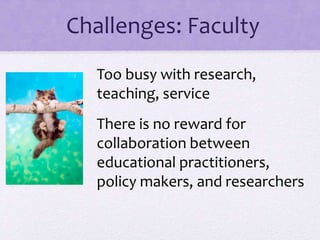
Challenges: Faculty
Too busy with research,
teaching, service
There is no reward for
collaboration between
educational practitioners,
policy makers, and researchers
Challenges: Students
Focus on completing coursework and research
have little time for networking
Part-time lessens opportunities to interact and
network
Research is:
• contextualized, engaging, and aimed at the
local good has cohort and small group support
but loses this at graduation – does not have
networks to spread or sustain
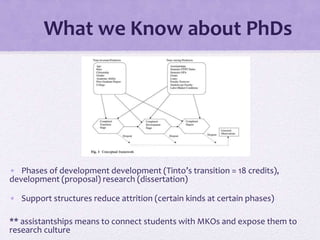
What we Know about PhDs
• Phases of development development (Tinto’s transition = 18 credits),
development (proposal) research (dissertation)
• Support structures reduce attrition (certain kinds at certain phases)
** assistantships means to connect students with MKOs and expose them to
research culture
Challenges for Alumni
• lose faculty and cohort support
• lose resources
• job attainment and research,
service, and teaching activities
increase
• chances to network with others
outside one’s institution lessen
Challenges for Programs
• Limited resources to maintain a student, alumni, and
faculty learning community
• Limited information on EdD graduates job placement-
related trends to inform program outcomes
June (2013)
Share Collaborate
Activity 2: (DRIVER DIAGRAM) To Create Learning
Communities Consortium Members Must Develop
an Action Plan – How can we get this done – what
are our next steps?
Driver Diagram
A tool to:
• conceptualize an challenge
and its system components
• demonstrate a pathway to
achieve the desired aim
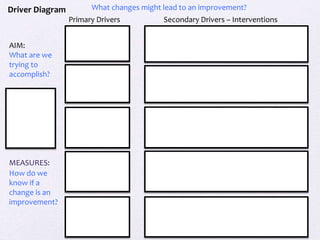
MEASURES:
Driver Diagram
What are we
trying to
accomplish?
How do we
know if a
change is an
improvement?
What changes might lead to an improvement?
AIM:
Primary Drivers Secondary Drivers – Interventions
Conclusion/Next Steps
Please complete our short survey to share your
thoughts and opinions regarding a CPED EdD
Learning Community and volunteer to get one
started.

Zambo & Hovannesian

  • 1.
    Students and Alumnifrom CPED programs PLEASE sit together
  • 2.
    Student and AlumniLearning Communities in the CPED Consortium Dr. Debby Zambo, Carnegie Project on the Education Doctorate and Dr. Audrey Hovannesian, California State University, San Bernardino
  • 3.
    Exchange Overview • Provideinformation on the benefits of Learning Communities (LCs)/Network Improvement Communities (NICs) • Consider the challenges to building these communities across faculty, students, alumni, and programs • Develop an aim statement and action plan to get Student, Alumni Faculty Learning Communities into CPED
  • 4.
    In 2012 TonyBryke Posed These Questions: 1. What if cadres of EdD candidates across multiple institutions were working on a problem, or parts of a problem, in a Networked Improvement Community? 2. What if CPED institutions served as supporting NICs while also developing human and social capacity for this work to grow?
  • 5.
    We want tomake these ideas a reality because learning communities have the potential to... • Encourage and build capacity for innovation and change • Tap the “wisdom of crowds” • Build on existing strengths • Encourage collaboration, respect, and equitable partnerships that are far reaching and sustain • Support students and graduates • Enrich faculty’s experiences in EdD programs
  • 6.
    CID Intellectual Communities andPhD Students • Promote creativity, culture, identity, purpose, and respect • Provide opportunities to hear a range of opinions • Expose students to diverse mentors • Prepare students for future work • Expand responsibility - community-wide commitment to help students develop and succeed
  • 7.
    Group Discussion • Canyou think of more benefits? What would happen if cadres of EdD students, alumni, and faculty across multiple institutions formed a learning community and worked together on a problem, or parts of a problem? • What benefits could a Learning Community bring to CPED, you, your students, your alumni, your program, education, etc..?
  • 8.
    How to create IntellectualCommunities • Set a clear purpose • Engage students fully (respect their views welcome their diversity - age gender culture, prior knowledge) • Share responsibility for all students • Share resources (generosity) • Open program doors • Allow risk and failure • Create space • Have social events
  • 9.
    What might beour aim? Increase from ___% to ___% the percentage of EdD students, alumni, and faculty across institutions working on a common problem of practice by _____. What is a possible EdD Learning Community participation goal (percentage)in what time period?
  • 10.
    Share Collaborate Activity 1:(ROOT CAUSES) To Create Learning Communities Consortium Members Need to Get to the Root of the Problem – why are we not doing it? Take a systems approach (challenges to faculty, students, alumni, programs, CPED, etc...) Students and Alumni do their bones Others choose
  • 11.
    11 Few to NoLCs with Students, Graduates, Faculty Student Challenges Alumni Challenges Faculty Challenges Program Challenges Other ROOT CAUSE ANALYSIS: AVISUAL REPRESENTATION OFYOUR PROBLEM
  • 12.
    Challenges: Faculty Too busywith research, teaching, service There is no reward for collaboration between educational practitioners, policy makers, and researchers
  • 13.
    Challenges: Students Focus oncompleting coursework and research have little time for networking Part-time lessens opportunities to interact and network Research is: • contextualized, engaging, and aimed at the local good has cohort and small group support but loses this at graduation – does not have networks to spread or sustain
  • 14.
    What we Knowabout PhDs • Phases of development development (Tinto’s transition = 18 credits), development (proposal) research (dissertation) • Support structures reduce attrition (certain kinds at certain phases) ** assistantships means to connect students with MKOs and expose them to research culture
  • 15.
    Challenges for Alumni •lose faculty and cohort support • lose resources • job attainment and research, service, and teaching activities increase • chances to network with others outside one’s institution lessen
  • 16.
    Challenges for Programs •Limited resources to maintain a student, alumni, and faculty learning community • Limited information on EdD graduates job placement- related trends to inform program outcomes June (2013)
  • 17.
    Share Collaborate Activity 2:(DRIVER DIAGRAM) To Create Learning Communities Consortium Members Must Develop an Action Plan – How can we get this done – what are our next steps?
  • 18.
    Driver Diagram A toolto: • conceptualize an challenge and its system components • demonstrate a pathway to achieve the desired aim
  • 19.
    MEASURES: Driver Diagram What arewe trying to accomplish? How do we know if a change is an improvement? What changes might lead to an improvement? AIM: Primary Drivers Secondary Drivers – Interventions
  • 20.
    Conclusion/Next Steps Please completeour short survey to share your thoughts and opinions regarding a CPED EdD Learning Community and volunteer to get one started.

Editor's Notes

  • #3 Tues 9:30-10:45 Have 1 hr 15 min Audrey - Introductions – us and attendees – 8 min for slides 1 , 2, 3 & 4
  • #4 Audrey
  • #5 Audrey
  • #6 Audrey
  • #7 Debby slides 5-7 - 7 min
  • #8 This would get them talking about current students Debby – engage in a 10-15 min discussion
  • #9 Debby
  • #10 Audrey – 5 min
  • #11 15 min to do Share Learn Collaborate: The organizers of this presentation will engage attendees in hands-on active learning and discourse. Participants will be briefly introduced to the above theoretical information and then get engaged in one of the three activities below. Ideas will be captured on chart paper and various other means and shared at the end. The ultimate goal of this presentation will be to get Consortium members excited about and committed to forming Learning Communities.
  • #12 See the system. Stay user-centered. Make sure you get the problem right. Use data when possible.
  • #13 We have 10 min to share out and cover slides 12-16 Audrey Audrey share info about her program here
  • #14 Audrey Share CSUSB experience on last point
  • #15 Debby Intrinsic attributes (age, gender, race, academic ability, prior degrees) and extrinsic commitments (full part time) and supports (assistantships**, GPA, grants, loans, faculty turnover, labor market - cost benefit) shape goals that influence the movement through phases of development (transition (training), development (proposal) research (dissertation) phase Different things mater at different stages Varied for stages of development Early - sense of belonging to a community - program choice and attrition Middle - authentic ways to participate in professional and scholarly behavior broad networks beyond departments schools - discipline profession
  • #16 Audrey Share CSUSB experience on last point
  • #17 Audrey
  • #18 Debby Share Learn Collaborate: The organizers of this presentation will engage attendees in hands-on active learning and discourse. Participants will be briefly introduced to the above theoretical information and then get engaged in one of the three activities below. Ideas will be captured on chart paper and various other means and shared at the end. The ultimate goal of this presentation will be to get Consortium members excited about and committed to forming Learning Communities.
  • #19 What changes can you make that will result in improvement? Identify 3-5 primary drivers and accompanying secondary drivers In general, a driver diagram has three key elements: targets, primary drivers, and secondary drivers. The target is one of the community’s agreed upon outcomes from the program improvement map. The primary drivers are the major causal explanations hypothesized to produce currently observed results. Secondary drivers, in contrast, are interventions in the system aimed at advancing improvement toward targets. Any argument for a specific secondary driver must explicate thinking about how a proposed intervention interconnects with understandings about primary causes or primary drivers for the outcomes currently observed. In so doing, an explicit causal explanation of problem-solution is developed. This can then be tested and refined against evidence.
  • #20 What changes can you make that will result in improvement? Identify 3-5 primary drivers and accompanying secondary drivers In general, a driver diagram has three key elements: targets, primary drivers, and secondary drivers. The target is one of the community’s agreed upon outcomes from the program improvement map. The primary drivers are the major causal explanations hypothesized to produce currently observed results. Secondary drivers, in contrast, are interventions in the system aimed at advancing improvement toward targets. Any argument for a specific secondary driver must explicate thinking about how a proposed intervention interconnects with understandings about primary causes or primary drivers for the outcomes currently observed. In so doing, an explicit causal explanation of problem-solution is developed. This can then be tested and refined against evidence.
  • #21 10 min closing and time for them to complete the survey