Dystonia
Dr. Hussain Ahmed
What is Dystonia?
• Dystonia is a neurologic movement disorder
characterized by sustained muscle
contractions, usually producing twisting and
repetitive movements or abnormal postures
or positions.
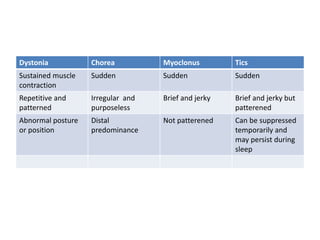
Dystonia Chorea Myoclonus Tics
Sustained muscle
contraction
Sudden Sudden Sudden
Repetitive and
patterned
Irregular and
purposeless
Brief and jerky Brief and jerky but
patterened
Abnormal posture
or position
Distal
predominance
Not patterened Can be suppressed
temporarily and
may persist during
sleep
Phenomenology of Dystonia
Clinically unifying and consistent features are:
• 1. Relatively longer duration contraction
• 2. Simultaneous contraction of agonist and
antagonist
• 3. Twisting of the affected body part
• 4. Continual contraction of same group of
muscles
Cont
• Painful /painless:- most dystonia are painless
except cervical dystonia(75%)
• Diurnal variation:- only present in DRD
• Aggravating factors:-fatigue, stress, emotions,
pregnancy
• Relieving factors:- relaxation ,hypnosis, sleep
• Associated features:-
– Other abnormal movements :- tremor, myoclonus
– Other neurological deficit:- weakness, spasticity, reflex
change, dementia, seizures, abnormal eye movements
Classification of dystonia
• Anatomical classification
• On the basis of etiology
• on the basis of onset of symptoms
Anatomical distribuiton
• Focal
• Segmental
• Multifocal
• Hemidystonia
• Generalized
Classification on the basis of age of
onset
• Childhood onset---- 0 to 12 years.
• Adolescent onset---- 13 to 20 years.
• Adult onset---- older than 20 years.
• In broader terms:
– Early onset---- before 20 years
– Late onset---- later than 20 years or in late
twenties.
On the basis of etiology
• Primary dystonia.
• Secondary dystonia
• Metabolic disorders Heredodegenerative
dystonia
• Drugs
Inherited Primary Dystonia
• Group of Genetic disorders usually onset in
childhood.
– Primary torsion dystonia intermittent unilateral
posturing of lower extremities progresses to all 4
limbs and axial musculature.
– Dopa - responsive dystonia aka Sagawa Syndrome
hallmark is diurnal variation
» All children with progressive dystonia should receive a
trial of L-dopa therapy to screen for dopa -responsive
dystonia
cont
– Myoclonus dystonia characterized by dystonia
involving the upper limb, head and/or neck as well
as myoclonic movements of these region. May
take on tremor like appearance termed dystonic
tremors.
• In primary dystonias although the main
clinical features are motor there may be
increased risk of depression, anxiety, OCD and
screening of psychologicaal comorbidities
shouldnot be overlooked.
Secondary dystonia
• Perinatal cerebral injury
• Infectious and post infectious
• Head trauma
• Stroke
• AV malformation
• Multiple sclerosis
• brain tumor
• Hypoparathyroidism,hypoxia
• Peripheral injury
Signs Potentially Suggestive of
Secondary Dystonia
• Patient history of a possible causative factor.
• Associated neurologic signs.
• Dystonia that occurs during periods of rest.
• Initial leg involvement during adulthood.
• Hemidystonia.
• Early onset of speech disturbance.
• Abnormal laboratory test results .
• Abnormal neuroimaging results.
• Signs suggestive of psychogenic causes.
• Cerebral palsy is a group of permanent disorder
of movement and posture that are attributed to
non progressive disturbances in developing fetal
or infant brain
– Spastic diplegia (35%)
– Spastic quadriplegia (20%)
– Hemilpegia (25%)
– Extrapyramidal ;athetoid dyskinetic (15%)
• Static encephalopathy, but features such as
movement disorder and orthopedic complication
can change or progress over time.
Metabolic causes
• Disorder of monoamine neurotransmitter
metabolism
• Wilson disease
• Biotin responsive basal ganglia disease
• Pantothenate kinase associated
neurodegeneration
Cont
• Huntington disease
• Neurodegeneration with brain Iron accumulation
• Spinocerebellar ataxia
• Nieman pick disease
• Metachromatic leuckodystrophy
• Neuroacanthocytosis
• Leigh disease
• Parkinson syndrome
Drug-Induced Dystonia
• Drugs
– Dopamine receptor blocking drugs
– Antipsychotics
– Anti emetics
– Anticonvulsants
– Flecainide
– CCB
• Toxins
– Manganese
– Carbon monoxide
– Carbon disulfide
– Cyanide Methanol
– Disulfiram
– Wasp-sting toxin Dopamine
Spectrum of Drug Induced Dystonia
• Acute Dystonic Reaction
– Occurs in 1st few days of exposure, typically
involves torticollis, retrocollis, oculogyric crisis and
tongue protrusion or laryngospasm.
– IV diphenhydramine 1-2mg/kg/dose
• Neuroleptic Malignent Syndrome
– Occurs within a month of initiation or dose
increase or withdrawel of dopamine agent
– Severe rigidity, high fever, delirium, dystonia
CONT
• Tardive dyskinesias
– Develop after more than 3 months of use.
– Involvement of the face particularly mouth, lips
and/or jaw with chewing jaw thrusting is
characteristic
– Removal of offending agent may not result in
clinical improvement
– Use of doapmine depleters such as reserpine is
helpful.
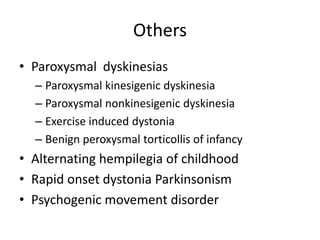
Others
• Paroxysmal dyskinesias
– Paroxysmal kinesigenic dyskinesia
– Paroxysmal nonkinesigenic dyskinesia
– Exercise induced dystonia
– Benign peroxysmal torticollis of infancy
• Alternating hempilegia of childhood
• Rapid onset dystonia Parkinsonism
• Psychogenic movement disorder
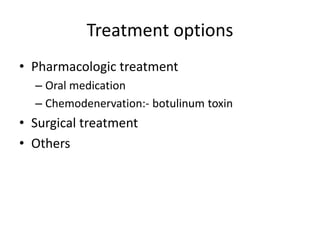
Treatment options
• Pharmacologic treatment
– Oral medication
– Chemodenervation:- botulinum toxin
• Surgical treatment
• Others
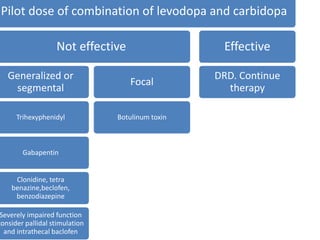
Pilot dose of combination of levodopa and carbidopa
Not effective
Generalized or
segmental
Trihexyphenidyl
Gabapentin
Clonidine, tetra
benazine,beclofen,
benzodiazepine
Severely impaired function
consider pallidal stimulation
and intrathecal baclofen
Focal
Botulinum toxin
Effective
DRD. Continue
therapy
Chemodenervation
• BOTULISM TOXIN A
• BOTULISM TOXIN B
– are commonly used for direct injection into the
affected muscles.
– MODE OF ACTION Blocks the release of
acetylcholine,thus relaxes the muscle
• Peripheral surgical procedures
– Rhizotomy
– Ramisectomy
– Myotomy
– Intrathecal baclofen
– Peripheral denervation
• CNS ablative procedures
– Pallidotomy
– Thalamotomy
• Deep brain stimulation procedures
– GPi stimulation
– VL thalamus stimulation
Other forms of treatment
• Stretching exercises
• Sensory tricks
• Manipulation based techniques
Thanks

Dystonia in Children

  • 1.
  • 2.
    What is Dystonia? •Dystonia is a neurologic movement disorder characterized by sustained muscle contractions, usually producing twisting and repetitive movements or abnormal postures or positions.
  • 3.
    Dystonia Chorea MyoclonusTics Sustained muscle contraction Sudden Sudden Sudden Repetitive and patterned Irregular and purposeless Brief and jerky Brief and jerky but patterened Abnormal posture or position Distal predominance Not patterened Can be suppressed temporarily and may persist during sleep
  • 4.
    Phenomenology of Dystonia Clinicallyunifying and consistent features are: • 1. Relatively longer duration contraction • 2. Simultaneous contraction of agonist and antagonist • 3. Twisting of the affected body part • 4. Continual contraction of same group of muscles
  • 5.
    Cont • Painful /painless:-most dystonia are painless except cervical dystonia(75%) • Diurnal variation:- only present in DRD • Aggravating factors:-fatigue, stress, emotions, pregnancy • Relieving factors:- relaxation ,hypnosis, sleep • Associated features:- – Other abnormal movements :- tremor, myoclonus – Other neurological deficit:- weakness, spasticity, reflex change, dementia, seizures, abnormal eye movements
  • 6.
    Classification of dystonia •Anatomical classification • On the basis of etiology • on the basis of onset of symptoms
  • 7.
    Anatomical distribuiton • Focal •Segmental • Multifocal • Hemidystonia • Generalized
  • 8.
    Classification on thebasis of age of onset • Childhood onset---- 0 to 12 years. • Adolescent onset---- 13 to 20 years. • Adult onset---- older than 20 years. • In broader terms: – Early onset---- before 20 years – Late onset---- later than 20 years or in late twenties.
  • 9.
    On the basisof etiology • Primary dystonia. • Secondary dystonia • Metabolic disorders Heredodegenerative dystonia • Drugs
  • 10.
    Inherited Primary Dystonia •Group of Genetic disorders usually onset in childhood. – Primary torsion dystonia intermittent unilateral posturing of lower extremities progresses to all 4 limbs and axial musculature. – Dopa - responsive dystonia aka Sagawa Syndrome hallmark is diurnal variation » All children with progressive dystonia should receive a trial of L-dopa therapy to screen for dopa -responsive dystonia
  • 11.
    cont – Myoclonus dystoniacharacterized by dystonia involving the upper limb, head and/or neck as well as myoclonic movements of these region. May take on tremor like appearance termed dystonic tremors. • In primary dystonias although the main clinical features are motor there may be increased risk of depression, anxiety, OCD and screening of psychologicaal comorbidities shouldnot be overlooked.
  • 12.
    Secondary dystonia • Perinatalcerebral injury • Infectious and post infectious • Head trauma • Stroke • AV malformation • Multiple sclerosis • brain tumor • Hypoparathyroidism,hypoxia • Peripheral injury
  • 13.
    Signs Potentially Suggestiveof Secondary Dystonia • Patient history of a possible causative factor. • Associated neurologic signs. • Dystonia that occurs during periods of rest. • Initial leg involvement during adulthood. • Hemidystonia. • Early onset of speech disturbance. • Abnormal laboratory test results . • Abnormal neuroimaging results. • Signs suggestive of psychogenic causes.
  • 14.
    • Cerebral palsyis a group of permanent disorder of movement and posture that are attributed to non progressive disturbances in developing fetal or infant brain – Spastic diplegia (35%) – Spastic quadriplegia (20%) – Hemilpegia (25%) – Extrapyramidal ;athetoid dyskinetic (15%) • Static encephalopathy, but features such as movement disorder and orthopedic complication can change or progress over time.
  • 15.
    Metabolic causes • Disorderof monoamine neurotransmitter metabolism • Wilson disease • Biotin responsive basal ganglia disease • Pantothenate kinase associated neurodegeneration
  • 16.
    Cont • Huntington disease •Neurodegeneration with brain Iron accumulation • Spinocerebellar ataxia • Nieman pick disease • Metachromatic leuckodystrophy • Neuroacanthocytosis • Leigh disease • Parkinson syndrome
  • 17.
    Drug-Induced Dystonia • Drugs –Dopamine receptor blocking drugs – Antipsychotics – Anti emetics – Anticonvulsants – Flecainide – CCB • Toxins – Manganese – Carbon monoxide – Carbon disulfide – Cyanide Methanol – Disulfiram – Wasp-sting toxin Dopamine
  • 18.
    Spectrum of DrugInduced Dystonia • Acute Dystonic Reaction – Occurs in 1st few days of exposure, typically involves torticollis, retrocollis, oculogyric crisis and tongue protrusion or laryngospasm. – IV diphenhydramine 1-2mg/kg/dose • Neuroleptic Malignent Syndrome – Occurs within a month of initiation or dose increase or withdrawel of dopamine agent – Severe rigidity, high fever, delirium, dystonia
  • 19.
    CONT • Tardive dyskinesias –Develop after more than 3 months of use. – Involvement of the face particularly mouth, lips and/or jaw with chewing jaw thrusting is characteristic – Removal of offending agent may not result in clinical improvement – Use of doapmine depleters such as reserpine is helpful.
  • 20.
    Others • Paroxysmal dyskinesias –Paroxysmal kinesigenic dyskinesia – Paroxysmal nonkinesigenic dyskinesia – Exercise induced dystonia – Benign peroxysmal torticollis of infancy • Alternating hempilegia of childhood • Rapid onset dystonia Parkinsonism • Psychogenic movement disorder
  • 22.
    Treatment options • Pharmacologictreatment – Oral medication – Chemodenervation:- botulinum toxin • Surgical treatment • Others
  • 23.
    Pilot dose ofcombination of levodopa and carbidopa Not effective Generalized or segmental Trihexyphenidyl Gabapentin Clonidine, tetra benazine,beclofen, benzodiazepine Severely impaired function consider pallidal stimulation and intrathecal baclofen Focal Botulinum toxin Effective DRD. Continue therapy
  • 24.
    Chemodenervation • BOTULISM TOXINA • BOTULISM TOXIN B – are commonly used for direct injection into the affected muscles. – MODE OF ACTION Blocks the release of acetylcholine,thus relaxes the muscle
  • 25.
    • Peripheral surgicalprocedures – Rhizotomy – Ramisectomy – Myotomy – Intrathecal baclofen – Peripheral denervation • CNS ablative procedures – Pallidotomy – Thalamotomy • Deep brain stimulation procedures – GPi stimulation – VL thalamus stimulation
  • 26.
    Other forms oftreatment • Stretching exercises • Sensory tricks • Manipulation based techniques
  • 27.

Editor's Notes

  • #11 Guanosine triphophate cyclohydrolase 1