Thanh Vu
Computing and Communications
Department
The Open University
Dynamic User Profiling for Search
Personalisation
Classical Search Systems
2
 AOL, Altavista return search results based on
 The user input query
 Regardless of the user searching preferences
Different users submit the same input query will
get the same returned result list
 Queries are usually short and ambiguous, e.g.,
Michael Jordan, Java, etc.
Different users have different information needs
with the same input query
Search Personalisation
 Return search results based on
 The input query
 The user searching interests
Different users submit the same input query will
probably get different search result lists
Even an individual user will get different search
results at different search times (e.g., Open US)
3
4
Part I: Dynamic group formation
The performance of search
personalisation
depends on
the richness of a user profile
J. Teevan, M. R. Morris, and S. Bush. Discovering and using groups to improve personalized search. In WSDM’2009
5
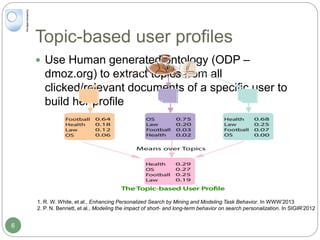
Topic-based user profiles
 Use Human generated ontology (ODP –
dmoz.org) to extract topics from all
clicked/relevant documents of a specific user to
build her profile
1. R. W. White, et al., Enhancing Personalized Search by Mining and Modeling Task Behavior. In WWW’2013
2. P. N. Bennett, et al., Modeling the impact of short- and long-term behavior on search personalization. In SIGIR’2012
6
Challenges for Human Generated
Ontology
 New topics which are not covered in the Ontology
will possibly emerge overtime
 Expensive human effort to classify/maintain each
document into correct categories
7
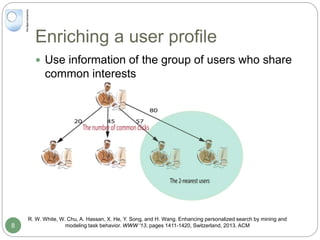
Enriching a user profile
 Use information of the group of users who share
common interests
R. W. White, W. Chu, A. Hassan, X. He, Y. Song, and H. Wang. Enhancing personalized search by mining and
modeling task behavior. WWW '13, pages 1411-1420, Switzerland, 2013. ACM8
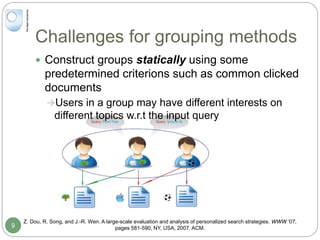
Challenges for grouping methods
 Construct groups statically using some
predetermined criterions such as common clicked
documents
Users in a group may have different interests on
different topics w.r.t the input query
Z. Dou, R. Song, and J.-R. Wen. A large-scale evaluation and analysis of personalized search strategies. WWW '07,
pages 581-590, NY, USA, 2007. ACM.9
Research Question
How can we enrich user profiles with dynamic
group formation?
1. How can we dynamically group users who share
common interests?
2. How can we enrich user profiles with group
information?
3. Can enriched user profiles help to improve search
performance?
10
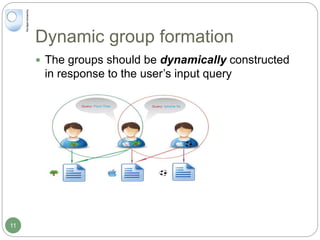
Dynamic group formation
 The groups should be dynamically constructed
in response to the user’s input query
11
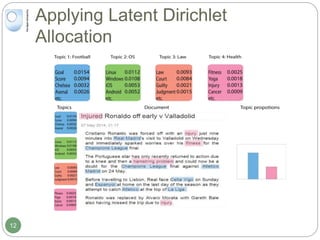
Applying Latent Dirichlet
Allocation
12
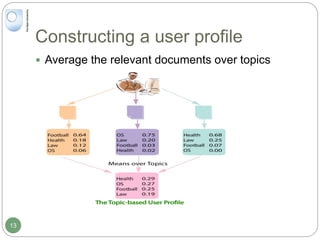
Constructing a user profile
 Average the relevant documents over topics
13
Query-dependent user grouping
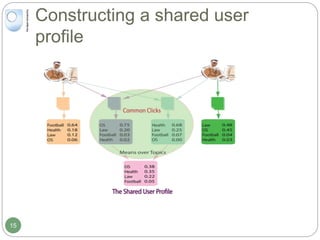
 Construct shared user profiles
 Use the input query as an indicator for grouping
users
14
Constructing a shared user
profile
15
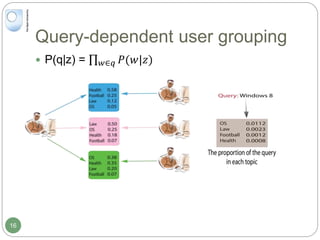
Query-dependent user grouping
 P(q|z) = 𝑤∈𝑞 𝑃(𝑤|𝑧)
16
Query-dependent user grouping
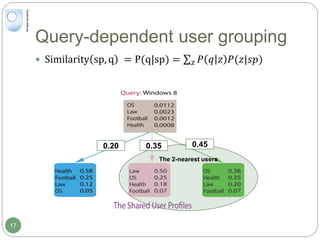
 Similarity sp, q = P(q|sp) = 𝑧 𝑃 𝑞 𝑧 𝑃(𝑧|𝑠𝑝)
The 2-nearest users
0.450.350.20
17
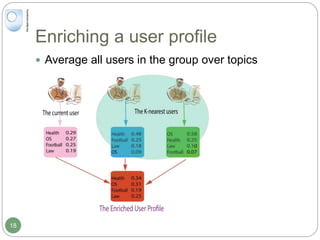
Enriching a user profile
 Average all users in the group over topics
18
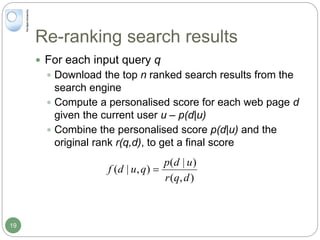
Re-ranking search results
 For each input query q
 Download the top n ranked search results from the
search engine
 Compute a personalised score for each web page d
given the current user u – p(d|u)
 Combine the personalised score p(d|u) and the
original rank r(q,d), to get a final score
),(
)|(
),|(
dqr
udp
qudf 
19
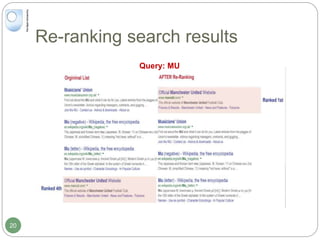
Re-ranking search results
Query: MU
20
Dataset
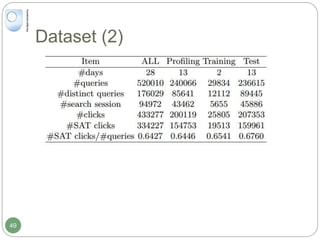
 Query logs from Bing search engine for 15 days
from 1st to 15th July 2012, 106 anonymous users
 A relevant document is a click with dwell time of
at least 30 seconds or the last click in a session
(SAT click)
21
Evaluation metrics
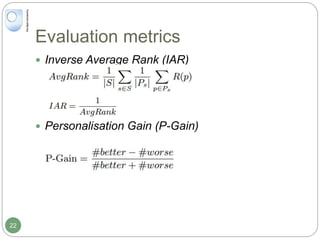
 Inverse Average Rank (IAR)
 Personalisation Gain (P-Gain)
22
Baseline and Personalisation
Strategies
 Baseline and Personalisation Strategies
 Baseline: The original ranked results from Bing
 S_Profile: Use only the current user profile
 S_Group: Enrich the profile with static group
 D_Group: Enrich the profile with dynamic group
23
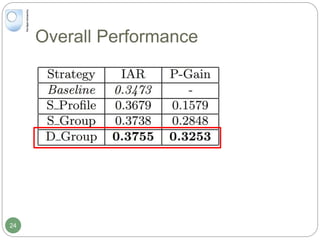
Overall Performance
24
25
Part II: Temporal User Profiles
Challenges for Time-awareness
 Previous methods use all the clicked/relevant
documents of a user to build her searching profile
 The documents are treated equally without
considering temporal features (i.e., the time of
documents being clicked and viewed)
The profile is too broad
Cannot fully express the current interest of the user
1. T. T. Vu, et al., Improving search personalisation with dynamic group formation. In SIGIR’2014
2. K. Raman, et al., Toward whole-session relevance: Exploring intrinsic diversity in web search. In SIGIR’2013
26
Research Question
How can we build user profiles with time-
awareness?
1. How can we build temporal user profiles?
2. Can the time-aware profiles help improve search
performance?
27
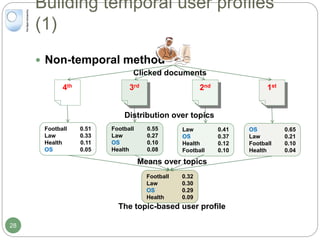
Building temporal user profiles
(1)
 Non-temporal method
4th 1st2nd3rd
Football
Law
Health
OS
0.51
0.33
0.11
0.05
Clicked documents
Football
Law
OS
Health
0.55
0.27
0.10
0.08
Law
OS
Health
Football
0.41
0.37
0.12
0.10
OS
Law
Football
Health
0.65
0.21
0.10
0.04
Distribution over topics
Football
Law
OS
Health
0.32
0.30
0.29
0.09
Means over topics
The topic-based user profile
28
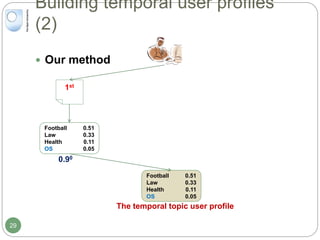
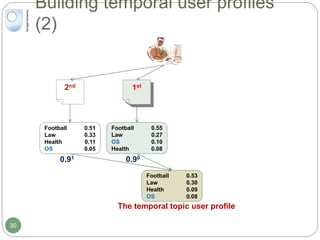
Building temporal user profiles
(2)
 Our method
1st
Football
Law
Health
OS
0.51
0.33
0.11
0.05
Football
Law
Health
OS
0.51
0.33
0.11
0.05
The temporal topic user profile
0.90
29
Football
Law
Health
OS
0.53
0.30
0.09
0.08
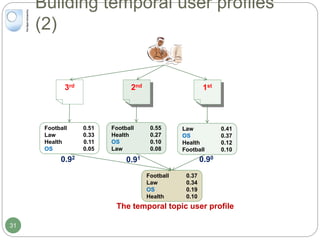
Building temporal user profiles
(2)
2nd 1st
Football
Law
Health
OS
0.51
0.33
0.11
0.05
Football
Law
OS
Health
0.55
0.27
0.10
0.08
The temporal topic user profile
0.91 0.90
30
Football
Law
OS
Health
0.37
0.34
0.19
0.10
0.910.92
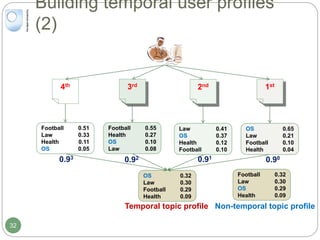
Building temporal user profiles
(2)
3rd 1st2nd
Football
Law
Health
OS
0.51
0.33
0.11
0.05
Football
Health
OS
Law
0.55
0.27
0.10
0.08
Law
OS
Health
Football
0.41
0.37
0.12
0.10
The temporal topic user profile
0.90
31
OS
Law
Football
Health
0.32
0.30
0.29
0.09
Building temporal user profiles
(2)
4th 1st2nd3rd
Football
Law
Health
OS
0.51
0.33
0.11
0.05
Football
Health
OS
Law
0.55
0.27
0.10
0.08
Law
OS
Health
Football
0.41
0.37
0.12
0.10
OS
Law
Football
Health
0.65
0.21
0.10
0.04
Temporal topic profile
0.93
0.92 0.91
0.90
Football
Law
OS
Health
0.32
0.30
0.29
0.09
Non-temporal topic profile
32
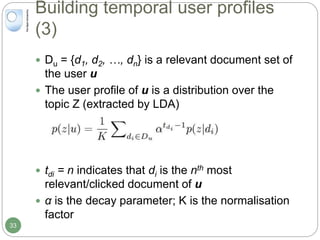
Building temporal user profiles
(3)
 Du = {d1, d2, …, dn} is a relevant document set of
the user u
 The user profile of u is a distribution over the
topic Z (extracted by LDA)
 tdi = n indicates that di is the nth most
relevant/clicked document of u
 α is the decay parameter; K is the normalisation
factor
33
Building temporal user profiles
(4)
 Long-term user profile
 Use relevant documents extracted from the user’s
whole search history
 Daily user profile
 Use relevant documents extracted from the search
history of the user in the current searching day
 Session user profile
 Use relevant documents extracted from the search
history of the user in the current search session
34
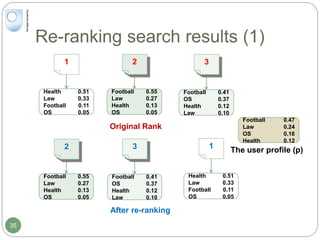
Re-ranking search results (1)
1 32
Health
Law
Football
OS
0.51
0.33
0.11
0.05
Football
Law
Health
OS
0.55
0.27
0.13
0.05
Football
OS
Health
Law
0.41
0.37
0.12
0.10
Original Rank
132
Health
Law
Football
OS
0.51
0.33
0.11
0.05
Football
Law
Health
OS
0.55
0.27
0.13
0.05
Football
OS
Health
Law
0.41
0.37
0.12
0.10
After re-ranking
Football
Law
OS
Health
0.47
0.24
0.16
0.12
The user profile (p)
35
Re-ranking search results (2)
 Personalised scores
 Use Jensen-Shannon divergence (DJS[d||p] )
1 32
Health
Law
Football
OS
0.51
0.33
0.11
0.05
Football
Law
Health
OS
0.55
0.27
0.13
0.05
Football
OS
Health
Law
0.41
0.37
0.12
0.10
Football
Law
OS
Health
0.47
0.24
0.16
0.12
Returned documents (d)
The user profile (p)
36
Re-ranking search results (3)
 Re-ranking Features
 Re-Ranking Algorithm: LambdaMART[1]
1. C. J. Burges, et al., Learning to rank with non-smooth cost functions. In NIPS’2007.
Feature Description
Personalised Features
LongTermScore Personalised score between document and long-term
profile
DailyScore Personalised score between document and daily profile
SessionScore Personalised score between document and session
profile
Non-personalised Features
DocRank Rank of document on original returned list
QuerySim Cosine similarity score between current and previous
queries
QueryNo Total number of queries that have been submitted in the
current search session (included the current query)
37
Evaluation
Dataset
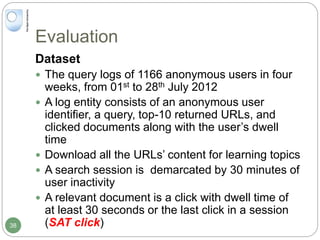
 The query logs of 1166 anonymous users in four
weeks, from 01st to 28th July 2012
 A log entity consists of an anonymous user
identifier, a query, top-10 returned URLs, and
clicked documents along with the user’s dwell
time
 Download all the URLs’ content for learning topics
 A search session is demarcated by 30 minutes of
user inactivity
 A relevant document is a click with dwell time of
at least 30 seconds or the last click in a session
(SAT click)38
Evaluation methodology
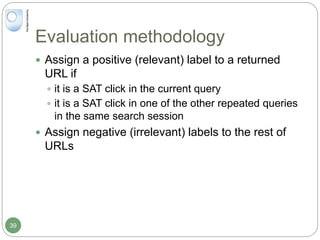
 Assign a positive (relevant) label to a returned
URL if
 it is a SAT click in the current query
 it is a SAT click in one of the other repeated queries
in the same search session
 Assign negative (irrelevant) labels to the rest of
URLs
39
Personalisation Methods and
Baselines
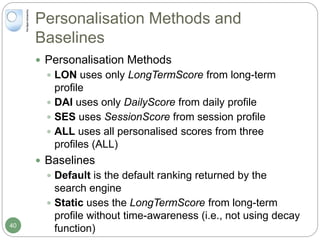
 Personalisation Methods
 LON uses only LongTermScore from long-term
profile
 DAI uses only DailyScore from daily profile
 SES uses SessionScore from session profile
 ALL uses all personalised scores from three
profiles (ALL)
 Baselines
 Default is the default ranking returned by the
search engine
 Static uses the LongTermScore from long-term
profile without time-awareness (i.e., not using decay
function)40
Results
 Evaluation metrics
 Mean Average Precision (MAP)
 Precision (P@k)
 Mean Reciprocal Rank (MRR)
 Normalized Discounted Cumulative Gain
(nDCG@k)
 For each evaluation metric, the higher value
indicates the better ranking
41
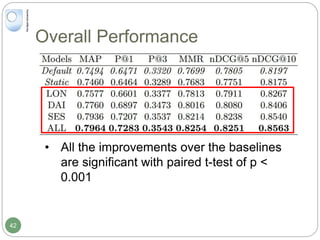
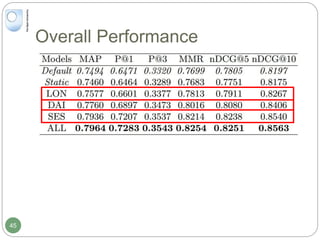
Overall Performance
• All the improvements over the baselines
are significant with paired t-test of p <
0.001
42
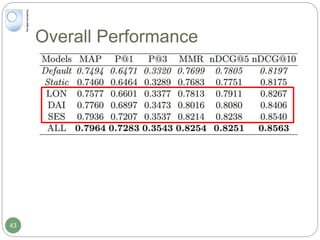
Overall Performance
43
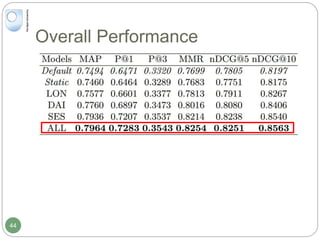
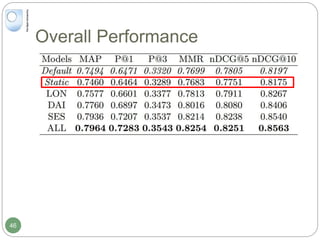
Overall Performance
44
Overall Performance
45
Overall Performance
46
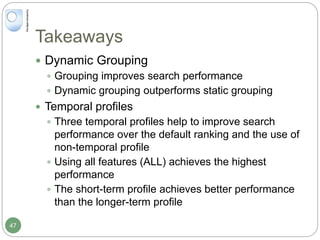
Takeaways
 Dynamic Grouping
 Grouping improves search performance
 Dynamic grouping outperforms static grouping
 Temporal profiles
 Three temporal profiles help to improve search
performance over the default ranking and the use of
non-temporal profile
 Using all features (ALL) achieves the highest
performance
 The short-term profile achieves better performance
than the longer-term profile
47
Thank you!
Any questions?
48
Dataset (2)
49
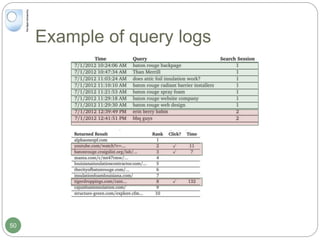
Example of query logs
50
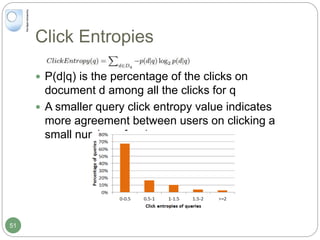
Click Entropies
 P(d|q) is the percentage of the clicks on
document d among all the clicks for q
 A smaller query click entropy value indicates
more agreement between users on clicking a
small number of web pages
51
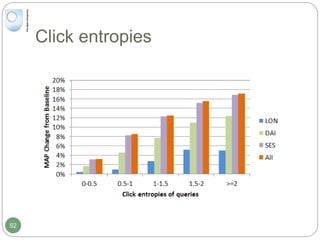
Click entropies
52
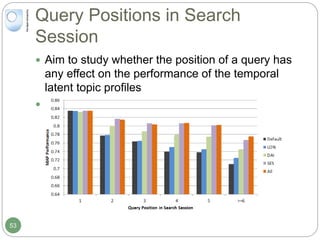
Query Positions in Search
Session
 Aim to study whether the position of a query has
any effect on the performance of the temporal
latent topic profiles
 Label the queries by their positions during the
search
53
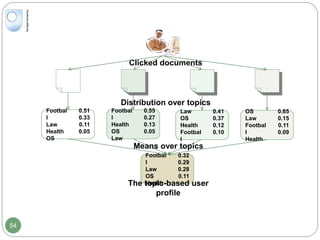
Footbal
l
Law
Health
OS
0.51
0.33
0.11
0.05
Clicked documents
Footbal
l
Health
OS
Law
0.55
0.27
0.13
0.05
Law
OS
Health
Footbal
l
0.41
0.37
0.12
0.10
OS
Law
Footbal
l
Health
0.65
0.15
0.11
0.09
Distribution over topics
Footbal
l
Law
OS
Health
0.32
0.29
0.28
0.11
Means over topics
The topic-based user
profile
54
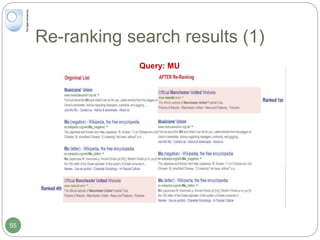
Re-ranking search results (1)
Query: MU
55
Pre-processing
 Remove the queries whose positive label set is
empty from the dataset
 Discard the domain-related queries (e.g.,
Facebook, Youtube)
56
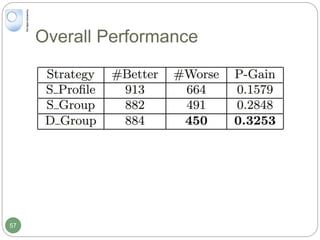
Overall Performance
57

Dynamic User Profiling for Search Personalisation

  • 1.
    Thanh Vu Computing andCommunications Department The Open University Dynamic User Profiling for Search Personalisation
  • 2.
    Classical Search Systems 2 AOL, Altavista return search results based on  The user input query  Regardless of the user searching preferences Different users submit the same input query will get the same returned result list  Queries are usually short and ambiguous, e.g., Michael Jordan, Java, etc. Different users have different information needs with the same input query
  • 3.
    Search Personalisation  Returnsearch results based on  The input query  The user searching interests Different users submit the same input query will probably get different search result lists Even an individual user will get different search results at different search times (e.g., Open US) 3
  • 4.
    4 Part I: Dynamicgroup formation
  • 5.
    The performance ofsearch personalisation depends on the richness of a user profile J. Teevan, M. R. Morris, and S. Bush. Discovering and using groups to improve personalized search. In WSDM’2009 5
  • 6.
    Topic-based user profiles Use Human generated ontology (ODP – dmoz.org) to extract topics from all clicked/relevant documents of a specific user to build her profile 1. R. W. White, et al., Enhancing Personalized Search by Mining and Modeling Task Behavior. In WWW’2013 2. P. N. Bennett, et al., Modeling the impact of short- and long-term behavior on search personalization. In SIGIR’2012 6
  • 7.
    Challenges for HumanGenerated Ontology  New topics which are not covered in the Ontology will possibly emerge overtime  Expensive human effort to classify/maintain each document into correct categories 7
  • 8.
    Enriching a userprofile  Use information of the group of users who share common interests R. W. White, W. Chu, A. Hassan, X. He, Y. Song, and H. Wang. Enhancing personalized search by mining and modeling task behavior. WWW '13, pages 1411-1420, Switzerland, 2013. ACM8
  • 9.
    Challenges for groupingmethods  Construct groups statically using some predetermined criterions such as common clicked documents Users in a group may have different interests on different topics w.r.t the input query Z. Dou, R. Song, and J.-R. Wen. A large-scale evaluation and analysis of personalized search strategies. WWW '07, pages 581-590, NY, USA, 2007. ACM.9
  • 10.
    Research Question How canwe enrich user profiles with dynamic group formation? 1. How can we dynamically group users who share common interests? 2. How can we enrich user profiles with group information? 3. Can enriched user profiles help to improve search performance? 10
  • 11.
    Dynamic group formation The groups should be dynamically constructed in response to the user’s input query 11
  • 12.
  • 13.
    Constructing a userprofile  Average the relevant documents over topics 13
  • 14.
    Query-dependent user grouping Construct shared user profiles  Use the input query as an indicator for grouping users 14
  • 15.
    Constructing a shareduser profile 15
  • 16.
    Query-dependent user grouping P(q|z) = 𝑤∈𝑞 𝑃(𝑤|𝑧) 16
  • 17.
    Query-dependent user grouping Similarity sp, q = P(q|sp) = 𝑧 𝑃 𝑞 𝑧 𝑃(𝑧|𝑠𝑝) The 2-nearest users 0.450.350.20 17
  • 18.
    Enriching a userprofile  Average all users in the group over topics 18
  • 19.
    Re-ranking search results For each input query q  Download the top n ranked search results from the search engine  Compute a personalised score for each web page d given the current user u – p(d|u)  Combine the personalised score p(d|u) and the original rank r(q,d), to get a final score ),( )|( ),|( dqr udp qudf  19
  • 20.
  • 21.
    Dataset  Query logsfrom Bing search engine for 15 days from 1st to 15th July 2012, 106 anonymous users  A relevant document is a click with dwell time of at least 30 seconds or the last click in a session (SAT click) 21
  • 22.
    Evaluation metrics  InverseAverage Rank (IAR)  Personalisation Gain (P-Gain) 22
  • 23.
    Baseline and Personalisation Strategies Baseline and Personalisation Strategies  Baseline: The original ranked results from Bing  S_Profile: Use only the current user profile  S_Group: Enrich the profile with static group  D_Group: Enrich the profile with dynamic group 23
  • 24.
  • 25.
    25 Part II: TemporalUser Profiles
  • 26.
    Challenges for Time-awareness Previous methods use all the clicked/relevant documents of a user to build her searching profile  The documents are treated equally without considering temporal features (i.e., the time of documents being clicked and viewed) The profile is too broad Cannot fully express the current interest of the user 1. T. T. Vu, et al., Improving search personalisation with dynamic group formation. In SIGIR’2014 2. K. Raman, et al., Toward whole-session relevance: Exploring intrinsic diversity in web search. In SIGIR’2013 26
  • 27.
    Research Question How canwe build user profiles with time- awareness? 1. How can we build temporal user profiles? 2. Can the time-aware profiles help improve search performance? 27
  • 28.
    Building temporal userprofiles (1)  Non-temporal method 4th 1st2nd3rd Football Law Health OS 0.51 0.33 0.11 0.05 Clicked documents Football Law OS Health 0.55 0.27 0.10 0.08 Law OS Health Football 0.41 0.37 0.12 0.10 OS Law Football Health 0.65 0.21 0.10 0.04 Distribution over topics Football Law OS Health 0.32 0.30 0.29 0.09 Means over topics The topic-based user profile 28
  • 29.
    Building temporal userprofiles (2)  Our method 1st Football Law Health OS 0.51 0.33 0.11 0.05 Football Law Health OS 0.51 0.33 0.11 0.05 The temporal topic user profile 0.90 29
  • 30.
    Football Law Health OS 0.53 0.30 0.09 0.08 Building temporal userprofiles (2) 2nd 1st Football Law Health OS 0.51 0.33 0.11 0.05 Football Law OS Health 0.55 0.27 0.10 0.08 The temporal topic user profile 0.91 0.90 30
  • 31.
    Football Law OS Health 0.37 0.34 0.19 0.10 0.910.92 Building temporal userprofiles (2) 3rd 1st2nd Football Law Health OS 0.51 0.33 0.11 0.05 Football Health OS Law 0.55 0.27 0.10 0.08 Law OS Health Football 0.41 0.37 0.12 0.10 The temporal topic user profile 0.90 31
  • 32.
    OS Law Football Health 0.32 0.30 0.29 0.09 Building temporal userprofiles (2) 4th 1st2nd3rd Football Law Health OS 0.51 0.33 0.11 0.05 Football Health OS Law 0.55 0.27 0.10 0.08 Law OS Health Football 0.41 0.37 0.12 0.10 OS Law Football Health 0.65 0.21 0.10 0.04 Temporal topic profile 0.93 0.92 0.91 0.90 Football Law OS Health 0.32 0.30 0.29 0.09 Non-temporal topic profile 32
  • 33.
    Building temporal userprofiles (3)  Du = {d1, d2, …, dn} is a relevant document set of the user u  The user profile of u is a distribution over the topic Z (extracted by LDA)  tdi = n indicates that di is the nth most relevant/clicked document of u  α is the decay parameter; K is the normalisation factor 33
  • 34.
    Building temporal userprofiles (4)  Long-term user profile  Use relevant documents extracted from the user’s whole search history  Daily user profile  Use relevant documents extracted from the search history of the user in the current searching day  Session user profile  Use relevant documents extracted from the search history of the user in the current search session 34
  • 35.
    Re-ranking search results(1) 1 32 Health Law Football OS 0.51 0.33 0.11 0.05 Football Law Health OS 0.55 0.27 0.13 0.05 Football OS Health Law 0.41 0.37 0.12 0.10 Original Rank 132 Health Law Football OS 0.51 0.33 0.11 0.05 Football Law Health OS 0.55 0.27 0.13 0.05 Football OS Health Law 0.41 0.37 0.12 0.10 After re-ranking Football Law OS Health 0.47 0.24 0.16 0.12 The user profile (p) 35
  • 36.
    Re-ranking search results(2)  Personalised scores  Use Jensen-Shannon divergence (DJS[d||p] ) 1 32 Health Law Football OS 0.51 0.33 0.11 0.05 Football Law Health OS 0.55 0.27 0.13 0.05 Football OS Health Law 0.41 0.37 0.12 0.10 Football Law OS Health 0.47 0.24 0.16 0.12 Returned documents (d) The user profile (p) 36
  • 37.
    Re-ranking search results(3)  Re-ranking Features  Re-Ranking Algorithm: LambdaMART[1] 1. C. J. Burges, et al., Learning to rank with non-smooth cost functions. In NIPS’2007. Feature Description Personalised Features LongTermScore Personalised score between document and long-term profile DailyScore Personalised score between document and daily profile SessionScore Personalised score between document and session profile Non-personalised Features DocRank Rank of document on original returned list QuerySim Cosine similarity score between current and previous queries QueryNo Total number of queries that have been submitted in the current search session (included the current query) 37
  • 38.
    Evaluation Dataset  The querylogs of 1166 anonymous users in four weeks, from 01st to 28th July 2012  A log entity consists of an anonymous user identifier, a query, top-10 returned URLs, and clicked documents along with the user’s dwell time  Download all the URLs’ content for learning topics  A search session is demarcated by 30 minutes of user inactivity  A relevant document is a click with dwell time of at least 30 seconds or the last click in a session (SAT click)38
  • 39.
    Evaluation methodology  Assigna positive (relevant) label to a returned URL if  it is a SAT click in the current query  it is a SAT click in one of the other repeated queries in the same search session  Assign negative (irrelevant) labels to the rest of URLs 39
  • 40.
    Personalisation Methods and Baselines Personalisation Methods  LON uses only LongTermScore from long-term profile  DAI uses only DailyScore from daily profile  SES uses SessionScore from session profile  ALL uses all personalised scores from three profiles (ALL)  Baselines  Default is the default ranking returned by the search engine  Static uses the LongTermScore from long-term profile without time-awareness (i.e., not using decay function)40
  • 41.
    Results  Evaluation metrics Mean Average Precision (MAP)  Precision (P@k)  Mean Reciprocal Rank (MRR)  Normalized Discounted Cumulative Gain (nDCG@k)  For each evaluation metric, the higher value indicates the better ranking 41
  • 42.
    Overall Performance • Allthe improvements over the baselines are significant with paired t-test of p < 0.001 42
  • 43.
  • 44.
  • 45.
  • 46.
  • 47.
    Takeaways  Dynamic Grouping Grouping improves search performance  Dynamic grouping outperforms static grouping  Temporal profiles  Three temporal profiles help to improve search performance over the default ranking and the use of non-temporal profile  Using all features (ALL) achieves the highest performance  The short-term profile achieves better performance than the longer-term profile 47
  • 48.
  • 49.
  • 50.
  • 51.
    Click Entropies  P(d|q)is the percentage of the clicks on document d among all the clicks for q  A smaller query click entropy value indicates more agreement between users on clicking a small number of web pages 51
  • 52.
  • 53.
    Query Positions inSearch Session  Aim to study whether the position of a query has any effect on the performance of the temporal latent topic profiles  Label the queries by their positions during the search 53
  • 54.
  • 55.
    Re-ranking search results(1) Query: MU 55
  • 56.
    Pre-processing  Remove thequeries whose positive label set is empty from the dataset  Discard the domain-related queries (e.g., Facebook, Youtube) 56
  • 57.

Editor's Notes

  • #40 Use the rank positions of the positive label as the ground truth to evaluate the search performance before and after re-ranking
  • #43 The session profile (SES) achieves better performance than the daily profile (DAI). It also shows that the daily profile (DAI) gains advantage over the long-term profile (LON). This indicates that the short-term profiles capture more details of user interest than the longer ones. The combination of all features (ALL) achieves the highest performance.
  • #44 Three temporal profiles help to improve search performance over default ranking and the use of non-temporal profile
  • #45 Using all features (ALL) achieves the highest performance
  • #46 The session profile achieves better performance than the daily profile The daily profile gains advantages over the long-term profile
  • #47 Without time-awareness, the long-term profile gets no improvement over the default ranking
  • #53 Show the improvement of the temporal profiles over the Default baseline using MAP metric for different magnitudes of click entropy we show the improvement of the temporal profiles over the Default ranking from the search engine in term of MAP metric for different magnitudes of click entropy. Here the statistical significance is also guaranteed with the use of paired t-test (p < 0:001). With smaller value of click entropy, the re-ranking performance is only slightly improved. For example, with click entropy between 0 and 0.5, the improvement of the MAP metric from long-term profile is of only 0.39%, in comparison with the original search engine. One may see that the effectiveness of the temporal pro les is increasing proportionally according to the value of click entropy. The highest improvements are achieved when click entropies are >= 2
  • #54  A query usually has a broader influence in a search session than only returning a list of URLs. The position of a query in a search session is also important because it may be fine-tuned by a user after the unsatisfactory results from previous queries. In this experiment we aim to study whether the position of a query has any effect on the performance of the temporal latent topic profiles. For each session, we label the queries by their positions during the search