ISSN: 2277 – 9043
                International Journal of Advanced Research in Computer Science and Electronics Engineering
                                                                               Volume 1, Issue 5, July 2012

       SURVEY OF ENERGY EFFICIENT
     MULTICAST ROUTING PROTOCOLS IN
                 MANET
                         Ranjeet Jaiswal1, Manish Chand Sahu2, Ankur Mishra3 Sanjay Sharma4
                                          OIST Bhopal1, 3, 4, LNCT Bhopal2
                                        Research scholor1, 2, 3, Asst. Professor3
              Ranjeet.jaiswal87@gmail.com1 , manishsahu7710@gmail.com2 , ankur_2469@yahoo.co.in3 ,
                                          Sanjaysharma@oriental.ac.in3

Abstract-- Although establishing correct and efficient           disk, system memory (DRAM), keyboard/mouse, CDROM
routes is an important design issue in mobile ad hoc             drive, flash drives, I/O subsystem, and the wireless network
networks (MANETs), a more challenging goal is to provide
                                                                 interface card .
energy efficient routes because mobile nodes’ operation time
                                                                 A typical example from Toshiba 410 CDT mobile
is the most critical limiting factor. This article surveys and
analyses the energy aware routing protocols proposed for         computer demon straits that nearly 36% of power
MANETs. They minimize either the active communication            consumed is by the display, 21% by the CPU/memory,
energy required to transmit or receive packets or the inactive   18% by the wireless interface, and 18% by the hard drive.
energy consumed when a mobile node stays idle but listens to     Consequently, energy conservation has been largely
the wireless medium for any possible communication requests      considered in the hardware design of the mobile terminal
from other nodes. Transmission power control approach and        [10] and in components such as CPU, disks, displays, etc.
load distribution approach belong to the former category,        Significant additional power savings may result by
and sleep/power-down mode approach belongs to the latter
                                                                 incorporating low-power strategies into the design of
category. While it is not clear that any particular algorithm
                                                                 network protocols used for data communication.
or a class of algorithms is the best for all scenarios, each
protocol has definite advantages/disadvantages and is well-      In ad hoc networks, nodes communicate with each other by
suited for certain situations. The purpose of this paper is to   way of radio signals, which are broadcast in nature.
facilitate the research efforts in combining the existing        Broadcast is a unique case of multicast, wherein all nodes
solutions to offer a more energy efficient routing mechanism.    in the network should get the broadcast message.
                                                                 Multicasting is a communication process in which the
                                                                 transmission of packets (message) is initiated by a single
       Keywords: Mobile Ad hoc Networks; Multicast               user and the message is received by one or more end users
Routing Protocols; Energy Efficiency, Security; Review           of the network. Multicasting in wired and wireless
Survey                                                           networks has been advantageous and used as a vital
                                                                 technology in many applications such as audio/ video
                    I.    INTRODUCTION
                                                                 conferencing, corporate communications, collaborative and
Mobile ad hoc networks comprise freely roaming                   groupware applications, distance learning, stock quotes,
wireless nodes that cooperatively make up for the                distribution of software, news and etc [1]. Under multicast
absence of fixed infrastructure; that is, the nodes              communications, a single stream of data can be shared with
themselves support the network functionality. Nodes              multiple recipients and data is only duplicated when
transiently associate with their peers that are within the       required.
radio connectivity range of their transceiver and
                                                                 However, it would be a difficult and challenging task to
implicitly agree to assist in provision of the basic
                                                                 offer energy efficient and reliable multicast routing in
network services. These associations are dynamically
                                                                 MANETs. It might not be possible to recharge / replace a
created and torn down. Studies show that the significant
                                                                 mobile node that is powered by batteries during a mission.
consumers of power in a typical laptop are the
                                                                 The inadequate battery lifetime imposes a limitation on the
microprocessor (CPU), liquid crystal display (LCD), hard
                                                                 network performance. To take full advantage of the lifetime

                                                                                                                          14

                                             All Rights Reserved © 2012 IJARCSEE
ISSN: 2277 – 9043
                     International Journal of Advanced Research in Computer Science and Electronics Engineering
                                                                                    Volume 1, Issue 5, July 2012
    of nodes, traffic should be routed in a way that energy            These protocols have unique attributes and utilize different
    consumption is minimized. In recent years, various energy          recovery mechanisms on energy consumption.
    efficient multicast routing protocols have been proposed.


                                                       Figure: 1 Multicast routing


 II. MULTICAST ROUTING PROTOCOL DESIGN: ISSUES                         Unlike wired networks, MANETs are characterized by scant
                     AND CHALLENGES                                    capacity caused by the noise and interference inherent in
                                                                       wireless transmission and multipath fading. Efficient multicast
The particular features of MANETs make the design of a                 routing protocols are expected to provide a fair number of
multicast routing protocol a challenging one. These protocols          control packets transmitted through the network relative to the
must deal with a number of issues, including, but not limited to,      number of data packets reaching their destination intact, and
high dynamic topology, limited and variable capacity, limited          methods to improve and increase the available capacity need to
energy resources, a high bit error rate, a multihop topology, and      be considered.
the hidden terminal problem. The requirements of existing and
future multicast routing protocols and the issues associated with           C.   Energy Consumption
these protocols that should be taken into consideration are listed
                                                                       Energy efficiency is an important consideration in such an
in what follows [2, 3, and 6].
                                                                       environment. Nodes in MANETs rely on limited battery power
    A.   Topology, Mobility, and Robustness                            for their energy. Energy-saving techniques aimed at minimizing
                                                                       the total power consumption of all nodes in the multicast group
In MANETs, nodes are free to move anywhere, anytime, and at            (minimize the number of nodes used to establish multicast
different speeds. The random and continued movement of the             connectivity, minimize the number of overhead controls, etc.)
nodes leads to a highly dynamic topology, especially in a high-        and at maximizing the multicast life span should be considered.
mobility environment. A multicast routing protocol should be
robust enough to react quickly with the mobility of the nodes               D. Quality of Service and Resource Management
and should adapt to topological changes in order to avoid
                                                                       Providing quality of service (QoS) assurance is one of the
dropping a data packet during the multicast session, which
                                                                       greatest challenges in designing algorithms for MANET
would create a low packet delivery ratio (PDR: the number of no
                                                                       multicasts. Multicast routing protocols should be able to reserve
duplicate data packets successfully delivered to each destination
                                                                       different network resources to achieve QoS requirements such
versus the number of data packets supposed to be received at
                                                                       as, capacity, delay, delay jitter, and packet loss. It is very
each destination). It is very important to minimize control
                                                                       difficult to meet all QoS requirements at the same time because
overhead while creating and maintaining the multicast group
                                                                       of the peculiarities of ad hoc networks. Even if this is done, the
topology, especially in an environment with limited capacity.
                                                                       protocol will be very complex (many routing tables, high control
    B.   Capacity and Efficiency                                       overhead, high energy consumption, etc.). As a result, doing so
                                                                       will not be suitable for these networks with their scarce


                                                                                                                                 15

                                                  All Rights Reserved © 2012 IJARCSEE
ISSN: 2277 – 9043
                          International Journal of Advanced Research in Computer Science and Electronics Engineering
                                                                                         Volume 1, Issue 5, July 2012
resources, and resource management and adaptive QoS methods          Ad-hoc Multicast Routing Protocol Utilizing Increasing id-
are more convenient than reservation methods for MANETs.             numbers (AMRIS) are proactive multicast routing protocols.
                                                                     Periodic broadcast of network topology updates are needed to
    E.   Security and Reliability                                    compute the shortest path from the source to every destination,
                                                                     which consumes a lot of bandwidth. In Table 3 gives the
Security provisioning is a crucial issue in MANET multicasting
                                                                     Characteristic comparison of proactive Multicast Routing
due to the broadcast nature of this type of network, the existence
                                                                     Protocol.
of a wireless medium, and the lack of any centralized
infrastructure. This makes MANETs vulnerable to
eavesdropping, interference, spoofing, and so forth. Multicast
routing protocols should take this into account, especially in
some applications such as military (battlefield) operations,
national crises, and emergency operations. Reliability is
particularly important in multicasting, especially in these
applications, and it becomes more difficult to deliver reliable
data to group members whose topology varies. A reliable
multicasting design depends on the answers of the following
three questions. By who are the errors detected? How are error
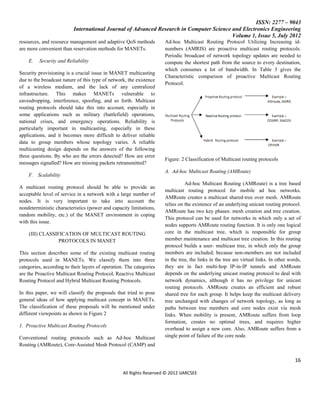
                                                                     Figure: 2 Classification of Multicast routing protocols
messages signalled? How are missing packets retransmitted?
                                                                     A. Ad-hoc Multicast Routing (AMRoute)
    F. Scalability
                                                                               Ad-hoc Multicast Routing (AMRoute) is a tree based
A multicast routing protocol should be able to provide an
                                                                     multicast routing protocol for mobile ad hoc networks.
acceptable level of service in a network with a large number of
                                                                     AMRoute creates a multicast shared-tree over mesh. AMRoute
nodes. It is very important to take into account the
                                                                     relies on the existence of an underlying unicast routing protocol.
nondeterministic characteristics (power and capacity limitations,
                                                                     AMRoute has two key phases: mesh creation and tree creation.
random mobility, etc.) of the MANET environment in coping
                                                                     This protocol can be used for networks in which only a set of
with this issue.
                                                                     nodes supports AMRoute routing function. It is only one logical
    (III) CLASSIFICATION OF MULTICAST ROUTING                        core in the multicast tree, which is responsible for group
                 PROTOCOLS IN MANET                                  member maintenance and multicast tree creation. In this routing
                                                                     protocol builds a user- multicast tree, in which only the group
This section describes some of the existing multicast routing        members are included; because non-members are not included
protocols used in MANETs. We classify them into three                in the tree, the links in the tree are virtual links. In other words,
categories, according to their layers of operation. The categories   they are in fact multi-hop IP-in-IP tunnels and AMRoute
are the Proactive Multicast Routing Protocol, Reactive Multicast     depends on the underlying unicast routing protocol to deal with
Routing Protocol and Hybrid Multicast Routing Protocols.             network dynamics, although it has no privilege for unicast
                                                                     routing protocols. AMRoute creates an efficient and robust
In this paper, we will classify the proposals that tried to pose     shared tree for each group. It helps keep the multicast delivery
general ideas of how applying multicast concept in MANETs.           tree unchanged with changes of network topology, as long as
The classification of these proposals will be mentioned under        paths between tree members and core nodes exist via mesh
different viewpoints as shown in Figure 2                            links. When mobility is present, AMRoute suffers from loop
                                                                     formation, creates no optimal trees, and requires higher
1. Proactive Multicast Routing Protocols
                                                                     overhead to assign a new core. Also, AMRoute suffers from a
Conventional routing protocols such as Ad-hoc Multicast              single point of failure of the core node.
Routing (AMRoute), Core-Assisted Mesh Protocol (CAMP) and

                                                                                                                                       16

                                                  All Rights Reserved © 2012 IJARCSEE
ISSN: 2277 – 9043
                          International Journal of Advanced Research in Computer Science and Electronics Engineering
                                                                                         Volume 1, Issue 5, July 2012
B. Ad hoc Multicast Routing Protocol utilizing increasing id-        protocol. CAMP modifies this table when a multicast group
numbers (AMRIS)                                                      joins or leaves the network. A Multicast Routing Table (MRT)
                                                                     is based on the Routing Table that contains the set of known
AMRIS [7] is a proactive shared tree based multicast routing         groups. Moreover, all member nodes maintain a set of caches
protocol, which is independent of the fundamental unicast            that Sender Forwarder Receiver contain previously seen data
routing protocol. In AMRIS, the tree maintenance procedure           packet information and unacknowledged membership requests.
operates continuously and locally to ensure a node’s connection      The creation and maintenance of meshes are main parts of
to the multicast session delivery tree. In AMRIS, the tree           CAMP.
maintenance procedure operates continuously and locally to
ensure a node’s connection to the multicast session delivery tree.                               AMROUTE     AMRIS       CAMP
AMRIS is an on-demand protocol that constructs a shared                 Structure of multicast
delivery tree to support multiple senders and receivers within a               routing              Tree        Tree        Mesh
multicast session. AMRIS dynamically assigns every node (on
demand) in a multicast session with an ID number known as                    Loop Free               NO         Yes          yes

msm-id. The msm-id provides a heuristic height to a node and              Dependencey on
the ranking order of msm-id numbers directs the flow of                  unicasting Routing
                                                                             Protocols              Yes          No         Yes
datagram in the multicast delivery tree. Every node calculates its
msm-id during the initialization phase, which is initiated by a
special node called S-id. Normally, the S-id is the source node if           Scalability            Fair        Fair        Good
there is only one source for the session. Otherwise, the S-id is       Comtol Packet flooding       Flat        Flat        Flat
the source node that has the minimum msm-id. The S-id                     Perodic Message
broadcasts a NEW_SESSION message to its neighbours. When                    Requirement             Yes         Yes         Yes
a node wants to join the multicast session, it chooses one of its
neighbours which has the smaller msm-id as its parent and send
it a JOIN-REQ message. If the neighbour is in the tree (if the       2. Reactive Multicast Routing Protocols
tree has been built), it answers with a JOIN-ACK message,             Traditional routing protocols such as On Demand Multicast
which means the joining is successful; otherwise (when it is the     Routing Protocol (ODMRP) and Multicast Ad-hoc on-demand
first time to build the tree), the neighbour forwards JOIN-REQ       Distance Vector (MAODV) are Reactive multicast routing
to its own neighbours and waits for the reply, which is repeated     protocols. Reactive routing that means discovers the route when
until the JOIN-REQ arrives at an on-tree node or the source. As      needed. Reactive routing protocols are well suited for a large-
a result, a delivery tree rooted from the source is formed to        scale, narrow-band MANET with moderate or low mobility. In
include all the group members and some relay non-members.            Table 4 gives the Characteristic comparison of Reactive
AMRIS repairs the broken links by performing local route repair      Multicast Routing Protocol.
without the need for any central controlling node, thereby
reducing the control overhead.                                       A. On-Demand Multicast Routing Protocol (ODMRP)
                                                                     On-Demand Multicast Routing Protocol (ODMRP) [8] is a
C. Core-Assisted Mesh protocol (CAMP)
                                                                     reactive mesh based multicast routing protocol. ODMRP is
Core-Assisted Mesh protocol (CAMP) [10] is a proactive               not only a multicast routing protocol, but also provides unicast
multicast routing protocol based on shared Meshes-The mesh           routing capability. The source establishes and maintains group
structure provides at least one path from each source to each        membership and multicast mesh on demand if it needs to send
receiver in the multicast group. CAMP relies on an underlying        data packets to the multicast group, which is somewhat similar
unicast protocol which can provide correct distances to all          to MAODV. A set of nodes, which is called forwarding group,
destinations within finite time. Every node maintains a Routing      participate in forwarding data packets among group members.
Table (RT) that is created by the underlying unicast routing         All the states in ODMRP are soft states, which are refreshed by
                                                                     the control messages mentioned above or data packets, which

                                                                                                                                   17

                                                  All Rights Reserved © 2012 IJARCSEE
ISSN: 2277 – 9043
                           International Journal of Advanced Research in Computer Science and Electronics Engineering
                                                                                          Volume 1, Issue 5, July 2012
achieves higher robustness. ODMRP uses a forwarding group              to maintain the sequence number. The group leader is by default
concept for multicast packet transmission, in which each               the first node joining the group, but could also be another node
multicast group G is associated with a forwarding group (FG).          when the first node leaves the group. The main drawbacks of
Nodes in FG are in charge of forwarding multicast packets of           MAODV are long delays and high overheads associated with
group G. In a multicast group of ODMRP, the source manages             fixing broken links in conditions of high mobility and traffic
the group membership, establishes and updates the multicast            load. Also, it has a low packet delivery ratio in scenarios with
routes on demand. Like reactive unicast routing protocols,             high mobility, large numbers of members, or a high traffic load.
ODMPR comprises two main phases: the request phase and the             Because of its dependence on AODV, MAODV is not flexible.
reply phase. When a multicast source has a packet to send but it       Finally, it suffers from a single point of failure, which is the
has no routing and group membership information, it floods a           multicast group leader.
Join Request packet to the entire network. Join Request packets
                                                                                                    ODMRP             MAODV
are member-advertising packets with piggybacked data payload.
When a node receives a non-duplicate JOIN Request, it stores               Multicast     delivery   Mesh              Core based tree
the upstream node ID in its routing table and rebroadcasts the             structure
packet. When the JOIN Request packet reaches a multicast                   Loop free                Yes               Yes
receiver, the receiver refreshes or creates an entry for the source        Periodic    message      Yes               No
in Member Table and broadcasts JOIN TABLE packets                          requirement
periodically to its neighbours. When a node receives a JOIN
TABLE packet, it checks each entry of the table to find out if             Routing hierarchy        Flat              Flat
there is an entry in the table whose next node ID field matches
its ID. If there is a match, the node recognizes that it is on the         scalability              Fare              Fare
path to the source, thus it is part of the forwarding group. Then it
sets the FG_FLAG and broadcasts its own JOIN TABLE built
                                                                       3. Hybrid Multicast Routing Protocols
upon matched entries. Consequently, each member of a
                                                                       Traditional routing protocol such as Optimized Polymorphic
forwarding group propagates the JOIN TABLE packets until the
                                                                       Hybrid Multicast Routing Protocol (OPHMR) is the Hybrid
multicast source is reached via the shortest path. This process
                                                                       multicast routing protocol. Hybrid routing protocol attempts to
constructs (or updates) the routes from sources to receivers and
                                                                       discover balance between the two such as proactive for
builds a mesh of nodes, the forwarding group.
                                                                       neighbourhood, reactive for far away.
B. Multicast Ad-hoc On-demand Distance Vector
                                                                       1. Optimized Polymorphic Hybrid Multicast Routing
(MAODV) Multicast operation of Ad-hoc On-demand Distance
                                                                       Protocol (OPHMR)
Vector (MAODV) [10] is a reactive tree-based multicast routing
                                                                       This protocol [9] is invested with different operational modes
protocol. MAODV is an extension of the unicast routing
                                                                       that are either proactive or reactive based on a MN’s power
protocol Ad-hoc On-demand Distance Vector (AODV). Using
                                                                       remainder, mobility level, and vicinity density level. It attempts
MAODV, all nodes in the network maintain local connectivity
                                                                       to address the issues of power efficiency, latency, and protocol
by broadcasting “Hello” messages with TTL set to one. Every
                                                                       overhead in an adaptive manner. OPHMR’s reactive behaviour
node maintains three tables, a Routing
                                                                       is based on the On-Demand Multicast Routing Protocol
Table (RT), a Multicast Routing Table (MRT) and a Request
                                                                       (ODMRP). It’s relatively simplistic. It generates on-demand
Table. RT stores routing information and has the         same
                                                                       route paths for multicast message requests. OPHMR’s proactive
function as in AODV. In unicast routing operations, every
                                                                       behaviour is based on the Multicast Zone Routing (MZR)
destination has a unique sequence number. Likewise every
                                                                       protocol. It builds a zone around each Mobile Node (in hops)
multicast group also has a sequence number to indicate the
                                                                       and periodically sends updates within each defined zone. For
freshness of the multicast routing information.
                                                                       added efficiency, OPHMR utilizes an optimizing scheme
Thus, one and only one group leader is elected to broadcast
                                                                       adapted from the Optimized Link State Routing (OLSR)
periodical GROUP HELLO messages throughout the MANET

                                                                                                                                        18

                                                   All Rights Reserved © 2012 IJARCSEE
ISSN: 2277 – 9043
                              International Journal of Advanced Research in Computer Science and Electronics Engineering
                                                                                             Volume 1, Issue 5, July 2012
protocol. It used to decrease the amount of control overhead that                     Systems, 2004.
                                                                                [6]. M.C.C. De, H. Gossain, D.P. Agrawal, Multicast over Wireless
is produced. OPHMR is, after a very lengthy period of time,
                                                                                      Mobile Ad-hoc Networks: Present and Future Directions, IEEE
able to extend battery life and enhance the survivability of the                      Network, 52–59, 2003.
mobile ad hoc nodes. As a result, it decreases the end-to-end                   [7]. J. G. Jetcheva and D. B. Johnson: Adaptive Demand-Driven
delay and increases the packet delivery ratio.                                        Multicast Routing in Multi-Hop Wireless Ad Hoc Networks,
                                                                                      Proceedings of the 2nd ACM International Symposium on Mobile
                                                                                      andAd-hoc Networking & Computing (MobiHOC), pages 33 - 44,
                        IV.     CONCLUSION                                            Long Beach, CA, October 2001.
                                                                                [8]. M. Maleki and M. Pedram, Lifetime-Aware Multicast Routing in
A mobile ad hoc network (MANET) consists of autonomous                                Wireless Ad hoc Networks, Proceedings of IEEE Wireless
                                                                                      Communications and Networking Conference, 2004.
mobile nodes, each of which communicates directly with the
                                                                                [9]. Adel Ben Mnaouer, Lei Chen, Chuan Heng Foh, Juki Wirawan
nodes within its wireless range or indirectly with other nodes in                     Tantra, "OPHMR: An Optimized Polymorphic Hybrid Multicast
a network. In order to facilitate secure and reliable                                 Routing Protocol for MANET," IEEE Transactions on Mobile
communication within a MANET, an efficient routing protocol                           Computing, vol. 6, no. 5, pp. 551-562, May 2007,
                                                                                      doi:10.1109/TMC.2007.1030
is required to discover routes between mobile nodes. The field
                                                                                [10]. CHRISTINE E. JONES, KRISHNA M. SIVALINGAM,
of MNAET is rapidly growing due to the many advantages and                            PRATHIMA AGRAWAL and JYH CHENG CHEN, “A Survey of
different application areas. Energy efficiency and security are                       Energy Efficient Network Protocols for Wireless Networks”,
some challenges faced in MANETs, especially in designing a                            Wireless Networks 7, 343–358, 2001Kluwer Academic Publishers.
                                                                                      Manufactured in The Netherlands.
routing protocol. In this paper, we surveyed a number of energy
                                                                                [11]. Garcia-Luna-Aceves, J.J. Madruga, E.L. Dept. of Comput. Eng.,
efficient multicast routing International                                             California Univ., Santa Cruz, CA, “The core-assisted mesh 11] C. C.
 protocols and secure multicast routing protocols. In many cases,                     Chiang, M. Gerla, and L. Zhang, “Adaptive shared tree multicast in
it is difficult to compare these protocols with each other directly                   mobile wireless networks,” Proceeding of GLOBECOM, pp. 1817–
                                                                                      1822, November1998. Protocol” 06 August 2002.
since each protocol has a different goal with different
assumptions and employs mechanisms to achieve the goal.
According to the study, these protocols have different strengths
and drawbacks. A multicast protocol can hardly satisfy all
requirements. In other words, one routing protocol cannot be a
solution for all energy efficient and security issues that are faced
in MANETs, but rather each protocol is designed to provide the
maximum possible requirements, according to certain required
scenarios.
                        V.     REFERENCES

    [1]. X. Chen, J. Wu, Multicasting Techniques in Mobile Ad-hoc
         Networks, Computer Science Department, South-west Texas State
         University, San Marcos, The Handbook of Ad-hoc Wireless
         Networks (2003) pp. 25–40.
    [2]. M. Mohammed, Energy Efficient Location Aided Routing Protocol
         for Wireless MANETs, International Journal of Computer Science
         and Information Security, vol. 4, 2009.
    [3]. M. Cheng, J. Shun, M. Min, Y. Li and W. Wu, Energy-Efficient
         Broadcast and Multicast Routing in Multihop Ad Hoc Wireless
         Networks, Wireless Communications and Mobile Computing, vol. 6,
         no. 2, pp. 213–223, 2006.
    [4]. L Junhai, X Liu, Y Danxia, Research on Multicast Routing Protocols
         for Mobile Ad-Hoc Networks Computer Networks – Elsevier, 2008.
    [5]. R. Vaishampayan, J.J. Garcia-Luna-Aceves, Energy Efficient and
         Robust Multicast Routing in Mobile Ad Hoc Networks, Proceedings
         of the IEEE International Conference on Mobile Ad-hoc and Sensor


                                                                                                                                                     19

                                                        All Rights Reserved © 2012 IJARCSEE

14 19

  • 1.
    ISSN: 2277 –9043 International Journal of Advanced Research in Computer Science and Electronics Engineering Volume 1, Issue 5, July 2012 SURVEY OF ENERGY EFFICIENT MULTICAST ROUTING PROTOCOLS IN MANET Ranjeet Jaiswal1, Manish Chand Sahu2, Ankur Mishra3 Sanjay Sharma4 OIST Bhopal1, 3, 4, LNCT Bhopal2 Research scholor1, 2, 3, Asst. Professor3 Ranjeet.jaiswal87@gmail.com1 , manishsahu7710@gmail.com2 , ankur_2469@yahoo.co.in3 , Sanjaysharma@oriental.ac.in3 Abstract-- Although establishing correct and efficient disk, system memory (DRAM), keyboard/mouse, CDROM routes is an important design issue in mobile ad hoc drive, flash drives, I/O subsystem, and the wireless network networks (MANETs), a more challenging goal is to provide interface card . energy efficient routes because mobile nodes’ operation time A typical example from Toshiba 410 CDT mobile is the most critical limiting factor. This article surveys and analyses the energy aware routing protocols proposed for computer demon straits that nearly 36% of power MANETs. They minimize either the active communication consumed is by the display, 21% by the CPU/memory, energy required to transmit or receive packets or the inactive 18% by the wireless interface, and 18% by the hard drive. energy consumed when a mobile node stays idle but listens to Consequently, energy conservation has been largely the wireless medium for any possible communication requests considered in the hardware design of the mobile terminal from other nodes. Transmission power control approach and [10] and in components such as CPU, disks, displays, etc. load distribution approach belong to the former category, Significant additional power savings may result by and sleep/power-down mode approach belongs to the latter incorporating low-power strategies into the design of category. While it is not clear that any particular algorithm network protocols used for data communication. or a class of algorithms is the best for all scenarios, each protocol has definite advantages/disadvantages and is well- In ad hoc networks, nodes communicate with each other by suited for certain situations. The purpose of this paper is to way of radio signals, which are broadcast in nature. facilitate the research efforts in combining the existing Broadcast is a unique case of multicast, wherein all nodes solutions to offer a more energy efficient routing mechanism. in the network should get the broadcast message. Multicasting is a communication process in which the transmission of packets (message) is initiated by a single Keywords: Mobile Ad hoc Networks; Multicast user and the message is received by one or more end users Routing Protocols; Energy Efficiency, Security; Review of the network. Multicasting in wired and wireless Survey networks has been advantageous and used as a vital technology in many applications such as audio/ video I. INTRODUCTION conferencing, corporate communications, collaborative and Mobile ad hoc networks comprise freely roaming groupware applications, distance learning, stock quotes, wireless nodes that cooperatively make up for the distribution of software, news and etc [1]. Under multicast absence of fixed infrastructure; that is, the nodes communications, a single stream of data can be shared with themselves support the network functionality. Nodes multiple recipients and data is only duplicated when transiently associate with their peers that are within the required. radio connectivity range of their transceiver and However, it would be a difficult and challenging task to implicitly agree to assist in provision of the basic offer energy efficient and reliable multicast routing in network services. These associations are dynamically MANETs. It might not be possible to recharge / replace a created and torn down. Studies show that the significant mobile node that is powered by batteries during a mission. consumers of power in a typical laptop are the The inadequate battery lifetime imposes a limitation on the microprocessor (CPU), liquid crystal display (LCD), hard network performance. To take full advantage of the lifetime 14 All Rights Reserved © 2012 IJARCSEE
  • 2.
    ISSN: 2277 –9043 International Journal of Advanced Research in Computer Science and Electronics Engineering Volume 1, Issue 5, July 2012 of nodes, traffic should be routed in a way that energy These protocols have unique attributes and utilize different consumption is minimized. In recent years, various energy recovery mechanisms on energy consumption. efficient multicast routing protocols have been proposed. Figure: 1 Multicast routing II. MULTICAST ROUTING PROTOCOL DESIGN: ISSUES Unlike wired networks, MANETs are characterized by scant AND CHALLENGES capacity caused by the noise and interference inherent in wireless transmission and multipath fading. Efficient multicast The particular features of MANETs make the design of a routing protocols are expected to provide a fair number of multicast routing protocol a challenging one. These protocols control packets transmitted through the network relative to the must deal with a number of issues, including, but not limited to, number of data packets reaching their destination intact, and high dynamic topology, limited and variable capacity, limited methods to improve and increase the available capacity need to energy resources, a high bit error rate, a multihop topology, and be considered. the hidden terminal problem. The requirements of existing and future multicast routing protocols and the issues associated with C. Energy Consumption these protocols that should be taken into consideration are listed Energy efficiency is an important consideration in such an in what follows [2, 3, and 6]. environment. Nodes in MANETs rely on limited battery power A. Topology, Mobility, and Robustness for their energy. Energy-saving techniques aimed at minimizing the total power consumption of all nodes in the multicast group In MANETs, nodes are free to move anywhere, anytime, and at (minimize the number of nodes used to establish multicast different speeds. The random and continued movement of the connectivity, minimize the number of overhead controls, etc.) nodes leads to a highly dynamic topology, especially in a high- and at maximizing the multicast life span should be considered. mobility environment. A multicast routing protocol should be robust enough to react quickly with the mobility of the nodes D. Quality of Service and Resource Management and should adapt to topological changes in order to avoid Providing quality of service (QoS) assurance is one of the dropping a data packet during the multicast session, which greatest challenges in designing algorithms for MANET would create a low packet delivery ratio (PDR: the number of no multicasts. Multicast routing protocols should be able to reserve duplicate data packets successfully delivered to each destination different network resources to achieve QoS requirements such versus the number of data packets supposed to be received at as, capacity, delay, delay jitter, and packet loss. It is very each destination). It is very important to minimize control difficult to meet all QoS requirements at the same time because overhead while creating and maintaining the multicast group of the peculiarities of ad hoc networks. Even if this is done, the topology, especially in an environment with limited capacity. protocol will be very complex (many routing tables, high control B. Capacity and Efficiency overhead, high energy consumption, etc.). As a result, doing so will not be suitable for these networks with their scarce 15 All Rights Reserved © 2012 IJARCSEE
  • 3.
    ISSN: 2277 –9043 International Journal of Advanced Research in Computer Science and Electronics Engineering Volume 1, Issue 5, July 2012 resources, and resource management and adaptive QoS methods Ad-hoc Multicast Routing Protocol Utilizing Increasing id- are more convenient than reservation methods for MANETs. numbers (AMRIS) are proactive multicast routing protocols. Periodic broadcast of network topology updates are needed to E. Security and Reliability compute the shortest path from the source to every destination, which consumes a lot of bandwidth. In Table 3 gives the Security provisioning is a crucial issue in MANET multicasting Characteristic comparison of proactive Multicast Routing due to the broadcast nature of this type of network, the existence Protocol. of a wireless medium, and the lack of any centralized infrastructure. This makes MANETs vulnerable to eavesdropping, interference, spoofing, and so forth. Multicast routing protocols should take this into account, especially in some applications such as military (battlefield) operations, national crises, and emergency operations. Reliability is particularly important in multicasting, especially in these applications, and it becomes more difficult to deliver reliable data to group members whose topology varies. A reliable multicasting design depends on the answers of the following three questions. By who are the errors detected? How are error Figure: 2 Classification of Multicast routing protocols messages signalled? How are missing packets retransmitted? A. Ad-hoc Multicast Routing (AMRoute) F. Scalability Ad-hoc Multicast Routing (AMRoute) is a tree based A multicast routing protocol should be able to provide an multicast routing protocol for mobile ad hoc networks. acceptable level of service in a network with a large number of AMRoute creates a multicast shared-tree over mesh. AMRoute nodes. It is very important to take into account the relies on the existence of an underlying unicast routing protocol. nondeterministic characteristics (power and capacity limitations, AMRoute has two key phases: mesh creation and tree creation. random mobility, etc.) of the MANET environment in coping This protocol can be used for networks in which only a set of with this issue. nodes supports AMRoute routing function. It is only one logical (III) CLASSIFICATION OF MULTICAST ROUTING core in the multicast tree, which is responsible for group PROTOCOLS IN MANET member maintenance and multicast tree creation. In this routing protocol builds a user- multicast tree, in which only the group This section describes some of the existing multicast routing members are included; because non-members are not included protocols used in MANETs. We classify them into three in the tree, the links in the tree are virtual links. In other words, categories, according to their layers of operation. The categories they are in fact multi-hop IP-in-IP tunnels and AMRoute are the Proactive Multicast Routing Protocol, Reactive Multicast depends on the underlying unicast routing protocol to deal with Routing Protocol and Hybrid Multicast Routing Protocols. network dynamics, although it has no privilege for unicast routing protocols. AMRoute creates an efficient and robust In this paper, we will classify the proposals that tried to pose shared tree for each group. It helps keep the multicast delivery general ideas of how applying multicast concept in MANETs. tree unchanged with changes of network topology, as long as The classification of these proposals will be mentioned under paths between tree members and core nodes exist via mesh different viewpoints as shown in Figure 2 links. When mobility is present, AMRoute suffers from loop formation, creates no optimal trees, and requires higher 1. Proactive Multicast Routing Protocols overhead to assign a new core. Also, AMRoute suffers from a Conventional routing protocols such as Ad-hoc Multicast single point of failure of the core node. Routing (AMRoute), Core-Assisted Mesh Protocol (CAMP) and 16 All Rights Reserved © 2012 IJARCSEE
  • 4.
    ISSN: 2277 –9043 International Journal of Advanced Research in Computer Science and Electronics Engineering Volume 1, Issue 5, July 2012 B. Ad hoc Multicast Routing Protocol utilizing increasing id- protocol. CAMP modifies this table when a multicast group numbers (AMRIS) joins or leaves the network. A Multicast Routing Table (MRT) is based on the Routing Table that contains the set of known AMRIS [7] is a proactive shared tree based multicast routing groups. Moreover, all member nodes maintain a set of caches protocol, which is independent of the fundamental unicast that Sender Forwarder Receiver contain previously seen data routing protocol. In AMRIS, the tree maintenance procedure packet information and unacknowledged membership requests. operates continuously and locally to ensure a node’s connection The creation and maintenance of meshes are main parts of to the multicast session delivery tree. In AMRIS, the tree CAMP. maintenance procedure operates continuously and locally to ensure a node’s connection to the multicast session delivery tree. AMROUTE AMRIS CAMP AMRIS is an on-demand protocol that constructs a shared Structure of multicast delivery tree to support multiple senders and receivers within a routing Tree Tree Mesh multicast session. AMRIS dynamically assigns every node (on demand) in a multicast session with an ID number known as Loop Free NO Yes yes msm-id. The msm-id provides a heuristic height to a node and Dependencey on the ranking order of msm-id numbers directs the flow of unicasting Routing Protocols Yes No Yes datagram in the multicast delivery tree. Every node calculates its msm-id during the initialization phase, which is initiated by a special node called S-id. Normally, the S-id is the source node if Scalability Fair Fair Good there is only one source for the session. Otherwise, the S-id is Comtol Packet flooding Flat Flat Flat the source node that has the minimum msm-id. The S-id Perodic Message broadcasts a NEW_SESSION message to its neighbours. When Requirement Yes Yes Yes a node wants to join the multicast session, it chooses one of its neighbours which has the smaller msm-id as its parent and send it a JOIN-REQ message. If the neighbour is in the tree (if the 2. Reactive Multicast Routing Protocols tree has been built), it answers with a JOIN-ACK message, Traditional routing protocols such as On Demand Multicast which means the joining is successful; otherwise (when it is the Routing Protocol (ODMRP) and Multicast Ad-hoc on-demand first time to build the tree), the neighbour forwards JOIN-REQ Distance Vector (MAODV) are Reactive multicast routing to its own neighbours and waits for the reply, which is repeated protocols. Reactive routing that means discovers the route when until the JOIN-REQ arrives at an on-tree node or the source. As needed. Reactive routing protocols are well suited for a large- a result, a delivery tree rooted from the source is formed to scale, narrow-band MANET with moderate or low mobility. In include all the group members and some relay non-members. Table 4 gives the Characteristic comparison of Reactive AMRIS repairs the broken links by performing local route repair Multicast Routing Protocol. without the need for any central controlling node, thereby reducing the control overhead. A. On-Demand Multicast Routing Protocol (ODMRP) On-Demand Multicast Routing Protocol (ODMRP) [8] is a C. Core-Assisted Mesh protocol (CAMP) reactive mesh based multicast routing protocol. ODMRP is Core-Assisted Mesh protocol (CAMP) [10] is a proactive not only a multicast routing protocol, but also provides unicast multicast routing protocol based on shared Meshes-The mesh routing capability. The source establishes and maintains group structure provides at least one path from each source to each membership and multicast mesh on demand if it needs to send receiver in the multicast group. CAMP relies on an underlying data packets to the multicast group, which is somewhat similar unicast protocol which can provide correct distances to all to MAODV. A set of nodes, which is called forwarding group, destinations within finite time. Every node maintains a Routing participate in forwarding data packets among group members. Table (RT) that is created by the underlying unicast routing All the states in ODMRP are soft states, which are refreshed by the control messages mentioned above or data packets, which 17 All Rights Reserved © 2012 IJARCSEE
  • 5.
    ISSN: 2277 –9043 International Journal of Advanced Research in Computer Science and Electronics Engineering Volume 1, Issue 5, July 2012 achieves higher robustness. ODMRP uses a forwarding group to maintain the sequence number. The group leader is by default concept for multicast packet transmission, in which each the first node joining the group, but could also be another node multicast group G is associated with a forwarding group (FG). when the first node leaves the group. The main drawbacks of Nodes in FG are in charge of forwarding multicast packets of MAODV are long delays and high overheads associated with group G. In a multicast group of ODMRP, the source manages fixing broken links in conditions of high mobility and traffic the group membership, establishes and updates the multicast load. Also, it has a low packet delivery ratio in scenarios with routes on demand. Like reactive unicast routing protocols, high mobility, large numbers of members, or a high traffic load. ODMPR comprises two main phases: the request phase and the Because of its dependence on AODV, MAODV is not flexible. reply phase. When a multicast source has a packet to send but it Finally, it suffers from a single point of failure, which is the has no routing and group membership information, it floods a multicast group leader. Join Request packet to the entire network. Join Request packets ODMRP MAODV are member-advertising packets with piggybacked data payload. When a node receives a non-duplicate JOIN Request, it stores Multicast delivery Mesh Core based tree the upstream node ID in its routing table and rebroadcasts the structure packet. When the JOIN Request packet reaches a multicast Loop free Yes Yes receiver, the receiver refreshes or creates an entry for the source Periodic message Yes No in Member Table and broadcasts JOIN TABLE packets requirement periodically to its neighbours. When a node receives a JOIN TABLE packet, it checks each entry of the table to find out if Routing hierarchy Flat Flat there is an entry in the table whose next node ID field matches its ID. If there is a match, the node recognizes that it is on the scalability Fare Fare path to the source, thus it is part of the forwarding group. Then it sets the FG_FLAG and broadcasts its own JOIN TABLE built 3. Hybrid Multicast Routing Protocols upon matched entries. Consequently, each member of a Traditional routing protocol such as Optimized Polymorphic forwarding group propagates the JOIN TABLE packets until the Hybrid Multicast Routing Protocol (OPHMR) is the Hybrid multicast source is reached via the shortest path. This process multicast routing protocol. Hybrid routing protocol attempts to constructs (or updates) the routes from sources to receivers and discover balance between the two such as proactive for builds a mesh of nodes, the forwarding group. neighbourhood, reactive for far away. B. Multicast Ad-hoc On-demand Distance Vector 1. Optimized Polymorphic Hybrid Multicast Routing (MAODV) Multicast operation of Ad-hoc On-demand Distance Protocol (OPHMR) Vector (MAODV) [10] is a reactive tree-based multicast routing This protocol [9] is invested with different operational modes protocol. MAODV is an extension of the unicast routing that are either proactive or reactive based on a MN’s power protocol Ad-hoc On-demand Distance Vector (AODV). Using remainder, mobility level, and vicinity density level. It attempts MAODV, all nodes in the network maintain local connectivity to address the issues of power efficiency, latency, and protocol by broadcasting “Hello” messages with TTL set to one. Every overhead in an adaptive manner. OPHMR’s reactive behaviour node maintains three tables, a Routing is based on the On-Demand Multicast Routing Protocol Table (RT), a Multicast Routing Table (MRT) and a Request (ODMRP). It’s relatively simplistic. It generates on-demand Table. RT stores routing information and has the same route paths for multicast message requests. OPHMR’s proactive function as in AODV. In unicast routing operations, every behaviour is based on the Multicast Zone Routing (MZR) destination has a unique sequence number. Likewise every protocol. It builds a zone around each Mobile Node (in hops) multicast group also has a sequence number to indicate the and periodically sends updates within each defined zone. For freshness of the multicast routing information. added efficiency, OPHMR utilizes an optimizing scheme Thus, one and only one group leader is elected to broadcast adapted from the Optimized Link State Routing (OLSR) periodical GROUP HELLO messages throughout the MANET 18 All Rights Reserved © 2012 IJARCSEE
  • 6.
    ISSN: 2277 –9043 International Journal of Advanced Research in Computer Science and Electronics Engineering Volume 1, Issue 5, July 2012 protocol. It used to decrease the amount of control overhead that Systems, 2004. [6]. M.C.C. De, H. Gossain, D.P. Agrawal, Multicast over Wireless is produced. OPHMR is, after a very lengthy period of time, Mobile Ad-hoc Networks: Present and Future Directions, IEEE able to extend battery life and enhance the survivability of the Network, 52–59, 2003. mobile ad hoc nodes. As a result, it decreases the end-to-end [7]. J. G. Jetcheva and D. B. Johnson: Adaptive Demand-Driven delay and increases the packet delivery ratio. Multicast Routing in Multi-Hop Wireless Ad Hoc Networks, Proceedings of the 2nd ACM International Symposium on Mobile andAd-hoc Networking & Computing (MobiHOC), pages 33 - 44, IV. CONCLUSION Long Beach, CA, October 2001. [8]. M. Maleki and M. Pedram, Lifetime-Aware Multicast Routing in A mobile ad hoc network (MANET) consists of autonomous Wireless Ad hoc Networks, Proceedings of IEEE Wireless Communications and Networking Conference, 2004. mobile nodes, each of which communicates directly with the [9]. Adel Ben Mnaouer, Lei Chen, Chuan Heng Foh, Juki Wirawan nodes within its wireless range or indirectly with other nodes in Tantra, "OPHMR: An Optimized Polymorphic Hybrid Multicast a network. In order to facilitate secure and reliable Routing Protocol for MANET," IEEE Transactions on Mobile communication within a MANET, an efficient routing protocol Computing, vol. 6, no. 5, pp. 551-562, May 2007, doi:10.1109/TMC.2007.1030 is required to discover routes between mobile nodes. The field [10]. CHRISTINE E. JONES, KRISHNA M. SIVALINGAM, of MNAET is rapidly growing due to the many advantages and PRATHIMA AGRAWAL and JYH CHENG CHEN, “A Survey of different application areas. Energy efficiency and security are Energy Efficient Network Protocols for Wireless Networks”, some challenges faced in MANETs, especially in designing a Wireless Networks 7, 343–358, 2001Kluwer Academic Publishers. Manufactured in The Netherlands. routing protocol. In this paper, we surveyed a number of energy [11]. Garcia-Luna-Aceves, J.J. Madruga, E.L. Dept. of Comput. Eng., efficient multicast routing International California Univ., Santa Cruz, CA, “The core-assisted mesh 11] C. C. protocols and secure multicast routing protocols. In many cases, Chiang, M. Gerla, and L. Zhang, “Adaptive shared tree multicast in it is difficult to compare these protocols with each other directly mobile wireless networks,” Proceeding of GLOBECOM, pp. 1817– 1822, November1998. Protocol” 06 August 2002. since each protocol has a different goal with different assumptions and employs mechanisms to achieve the goal. According to the study, these protocols have different strengths and drawbacks. A multicast protocol can hardly satisfy all requirements. In other words, one routing protocol cannot be a solution for all energy efficient and security issues that are faced in MANETs, but rather each protocol is designed to provide the maximum possible requirements, according to certain required scenarios. V. REFERENCES [1]. X. Chen, J. Wu, Multicasting Techniques in Mobile Ad-hoc Networks, Computer Science Department, South-west Texas State University, San Marcos, The Handbook of Ad-hoc Wireless Networks (2003) pp. 25–40. [2]. M. Mohammed, Energy Efficient Location Aided Routing Protocol for Wireless MANETs, International Journal of Computer Science and Information Security, vol. 4, 2009. [3]. M. Cheng, J. Shun, M. Min, Y. Li and W. Wu, Energy-Efficient Broadcast and Multicast Routing in Multihop Ad Hoc Wireless Networks, Wireless Communications and Mobile Computing, vol. 6, no. 2, pp. 213–223, 2006. [4]. L Junhai, X Liu, Y Danxia, Research on Multicast Routing Protocols for Mobile Ad-Hoc Networks Computer Networks – Elsevier, 2008. [5]. R. Vaishampayan, J.J. Garcia-Luna-Aceves, Energy Efficient and Robust Multicast Routing in Mobile Ad Hoc Networks, Proceedings of the IEEE International Conference on Mobile Ad-hoc and Sensor 19 All Rights Reserved © 2012 IJARCSEE