Presented by:
 Crystal Tenty, Natalie
Schraner and Jill Winsor
   Risks survivors who are experiencing
    homelessness face in regard to DV/IPV and
    SA.
   How perpetrators target victims/survivors
   Barriers to accessing services
   Trauma
   Advocacy and safety planning
    While overall rates of victimization in this
     country are down, rates of victimization among
     homeless women remain relatively unchanged

    One study found 92% of homeless mothers had
     experienced severe physical &/or sexual violence
     at some point in their lives with 43% reporting
     sexual abuse in childhood and 63% reporting
     intimate partner violence in adulthood

    Stats from “No Safe Place: Sexual Assault in the Lives of Homeless Women”
           By Lisa Goodman, Katya Fels, and Catherine Glenn on Vawnet.org
One study of homeless women discovered that
  those who reported a rape in the last year
    were significantly more likely than non-
        victims to suffer from 2 or more
 gynecological conditions & 2 or more serious
   physical health conditions within the last
 year and they were also more likely to report
   they needed to see a physician during the
      past year but were unable to do so
                  (vawnet.org)
   “Homeless” vs. “Battered women” categories.
   Some homeless-based services are not trauma-
    informed.

   Some DV/SA services are not set up to support
    women who have experienced chronic
    homelessness.

   Much of the emergency financial assistance that
    does exist for survivors are earmarked for DV
    survivors or shelter residents and not accessible
    for SA or AMAC survivors.
   Many reports only count the homeless who
    are sleeping on the street or staying in
    shelters

    We count people sleeping in their cars,
    couch surfing, staying with abusers to stay
    off the street
   Anyone can be a victim of sexual violence

   Crosses gender, race, class, age, sexual
    orientation, location
   “She let me pay for it last time, what’s the
    difference?”

   “She’ll lose her kids if she leaves my house,
    she can’t complain about what happens
    here.”

   “If I get her high she won’t even notice.”
   Everybody knows she’s crazy, no one will
    believe her.”

   “There’s a warrant out for her, she can’t go
    to the cops.”

   “She only knows my street name, she can’t
    rat on me.”
   Perpetrators select victims that they see as:

     Vulnerable:disabled, socially isolated, drug
     affected, etc.

     Accessible:sleeping on the streets, couch
     surfing, etc.

     Lacking   Credibility: criminal background, mental
     health
   All forms of societal oppression can be used
    by a perpetrator to facilitate violence
     Immigration   status, race, language

   When multiple forms of oppression intersect,
    people are at higher risk for sexual predation

     Sexworkers may be seen as more accessible,
     vulnerable (participating in sex trade), lacking
     credibility (work may be criminalized, not
     supported by society)
   Homelessness does increase a person’s
    potential risk of being chosen by a
    perpetrator for victimization

   BUT!!!
    Sexual assault is always the result of a
    choice made by a perpetrator, not the
    situations a survivor is living through
   Using the VAL, evaluate the survivor’s
    Vulnerability, Accessibility, and Lack of
    Credibility


   What are the survivor’s strengths and skills?
Game board Activity
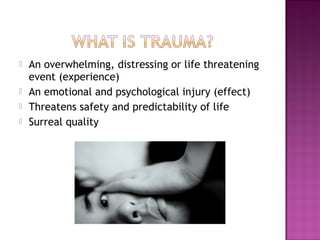
   An overwhelming, distressing or life threatening
    event (experience)
   An emotional and psychological injury (effect)
   Threatens safety and predictability of life
   Surreal quality
Single event
        -natural disaster
        -military duty
        -sexual assault
        -car accident

Effects of acute trauma
        -PTSD, GAD, MDD
        -disruption of Life
        -can regain sense of normalcy
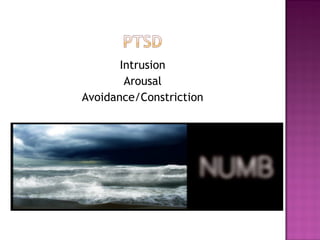
Intrusion
        Arousal
Avoidance/Constriction
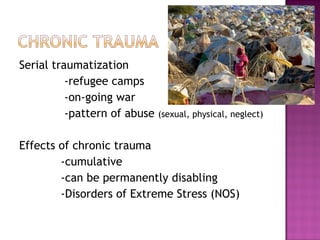
Serial traumatization
          -refugee camps
          -on-going war
          -pattern of abuse   (sexual, physical, neglect)


Effects of chronic trauma
        -cumulative
        -can be permanently disabling
        -Disorders of Extreme Stress (NOS)
“…most studies indicate a considerable
 burden of cognitive dysfunction among
 homeless people.”

  Injury to the brain via accidents, abuse,
      chronic drug use, untreated illness


        TBI diagnosable by a doctor
Mary has lived on the streets of Old Town on-
and-off for twelve years. She was sexually
abused as a child and witnessed domestic
violence between her parents who had
alcoholism. Mary remembers cracking her head
open when her father pushed her down the
stairs.
Mary often felt restless in school and struggled to
 pay attention; she was constantly in trouble and
 had failing grades. Mary dropped out of school
 and moved out of home at age 15. Mary self-
 medicated her Major Depressive Disorder and
 Generalized Anxiety with alcohol and heroine.
 While engaging in survival sex last week she was
 sexually assaulted on the job.
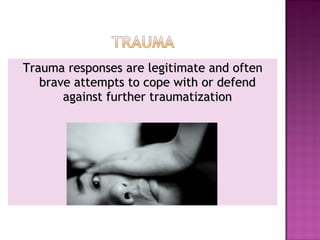
Trauma responses are legitimate and often
   brave attempts to cope with or defend
       against further traumatization
 Alcohol and drug-use
 High-risk behaviors
 “Difficult” behaviors
 “Acquiescence”
 Reluctance to seek

treatment or report
“The shelter kicked me out because I forgot
  the curfew”

“I lost my SSI because I missed my
  appointment”

“I feel trapped and nervous in the shelter”
“I won’t go to the hospital. They only think I’m
  a junkie”

“I can’t see my DV caseworker because that
  neighborhood has too much relapse
  potential”

“What’s one more rape. I mean it’s happened
 since I was 3”
   Build relationship
   Assess needs, refer and connect to other
    service providers
   Advocate for your clients primary needs
   See ‘problematic behaviors’ within a
    context
   Lacking access to personal items
   Traumatization within shelter system
   Coping skills and other behaviors may
    violate agency’s rules (Use of
    Drugs/alcohol, looking for sex work on
    shelter computer, etc)
   Power dynamics between
    provider/advocate and participant
   Feeling dehumanized by authority figures
   Re-evaluate your agency’s policies and
    procedures
   Meet them where they’re at-LITERALLY
   Outreach to homeless communities
   Connect with non-DV/SA specific agencies
    (A&D treatment, health clinics, drop-in
    centers, etc) –co-advocate when
    appropriate.
   Bring care packages with you to the hospital
   Client assistance $
Think outside the box-
    Emotional safety, physical safety, property
    security and mental and physical health and
                     well-being
   Explore their built-in strengths/survival skills
       Drawing upon and validating Intuition
   Help identify safe locations in their neighborhood or
    locale
   Encourage clients to share their skills with one
    another and look out for one another.
   Offer educational classes on topics relevant to
    participants
   Explore ways they can keep their property secure
   Be comfortable talking about sex and
    sexual/reproductive organs
   Have some basic knowledge around safer sex
    practices
   Have safer sex supplies handy (condoms, lube,
    wet wipes, rubber gloves)
   Initiate discussion (when appropriate) with
    participants around negotiating safer sex with
    their clients
   DO NOT JUDGE, PATERNALIZE OR PATHOLOGIZE
Resource: “Tricks of the Trade” by Lynn Stern
  www.berkeleyneed.org/resources/tricksmanual.pdf
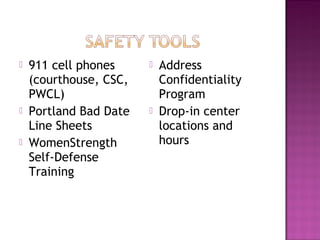
   911 cell phones        Address
    (courthouse, CSC,       Confidentiality
    PWCL)                   Program
   Portland Bad Date      Drop-in center
    Line Sheets             locations and
   WomenStrength           hours
    Self-Defense
    Training
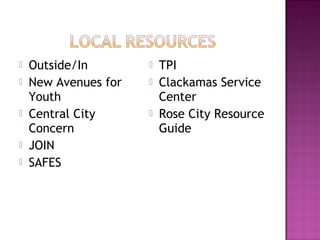
   Outside/In           TPI
   New Avenues for      Clackamas Service
    Youth                 Center
   Central City         Rose City Resource
    Concern               Guide
   JOIN
   SAFES
Questions?
DSM-IV
Herman, Judith
Feminist Therapy
Roth “Complex Trauma”

The Intersections of Homelessness and Domestic and Sexual Violence

  • 1.
    Presented by: CrystalTenty, Natalie Schraner and Jill Winsor
  • 2.
    Risks survivors who are experiencing homelessness face in regard to DV/IPV and SA.  How perpetrators target victims/survivors  Barriers to accessing services  Trauma  Advocacy and safety planning
  • 3.
    While overall rates of victimization in this country are down, rates of victimization among homeless women remain relatively unchanged  One study found 92% of homeless mothers had experienced severe physical &/or sexual violence at some point in their lives with 43% reporting sexual abuse in childhood and 63% reporting intimate partner violence in adulthood Stats from “No Safe Place: Sexual Assault in the Lives of Homeless Women” By Lisa Goodman, Katya Fels, and Catherine Glenn on Vawnet.org
  • 4.
    One study ofhomeless women discovered that those who reported a rape in the last year were significantly more likely than non- victims to suffer from 2 or more gynecological conditions & 2 or more serious physical health conditions within the last year and they were also more likely to report they needed to see a physician during the past year but were unable to do so (vawnet.org)
  • 5.
    “Homeless” vs. “Battered women” categories.  Some homeless-based services are not trauma- informed.  Some DV/SA services are not set up to support women who have experienced chronic homelessness.  Much of the emergency financial assistance that does exist for survivors are earmarked for DV survivors or shelter residents and not accessible for SA or AMAC survivors.
  • 7.
    Many reports only count the homeless who are sleeping on the street or staying in shelters  We count people sleeping in their cars, couch surfing, staying with abusers to stay off the street
  • 8.
    Anyone can be a victim of sexual violence  Crosses gender, race, class, age, sexual orientation, location
  • 9.
    “She let me pay for it last time, what’s the difference?”  “She’ll lose her kids if she leaves my house, she can’t complain about what happens here.”  “If I get her high she won’t even notice.”
  • 10.
    Everybody knows she’s crazy, no one will believe her.”  “There’s a warrant out for her, she can’t go to the cops.”  “She only knows my street name, she can’t rat on me.”
  • 11.
    Perpetrators select victims that they see as:  Vulnerable:disabled, socially isolated, drug affected, etc.  Accessible:sleeping on the streets, couch surfing, etc.  Lacking Credibility: criminal background, mental health
  • 12.
    All forms of societal oppression can be used by a perpetrator to facilitate violence  Immigration status, race, language  When multiple forms of oppression intersect, people are at higher risk for sexual predation  Sexworkers may be seen as more accessible, vulnerable (participating in sex trade), lacking credibility (work may be criminalized, not supported by society)
  • 13.
    Homelessness does increase a person’s potential risk of being chosen by a perpetrator for victimization  BUT!!! Sexual assault is always the result of a choice made by a perpetrator, not the situations a survivor is living through
  • 14.
    Using the VAL, evaluate the survivor’s Vulnerability, Accessibility, and Lack of Credibility  What are the survivor’s strengths and skills?
  • 15.
  • 16.
    An overwhelming, distressing or life threatening event (experience)  An emotional and psychological injury (effect)  Threatens safety and predictability of life  Surreal quality
  • 17.
    Single event -natural disaster -military duty -sexual assault -car accident Effects of acute trauma -PTSD, GAD, MDD -disruption of Life -can regain sense of normalcy
  • 18.
    Intrusion Arousal Avoidance/Constriction
  • 19.
    Serial traumatization -refugee camps -on-going war -pattern of abuse (sexual, physical, neglect) Effects of chronic trauma -cumulative -can be permanently disabling -Disorders of Extreme Stress (NOS)
  • 20.
    “…most studies indicatea considerable burden of cognitive dysfunction among homeless people.” Injury to the brain via accidents, abuse, chronic drug use, untreated illness TBI diagnosable by a doctor
  • 21.
    Mary has livedon the streets of Old Town on- and-off for twelve years. She was sexually abused as a child and witnessed domestic violence between her parents who had alcoholism. Mary remembers cracking her head open when her father pushed her down the stairs.
  • 22.
    Mary often feltrestless in school and struggled to pay attention; she was constantly in trouble and had failing grades. Mary dropped out of school and moved out of home at age 15. Mary self- medicated her Major Depressive Disorder and Generalized Anxiety with alcohol and heroine. While engaging in survival sex last week she was sexually assaulted on the job.
  • 23.
    Trauma responses arelegitimate and often brave attempts to cope with or defend against further traumatization
  • 24.
     Alcohol anddrug-use  High-risk behaviors  “Difficult” behaviors  “Acquiescence”  Reluctance to seek treatment or report
  • 25.
    “The shelter kickedme out because I forgot the curfew” “I lost my SSI because I missed my appointment” “I feel trapped and nervous in the shelter”
  • 26.
    “I won’t goto the hospital. They only think I’m a junkie” “I can’t see my DV caseworker because that neighborhood has too much relapse potential” “What’s one more rape. I mean it’s happened since I was 3”
  • 28.
    Build relationship  Assess needs, refer and connect to other service providers  Advocate for your clients primary needs  See ‘problematic behaviors’ within a context
  • 29.
    Lacking access to personal items  Traumatization within shelter system  Coping skills and other behaviors may violate agency’s rules (Use of Drugs/alcohol, looking for sex work on shelter computer, etc)  Power dynamics between provider/advocate and participant  Feeling dehumanized by authority figures
  • 30.
    Re-evaluate your agency’s policies and procedures  Meet them where they’re at-LITERALLY  Outreach to homeless communities  Connect with non-DV/SA specific agencies (A&D treatment, health clinics, drop-in centers, etc) –co-advocate when appropriate.  Bring care packages with you to the hospital  Client assistance $
  • 31.
    Think outside thebox- Emotional safety, physical safety, property security and mental and physical health and well-being  Explore their built-in strengths/survival skills Drawing upon and validating Intuition  Help identify safe locations in their neighborhood or locale  Encourage clients to share their skills with one another and look out for one another.  Offer educational classes on topics relevant to participants  Explore ways they can keep their property secure
  • 32.
    Be comfortable talking about sex and sexual/reproductive organs  Have some basic knowledge around safer sex practices  Have safer sex supplies handy (condoms, lube, wet wipes, rubber gloves)  Initiate discussion (when appropriate) with participants around negotiating safer sex with their clients  DO NOT JUDGE, PATERNALIZE OR PATHOLOGIZE Resource: “Tricks of the Trade” by Lynn Stern www.berkeleyneed.org/resources/tricksmanual.pdf
  • 33.
    911 cell phones  Address (courthouse, CSC, Confidentiality PWCL) Program  Portland Bad Date  Drop-in center Line Sheets locations and  WomenStrength hours Self-Defense Training
  • 34.
    Outside/In  TPI  New Avenues for  Clackamas Service Youth Center  Central City  Rose City Resource Concern Guide  JOIN  SAFES
  • 36.
  • 37.