DHS 2009 Sec 4 SAP Preliminary Exam Mathematics Paper 2


                                 p2 − q p
1       (a)        Given that           = , express q in terms of p.                               [3]
                                   q       2
        (b)        Express as a fraction in its lowest terms,
                             3 − 2x     x
                                     −      .                                                      [3]
                           x − 5x + 6 3 − x
                             2


Answer:


              p2 − q p2
1 (a)                =
                q       4
                  q       4
                     =
                 p 2
                       4 + p2
                           4 p2
                     q=
                          4 + p2

    (b)
                3 − 2x
                        −
                           x
                               =
                                 (3 − 2x ) + x ( x − 2)
              x − 5x + 6 3 − x
               2
                                    ( x − 2 )( x − 3)
                                   =
                                       ( x − 1)( x − 3)
                                       ( x − 2 )( x − 3)
                                       x −1
                                   =
                                       x−2


2


               1st                                     2nd                        3rd
              pattern                                pattern                    pattern


        In the diagram above, each pattern is made up of dots, lines and small triangles. In the
        1st pattern, there are 9 dots, 15 lines and 7 small triangles.
(a)         How many small triangles are there in the
                      (i)     4th pattern,
                      (ii)    n th pattern?                                                                [2]
          (b)         How many lines are there in the n th pattern?                                        [1]
          (c)         If there are d dots, l lines and T triangles in one of these patterns, write down
                      an equation connecting d, l and T.                                                   [2]


2 (a)           (i)                 16

                (ii)                3n + 4

    (b)         6n + 9

    (c)         ( 6n + 9 ) − ( 3n + 6 ) + 1 = ( 3n + 4 )
                                 l − d +1 = T


3         A cylindrical container which has an internal diameter of 60 cm and an internal height
          of 1.05 m weighs 7 kg when empty.
          (a)          Find the weight of the container when it is full of oil, if the density of oil is
                        7
                          g/cm3 .
                        9
          (b)          How many times will the oil in the container fill a hemispherical bowl of
                                                              22
                       internal diameter of 7 cm? [Take π =      ]                                         [5]
                                                              7
          (c)          Find the internal surface area of the hemispherical bowl in contact with the
                       oil.                                                                                [2]


3 (a)           Volume of the cylindrical container
                  22
                = × 302 ×105
                   7
                = 297 000 cm3

                Weight of the cylindrical container
                      7
                = 7 + × 297
                      9
                = 7 + 231 = 238 kg
3


    (b)          Volume of a hemispherical bowl
                   1 4 22
                 = × × × 3.53
                   2 3 7
                   539
                 =      cm3
                    6
                 Number of times the oil will fill the bowl
                             539
                 = 297 000 ÷
                              6
                         6
                 = 3306
                        49

    (c)          Internal surface area in contact with oil
                    1      22
                 = × 4 × × 3.52
                    2       7
                 = 77 cm  2


4         In May 2007, the Credit Bureau Singapore released the following data on
          Singaporeans’ home loans/ mortgages for the period from March 2005 to March
          2007.

                 No of Singaporeans with:              March 2005   March 2006    March 2007
           2 or more home loans                            19901        25977        41078
           2 or more home loans valued at                  1416         1962         2925
           a total of more than S$1 million
           More       than     S$1     million             2381         2381         4291
           in home loans


          The information for those Singaporeans with 2 or more home loans over this period of
                                                          ⎛ 19901 ⎞
          comparison can be represented by the matrix P = ⎜ 25977 ⎟ .
                                                          ⎜       ⎟
                                                          ⎜ 41078 ⎟
                                                          ⎝       ⎠
          The information for those Singaporeans with 2 or more home loans valued at a total
          of more than S$1 million over this period of comparison is represented by a matrix Q.
          (i)       Write down the matrix Q.                                                      [1]

          (ii)      Calculate the matrix ( P − Q ) .                                              [1]


                                                                                   [Turn over
(iii)         Describe what is represented by the elements of ( P − Q ) .                      [1]

    The information for those Singaporeans with home loans in 2005 is represented by the
    matrix A = (19901 1416 2381) .

    Information for those Singaporeans with home loans in 2007 is represented by the
    matrix B.
    (iv)          Write down the matrix B.                                                         [1]
    (v)           Show that the matrix C, in terms of A and/ or B, which has its elements
                  showing the increase of each category over the period of 2005 to 2007 is
                   ( 21177   1509 1910 ) .                                                         [1]

                                         ⎛ 1                     ⎞
                                         ⎜ 19901   0         0 ⎟
                                         ⎜                       ⎟
                                                   1
    (vi)          A matrix D is given by ⎜ 0                 0 ⎟ . Evaluate (100 CD ) , rounding
                                         ⎜       1416            ⎟
                                         ⎜                       ⎟
                                         ⎜ 0                 1 ⎟
                                         ⎜         0             ⎟
                                         ⎝                  2381 ⎠
                  off each element to the nearest whole number.                                    [1]
    (vii)         Describe what is represented by the elements of the matrix (100 CD ) .           [2]

                           ⎛ 1416 ⎞
4           (i)        Q = ⎜ 1962 ⎟
                           ⎜      ⎟
                           ⎜ 2925 ⎟
                           ⎝      ⎠
                                   ⎛ 19901 − 1416 ⎞
            (ii)       ( P − Q ) = ⎜ 25977 − 1962 ⎟
                                   ⎜              ⎟
                                   ⎜ 41078 − 2925 ⎟
                                   ⎝              ⎠
                                   ⎛ 18485 ⎞
                                = ⎜ 24015 ⎟
                                   ⎜       ⎟
                                   ⎜ 38153 ⎟
                                   ⎝       ⎠
            (iii)      The elements of        (P − Q)   represent the information for those
            Singaporeans with 2 or more home loans valued at a total of less than or equal
            to S$1 million over this period of comparison.

            (iv)       B = ( 41078 2925 4291)
            (v)        C = ( 41078 − 19901 2925 − 1416 4291 − 2381)
                         = ( 21177 1509 1910 )        [shown]
5


                                                         ⎛ 1                        ⎞
                                                         ⎜ 19901   0            0 ⎟
                                                         ⎜                          ⎟
                                                                   1
            (vi)     (100 CD ) = 100 ( 21177 1509 1910 ) ⎜ 0
                                                         ⎜
                                                                                0 ⎟
                                                                                    ⎟
                                                                 1416
                                                         ⎜                          ⎟
                                                         ⎜ 0                    1 ⎟
                                                         ⎜         0                ⎟
                                                         ⎝                     2381 ⎠
                               = (106 106 80 )
            (vii) 106 represents the percentage increase in number of Singaporeans
            having 2 or more home loans over the period of March 2005 to March 2007.
            106 represents the percentage increase in number of Singaporeans having 2 or
            more home loans valued at more than S$1 million over the period of March
            2005 to March 2007.
            80 represents the percentage increase in number of Singaporeans with home
            loans of more than S$1 million over the period of March 2005 to March 2007.


5   In Singapore, the rate for the usage of water for the month of July in 2009 is as
    follows:
    Water used                        : $1.17 per m3
    Water borne fee                   : $0.28 per m3
    Sanitary Appliance fee            : $2.80 per fitting
    Water Conservation tax            : 30% of the amount payable for water used
    Goods and Services tax (GST): 7% of all the above fees/ tax


    (i)        In July, the GST payable for water used only by a Pasir Ris 5-room household
               is $3.11.
               Calculate the amount, excluding GST, paid for water used in July by this
               household.                                                                            [2]
    (ii)       Show that the amount of water used by this household in July, is
               approximately 38.0 m3.                                                                [1]
    (iii)      Hence, find the overall water bill if this household has 2 sanitary fittings.         [2]
    (iv)       If the national average of water usage per month for a typical 5-room HDB flat
               in Singapore is 19.1 m3,
               (a)     how many percent above average is the water usage for this
                       household?                                                                    [2]


                                                                                        [Turn over
(b)     what is the average water usage per day for a typical 5-room HDB flat
                           in Singapore for the month of July?                                     [1]


5                                                       $3.11×100
    (i)          Amount paid for water used only =
                                                            7

                 = $44.43 (to nearest cent)


                 44.43
    (ii)               = 37.97 ≈ 38.0 m3 (to 3 sig. fig.)
                 1.17


    (iii)        ( 38.0 ×1.17 ×1.3 + 38.0 × 0.28 + 2 × 2.80 ) ×1.07
                 = $79.17 (to nearest cent)


                  38.0 − 19.1
    (iv) (a)                  ×100 = 49.7% (to 3 sig. fig.)
                     38.0

                  19.1
           (b)         = 0.616 m3 (to 3 sig. fig.)
                   31


6
                                                               C


                                      P
                                                D

                                                        B


                                     42°
                               R                                      A
                                                H

          The points D, H, R and P lie on the circumference of a circle. DR is a diameter of the
                                                                                  ˆ
          circle, DA is a tangent to the circle at D, CBH is a straight line and DRH = 42° .
          (a)       Find, with reason,
7


                      (i)        ˆ
                                DHR ,        (ii)        ˆ
                                                        RDH ,
                      (iii)      ˆ
                                DAR ,        (iv)        ˆ
                                                        RPH .                                      [4]
          (b)                          ˆ
                      Given also that DBH = 107° , find
                      (i)        ˆ
                                RCH ,        (ii)        ˆ
                                                        DHC .                                      [2]
          (c)         Show that the triangles DHR and AHD are similar.                             [2]


    (a)         (i)             ˆ
                              DHR = 90 ( in a semicircle)
6
                               ˆ
                              RDH = 90 − 42 (complementary s, ΔDHR)
                (ii)
                                  = 48
                               ˆ
                              RDA = 90 (tangent ⊥ radius)
                (iii)          ˆ
                              DAR = 90 − 42 (complementary s, ΔRDA)
                                  = 48
                               ˆ       ˆ
                              RPH = RDH ( s in the same segment)
                (iv)
                                  = 48

                               ˆ     ˆ     ˆ
                              RCH + CDB = DBH (ext.         = sum of int. opp.   s)
    (b)         (i)                  ˆ
                                   RCH = 107 − 90
                                        = 17
                               ˆ     ˆ       ˆ
                              DHC + RCH = RDH (ext.         = sum of int. opp.   s)
                (ii)                  ˆ
                                    DHC = 48 − 17
                                         = 31

                  ˆ         ˆ
                DHR = 90 = AHD ( s on a straight line)
                 ˆ          ˆ
                RDH = 48 = DAH ((a)(ii)&(iii))
    (c)          ˆ      ˆ
                DRH = ADH (3rd s of Δs)
                Since there are 3 pairs of equal corresponding         s,
                triangles DHR and AHD are similar. (Shown)


                                                    Q
7
                                                    P
                                            R           S


                                     A              B           C
                                                                                      [Turn over
The diagram shows three semicircles each of radius 18 cm with centres at A, B and C
          in a straight lines shown above. A fourth circle centre at P and with radius r cm is
          drawn to touch the other three semicircles. Given that BPQ is a straight line which is
          tangential to the two semicircles with centres A and C at point B,
          (a)      show that r = 4.5 cm,                                                           [3]
          (b)                         ˆ
                   Find the value of PAC in radians,                                               [2]
          (c)      Calculate the area of the shaded region.                                        [3]


                           (18 + r ) = (18 − r ) + 182
                                     2            2
                ΔABP :
7
    (a)         182 + 2 (18 ) r + r 2 = 182 − 2 (18 ) r + r 2 + 182
                r = 4.5

               ˆ    13.5
          tan PAC =
    (b)              18
            ˆ
          PAC = 0.644 rad
    (c)  Area of shaded region
            ⎡1            1                 1         ⎛π        ⎞⎤
          2 ⎢ ×18 ×13.5 − ×182 × ( 0.644 ) − × 4.52 × ⎜ − 0.644 ⎟ ⎥
        = ⎣2              2                 2         ⎝2        ⎠⎦

           = 15.7 cm2
9

8
                 P                       Q

                                             0.874 km


                  1.3 km
                                                     R
                                                                          North
                                                             T
                                             26.3°

                                     S
        In the diagram, ST represents the northward-bound MRT line. The quadrilateral PQRS
        formed the fence that boarded a carnival for the F1 Night Race in September. The
        point P is due west of S and PS is parallel to QR. Given that PRT is a straight line,
                                        ˆ              ˆ
           QR = 0.874 km, PS = 1.3 km, RST = 26.3 and SRT = 90 . Find
        (i)       the bearing of R from T,                                                         [1]
        (ii)      the length of PR,                                                                [1]
                  Hence, show that PQ = 0.54 km,                                                   [2]

        (iii)         ˆ
                     QPR .                                                                         [1]
        (iv)      The Singapore Flyer is built at the point Q. If the angle of depression of P
                  from the highest point of the wheel is 8° , find the height, in metres, of the
                  entire flyer.                                                                    [1]
        (v)       A man walked from P along PS and reached a point X such that the angle of
                  elevation of the highest point of the wheel is a maximum. Find the angle of
                  elevation, (you may ignore the height of the man).                               [3]


                  ˆ
                RTS = 90 − 26.3
8 (i)
                    = 63.7 (complementary angles)
                Hence, the bearing of R from T is 180 + 63.7 = 243.7

    (ii)                ˆ
                ΔPST : SPT = 26.3
                                   PR
                        cos 26.3 =
                                   1.3
                        PR = 1.17 km (3 sig. fig.)


                                                                                     [Turn over
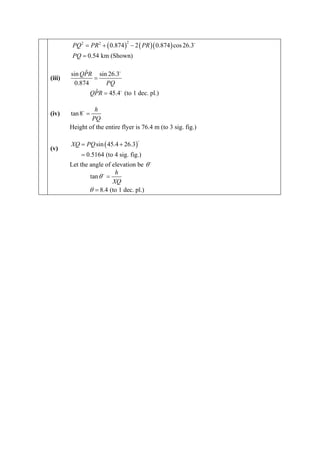
PQ 2 = PR 2 + ( 0.874 ) − 2 ( PR )( 0.874 ) cos 26.3
                                2


         PQ = 0.54 km (Shown)

             ˆ
        sin QPR sin 26.3
(iii)           =
         0.874      PQ
                 ˆ
               QPR = 45.4 (to 1 dec. pl.)

                 h
(iv)    tan 8 =
                PQ
        Height of the entire flyer is 76.4 m (to 3 sig. fig.)

        XQ = PQ sin ( 45.4 + 26.3)
(v)
            = 0.5164 (to 4 sig. fig.)
        Let the angle of elevation be θ
                          h
                tan θ =
                         XQ
                θ = 8.4 (to 1 dec. pl.)
11

9       According to the Straits Times, a check on a random selection of basic goods at
        several supermarkets in Singapore revealed an increase in the prices since the
        beginning of the year. In particular, a pack of fresh chicken (between 1 to 1.3 kg) now
        cost 70 cents more than its original cost at the beginning of the year.
        In 2008, Yusof budgeted $234 for fresh chicken to be used during his wedding
        reception in January 2009.
        (i)        If x represents the number of packs of fresh chicken (between 1 to 1.3 kg)
                   which Yusof could buy at the beginning of 2009, write down an expression, in
                   terms of x, for the original cost of a pack of fresh chicken (between 1 to 1.3
                   kg).                                                                               [1]
        (ii)       Yusof found that he would get 7 packs of fresh chicken (between 1 to 1.3 kg)
                   less than that at the beginning of the year if he decided to delay the wedding
                   reception till September 2009.
                   Write down an expression, in terms of x, for the current cost of a pack of fresh
                   chicken (between 1 to 1.3 kg).                                                     [1]
        (iii)      Write down an equation in x, and show that it reduces to x 2 − 7 x − 2340 = 0 .    [3]
        (iv)       Solve the equation x 2 − 7 x − 2340 = 0 .                                          [2]
        (v)        Calculate the percentage increase in the price of a pack of fresh chicken
                   (between 1 to 1.3 kg).                                                             [2]


                                                                                         234
9 (i)           The original cost of a pack of fresh chicken (between 1 to 1.3 kg) = $
                                                                                          x
                 234 234 7
    (iii)              −      =
                x−7        x    10
                234 x − 234( x − 7) 7
                                      =
                      x( x − 7)         10
                10 [ 234 x − 234 x + 1638] = 7 x 2 − 49 x
                7 x 2 − 49 x − 16380 = 0
                ⇒ x 2 − 7 x − 2340 = 0 [shown]

    (iv)        x 2 − 7 x − 2340 = 0
                ( x − 52 )( x + 45) = 0
                x = 52      or       x = −45 (rejected)

    (v)         GKC could buy 52 – 7 = 45 packs now.


                                                                                         [Turn over
234
               (vi)   original price = $       = $4.50
                                           52
                                                                      0.70
                      Percentage increase in price per pack =              × 100%
                                                                      4.50
                                                                        5
                                                                   = 15 %
                                                                        9


10   In a recent Olympic diving event, a male participant stood on a platform and
     performed a dive into the water.
     During the dive, the horizontal distance of the participant away from the platform,
     x m, and the corresponding vertical distance of the participant above the platform,
     y m, are related by the equation
                                                  13    x2
                                             y=      x−    .
                                                  10    2
     Some corresponding values of x and y are given in the table below.


           x               0       1            2              3           4        5          6
           y               0       0.8         0.6        −0.6           −2.8       −6         p


     (a)          Find the value of p.                                                               [1]
     (b)          Using a scale of 2 cm to 1 unit, draw a horizontal x-axis for 0 ≤ x ≤ 6 .
                  Using a scale of 2 cm to 1 unit, draw a vertical y-axis for − 11 ≤ y ≤ 1 .
                  On your axes, plot the points given in the table and join them with a smooth
                  curve.                                                                             [3]
     (c)          Use your graph to find the distance(s) the participant was from the platform the
                  when he was 0.5 m above the platform.                                              [2]
     (d)          Use your graph to find the maximum height above the platform reached by the
                  participant.                                                                       [1]
     (e)          By drawing a tangent, find the gradient of the curve at the point (3, −0.6).
                  What can be said about the movement of the participant at this instant?            [3]
     (f)          The participant entered the water when he was 4.4 m away from the platform
                  horizontally. Use your graph to determine the height of the platform above the
                  water.                                                                             [1]
13

     (g)   Is the graph useful in finding the position of the participant beyond a
           horizontal distance of 4.4 m? Justify your answer.                        [1]

     (a)   p = −10.2
10
     (b)


           (b)   Correct axes                    --- B1
                 Points plotted correctly        --- B1
                 Shape                           --- B1


                                                                       [Turn over
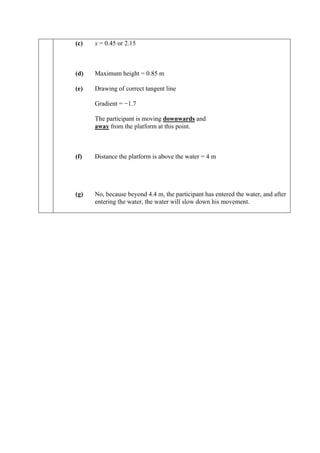
(c)   x = 0.45 or 2.15


(d)   Maximum height = 0.85 m

(e)   Drawing of correct tangent line

      Gradient = −1.7

      The participant is moving downwards and
      away from the platform at this point.


(f)   Distance the platform is above the water = 4 m


(g)   No, because beyond 4.4 m, the participant has entered the water, and after
      entering the water, the water will slow down his movement.
15


11   A bag holds some coloured balls. There are 15 red, 3 blue and 2 white balls. Two
     balls are picked from the bag at random, without replacement. The tree diagram
     below shows the possible outcomes and some of their probabilities.
                                                                     Second Pick
                                                            b           Red
                                          First Pick        3
                                              Red          19           Blue
                           3
                           4                                2
                                                                       White
                                                           19
                                                                15
                                                                19      Red
                            3                                    2
                           20                                   19
                                             Blue                       Blue

                                                                c
                                                                       White

                                                           15
                           a                                            Red
                                                           19


                                            White          d            Blue

                                                            1
                                                                       White
                                                           19

     (a)    State the values of a, b, c and d.                                                  [2]
     (b)    Expressing your answers as a fraction in its lowest terms, find the probability
            that
            (i)       both balls are white,                                                     [1]
            (ii)      at least one ball is red.                                                 [2]
                    1     14     2          3
11   (a)   a=         , b= , c=    and d =
                   10     19    19         19
                                                    1 1
           (b)       (i)        P (both white) =     ×
                                                   10 19


                                                                                   [Turn over
1
                                             =        .
                                                  190
                     (ii)    P       (at         least      1       ball   is     red)   =
                             ⎛ 3 14 ⎞ ⎛ 3 3 ⎞ ⎛ 3 2 ⎞ 18
                             ⎜ × ⎟ + 2⎜ × ⎟ + 2⎜ × ⎟ =
                             ⎝ 4 19 ⎠ ⎝ 4 19 ⎠ ⎝ 4 19 ⎠ 19


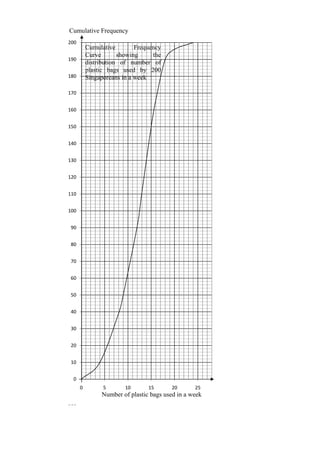
12   In a bid to make our society more environmentally friendly, a survey was conducted
     and the cumulative frequency curve shown illustrates the number of plastic bags used,
     by 200 Singaporeans in a week.
     (a)    Use the graph to find
            (i)       the median number of plastic bags used,                                 [1]
            (ii)      the lower quartile,                                                     [1]
            (iii)     the interquartile range,                                                [1]
     (b)    A person is considered to be a ‘reddie’ if he uses more than 18 plastic bags in
            a week. A Singaporean is chosen at random. Calculate, leaving your answer
            as a fraction in its lowest term, the probability of getting a ‘reddie’.          [2]
     (c)    Given that 19.5% of Singaporean surveyed are ‘green crusaders’, use the
            graph to find the minimum number of plastic bags used by a Singaporean who
            is not a green crusader.                                                          [2]
     (d)    The frequency table for this set of data is given below. Showing your method
            clearly, prove that the values are as shown in the table.                         [2]
                   Number of plastic        Number of Singaporeans
                  bags used per week                     surveyed
                       0< x≤4                              10
                       4< x≤8                              29
                       8 < x ≤ 12                          52
                      12 < x ≤ 16                          75
                      16 < x ≤ 20                          30
                      20 < x ≤ 24                           4
     (e)    Calculate,
            (i)       the mean,                                                               [3]
            (ii)      the standard deviation.                                                 [2]
17

(f)   A similar survey was also conducted in Hong Kong and the table below shows
      the results of the processed data.
               Mean                 11.96   Compare, briefly, the results for the
       Standard Deviation            2.90   two countries.                          [1]


                                                                     [Turn over
Cumulative Frequency
200
          Cumulative        Frequency
          Curve       showing     the
190
          distribution of number of
          plastic bags used by 200
180       Singaporeans in a week

170


160


150


140


130


120


110


100


90


80


70


60


50


40


30


20


10


 0
      0         5       10      15      20       25
               Number of plastic bags used in a week
200
19


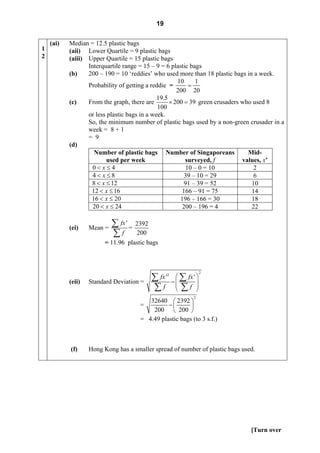
    (ai)   Median = 12.5 plastic bags
1          (aii) Lower Quartile = 9 plastic bags
2          (aiii) Upper Quartile = 15 plastic bags
                  Interquartile range = 15 – 9 = 6 plastic bags
           (b)    200 – 190 = 10 ‘reddies’ who used more than 18 plastic bags in a week.
                                                      10     1
                  Probability of getting a reddie =        =
                                                      200 20
                                              19.5
           (c)    From the graph, there are        × 200 = 39 green crusaders who used 8
                                              100
                  or less plastic bags in a week.
                  So, the minimum number of plastic bags used by a non-green crusader in a
                  week = 8 + 1
                  = 9
           (d)
                    Number of plastic bags Number of Singaporeans               Mid-
                          used per week                  surveyed, f          values, x’
                    0< x≤4                                10 – 0 = 10             2
                    4< x≤8                               39 – 10 = 29             6
                   8 < x ≤ 12                            91 – 39 = 52            10
                   12 < x ≤ 16                          166 – 91 = 75            14
                   16 < x ≤ 20                         196 – 166 = 30            18
                    20 < x ≤ 24                         200 – 196 = 4            22


           (ei)    Mean =
                            ∑ fx ' =   2392
                            ∑f          200
                         = 11.96 plastic bags


                                              ∑ fx '     ⎛ ∑ fx ' ⎞
                                                                      2
                                                    2

                                                        −⎜
                                                         ⎜ ∑f ⎟
           (eii)   Standard Deviation =
                                              ∑f         ⎝
                                                                  ⎟
                                                                  ⎠
                                                                 2
                                           32640 ⎛ 2392 ⎞
                                        =         −⎜       ⎟
                                            200 ⎝ 200 ⎠
                                        = 4.49 plastic bags (to 3 s.f.)


           (f)     Hong Kong has a smaller spread of number of plastic bags used.


                                                                               [Turn over

Dunman High Answers_tobechecked_

  • 1.
    DHS 2009 Sec4 SAP Preliminary Exam Mathematics Paper 2 p2 − q p 1 (a) Given that = , express q in terms of p. [3] q 2 (b) Express as a fraction in its lowest terms, 3 − 2x x − . [3] x − 5x + 6 3 − x 2 Answer: p2 − q p2 1 (a) = q 4 q 4 = p 2 4 + p2 4 p2 q= 4 + p2 (b) 3 − 2x − x = (3 − 2x ) + x ( x − 2) x − 5x + 6 3 − x 2 ( x − 2 )( x − 3) = ( x − 1)( x − 3) ( x − 2 )( x − 3) x −1 = x−2 2 1st 2nd 3rd pattern pattern pattern In the diagram above, each pattern is made up of dots, lines and small triangles. In the 1st pattern, there are 9 dots, 15 lines and 7 small triangles.
  • 2.
    (a) How many small triangles are there in the (i) 4th pattern, (ii) n th pattern? [2] (b) How many lines are there in the n th pattern? [1] (c) If there are d dots, l lines and T triangles in one of these patterns, write down an equation connecting d, l and T. [2] 2 (a) (i) 16 (ii) 3n + 4 (b) 6n + 9 (c) ( 6n + 9 ) − ( 3n + 6 ) + 1 = ( 3n + 4 ) l − d +1 = T 3 A cylindrical container which has an internal diameter of 60 cm and an internal height of 1.05 m weighs 7 kg when empty. (a) Find the weight of the container when it is full of oil, if the density of oil is 7 g/cm3 . 9 (b) How many times will the oil in the container fill a hemispherical bowl of 22 internal diameter of 7 cm? [Take π = ] [5] 7 (c) Find the internal surface area of the hemispherical bowl in contact with the oil. [2] 3 (a) Volume of the cylindrical container 22 = × 302 ×105 7 = 297 000 cm3 Weight of the cylindrical container 7 = 7 + × 297 9 = 7 + 231 = 238 kg
  • 3.
    3 (b) Volume of a hemispherical bowl 1 4 22 = × × × 3.53 2 3 7 539 = cm3 6 Number of times the oil will fill the bowl 539 = 297 000 ÷ 6 6 = 3306 49 (c) Internal surface area in contact with oil 1 22 = × 4 × × 3.52 2 7 = 77 cm 2 4 In May 2007, the Credit Bureau Singapore released the following data on Singaporeans’ home loans/ mortgages for the period from March 2005 to March 2007. No of Singaporeans with: March 2005 March 2006 March 2007 2 or more home loans 19901 25977 41078 2 or more home loans valued at 1416 1962 2925 a total of more than S$1 million More than S$1 million 2381 2381 4291 in home loans The information for those Singaporeans with 2 or more home loans over this period of ⎛ 19901 ⎞ comparison can be represented by the matrix P = ⎜ 25977 ⎟ . ⎜ ⎟ ⎜ 41078 ⎟ ⎝ ⎠ The information for those Singaporeans with 2 or more home loans valued at a total of more than S$1 million over this period of comparison is represented by a matrix Q. (i) Write down the matrix Q. [1] (ii) Calculate the matrix ( P − Q ) . [1] [Turn over
  • 4.
    (iii) Describe what is represented by the elements of ( P − Q ) . [1] The information for those Singaporeans with home loans in 2005 is represented by the matrix A = (19901 1416 2381) . Information for those Singaporeans with home loans in 2007 is represented by the matrix B. (iv) Write down the matrix B. [1] (v) Show that the matrix C, in terms of A and/ or B, which has its elements showing the increase of each category over the period of 2005 to 2007 is ( 21177 1509 1910 ) . [1] ⎛ 1 ⎞ ⎜ 19901 0 0 ⎟ ⎜ ⎟ 1 (vi) A matrix D is given by ⎜ 0 0 ⎟ . Evaluate (100 CD ) , rounding ⎜ 1416 ⎟ ⎜ ⎟ ⎜ 0 1 ⎟ ⎜ 0 ⎟ ⎝ 2381 ⎠ off each element to the nearest whole number. [1] (vii) Describe what is represented by the elements of the matrix (100 CD ) . [2] ⎛ 1416 ⎞ 4 (i) Q = ⎜ 1962 ⎟ ⎜ ⎟ ⎜ 2925 ⎟ ⎝ ⎠ ⎛ 19901 − 1416 ⎞ (ii) ( P − Q ) = ⎜ 25977 − 1962 ⎟ ⎜ ⎟ ⎜ 41078 − 2925 ⎟ ⎝ ⎠ ⎛ 18485 ⎞ = ⎜ 24015 ⎟ ⎜ ⎟ ⎜ 38153 ⎟ ⎝ ⎠ (iii) The elements of (P − Q) represent the information for those Singaporeans with 2 or more home loans valued at a total of less than or equal to S$1 million over this period of comparison. (iv) B = ( 41078 2925 4291) (v) C = ( 41078 − 19901 2925 − 1416 4291 − 2381) = ( 21177 1509 1910 ) [shown]
  • 5.
    5 ⎛ 1 ⎞ ⎜ 19901 0 0 ⎟ ⎜ ⎟ 1 (vi) (100 CD ) = 100 ( 21177 1509 1910 ) ⎜ 0 ⎜ 0 ⎟ ⎟ 1416 ⎜ ⎟ ⎜ 0 1 ⎟ ⎜ 0 ⎟ ⎝ 2381 ⎠ = (106 106 80 ) (vii) 106 represents the percentage increase in number of Singaporeans having 2 or more home loans over the period of March 2005 to March 2007. 106 represents the percentage increase in number of Singaporeans having 2 or more home loans valued at more than S$1 million over the period of March 2005 to March 2007. 80 represents the percentage increase in number of Singaporeans with home loans of more than S$1 million over the period of March 2005 to March 2007. 5 In Singapore, the rate for the usage of water for the month of July in 2009 is as follows: Water used : $1.17 per m3 Water borne fee : $0.28 per m3 Sanitary Appliance fee : $2.80 per fitting Water Conservation tax : 30% of the amount payable for water used Goods and Services tax (GST): 7% of all the above fees/ tax (i) In July, the GST payable for water used only by a Pasir Ris 5-room household is $3.11. Calculate the amount, excluding GST, paid for water used in July by this household. [2] (ii) Show that the amount of water used by this household in July, is approximately 38.0 m3. [1] (iii) Hence, find the overall water bill if this household has 2 sanitary fittings. [2] (iv) If the national average of water usage per month for a typical 5-room HDB flat in Singapore is 19.1 m3, (a) how many percent above average is the water usage for this household? [2] [Turn over
  • 6.
    (b) what is the average water usage per day for a typical 5-room HDB flat in Singapore for the month of July? [1] 5 $3.11×100 (i) Amount paid for water used only = 7 = $44.43 (to nearest cent) 44.43 (ii) = 37.97 ≈ 38.0 m3 (to 3 sig. fig.) 1.17 (iii) ( 38.0 ×1.17 ×1.3 + 38.0 × 0.28 + 2 × 2.80 ) ×1.07 = $79.17 (to nearest cent) 38.0 − 19.1 (iv) (a) ×100 = 49.7% (to 3 sig. fig.) 38.0 19.1 (b) = 0.616 m3 (to 3 sig. fig.) 31 6 C P D B 42° R A H The points D, H, R and P lie on the circumference of a circle. DR is a diameter of the ˆ circle, DA is a tangent to the circle at D, CBH is a straight line and DRH = 42° . (a) Find, with reason,
  • 7.
    7 (i) ˆ DHR , (ii) ˆ RDH , (iii) ˆ DAR , (iv) ˆ RPH . [4] (b) ˆ Given also that DBH = 107° , find (i) ˆ RCH , (ii) ˆ DHC . [2] (c) Show that the triangles DHR and AHD are similar. [2] (a) (i) ˆ DHR = 90 ( in a semicircle) 6 ˆ RDH = 90 − 42 (complementary s, ΔDHR) (ii) = 48 ˆ RDA = 90 (tangent ⊥ radius) (iii) ˆ DAR = 90 − 42 (complementary s, ΔRDA) = 48 ˆ ˆ RPH = RDH ( s in the same segment) (iv) = 48 ˆ ˆ ˆ RCH + CDB = DBH (ext. = sum of int. opp. s) (b) (i) ˆ RCH = 107 − 90 = 17 ˆ ˆ ˆ DHC + RCH = RDH (ext. = sum of int. opp. s) (ii) ˆ DHC = 48 − 17 = 31 ˆ ˆ DHR = 90 = AHD ( s on a straight line) ˆ ˆ RDH = 48 = DAH ((a)(ii)&(iii)) (c) ˆ ˆ DRH = ADH (3rd s of Δs) Since there are 3 pairs of equal corresponding s, triangles DHR and AHD are similar. (Shown) Q 7 P R S A B C [Turn over
  • 8.
    The diagram showsthree semicircles each of radius 18 cm with centres at A, B and C in a straight lines shown above. A fourth circle centre at P and with radius r cm is drawn to touch the other three semicircles. Given that BPQ is a straight line which is tangential to the two semicircles with centres A and C at point B, (a) show that r = 4.5 cm, [3] (b) ˆ Find the value of PAC in radians, [2] (c) Calculate the area of the shaded region. [3] (18 + r ) = (18 − r ) + 182 2 2 ΔABP : 7 (a) 182 + 2 (18 ) r + r 2 = 182 − 2 (18 ) r + r 2 + 182 r = 4.5 ˆ 13.5 tan PAC = (b) 18 ˆ PAC = 0.644 rad (c) Area of shaded region ⎡1 1 1 ⎛π ⎞⎤ 2 ⎢ ×18 ×13.5 − ×182 × ( 0.644 ) − × 4.52 × ⎜ − 0.644 ⎟ ⎥ = ⎣2 2 2 ⎝2 ⎠⎦ = 15.7 cm2
  • 9.
    9 8 P Q 0.874 km 1.3 km R North T 26.3° S In the diagram, ST represents the northward-bound MRT line. The quadrilateral PQRS formed the fence that boarded a carnival for the F1 Night Race in September. The point P is due west of S and PS is parallel to QR. Given that PRT is a straight line, ˆ ˆ QR = 0.874 km, PS = 1.3 km, RST = 26.3 and SRT = 90 . Find (i) the bearing of R from T, [1] (ii) the length of PR, [1] Hence, show that PQ = 0.54 km, [2] (iii) ˆ QPR . [1] (iv) The Singapore Flyer is built at the point Q. If the angle of depression of P from the highest point of the wheel is 8° , find the height, in metres, of the entire flyer. [1] (v) A man walked from P along PS and reached a point X such that the angle of elevation of the highest point of the wheel is a maximum. Find the angle of elevation, (you may ignore the height of the man). [3] ˆ RTS = 90 − 26.3 8 (i) = 63.7 (complementary angles) Hence, the bearing of R from T is 180 + 63.7 = 243.7 (ii) ˆ ΔPST : SPT = 26.3 PR cos 26.3 = 1.3 PR = 1.17 km (3 sig. fig.) [Turn over
  • 10.
    PQ 2 =PR 2 + ( 0.874 ) − 2 ( PR )( 0.874 ) cos 26.3 2 PQ = 0.54 km (Shown) ˆ sin QPR sin 26.3 (iii) = 0.874 PQ ˆ QPR = 45.4 (to 1 dec. pl.) h (iv) tan 8 = PQ Height of the entire flyer is 76.4 m (to 3 sig. fig.) XQ = PQ sin ( 45.4 + 26.3) (v) = 0.5164 (to 4 sig. fig.) Let the angle of elevation be θ h tan θ = XQ θ = 8.4 (to 1 dec. pl.)
  • 11.
    11 9 According to the Straits Times, a check on a random selection of basic goods at several supermarkets in Singapore revealed an increase in the prices since the beginning of the year. In particular, a pack of fresh chicken (between 1 to 1.3 kg) now cost 70 cents more than its original cost at the beginning of the year. In 2008, Yusof budgeted $234 for fresh chicken to be used during his wedding reception in January 2009. (i) If x represents the number of packs of fresh chicken (between 1 to 1.3 kg) which Yusof could buy at the beginning of 2009, write down an expression, in terms of x, for the original cost of a pack of fresh chicken (between 1 to 1.3 kg). [1] (ii) Yusof found that he would get 7 packs of fresh chicken (between 1 to 1.3 kg) less than that at the beginning of the year if he decided to delay the wedding reception till September 2009. Write down an expression, in terms of x, for the current cost of a pack of fresh chicken (between 1 to 1.3 kg). [1] (iii) Write down an equation in x, and show that it reduces to x 2 − 7 x − 2340 = 0 . [3] (iv) Solve the equation x 2 − 7 x − 2340 = 0 . [2] (v) Calculate the percentage increase in the price of a pack of fresh chicken (between 1 to 1.3 kg). [2] 234 9 (i) The original cost of a pack of fresh chicken (between 1 to 1.3 kg) = $ x 234 234 7 (iii) − = x−7 x 10 234 x − 234( x − 7) 7 = x( x − 7) 10 10 [ 234 x − 234 x + 1638] = 7 x 2 − 49 x 7 x 2 − 49 x − 16380 = 0 ⇒ x 2 − 7 x − 2340 = 0 [shown] (iv) x 2 − 7 x − 2340 = 0 ( x − 52 )( x + 45) = 0 x = 52 or x = −45 (rejected) (v) GKC could buy 52 – 7 = 45 packs now. [Turn over
  • 12.
    234 (vi) original price = $ = $4.50 52 0.70 Percentage increase in price per pack = × 100% 4.50 5 = 15 % 9 10 In a recent Olympic diving event, a male participant stood on a platform and performed a dive into the water. During the dive, the horizontal distance of the participant away from the platform, x m, and the corresponding vertical distance of the participant above the platform, y m, are related by the equation 13 x2 y= x− . 10 2 Some corresponding values of x and y are given in the table below. x 0 1 2 3 4 5 6 y 0 0.8 0.6 −0.6 −2.8 −6 p (a) Find the value of p. [1] (b) Using a scale of 2 cm to 1 unit, draw a horizontal x-axis for 0 ≤ x ≤ 6 . Using a scale of 2 cm to 1 unit, draw a vertical y-axis for − 11 ≤ y ≤ 1 . On your axes, plot the points given in the table and join them with a smooth curve. [3] (c) Use your graph to find the distance(s) the participant was from the platform the when he was 0.5 m above the platform. [2] (d) Use your graph to find the maximum height above the platform reached by the participant. [1] (e) By drawing a tangent, find the gradient of the curve at the point (3, −0.6). What can be said about the movement of the participant at this instant? [3] (f) The participant entered the water when he was 4.4 m away from the platform horizontally. Use your graph to determine the height of the platform above the water. [1]
  • 13.
    13 (g) Is the graph useful in finding the position of the participant beyond a horizontal distance of 4.4 m? Justify your answer. [1] (a) p = −10.2 10 (b) (b) Correct axes --- B1 Points plotted correctly --- B1 Shape --- B1 [Turn over
  • 14.
    (c) x = 0.45 or 2.15 (d) Maximum height = 0.85 m (e) Drawing of correct tangent line Gradient = −1.7 The participant is moving downwards and away from the platform at this point. (f) Distance the platform is above the water = 4 m (g) No, because beyond 4.4 m, the participant has entered the water, and after entering the water, the water will slow down his movement.
  • 15.
    15 11 A bag holds some coloured balls. There are 15 red, 3 blue and 2 white balls. Two balls are picked from the bag at random, without replacement. The tree diagram below shows the possible outcomes and some of their probabilities. Second Pick b Red First Pick 3 Red 19 Blue 3 4 2 White 19 15 19 Red 3 2 20 19 Blue Blue c White 15 a Red 19 White d Blue 1 White 19 (a) State the values of a, b, c and d. [2] (b) Expressing your answers as a fraction in its lowest terms, find the probability that (i) both balls are white, [1] (ii) at least one ball is red. [2] 1 14 2 3 11 (a) a= , b= , c= and d = 10 19 19 19 1 1 (b) (i) P (both white) = × 10 19 [Turn over
  • 16.
    1 = . 190 (ii) P (at least 1 ball is red) = ⎛ 3 14 ⎞ ⎛ 3 3 ⎞ ⎛ 3 2 ⎞ 18 ⎜ × ⎟ + 2⎜ × ⎟ + 2⎜ × ⎟ = ⎝ 4 19 ⎠ ⎝ 4 19 ⎠ ⎝ 4 19 ⎠ 19 12 In a bid to make our society more environmentally friendly, a survey was conducted and the cumulative frequency curve shown illustrates the number of plastic bags used, by 200 Singaporeans in a week. (a) Use the graph to find (i) the median number of plastic bags used, [1] (ii) the lower quartile, [1] (iii) the interquartile range, [1] (b) A person is considered to be a ‘reddie’ if he uses more than 18 plastic bags in a week. A Singaporean is chosen at random. Calculate, leaving your answer as a fraction in its lowest term, the probability of getting a ‘reddie’. [2] (c) Given that 19.5% of Singaporean surveyed are ‘green crusaders’, use the graph to find the minimum number of plastic bags used by a Singaporean who is not a green crusader. [2] (d) The frequency table for this set of data is given below. Showing your method clearly, prove that the values are as shown in the table. [2] Number of plastic Number of Singaporeans bags used per week surveyed 0< x≤4 10 4< x≤8 29 8 < x ≤ 12 52 12 < x ≤ 16 75 16 < x ≤ 20 30 20 < x ≤ 24 4 (e) Calculate, (i) the mean, [3] (ii) the standard deviation. [2]
  • 17.
    17 (f) A similar survey was also conducted in Hong Kong and the table below shows the results of the processed data. Mean 11.96 Compare, briefly, the results for the Standard Deviation 2.90 two countries. [1] [Turn over
  • 18.
    Cumulative Frequency 200 Cumulative Frequency Curve showing the 190 distribution of number of plastic bags used by 200 180 Singaporeans in a week 170 160 150 140 130 120 110 100 90 80 70 60 50 40 30 20 10 0 0 5 10 15 20 25 Number of plastic bags used in a week 200
  • 19.
    19 (ai) Median = 12.5 plastic bags 1 (aii) Lower Quartile = 9 plastic bags 2 (aiii) Upper Quartile = 15 plastic bags Interquartile range = 15 – 9 = 6 plastic bags (b) 200 – 190 = 10 ‘reddies’ who used more than 18 plastic bags in a week. 10 1 Probability of getting a reddie = = 200 20 19.5 (c) From the graph, there are × 200 = 39 green crusaders who used 8 100 or less plastic bags in a week. So, the minimum number of plastic bags used by a non-green crusader in a week = 8 + 1 = 9 (d) Number of plastic bags Number of Singaporeans Mid- used per week surveyed, f values, x’ 0< x≤4 10 – 0 = 10 2 4< x≤8 39 – 10 = 29 6 8 < x ≤ 12 91 – 39 = 52 10 12 < x ≤ 16 166 – 91 = 75 14 16 < x ≤ 20 196 – 166 = 30 18 20 < x ≤ 24 200 – 196 = 4 22 (ei) Mean = ∑ fx ' = 2392 ∑f 200 = 11.96 plastic bags ∑ fx ' ⎛ ∑ fx ' ⎞ 2 2 −⎜ ⎜ ∑f ⎟ (eii) Standard Deviation = ∑f ⎝ ⎟ ⎠ 2 32640 ⎛ 2392 ⎞ = −⎜ ⎟ 200 ⎝ 200 ⎠ = 4.49 plastic bags (to 3 s.f.) (f) Hong Kong has a smaller spread of number of plastic bags used. [Turn over