MONTFORT SECONDARY SCHOOL

                    ‘O’ LEVEL PRELIMINARY EXAMINATION 2009

________________________________________________________________

Secondary 4 Express / 5 Normal

MATHEMATICS                                                               4016/02
PAPER 2

Wednesday             2 September 2009              1100 – 1330       2 h 30 min

Additional Materials: Answer Paper
                      Graph Paper (1 sheet)
________________________________________________________________

READ THESE INSTRUCTIONS FIRST

Write your name, class and register number on all the work you hand in.
Write in dark blue or black pen on both sides of the paper.
You may use a pencil for any diagrams or graphs.
Do not use staples, paper clips, highlighters, glue or correction fluid.

Answer all questions.
If working is needed for any question it must be shown with the answer.
Omission of essential working will result in loss of marks.
Calculators should be used where appropriate.
If the degree of accuracy is not specified in the question, and if the answer is not
exact, give the answer to three significant figures. Give answers in degrees to
one decimal place.
For π, use either your calculator value or 3.142, unless the question requires the
answer in terms of π.

At the end of the examination, fasten all your work securely together.
The number of marks is given in brackets [ ] at the end of each question or part
question. The total number of marks for this paper is 100.


________________________________________________________________
               This document consists of 11 printed pages.
Setter: A. Low
2


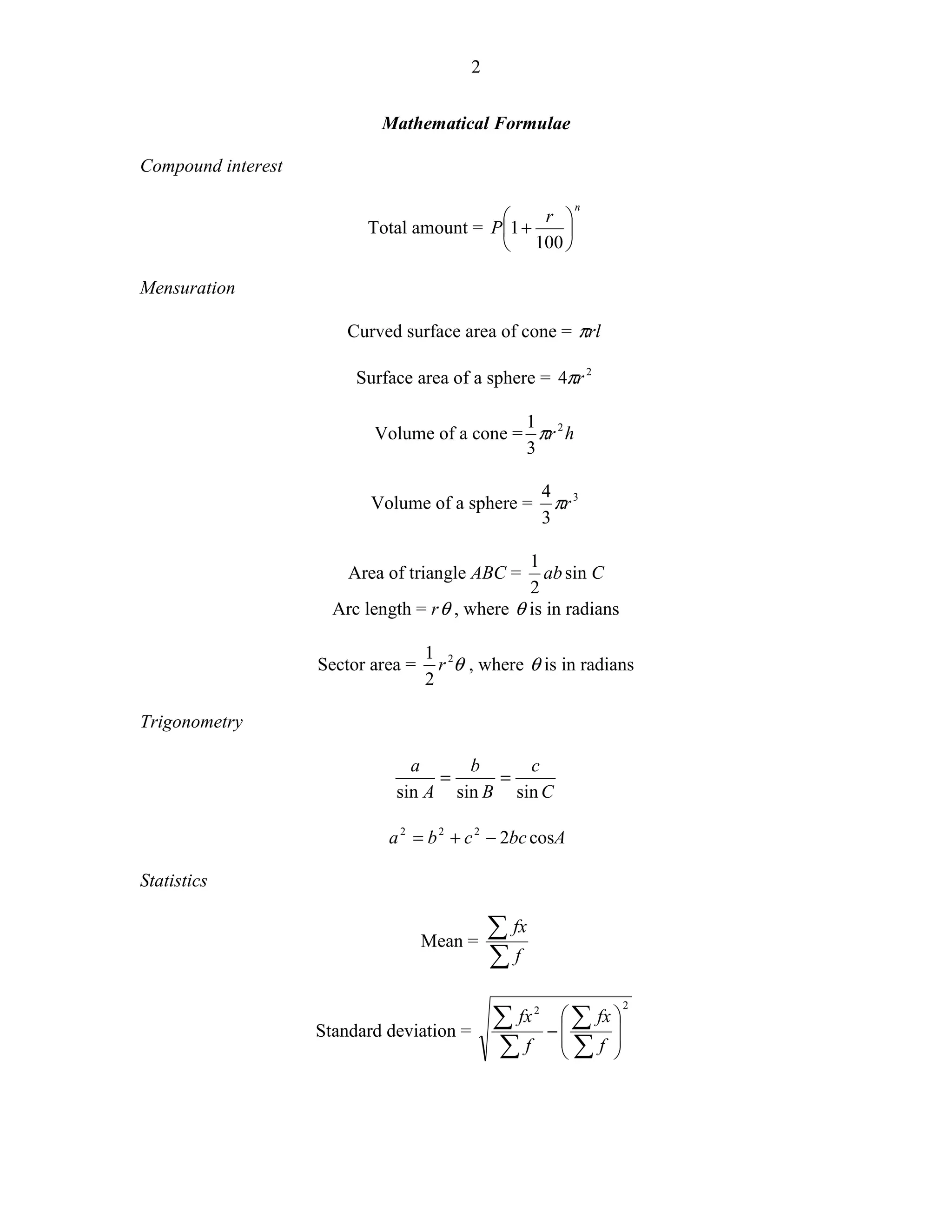
                            Mathematical Formulae

Compound interest

                                                             n
                                              r 
                          Total amount = P1 +   
                                           100 

Mensuration

                        Curved surface area of cone = πrl

                         Surface area of a sphere = 4πr 2

                                             1
                           Volume of a cone = πr 2 h
                                             3

                                                          4 3
                           Volume of a sphere =             πr
                                                          3

                                                 1
                        Area of triangle ABC =     ab sin C
                                                 2
                      Arc length = r θ , where θ is in radians

                                    1 2
                    Sector area =     r θ , where θ is in radians
                                    2

Trigonometry

                                a     b     c
                                   =     =
                              sin A sin B sin C

                             a 2 = b 2 + c 2 − 2bc cosA

Statistics


                                    Mean =
                                               ∑ fx
                                               ∑f

                                               ∑ fx         ∑ fx 
                                                      2               2

                    Standard deviation =                  −      
                                               ∑f          ∑f 
                                                                 
3

                                       Answer all the questions

                          9 − 6 x + x2
1. (a)         Simplify                .                                           [2]
                           2 x 2 − 18

   (b)         Express as a single fraction in its simplest form,

                                                        6 y + 5z
                                                   2−            .
                                                        3 y − 4z
                                                                                  [2]
                      Express x − 7 x − 9 in the form ( x − a ) − b .
                                   2                                 2
   (c)         (i)                                                                 [1]

               (ii)   Hence, solve the equation x 2 − 7 x − 9 = 0 giving your answers
                      correct to two significant figures.                          [2]


2. The diagram shows a tent. BCFE is the rectangular base of the tent. ABC and
   DEF are vertical ends of the tent. BC = EF = 1 m, BE = CF = 2.2 m and
   AB = AC = DE = DF = 1.3 m.


               .

         (a)   Show that the height of the tent is 1.2 m.                        [2]
         (b)   Calculate the volume of the tent,                                 [2]
         (c)   Calculate the total surface area of the tent.                     [2]
         (d)   The canvas used to make the tent costs 0.02 cents per cm2. Calculate the
               cost of the canvas used to make the tent.                         [2]
4


3. A boy buys a 500 ml packet of mango juice for $1.50 and a 1 litre packet of
   orange juice for $2.50.

   (a)     Mango juice costs x cents more per litre than orange juice. Find the value
           of x.                                                               [2]

   The two packets of juices are geometrically similar.

   (b)     Given that the height of the packet of orange juice is 25 cm, calculate the
           height of the packet of mango juice. Give your answer correct to two
           decimal places.                                                      [2]

   The boy makes a bowl of fruit punch with the juices and water. He mixes water,
   mango juice and orange juice in the ratio 1 : 2 : 5.

   (c)     Find the largest volume, in litres, of fruit punch he can make.      [2]

   (d)     Find the percentage of juice left unused.                            [2]


4. The diagram shows a rectangle ABCD. M is the midpoint of AD and CM
   intersects DN at P. BC = 3 cm, CD = 7 cm and DN = 5 cm.

                   A                            N         B


                                     5 cm                 3 cm
               M                P


                   D                7 cm                  C

   (a)     Write down the value of sin ∠ BND.                                   [1]

   (b)     Calculate

           (i)         ∠ MCD,                                                   [2]
           (ii)        ∠ ADN,                                                   [2]
           (iii)       ∠ MPD.                                                   [2]
5


5. A boat travelled 200 m downstream (with the current) from A to B. AB is parallel
   to the banks of the river. The speed of a boat in still water is v m/s and the speed
   of the current is 2 m/s.
                    Upstream                                   Downstream


                                  A                            B
                                               200 m

                        current


   (a)     Find an expression, in terms of v, for the time taken, in seconds, for the
           boat to travel downstream from A to B.                                [1]

   (b)     The boat then travelled upstream (against the current) from B to A.

           Find an expression, in terms of v, for the time taken, in seconds, for the
           boat to travel from B to A.                                           [1]

   (c)     The total time taken for the journey downstream and upstream is
           4 minutes.

           Write down an equation to represent this information, and show that it
           simplifies to 3v 2 − 5v − 12 = 0 .                                [3]

   (d)     Solve the equation 3v 2 − 5v − 12 = 0 .                               [2]

   (e)     Find the time, in seconds, for the boat to travel from B to A.        [1]
6


6. The diagram shows a circle ABCE. The tangents at C and E meet at D. Angle
   GCD = angle GED = 90° and angle AMB = 54°.


   (a)    Explain why G is the centre of the circle.                    [2]

   (b)    Find

          (i)     angle ACB,                                            [1]
          (ii)    angle CAB,                                            [2]
          (iii)   angle CDE.                                            [3]

   (c)    Show that triangles ABG and ECG are similar.                  [2]

   (d)    State where the centre of the circle CDEG lies.               [1]
7


7. The diagram shows a horizontal field PQRS. R is due east of S.
   PQ = 245 m, SR = 290 m, angle PSR = 47°, angle SPR = 70° and
   angle RPQ = 36°.


          (a)     Calculate the bearing of P from R.                          [2]

          (b)     Show that PR = 225.7 m.                                     [2]

          (c)     Calculate

                  (i)     how far R is south of P,                            [2]
                  (ii)    the distance QR,                                    [3]
                  (iii)   the shortest distance from P to QR.                 [2]

            (d)   A bird is 50 m vertically above P. Calculate the largest angle of
                  elevation of the bird when viewed from any point along QR.[2]
8


8.   (a)   The cumulative frequency curve shows the marks for Mathematics Paper 1
           of 80 candidates. The maximum mark of Paper 1 is 80.


           (i)    Use the graph to find

                  (a)    the median mark,                                      [1]
                  (b)    the upper quartile,                                   [1]
                  (c)    the interquartile range,                              [1]
                  (d)    the 35th percentile.                                  [1]

           (ii)   To score a distinction in Paper 1, a candidate has to attain more
                  than 67 marks. Two candidates are chosen at random. Find the
                  probability both of them attained distinction.                [2]
9


(b)   The same 80 candidates sat for Mathematics Paper 2. The box and
      whiskers diagram illustrates the marks obtained. The maximum mark for
      Paper 2 is 100.


      (i)     Find the range of marks for Paper 2.                       [1]

      (ii)    A candidate is chosen at random. Write down the probability that
              this candidate attained at most 40 marks for Paper 2.    [1]


      (iii)   Compare the marks for Papers 1 and 2 in two different ways.
                                                                        [2]

      (iv)    Giving a reason, state whether Paper 1 or Paper 2 was more
              difficult.                                                 [1]
10


9. The diagram shows two circles with radii 6 cm with centres at O and at P. The
   circle with centre P passes through O. The two circles intersect at A and B.


                                         2π
   (a)     Explain why angle AOB =          rad.                                 [2]
                                          3

   (b)     Find the perimeter of the shaded region.                              [2]

   (c)     Find the area of the shaded region.                                   [3]


10. The first five terms of a sequence and the difference between successive terms are
    shown below.

  Sequence     4         13         26           43        64        a

  Difference       9          13         17           21        b


   (a)     Write down the value of a and of b.                                   [2]

   (b)     Find an expression, in terms of n, for the n th difference.           [1]

   (c)     Find the tenth difference.                                            [1]

   (d)     Given that the n th term of the sequence is given by pn 2 + qn + r , find the
           value of p, of q and of r.                                             [3]
11


                                                                  1     2
      11. The variables x and y are connected by the equation y =   x − . Some
                                                                  2     x
         corresponding values of x and y are given in the following table.

        x         0.5              1           1.5          2   2.5      3      3.5       4
        y        −3.75            −1.5          p           0   0.45    0.83     q       1.5

        (a) Find the value of p and of q giving your answers correct to two decimal places.
                                                                                    [2]

        (b) Using a scale of 4 cm to represent 1unit draw a horizontal x-axis for
            0.5 ≤ x ≤ 4.
            Using a scale of 2 cm to represent 1 unit on the y−axis, draw a vertical y-axis
            for −4 ≤ y ≤ 2.
            On your axes, plot the points given in the table and join them with a smooth
            curve.                                                                    [3]

        (c) Use your graph to find the range of values of x for which x 2 − 2 x − 4 ≥ 0 .
                                                                                        [2]

        (d) By drawing a tangent, find the gradient of the curve at the point (1, −1.5).
                                                                                      [2]

        (e) On the same axes, draw the graph of 4 x + 3 y = 6 .                              [1]

        (f) (i) Write down the x coordinate of the point where the two graphs intersect.
                                                                                   [1]
            (ii) The value of x is a solution of the equation Ax + Bx − 12 = 0 . Find the
                                                                2

                 value of A and the value of B.                                    [2]

                                                 End of Paper

Answers

                   x−3                            13 z
1.       (a)                             (b)
                  2( x + 3)                      4z − 3 y
                ( x − 3.5 ) − 21.25 (ii)
                              2
(c)      (i)                                            x = 8.1, -1.1
2.       (a)    1.2 m (b)        1.32 m3                (c)     9.12 m2       (d)   $18.24
3.       x = 50 (b)      19.84 cm       (c)             1.6 L (d)      6.67 %
4.       (a)    0.6      (b)     (i)    12.2°           (ii)    53.1° (iii)   49.0°
                 200              200
5.       (a)             (b)            (d)             v = 3 (e)      200 s
                 v+2              v−2
12


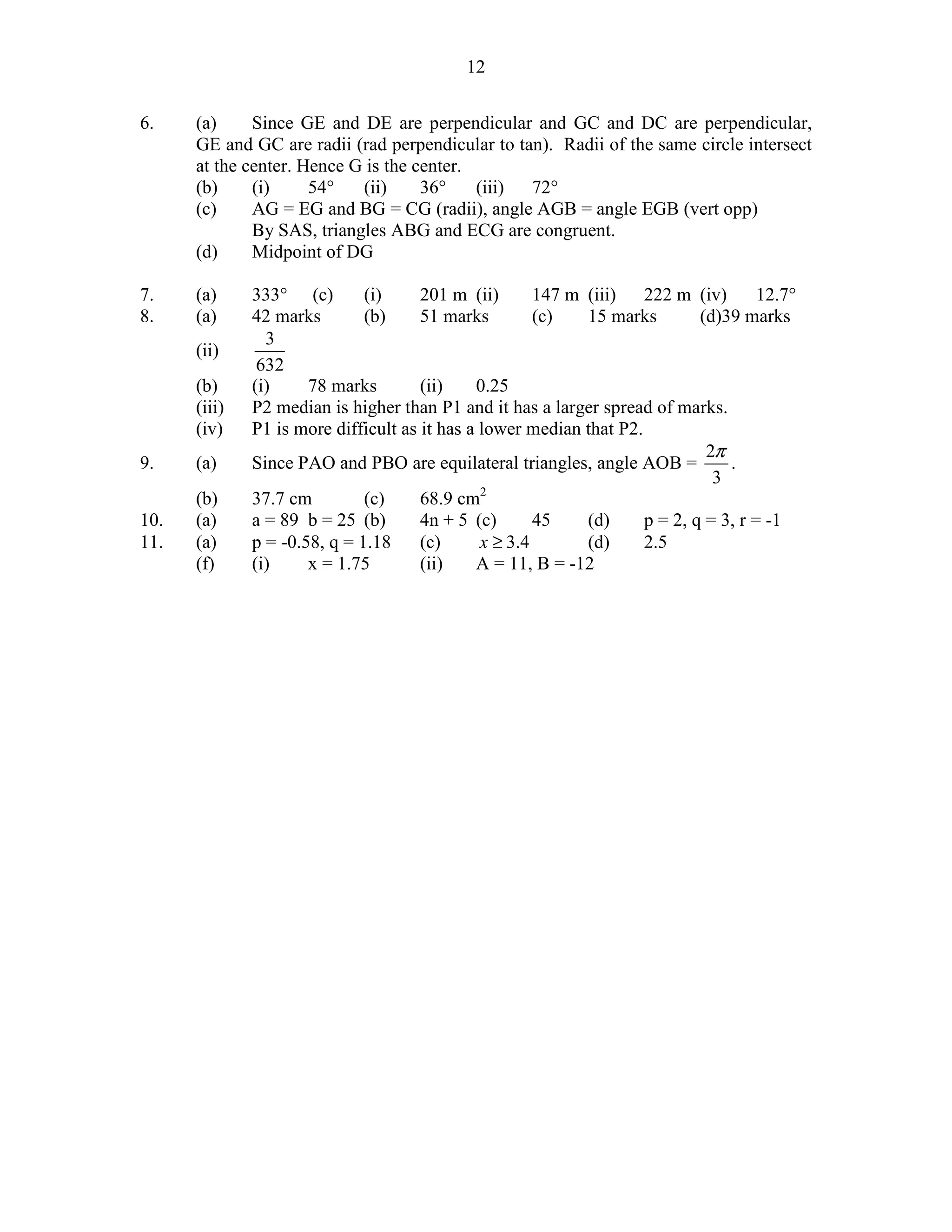
6.    (a)     Since GE and DE are perpendicular and GC and DC are perpendicular,
      GE and GC are radii (rad perpendicular to tan). Radii of the same circle intersect
      at the center. Hence G is the center.
      (b)     (i)     54°   (ii)     36°    (iii) 72°
      (c)     AG = EG and BG = CG (radii), angle AGB = angle EGB (vert opp)
              By SAS, triangles ABG and ECG are congruent.
      (d)     Midpoint of DG

7.    (a)     333° (c)        (i)     201 m (ii)       147 m (iii)   222 m (iv)       12.7°
8.    (a)     42 marks        (b)     51 marks         (c)   15 marks        (d)39 marks
                3
      (ii)
               632
      (b)     (i)     78 marks        (ii)    0.25
      (iii)   P2 median is higher than P1 and it has a larger spread of marks.
      (iv)    P1 is more difficult as it has a lower median that P2.
                                                                              2π
9.    (a)     Since PAO and PBO are equilateral triangles, angle AOB =           .
                                                                               3
      (b)     37.7 cm         (c)     68.9 cm2
10.   (a)     a = 89 b = 25 (b)       4n + 5 (c)       45    (d)     p = 2, q = 3, r = -1
11.   (a)     p = -0.58, q = 1.18     (c)      x ≥ 3.4       (d)     2.5
      (f)     (i)     x = 1.75        (ii)    A = 11, B = -12

Monfort Emath Paper2_printed

  • 1.
    MONTFORT SECONDARY SCHOOL ‘O’ LEVEL PRELIMINARY EXAMINATION 2009 ________________________________________________________________ Secondary 4 Express / 5 Normal MATHEMATICS 4016/02 PAPER 2 Wednesday 2 September 2009 1100 – 1330 2 h 30 min Additional Materials: Answer Paper Graph Paper (1 sheet) ________________________________________________________________ READ THESE INSTRUCTIONS FIRST Write your name, class and register number on all the work you hand in. Write in dark blue or black pen on both sides of the paper. You may use a pencil for any diagrams or graphs. Do not use staples, paper clips, highlighters, glue or correction fluid. Answer all questions. If working is needed for any question it must be shown with the answer. Omission of essential working will result in loss of marks. Calculators should be used where appropriate. If the degree of accuracy is not specified in the question, and if the answer is not exact, give the answer to three significant figures. Give answers in degrees to one decimal place. For π, use either your calculator value or 3.142, unless the question requires the answer in terms of π. At the end of the examination, fasten all your work securely together. The number of marks is given in brackets [ ] at the end of each question or part question. The total number of marks for this paper is 100. ________________________________________________________________ This document consists of 11 printed pages. Setter: A. Low
  • 2.
    2 Mathematical Formulae Compound interest n  r  Total amount = P1 +   100  Mensuration Curved surface area of cone = πrl Surface area of a sphere = 4πr 2 1 Volume of a cone = πr 2 h 3 4 3 Volume of a sphere = πr 3 1 Area of triangle ABC = ab sin C 2 Arc length = r θ , where θ is in radians 1 2 Sector area = r θ , where θ is in radians 2 Trigonometry a b c = = sin A sin B sin C a 2 = b 2 + c 2 − 2bc cosA Statistics Mean = ∑ fx ∑f ∑ fx  ∑ fx  2 2 Standard deviation = −  ∑f ∑f   
  • 3.
    3 Answer all the questions 9 − 6 x + x2 1. (a) Simplify . [2] 2 x 2 − 18 (b) Express as a single fraction in its simplest form, 6 y + 5z 2− . 3 y − 4z [2] Express x − 7 x − 9 in the form ( x − a ) − b . 2 2 (c) (i) [1] (ii) Hence, solve the equation x 2 − 7 x − 9 = 0 giving your answers correct to two significant figures. [2] 2. The diagram shows a tent. BCFE is the rectangular base of the tent. ABC and DEF are vertical ends of the tent. BC = EF = 1 m, BE = CF = 2.2 m and AB = AC = DE = DF = 1.3 m. . (a) Show that the height of the tent is 1.2 m. [2] (b) Calculate the volume of the tent, [2] (c) Calculate the total surface area of the tent. [2] (d) The canvas used to make the tent costs 0.02 cents per cm2. Calculate the cost of the canvas used to make the tent. [2]
  • 4.
    4 3. A boybuys a 500 ml packet of mango juice for $1.50 and a 1 litre packet of orange juice for $2.50. (a) Mango juice costs x cents more per litre than orange juice. Find the value of x. [2] The two packets of juices are geometrically similar. (b) Given that the height of the packet of orange juice is 25 cm, calculate the height of the packet of mango juice. Give your answer correct to two decimal places. [2] The boy makes a bowl of fruit punch with the juices and water. He mixes water, mango juice and orange juice in the ratio 1 : 2 : 5. (c) Find the largest volume, in litres, of fruit punch he can make. [2] (d) Find the percentage of juice left unused. [2] 4. The diagram shows a rectangle ABCD. M is the midpoint of AD and CM intersects DN at P. BC = 3 cm, CD = 7 cm and DN = 5 cm. A N B 5 cm 3 cm M P D 7 cm C (a) Write down the value of sin ∠ BND. [1] (b) Calculate (i) ∠ MCD, [2] (ii) ∠ ADN, [2] (iii) ∠ MPD. [2]
  • 5.
    5 5. A boattravelled 200 m downstream (with the current) from A to B. AB is parallel to the banks of the river. The speed of a boat in still water is v m/s and the speed of the current is 2 m/s. Upstream Downstream A B 200 m current (a) Find an expression, in terms of v, for the time taken, in seconds, for the boat to travel downstream from A to B. [1] (b) The boat then travelled upstream (against the current) from B to A. Find an expression, in terms of v, for the time taken, in seconds, for the boat to travel from B to A. [1] (c) The total time taken for the journey downstream and upstream is 4 minutes. Write down an equation to represent this information, and show that it simplifies to 3v 2 − 5v − 12 = 0 . [3] (d) Solve the equation 3v 2 − 5v − 12 = 0 . [2] (e) Find the time, in seconds, for the boat to travel from B to A. [1]
  • 6.
    6 6. The diagramshows a circle ABCE. The tangents at C and E meet at D. Angle GCD = angle GED = 90° and angle AMB = 54°. (a) Explain why G is the centre of the circle. [2] (b) Find (i) angle ACB, [1] (ii) angle CAB, [2] (iii) angle CDE. [3] (c) Show that triangles ABG and ECG are similar. [2] (d) State where the centre of the circle CDEG lies. [1]
  • 7.
    7 7. The diagramshows a horizontal field PQRS. R is due east of S. PQ = 245 m, SR = 290 m, angle PSR = 47°, angle SPR = 70° and angle RPQ = 36°. (a) Calculate the bearing of P from R. [2] (b) Show that PR = 225.7 m. [2] (c) Calculate (i) how far R is south of P, [2] (ii) the distance QR, [3] (iii) the shortest distance from P to QR. [2] (d) A bird is 50 m vertically above P. Calculate the largest angle of elevation of the bird when viewed from any point along QR.[2]
  • 8.
    8 8. (a) The cumulative frequency curve shows the marks for Mathematics Paper 1 of 80 candidates. The maximum mark of Paper 1 is 80. (i) Use the graph to find (a) the median mark, [1] (b) the upper quartile, [1] (c) the interquartile range, [1] (d) the 35th percentile. [1] (ii) To score a distinction in Paper 1, a candidate has to attain more than 67 marks. Two candidates are chosen at random. Find the probability both of them attained distinction. [2]
  • 9.
    9 (b) The same 80 candidates sat for Mathematics Paper 2. The box and whiskers diagram illustrates the marks obtained. The maximum mark for Paper 2 is 100. (i) Find the range of marks for Paper 2. [1] (ii) A candidate is chosen at random. Write down the probability that this candidate attained at most 40 marks for Paper 2. [1] (iii) Compare the marks for Papers 1 and 2 in two different ways. [2] (iv) Giving a reason, state whether Paper 1 or Paper 2 was more difficult. [1]
  • 10.
    10 9. The diagramshows two circles with radii 6 cm with centres at O and at P. The circle with centre P passes through O. The two circles intersect at A and B. 2π (a) Explain why angle AOB = rad. [2] 3 (b) Find the perimeter of the shaded region. [2] (c) Find the area of the shaded region. [3] 10. The first five terms of a sequence and the difference between successive terms are shown below. Sequence 4 13 26 43 64 a Difference 9 13 17 21 b (a) Write down the value of a and of b. [2] (b) Find an expression, in terms of n, for the n th difference. [1] (c) Find the tenth difference. [1] (d) Given that the n th term of the sequence is given by pn 2 + qn + r , find the value of p, of q and of r. [3]
  • 11.
    11 1 2 11. The variables x and y are connected by the equation y = x − . Some 2 x corresponding values of x and y are given in the following table. x 0.5 1 1.5 2 2.5 3 3.5 4 y −3.75 −1.5 p 0 0.45 0.83 q 1.5 (a) Find the value of p and of q giving your answers correct to two decimal places. [2] (b) Using a scale of 4 cm to represent 1unit draw a horizontal x-axis for 0.5 ≤ x ≤ 4. Using a scale of 2 cm to represent 1 unit on the y−axis, draw a vertical y-axis for −4 ≤ y ≤ 2. On your axes, plot the points given in the table and join them with a smooth curve. [3] (c) Use your graph to find the range of values of x for which x 2 − 2 x − 4 ≥ 0 . [2] (d) By drawing a tangent, find the gradient of the curve at the point (1, −1.5). [2] (e) On the same axes, draw the graph of 4 x + 3 y = 6 . [1] (f) (i) Write down the x coordinate of the point where the two graphs intersect. [1] (ii) The value of x is a solution of the equation Ax + Bx − 12 = 0 . Find the 2 value of A and the value of B. [2] End of Paper Answers x−3 13 z 1. (a) (b) 2( x + 3) 4z − 3 y ( x − 3.5 ) − 21.25 (ii) 2 (c) (i) x = 8.1, -1.1 2. (a) 1.2 m (b) 1.32 m3 (c) 9.12 m2 (d) $18.24 3. x = 50 (b) 19.84 cm (c) 1.6 L (d) 6.67 % 4. (a) 0.6 (b) (i) 12.2° (ii) 53.1° (iii) 49.0° 200 200 5. (a) (b) (d) v = 3 (e) 200 s v+2 v−2
  • 12.
    12 6. (a) Since GE and DE are perpendicular and GC and DC are perpendicular, GE and GC are radii (rad perpendicular to tan). Radii of the same circle intersect at the center. Hence G is the center. (b) (i) 54° (ii) 36° (iii) 72° (c) AG = EG and BG = CG (radii), angle AGB = angle EGB (vert opp) By SAS, triangles ABG and ECG are congruent. (d) Midpoint of DG 7. (a) 333° (c) (i) 201 m (ii) 147 m (iii) 222 m (iv) 12.7° 8. (a) 42 marks (b) 51 marks (c) 15 marks (d)39 marks 3 (ii) 632 (b) (i) 78 marks (ii) 0.25 (iii) P2 median is higher than P1 and it has a larger spread of marks. (iv) P1 is more difficult as it has a lower median that P2. 2π 9. (a) Since PAO and PBO are equilateral triangles, angle AOB = . 3 (b) 37.7 cm (c) 68.9 cm2 10. (a) a = 89 b = 25 (b) 4n + 5 (c) 45 (d) p = 2, q = 3, r = -1 11. (a) p = -0.58, q = 1.18 (c) x ≥ 3.4 (d) 2.5 (f) (i) x = 1.75 (ii) A = 11, B = -12