On the semiotic appropriation
             of ICT tools
   for people in loss of autonomy
           +               +          *                   +                    *
N. Pignier , D. Tsala-Effa , L. Billonnet , A. Geslin-Beyaert and J.M. Dumas

                           University of Limoges
               +
                   Centre de Recherches Sémiotiques (CeReS)
                   Faculté des Lettres et Sciences Humaines
    *
        Ecole Nationale Supérieure d’Ingénieurs de Limoges (ENSIL)
Outline

I.   Introduction and context
II. Deployment of home automation and ICT packs
III. Major results
IV. Learning from experimentation…
V. What about semiotics?
VI. Methodology
VII. To a human-machine semiotic interface
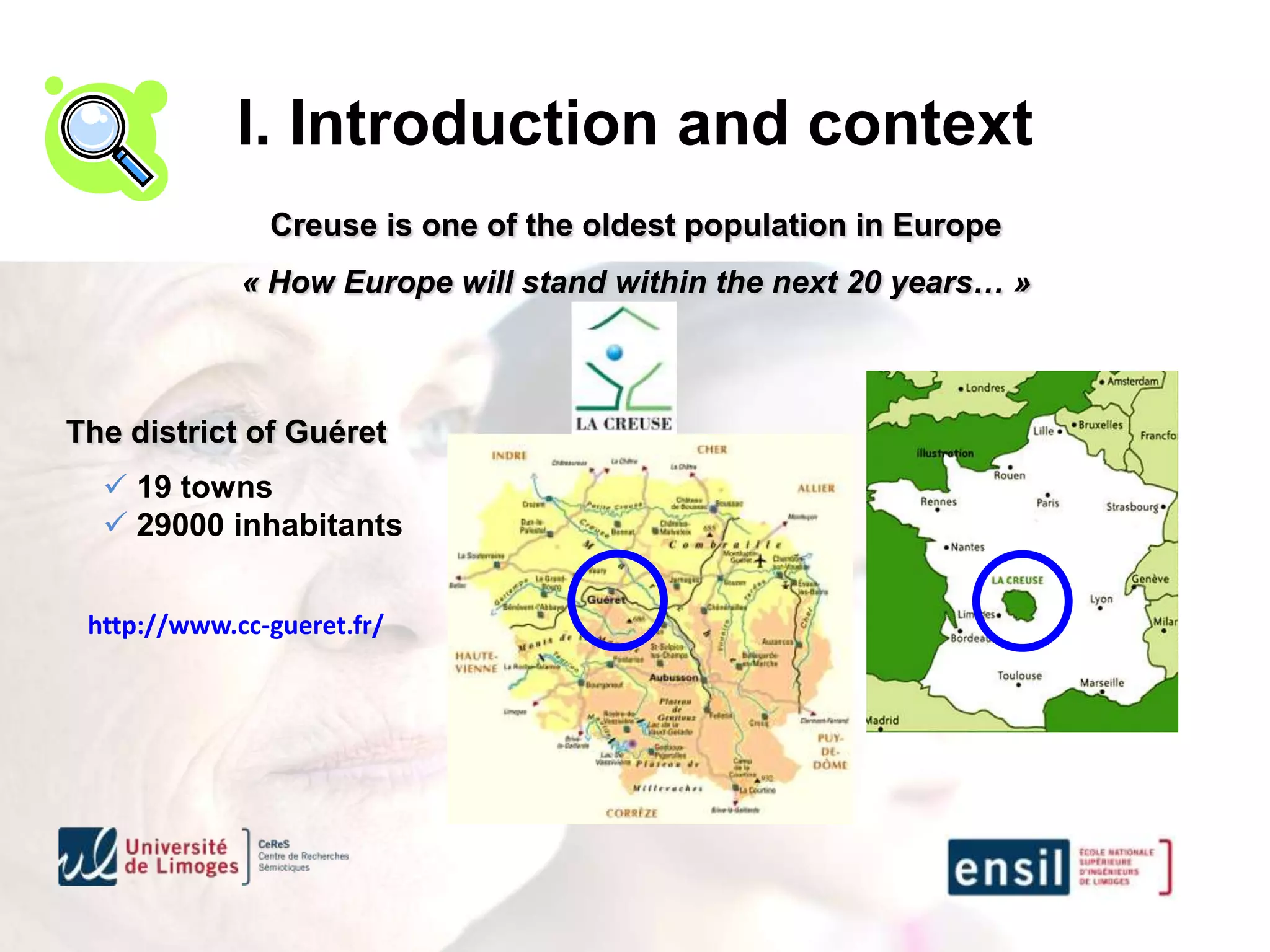
I. Introduction and context
               Creuse is one of the oldest population in Europe
             « How Europe will stand within the next 20 years… »


The district of Guéret
   19 towns
   29000 inhabitants


 http://www.cc-gueret.fr/
II. Deployment of home
          automation and ICT packs
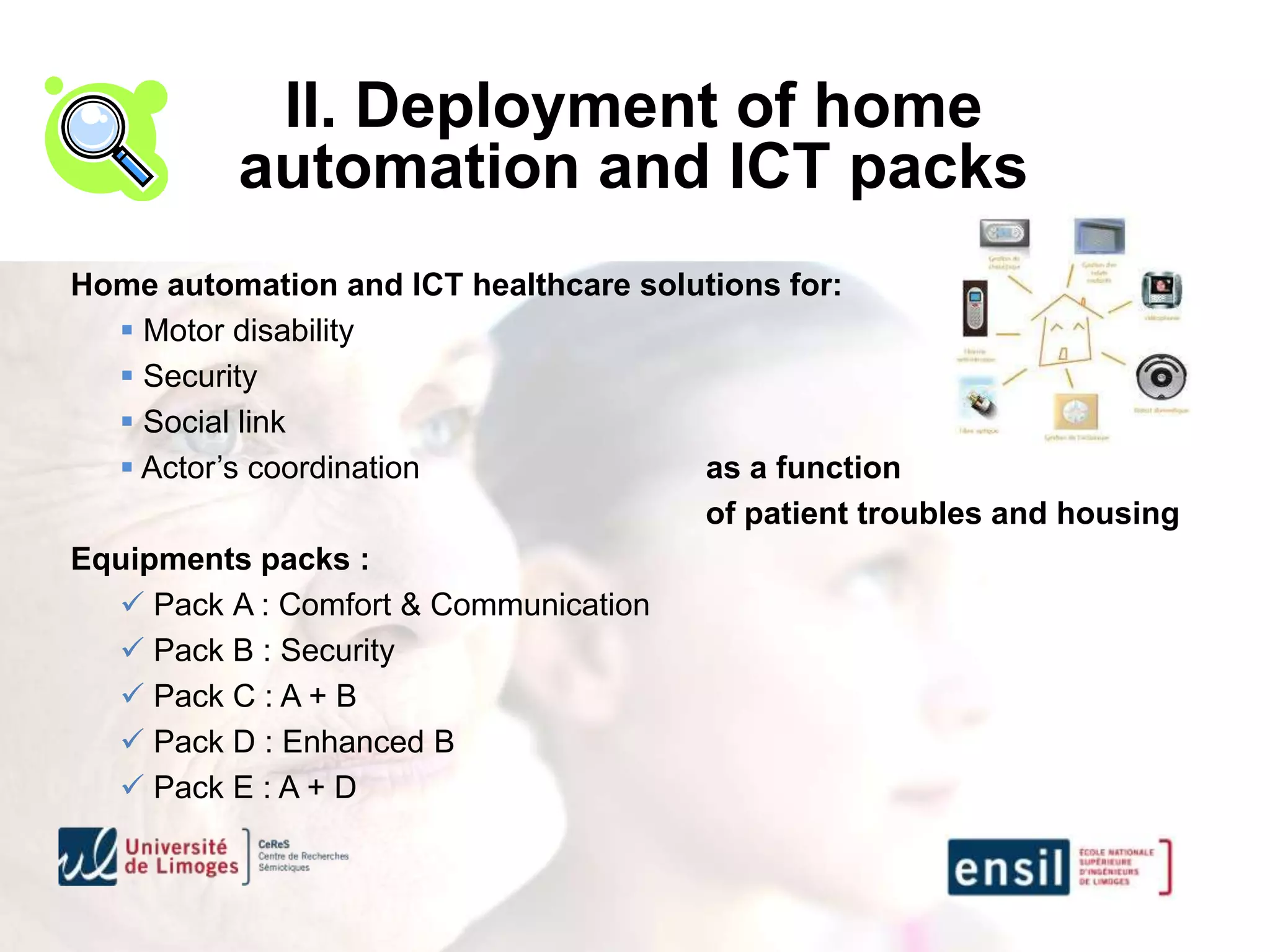
Home automation and ICT healthcare solutions for:
   Motor disability
   Security
   Social link
   Actor’s coordination               as a function
                                       of patient troubles and housing
Equipments packs :
   Pack A : Comfort & Communication
   Pack B : Security
   Pack C : A + B
   Pack D : Enhanced B
   Pack E : A + D
III. Major results
Appropriation and interest at home:

   The major part of families wish to maintain the equipment and

  imagine a system of coverage mutualized for a better financing.

   The equipments of home automation are better accepted than the
  “communicating equipments” (which did not work well).


Appropriation and interest in medical institution:

   Persons with a single room take better benefit of the equipments.

   The professionals show a better image of themselves.

   Decline of the stress for people in charge of disoriented persons.
IV. Learning from experimentation…
 Only 8 % of the calls come from a situation of loss of autonomy.
 ICT: a wish but still an unsuitable system; feeling of disappointment.
 Poor consideration of human being, user friendliness, personalization,
         dignity and respect.
 Feeling of intrusion and stigmatization.
 Training and information needed for a better appropriation of equipments.


1. Need for an ethical dimension.
2. Appropriation of ICT tools is a condition of success.

                     … to the semiotic approach
V. What about semiotics ?
1. Definition
   Saussure (1916) : “The life of signs within the social life”.
   Today semiotics is a human science which analyzes systems of
  signification, whatever the language which expresses them:
  texts, utterances, pictures, spaces, etc.

2. Semiotics of the ICT includes two main directions:
  i.the multimedia, multimodal and hypertextual contents;
  ii.the graphic and material interfaces.

In both cases, the semiotician questions the conditions of perception
of a text or an object on a digital support.
V. What about semiotics ?
3. Semiotics of the ICT in the field of health

 is interested in the way the user, with his current skills and the
  gestural, cultural experiences which he developed in the course of the
  practices of the everyday life perceives such or such digital object intended to
  help him.
 As a consequence, the ICT object is acceptable only insofar as it interacts
  with the person through his experiences
         (ex : failure of the light path that does not tell the story of the person).


Finally, the semiotician thinks out the coherence between design of a
digital device and the perception the user can have of the interaction
with this device.
VI. Methodology
           Importance of the gestural interaction
The specificity of the material interface is not only connected to the
shape, the size, the color but it also includes the mode of gestural
interaction.
   Gesture = any physical movement required by the digital interfaces of the objects to
  activate an action


Gestures required by the material and graphic device to interact with
the digital object constitute a modality that is a set of specific rules,
based on a singular value system.
   Example of gestures : press on a button in the keyboard, pinch fingers on a touch-
  sensitive screen to shrink an image, spread them to enlarge it, ...
VI. Methodology
     Our hypothesis: the pleasure of the interaction
1.     The pleasure bound to the use of a digital object can be of
       diverse nature.
      It can be bound to the aesthetics, andor to the performance,
          andor to the features…
      but also to the gestural relation.


2. The pleasure bound to the interaction with the object can
     appear from various modes of interaction, each based on a
     particular system value.
VI. Methodology
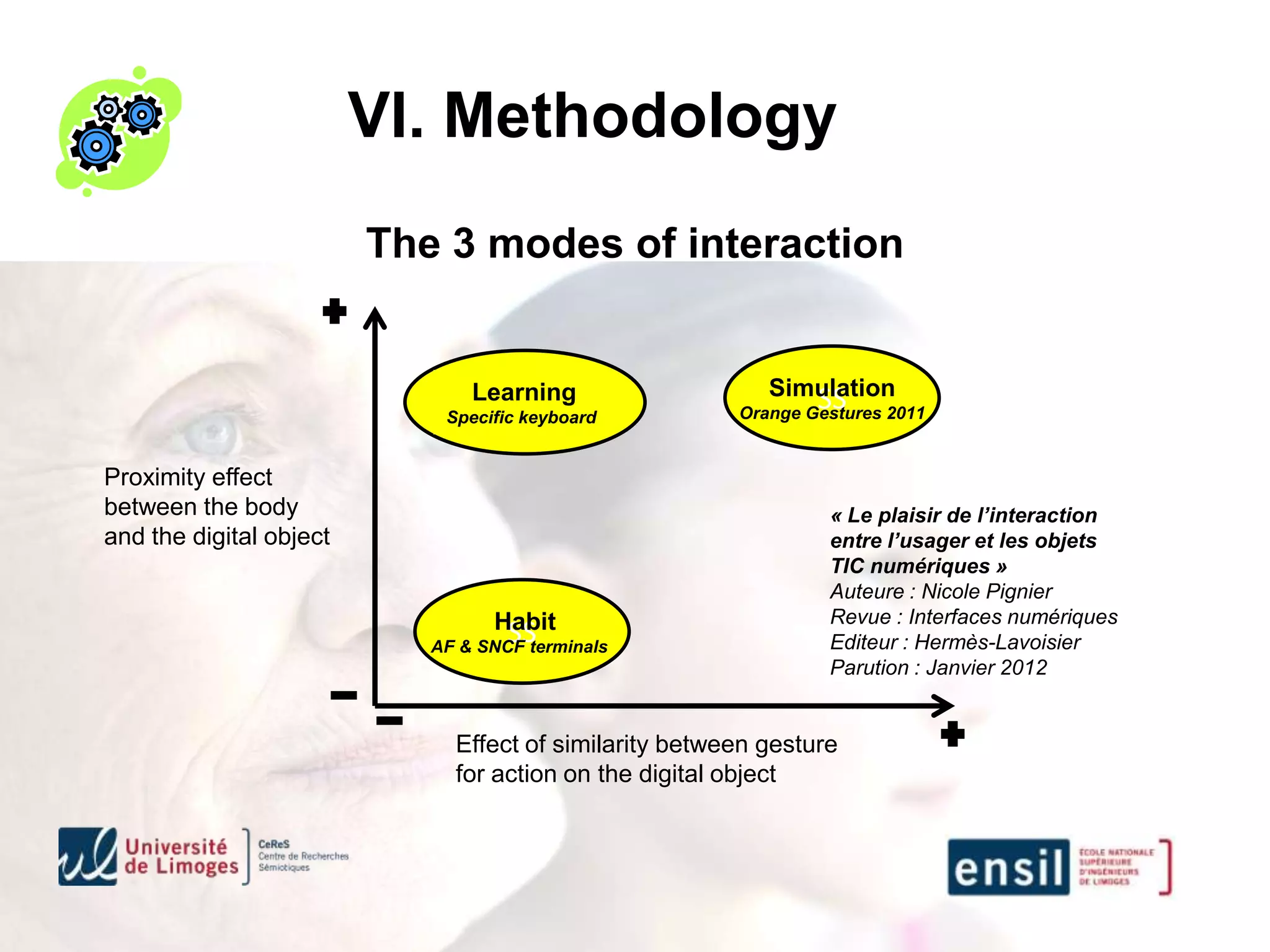
                         The 3 modes of interaction


                                Learning                   Simulation
                                                              SS
                                     SS
                             Specific keyboard          Orange Gestures 2011


Proximity effect
between the body                                                 « Le plaisir de l’interaction
and the digital object                                           entre l’usager et les objets
                                                                 TIC numériques »
                                                                 Auteure : Nicole Pignier
                                  Habit                          Revue : Interfaces numériques
                                   SS
                            AF & SNCF terminals                  Editeur : Hermès-Lavoisier
                                                                 Parution : Janvier 2012


                              Effect of similarity between gesture
                              for action on the digital object
VII. To the human-machine semiotic
            interface (HMSI)
                         Necessary conditions
To generate sense for the user
   the designer has to think of the graphic and material interface of the digital
  object according to the specificity of the user (his gestural
  memory, lifestyle, biography).

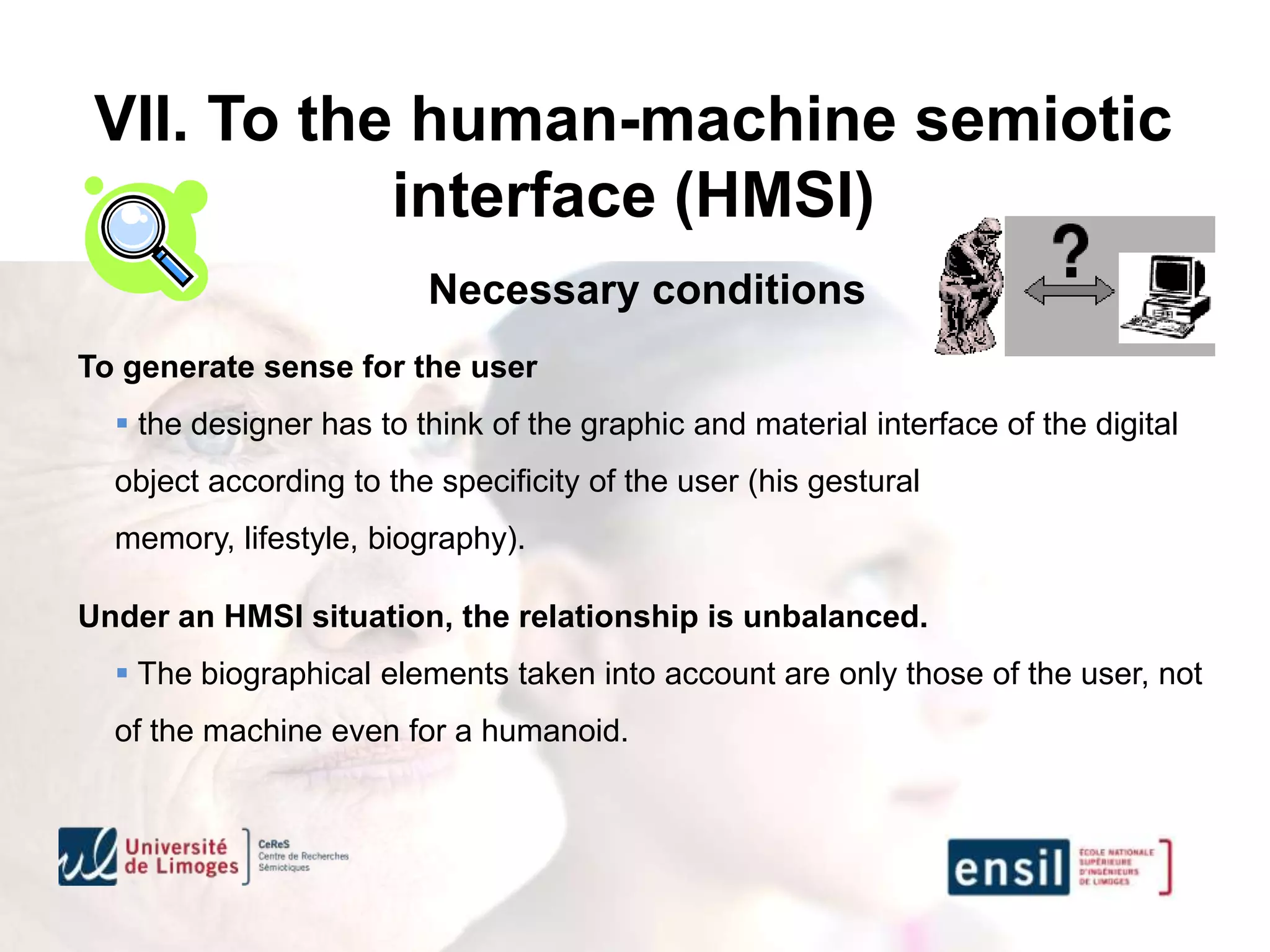
Under an HMSI situation, the relationship is unbalanced.
   The biographical elements taken into account are only those of the user, not
  of the machine even for a humanoid.
VII. To the human-machine semiotic
            interface (HMSI)
                         Necessary conditions
The interaction user/digital object : only a quest of result or also an art to
make, a process?

To generate sense for the user, the designer has to think the interaction not only
as result, efficiency, because this point of view supposes that the body of the
user is only an instrument which serves to activate commands but also as
process, art to make.

In this case, the designer supposes also that the body of the user find, during the
relation with the object, a dynamics, a cooperation on which bases itself the
pleasure of the interaction.
VII. To the human-machine semiotic
            interface (HMSI)
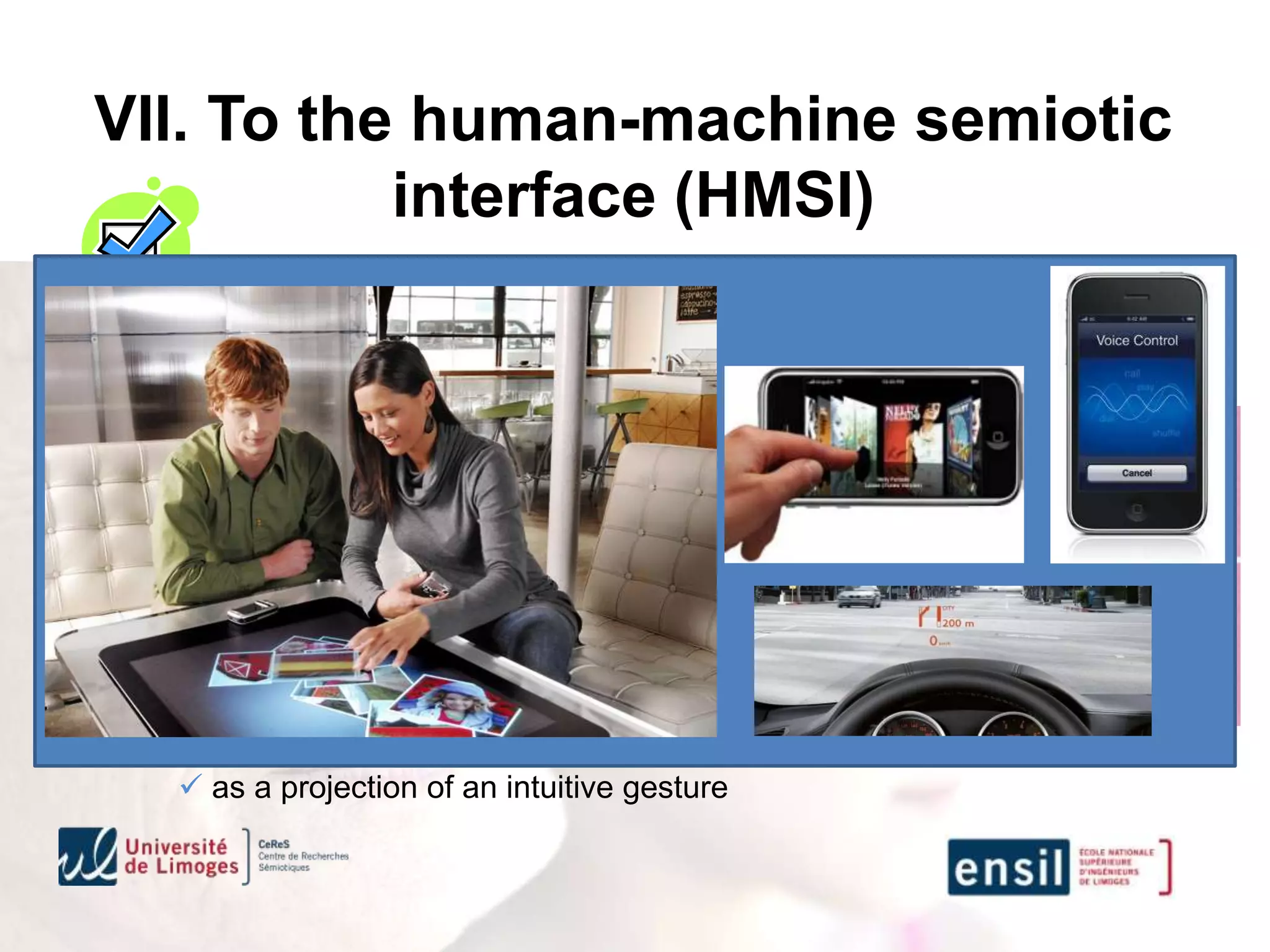
            Intuitive interfaces for a natural gesture
Several mono or multimodal interfaces techniques
   dematerialized interfaces
       vocal interfaces (analysis and synthesis)
       virtual interfaces using gesture recognition

   augmented reality and virtual assistive information
       haptic, visual or auditive augmentation as a an assistance
       haptic, visual or auditive augmentation as a validation

   intuitive tactile sensitive processes
        as a projection of an intuitive gesture
On the semiotic appropriation
           of the ICT tools
   for people in loss of autonomy
         +               +            *                   +                    *
N. Pignier , D. Tsala-Effa , L. Billonnet , A. Geslin-Beyaert and J.M. Dumas

                         University of Limoges
             +
                 Centre de Recherches Sémiotiques (CeReS)
                 Faculté des Lettres et Sciences Humaines
     •Ecole Nationale Supérieure d’Ingénieurs de Limoges (ENSIL)

Mr Dumas Autonomy & ICT

  • 1.
    On the semioticappropriation of ICT tools for people in loss of autonomy + + * + * N. Pignier , D. Tsala-Effa , L. Billonnet , A. Geslin-Beyaert and J.M. Dumas University of Limoges + Centre de Recherches Sémiotiques (CeReS) Faculté des Lettres et Sciences Humaines * Ecole Nationale Supérieure d’Ingénieurs de Limoges (ENSIL)
  • 2.
    Outline I. Introduction and context II. Deployment of home automation and ICT packs III. Major results IV. Learning from experimentation… V. What about semiotics? VI. Methodology VII. To a human-machine semiotic interface
  • 3.
    I. Introduction andcontext Creuse is one of the oldest population in Europe « How Europe will stand within the next 20 years… » The district of Guéret  19 towns  29000 inhabitants http://www.cc-gueret.fr/
  • 4.
    II. Deployment ofhome automation and ICT packs Home automation and ICT healthcare solutions for:  Motor disability  Security  Social link  Actor’s coordination as a function of patient troubles and housing Equipments packs :  Pack A : Comfort & Communication  Pack B : Security  Pack C : A + B  Pack D : Enhanced B  Pack E : A + D
  • 5.
    III. Major results Appropriationand interest at home:  The major part of families wish to maintain the equipment and imagine a system of coverage mutualized for a better financing.  The equipments of home automation are better accepted than the “communicating equipments” (which did not work well). Appropriation and interest in medical institution:  Persons with a single room take better benefit of the equipments.  The professionals show a better image of themselves.  Decline of the stress for people in charge of disoriented persons.
  • 6.
    IV. Learning fromexperimentation…  Only 8 % of the calls come from a situation of loss of autonomy.  ICT: a wish but still an unsuitable system; feeling of disappointment.  Poor consideration of human being, user friendliness, personalization, dignity and respect.  Feeling of intrusion and stigmatization.  Training and information needed for a better appropriation of equipments. 1. Need for an ethical dimension. 2. Appropriation of ICT tools is a condition of success. … to the semiotic approach
  • 7.
    V. What aboutsemiotics ? 1. Definition  Saussure (1916) : “The life of signs within the social life”.  Today semiotics is a human science which analyzes systems of signification, whatever the language which expresses them: texts, utterances, pictures, spaces, etc. 2. Semiotics of the ICT includes two main directions: i.the multimedia, multimodal and hypertextual contents; ii.the graphic and material interfaces. In both cases, the semiotician questions the conditions of perception of a text or an object on a digital support.
  • 8.
    V. What aboutsemiotics ? 3. Semiotics of the ICT in the field of health  is interested in the way the user, with his current skills and the gestural, cultural experiences which he developed in the course of the practices of the everyday life perceives such or such digital object intended to help him.  As a consequence, the ICT object is acceptable only insofar as it interacts with the person through his experiences (ex : failure of the light path that does not tell the story of the person). Finally, the semiotician thinks out the coherence between design of a digital device and the perception the user can have of the interaction with this device.
  • 9.
    VI. Methodology Importance of the gestural interaction The specificity of the material interface is not only connected to the shape, the size, the color but it also includes the mode of gestural interaction.  Gesture = any physical movement required by the digital interfaces of the objects to activate an action Gestures required by the material and graphic device to interact with the digital object constitute a modality that is a set of specific rules, based on a singular value system.  Example of gestures : press on a button in the keyboard, pinch fingers on a touch- sensitive screen to shrink an image, spread them to enlarge it, ...
  • 10.
    VI. Methodology Our hypothesis: the pleasure of the interaction 1. The pleasure bound to the use of a digital object can be of diverse nature.  It can be bound to the aesthetics, andor to the performance, andor to the features…  but also to the gestural relation. 2. The pleasure bound to the interaction with the object can appear from various modes of interaction, each based on a particular system value.
  • 11.
    VI. Methodology The 3 modes of interaction Learning Simulation SS SS Specific keyboard Orange Gestures 2011 Proximity effect between the body « Le plaisir de l’interaction and the digital object entre l’usager et les objets TIC numériques » Auteure : Nicole Pignier Habit Revue : Interfaces numériques SS AF & SNCF terminals Editeur : Hermès-Lavoisier Parution : Janvier 2012 Effect of similarity between gesture for action on the digital object
  • 12.
    VII. To thehuman-machine semiotic interface (HMSI) Necessary conditions To generate sense for the user  the designer has to think of the graphic and material interface of the digital object according to the specificity of the user (his gestural memory, lifestyle, biography). Under an HMSI situation, the relationship is unbalanced.  The biographical elements taken into account are only those of the user, not of the machine even for a humanoid.
  • 13.
    VII. To thehuman-machine semiotic interface (HMSI) Necessary conditions The interaction user/digital object : only a quest of result or also an art to make, a process? To generate sense for the user, the designer has to think the interaction not only as result, efficiency, because this point of view supposes that the body of the user is only an instrument which serves to activate commands but also as process, art to make. In this case, the designer supposes also that the body of the user find, during the relation with the object, a dynamics, a cooperation on which bases itself the pleasure of the interaction.
  • 14.
    VII. To thehuman-machine semiotic interface (HMSI) Intuitive interfaces for a natural gesture Several mono or multimodal interfaces techniques  dematerialized interfaces  vocal interfaces (analysis and synthesis)  virtual interfaces using gesture recognition  augmented reality and virtual assistive information  haptic, visual or auditive augmentation as a an assistance  haptic, visual or auditive augmentation as a validation  intuitive tactile sensitive processes  as a projection of an intuitive gesture
  • 15.
    On the semioticappropriation of the ICT tools for people in loss of autonomy + + * + * N. Pignier , D. Tsala-Effa , L. Billonnet , A. Geslin-Beyaert and J.M. Dumas University of Limoges + Centre de Recherches Sémiotiques (CeReS) Faculté des Lettres et Sciences Humaines •Ecole Nationale Supérieure d’Ingénieurs de Limoges (ENSIL)