Toward a Civiliza-on of  
      Collec-ve Intelligence 


     Prof. Pierre Lévy (Twi;er: @plevy) 
    Fellow of the Royal Society of Canada 
Canada Research Chair in Collec-ve Intelligence 
             University of O;awa 
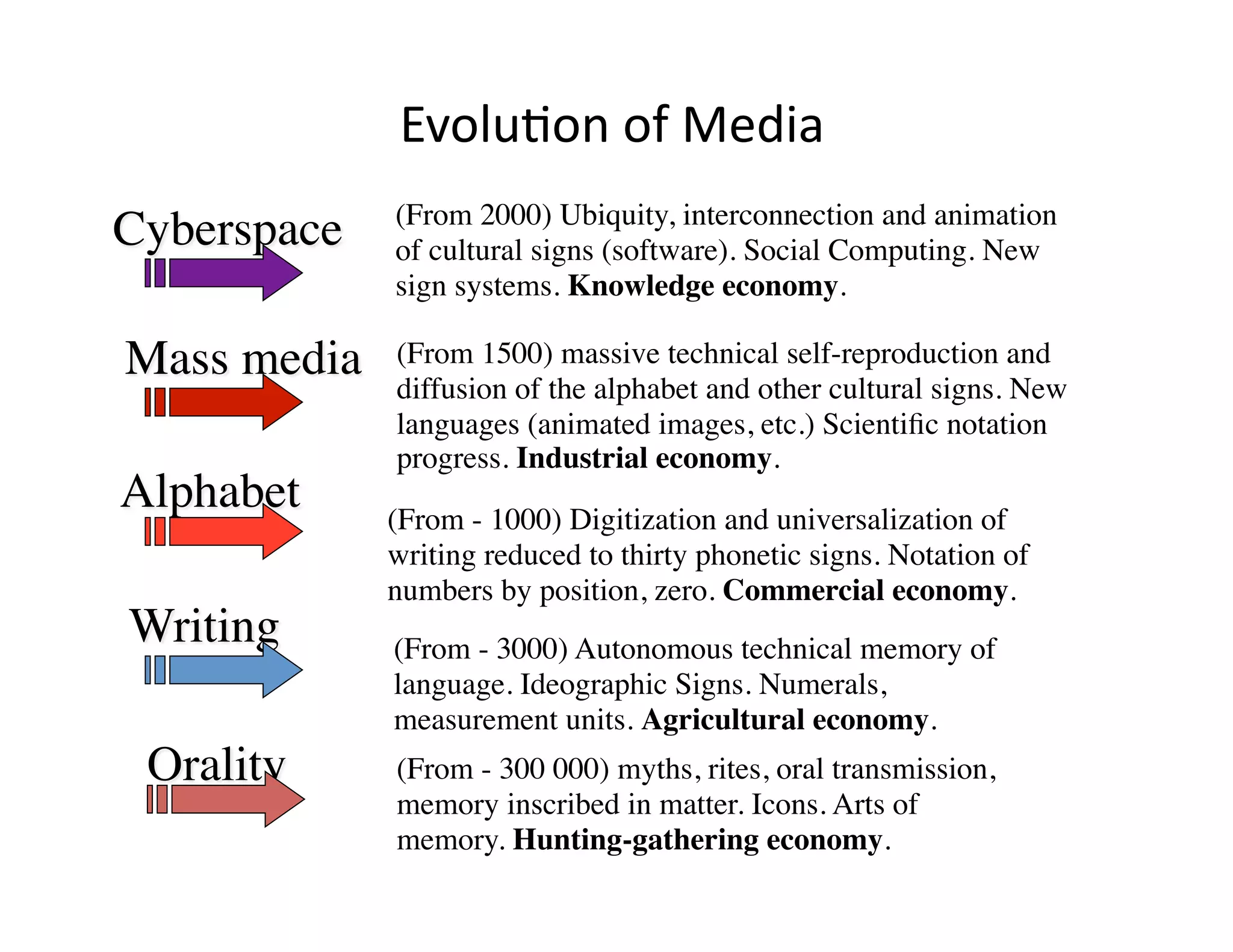
Evolu-on of Media 
(From 2000) Ubiquity, interconnection and animation
of cultural signs (software). Social Computing. New
sign systems. Knowledge economy.

(From 1500) massive technical self-reproduction and
diffusion of the alphabet and other cultural signs. New
languages (animated images, etc.) Scientific notation
progress. Industrial economy. 

(From - 1000) Digitization and universalization of
writing reduced to thirty phonetic signs. Notation of
numbers by position, zero. Commercial economy.
(From - 3000) Autonomous technical memory of
language. Ideographic Signs. Numerals,
measurement units. Agricultural economy.
(From - 300 000) myths, rites, oral transmission,
memory inscribed in matter. Icons. Arts of
memory. Hunting-gathering economy.
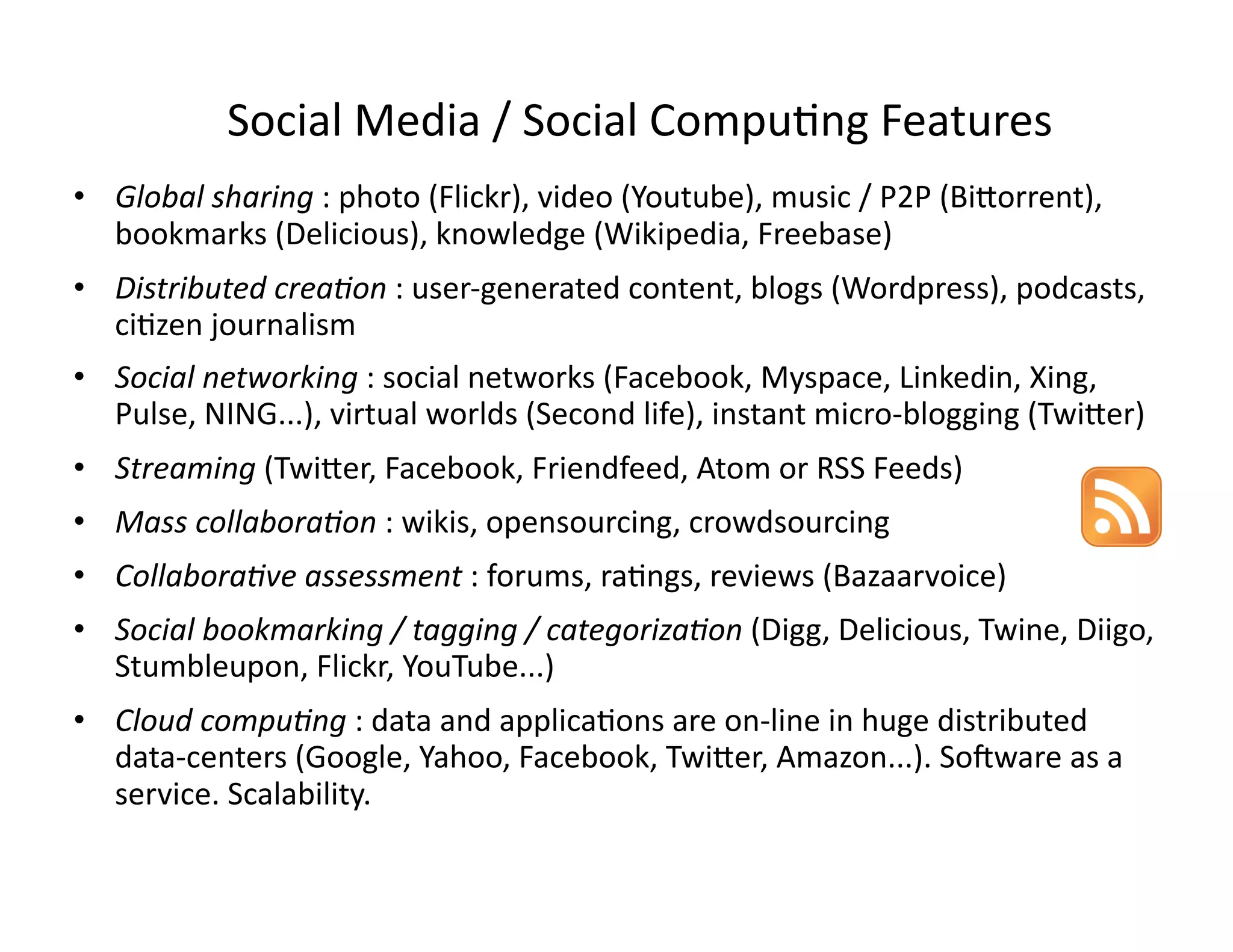
Social Media / Social Compu-ng Features 
•  Global sharing : photo (Flickr), video (Youtube), music / P2P (Bi;orrent), 
   bookmarks (Delicious), knowledge (Wikipedia, Freebase) 
•  Distributed crea3on : user‐generated content, blogs (Wordpress), podcasts, 
   ci-zen journalism 
•  Social networking : social networks (Facebook, Myspace, Linkedin, Xing, 
   Pulse, NING...), virtual worlds (Second life), instant micro‐blogging (Twi;er) 
•  Streaming (Twi;er, Facebook, Friendfeed, Atom or RSS Feeds)  
•  Mass collabora3on : wikis, opensourcing, crowdsourcing 
•  Collabora3ve assessment : forums, ra-ngs, reviews (Bazaarvoice) 
•  Social bookmarking / tagging / categoriza3on (Digg, Delicious, Twine, Diigo, 
   Stumbleupon, Flickr, YouTube...) 
•  Cloud compu3ng : data and applica-ons are on‐line in huge distributed 
   data‐centers (Google, Yahoo, Facebook, Twi;er, Amazon...). SoZware as a 
   service. Scalability. 
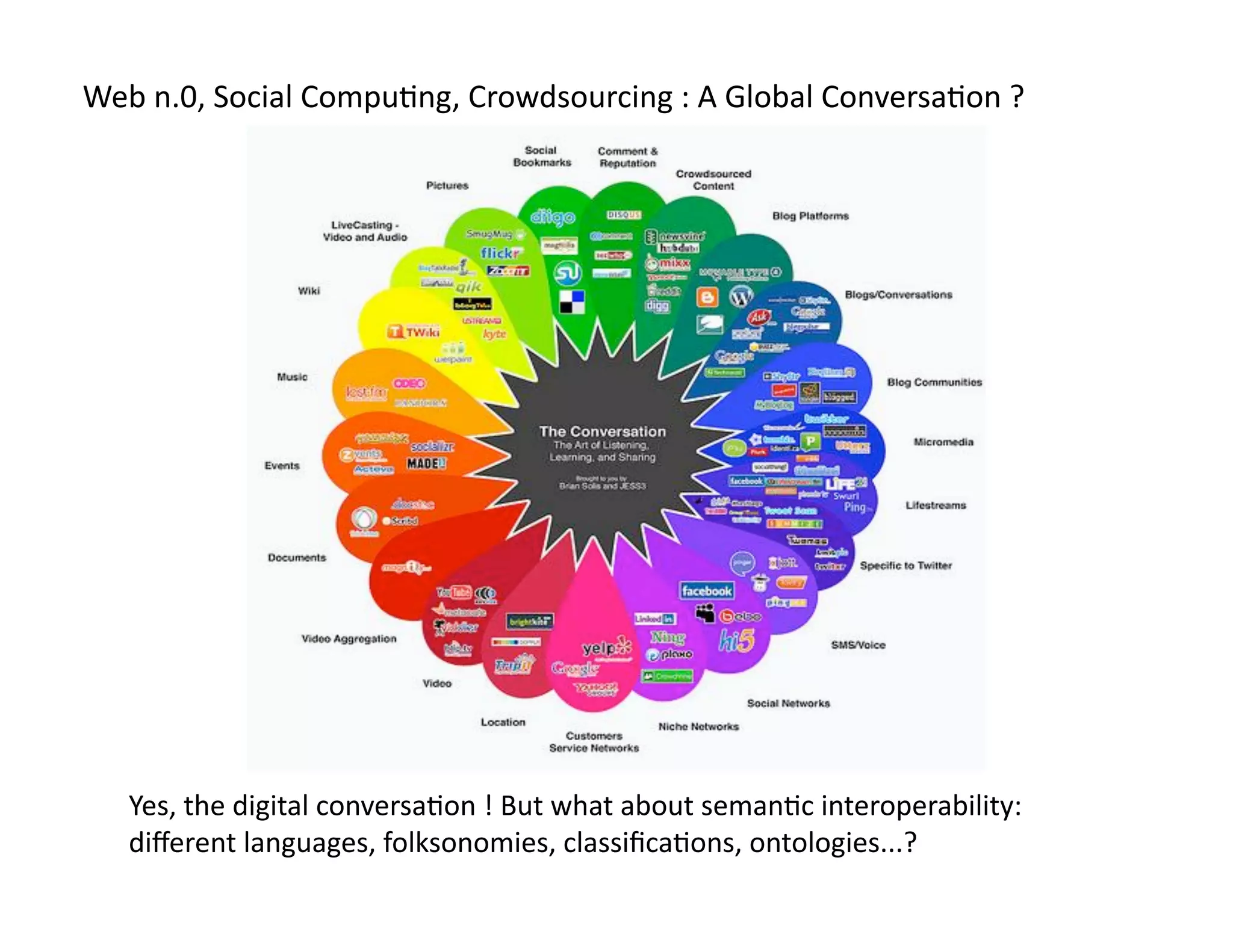
Web n.0, Social Compu-ng, Crowdsourcing : A Global Conversa-on ? 


   Yes, the digital conversa-on ! But what about seman-c interoperability: 
   different languages, folksonomies, classifica-ons, ontologies...? 
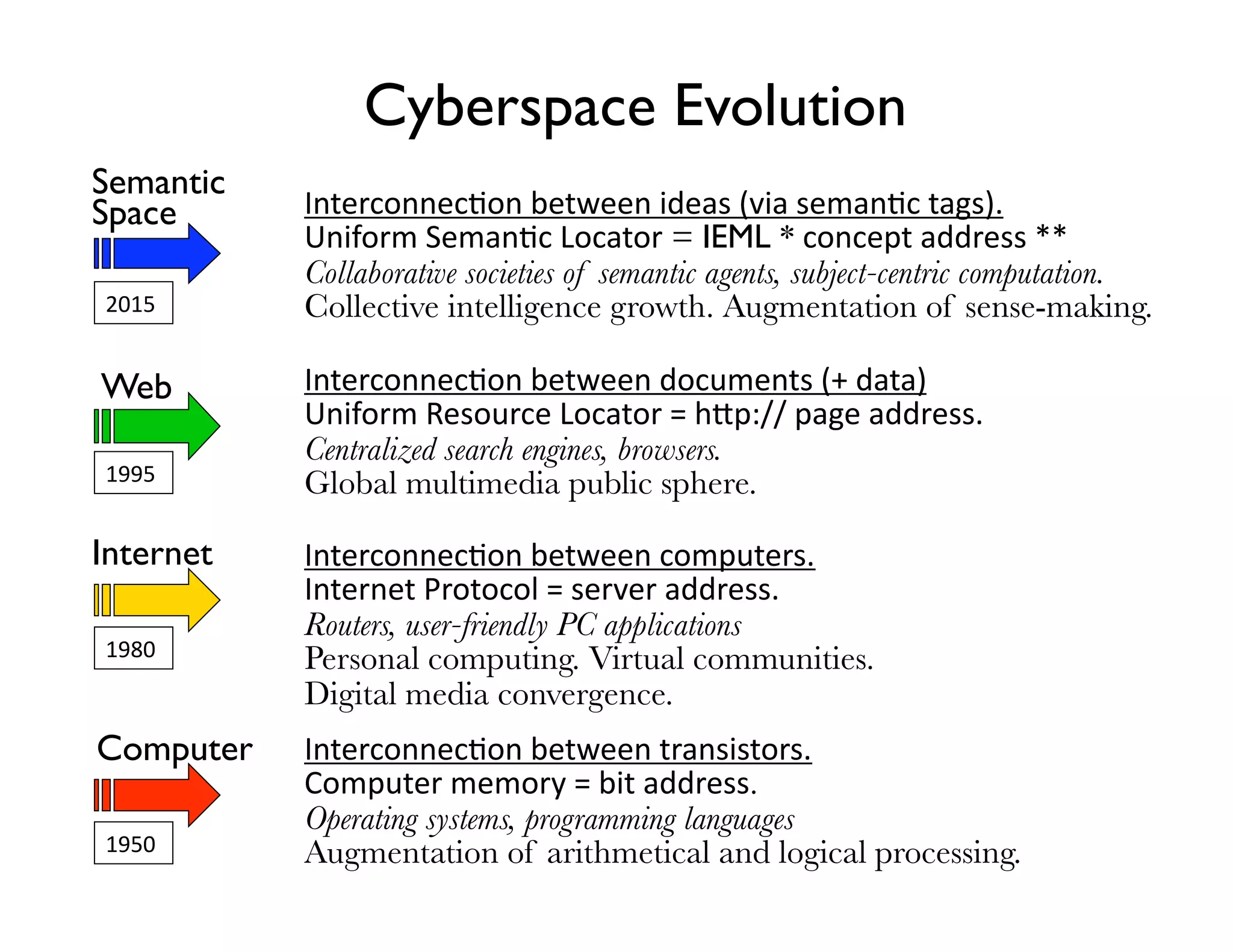
Cyberspace Evolution
Semantic
Space
      Interconnec-on between ideas (via seman-c tags). "
            Uniform Seman-c Locator = IEML * concept address ** 
            Collaborative societies of semantic agents, subject-centric computation.
2015        Collective intelligence growth. Augmentation of sense-making.

Web
        Interconnec-on between documents (+ data)
            Uniform Resource Locator = h;p:// page address. 
            Centralized search engines, browsers.
1995        Global multimedia public sphere. 

Internet
   Interconnec-on between computers. 
            Internet Protocol = server address. 
            Routers, user-friendly PC applications
1980        Personal computing. Virtual communities. "
            Digital media convergence. 
Computer
   Interconnec-on between transistors.
            Computer memory = bit address. "
            Operating systems, programming languages
1950        Augmentation of arithmetical and logical processing.
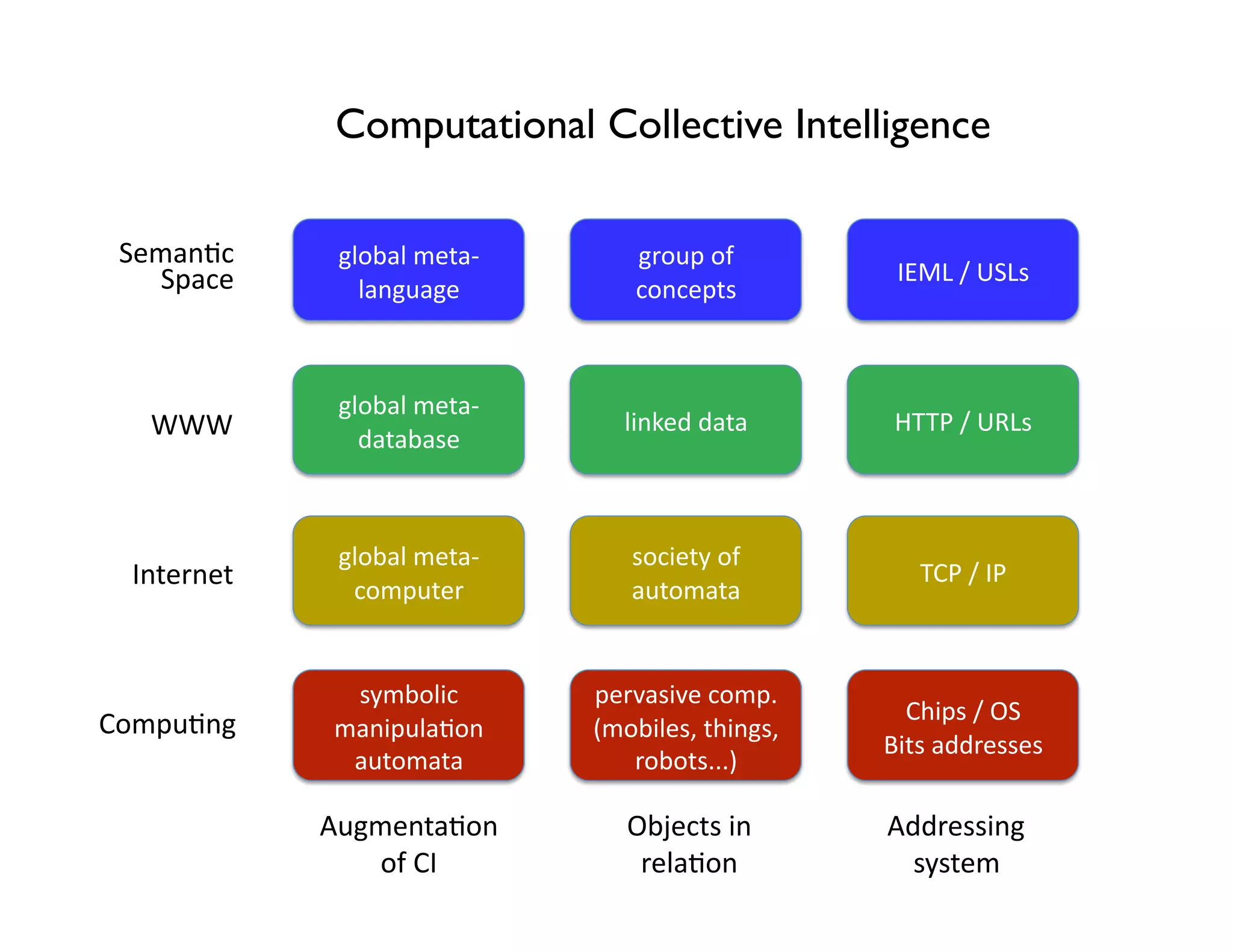
Computational Collective Intelligence

 Seman-c       global meta‐      group of 
   Space                                            IEML / USLs 
                 language        concepts 


               global meta‐
   WWW                          linked data        HTTP / URLs 
                 database 


               global meta‐      society of 
  Internet      computer         automata 
                                                      TCP / IP 


               symbolic       pervasive comp. 
Compu-ng                                             Chips / OS 
              manipula-on     (mobiles, things, 
                                                   Bits addresses 
               automata          robots...)  

              Augmenta-on        Objects in        Addressing 
                  of CI           rela-on            system 
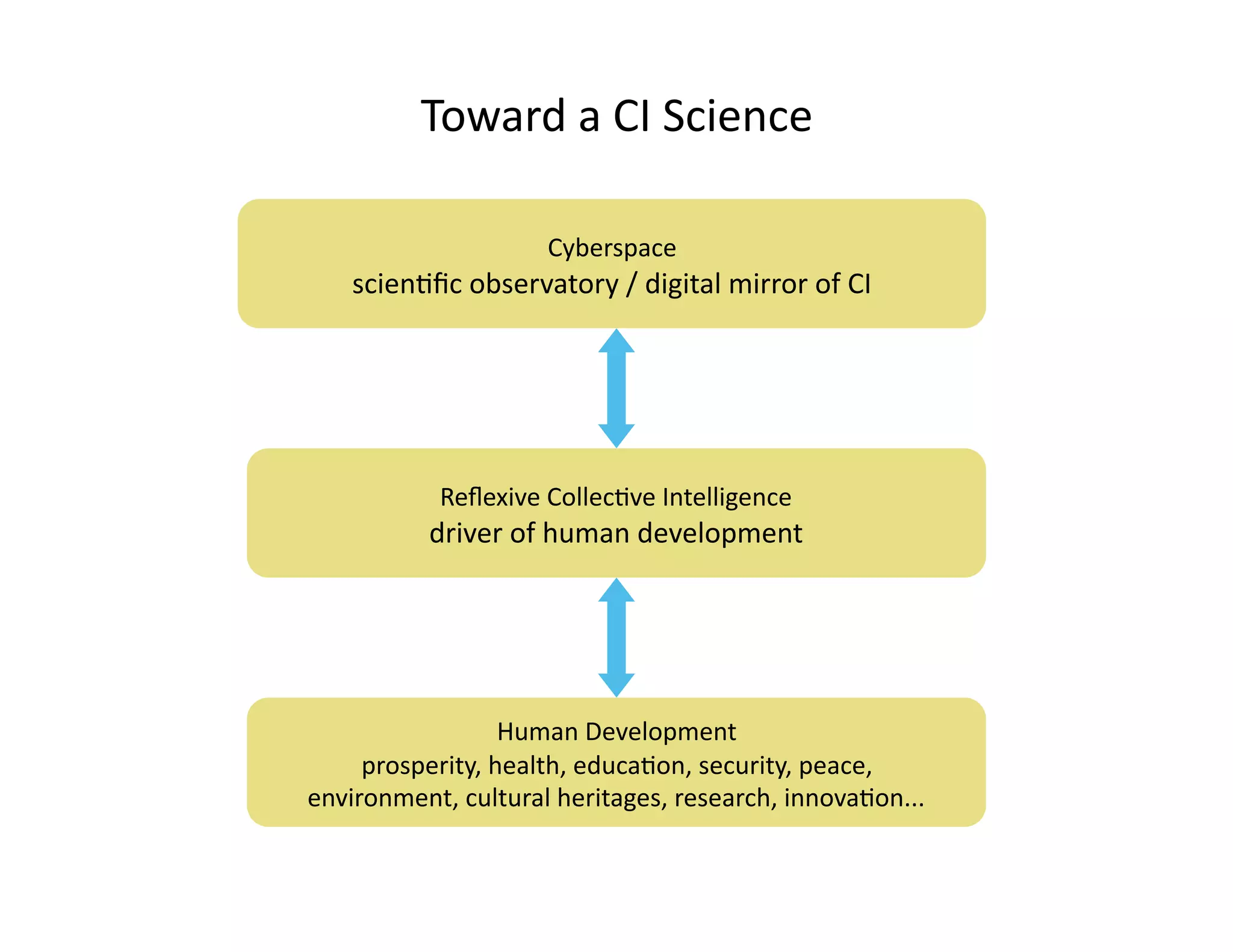
Toward a CI Science 

                     Cyberspace 
    scien-fic observatory / digital mirror of CI 


           Reflexive Collec-ve Intelligence 
          driver of human development 


                  Human Development 
     prosperity, health, educa-on, security, peace, 
environment, cultural heritages, research, innova-on... 
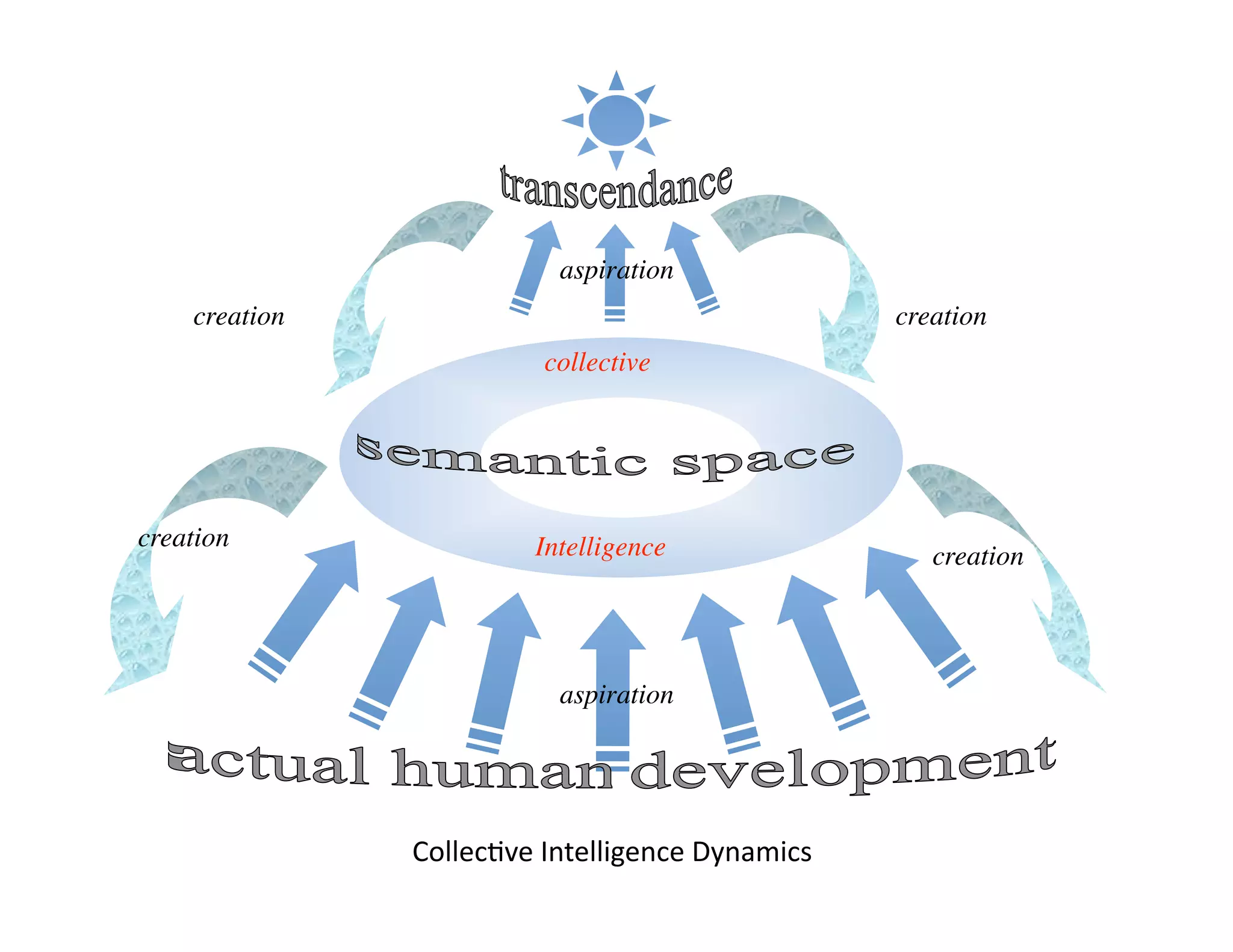
aspiration
     creation
                                      creation
                           collective


creation
                 Intelligence
                creation


                            aspiration


                 Collec-ve Intelligence Dynamics 
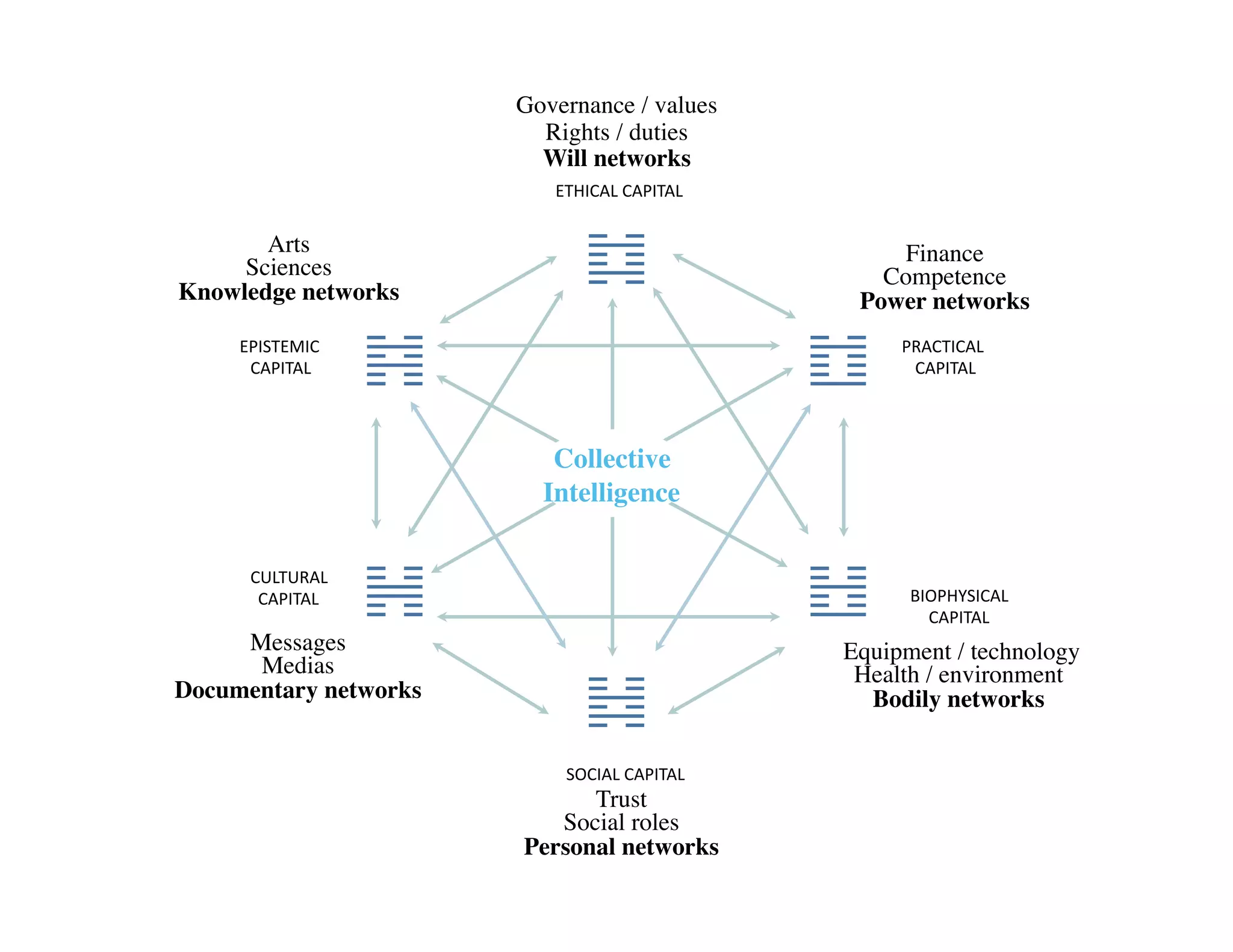
Governance / values 
                          Rights / duties
                          Will networks
                           ETHICAL CAPITAL 

       Arts                                        Finance
     Sciences                                     Competence
Knowledge networks
                              Power networks
     EPISTEMIC                                       PRACTICAL 
      CAPITAL                                          CAPITAL 


                           Collective
                          Intelligence

      CULTURAL 
       CAPITAL                                        BIOPHYSICAL 
                                                        CAPITAL 
     Messages                                  Equipment / technology
      Medias                                    Health / environment 
Documentary networks
                             Bodily networks

                            SOCIAL CAPITAL 
                              Trust
                           Social roles
                        Personal networks
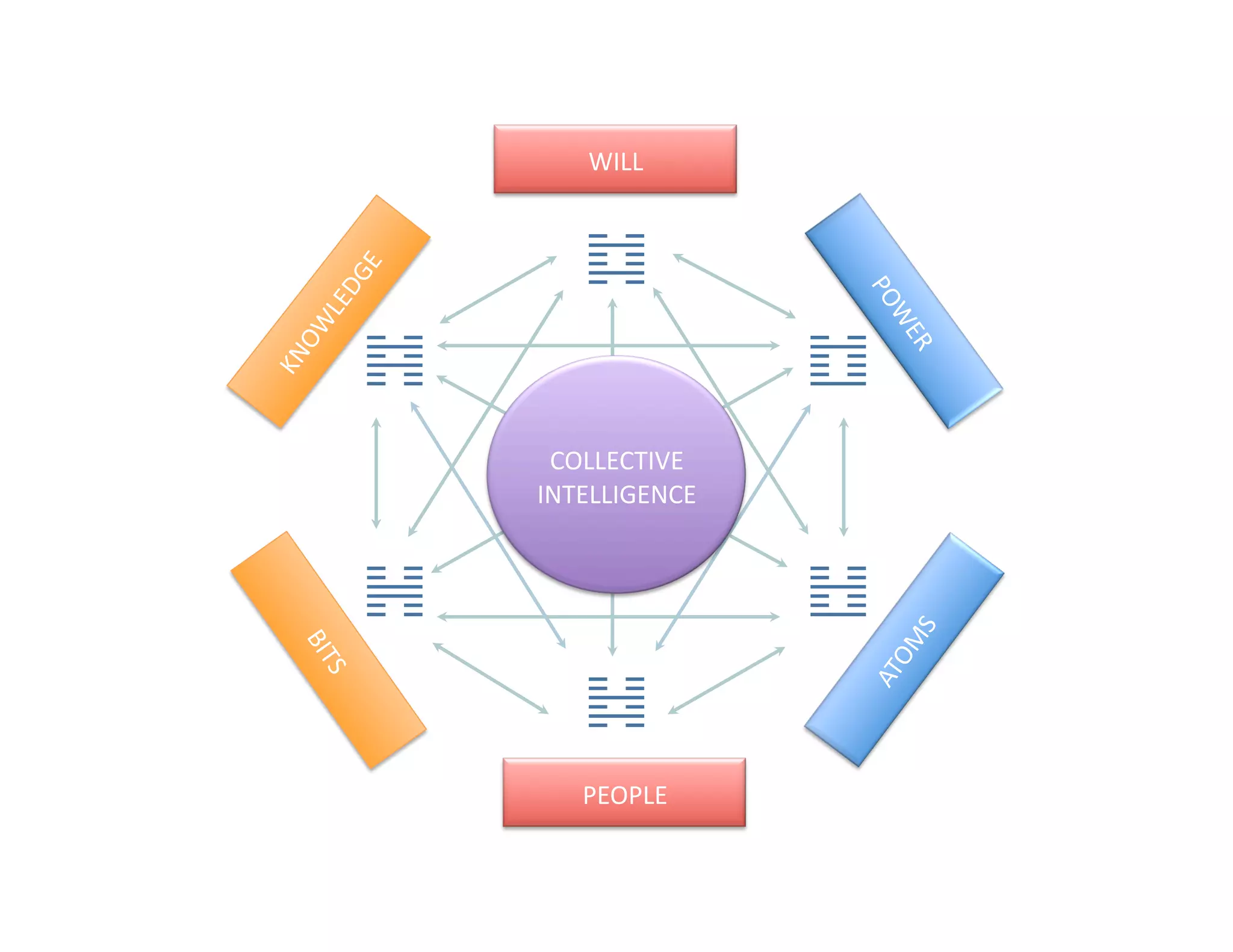
WILL 


  COLLECTIVE 
  Collective
INTELLIGENCE 
 Intelligence


   PEOPLE 
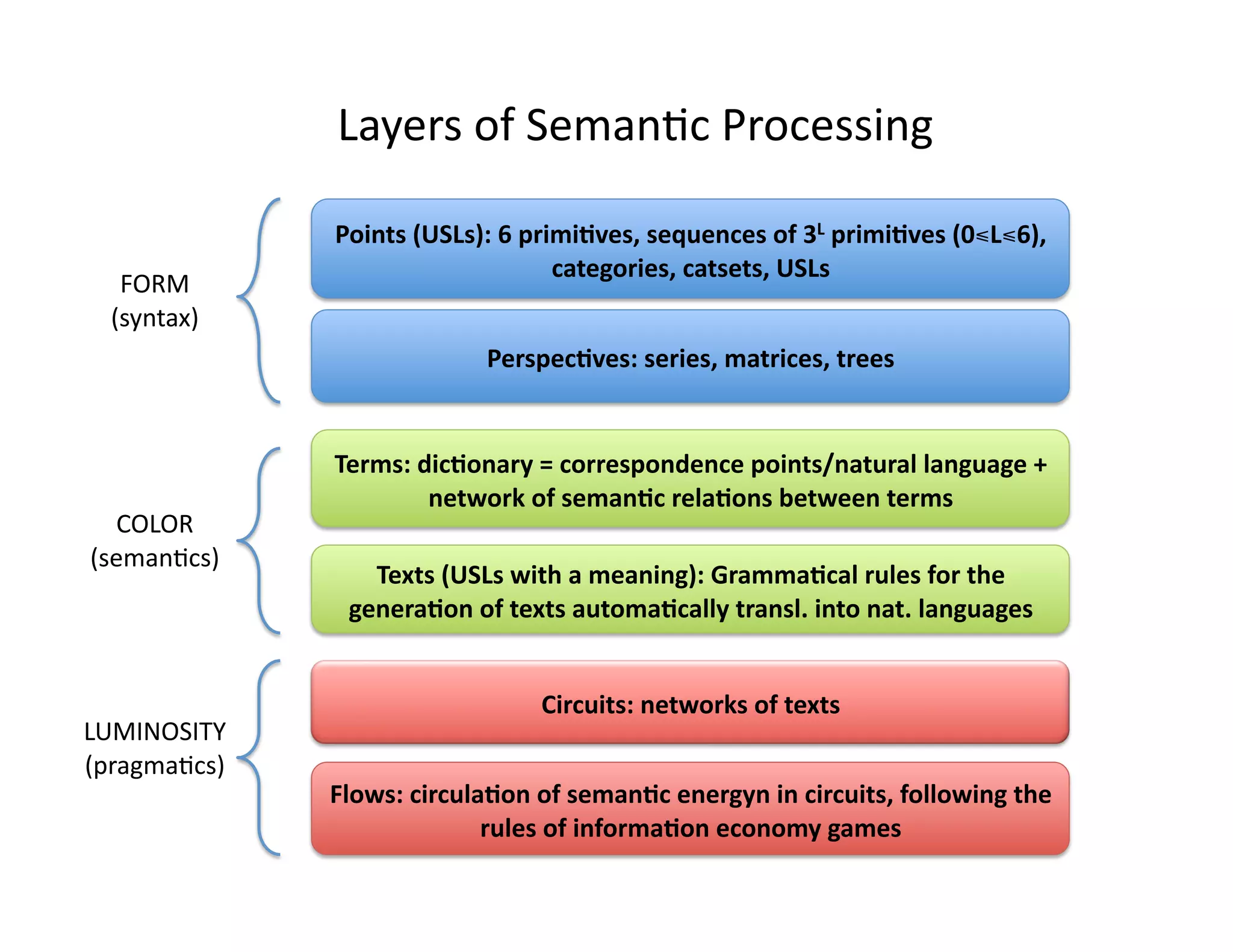
Layers of Seman-c Processing 

               Points (USLs): 6 primi-ves, sequences of 3L primi-ves (0⩽L⩽6),  
                                   categories, catsets, USLs 
   FORM 
  (syntax) 
                            Perspec-ves: series, matrices, trees 


               Terms: dic-onary = correspondence points/natural language + 
                       network of seman-c rela-ons between terms 
  COLOR 
(seman-cs) 
                  Texts (USLs with a meaning): Gramma-cal rules for the 
                genera-on of texts automa-cally transl. into nat. languages  


                                 Circuits: networks of texts 
LUMINOSITY 
(pragma-cs) 
               Flows: circula-on of seman-c energyn in circuits, following the 
                             rules of informa-on economy games 
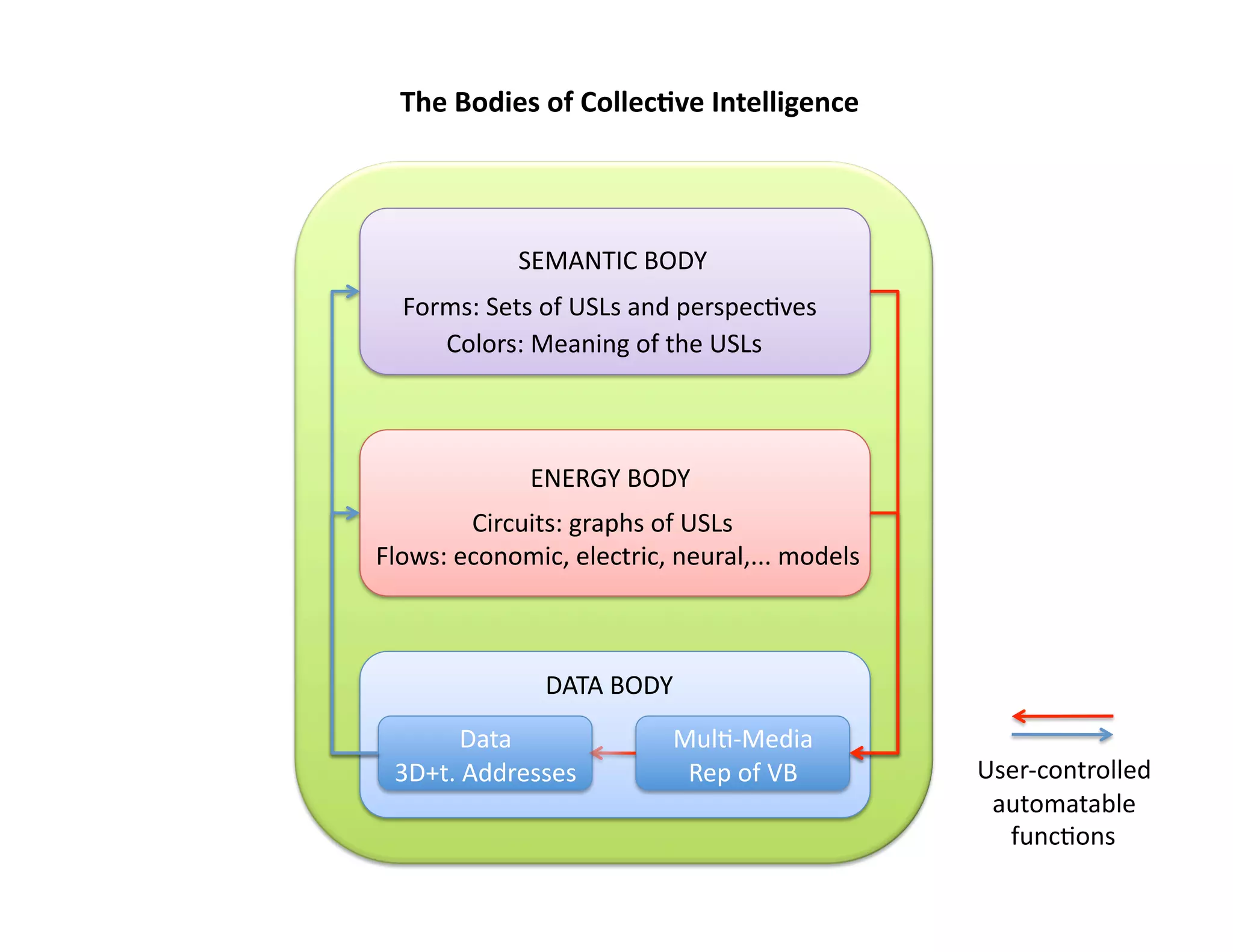
The Bodies of Collec-ve Intelligence 


             SEMANTIC BODY  
  Forms: Sets of USLs and perspec-ves 
     Colors: Meaning of the USLs 


              ENERGY BODY 
        Circuits: graphs of USLs 
Flows: economic, electric, neural,... models 


               DATA BODY 
       Data                Mul-‐Media 
 3D+t. Addresses            Rep of VB           User‐controlled 
                                                 automatable 
                                                  func-ons 
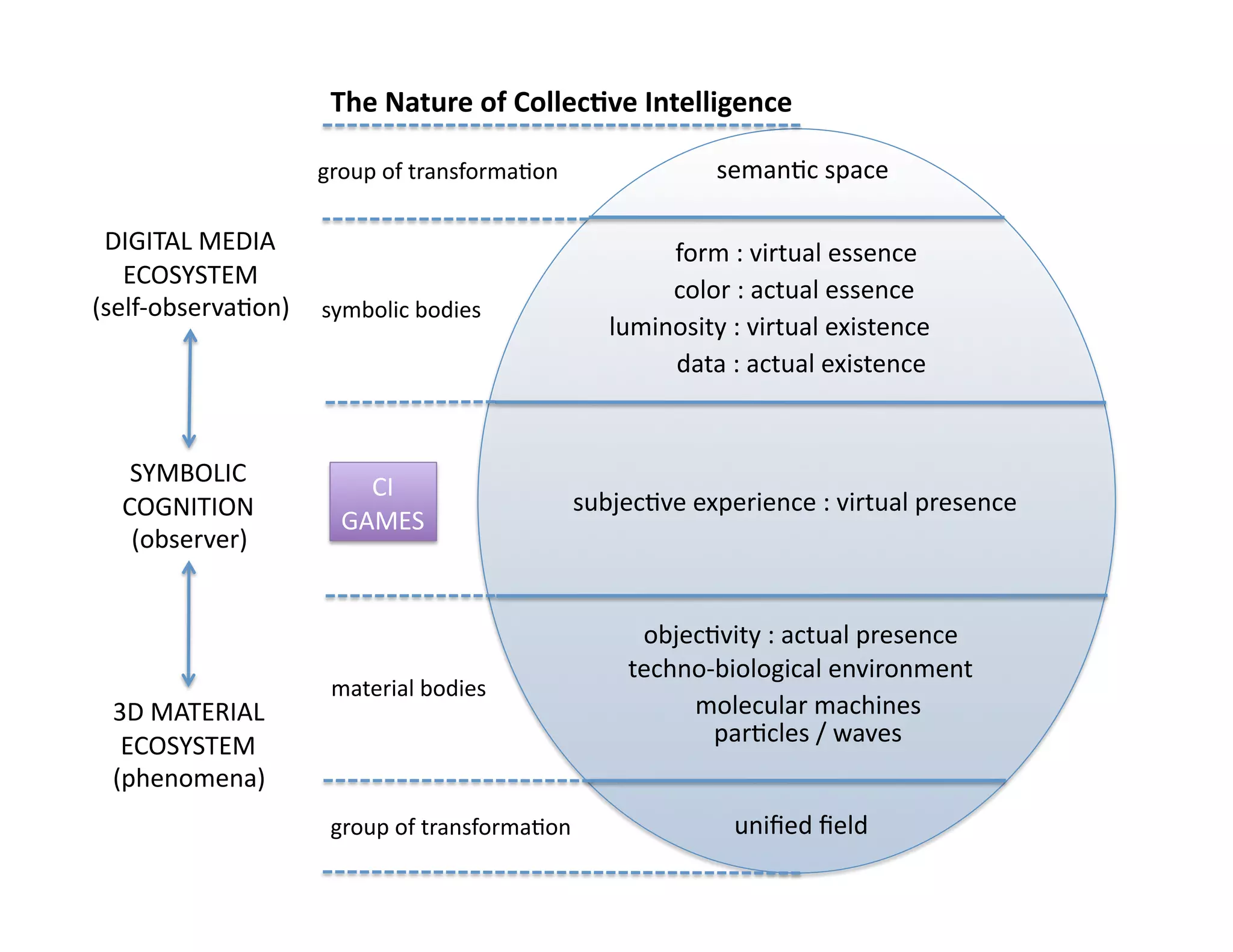
The Nature of Collec-ve Intelligence 

                    group of transforma-on                 seman-c space 

 DIGITAL MEDIA                                        form : virtual essence 
   ECOSYSTEM 
                                                      color : actual essence 
(self‐observa-on)  symbolic bodies 
                                                 luminosity : virtual existence 
                                                      data : actual existence 


   SYMBOLIC 
                        CI 
  COGNITION                                   subjec-ve experience : virtual presence  
                      GAMES 
   (observer) 


                                                   objec-vity : actual presence 
                                                  techno‐biological environment 
                     material bodies 
 3D MATERIAL                                           molecular machines 
  ECOSYSTEM                                              par-cles / waves 
 (phenomena) 
                     group of transforma-on                 unified field 
IEML and the « Seman-c Web » 
Differences of nature between  
                IEML and XML / RDF / OWL 
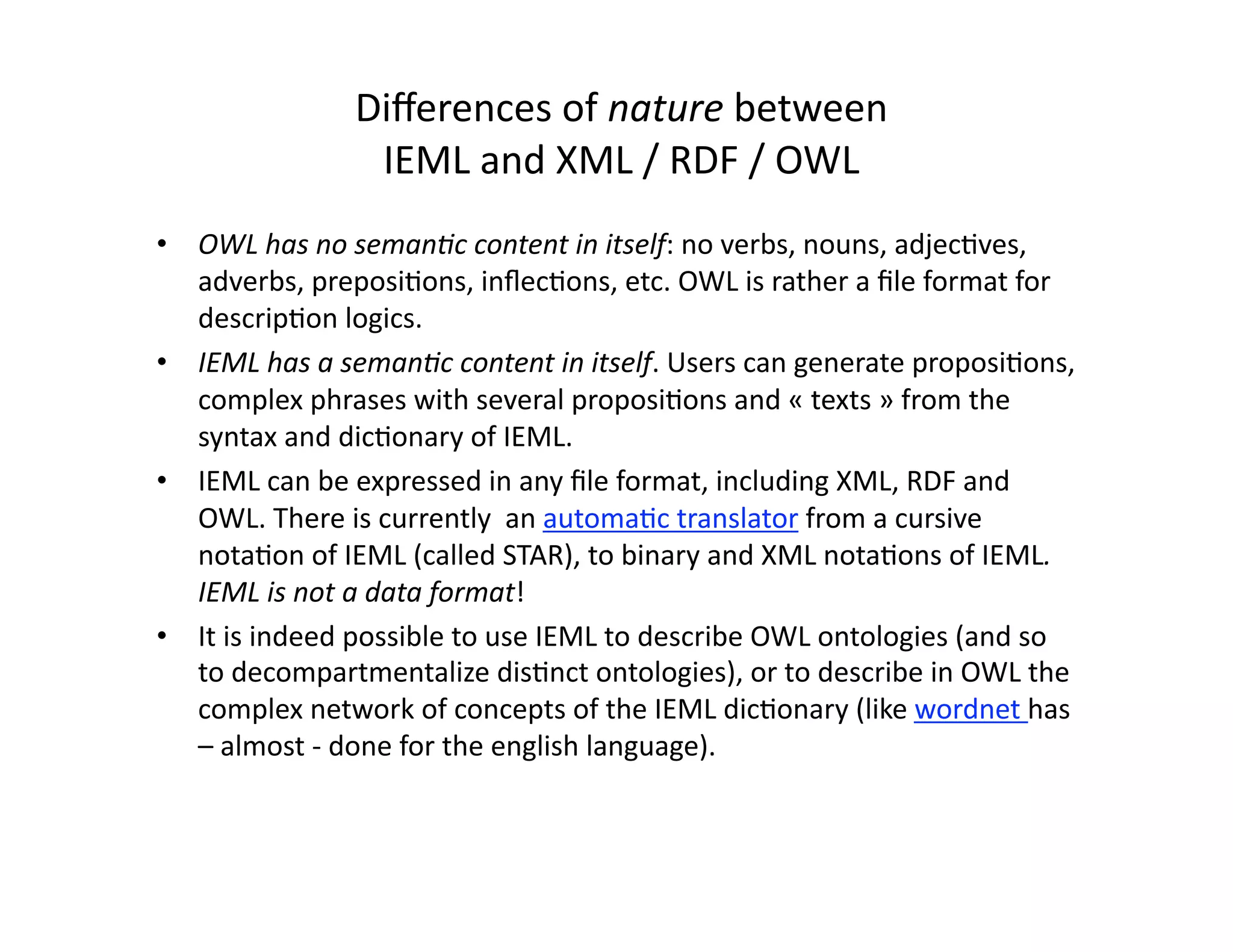
•  OWL has no seman3c content in itself: no verbs, nouns, adjec-ves, 
   adverbs, preposi-ons, inflec-ons, etc. OWL is rather a file format for 
   descrip-on logics. 
•  IEML has a seman3c content in itself. Users can generate proposi-ons, 
   complex phrases with several proposi-ons and « texts » from the 
   syntax and dic-onary of IEML.  
•  IEML can be expressed in any file format, including XML, RDF and 
   OWL. There is currently  an automa-c translator from a cursive 
   nota-on of IEML (called STAR), to binary and XML nota-ons of IEML. 
   IEML is not a data format! 
•  It is indeed possible to use IEML to describe OWL ontologies (and so 
   to decompartmentalize dis-nct ontologies), or to describe in OWL the 
   complex network of concepts of the IEML dic-onary (like wordnet has 
   – almost ‐ done for the english language). 
Differences of goals between  
                      IEML and XML / RDF / OWL 

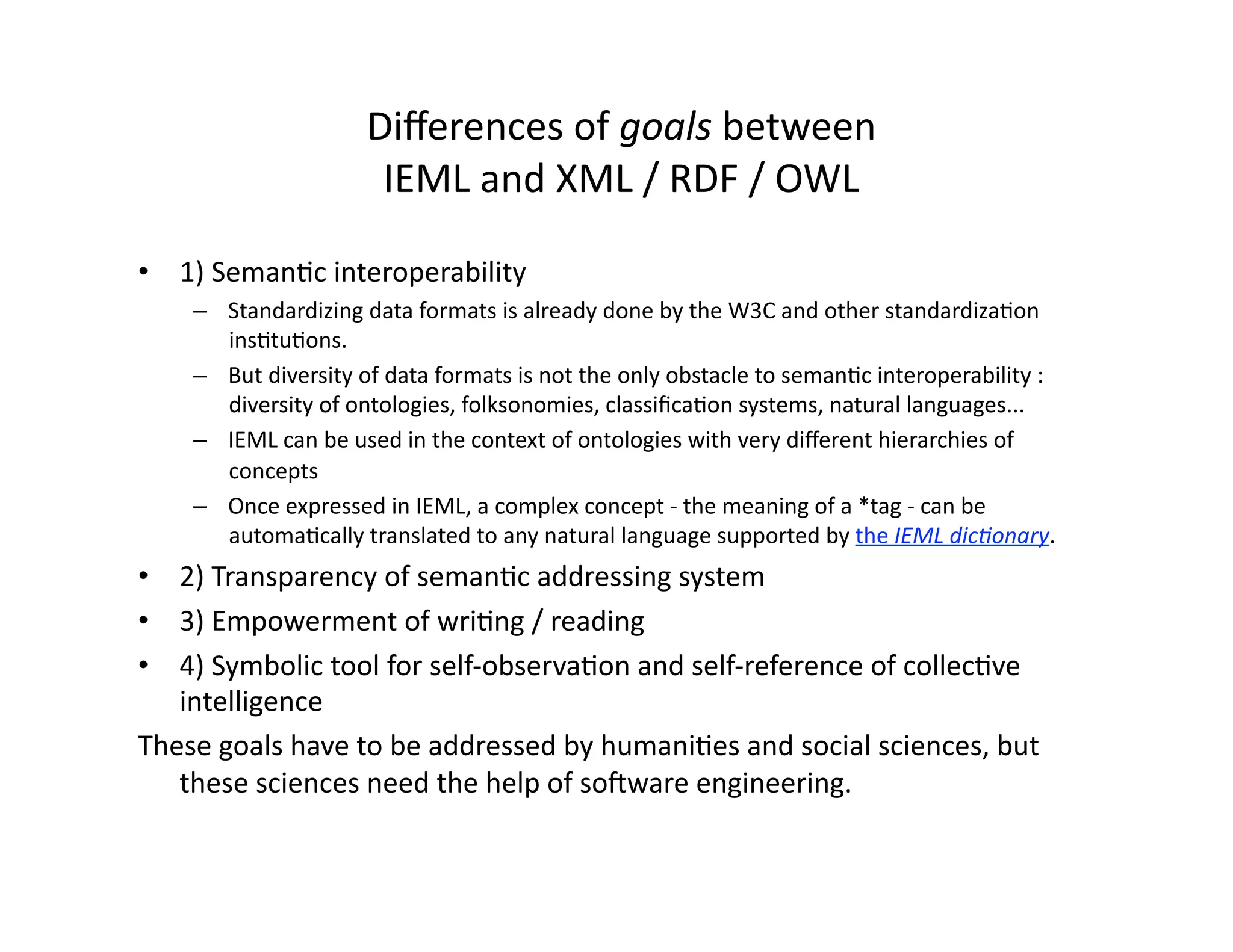
•  1) Seman-c interoperability 
    –  Standardizing data formats is already done by the W3C and other standardiza-on 
       ins-tu-ons. 
    –  But diversity of data formats is not the only obstacle to seman-c interoperability : 
       diversity of ontologies, folksonomies, classifica-on systems, natural languages...  
    –  IEML can be used in the context of ontologies with very different hierarchies of 
       concepts 
    –  Once expressed in IEML, a complex concept ‐ the meaning of a *tag ‐ can be 
       automa-cally translated to any natural language supported by the IEML dic3onary. 
•  2) Transparency of seman-c addressing system 
•  3) Empowerment of wri-ng / reading 
•  4) Symbolic tool for self‐observa-on and self‐reference of collec-ve 
   intelligence 
These goals have to be addressed by humani-es and social sciences, but 
   these sciences need the help of soZware engineering.  
Toward a transparent  
             seman-c addressing system (1) 

•  Opacity by design of the URIs 
    –   h;p://www.w3.org/TR/webarch/#uri‐opacity 
•  By contrast, IEML expressions form a group of 
   transforma3ons. Automatable algebraic transforma-ons 
   on IEML symbols correspond to automatable algebraic 
   transforma-ons on significa-ons (on “seman-cs”). 
•  The IEML seman-c space (the immense set of IEML 
   « texts », called USLs ) is in principle independent of the 
   URI address space just as it is independent of any physical 
   or telecommunica-on addressing system. 
Toward a transparent  
            seman-c addressing system (2) 

•  IEML can bring to the system of URIs a general seman3c 
   interconnec3on and a full group of transforma3on on 
   seman3cs. IEML‐URIs can be directly used as concepts in 
   RDF or OWL. The IEML research program can offer an 
   alterna-ve grounding to the en--es of the Web of data, 
   mapping URIs to such IEML‐URIs. 
•  The power of IEML can be leveraged by the exis-ng 
   standards of the Web of data. Symmetrically, the 
   expressive and algebraic proper-es of IEML can leverage 
   the current Web of data by providing it with a novel 
   grounding that can make it more seman-c. 

Toward a Civilization of Collective Intelligence

  • 1.
    Toward a Civiliza-on of   Collec-ve Intelligence  Prof. Pierre Lévy (Twi;er: @plevy)  Fellow of the Royal Society of Canada  Canada Research Chair in Collec-ve Intelligence  University of O;awa 
  • 2.
    Evolu-on of Media  (From 2000) Ubiquity,interconnection and animation of cultural signs (software). Social Computing. New sign systems. Knowledge economy. (From 1500) massive technical self-reproduction and diffusion of the alphabet and other cultural signs. New languages (animated images, etc.) Scientific notation progress. Industrial economy. (From - 1000) Digitization and universalization of writing reduced to thirty phonetic signs. Notation of numbers by position, zero. Commercial economy. (From - 3000) Autonomous technical memory of language. Ideographic Signs. Numerals, measurement units. Agricultural economy. (From - 300 000) myths, rites, oral transmission, memory inscribed in matter. Icons. Arts of memory. Hunting-gathering economy.
  • 3.
    Social Media / Social Compu-ng Features  •  Global sharing : photo (Flickr), video (Youtube), music / P2P (Bi;orrent),  bookmarks (Delicious), knowledge (Wikipedia, Freebase)  •  Distributed crea3on : user‐generated content, blogs (Wordpress), podcasts,  ci-zen journalism  •  Social networking : social networks (Facebook, Myspace, Linkedin, Xing,  Pulse, NING...), virtual worlds (Second life), instant micro‐blogging (Twi;er)  •  Streaming (Twi;er, Facebook, Friendfeed, Atom or RSS Feeds)   •  Mass collabora3on : wikis, opensourcing, crowdsourcing  •  Collabora3ve assessment : forums, ra-ngs, reviews (Bazaarvoice)  •  Social bookmarking / tagging / categoriza3on (Digg, Delicious, Twine, Diigo,  Stumbleupon, Flickr, YouTube...)  •  Cloud compu3ng : data and applica-ons are on‐line in huge distributed  data‐centers (Google, Yahoo, Facebook, Twi;er, Amazon...). SoZware as a  service. Scalability. 
  • 4.
    Web n.0, Social Compu-ng, Crowdsourcing : A Global Conversa-on ?  Yes, the digital conversa-on ! But what about seman-c interoperability:  different languages, folksonomies, classifica-ons, ontologies...? 
  • 5.
    Cyberspace Evolution Semantic Space Interconnec-on between ideas (via seman-c tags). " Uniform Seman-c Locator = IEML * concept address ** Collaborative societies of semantic agents, subject-centric computation. 2015  Collective intelligence growth. Augmentation of sense-making. Web Interconnec-on between documents (+ data) Uniform Resource Locator = h;p:// page address. Centralized search engines, browsers. 1995  Global multimedia public sphere. Internet Interconnec-on between computers. Internet Protocol = server address. Routers, user-friendly PC applications 1980  Personal computing. Virtual communities. " Digital media convergence. Computer Interconnec-on between transistors. Computer memory = bit address. " Operating systems, programming languages 1950  Augmentation of arithmetical and logical processing.
  • 6.
    Computational Collective Intelligence Seman-c  global meta‐ group of  Space  IEML / USLs  language  concepts  global meta‐ WWW  linked data  HTTP / URLs  database  global meta‐ society of  Internet  computer  automata  TCP / IP  symbolic  pervasive comp.  Compu-ng  Chips / OS  manipula-on  (mobiles, things,  Bits addresses  automata  robots...)   Augmenta-on  Objects in  Addressing  of CI  rela-on  system 
  • 7.
    Toward a CI Science  Cyberspace  scien-fic observatory / digital mirror of CI  Reflexive Collec-ve Intelligence  driver of human development  Human Development  prosperity, health, educa-on, security, peace,  environment, cultural heritages, research, innova-on... 
  • 8.
    aspiration creation creation collective creation Intelligence creation aspiration Collec-ve Intelligence Dynamics 
  • 9.
    Governance / values Rights / duties Will networks ETHICAL CAPITAL  Arts Finance Sciences Competence Knowledge networks Power networks EPISTEMIC  PRACTICAL  CAPITAL   CAPITAL  Collective Intelligence CULTURAL  CAPITAL  BIOPHYSICAL  CAPITAL  Messages Equipment / technology Medias Health / environment Documentary networks Bodily networks SOCIAL CAPITAL  Trust Social roles Personal networks
  • 10.
    WILL  COLLECTIVE  Collective INTELLIGENCE  Intelligence PEOPLE 
  • 11.
    Layers of Seman-c Processing  Points (USLs): 6 primi-ves, sequences of 3L primi-ves (0⩽L⩽6),   categories, catsets, USLs  FORM  (syntax)  Perspec-ves: series, matrices, trees  Terms: dic-onary = correspondence points/natural language +  network of seman-c rela-ons between terms  COLOR  (seman-cs)  Texts (USLs with a meaning): Gramma-cal rules for the  genera-on of texts automa-cally transl. into nat. languages   Circuits: networks of texts  LUMINOSITY  (pragma-cs)  Flows: circula-on of seman-c energyn in circuits, following the  rules of informa-on economy games 
  • 12.
    The Bodies of Collec-ve Intelligence  SEMANTIC BODY   Forms: Sets of USLs and perspec-ves  Colors: Meaning of the USLs  ENERGY BODY  Circuits: graphs of USLs  Flows: economic, electric, neural,... models  DATA BODY  Data  Mul-‐Media  3D+t. Addresses  Rep of VB  User‐controlled  automatable  func-ons 
  • 13.
    The Nature of Collec-ve Intelligence  group of transforma-on  seman-c space  DIGITAL MEDIA  form : virtual essence  ECOSYSTEM  color : actual essence  (self‐observa-on)  symbolic bodies  luminosity : virtual existence  data : actual existence  SYMBOLIC  CI  COGNITION  subjec-ve experience : virtual presence   GAMES  (observer)  objec-vity : actual presence  techno‐biological environment  material bodies  3D MATERIAL  molecular machines  ECOSYSTEM  par-cles / waves  (phenomena)  group of transforma-on  unified field 
  • 14.
  • 15.
    Differences of nature between   IEML and XML / RDF / OWL  •  OWL has no seman3c content in itself: no verbs, nouns, adjec-ves,  adverbs, preposi-ons, inflec-ons, etc. OWL is rather a file format for  descrip-on logics.  •  IEML has a seman3c content in itself. Users can generate proposi-ons,  complex phrases with several proposi-ons and « texts » from the  syntax and dic-onary of IEML.   •  IEML can be expressed in any file format, including XML, RDF and  OWL. There is currently  an automa-c translator from a cursive  nota-on of IEML (called STAR), to binary and XML nota-ons of IEML.  IEML is not a data format!  •  It is indeed possible to use IEML to describe OWL ontologies (and so  to decompartmentalize dis-nct ontologies), or to describe in OWL the  complex network of concepts of the IEML dic-onary (like wordnet has  – almost ‐ done for the english language). 
  • 16.
    Differences of goals between   IEML and XML / RDF / OWL  •  1) Seman-c interoperability  –  Standardizing data formats is already done by the W3C and other standardiza-on  ins-tu-ons.  –  But diversity of data formats is not the only obstacle to seman-c interoperability :  diversity of ontologies, folksonomies, classifica-on systems, natural languages...   –  IEML can be used in the context of ontologies with very different hierarchies of  concepts  –  Once expressed in IEML, a complex concept ‐ the meaning of a *tag ‐ can be  automa-cally translated to any natural language supported by the IEML dic3onary.  •  2) Transparency of seman-c addressing system  •  3) Empowerment of wri-ng / reading  •  4) Symbolic tool for self‐observa-on and self‐reference of collec-ve  intelligence  These goals have to be addressed by humani-es and social sciences, but  these sciences need the help of soZware engineering.  
  • 17.
    Toward a transparent   seman-c addressing system (1)  •  Opacity by design of the URIs  –   h;p://www.w3.org/TR/webarch/#uri‐opacity  •  By contrast, IEML expressions form a group of  transforma3ons. Automatable algebraic transforma-ons  on IEML symbols correspond to automatable algebraic  transforma-ons on significa-ons (on “seman-cs”).  •  The IEML seman-c space (the immense set of IEML  « texts », called USLs ) is in principle independent of the  URI address space just as it is independent of any physical  or telecommunica-on addressing system. 
  • 18.
    Toward a transparent   seman-c addressing system (2)  •  IEML can bring to the system of URIs a general seman3c  interconnec3on and a full group of transforma3on on  seman3cs. IEML‐URIs can be directly used as concepts in  RDF or OWL. The IEML research program can offer an  alterna-ve grounding to the en--es of the Web of data,  mapping URIs to such IEML‐URIs.  •  The power of IEML can be leveraged by the exis-ng  standards of the Web of data. Symmetrically, the  expressive and algebraic proper-es of IEML can leverage  the current Web of data by providing it with a novel  grounding that can make it more seman-c.