Evaluation and
Assessment for
Busy Preventionists
Holly Rider-Milkovich
Senior Director, Prevention Education
Closed captioning available at: http://bit.ly/chasco-2
Closed Captioning
Provided by StreamText
1. Click the link provided in the webinar chat panel
o http://bit.ly/chasco-2
o The captioning will appear in a separate window so please
adjust your viewing setting to allow for two side-by-side screens
on your monitor
2. Captioning will appear in real-time by StreamText staff
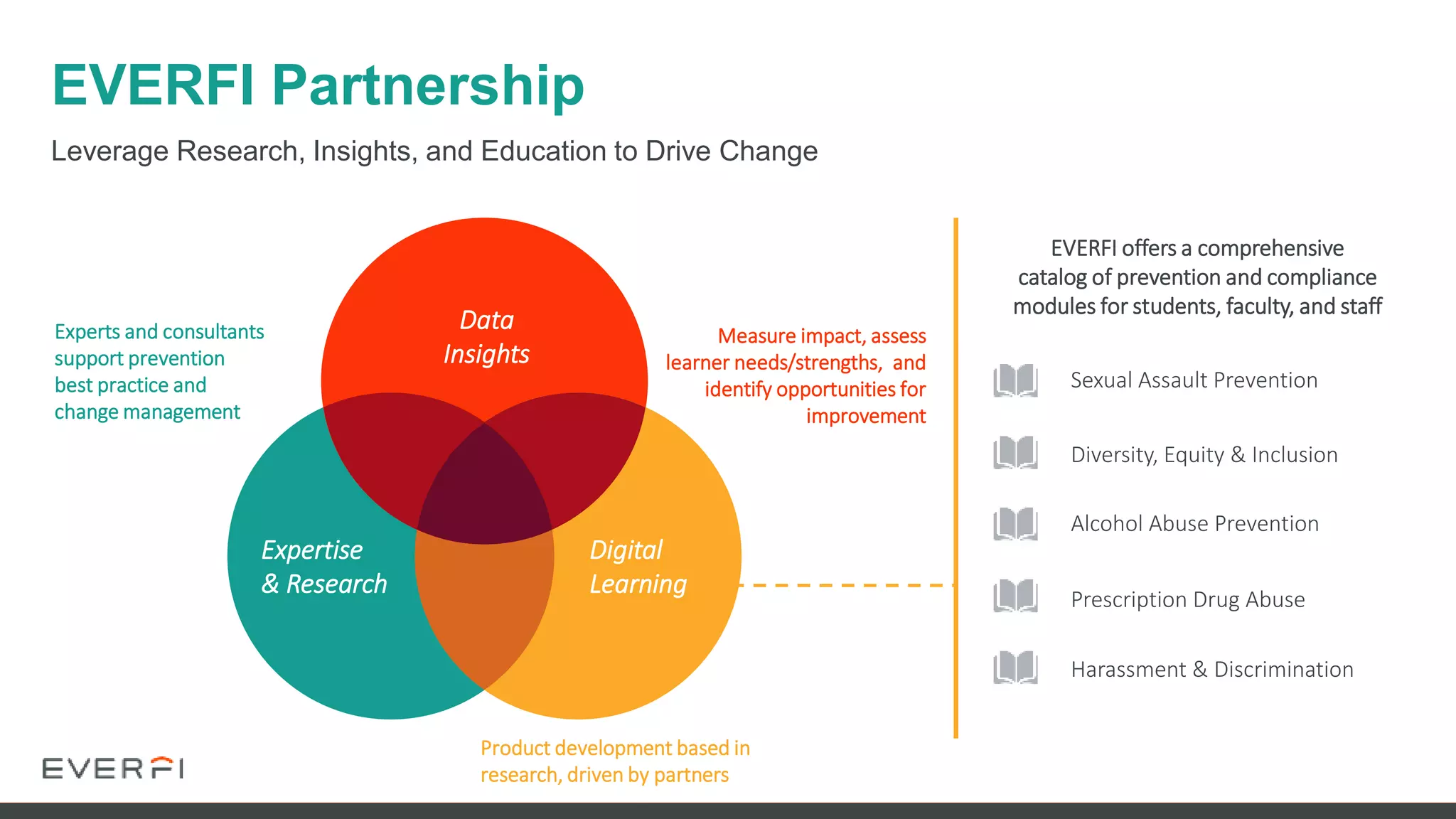
Leverage Research, Insights, and Education to Drive Change
Product development based in
research, driven by partners
Measure impact, assess
learner needs/strengths, and
identify opportunities for
improvement
Experts and consultants
support prevention
best practice and
change management
EVERFI offers a comprehensive
catalog of prevention and compliance
modules for students, faculty, and staff
Sexual Assault Prevention
Diversity, Equity & Inclusion
Harassment & Discrimination
Prescription Drug Abuse
Alcohol Abuse Prevention
Digital
Learning
Expertise
& Research
Data
Insights
EVERFI Partnership
Presenter
Holly Rider-Milkovich
Senior Director of Prevention Education
at EVERFI.
Holly brings over two decades of experience in
campus and community sexual assault
prevention at the local, state, and national level
to her work at EVERFI.
Closed captioning available at: http://bit.ly/chasco-2
Evaluation and Assessment—
What’s the Difference?1
Assessment: Diagnostic,
Formative, Process,
Summative
2
3
4
It’s Not A Party til a Logic Model
Shows Up
Clutch Evaluation and
Assessment Resources
Our Time
Together
CRITICAL PROCESSES
POLICY
PROGRAMMING
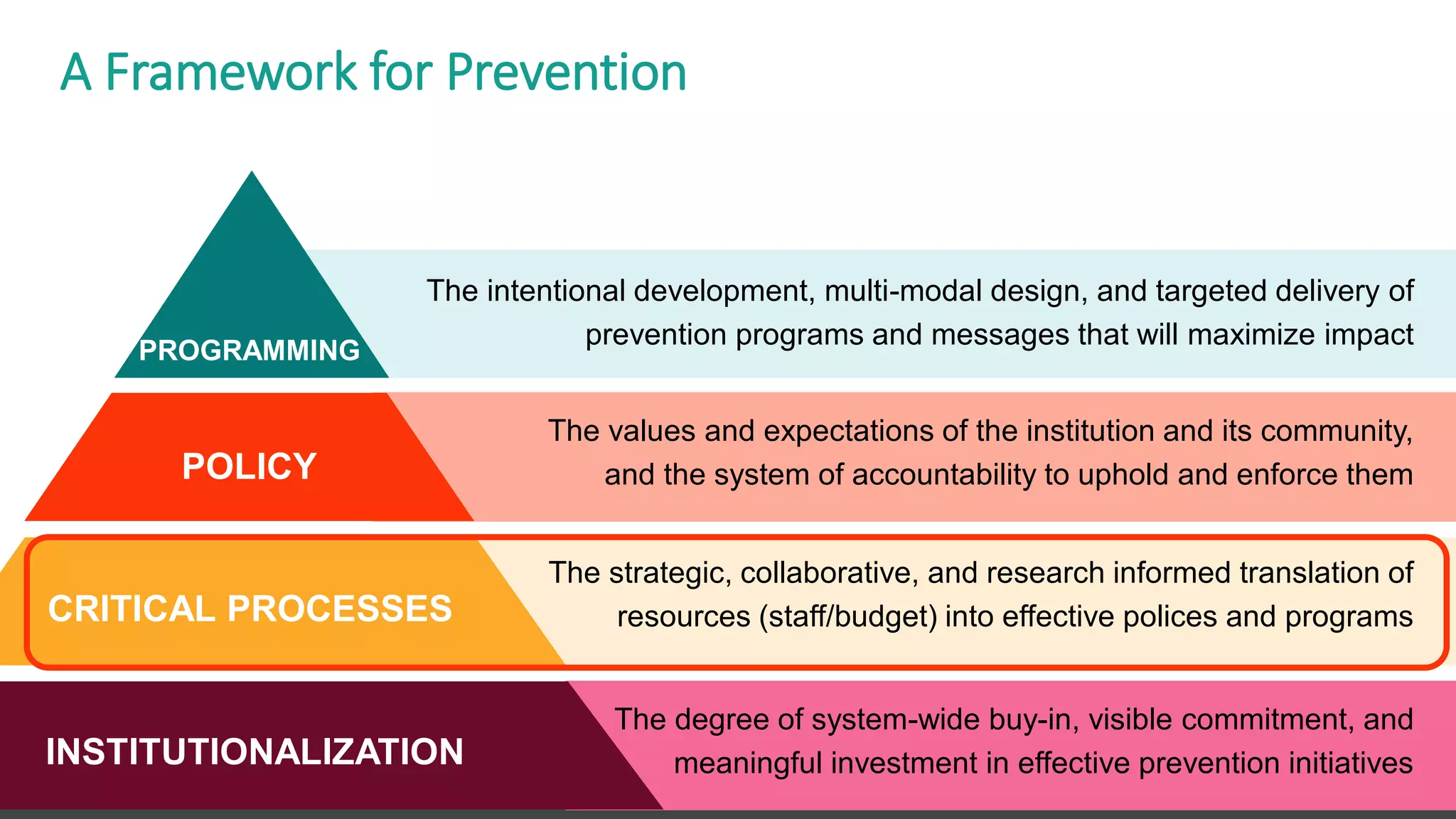
A Framework for Prevention
The degree of system-wide buy-in, visible commitment, and
meaningful investment in effective prevention initiatives
The strategic, collaborative, and research informed translation of
resources (staff/budget) into effective polices and programs
The values and expectations of the institution and its community,
and the system of accountability to uphold and enforce them
The intentional development, multi-modal design, and targeted delivery of
prevention programs and messages that will maximize impact
INSTITUTIONALIZATION
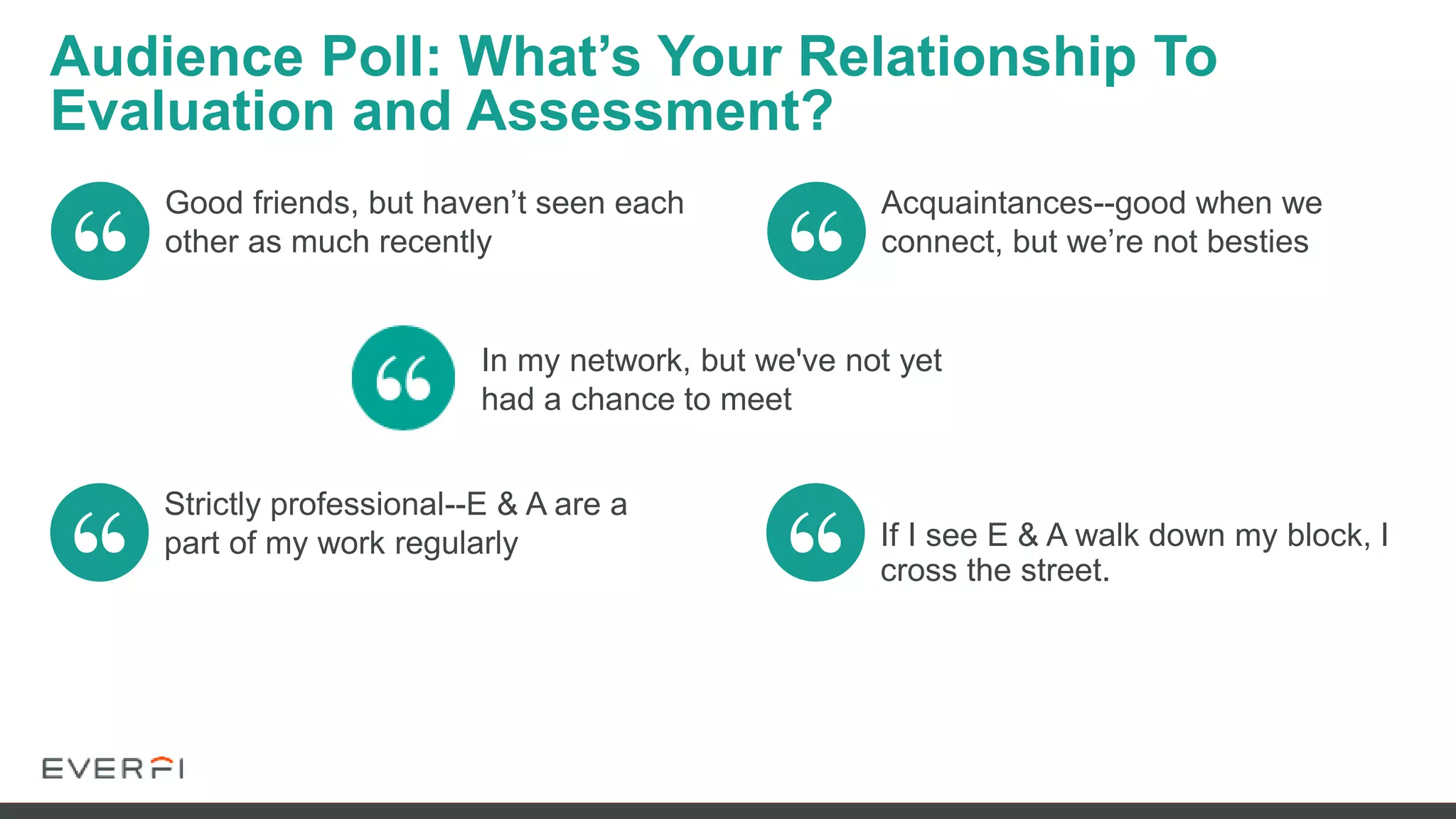
Good friends, but haven’t seen each
other as much recently
Strictly professional--E & A are a
part of my work regularly
Acquaintances--good when we
connect, but we’re not besties
If I see E & A walk down my block, I
cross the street.
Audience Poll: What’s Your Relationship To
Evaluation and Assessment?
In my network, but we've not yet
had a chance to meet
Evaluation and
Assessment: What’s
The Difference?
A Few Distinctions. . .
Research Evaluation Assessment
Focused on increasing
knowledge in a field or
testing a hypothesis
“Conducted according to a set
of guidelines”; makes a
judgment; summative;
typically fixed in time
Non-judgmental
measure of program that
provides information to
improve future efforts;
diagnostic, formative and
summative;
Source: CDC
Assessment &
Evaluation Stages
• Diagnostic, Formative, Process, Summative
Diagnostic
Formative
Process
Summative
Assessment & Evaluation Is Ongoing
12
What does the person
already know?
What is the scope of the
problem?
Did I change KABBS?
Did I improve conditions?
How well is the program
working?
Are interventions being
delivered as designed
Will the program meet
community needs?
Is it feasible?
Diagnostic Assessment
Data sources to consider include:
• Data from on-line pre-course
assessments
• Campus Climate Surveys
• Confidential Crisis Line call aggregate
data
“It's so much easier to suggest
solutions when you don't know
too much about the problem.” -
Malcolm Forbes
• Hospitalization/ transport
records
• Conduct reports
• Diagnostic Inventories
Formative Evaluation
Formative evaluation ensures that a
program or program activity is
feasible, appropriate, and
acceptable before it is fully
implemented.
Source: CDC
Data sources to consider include:
• Key stakeholder interviews
• Focus groups with target population
• Prevention Pro Analysis
Establish a planning group
Conduct a needs assessment
What is the problem?
Individual determinants
Environmental determinants
Identify specific needs and target groups
Develop long-term behavioral objectives for the target group
Review prior intervention efforts (identify successes/challenges)
Assess community and group capacity
1
2
3
4
5
Formative Evaluation In Action
Process
Data sources to consider include:
• Participant data
• Program delivery /fidelity monitoring
• Trainer/staff focus groups
Process evaluations allow evaluators to
make the important distinction between
implementation failure and theory failure.
Source: Eyesite
1
Make sure
everyone
knows why
fidelity matters
2
Review
checklist tool
with team
member being
observed
3
Provide
constructive
feedback to
team member
4
Pay attention to
success! What
worked well
and why?
5
Watch for
patterns of
concern;
opportunities
for early
intervention
Program Monitoring Considerations
17Source: http://www.episcenter.psu.edu/fidelity/more
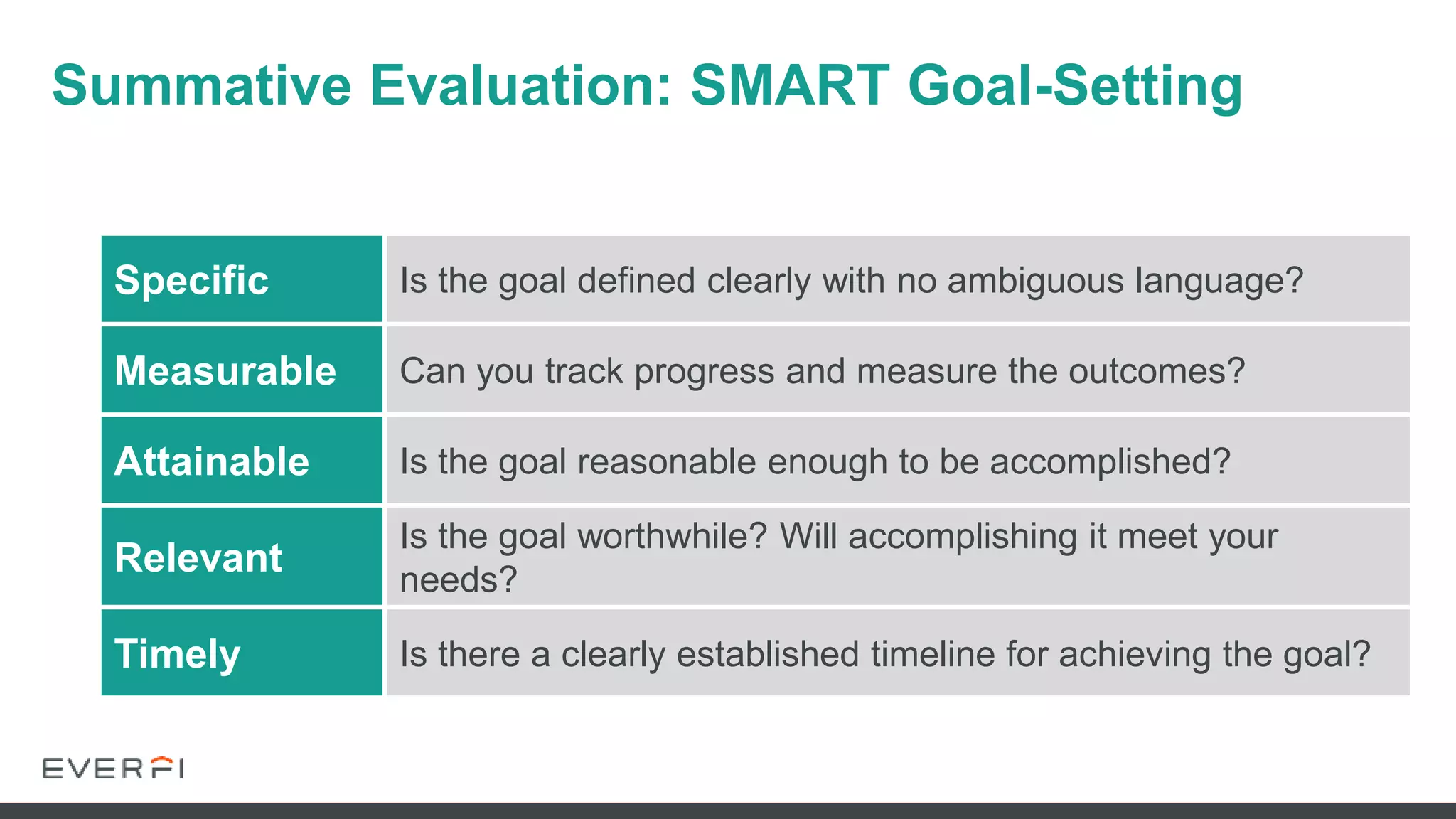
Specific Is the goal defined clearly with no ambiguous language?
Measurable Can you track progress and measure the outcomes?
Attainable Is the goal reasonable enough to be accomplished?
Relevant
Is the goal worthwhile? Will accomplishing it meet your
needs?
Timely Is there a clearly established timeline for achieving the goal?
Summative Evaluation: SMART Goal-Setting
Knowledge The individual knows basic facts about the health issue and the behavioral alternative
Attitudes
& Beliefs
The individual has more positive than negative attitudes toward the behavioral alternative
Perceived
Outcomes
The individual believes that advantages of behavioral alternative outweigh disadvantages
Social Norms
The individual perceives more social (normative) pressure to perform the behavioral
alternative than not to do so
Personal
Norms
The individual perceives that performing the behavioral alternative is more consistent than
inconsistent with their own self-image or standards
Behavioral
Skills
The individual has the skills necessary to perform the behavioral alternative
Perceived
Behavioral
Control
The individual perceives that they have the capability to perform the behavioral alternative
at specific times and places, and there are no insurmountable environmental constraints
that make it impossible to act
Individual Determinants  Learning Objectives
Its Not A Party ‘Til A
Logic Model Shows Up. . .
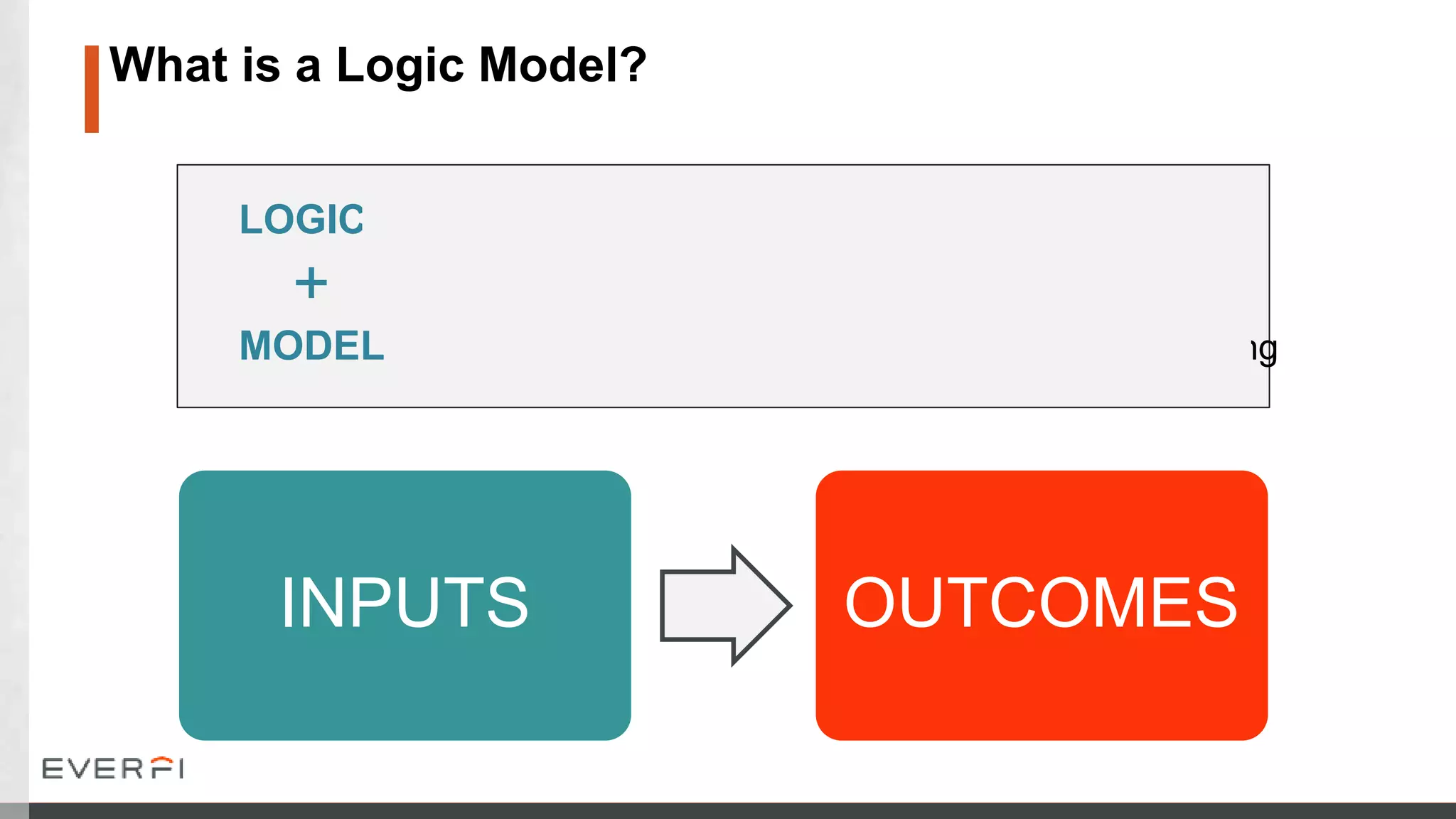
What is a Logic Model?
INPUTS OUTCOMES
LOGIC : a reasonable way of making sense of something
+
MODEL : a representation or simplified version of something
Addressing
upstream and
downstream factors
associated with
perpetration.
PERPETRATION
Educating and
empowering
students to identify,
reduce, and react
to risk.
VICTIMIZATION
Creating a
community that
promotes safe,
healthy, positive
attitudes and
actions.
COMMUNITY
Instituting
comprehensive and
effective
disciplinary
systems and
processes.
POLICY&
ADJUDICATION
Offering
accessible and
accommodating
resources to ensure
survivors’ health and
wellness.
COUNSELING
&HEALTHCARE
Creating a
community that
speaks out against
violence and
supports survivors.
ADVOCACY
&SUPPORT
PREVENTION RESPONSE&INPUTS
The purpose of your
efforts, towards
which you direct the
use of resources.
GOALS
The tangible and
intangible resources
available to help
you achieve goals.
The overarching
ideals and objectives
of your institution.
MISSION
FORMATIVE PROCESS SUMMATIVERESEARCH &
EVALUATION
What resources do we
have?
How are we going to
use our resources?
How are we going to
measure results?
Are we meeting our
goals and mission?
PREVENTION RESPONSE&INPUTS
The purpose of your
efforts, towards
which you direct the
use of resources.
GOALS
The tangible and
intangible resources
available to help
you achieve goals.
The overarching
ideals and objectives
of your institution.
MISSION
FORMATIVE PROCESS SUMMATIVE
Assessment
& Evaluation
What problem are we trying to
solve? Why does it matter?
PREVENTION RESPONSE&INPUTS
The purpose of your
efforts, towards
which you direct the
use of resources.
GOALS
The tangible and
intangible resources
available to help
you achieve goals.
The overarching
ideals and objectives
of your institution.
MISSION
FORMATIVE PROCESS SUMMATIVERESEARCH &
EVALUATION
What problem are we trying
to solve? Why does it
matter?
What are our goals?
How your
resources will be
utilized towards
prevention.
ACTIVITIES
The products and
deliverables based
on your activities.OUTPUTS
What happens
as a result of
your activities
and outputs.
OUTCOMES
How your
resources will be
utilized towards
response.
ACTIVITIES
The products and
deliverables based
on your activities.
OUTPUTS
What happens
as a result of
your activities
and outputs.
OUTCOMES
PREVENTION RESPONSE&INPUTS
The purpose of your
efforts, towards
which you direct the
use of resources.
GOALS
The tangible and
intangible resources
available to help
you achieve goals.
The overarching
ideals and objectives
of your institution.
MISSION
FORMATIVE PROCESS SUMMATIVE
ASSESSMENT & EVALUATION
What problem are we trying
to solve? Why does it
matter?
What are our goals?
What outcomes need to
happen to meet our goals
and what activities will
produce them?
How your
resources will be
utilized towards
prevention.
ACTIVITIES
The products and
deliverables based
on your activities.OUTPUTS
What happens
as a result of
your activities
and outputs.
OUTCOMES
How your
resources will be
utilized towards
response.
ACTIVITIES
The products and
deliverables based
on your activities.
OUTPUTS
What happens
as a result of
your activities
and outputs.
OUTCOMES
PREVENTION RESPONSE&INPUTS
The purpose of your
efforts, towards
which you direct the
use of resources.
GOALS
The tangible and
intangible resources
available to help
you achieve goals.
The overarching
ideals and objectives
of your institution.
MISSION
FORMATIVE PROCESS SUMMATIVE
ASSESSMENT & EVALUATION
What problem are we trying
to solve? Why does it
matter?
What are our goals?
What outcomes need to
happen to meet our goals
and what activities will
produce them?
What resources do we have?
What do we need?
Addressing
upstream and
downstream factors
associated with
perpetration.
PERPETRATION
Educating and
empowering
students to identify,
reduce, and react
to risk.
VICTIMIZATION
Creating a
community that
promotes safe,
healthy, positive
attitudes and
actions.
COMMUNITY
Instituting
comprehensive and
effective
disciplinary
systems and
processes.
POLICY&
ADJUDICATION
Offering
accessible and
accommodating
resources to ensure
survivors’ health and
wellness.
COUNSELING
&HEALTHCARE
Creating a
community that
speaks out against
violence and
supports survivors.
ADVOCACY
&SUPPORT
PREVENTION RESPONSE&INPUTS
The purpose of your
efforts, towards
which you direct the
use of resources.
GOALS
The tangible and
intangible resources
available to help
you achieve goals.
The overarching
ideals and objectives
of your institution.
MISSION
FORMATIVE PROCESS SUMMATIVE
RESEARCH & EVALUATION
What problem are we trying to
solve? Why does it matter?
What are our goals?
What outcomes need to happen
to meet our goals and what
activities will produce them?
What resources do we have?
What do we need?
Clutch Evaluation &
Assessment Resources
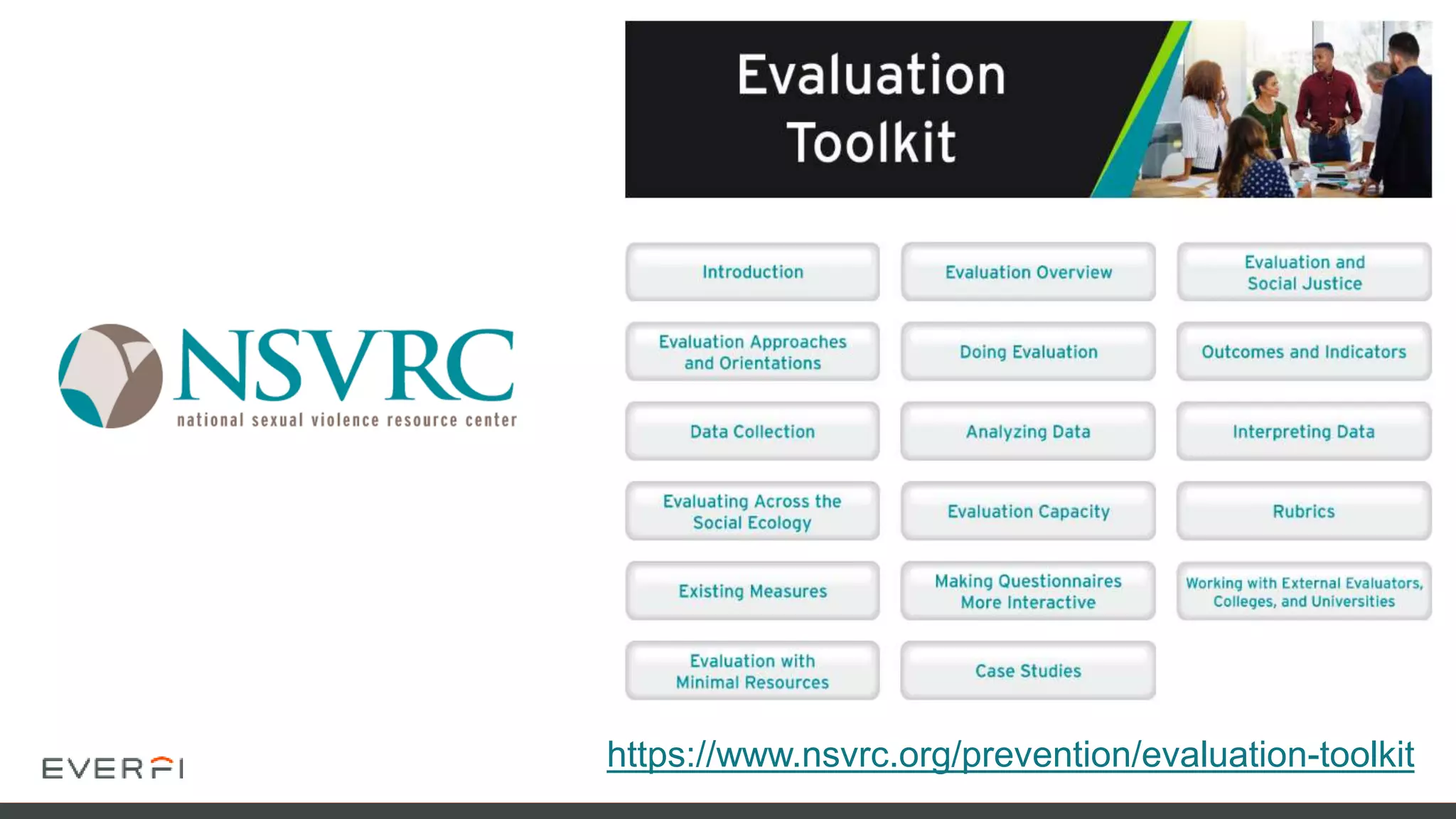
https://www.nsvrc.org/prevention/evaluation-toolkit
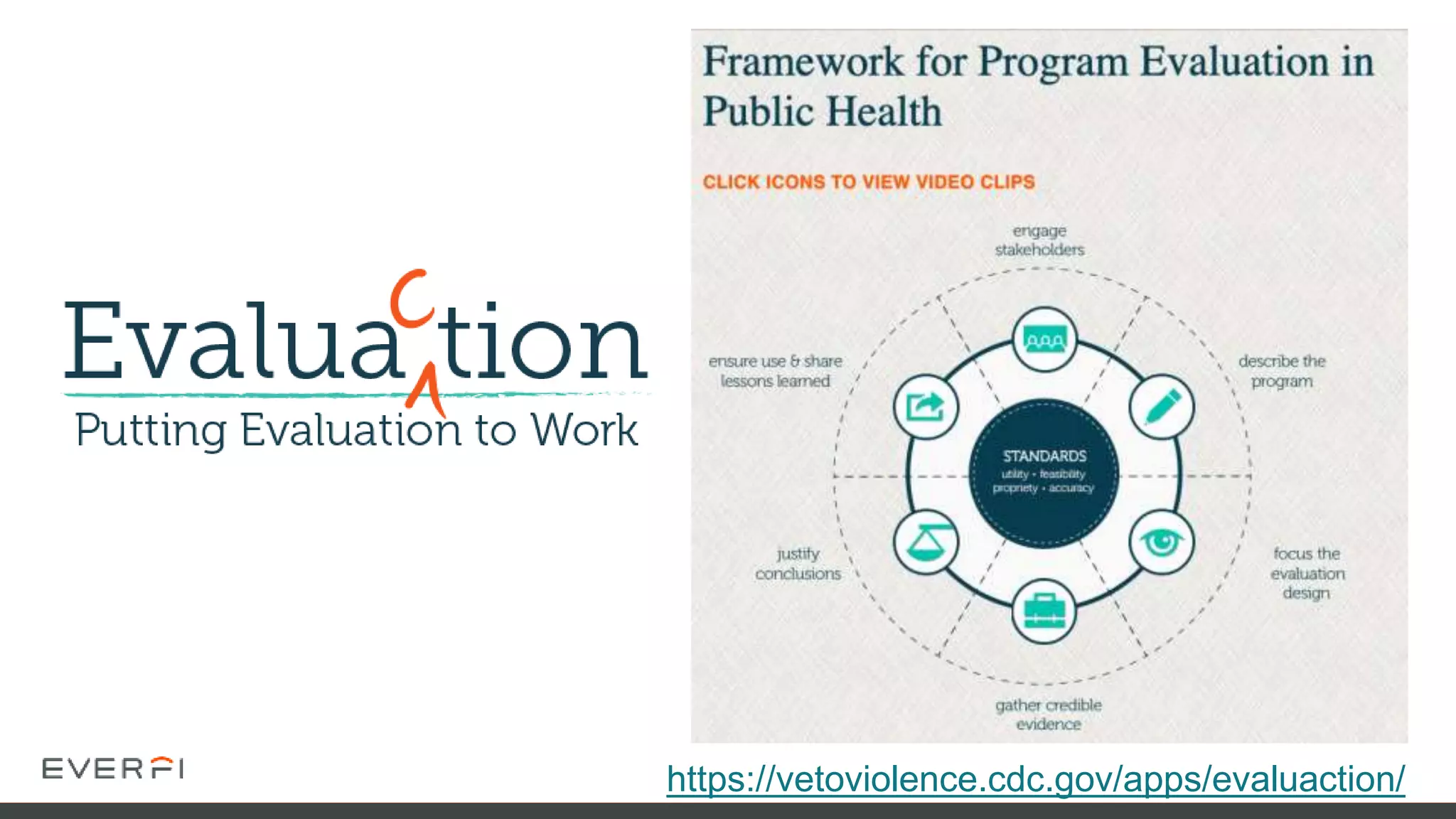
https://vetoviolence.cdc.gov/apps/evaluaction/
ARE YOU A LEADING
PREVENTION
INSTITUTION?
Find out how you measure up against
best practice and the nation’s leading
institutions.
Complete the Campus Prevention
Network’s Sexual Assault Diagnostic
Inventory (SADI) and/or Alcohol
Diagnostic Inventory (ADI).
• Go to: https://everfi.com/networks/campus-prevention-network/
• Click the Join the Network Button
I'd be interested in more EVERFI
resources on evaluation and
assessment
A
I'd be interested in learning more
about EVERFI services related
evaluation and assessment
B
Want To Learn
More? Quick
Poll
Evaluation and
Assessment for
Busy Preventionists
Holly Rider-Milkovich
Senior Director, Prevention Education
Closed captioning available at: http://bit.ly/chasco-2

Evaluation and Assessment for Busy Professionals

  • 1.
    Evaluation and Assessment for BusyPreventionists Holly Rider-Milkovich Senior Director, Prevention Education Closed captioning available at: http://bit.ly/chasco-2
  • 2.
    Closed Captioning Provided byStreamText 1. Click the link provided in the webinar chat panel o http://bit.ly/chasco-2 o The captioning will appear in a separate window so please adjust your viewing setting to allow for two side-by-side screens on your monitor 2. Captioning will appear in real-time by StreamText staff
  • 4.
    Leverage Research, Insights,and Education to Drive Change Product development based in research, driven by partners Measure impact, assess learner needs/strengths, and identify opportunities for improvement Experts and consultants support prevention best practice and change management EVERFI offers a comprehensive catalog of prevention and compliance modules for students, faculty, and staff Sexual Assault Prevention Diversity, Equity & Inclusion Harassment & Discrimination Prescription Drug Abuse Alcohol Abuse Prevention Digital Learning Expertise & Research Data Insights EVERFI Partnership
  • 5.
    Presenter Holly Rider-Milkovich Senior Directorof Prevention Education at EVERFI. Holly brings over two decades of experience in campus and community sexual assault prevention at the local, state, and national level to her work at EVERFI. Closed captioning available at: http://bit.ly/chasco-2
  • 6.
    Evaluation and Assessment— What’sthe Difference?1 Assessment: Diagnostic, Formative, Process, Summative 2 3 4 It’s Not A Party til a Logic Model Shows Up Clutch Evaluation and Assessment Resources Our Time Together
  • 7.
    CRITICAL PROCESSES POLICY PROGRAMMING A Frameworkfor Prevention The degree of system-wide buy-in, visible commitment, and meaningful investment in effective prevention initiatives The strategic, collaborative, and research informed translation of resources (staff/budget) into effective polices and programs The values and expectations of the institution and its community, and the system of accountability to uphold and enforce them The intentional development, multi-modal design, and targeted delivery of prevention programs and messages that will maximize impact INSTITUTIONALIZATION
  • 8.
    Good friends, buthaven’t seen each other as much recently Strictly professional--E & A are a part of my work regularly Acquaintances--good when we connect, but we’re not besties If I see E & A walk down my block, I cross the street. Audience Poll: What’s Your Relationship To Evaluation and Assessment? In my network, but we've not yet had a chance to meet
  • 9.
  • 10.
    A Few Distinctions.. . Research Evaluation Assessment Focused on increasing knowledge in a field or testing a hypothesis “Conducted according to a set of guidelines”; makes a judgment; summative; typically fixed in time Non-judgmental measure of program that provides information to improve future efforts; diagnostic, formative and summative; Source: CDC
  • 11.
    Assessment & Evaluation Stages •Diagnostic, Formative, Process, Summative
  • 12.
    Diagnostic Formative Process Summative Assessment & EvaluationIs Ongoing 12 What does the person already know? What is the scope of the problem? Did I change KABBS? Did I improve conditions? How well is the program working? Are interventions being delivered as designed Will the program meet community needs? Is it feasible?
  • 13.
    Diagnostic Assessment Data sourcesto consider include: • Data from on-line pre-course assessments • Campus Climate Surveys • Confidential Crisis Line call aggregate data “It's so much easier to suggest solutions when you don't know too much about the problem.” - Malcolm Forbes • Hospitalization/ transport records • Conduct reports • Diagnostic Inventories
  • 14.
    Formative Evaluation Formative evaluationensures that a program or program activity is feasible, appropriate, and acceptable before it is fully implemented. Source: CDC Data sources to consider include: • Key stakeholder interviews • Focus groups with target population • Prevention Pro Analysis
  • 15.
    Establish a planninggroup Conduct a needs assessment What is the problem? Individual determinants Environmental determinants Identify specific needs and target groups Develop long-term behavioral objectives for the target group Review prior intervention efforts (identify successes/challenges) Assess community and group capacity 1 2 3 4 5 Formative Evaluation In Action
  • 16.
    Process Data sources toconsider include: • Participant data • Program delivery /fidelity monitoring • Trainer/staff focus groups Process evaluations allow evaluators to make the important distinction between implementation failure and theory failure. Source: Eyesite
  • 17.
    1 Make sure everyone knows why fidelitymatters 2 Review checklist tool with team member being observed 3 Provide constructive feedback to team member 4 Pay attention to success! What worked well and why? 5 Watch for patterns of concern; opportunities for early intervention Program Monitoring Considerations 17Source: http://www.episcenter.psu.edu/fidelity/more
  • 18.
    Specific Is thegoal defined clearly with no ambiguous language? Measurable Can you track progress and measure the outcomes? Attainable Is the goal reasonable enough to be accomplished? Relevant Is the goal worthwhile? Will accomplishing it meet your needs? Timely Is there a clearly established timeline for achieving the goal? Summative Evaluation: SMART Goal-Setting
  • 19.
    Knowledge The individualknows basic facts about the health issue and the behavioral alternative Attitudes & Beliefs The individual has more positive than negative attitudes toward the behavioral alternative Perceived Outcomes The individual believes that advantages of behavioral alternative outweigh disadvantages Social Norms The individual perceives more social (normative) pressure to perform the behavioral alternative than not to do so Personal Norms The individual perceives that performing the behavioral alternative is more consistent than inconsistent with their own self-image or standards Behavioral Skills The individual has the skills necessary to perform the behavioral alternative Perceived Behavioral Control The individual perceives that they have the capability to perform the behavioral alternative at specific times and places, and there are no insurmountable environmental constraints that make it impossible to act Individual Determinants  Learning Objectives
  • 20.
    Its Not AParty ‘Til A Logic Model Shows Up. . .
  • 21.
    What is aLogic Model? INPUTS OUTCOMES LOGIC : a reasonable way of making sense of something + MODEL : a representation or simplified version of something
  • 22.
    Addressing upstream and downstream factors associatedwith perpetration. PERPETRATION Educating and empowering students to identify, reduce, and react to risk. VICTIMIZATION Creating a community that promotes safe, healthy, positive attitudes and actions. COMMUNITY Instituting comprehensive and effective disciplinary systems and processes. POLICY& ADJUDICATION Offering accessible and accommodating resources to ensure survivors’ health and wellness. COUNSELING &HEALTHCARE Creating a community that speaks out against violence and supports survivors. ADVOCACY &SUPPORT PREVENTION RESPONSE&INPUTS The purpose of your efforts, towards which you direct the use of resources. GOALS The tangible and intangible resources available to help you achieve goals. The overarching ideals and objectives of your institution. MISSION FORMATIVE PROCESS SUMMATIVERESEARCH & EVALUATION What resources do we have? How are we going to use our resources? How are we going to measure results? Are we meeting our goals and mission?
  • 23.
    PREVENTION RESPONSE&INPUTS The purposeof your efforts, towards which you direct the use of resources. GOALS The tangible and intangible resources available to help you achieve goals. The overarching ideals and objectives of your institution. MISSION FORMATIVE PROCESS SUMMATIVE Assessment & Evaluation What problem are we trying to solve? Why does it matter?
  • 24.
    PREVENTION RESPONSE&INPUTS The purposeof your efforts, towards which you direct the use of resources. GOALS The tangible and intangible resources available to help you achieve goals. The overarching ideals and objectives of your institution. MISSION FORMATIVE PROCESS SUMMATIVERESEARCH & EVALUATION What problem are we trying to solve? Why does it matter? What are our goals?
  • 25.
    How your resources willbe utilized towards prevention. ACTIVITIES The products and deliverables based on your activities.OUTPUTS What happens as a result of your activities and outputs. OUTCOMES How your resources will be utilized towards response. ACTIVITIES The products and deliverables based on your activities. OUTPUTS What happens as a result of your activities and outputs. OUTCOMES PREVENTION RESPONSE&INPUTS The purpose of your efforts, towards which you direct the use of resources. GOALS The tangible and intangible resources available to help you achieve goals. The overarching ideals and objectives of your institution. MISSION FORMATIVE PROCESS SUMMATIVE ASSESSMENT & EVALUATION What problem are we trying to solve? Why does it matter? What are our goals? What outcomes need to happen to meet our goals and what activities will produce them?
  • 26.
    How your resources willbe utilized towards prevention. ACTIVITIES The products and deliverables based on your activities.OUTPUTS What happens as a result of your activities and outputs. OUTCOMES How your resources will be utilized towards response. ACTIVITIES The products and deliverables based on your activities. OUTPUTS What happens as a result of your activities and outputs. OUTCOMES PREVENTION RESPONSE&INPUTS The purpose of your efforts, towards which you direct the use of resources. GOALS The tangible and intangible resources available to help you achieve goals. The overarching ideals and objectives of your institution. MISSION FORMATIVE PROCESS SUMMATIVE ASSESSMENT & EVALUATION What problem are we trying to solve? Why does it matter? What are our goals? What outcomes need to happen to meet our goals and what activities will produce them? What resources do we have? What do we need?
  • 27.
    Addressing upstream and downstream factors associatedwith perpetration. PERPETRATION Educating and empowering students to identify, reduce, and react to risk. VICTIMIZATION Creating a community that promotes safe, healthy, positive attitudes and actions. COMMUNITY Instituting comprehensive and effective disciplinary systems and processes. POLICY& ADJUDICATION Offering accessible and accommodating resources to ensure survivors’ health and wellness. COUNSELING &HEALTHCARE Creating a community that speaks out against violence and supports survivors. ADVOCACY &SUPPORT PREVENTION RESPONSE&INPUTS The purpose of your efforts, towards which you direct the use of resources. GOALS The tangible and intangible resources available to help you achieve goals. The overarching ideals and objectives of your institution. MISSION FORMATIVE PROCESS SUMMATIVE RESEARCH & EVALUATION What problem are we trying to solve? Why does it matter? What are our goals? What outcomes need to happen to meet our goals and what activities will produce them? What resources do we have? What do we need?
  • 28.
  • 29.
  • 30.
  • 31.
    ARE YOU ALEADING PREVENTION INSTITUTION? Find out how you measure up against best practice and the nation’s leading institutions. Complete the Campus Prevention Network’s Sexual Assault Diagnostic Inventory (SADI) and/or Alcohol Diagnostic Inventory (ADI). • Go to: https://everfi.com/networks/campus-prevention-network/ • Click the Join the Network Button
  • 32.
    I'd be interestedin more EVERFI resources on evaluation and assessment A I'd be interested in learning more about EVERFI services related evaluation and assessment B Want To Learn More? Quick Poll
  • 33.
    Evaluation and Assessment for BusyPreventionists Holly Rider-Milkovich Senior Director, Prevention Education Closed captioning available at: http://bit.ly/chasco-2