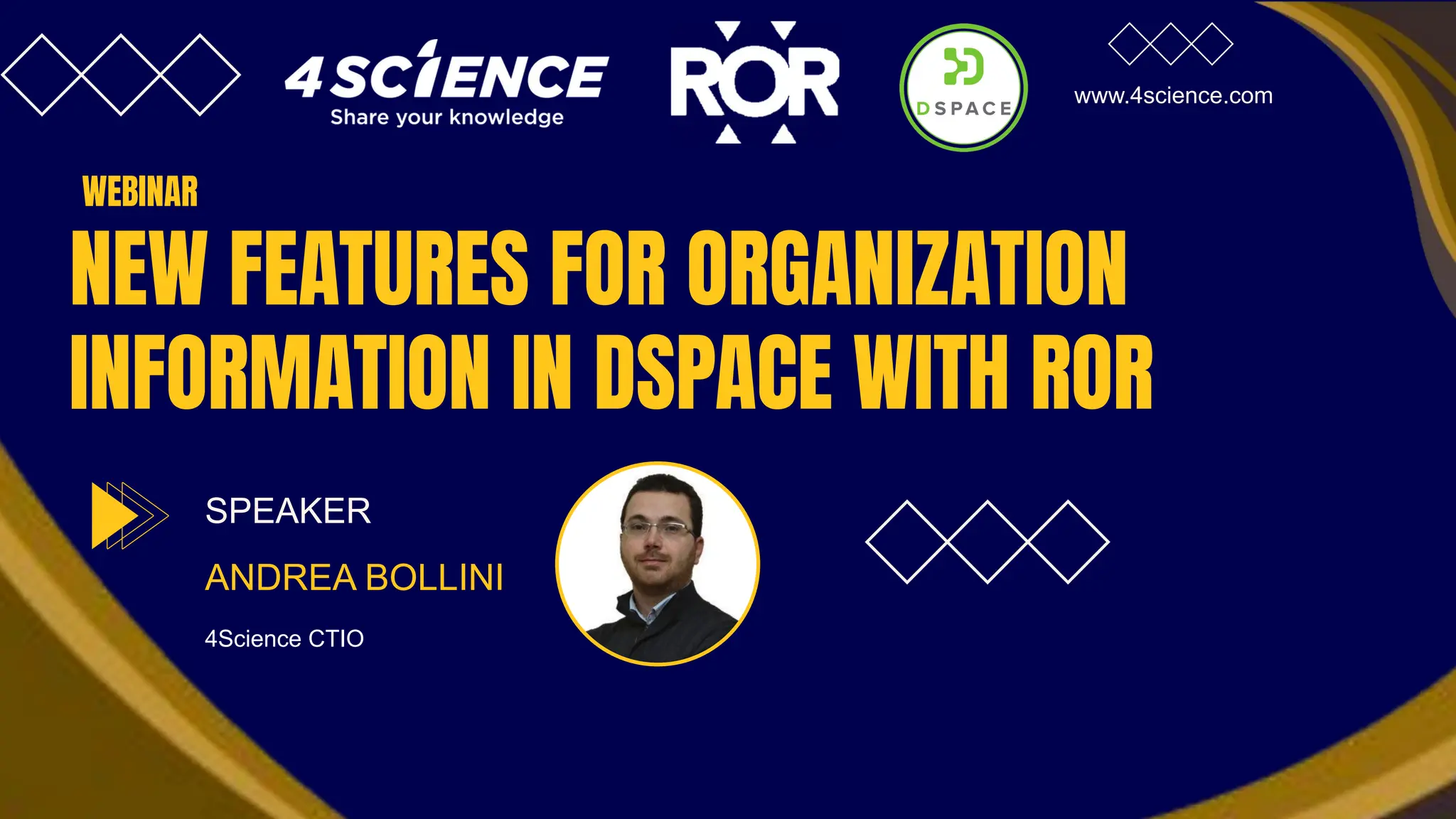
NEW FEATURES FOR ORGANIZATION
INFORMATION IN DSPACE WITH ROR
www.4science.com
SPEAKER
ANDREA BOLLINI
4Science CTIO
WEBINAR
AGENDA
01
02
03
04
05
TECHNICAL IMPLEMENTATION
LIVE DEMONSTRATION
FUTURE DEVELOPMENTS
INTRODUCTION TO ROR
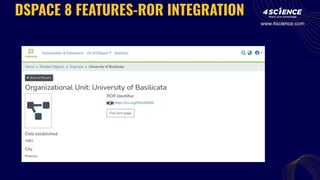
BENEFITS OF ROR INTEGRATION IN DSPACE
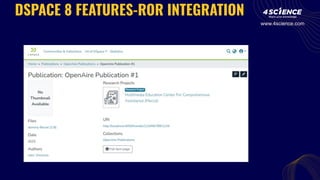
www.4science.com
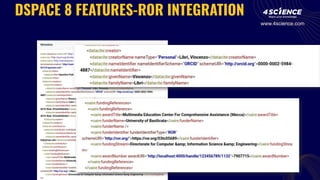
Introduction to the
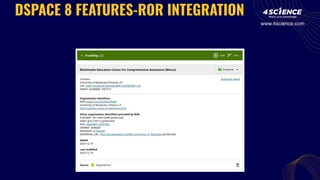
Research Organization Registry (ROR)
Dr. Amanda French, ROR Technical Community Manager, Crossref - amanda@ror.org
What is ROR?
ROR, the Research Organization Registry, is a
global, community-led registry of open
persistent identifiers for research organizations.
ROR is an established, trusted, widely adopted,
no-cost service that is becoming a standard in
scholarly communication and scholarly publishing.
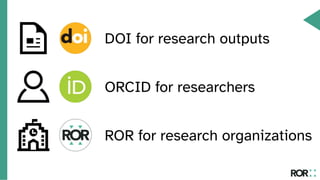
ROR for research organizations
DOI for research outputs
ORCID for researchers
Why ROR?
ROR makes information about research
organizations clean, normalized, and easy to
exchange among software systems so that journal
articles, datasets, and other research outputs can
be reliably connected to universities, funders,
companies, laboratories, and other institutions.
Why ROR?
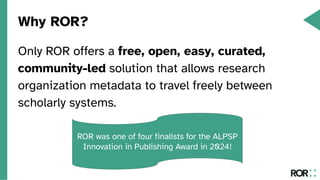
Only ROR offers a free, open, easy, curated,
community-led solution that allows research
organization metadata to travel freely between
scholarly systems.
ROR was one of four finalists for the ALPSP
Innovation in Publishing Award in 2024!
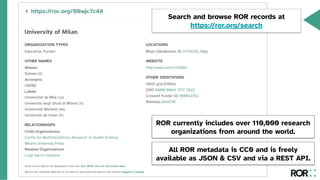
Search and browse ROR records at
https://ror.org/search
ROR currently includes over 110,000 research
organizations from around the world.
All ROR metadata is CC0 and is freely
available as JSON & CSV and via a REST API.
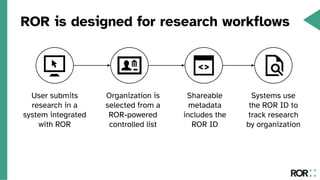
User submits
research in a
system integrated
with ROR
Organization is
selected from a
ROR-powered
controlled list
Shareable
metadata
includes the
ROR ID
Systems use
the ROR ID to
track research
by organization
ROR is designed for research workflows
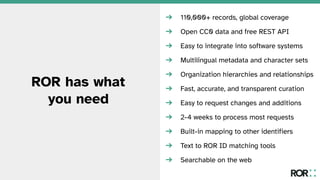
ROR has what
you need
➔ 110,000+ records, global coverage
➔ Open CC0 data and free REST API
➔ Easy to integrate into software systems
➔ Multilingual metadata and character sets
➔ Organization hierarchies and relationships
➔ Fast, accurate, and transparent curation
➔ Easy to request changes and additions
➔ 2-4 weeks to process most requests
➔ Built-in mapping to other identifiers
➔ Text to ROR ID matching tools
➔ Searchable on the web
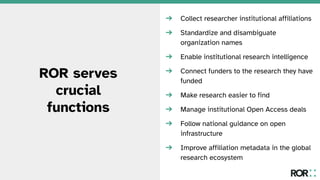
ROR serves
crucial
functions
➔ Collect researcher institutional affiliations
➔ Standardize and disambiguate
organization names
➔ Enable institutional research intelligence
➔ Connect funders to the research they have
funded
➔ Make research easier to find
➔ Manage institutional Open Access deals
➔ Follow national guidance on open
infrastructure
➔ Improve affiliation metadata in the global
research ecosystem
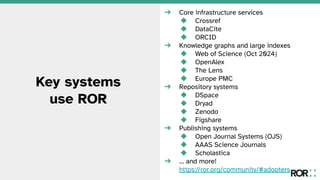
Key systems
use ROR
➔ Core infrastructure services
◆ Crossref
◆ DataCite
◆ ORCID
➔ Knowledge graphs and large indexes
◆ Web of Science (Oct 2024)
◆ OpenAlex
◆ The Lens
◆ Europe PMC
➔ Repository systems
◆ DSpace
◆ Dryad
◆ Zenodo
◆ Figshare
➔ Publishing systems
◆ Open Journal Systems (OJS)
◆ AAAS Science Journals
◆ Scholastica
➔ … and more!
https://ror.org/community/#adopters
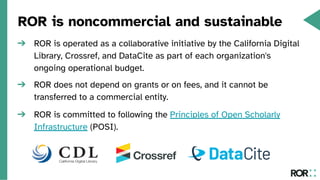
ROR is noncommercial and sustainable
➔ ROR is operated as a collaborative initiative by the California Digital
Library, Crossref, and DataCite as part of each organization's
ongoing operational budget.
➔ ROR does not depend on grants or on fees, and it cannot be
transferred to a commercial entity.
➔ ROR is committed to following the Principles of Open Scholarly
Infrastructure (POSI).
Learn more about ROR
Visit us at ror.org Contact us at info@ror.org
Get involved with ROR: https://ror.org/community/#get-involved
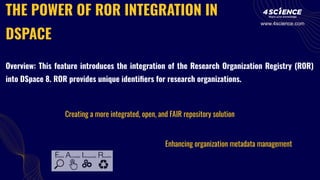
THE POWER OF ROR INTEGRATION IN
DSPACE
Creating a more integrated, open, and FAIR repository solution
Enhancing organization metadata management
Overview: This feature introduces the integration of the Research Organization Registry (ROR)
into DSpace 8. ROR provides unique identifiers for research organizations.
www.4science.com
KEY BENEFITS OF ROR INTEGRATION IN
DSPACE
Standardizing the identification of research organizations is essential for organizing and retrieving
research outputs effectively.
Enhanced Metadata Quality: By using ROR as an Organization Data Provider, DSpace 8 improves the
accuracy and quality of metadata mentioning organization (funders, publishers, affiliations)
Improved Discoverability: The ROR integration enhances the discoverability of research outputs by linking
them to standardized organizational identifiers
Interoperability: ROR information is shareable via OAI-PMH and ORCID, increasing interoperability with
other systems and platforms
www.4science.com
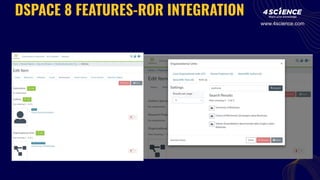
DSPACE 8 FEATURES-ROR INTEGRATION
www.4science.com
DSPACE 8 FEATURES-ROR INTEGRATION
www.4science.com
DSPACE 8 FEATURES-ROR INTEGRATION
www.4science.com
DSPACE 8 FEATURES-ROR INTEGRATION
www.4science.com
DSPACE 8 FEATURES-ROR INTEGRATION
www.4science.com
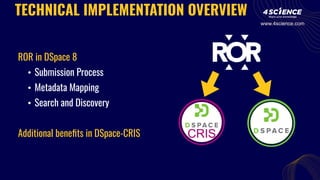
ROR in DSpace 8
• Submission Process
• Metadata Mapping
• Search and Discovery
Additional benefits in DSpace-CRIS
TECHNICAL IMPLEMENTATION OVERVIEW
www.4science.com
• ROR as a Live import Data Provider
• Query ROR via the official ROR API v1
ROR IN DSPACE 8 - SUBMISSION PROCESSwww.4science.com
• New metadata fields for
- ROR IDs
organization.identifier.ror
- Parent Organization
organization.parentOrganization
• Configurable mapping via the ror-integration.xml
ROR IN DSPACE 8 - METADATA MAPPING www.4science.com
• Improved organization name normalization
• Enhanced faceting and filtering
ROR IN DSPACE 8 - SEARCH AND DISCOVERY
www.4science.com
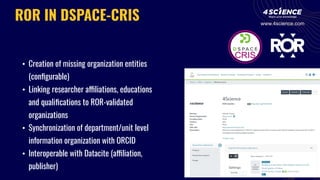
• Creation of missing organization entities
(configurable)
• Linking researcher affiliations, educations
and qualifications to ROR-validated
organizations
• Synchronization of department/unit level
information organization with ORCID
• Interoperable with Datacite (affiliation,
publisher)
ROR IN DSPACE-CRIS www.4science.com
LIVE DEMONSTRATION
www.4science.com
THE ROAD AHEAD
• Update the mapping to use ROR API v2
• Improve the interoperability out of box: using the ROR iD to
identify funders also in the datacite metadata
• Ensure that the ROR iD is preserved during import of publications
and other entities, if available
• Explore new features that could be added on top of it (💡search
OpenAlex for other content related to an Organization)
www.4science.com
CONCLUSIONS
• Represents a step forward in standardizing organizational metadata
• Enhanced Data Quality and Integrity
• Ensures consistent and accurate representation of institutional affiliations
• Reduces manual errors and improves overall data reliability
• Boosting Global Visibility and Collaboration
• Facilitates easier discovery of research outputs on a global scale
• Enhances opportunities for inter-institutional collaboration
www.4science.com
www.4science.com
CONCLUSIONS
• Alignment with Open Science Principles
• Supports FAIR (Findable, Accessible, Interoperable, Reusable) data principles
• Contributes to the broader open science ecosystem
• Improved Interoperability Seamless data exchange with external systems (e.g., ORCID, OAI-PMH)
• Empowering Institutional Identity: Strengthens the digital presence of research organizations
• Enables more accurate tracking and showcasing of institutional research impact
• A Step Towards Next-Generation Repository Services
www.4science.com
THANK YOU
Andrea Bollini
andrea.bollini@4science.com
www.4science.com
info@4science.com 4science
International
4science
4science_
IT
4ScienceDSpa
ce
@4Science@mastodon.s
ocial

New Features for Organization Information in DSpace with ROR

  • 1.
    NEW FEATURES FORORGANIZATION INFORMATION IN DSPACE WITH ROR www.4science.com SPEAKER ANDREA BOLLINI 4Science CTIO WEBINAR
  • 2.
    AGENDA 01 02 03 04 05 TECHNICAL IMPLEMENTATION LIVE DEMONSTRATION FUTUREDEVELOPMENTS INTRODUCTION TO ROR BENEFITS OF ROR INTEGRATION IN DSPACE www.4science.com
  • 3.
    Introduction to the ResearchOrganization Registry (ROR) Dr. Amanda French, ROR Technical Community Manager, Crossref - amanda@ror.org
  • 4.
    What is ROR? ROR,the Research Organization Registry, is a global, community-led registry of open persistent identifiers for research organizations. ROR is an established, trusted, widely adopted, no-cost service that is becoming a standard in scholarly communication and scholarly publishing.
  • 5.
    ROR for researchorganizations DOI for research outputs ORCID for researchers
  • 6.
    Why ROR? ROR makesinformation about research organizations clean, normalized, and easy to exchange among software systems so that journal articles, datasets, and other research outputs can be reliably connected to universities, funders, companies, laboratories, and other institutions.
  • 7.
    Why ROR? Only RORoffers a free, open, easy, curated, community-led solution that allows research organization metadata to travel freely between scholarly systems. ROR was one of four finalists for the ALPSP Innovation in Publishing Award in 2024!
  • 8.
    Search and browseROR records at https://ror.org/search ROR currently includes over 110,000 research organizations from around the world. All ROR metadata is CC0 and is freely available as JSON & CSV and via a REST API.
  • 9.
    User submits research ina system integrated with ROR Organization is selected from a ROR-powered controlled list Shareable metadata includes the ROR ID Systems use the ROR ID to track research by organization ROR is designed for research workflows
  • 10.
    ROR has what youneed ➔ 110,000+ records, global coverage ➔ Open CC0 data and free REST API ➔ Easy to integrate into software systems ➔ Multilingual metadata and character sets ➔ Organization hierarchies and relationships ➔ Fast, accurate, and transparent curation ➔ Easy to request changes and additions ➔ 2-4 weeks to process most requests ➔ Built-in mapping to other identifiers ➔ Text to ROR ID matching tools ➔ Searchable on the web
  • 11.
    ROR serves crucial functions ➔ Collectresearcher institutional affiliations ➔ Standardize and disambiguate organization names ➔ Enable institutional research intelligence ➔ Connect funders to the research they have funded ➔ Make research easier to find ➔ Manage institutional Open Access deals ➔ Follow national guidance on open infrastructure ➔ Improve affiliation metadata in the global research ecosystem
  • 12.
    Key systems use ROR ➔Core infrastructure services ◆ Crossref ◆ DataCite ◆ ORCID ➔ Knowledge graphs and large indexes ◆ Web of Science (Oct 2024) ◆ OpenAlex ◆ The Lens ◆ Europe PMC ➔ Repository systems ◆ DSpace ◆ Dryad ◆ Zenodo ◆ Figshare ➔ Publishing systems ◆ Open Journal Systems (OJS) ◆ AAAS Science Journals ◆ Scholastica ➔ … and more! https://ror.org/community/#adopters
  • 13.
    ROR is noncommercialand sustainable ➔ ROR is operated as a collaborative initiative by the California Digital Library, Crossref, and DataCite as part of each organization's ongoing operational budget. ➔ ROR does not depend on grants or on fees, and it cannot be transferred to a commercial entity. ➔ ROR is committed to following the Principles of Open Scholarly Infrastructure (POSI).
  • 14.
    Learn more aboutROR Visit us at ror.org Contact us at info@ror.org Get involved with ROR: https://ror.org/community/#get-involved
  • 15.
    THE POWER OFROR INTEGRATION IN DSPACE Creating a more integrated, open, and FAIR repository solution Enhancing organization metadata management Overview: This feature introduces the integration of the Research Organization Registry (ROR) into DSpace 8. ROR provides unique identifiers for research organizations. www.4science.com
  • 16.
    KEY BENEFITS OFROR INTEGRATION IN DSPACE Standardizing the identification of research organizations is essential for organizing and retrieving research outputs effectively. Enhanced Metadata Quality: By using ROR as an Organization Data Provider, DSpace 8 improves the accuracy and quality of metadata mentioning organization (funders, publishers, affiliations) Improved Discoverability: The ROR integration enhances the discoverability of research outputs by linking them to standardized organizational identifiers Interoperability: ROR information is shareable via OAI-PMH and ORCID, increasing interoperability with other systems and platforms www.4science.com
  • 17.
    DSPACE 8 FEATURES-RORINTEGRATION www.4science.com
  • 18.
    DSPACE 8 FEATURES-RORINTEGRATION www.4science.com
  • 19.
    DSPACE 8 FEATURES-RORINTEGRATION www.4science.com
  • 20.
    DSPACE 8 FEATURES-RORINTEGRATION www.4science.com
  • 21.
    DSPACE 8 FEATURES-RORINTEGRATION www.4science.com
  • 22.
    ROR in DSpace8 • Submission Process • Metadata Mapping • Search and Discovery Additional benefits in DSpace-CRIS TECHNICAL IMPLEMENTATION OVERVIEW www.4science.com
  • 23.
    • ROR asa Live import Data Provider • Query ROR via the official ROR API v1 ROR IN DSPACE 8 - SUBMISSION PROCESSwww.4science.com
  • 24.
    • New metadatafields for - ROR IDs organization.identifier.ror - Parent Organization organization.parentOrganization • Configurable mapping via the ror-integration.xml ROR IN DSPACE 8 - METADATA MAPPING www.4science.com
  • 25.
    • Improved organizationname normalization • Enhanced faceting and filtering ROR IN DSPACE 8 - SEARCH AND DISCOVERY www.4science.com
  • 26.
    • Creation ofmissing organization entities (configurable) • Linking researcher affiliations, educations and qualifications to ROR-validated organizations • Synchronization of department/unit level information organization with ORCID • Interoperable with Datacite (affiliation, publisher) ROR IN DSPACE-CRIS www.4science.com
  • 27.
  • 28.
    THE ROAD AHEAD •Update the mapping to use ROR API v2 • Improve the interoperability out of box: using the ROR iD to identify funders also in the datacite metadata • Ensure that the ROR iD is preserved during import of publications and other entities, if available • Explore new features that could be added on top of it (💡search OpenAlex for other content related to an Organization) www.4science.com
  • 29.
    CONCLUSIONS • Represents astep forward in standardizing organizational metadata • Enhanced Data Quality and Integrity • Ensures consistent and accurate representation of institutional affiliations • Reduces manual errors and improves overall data reliability • Boosting Global Visibility and Collaboration • Facilitates easier discovery of research outputs on a global scale • Enhances opportunities for inter-institutional collaboration www.4science.com www.4science.com
  • 30.
    CONCLUSIONS • Alignment withOpen Science Principles • Supports FAIR (Findable, Accessible, Interoperable, Reusable) data principles • Contributes to the broader open science ecosystem • Improved Interoperability Seamless data exchange with external systems (e.g., ORCID, OAI-PMH) • Empowering Institutional Identity: Strengthens the digital presence of research organizations • Enables more accurate tracking and showcasing of institutional research impact • A Step Towards Next-Generation Repository Services www.4science.com
  • 31.
    THANK YOU Andrea Bollini andrea.bollini@4science.com www.4science.com info@4science.com4science International 4science 4science_ IT 4ScienceDSpa ce @4Science@mastodon.s ocial