Graphs 1
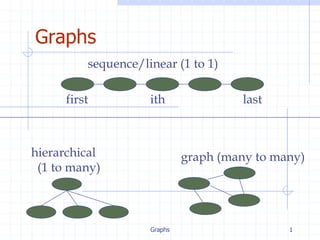
Graphs
hierarchical
(1 to many)
graph (many to many)
first ith last
sequence/linear (1 to 1)
Graphs 2
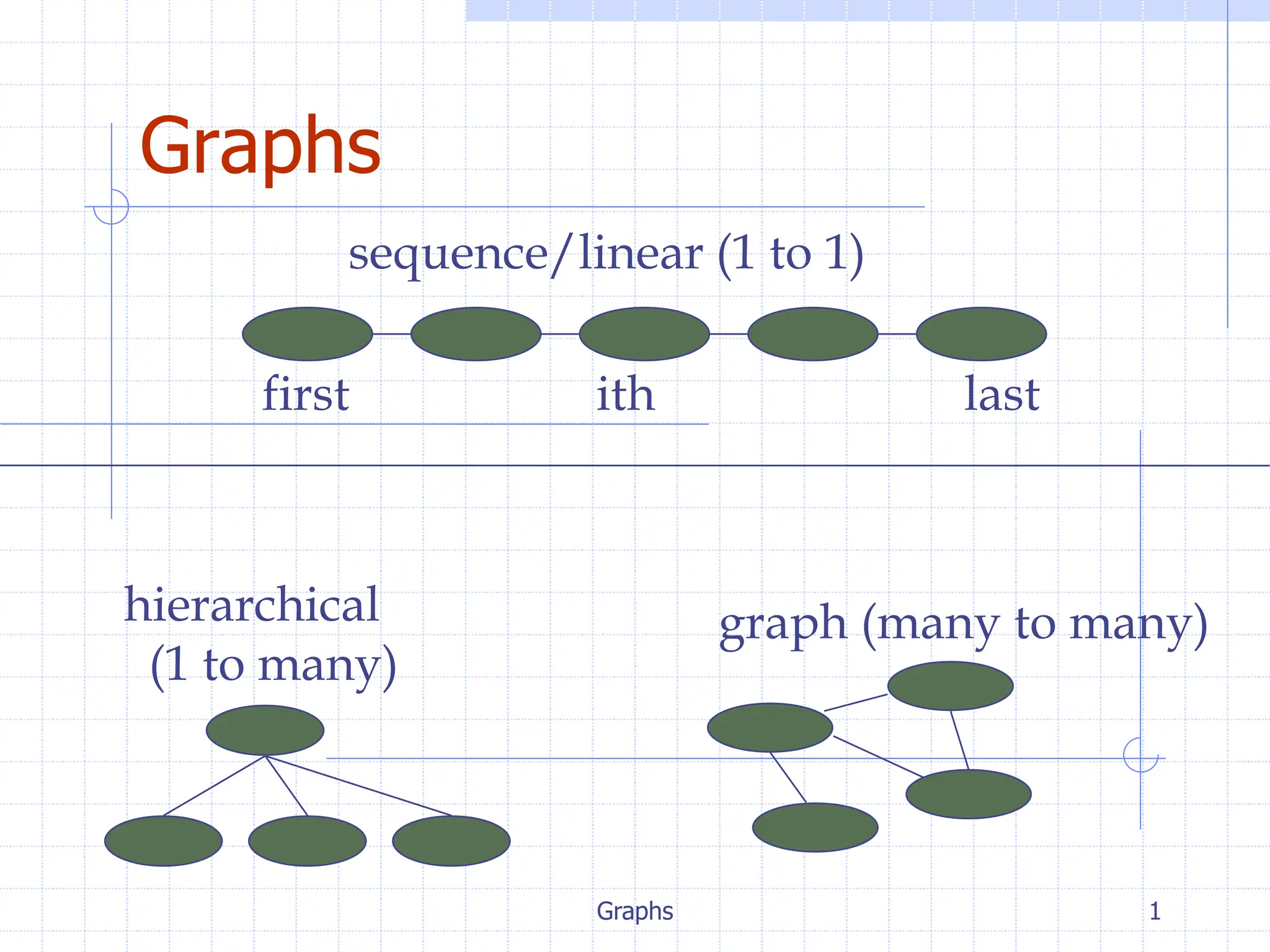
What is a Graph?
A graph is a pair (V, E), where
 V is a set of nodes, called vertices
 E is a collection of pairs of vertices, called edges
V(G) and E(G) represent the sets of vertices and edges of G,
respectively
Example:
A tree is a special type of graph!
a b
c
d e
V= {a, b, c, d, e}
E= {(a,b), (a,c), (a,d),
(b,e), (c,d), (c,e), (d,e)}
Graphs 3
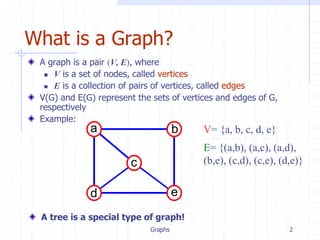
John
David
Paul
brown.edu
cox.net
cs.brown.edu
att.net
qwest.net
math.brown.edu
cslab1b
cslab1a
Applications
Electronic circuits
 Printed circuit board
 Integrated circuit
Transportation networks
 Highway network
 Flight network
Computer networks
 Local area network
 Internet
 Web
Databases
 Entity-relationship diagram
Graphs 4
What can we do with graphs?
Find a path from one place to another
Find the shortest path from one place to another
Determine connectivity
Find the “weakest link” (min cut)
• check amount of redundancy in case of failures
Find the amount of flow that will go through them
Graphs 5
Edge and Graph Types
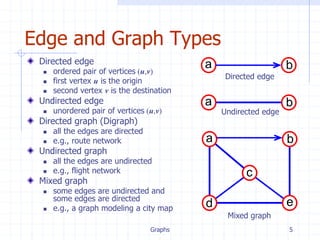
Directed edge
 ordered pair of vertices (u,v)
 first vertex u is the origin
 second vertex v is the destination
Undirected edge
 unordered pair of vertices (u,v)
Directed graph (Digraph)
 all the edges are directed
 e.g., route network
Undirected graph
 all the edges are undirected
 e.g., flight network
Mixed graph
 some edges are undirected and
some edges are directed
 e.g., a graph modeling a city map
a b
a b
a b
c
d e
Directed edge
Undirected edge
Mixed graph
Graphs 6
Terminology
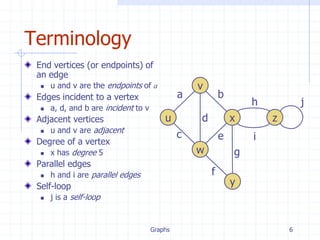
End vertices (or endpoints) of
an edge
 u and v are the endpoints of a
Edges incident to a vertex
 a, d, and b are incident to v
Adjacent vertices
 u and v are adjacent
Degree of a vertex
 x has degree 5
Parallel edges
 h and i are parallel edges
Self-loop
 j is a self-loop
x
u
v
w
z
y
a
c
b
e
d
f
g
h
i
j
Graphs 7
Terminology (cont.)
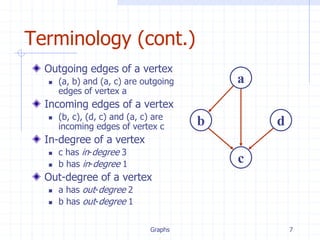
Outgoing edges of a vertex
 (a, b) and (a, c) are outgoing
edges of vertex a
Incoming edges of a vertex
 (b, c), (d, c) and (a, c) are
incoming edges of vertex c
In-degree of a vertex
 c has in-degree 3
 b has in-degree 1
Out-degree of a vertex
 a has out-degree 2
 b has out-degree 1
a
b d
c
Graphs 8
Graph Representation
For graphs to be computationally useful, they
have to be conveniently represented in
programs
There are two computer representations of
graphs:
 Adjacency matrix representation
 Adjacency lists representation
Graphs 9
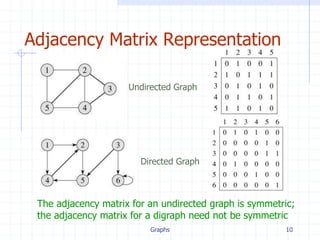
Adjacency Matrix Representation
Assume V = {1, 2, …, n}
An adjacency matrix represents the graph as a n x n
matrix A:
 A[i, j] = 1 if edge (i, j)  E (or weight of edge)
= 0 if edge (i, j)  E
1
2 4
3
a
d
b c
A 1 2 3 4
1 0 1 1 0
2 0 0 1 0
3 0 0 0 0
4 0 0 1 0
Graphs 10
Adjacency Matrix Representation
Undirected Graph
Directed Graph
The adjacency matrix for an undirected graph is symmetric;
the adjacency matrix for a digraph need not be symmetric
Graphs 11
Adjacency Matrix Representation
Pros:
 Simple to implement
 Easy and fast to tell if a pair (i, j) is an edge:
simply check if A[i, j] is 1 or 0
 Can be very efficient for small graphs
Cons:
 No matter how few edges the graph has, the
matrix takes O(n2) in memory
Graphs 12
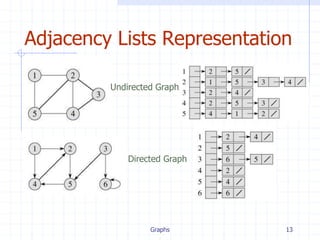
Adjacency Lists Representation
A graph is represented by a one-dimensional array L of
linked lists, where
 L[i] is the linked list containing all the nodes adjacent
to node i.
 The nodes in the list L[i] are in no particular order
Example:
 Adj[1] = {2,3}
 Adj[2] = {3}
 Adj[3] = {}
 Adj[4] = {3}
1
2 4
3
Graphs 13
Adjacency Lists Representation
Undirected Graph
Directed Graph
Graphs 14
Adjacency Lists Representation
Pros:
 Saves on space (memory): the representation
takes O(|V|+|E|) memory.
 Good for large, sparse graphs (e.g., planar maps)
Cons:
 It can take up to O(n) time to determine if a pair
of nodes (i, j) is an edge: one would have to
search the linked list L[i], which takes time
proportional to the length of L[i].

Graph Introduction.ppt

  • 1.
    Graphs 1 Graphs hierarchical (1 tomany) graph (many to many) first ith last sequence/linear (1 to 1)
  • 2.
    Graphs 2 What isa Graph? A graph is a pair (V, E), where  V is a set of nodes, called vertices  E is a collection of pairs of vertices, called edges V(G) and E(G) represent the sets of vertices and edges of G, respectively Example: A tree is a special type of graph! a b c d e V= {a, b, c, d, e} E= {(a,b), (a,c), (a,d), (b,e), (c,d), (c,e), (d,e)}
  • 3.
    Graphs 3 John David Paul brown.edu cox.net cs.brown.edu att.net qwest.net math.brown.edu cslab1b cslab1a Applications Electronic circuits Printed circuit board  Integrated circuit Transportation networks  Highway network  Flight network Computer networks  Local area network  Internet  Web Databases  Entity-relationship diagram
  • 4.
    Graphs 4 What canwe do with graphs? Find a path from one place to another Find the shortest path from one place to another Determine connectivity Find the “weakest link” (min cut) • check amount of redundancy in case of failures Find the amount of flow that will go through them
  • 5.
    Graphs 5 Edge andGraph Types Directed edge  ordered pair of vertices (u,v)  first vertex u is the origin  second vertex v is the destination Undirected edge  unordered pair of vertices (u,v) Directed graph (Digraph)  all the edges are directed  e.g., route network Undirected graph  all the edges are undirected  e.g., flight network Mixed graph  some edges are undirected and some edges are directed  e.g., a graph modeling a city map a b a b a b c d e Directed edge Undirected edge Mixed graph
  • 6.
    Graphs 6 Terminology End vertices(or endpoints) of an edge  u and v are the endpoints of a Edges incident to a vertex  a, d, and b are incident to v Adjacent vertices  u and v are adjacent Degree of a vertex  x has degree 5 Parallel edges  h and i are parallel edges Self-loop  j is a self-loop x u v w z y a c b e d f g h i j
  • 7.
    Graphs 7 Terminology (cont.) Outgoingedges of a vertex  (a, b) and (a, c) are outgoing edges of vertex a Incoming edges of a vertex  (b, c), (d, c) and (a, c) are incoming edges of vertex c In-degree of a vertex  c has in-degree 3  b has in-degree 1 Out-degree of a vertex  a has out-degree 2  b has out-degree 1 a b d c
  • 8.
    Graphs 8 Graph Representation Forgraphs to be computationally useful, they have to be conveniently represented in programs There are two computer representations of graphs:  Adjacency matrix representation  Adjacency lists representation
  • 9.
    Graphs 9 Adjacency MatrixRepresentation Assume V = {1, 2, …, n} An adjacency matrix represents the graph as a n x n matrix A:  A[i, j] = 1 if edge (i, j)  E (or weight of edge) = 0 if edge (i, j)  E 1 2 4 3 a d b c A 1 2 3 4 1 0 1 1 0 2 0 0 1 0 3 0 0 0 0 4 0 0 1 0
  • 10.
    Graphs 10 Adjacency MatrixRepresentation Undirected Graph Directed Graph The adjacency matrix for an undirected graph is symmetric; the adjacency matrix for a digraph need not be symmetric
  • 11.
    Graphs 11 Adjacency MatrixRepresentation Pros:  Simple to implement  Easy and fast to tell if a pair (i, j) is an edge: simply check if A[i, j] is 1 or 0  Can be very efficient for small graphs Cons:  No matter how few edges the graph has, the matrix takes O(n2) in memory
  • 12.
    Graphs 12 Adjacency ListsRepresentation A graph is represented by a one-dimensional array L of linked lists, where  L[i] is the linked list containing all the nodes adjacent to node i.  The nodes in the list L[i] are in no particular order Example:  Adj[1] = {2,3}  Adj[2] = {3}  Adj[3] = {}  Adj[4] = {3} 1 2 4 3
  • 13.
    Graphs 13 Adjacency ListsRepresentation Undirected Graph Directed Graph
  • 14.
    Graphs 14 Adjacency ListsRepresentation Pros:  Saves on space (memory): the representation takes O(|V|+|E|) memory.  Good for large, sparse graphs (e.g., planar maps) Cons:  It can take up to O(n) time to determine if a pair of nodes (i, j) is an edge: one would have to search the linked list L[i], which takes time proportional to the length of L[i].

Editor's Notes

  • #2 2/1/2024 11:50 AM