CGIAR is a global research partnership for a food secure future

Dryland Cereals
Value for Money Proposition
Theory of change

•
•
•
•
•
•

Increased and
stable access to
dryland cereals

Behavioral Change
Improved/diverse varieties grown
Good agronomic practices used
Increased produce marketed
Quality seed produced and made available
Advanced research technologies used
Up-to-date data used in policy decisions
•
•
•
•
•
•
•
•
•

Reduced
Rural Poverty

Increased
consumption and
nutrition from
dryland cereals

Enhanced
Environmental
Sustainability

Increased
resilience to
environmental
variability

Increased and
more equitable
income

•
•
•
•
•
•

RESEARCH
OUTCOMES

Improved varieties
Management packages
Publicly available datasets and information
Phenotyping protocols
Trained people
Improved infrastructure
Seed production and delivery practices
Post-harvest processing technologies
Training modules

=

+

Nutrition

Enhanced
Environmental
Sustainability

The high-iron pearl millet variety, ICTP 8203Fe,
with 71 ppm of Fe density and 2.21 t/ha of
grain yield, was released as Dhanshakti in
Maharashtra, India, early this year.
Fertilizer micro-dosing in finger millet was recommended to
farmers in East and Southern Africa, based on the results that
micro-dosing at a rate of 20 kg nitrogen per hectare, increases
grain yields by 20-40%.

Lessons

Opportunities

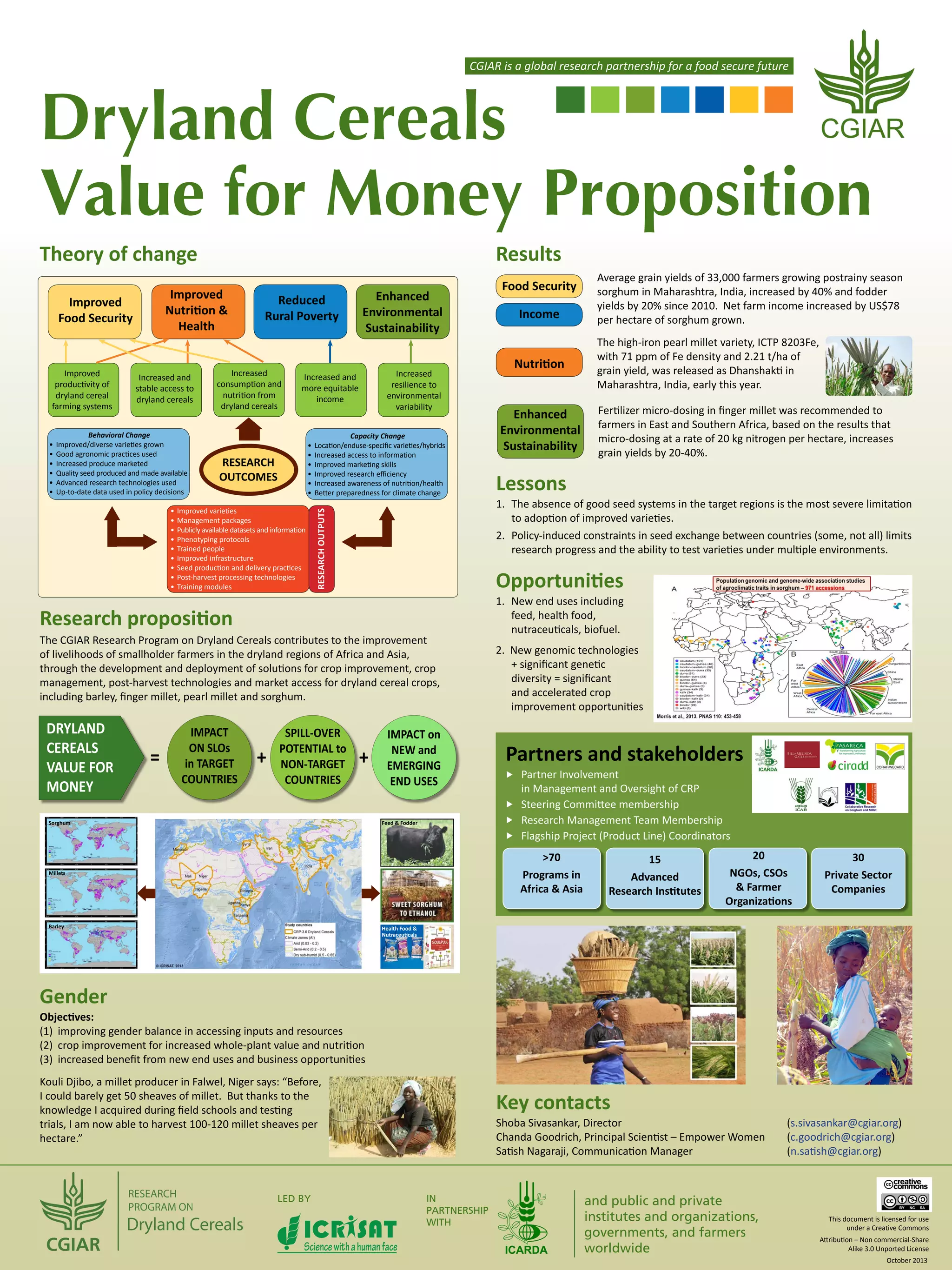
The CGIAR Research Program on Dryland Cereals contributes to the improvement
of livelihoods of smallholder farmers in the dryland regions of Africa and Asia,
through the development and deployment of solutions for crop improvement, crop
management, post-harvest technologies and market access for dryland cereal crops,
including barley, finger millet, pearl millet and sorghum.

IMPACT
ON SLOs
in TARGET
COUNTRIES

Income

Capacity Change
Location/enduse-specific varieties/hybrids
Increased access to information
Improved marketing skills
Improved research efficiency
Increased awareness of nutrition/health
Better preparedness for climate change

Research proposition

DRYLAND
CEREALS
VALUE FOR
MONEY

Food Security

Average grain yields of 33,000 farmers growing postrainy season
sorghum in Maharashtra, India, increased by 40% and fodder
yields by 20% since 2010. Net farm income increased by US$78
per hectare of sorghum grown.

RESEARCH OUTPUTS

Improved
Nutrition &
Health

Improved
Food Security

Improved
productivity of
dryland cereal
farming systems

Results

SPILL-OVER
POTENTIAL to
NON-TARGET
COUNTRIES

+

Sorghum

IMPACT on
NEW and
EMERGING
END USES
Feed & Fodder

1. The absence of good seed systems in the target regions is the most severe limitation
to adoption of improved varieties.
2. Policy-induced constraints in seed exchange between countries (some, not all) limits
research progress and the ability to test varieties under multiple environments.

1. New end uses including
feed, health food,
nutraceuticals, biofuel.
2. New genomic technologies
+ significant genetic
diversity = significant
and accelerated crop
improvement opportunities

Partners and stakeholders
• Partner Involvement
in Management and Oversight of CRP
• Steering Committee membership
• Research Management Team Membership
• Flagship Project (Product Line) Coordinators
>70
Programs in
Africa & Asia

Millets

Barley

15
Advanced
Research Institutes

20
NGOs, CSOs
& Farmer
Organizations

30
Private Sector
Companies

Health Food &
Nutraceuticals

Gender
Objectives:
(1) improving gender balance in accessing inputs and resources
(2) crop improvement for increased whole-plant value and nutrition
(3) increased benefit from new end uses and business opportunities
Kouli Djibo, a millet producer in Falwel, Niger says: “Before,
I could barely get 50 sheaves of millet. But thanks to the
knowledge I acquired during field schools and testing
trials, I am now able to harvest 100-120 millet sheaves per
hectare.”

LED BY

Science with a human face

Key contacts
Shoba Sivasankar, Director
Chanda Goodrich, Principal Scientist – Empower Women
Satish Nagaraji, Communication Manager

IN
PARTNERSHIP
WITH

and public and private
institutes and organizations,
governments, and farmers
worldwide

(s.sivasankar@cgiar.org)
(c.goodrich@cgiar.org)
(n.satish@cgiar.org)

This document is licensed for use
under a Creative Commons
Attribution – Non commercial-Share
Alike 3.0 Unported License
October 2013

CGIAR Research Program on Dryland Cereals, Value for money

  • 1.
    CGIAR is aglobal research partnership for a food secure future Dryland Cereals Value for Money Proposition Theory of change • • • • • • Increased and stable access to dryland cereals Behavioral Change Improved/diverse varieties grown Good agronomic practices used Increased produce marketed Quality seed produced and made available Advanced research technologies used Up-to-date data used in policy decisions • • • • • • • • • Reduced Rural Poverty Increased consumption and nutrition from dryland cereals Enhanced Environmental Sustainability Increased resilience to environmental variability Increased and more equitable income • • • • • • RESEARCH OUTCOMES Improved varieties Management packages Publicly available datasets and information Phenotyping protocols Trained people Improved infrastructure Seed production and delivery practices Post-harvest processing technologies Training modules = + Nutrition Enhanced Environmental Sustainability The high-iron pearl millet variety, ICTP 8203Fe, with 71 ppm of Fe density and 2.21 t/ha of grain yield, was released as Dhanshakti in Maharashtra, India, early this year. Fertilizer micro-dosing in finger millet was recommended to farmers in East and Southern Africa, based on the results that micro-dosing at a rate of 20 kg nitrogen per hectare, increases grain yields by 20-40%. Lessons Opportunities The CGIAR Research Program on Dryland Cereals contributes to the improvement of livelihoods of smallholder farmers in the dryland regions of Africa and Asia, through the development and deployment of solutions for crop improvement, crop management, post-harvest technologies and market access for dryland cereal crops, including barley, finger millet, pearl millet and sorghum. IMPACT ON SLOs in TARGET COUNTRIES Income Capacity Change Location/enduse-specific varieties/hybrids Increased access to information Improved marketing skills Improved research efficiency Increased awareness of nutrition/health Better preparedness for climate change Research proposition DRYLAND CEREALS VALUE FOR MONEY Food Security Average grain yields of 33,000 farmers growing postrainy season sorghum in Maharashtra, India, increased by 40% and fodder yields by 20% since 2010. Net farm income increased by US$78 per hectare of sorghum grown. RESEARCH OUTPUTS Improved Nutrition & Health Improved Food Security Improved productivity of dryland cereal farming systems Results SPILL-OVER POTENTIAL to NON-TARGET COUNTRIES + Sorghum IMPACT on NEW and EMERGING END USES Feed & Fodder 1. The absence of good seed systems in the target regions is the most severe limitation to adoption of improved varieties. 2. Policy-induced constraints in seed exchange between countries (some, not all) limits research progress and the ability to test varieties under multiple environments. 1. New end uses including feed, health food, nutraceuticals, biofuel. 2. New genomic technologies + significant genetic diversity = significant and accelerated crop improvement opportunities Partners and stakeholders • Partner Involvement in Management and Oversight of CRP • Steering Committee membership • Research Management Team Membership • Flagship Project (Product Line) Coordinators >70 Programs in Africa & Asia Millets Barley 15 Advanced Research Institutes 20 NGOs, CSOs & Farmer Organizations 30 Private Sector Companies Health Food & Nutraceuticals Gender Objectives: (1) improving gender balance in accessing inputs and resources (2) crop improvement for increased whole-plant value and nutrition (3) increased benefit from new end uses and business opportunities Kouli Djibo, a millet producer in Falwel, Niger says: “Before, I could barely get 50 sheaves of millet. But thanks to the knowledge I acquired during field schools and testing trials, I am now able to harvest 100-120 millet sheaves per hectare.” LED BY Science with a human face Key contacts Shoba Sivasankar, Director Chanda Goodrich, Principal Scientist – Empower Women Satish Nagaraji, Communication Manager IN PARTNERSHIP WITH and public and private institutes and organizations, governments, and farmers worldwide (s.sivasankar@cgiar.org) (c.goodrich@cgiar.org) (n.satish@cgiar.org) This document is licensed for use under a Creative Commons Attribution – Non commercial-Share Alike 3.0 Unported License October 2013