Drugs in ADHD
(Attention Deficit Hyperactivity Disorder)
Dr. Samir H Dalwai
MD, DCH, FCPS, DNB, LLB
Developmental & Behavioral Pediatrician,
President, IndianAcademy of Pediatrics-Mumbai,
Chairperson, IAPChapter of Developmental Pediatrics,
Founder Director, New Horizons Group.
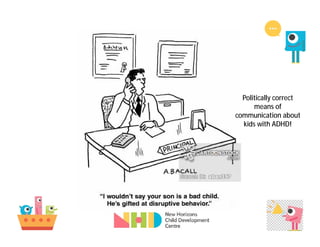
Politically correct
means of
communication about
kids with ADHD!
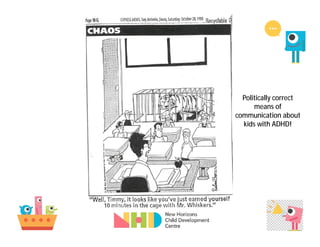
Politically correct
means of
communication about
kids with ADHD!
Jose S Perez’s
interpretationof
how we wish
it couldbe!
Opening Comments
1. ADHD is a syndrome with a constellation of symptoms
2. Core features are Hyperactivity, Impulsivity, Inattention….
and also INCONSISTANCY*.
3. Pervasive across many life functions, especially concerned
with learning and achievement, classically called
“ executive functioning”
(*New Horizons Child Development Centre)
Opening Comments
4. Associated with many co-morbidities/co-exiting conditions
5. Requires multi-dimensional treatment approach which would
include pharmacotherapy
6. Only a persistent and sustained goal oriented programme over
a specified period of time with propercompliance along with
adherence to medication is required for maximum benefit.
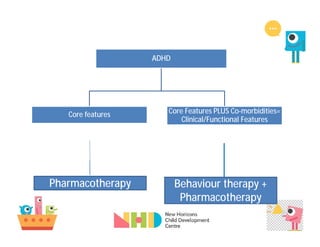
ADHD
Core features Core Features PLUS Co-morbidities=
Clinical/Functional Features
Pharmacotherapy Behaviour therapy +
Pharmacotherapy
Aim of Management
• The TARGET is to enable the child to function
appropriately and independently at home, in
school and in society.
• Co-morbid/ co-existing conditions must be
addressed and treated concurrently with
ADHD
New Horizons Child Development Centre
Data
1301
547
422
128
0
200
400
600
800
1000
1200
1400
2009-2012 2013-2015
Numberofchildren
Children with ADHD in 2009-12 (TISS_NHCDC Study) & 2013-2015;
and mean age [2013-15 data analysis is ongoing]
Total children
Children with ADHD
32.4%
23.4%
6.9 years
7.1 years
25
21
6 5
17
4
8
4
2 1 1 1 1 2 1
0
5
10
15
20
25
30
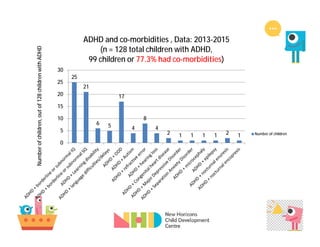
Numberofchildren,outof128childrenwithADHD ADHD and co-morbidities , Data: 2013-2015
(n = 128 total children with ADHD,
99 children or 77.3% had co-morbidities)
Number of children
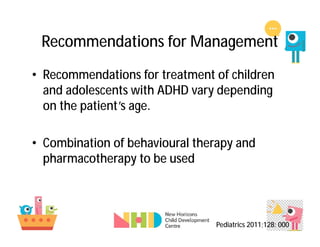
Recommendations for Management
• Recommendations for treatment of children
and adolescents with ADHD vary depending
on the patient’s age.
• Combination of behavioural therapy and
pharmacotherapy to be used
Pediatrics 2011;128: 000
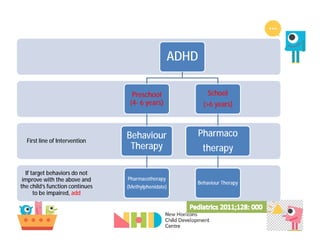
If target behaviors do not
improve with the above and
the child’s function continues
to be impaired, add
First line of Intervention
ADHD
Preschool
(4- 6 years)
Behaviour
Therapy
Pharmacotherapy
(Methylphenidate)
School
(>6 years)
Pharmaco
therapy
Behaviour Therapy
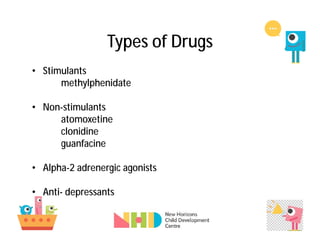
Types of Drugs
• Stimulants
methylphenidate
• Non-stimulants
atomoxetine
clonidine
guanfacine
• Alpha-2 adrenergic agonists
• Anti- depressants
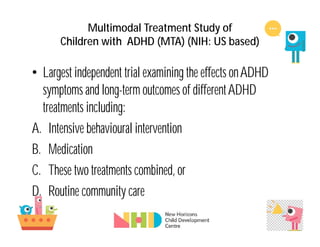
Multimodal Treatment Study of
Children with ADHD (MTA) (NIH: US based)
• Largest independent trial examining the effects onADHD
symptoms and long-term outcomes of differentADHD
treatments including:
A. Intensive behavioural intervention
B. Medication
C. These two treatments combined, or
D. Routine community care
Multimodal Treatment Study of Children with
ADHD (MTA) (NIH: US based)
• Primary analyses- outcomes in this study were
– not significantly different for pharmacological treatment alone versus
combined treatment after correction for multiple tests,
–but the combined group allowed as good a result with significantly
lower dose of medication (methylphenidate)
• Secondary analyses-
–combined treatment was significantly better than pharmacological
treatment alone
1. Initial advantage of medication wore off after 3 years of
pharmacotherapy.
2. Children who had been assigned to intensive behavioural treatment
were more likely to begin taking medication;
while those who had been taking medication were more likely to
stop.
3. Among children originally in the behavioural treatment group, the
incidence of high medication use increased from 14 to 45 percent.
Multimodal Treatment Study of Children with
ADHD (MTA) (NIH: US based)
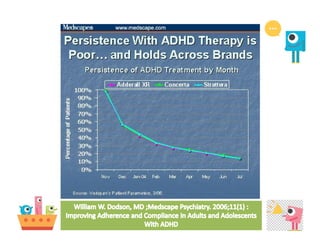
• Poor understanding on the part of patients (they presumeADHD is an
academic problem as medication is not given on holidays and
weekends)
• Expecting ‘CURE’. Failure to understand that treatment is protective-
both now and for future adverse consequence- not curative
• Side-effects
• Multiple doses
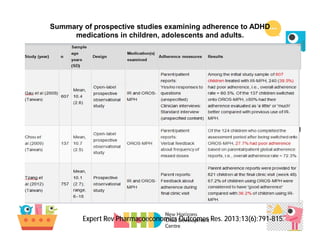
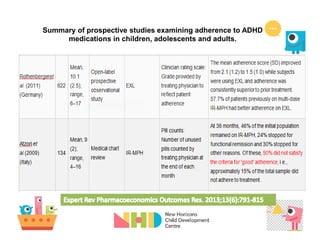
Expert Rev Pharmacoeconomics Outcomes Res. 2013;13(6):791-815.
Summary of prospective studies examining adherence to ADHD
medications in children, adolescents and adults.
Summary of prospective studies examining adherence to ADHD
medications in children, adolescents and adults.
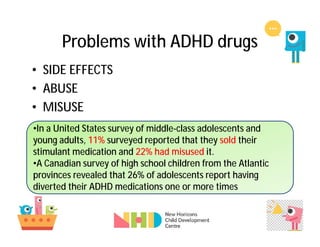
Problems with ADHD drugs
• SIDE EFFECTS
• ABUSE
• MISUSE
•In a United States survey of middle-class adolescents and
young adults, 11% surveyed reported that they sold their
stimulant medication and 22% had misused it.
•A Canadian survey of high school children from the Atlantic
provinces revealed that 26% of adolescents report having
diverted their ADHD medications one or more times
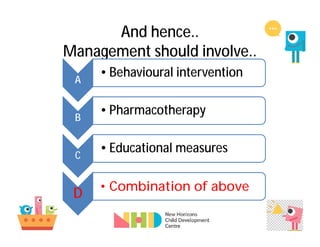
And hence..
Management should involve..
A
• Behavioural intervention
B
• Pharmacotherapy
C
• Educational measures
D • Combination of above
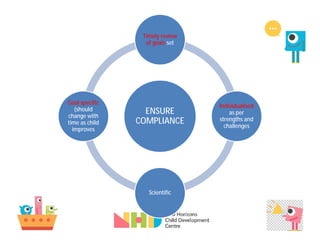
ENSURE
COMPLIANCE
Timely review
of goals set
Individualised
as per
strengths and
challenges
Scientific
Goal specific
(should
change with
time as child
improves
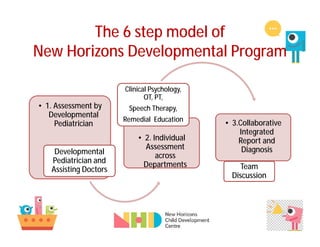
The 6 step model of
New Horizons Developmental Program
• 1. Assessment by
Developmental
Pediatrician
Developmental
Pediatrician and
Assisting Doctors
• 2. Individual
Assessment
across
Departments
Clinical Psychology,
OT, PT,
Speech Therapy,
Remedial Education
• 3.Collaborative
Integrated
Report and
Diagnosis
Team
Discussion
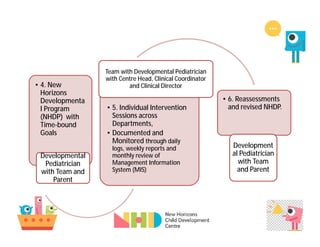
• 4. New
Horizons
Developmenta
l Program
(NHDP) with
Time-bound
Goals
Developmental
Pediatrician
with Team and
Parent
• 5. Individual Intervention
Sessions across
Departments,
• Documented and
Monitored through daily
logs, weekly reports and
monthly review of
Management Information
System (MIS)
Team with Developmental Pediatrician
with Centre Head, Clinical Coordinator
and Clinical Director
• 6. Reassessments
and revised NHDP.
Development
al Pediatrician
with Team
and Parent
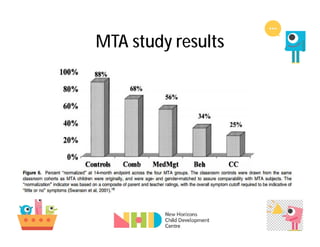
MTA study results
New Horizons CDC data
•Total no of children evaluated: 281
•Data available: 68
•Time frame of retrospective analysis :2015
•No. of children withADHD: 13
•No. of children compliant to a 6 month programme: 13 (100%)
•No. of children compliant to a 1 year programme: 4 (30%)
Social factors
• India is home to 38 million children 0-9 years of age with one
or more neurodevelopmental disorders (Silbeberg, 2014 and
Census, 2011).
• Yet, only 2-3% of children with disabilities have access to
education.
• Rehabilitation Council of India (RCI) estimated that 30
million children with disabilities need education. RCI aims to
educate 10% of these children by 2020.
Key Messages
1. ConsiderADHD to be a constellation of issues; the functional
resolution of each of which is the ultimate aim of the physician.
2. The devil is in the detail; ensure each area has a target and a strategy.
3. Each strategy needs tactics; delivered via multiple stakeholders over
a period of time.
4. This requires a Documented Program at the outset which will
enumerate the script and the role of each player, lead the way till its
conclusion; the New Horizons Developmental Program (NHDP) is
one such indigenously developed program.
Thank You!
IAP Mumbai, IAP Navi Mumbai,
IAP
CHAPTER OF DEVELOPMENTAL PEDIATRICS
National Conference of Developmental Pediatrics
NCDP-EMBICON 2016
Mumbai - 1, 2 October 2016
www.ncdp-embicon2016.com
Theme:IntegratingDevelopmental PediatricsintoOffice Practice

Drugs in ADHD

  • 1.
    Drugs in ADHD (AttentionDeficit Hyperactivity Disorder) Dr. Samir H Dalwai MD, DCH, FCPS, DNB, LLB Developmental & Behavioral Pediatrician, President, IndianAcademy of Pediatrics-Mumbai, Chairperson, IAPChapter of Developmental Pediatrics, Founder Director, New Horizons Group.
  • 2.
  • 3.
  • 4.
  • 5.
    Opening Comments 1. ADHDis a syndrome with a constellation of symptoms 2. Core features are Hyperactivity, Impulsivity, Inattention…. and also INCONSISTANCY*. 3. Pervasive across many life functions, especially concerned with learning and achievement, classically called “ executive functioning” (*New Horizons Child Development Centre)
  • 6.
    Opening Comments 4. Associatedwith many co-morbidities/co-exiting conditions 5. Requires multi-dimensional treatment approach which would include pharmacotherapy 6. Only a persistent and sustained goal oriented programme over a specified period of time with propercompliance along with adherence to medication is required for maximum benefit.
  • 7.
    ADHD Core features CoreFeatures PLUS Co-morbidities= Clinical/Functional Features Pharmacotherapy Behaviour therapy + Pharmacotherapy
  • 8.
    Aim of Management •The TARGET is to enable the child to function appropriately and independently at home, in school and in society. • Co-morbid/ co-existing conditions must be addressed and treated concurrently with ADHD
  • 9.
    New Horizons ChildDevelopment Centre Data 1301 547 422 128 0 200 400 600 800 1000 1200 1400 2009-2012 2013-2015 Numberofchildren Children with ADHD in 2009-12 (TISS_NHCDC Study) & 2013-2015; and mean age [2013-15 data analysis is ongoing] Total children Children with ADHD 32.4% 23.4% 6.9 years 7.1 years
  • 10.
    25 21 6 5 17 4 8 4 2 11 1 1 2 1 0 5 10 15 20 25 30 Numberofchildren,outof128childrenwithADHD ADHD and co-morbidities , Data: 2013-2015 (n = 128 total children with ADHD, 99 children or 77.3% had co-morbidities) Number of children
  • 11.
    Recommendations for Management •Recommendations for treatment of children and adolescents with ADHD vary depending on the patient’s age. • Combination of behavioural therapy and pharmacotherapy to be used Pediatrics 2011;128: 000
  • 12.
    If target behaviorsdo not improve with the above and the child’s function continues to be impaired, add First line of Intervention ADHD Preschool (4- 6 years) Behaviour Therapy Pharmacotherapy (Methylphenidate) School (>6 years) Pharmaco therapy Behaviour Therapy
  • 13.
    Types of Drugs •Stimulants methylphenidate • Non-stimulants atomoxetine clonidine guanfacine • Alpha-2 adrenergic agonists • Anti- depressants
  • 14.
    Multimodal Treatment Studyof Children with ADHD (MTA) (NIH: US based) • Largest independent trial examining the effects onADHD symptoms and long-term outcomes of differentADHD treatments including: A. Intensive behavioural intervention B. Medication C. These two treatments combined, or D. Routine community care
  • 15.
    Multimodal Treatment Studyof Children with ADHD (MTA) (NIH: US based) • Primary analyses- outcomes in this study were – not significantly different for pharmacological treatment alone versus combined treatment after correction for multiple tests, –but the combined group allowed as good a result with significantly lower dose of medication (methylphenidate) • Secondary analyses- –combined treatment was significantly better than pharmacological treatment alone
  • 16.
    1. Initial advantageof medication wore off after 3 years of pharmacotherapy. 2. Children who had been assigned to intensive behavioural treatment were more likely to begin taking medication; while those who had been taking medication were more likely to stop. 3. Among children originally in the behavioural treatment group, the incidence of high medication use increased from 14 to 45 percent. Multimodal Treatment Study of Children with ADHD (MTA) (NIH: US based)
  • 17.
    • Poor understandingon the part of patients (they presumeADHD is an academic problem as medication is not given on holidays and weekends) • Expecting ‘CURE’. Failure to understand that treatment is protective- both now and for future adverse consequence- not curative • Side-effects • Multiple doses
  • 18.
    Expert Rev PharmacoeconomicsOutcomes Res. 2013;13(6):791-815. Summary of prospective studies examining adherence to ADHD medications in children, adolescents and adults.
  • 19.
    Summary of prospectivestudies examining adherence to ADHD medications in children, adolescents and adults.
  • 20.
    Problems with ADHDdrugs • SIDE EFFECTS • ABUSE • MISUSE •In a United States survey of middle-class adolescents and young adults, 11% surveyed reported that they sold their stimulant medication and 22% had misused it. •A Canadian survey of high school children from the Atlantic provinces revealed that 26% of adolescents report having diverted their ADHD medications one or more times
  • 22.
    And hence.. Management shouldinvolve.. A • Behavioural intervention B • Pharmacotherapy C • Educational measures D • Combination of above
  • 23.
    ENSURE COMPLIANCE Timely review of goalsset Individualised as per strengths and challenges Scientific Goal specific (should change with time as child improves
  • 24.
    The 6 stepmodel of New Horizons Developmental Program • 1. Assessment by Developmental Pediatrician Developmental Pediatrician and Assisting Doctors • 2. Individual Assessment across Departments Clinical Psychology, OT, PT, Speech Therapy, Remedial Education • 3.Collaborative Integrated Report and Diagnosis Team Discussion
  • 25.
    • 4. New Horizons Developmenta lProgram (NHDP) with Time-bound Goals Developmental Pediatrician with Team and Parent • 5. Individual Intervention Sessions across Departments, • Documented and Monitored through daily logs, weekly reports and monthly review of Management Information System (MIS) Team with Developmental Pediatrician with Centre Head, Clinical Coordinator and Clinical Director • 6. Reassessments and revised NHDP. Development al Pediatrician with Team and Parent
  • 26.
  • 27.
    New Horizons CDCdata •Total no of children evaluated: 281 •Data available: 68 •Time frame of retrospective analysis :2015 •No. of children withADHD: 13 •No. of children compliant to a 6 month programme: 13 (100%) •No. of children compliant to a 1 year programme: 4 (30%)
  • 28.
    Social factors • Indiais home to 38 million children 0-9 years of age with one or more neurodevelopmental disorders (Silbeberg, 2014 and Census, 2011). • Yet, only 2-3% of children with disabilities have access to education. • Rehabilitation Council of India (RCI) estimated that 30 million children with disabilities need education. RCI aims to educate 10% of these children by 2020.
  • 29.
    Key Messages 1. ConsiderADHDto be a constellation of issues; the functional resolution of each of which is the ultimate aim of the physician. 2. The devil is in the detail; ensure each area has a target and a strategy. 3. Each strategy needs tactics; delivered via multiple stakeholders over a period of time. 4. This requires a Documented Program at the outset which will enumerate the script and the role of each player, lead the way till its conclusion; the New Horizons Developmental Program (NHDP) is one such indigenously developed program.
  • 30.
    Thank You! IAP Mumbai,IAP Navi Mumbai, IAP CHAPTER OF DEVELOPMENTAL PEDIATRICS National Conference of Developmental Pediatrics NCDP-EMBICON 2016 Mumbai - 1, 2 October 2016 www.ncdp-embicon2016.com Theme:IntegratingDevelopmental PediatricsintoOffice Practice