ADHD BRAIN DEVELOPMENT &
FUNCTION
Peter Mason
Consultant Psychiatrist
Adult ADHD Service
Cheshire & Wirral Partnership NHS
Foundation Trust
Core symptoms of ADHD
• Inattention
• Hyperactivity
• Impulsivity
Inattention
• Distractible
• Difficulty maintaining attention / concentrating
• Not listening when spoken to
• Difficulty organising / following instructions
• Avoiding activities involving mental effort
• Forgetful
Hyperactivity symptoms
• Fidgety
• Getting up from seat when should be seated
• Running about when should be still
• Noisy doing leisure activities
• Often ‘on the go’ or acts as if ‘driven by a motor’
• Talking excessively
Impulsivity
• Interrupting or intruding on others
• Blurting out answers to questions
• Trouble waiting in turn
• Risk taking
• Spending
• Fighting
Prevalence of ADHD
• 40% of children exhibit parent-reported problems with
attention or hyperactivity corresponding to ADHD
diagnostic criteria at age 4.1
• 5.29%2 and 7.1%3 in children and adolescents.2,3
• 3.4% (range 1.2–7.3%) in adults.4
1. Jacobsen et al (2018), 2.Polanczyk G (2007), 3. Willcutt (2012), 4. Fayyad (2007)
Aetiology of ADHD
Genetic
• Parents & siblings of ADHD children are 4 to 5 times
more likely to have ADHD than general population.
• Twin studies give a heritability estimate of 70 - 90%.
• Over 50 different genes implicated in ADHD
Aetiology of ADHD
Others
• Neonatal hypoxia
• Lead exposure
• Extreme prematurity & low birth weight
• Intrauterine exposure to alcohol (FAS) and nicotine
• Acquired brain disorder (encephalitis or trauma)
• Diet
Prevalence of ADHD
• 40% of children exhibit parent-reported problems with
attention or hyperactivity corresponding to ADHD
diagnostic criteria at age 4.1
• 5.29%2 and 7.1%3 in children and adolescents.2,3
• 3.4% (range 1.2–7.3%) in adults.4
1. Jacobsen et al (2018), 2.Polanczyk G (2007), 3. Willcutt (2012), 4. Fayyad (2007)
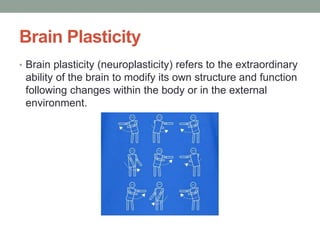
Brain Plasticity
• Brain plasticity (neuroplasticity) refers to the extraordinary
ability of the brain to modify its own structure and function
following changes within the body or in the external
environment.
Brain structures
• Working memory
• Decision making
• Insight
• Judgement
• Inhibition of
distractions
Thinner in ADHD
Prefrontal Cortex
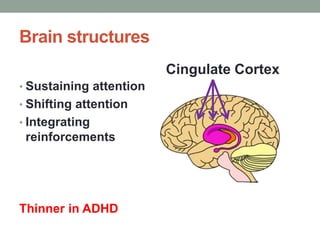
Brain structures
• Sustaining attention
• Shifting attention
• Integrating
reinforcements
Thinner in ADHD
Cingulate Cortex
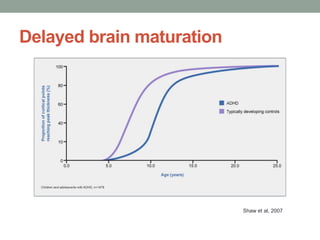
Delayed brain maturation
Shaw et al, 2007
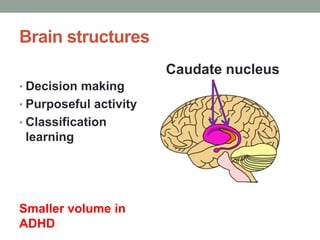
Brain structures
• Decision making
• Purposeful activity
• Classification
learning
Smaller volume in
ADHD
Caudate nucleus
Brain structures
• Mood
• Motivation
• Pleasure
Smaller volume in
ADHD
Nucleus accumbens
Brain structures
• Learning
• Responding to
stimuli
• Memory
• Regulating
movement
• Smaller volume in
ADHD
Putamen
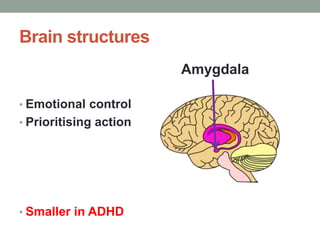
Brain structures
• Emotional control
• Prioritising action
• Smaller in ADHD
Amygdala
Brain structures
• Long-term memory
• Working memory
Smaller volume in
ADHD
Hippocampus
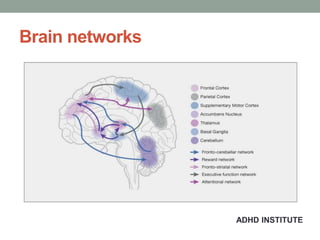
Brain networks
ADHD INSTITUTE
Brain networks
Dorsal anterior
cingulate cortex
• Selective
attention
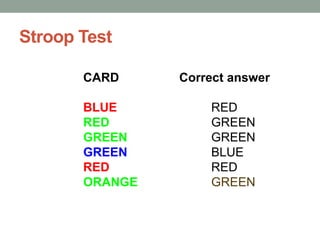
Stroop Test
CARD Correct answer
BLUE RED
RED GREEN
GREEN GREEN
GREEN BLUE
RED RED
ORANGE GREEN
Brain networks
Dorsolateral
prefrontal cortex
• Sustained
attention and
problem
solving
N-back test
If N = 1:
• Stimulus: 4 Response: None
• Stimulus: 2 Response: 4
• Stimulus: 1 Response: 2
• Stimulus: 3 Response: 1etc.
Brain networks
Underactive networks:
• Frontoparietal network (executive control circuit)
Overactive networks:
• Default mode network (resting brain)
• Visual network
• Dorsal attention network
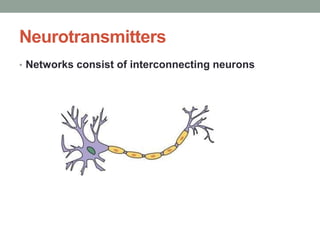
Neurotransmitters
• Networks consist of interconnecting neurons
Neurotransmitters
Dopamine Transporter
Presynaptic vesicle
Post synaptic receptor
Dopamine
Genetics of ADHD
Polymorphisms which may influence susceptibility to
ADHD:
• D4
• D5
• DAT
• Dopamine β Hydroxylase
• SNAP 25
• Serotonin transporter
• HTR 1B
How does Methylphenidate work?
Dopamine Transporter
Presynaptic vesicle
Post synaptic receptor
Dopamine
How does Dexamfetamine work?
Dopamine Transporter
Presynaptic vesicle
Post synaptic receptor
Dopamine
How does Atomoxetine work?
Noradrenaline Transporter
Presynaptic vesicle
Post synaptic receptor
NA & Dopamine
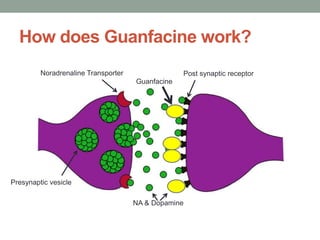
How does Guanfacine work?
Noradrenaline Transporter
Presynaptic vesicle
Post synaptic receptor
NA & Dopamine
Guanfacine
Summary
ADHD is associated with differences in:
• Brain structure
• Brain function
• Brain chemistry
• Brain maturation
ADHD is a continuum of symptoms of inattention,
impulsivity and restlessness
The brain is plastic

Adhd brain-development-and-function-space-stockport-19-10-2018

Editor's Notes

  • #25 Executive control circuit: role in making decisions and learning new tasks. May be responsible for mind wandering and lack of motivation or impulse control. Default mode network: switches off default network activity when focus is needed.