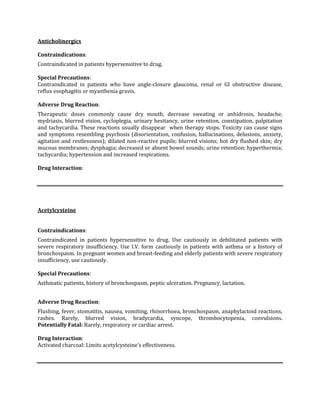
Anticholinergics

Contraindications:
Contraindicated in patients hypersensitive to drug.

Special Precautions:
Contraindicated in patients who have angle-closure glaucoma, renal or GI obstructive disease,
reflux esophagitis or myasthenia gravis.

Adverse Drug Reaction:
Therapeutic doses commonly cause dry mouth, decrease sweating or anhidrosis, headache,
mydriasis, blurred vision, cycloplegia, urinary hesitancy, urine retention, constipation, palpitation
and tachycardia. These reactions usually disappear when therapy stops. Toxicity can cause signs
and symptoms resembling psychosis (disorientation, confusion, hallucinations, delusions, anxiety,
agitation and restlessness); dilated non-reactive pupils; blurred visions; hot dry flushed skin; dry
mucous membranes; dysphagia; decreased or absent bowel sounds; urine retention; hyperthermia;
tachycardia; hypertension and increased respirations.

Drug Interaction:


Acetylcysteine


Contraindications:
Contraindicated in patients hypersensitive to drug. Use cautiously in debilitated patients with
severe respiratory insufficiency. Use I.V. form cautiously in patients with asthma or a history of
bronchospasm. In pregnant women and breast-feeding and elderly patients with severe respiratory
insufficiency, use cautiously.

Special Precautions:
Asthmatic patients, history of bronchospasm, peptic ulceration. Pregnancy, lactation.


Adverse Drug Reaction:
Flushing, fever, stomatitis, nausea, vomiting, rhinorrhoea, bronchospasm, anaphylactoid reactions,
rashes. Rarely, blurred vision, bradycardia, syncope, thrombocytopenia, convulsions.
Potentially Fatal: Rarely, respiratory or cardiac arrest.

Drug Interaction:
Activated charcoal: Limits acetylcysteine’s effectiveness.
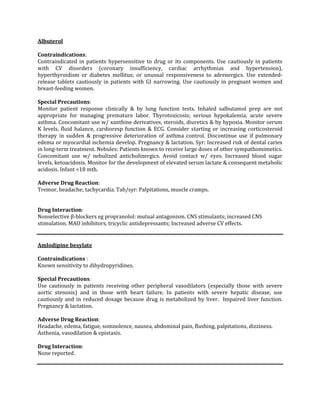
Albuterol

Contraindications:
Contraindicated in patients hypersensitive to drug or its components. Use cautiously in patients
with CV disorders (coronary insufficiency, cardiac arrhythmias and hypertension),
hyperthyroidism or diabetes mellitus; or unusual responsiveness to adrenergics. Use extended-
release tablets cautiously in patients with GI narrowing. Use cautiously in pregnant women and
breast-feeding women.

Special Precautions:
Monitor patient response clinically & by lung function tests. Inhaled salbutamol prep are not
appropriate for managing premature labor. Thyrotoxicosis; serious hypokalemia; acute severe
asthma. Concomitant use w/ xanthine derivatives, steroids, diuretics & by hypoxia. Monitor serum
K levels, fluid balance, cardioresp function & ECG. Consider starting or increasing corticosteroid
therapy in sudden & progressive deterioration of asthma control. Discontinue use if pulmonary
edema or myocardial ischemia develop. Pregnancy & lactation. Syr: Increased risk of dental caries
in long-term treatment. Nebules: Patients known to receive large doses of other sympathomimetics.
Concomitant use w/ nebulized anticholinergics. Avoid contact w/ eyes. Increased blood sugar
levels, ketoacidosis. Monitor for the development of elevated serum lactate & consequent metabolic
acidosis. Infant <18 mth.

Adverse Drug Reaction:
Tremor, headache; tachycardia. Tab/syr: Palpitations, muscle cramps.


Drug Interaction:
Nonselective β-blockers eg propranolol: mutual antagonism. CNS stimulants; increased CNS
stimulation. MAO inhibitors, tricyclic antidepressants; Increased adverse CV effects.


Amlodipine besylate

Contraindications :
Known sensitivity to dihydropyridines.

Special Precautions:
Use cautiously in patients receiving other peripheral vasodilators (especially those with severe
aortic stenosis) and in those with heart failure. In patients with severe hepatic disease, use
cautiously and in reduced dosage because drug is metabolized by liver. Impaired liver function.
Pregnancy & lactation.

Adverse Drug Reaction:
Headache, edema, fatigue, somnolence, nausea, abdominal pain, flushing, palpitations, dizziness.
Asthenia, vasodilation & epistaxis.

Drug Interaction:
None reported.
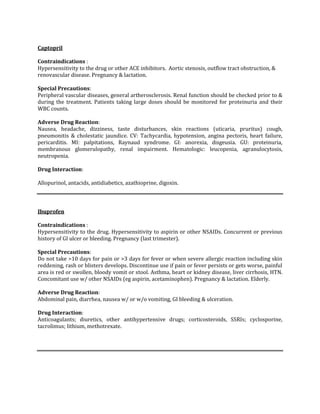
Captopril

Contraindications :
Hypersensitivity to the drug or other ACE inhibitors. Aortic stenosis, outflow tract obstruction, &
renovascular disease. Pregnancy & lactation.

Special Precautions:
Peripheral vascular diseases, general artherosclerosis. Renal function should be checked prior to &
during the treatment. Patients taking large doses should be monitored for proteinuria and their
WBC counts.

Adverse Drug Reaction:
Nausea, headache, dizziness, taste disturbances, skin reactions (uticaria, pruritus) cough,
pneumonitis & cholestatic jaundice. CV: Tachycardia, hypotension, angina pectoris, heart failure,
pericarditis. MI: palpitations, Raynaud syndrome. GI: anorexia, disgeusia. GU: proteinuria,
membranous glomerulopathy, renal impairment. Hematologic: leucopenia, agranulocytosis,
neutropenia.

Drug Interaction:

Allopurinol, antacids, antidiabetics, azathioprine, digoxin.


Ibuprofen

Contraindications :
Hypersensitivity to the drug. Hypersensitivity to aspirin or other NSAIDs. Concurrent or previous
history of GI ulcer or bleeding. Pregnancy (last trimester).

Special Precautions:
Do not take >10 days for pain or >3 days for fever or when severe allergic reaction including skin
reddening, rash or blisters develops. Discontinue use if pain or fever persists or gets worse, painful
area is red or swollen, bloody vomit or stool. Asthma, heart or kidney disease, liver cirrhosis, HTN.
Concomitant use w/ other NSAIDs (eg aspirin, acetaminophen). Pregnancy & lactation. Elderly.

Adverse Drug Reaction:
Abdominal pain, diarrhea, nausea w/ or w/o vomiting, GI bleeding & ulceration.

Drug Interaction:
Anticoagulants; diuretics, other antihypertensive drugs; corticosteroids, SSRIs; cyclosporine,
tacrolimus; lithium, methotrexate.
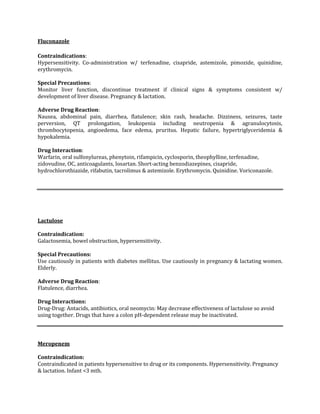
Fluconazole

Contraindications:
Hypersensitivity. Co-administration w/ terfenadine, cisapride, astemizole, pimozide, quinidine,
erythromycin.

Special Precautions:
Monitor liver function, discontinue treatment if clinical signs & symptoms consistent w/
development of liver disease. Pregnancy & lactation.

Adverse Drug Reaction:
Nausea, abdominal pain, diarrhea, flatulence; skin rash, headache. Dizziness, seizures, taste
perversion, QT prolongation, leukopenia including neutropenia & agranulocytosis,
thrombocytopenia, angioedema, face edema, pruritus. Hepatic failure, hypertriglyceridemia &
hypokalemia.

Drug Interaction:
Warfarin, oral sulfonylureas, phenytoin, rifampicin, cyclosporin, theophylline, terfenadine,
zidovudine, OC, anticoagulants, losartan. Short-acting benzodiazepines, cisapride,
hydrochlorothiazide, rifabutin, tacrolimus & astemizole. Erythromycin. Quinidine. Voriconazole.


Lactulose

Contraindication:
Galactosemia, bowel obstruction, hypersensitivity.

Special Precautions:
Use cautiously in patients with diabetes mellitus. Use cautiously in pregnancy & lactating women.
Elderly.

Adverse Drug Reaction:
Flatulence, diarrhea.

Drug Interactions:
Drug-Drug: Antacids, antibiotics, oral neomycin: May decrease effectiveness of lactulose so avoid
using together. Drugs that have a colon pH-dependent release may be inactivated.


Meropenem

Contraindication:
Contraindicated in patients hypersensitive to drug or its components. Hypersensitivity. Pregnancy
& lactation. Infant <3 mth.
Special Precautions:
Hypersensitivity to carbapenems, penicillins or other β-lactam antibiotics. Consider
pseudomembranous colitis in patients who develop diarrhea. Monitor liver function in patients w/
preexisting liver disorders. +ve direct/indirect Coombs' test.

Adverse Drug Reaction:
Thrombocythemia. Nausea, vomiting, diarrhea. Increases in serum transaminases, bilirubin,
alkaline phosphatase, lactic dehydrogenase. Inflammation, thrombophlebitis, pain.

Drug Interactions:
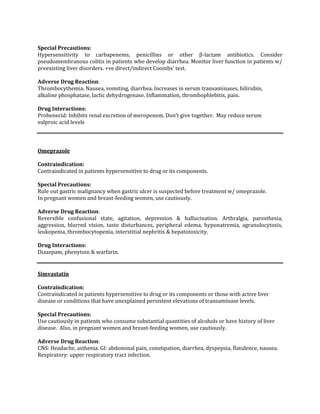
Probenecid: Inhibits renal excretion of meropenem. Don’t give together. May reduce serum
valproic acid levels


Omeprazole

Contraindication:
Contraindicated in patients hypersensitive to drug or its components.

Special Precautions:
Rule out gastric malignancy when gastric ulcer is suspected before treatment w/ omeprazole.
In pregnant women and breast-feeding women, use cautiously.

Adverse Drug Reaction:
Reversible confusional state, agitation, depression & hallucination. Arthralgia, paresthesia,
aggression, blurred vision, taste disturbances, peripheral edema, hyponatremia, agranulocytosis,
leukopenia, thrombocytopenia, interstitial nephritis & hepatotoxicity.

Drug Interactions:
Diazepam, phenytoin & warfarin.


Simvastatin

Contraindication:
Contraindicated in patients hypersensitive to drug or its components or those with active liver
disease or conditions that have unexplained persistent elevations of transaminase levels.

Special Precautions:
Use cautiously in patients who consume substantial quantities of alcohols or have history of liver
disease. Also, in pregnant women and breast-feeding women, use cautiously.

Adverse Drug Reaction:
CNS: Headache, asthenia. GI: abdominal pain, constipation, diarrhea, dyspepsia, flatulence, nausea.
Respiratory: upper respiratory tract infection.
Drug Interactions:
Drug-drug. Amiodarone, verapamil: Increases risk of myopathy and rhabdomyolosis. Don’t exceed
20 mg simvastatin daily.


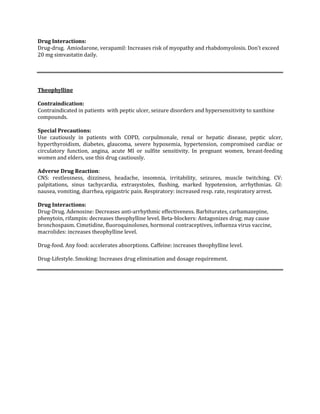
Theophylline

Contraindication:
Contraindicated in patients with peptic ulcer, seizure disorders and hypersensitivity to xanthine
compounds.

Special Precautions:
Use cautiously in patients with COPD, corpulmonale, renal or hepatic disease, peptic ulcer,
hyperthyroidism, diabetes, glaucoma, severe hypoxemia, hypertension, compromised cardiac or
circulatory function, angina, acute MI or sulfite sensitivity. In pregnant women, breast-feeding
women and elders, use this drug cautiously.

Adverse Drug Reaction:
CNS: restlessness, dizziness, headache, insomnia, irritability, seizures, muscle twitching. CV:
palpitations, sinus tachycardia, extrasystoles, flushing, marked hypotension, arrhythmias. GI:
nausea, vomiting, diarrhea, epigastric pain. Respiratory: increased resp. rate, respiratory arrest.

Drug Interactions:
Drug-Drug. Adenosine: Decreases anti-arrhythmic effectiveness. Barbiturates, carbamazepine,
phenytoin, rifampin: decreases theophylline level. Beta-blockers: Antagonizes drug; may cause
bronchospasm. Cimetidine, fluoroquinolones, hormonal contraceptives, influenza virus vaccine,
macrolides: increases theophylline level.

Drug-food. Any food: accelerates absorptions. Caffeine: increases theophylline level.

Drug-Lifestyle. Smoking: Increases drug elimination and dosage requirement.

Drug info concise

  • 1.
    Anticholinergics Contraindications: Contraindicated in patientshypersensitive to drug. Special Precautions: Contraindicated in patients who have angle-closure glaucoma, renal or GI obstructive disease, reflux esophagitis or myasthenia gravis. Adverse Drug Reaction: Therapeutic doses commonly cause dry mouth, decrease sweating or anhidrosis, headache, mydriasis, blurred vision, cycloplegia, urinary hesitancy, urine retention, constipation, palpitation and tachycardia. These reactions usually disappear when therapy stops. Toxicity can cause signs and symptoms resembling psychosis (disorientation, confusion, hallucinations, delusions, anxiety, agitation and restlessness); dilated non-reactive pupils; blurred visions; hot dry flushed skin; dry mucous membranes; dysphagia; decreased or absent bowel sounds; urine retention; hyperthermia; tachycardia; hypertension and increased respirations. Drug Interaction: Acetylcysteine Contraindications: Contraindicated in patients hypersensitive to drug. Use cautiously in debilitated patients with severe respiratory insufficiency. Use I.V. form cautiously in patients with asthma or a history of bronchospasm. In pregnant women and breast-feeding and elderly patients with severe respiratory insufficiency, use cautiously. Special Precautions: Asthmatic patients, history of bronchospasm, peptic ulceration. Pregnancy, lactation. Adverse Drug Reaction: Flushing, fever, stomatitis, nausea, vomiting, rhinorrhoea, bronchospasm, anaphylactoid reactions, rashes. Rarely, blurred vision, bradycardia, syncope, thrombocytopenia, convulsions. Potentially Fatal: Rarely, respiratory or cardiac arrest. Drug Interaction: Activated charcoal: Limits acetylcysteine’s effectiveness.
  • 2.
    Albuterol Contraindications: Contraindicated in patientshypersensitive to drug or its components. Use cautiously in patients with CV disorders (coronary insufficiency, cardiac arrhythmias and hypertension), hyperthyroidism or diabetes mellitus; or unusual responsiveness to adrenergics. Use extended- release tablets cautiously in patients with GI narrowing. Use cautiously in pregnant women and breast-feeding women. Special Precautions: Monitor patient response clinically & by lung function tests. Inhaled salbutamol prep are not appropriate for managing premature labor. Thyrotoxicosis; serious hypokalemia; acute severe asthma. Concomitant use w/ xanthine derivatives, steroids, diuretics & by hypoxia. Monitor serum K levels, fluid balance, cardioresp function & ECG. Consider starting or increasing corticosteroid therapy in sudden & progressive deterioration of asthma control. Discontinue use if pulmonary edema or myocardial ischemia develop. Pregnancy & lactation. Syr: Increased risk of dental caries in long-term treatment. Nebules: Patients known to receive large doses of other sympathomimetics. Concomitant use w/ nebulized anticholinergics. Avoid contact w/ eyes. Increased blood sugar levels, ketoacidosis. Monitor for the development of elevated serum lactate & consequent metabolic acidosis. Infant <18 mth. Adverse Drug Reaction: Tremor, headache; tachycardia. Tab/syr: Palpitations, muscle cramps. Drug Interaction: Nonselective β-blockers eg propranolol: mutual antagonism. CNS stimulants; increased CNS stimulation. MAO inhibitors, tricyclic antidepressants; Increased adverse CV effects. Amlodipine besylate Contraindications : Known sensitivity to dihydropyridines. Special Precautions: Use cautiously in patients receiving other peripheral vasodilators (especially those with severe aortic stenosis) and in those with heart failure. In patients with severe hepatic disease, use cautiously and in reduced dosage because drug is metabolized by liver. Impaired liver function. Pregnancy & lactation. Adverse Drug Reaction: Headache, edema, fatigue, somnolence, nausea, abdominal pain, flushing, palpitations, dizziness. Asthenia, vasodilation & epistaxis. Drug Interaction: None reported.
  • 3.
    Captopril Contraindications : Hypersensitivity tothe drug or other ACE inhibitors. Aortic stenosis, outflow tract obstruction, & renovascular disease. Pregnancy & lactation. Special Precautions: Peripheral vascular diseases, general artherosclerosis. Renal function should be checked prior to & during the treatment. Patients taking large doses should be monitored for proteinuria and their WBC counts. Adverse Drug Reaction: Nausea, headache, dizziness, taste disturbances, skin reactions (uticaria, pruritus) cough, pneumonitis & cholestatic jaundice. CV: Tachycardia, hypotension, angina pectoris, heart failure, pericarditis. MI: palpitations, Raynaud syndrome. GI: anorexia, disgeusia. GU: proteinuria, membranous glomerulopathy, renal impairment. Hematologic: leucopenia, agranulocytosis, neutropenia. Drug Interaction: Allopurinol, antacids, antidiabetics, azathioprine, digoxin. Ibuprofen Contraindications : Hypersensitivity to the drug. Hypersensitivity to aspirin or other NSAIDs. Concurrent or previous history of GI ulcer or bleeding. Pregnancy (last trimester). Special Precautions: Do not take >10 days for pain or >3 days for fever or when severe allergic reaction including skin reddening, rash or blisters develops. Discontinue use if pain or fever persists or gets worse, painful area is red or swollen, bloody vomit or stool. Asthma, heart or kidney disease, liver cirrhosis, HTN. Concomitant use w/ other NSAIDs (eg aspirin, acetaminophen). Pregnancy & lactation. Elderly. Adverse Drug Reaction: Abdominal pain, diarrhea, nausea w/ or w/o vomiting, GI bleeding & ulceration. Drug Interaction: Anticoagulants; diuretics, other antihypertensive drugs; corticosteroids, SSRIs; cyclosporine, tacrolimus; lithium, methotrexate.
  • 4.
    Fluconazole Contraindications: Hypersensitivity. Co-administration w/terfenadine, cisapride, astemizole, pimozide, quinidine, erythromycin. Special Precautions: Monitor liver function, discontinue treatment if clinical signs & symptoms consistent w/ development of liver disease. Pregnancy & lactation. Adverse Drug Reaction: Nausea, abdominal pain, diarrhea, flatulence; skin rash, headache. Dizziness, seizures, taste perversion, QT prolongation, leukopenia including neutropenia & agranulocytosis, thrombocytopenia, angioedema, face edema, pruritus. Hepatic failure, hypertriglyceridemia & hypokalemia. Drug Interaction: Warfarin, oral sulfonylureas, phenytoin, rifampicin, cyclosporin, theophylline, terfenadine, zidovudine, OC, anticoagulants, losartan. Short-acting benzodiazepines, cisapride, hydrochlorothiazide, rifabutin, tacrolimus & astemizole. Erythromycin. Quinidine. Voriconazole. Lactulose Contraindication: Galactosemia, bowel obstruction, hypersensitivity. Special Precautions: Use cautiously in patients with diabetes mellitus. Use cautiously in pregnancy & lactating women. Elderly. Adverse Drug Reaction: Flatulence, diarrhea. Drug Interactions: Drug-Drug: Antacids, antibiotics, oral neomycin: May decrease effectiveness of lactulose so avoid using together. Drugs that have a colon pH-dependent release may be inactivated. Meropenem Contraindication: Contraindicated in patients hypersensitive to drug or its components. Hypersensitivity. Pregnancy & lactation. Infant <3 mth.
  • 5.
    Special Precautions: Hypersensitivity tocarbapenems, penicillins or other β-lactam antibiotics. Consider pseudomembranous colitis in patients who develop diarrhea. Monitor liver function in patients w/ preexisting liver disorders. +ve direct/indirect Coombs' test. Adverse Drug Reaction: Thrombocythemia. Nausea, vomiting, diarrhea. Increases in serum transaminases, bilirubin, alkaline phosphatase, lactic dehydrogenase. Inflammation, thrombophlebitis, pain. Drug Interactions: Probenecid: Inhibits renal excretion of meropenem. Don’t give together. May reduce serum valproic acid levels Omeprazole Contraindication: Contraindicated in patients hypersensitive to drug or its components. Special Precautions: Rule out gastric malignancy when gastric ulcer is suspected before treatment w/ omeprazole. In pregnant women and breast-feeding women, use cautiously. Adverse Drug Reaction: Reversible confusional state, agitation, depression & hallucination. Arthralgia, paresthesia, aggression, blurred vision, taste disturbances, peripheral edema, hyponatremia, agranulocytosis, leukopenia, thrombocytopenia, interstitial nephritis & hepatotoxicity. Drug Interactions: Diazepam, phenytoin & warfarin. Simvastatin Contraindication: Contraindicated in patients hypersensitive to drug or its components or those with active liver disease or conditions that have unexplained persistent elevations of transaminase levels. Special Precautions: Use cautiously in patients who consume substantial quantities of alcohols or have history of liver disease. Also, in pregnant women and breast-feeding women, use cautiously. Adverse Drug Reaction: CNS: Headache, asthenia. GI: abdominal pain, constipation, diarrhea, dyspepsia, flatulence, nausea. Respiratory: upper respiratory tract infection.
  • 6.
    Drug Interactions: Drug-drug. Amiodarone,verapamil: Increases risk of myopathy and rhabdomyolosis. Don’t exceed 20 mg simvastatin daily. Theophylline Contraindication: Contraindicated in patients with peptic ulcer, seizure disorders and hypersensitivity to xanthine compounds. Special Precautions: Use cautiously in patients with COPD, corpulmonale, renal or hepatic disease, peptic ulcer, hyperthyroidism, diabetes, glaucoma, severe hypoxemia, hypertension, compromised cardiac or circulatory function, angina, acute MI or sulfite sensitivity. In pregnant women, breast-feeding women and elders, use this drug cautiously. Adverse Drug Reaction: CNS: restlessness, dizziness, headache, insomnia, irritability, seizures, muscle twitching. CV: palpitations, sinus tachycardia, extrasystoles, flushing, marked hypotension, arrhythmias. GI: nausea, vomiting, diarrhea, epigastric pain. Respiratory: increased resp. rate, respiratory arrest. Drug Interactions: Drug-Drug. Adenosine: Decreases anti-arrhythmic effectiveness. Barbiturates, carbamazepine, phenytoin, rifampin: decreases theophylline level. Beta-blockers: Antagonizes drug; may cause bronchospasm. Cimetidine, fluoroquinolones, hormonal contraceptives, influenza virus vaccine, macrolides: increases theophylline level. Drug-food. Any food: accelerates absorptions. Caffeine: increases theophylline level. Drug-Lifestyle. Smoking: Increases drug elimination and dosage requirement.