Dr Pratyush Chaudhuri Supported by Nirmal Clinics Science comes first .


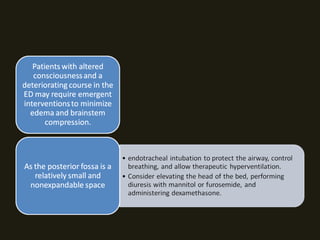
H1- receptor antagonists These agents may suppress vestibular responses through an effect in the CNS; however, the mechanism remains unknown. Some investigators believe this action is mediated primarily by central anticholinergic activity. Dimenhydrinate (Dramamine, Dimetabs, Dymenate, Triptone) A 1:1 salt of 8-chlorotheophylline and diphenhydramine, thought to be particularly useful in treatment of peripheral vertigo. Diminishes vestibular stimulation and depresses labyrinthine function through central anticholinergic activity. Dosing Interactions Contraindications Precautions Adult 50-100 mg PO q4-6h; not to exceed 400 mg/d; 50 mg IV in 10 mL NaCl; injection is given over 2 min; not for intra-arterial administration; 50 mg IM prn Pediatric <2 years: Not established 2-6 years: 12.5-25 mg PO q6-8h, not to exceed 75 mg/d; 1.25 mg/kg or 37.5 mg/m 2  IM qid, not to exceed 300 mg/d 6-12 years: 25-50 mg PO q6-8h; not to exceed 150 mg/d >12 years: Administer as in adults Dosing Interactions Contraindications Precautions Alcohol or other CNS depressants may have additive effect; potentially ototoxic antibiotics may mask ototoxic symptoms, and irreversible damage may result Dosing Interactions Contraindications Precautions Documented hypersensitivity; do not administer to neonates; IV products may contain benzyl alcohol, which has been associated with fatal &quot;gasping syndrome&quot; in premature infants and low-birth-weight infants Dosing Interactions Contraindications Precautions Pregnancy B - Fetal risk not confirmed in studies in humans but has been shown in some studies in animals Precautions Do not treat severe emesis with antiemetic drugs alone; may contain either sulfites or tartrazine, which may cause allergic-type reactions in susceptible persons; may impede diagnosis of conditions such as brain tumors, intestinal obstruction, and appendicitis; may obscure signs of toxicity from overdosage of other drugs Diphenhydramine (Benadryl, Bydramine, Hyrexin) Used for treatment and prophylaxis of vestibular disorders. Dosing Interactions Contraindications Precautions Adult 25-50 mg PO q6-8h prn; not to exceed 400 mg/d; 10-50 mg IV/IM q6-8h prn; not to exceed 400 mg/d Pediatric 12.5-25 mg PO tid/qid or 5 mg/kg/d PO or 150 mg/m 2 /d PO divided tid/qid; not to exceed 300 mg/d 5 mg/kg/d IV/IM or 150 mg/m 2 /d IV/IM divided qid; not to exceed 300 mg/d Dosing Interactions Contraindications Precautions Potentiates effect of CNS depressants; because of alcohol content, do not give syrup dosage form to patient taking medications that can cause disulfiramlike reactions Dosing Interactions Contraindications Precautions Documented hypersensitivity Dosing Interactions Contraindications Precautions Pregnancy C - Fetal risk revealed in studies in animals but not established or not studied in humans; may use if benefits outweigh risk to fetus Precautions May exacerbate angle-closure glaucoma, hyperthyroidism, peptic ulcer, and urinary tract obstruction Promethazine hydrochloride (Phenergan) Used for symptomatic treatment of nausea in vestibular dysfunction. An antidopaminergic agent effective in treatment of vertigo, blocks postsynaptic mesolimbic dopaminergic receptors in brain and reduces stimuli to brainstem reticular system. Dosing Interactions Contraindications Precautions Adult 12.5 mg PO/PR tid and 25 mg PO/PR hs; 25 mg IV/IM and repeat prn in 2 h; switch to PO as soon as possible Pediatric <2 years: Contraindicated >2 years: 0.25-1 mg/kg PO/IV/IM/PR 4-6 times/d Dosing Interactions Contraindications Precautions May have additive effects with other CNS depressants or anticonvulsants; coadministration with epinephrine may cause hypotension Dosing Interactions Contraindications Precautions Documented hypersensitivity; administration by SC or IP route; children <2 y (incidences of death due to respiratory depression) Dosing Interactions Contraindications Precautions Pregnancy C - Fetal risk revealed in studies in animals but not established or not studied in humans; may use if benefits outweigh risk to fetus Precautions Must not administer SC or IP, since necrotic lesions may develop; causes sedation and may have adverse anticholinergic effects; caution in cardiovascular disease, impaired liver function, seizures, sleep apnea, and asthma Benzodiazepines Centrally, these agents inhibit vestibular responses, presumably by potentiating inhibitory GABA receptors. Diazepam (Valium, Diastat, Diazemuls) Probably most commonly used benzodiazepine to treat vertigo. Highly lipophilic and undergoes rapid redistribution after administration. Duration of effects in CNS relatively short, which may make it relatively less desirable. Dosing Interactions Contraindications Precautions Adult 5-10 mg PO/IV/IM q3-4h and repeat q2-4h prn; not to exceed 30 mg/8 h Pediatric 0.12-0.8 mg/kg/d PO divided q6-8h; not to exceed 10 mg/dose 0.05-0.3 mg/kg/dose IV/IM over 2-3 min and repeat in 2-4 h prn Dosing Interactions Contraindications Precautions Phenothiazines, barbiturates, alcohols, and MAOIs may increase toxicity in CNS Dosing Interactions Contraindications Precautions Documented hypersensitivity; narrow-angle glaucoma Dosing Interactions Contraindications Precautions Pregnancy D - Fetal risk shown in humans; use only if benefits outweigh risk to fetus Precautions Caution with other CNS depressants, low albumin levels, or hepatic disease (may increase toxicity) Lorazepam (Ativan) Sedative hypnotic in benzodiazepine class that has short time to onset and relatively long half-life. Depresses all levels of CNS, including limbic and reticular formation, probably through increased action of GABA, a major inhibitory neurotransmitter. Dosing Interactions Contraindications Precautions Adult 1.0-10 mg/d PO/IM/IV divided bid/tid Pediatric 0.05 mg/kg/dose PO/IM/IV q4-8h Dosing Interactions Contraindications Precautions Alcohol, phenothiazines, barbiturates, and MAOIs may increase toxicity in CNS Dosing Interactions Contraindications Precautions Documented hypersensitivity; preexisting CNS depression; hypotension; narrow-angle glaucoma Dosing Interactions Contraindications Precautions Pregnancy D - Fetal risk shown in humans; use only if benefits outweigh risk to fetus Precautions Caution in renal or hepatic impairment, myasthenia gravis, organic brain syndrome, or Parkinson disease Diuretics Diuretic agents are used as a temporary measure to lower ICP until definitive intervention is performed. Mannitol (Osmitrol) Nonreabsorbable solute, decreases water reabsorption in water-soluble portions of nephron. Reduces reabsorption of sodium chloride as well. Perhaps more importantly, does not cross blood-brain barrier. Creates osmotic gradient, drawing water from brain into intravascular compartment. Used to lower ICP in variety of conditions. Initially assess for adequate renal function in adults by administering test dose of 200 mg/kg IV over 3-5 min. Should produce a urine flow of at least 30-50 mL/h over 2-3 h. In children, assess by administering same test dose and rate. Should produce a urine flow of at least 1 mL/kg/h over 1-3 h. Dosing Interactions Contraindications Precautions Adult 1 g/kg IV of 20% or 25% solution Pediatric 250-1000 mg/kg/dose IV or alternative as follows Initial dose: 0.5-1 g/kg IV Maintenance dose: 0.25–0.5 g/kg IV q4-6h Dosing Interactions Contraindications Precautions None reported Dosing Interactions Contraindications Precautions Caution in renal or hepatic impairment, myasthenia gravis, organic brain syndrome, or Parkinson disease Dosing Interactions Contraindications Precautions Pregnancy C - Fetal risk revealed in studies in animals but not established or not studied in humans; may use if benefits outweigh risk to fetus Precautions Carefully evaluate cardiovascular status before rapid administration of mannitol, since sudden increase in extracellular fluid may lead to fulminating CHF; avoid pseudoagglutination—when blood given simultaneously, add at least 20 mEq of sodium chloride to each liter of mannitol solution; do not give electrolyte-free mannitol solutions with blood Furosemide (Lasix) Loop diuretic that blocks transport of sodium, potassium, and chloride in thick ascending limb of loop of Henle in kidney. May enhance effect of mannitol and produce greater and more sustained decrease in ICP. Dosing Interactions Contraindications Precautions Adult 20-40 mg/d IV/IM or 0.5-1 mg/kg IV Pediatric 1 mg/kg IV/IM slowly under close supervision; not to exceed 6 mg/kg Dosing Interactions Contraindications Precautions Metformin decreases concentrations; interferes with hypoglycemic effect of antidiabetic agents and antagonizes muscle-relaxing effect of tubocurarine; coadministration of aminoglycosides may increase auditory toxicity (hearing loss of varying degrees may occur); may enhance anticoagulant activity of warfarin; increased plasma levels and toxicity of lithium are possible Dosing Interactions Contraindications Precautions Documented hypersensitivity; hepatic coma; anuria; severe electrolyte depletion Dosing Interactions Contraindications Precautions Pregnancy C - Fetal risk revealed in studies in animals but not established or not studied in humans; may use if benefits outweigh risk to fetus Precautions Volume depletion, hypotension, azotemia, marked hypokalemia, and hypochloremic metabolic alkalosis are all risks of therapy; patient's intravascular volume status and serum electrolytes must be monitored closely; hypocalcemia also possible, particularly in patients with hypoparathyroidism Transient deafness has been described after rapid IV administration of large doses, particularly when other ototoxic drugs also administered Perform frequent determinations of serum electrolytes, CO 2 , glucose, creatinine, uric acid, calcium, and BUN during first few months of therapy and periodically thereafter Corticosteroids These agents are used to decrease brain edema associated with intracranial tumors. Dexamethasone (Decadron) Preferred corticosteroid for this purpose because it demonstrates high glucocorticoid potency and minimal mineralocorticoid activity. Dosing Interactions Contraindications Precautions Adult 10 mg IV followed by 4-6 mg IV q6h Pediatric 0.5-1.5 mg/kg IV; then 0.05-0.1 mg/kg IV q6h
Follow-up Further Inpatient Care Most patients with proven or suspected central vertigo should be admitted to the hospital for further evaluation and treatment.  Patients should be admitted under the care of a neurologist or neurosurgeon.  Patients with evidence of acute brainstem or cerebellar disease should be admitted to a monitored bed, preferably in an intensive care unit. Transfer Transfer may be necessary for patients seen in facilities lacking cranial imaging capability or neurosurgical coverage. Transferred patients require monitoring and the availability of definitive airway management during the transport period. Deterrence/Prevention The clinician should suspect TIAs in patients with recurrent transient symptoms and risk factors for atherosclerotic or cardioembolic disease. Prognostic scores for early risk of stroke after TIA may be helpful in assessing risk. 17  A correct diagnosis of TIA followed by appropriate aspirin or anticoagulant therapy may decrease the risk of a future CVA significantly. Prognosis Prognosis for patients with central vertigo depends on the underlying disease and is highly variable.  Neurosurgical advancements have improved the prognosis for many serious conditions. This magnifies the importance of identifying these patients in the emergency setting.  The prognosis of infarction of the basilar or vertebral arteries is poor. In one series, 45% of patients presented in coma. Importantly, half of the patients in this series had prodromal symptoms, including vertigo, which cleared completely in the 6 months prior to the stroke. 12  The prognosis for patients with spontaneous cerebellar hemorrhage is poor. Neurologic deterioration in these patients is associated independently with a hematoma in the central vermian area of the cerebellum and with secondary hydrocephalus. 1  Patient Education Most causes of central vertigo have serious ramifications. Inform the patient of the suspected diagnosis in understandable terms and explain the necessity of hospital admission.  For excellent patient education resources, visit eMedicine's  Brain and Nervous System Center . Also, see eMedicine's patient education article  Vertigo . Miscellaneous Medicolegal Pitfalls Failure to have a low threshold for obtaining consultation, imaging, and further studies on patients who present with isolated vertigo and who have risk factors for atherosclerotic or other central disease  Failure to monitor patients closely for clinical deterioration who have disease involving or compromising the brain stem Special Concerns Geriatric patients are at particularly high risk for cerebrovascular disease and should be evaluated aggressively.

Neuro clinics 40 vertigo-3

  • 1.
    Dr Pratyush ChaudhuriSupported by Nirmal Clinics Science comes first .
  • 2.
  • 3.
  • 4.
  • 5.
  • 6.
  • 7.
  • 8.
  • 9.
  • 10.
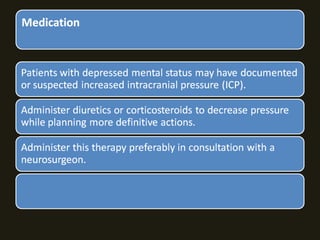
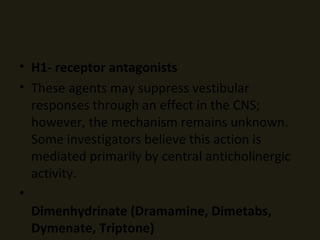
    H1- receptor antagonistsThese agents may suppress vestibular responses through an effect in the CNS; however, the mechanism remains unknown. Some investigators believe this action is mediated primarily by central anticholinergic activity. Dimenhydrinate (Dramamine, Dimetabs, Dymenate, Triptone) A 1:1 salt of 8-chlorotheophylline and diphenhydramine, thought to be particularly useful in treatment of peripheral vertigo. Diminishes vestibular stimulation and depresses labyrinthine function through central anticholinergic activity. Dosing Interactions Contraindications Precautions Adult 50-100 mg PO q4-6h; not to exceed 400 mg/d; 50 mg IV in 10 mL NaCl; injection is given over 2 min; not for intra-arterial administration; 50 mg IM prn Pediatric <2 years: Not established 2-6 years: 12.5-25 mg PO q6-8h, not to exceed 75 mg/d; 1.25 mg/kg or 37.5 mg/m 2 IM qid, not to exceed 300 mg/d 6-12 years: 25-50 mg PO q6-8h; not to exceed 150 mg/d >12 years: Administer as in adults Dosing Interactions Contraindications Precautions Alcohol or other CNS depressants may have additive effect; potentially ototoxic antibiotics may mask ototoxic symptoms, and irreversible damage may result Dosing Interactions Contraindications Precautions Documented hypersensitivity; do not administer to neonates; IV products may contain benzyl alcohol, which has been associated with fatal &quot;gasping syndrome&quot; in premature infants and low-birth-weight infants Dosing Interactions Contraindications Precautions Pregnancy B - Fetal risk not confirmed in studies in humans but has been shown in some studies in animals Precautions Do not treat severe emesis with antiemetic drugs alone; may contain either sulfites or tartrazine, which may cause allergic-type reactions in susceptible persons; may impede diagnosis of conditions such as brain tumors, intestinal obstruction, and appendicitis; may obscure signs of toxicity from overdosage of other drugs Diphenhydramine (Benadryl, Bydramine, Hyrexin) Used for treatment and prophylaxis of vestibular disorders. Dosing Interactions Contraindications Precautions Adult 25-50 mg PO q6-8h prn; not to exceed 400 mg/d; 10-50 mg IV/IM q6-8h prn; not to exceed 400 mg/d Pediatric 12.5-25 mg PO tid/qid or 5 mg/kg/d PO or 150 mg/m 2 /d PO divided tid/qid; not to exceed 300 mg/d 5 mg/kg/d IV/IM or 150 mg/m 2 /d IV/IM divided qid; not to exceed 300 mg/d Dosing Interactions Contraindications Precautions Potentiates effect of CNS depressants; because of alcohol content, do not give syrup dosage form to patient taking medications that can cause disulfiramlike reactions Dosing Interactions Contraindications Precautions Documented hypersensitivity Dosing Interactions Contraindications Precautions Pregnancy C - Fetal risk revealed in studies in animals but not established or not studied in humans; may use if benefits outweigh risk to fetus Precautions May exacerbate angle-closure glaucoma, hyperthyroidism, peptic ulcer, and urinary tract obstruction Promethazine hydrochloride (Phenergan) Used for symptomatic treatment of nausea in vestibular dysfunction. An antidopaminergic agent effective in treatment of vertigo, blocks postsynaptic mesolimbic dopaminergic receptors in brain and reduces stimuli to brainstem reticular system. Dosing Interactions Contraindications Precautions Adult 12.5 mg PO/PR tid and 25 mg PO/PR hs; 25 mg IV/IM and repeat prn in 2 h; switch to PO as soon as possible Pediatric <2 years: Contraindicated >2 years: 0.25-1 mg/kg PO/IV/IM/PR 4-6 times/d Dosing Interactions Contraindications Precautions May have additive effects with other CNS depressants or anticonvulsants; coadministration with epinephrine may cause hypotension Dosing Interactions Contraindications Precautions Documented hypersensitivity; administration by SC or IP route; children <2 y (incidences of death due to respiratory depression) Dosing Interactions Contraindications Precautions Pregnancy C - Fetal risk revealed in studies in animals but not established or not studied in humans; may use if benefits outweigh risk to fetus Precautions Must not administer SC or IP, since necrotic lesions may develop; causes sedation and may have adverse anticholinergic effects; caution in cardiovascular disease, impaired liver function, seizures, sleep apnea, and asthma Benzodiazepines Centrally, these agents inhibit vestibular responses, presumably by potentiating inhibitory GABA receptors. Diazepam (Valium, Diastat, Diazemuls) Probably most commonly used benzodiazepine to treat vertigo. Highly lipophilic and undergoes rapid redistribution after administration. Duration of effects in CNS relatively short, which may make it relatively less desirable. Dosing Interactions Contraindications Precautions Adult 5-10 mg PO/IV/IM q3-4h and repeat q2-4h prn; not to exceed 30 mg/8 h Pediatric 0.12-0.8 mg/kg/d PO divided q6-8h; not to exceed 10 mg/dose 0.05-0.3 mg/kg/dose IV/IM over 2-3 min and repeat in 2-4 h prn Dosing Interactions Contraindications Precautions Phenothiazines, barbiturates, alcohols, and MAOIs may increase toxicity in CNS Dosing Interactions Contraindications Precautions Documented hypersensitivity; narrow-angle glaucoma Dosing Interactions Contraindications Precautions Pregnancy D - Fetal risk shown in humans; use only if benefits outweigh risk to fetus Precautions Caution with other CNS depressants, low albumin levels, or hepatic disease (may increase toxicity) Lorazepam (Ativan) Sedative hypnotic in benzodiazepine class that has short time to onset and relatively long half-life. Depresses all levels of CNS, including limbic and reticular formation, probably through increased action of GABA, a major inhibitory neurotransmitter. Dosing Interactions Contraindications Precautions Adult 1.0-10 mg/d PO/IM/IV divided bid/tid Pediatric 0.05 mg/kg/dose PO/IM/IV q4-8h Dosing Interactions Contraindications Precautions Alcohol, phenothiazines, barbiturates, and MAOIs may increase toxicity in CNS Dosing Interactions Contraindications Precautions Documented hypersensitivity; preexisting CNS depression; hypotension; narrow-angle glaucoma Dosing Interactions Contraindications Precautions Pregnancy D - Fetal risk shown in humans; use only if benefits outweigh risk to fetus Precautions Caution in renal or hepatic impairment, myasthenia gravis, organic brain syndrome, or Parkinson disease Diuretics Diuretic agents are used as a temporary measure to lower ICP until definitive intervention is performed. Mannitol (Osmitrol) Nonreabsorbable solute, decreases water reabsorption in water-soluble portions of nephron. Reduces reabsorption of sodium chloride as well. Perhaps more importantly, does not cross blood-brain barrier. Creates osmotic gradient, drawing water from brain into intravascular compartment. Used to lower ICP in variety of conditions. Initially assess for adequate renal function in adults by administering test dose of 200 mg/kg IV over 3-5 min. Should produce a urine flow of at least 30-50 mL/h over 2-3 h. In children, assess by administering same test dose and rate. Should produce a urine flow of at least 1 mL/kg/h over 1-3 h. Dosing Interactions Contraindications Precautions Adult 1 g/kg IV of 20% or 25% solution Pediatric 250-1000 mg/kg/dose IV or alternative as follows Initial dose: 0.5-1 g/kg IV Maintenance dose: 0.25–0.5 g/kg IV q4-6h Dosing Interactions Contraindications Precautions None reported Dosing Interactions Contraindications Precautions Caution in renal or hepatic impairment, myasthenia gravis, organic brain syndrome, or Parkinson disease Dosing Interactions Contraindications Precautions Pregnancy C - Fetal risk revealed in studies in animals but not established or not studied in humans; may use if benefits outweigh risk to fetus Precautions Carefully evaluate cardiovascular status before rapid administration of mannitol, since sudden increase in extracellular fluid may lead to fulminating CHF; avoid pseudoagglutination—when blood given simultaneously, add at least 20 mEq of sodium chloride to each liter of mannitol solution; do not give electrolyte-free mannitol solutions with blood Furosemide (Lasix) Loop diuretic that blocks transport of sodium, potassium, and chloride in thick ascending limb of loop of Henle in kidney. May enhance effect of mannitol and produce greater and more sustained decrease in ICP. Dosing Interactions Contraindications Precautions Adult 20-40 mg/d IV/IM or 0.5-1 mg/kg IV Pediatric 1 mg/kg IV/IM slowly under close supervision; not to exceed 6 mg/kg Dosing Interactions Contraindications Precautions Metformin decreases concentrations; interferes with hypoglycemic effect of antidiabetic agents and antagonizes muscle-relaxing effect of tubocurarine; coadministration of aminoglycosides may increase auditory toxicity (hearing loss of varying degrees may occur); may enhance anticoagulant activity of warfarin; increased plasma levels and toxicity of lithium are possible Dosing Interactions Contraindications Precautions Documented hypersensitivity; hepatic coma; anuria; severe electrolyte depletion Dosing Interactions Contraindications Precautions Pregnancy C - Fetal risk revealed in studies in animals but not established or not studied in humans; may use if benefits outweigh risk to fetus Precautions Volume depletion, hypotension, azotemia, marked hypokalemia, and hypochloremic metabolic alkalosis are all risks of therapy; patient's intravascular volume status and serum electrolytes must be monitored closely; hypocalcemia also possible, particularly in patients with hypoparathyroidism Transient deafness has been described after rapid IV administration of large doses, particularly when other ototoxic drugs also administered Perform frequent determinations of serum electrolytes, CO 2 , glucose, creatinine, uric acid, calcium, and BUN during first few months of therapy and periodically thereafter Corticosteroids These agents are used to decrease brain edema associated with intracranial tumors. Dexamethasone (Decadron) Preferred corticosteroid for this purpose because it demonstrates high glucocorticoid potency and minimal mineralocorticoid activity. Dosing Interactions Contraindications Precautions Adult 10 mg IV followed by 4-6 mg IV q6h Pediatric 0.5-1.5 mg/kg IV; then 0.05-0.1 mg/kg IV q6h
  • 11.
    Follow-up Further InpatientCare Most patients with proven or suspected central vertigo should be admitted to the hospital for further evaluation and treatment. Patients should be admitted under the care of a neurologist or neurosurgeon. Patients with evidence of acute brainstem or cerebellar disease should be admitted to a monitored bed, preferably in an intensive care unit. Transfer Transfer may be necessary for patients seen in facilities lacking cranial imaging capability or neurosurgical coverage. Transferred patients require monitoring and the availability of definitive airway management during the transport period. Deterrence/Prevention The clinician should suspect TIAs in patients with recurrent transient symptoms and risk factors for atherosclerotic or cardioembolic disease. Prognostic scores for early risk of stroke after TIA may be helpful in assessing risk. 17 A correct diagnosis of TIA followed by appropriate aspirin or anticoagulant therapy may decrease the risk of a future CVA significantly. Prognosis Prognosis for patients with central vertigo depends on the underlying disease and is highly variable. Neurosurgical advancements have improved the prognosis for many serious conditions. This magnifies the importance of identifying these patients in the emergency setting. The prognosis of infarction of the basilar or vertebral arteries is poor. In one series, 45% of patients presented in coma. Importantly, half of the patients in this series had prodromal symptoms, including vertigo, which cleared completely in the 6 months prior to the stroke. 12 The prognosis for patients with spontaneous cerebellar hemorrhage is poor. Neurologic deterioration in these patients is associated independently with a hematoma in the central vermian area of the cerebellum and with secondary hydrocephalus. 1 Patient Education Most causes of central vertigo have serious ramifications. Inform the patient of the suspected diagnosis in understandable terms and explain the necessity of hospital admission. For excellent patient education resources, visit eMedicine's Brain and Nervous System Center . Also, see eMedicine's patient education article Vertigo . Miscellaneous Medicolegal Pitfalls Failure to have a low threshold for obtaining consultation, imaging, and further studies on patients who present with isolated vertigo and who have risk factors for atherosclerotic or other central disease Failure to monitor patients closely for clinical deterioration who have disease involving or compromising the brain stem Special Concerns Geriatric patients are at particularly high risk for cerebrovascular disease and should be evaluated aggressively.