C limate C hange Vulnerability, A daptation and
         Mitigation of L ivestock Systems in Kenya
           Nanyingi M O, Kiama S G, Thumbi S M, Muchemi G M and Bett B


                THE ME : C L IMA TE C HA NGE A ND ONE HE A L TH


           8th Biennial Scientific C onference (FVM) and the 46th A nnual Scientific
                        C onference (KVA ), Safari Park Hotel, Nairobi
                                    25th A pril 2012 (12.30pm)


                                                                                       1

05/10/12
1.0 C limate change impacts on livestock


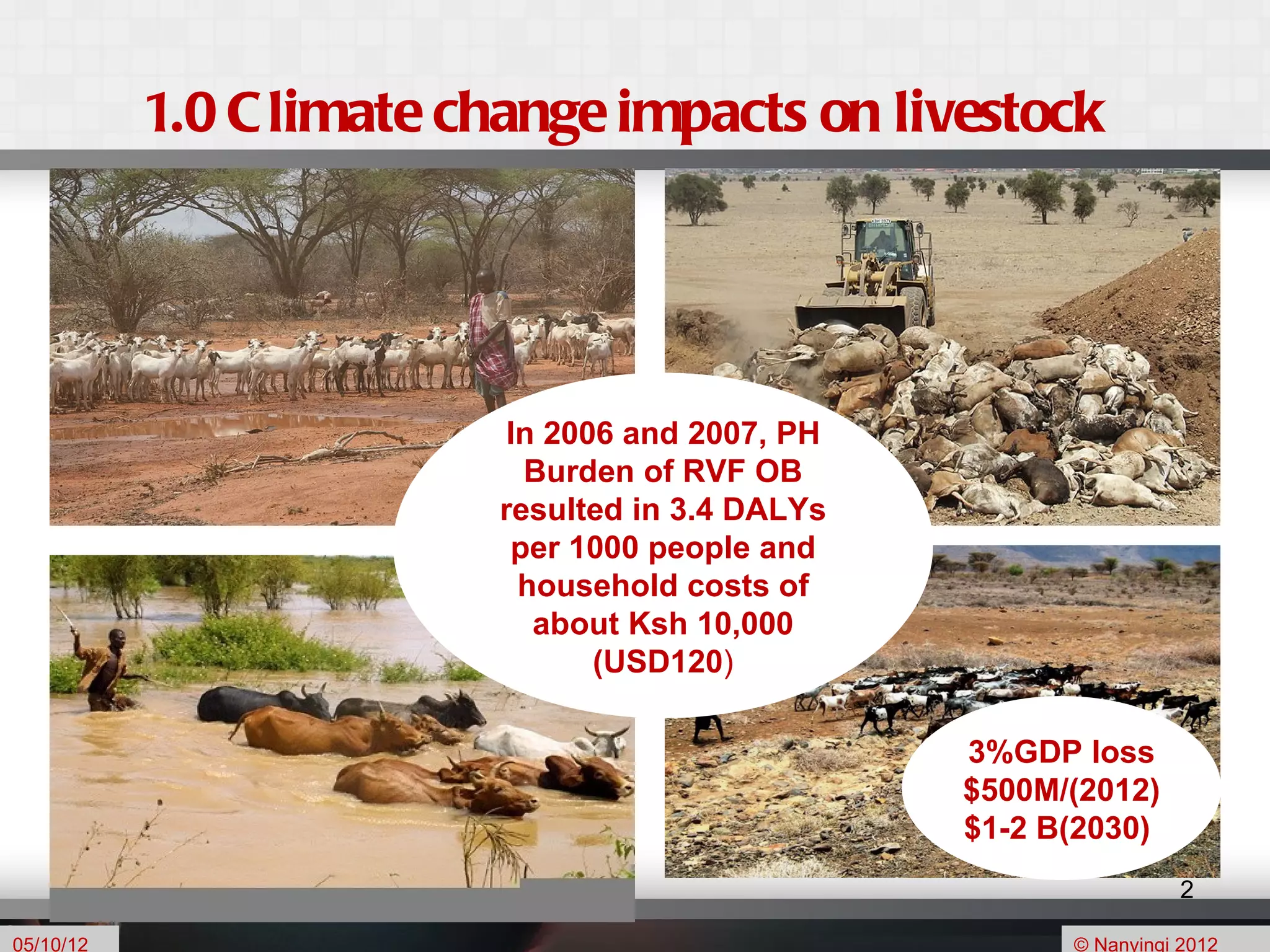
                          In 2006 and 2007, PH
                           Burden of RVF OB
                         resulted in 3.4 DALYs
                          per 1000 people and
                           household costs of
                            about Ksh 10,000
                                (USD120)

                                                 3%GDP loss
                                                 $500M/(2012)
                                                 $1-2 B(2030)
                                                                  2

05/10/12                                               © Nanyingi 2012
1.2 Vulnerability and A daptive capacity
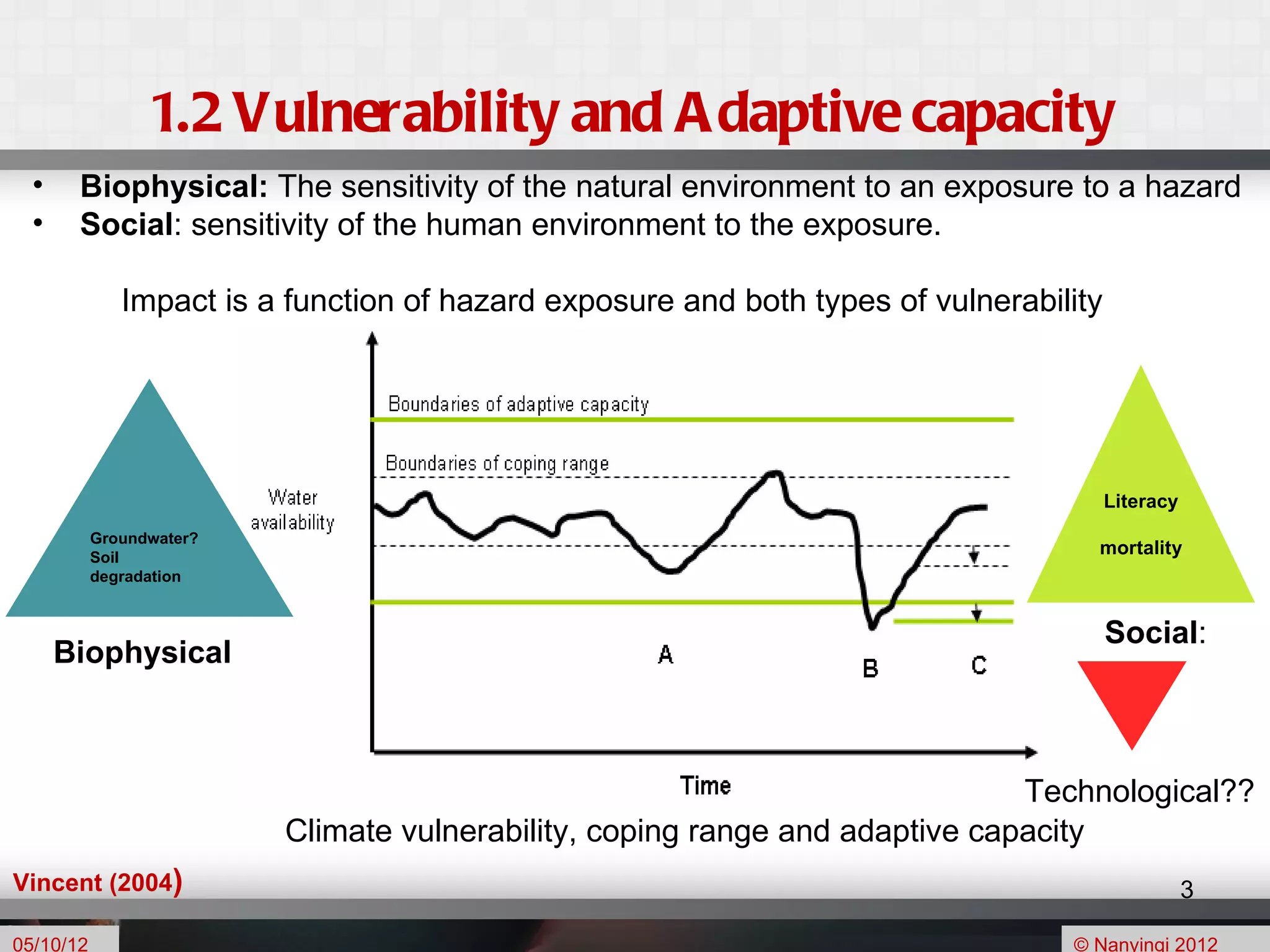
  •    Biophysical: The sensitivity of the natural environment to an exposure to a hazard
  •    Social: sensitivity of the human environment to the exposure.

              Impact is a function of hazard exposure and both types of vulnerability


                                                                                        Literacy
           Groundwater?
           Soil
                                                                                    mortality
           degradation


                                                                                        Social:
      Biophysical


                                                                              Technological??
                          Climate vulnerability, coping range and adaptive capacity
Vincent (2004)                                                                                     3

05/10/12                                                                          © Nanyingi 2012
1.3 A daptation and Mitigation ?
    To effectively m anage vulnerability: Ad aptation is to red uce sensitivity and
     M itigation to red uce the m agnitud e of clim ate change im pact.

    Ad aptation research can help inform d ecisions by farm ers and policy m akers on
     im plications over a range of tim efram es to effectively integrate m itigation
     m echanism s

    Vulnerability analyses can guid e governm ents of the investm ent or d isinvestm ent
     d ecisions currently or in the near future in relation to clim ate-sensitive aspects.

    Translating ad aptation options into m itigation requires consid eration of a m ore
     com prehensive risk m anagem ent / vulnerability fram ework that allows exploration
     of quantified scenarios.

                                                                                       4
  Howden et al 2007
05/10/12                                                                    © Nanyingi 2012
1.4 E xisting adaptation and mitigation strategies
    N om ad ic pastoralism in search of water and pastures

    D esignated com m unity watering points or buffer grazing areas

    Trad itional Early Warning System s (TEWS)

    U se of em ergency fod d ers or forage crops

    D iversification of species herd com position(sm all rum inants)

    Increase of herd size as security to m ortality and L ivestock trad ing

    Ethno-veterinary M ed icine (EVM )

                                                                                                  5
                                     Nanyingi et al., 2008; Hellmuth et al., 2009; Notenbaert et al.,
05/10/12
                                     2010
                                                                                         © Nanyingi 2012
1.5 Impediments to adaptation and Mitigation
    L ack of econom ic capacity to ad apt to a rapid ly changing clim ate

    Environm ental D egrad ation: fragm entation and D esertification

    Arm ed conflict and out-m igration (Stock theft and trad e barriers)

    L ack of appropriate breed s of anim als

    Ineffective livestock policies (Institutional or governm ent )

    Extrem e increase in hum an and anim al Populations (Exponential)

    D eplorable ed ucation levels and Religious beliefs

  Madisson 2010                                                                         6

05/10/12                                                                     © Nanyingi 2012
1.6 E merging adaptation/mitigation mechanisms
    Sustainable Intensification
    Im proved feed ing regim es by supplem entation and clim ate resistant forage crops
     ,conservation of grassland s, rotational or ad aptive grazing
    Prod uction ad justm ents- m od ifying stock routings and d istances
    Reprod uctive technologies for increased prod uction and d isease/   heat tolerant breed s
     , faster growing breed s
    M arket im provem ent by incentives and stand ard ization
    Physical infrastructure (Road s, rails, jetty's, cooling facilities)
    D isease Surveillance and M anagem ent (Transbound ary)- DVS
    Im proved m anagem ent of water, herd com position, stock rates

    Survival and livelihood diversification
 D iversifying incom es by m ixed livestock farm ing system s
 Ind ex Based L ivelihood Insurance system s (IBL I)
                                                                Madisson 2010; Herrero et al 2010
                                                                                           7

05/10/12                                                                          © Nanyingi 2012
2.0 Why climate change research?

    To und erstand how short-term response strategies m ay link to long-term options for
     im plem ented d ecisions d o not und erm ine coping ability.

    L inking C lim ate change with existing d ynam ic policies to cope with high level of
     uncertainty in the tim ing and m agnitud e of potential clim ate changes and the rapid ly
     evolving knowled ge base (NSC C )

    D evelopm ent of spatial pred ictive m od els for im proved und erstand ing and
     translation into accurate seasonal forecasting of future clim atological d ata

    C ollaborative efforts in ad d ressing the clim ate change challenges can support “one
     health” initiatives ad d ressing clim ate sensitive neglected zoonotic d iseases.


                                                                                            8

05/10/12                                                                         © Nanyingi 2012
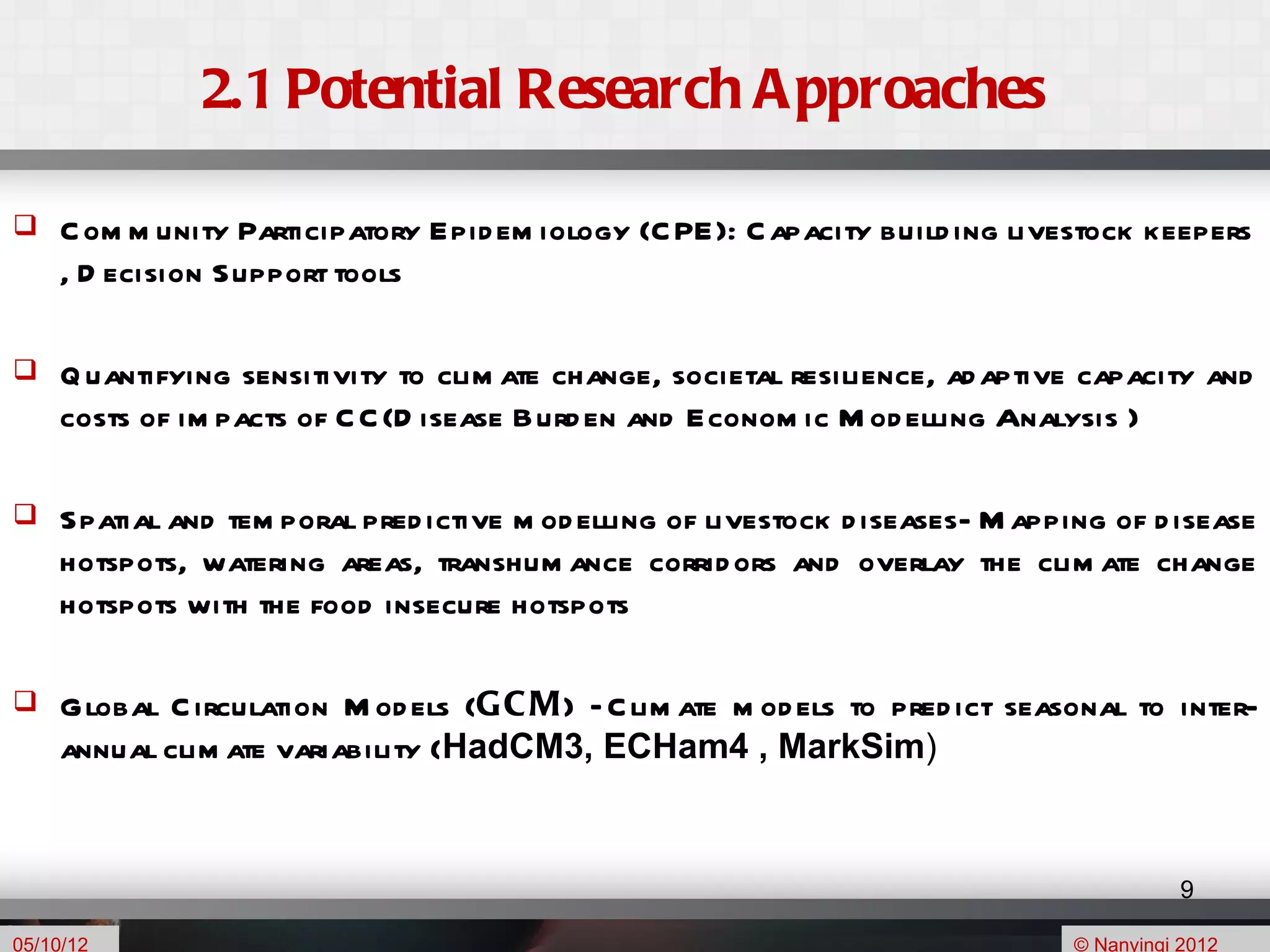
2.1 Potential Research A pproaches

    C om m unity Participatory Epid em iology (C PE): C apacity build ing livestock keepers
     , D ecision Support tools

    Q uantifying sensitivity to clim ate change, societal resilience, ad aptive capacity and
     costs of im pacts of C C (D isease Burd en and Econom ic M od elling Analysis )

    Spatial and tem poral pred ictive m od elling of livestock d iseases- M apping of d isease
     hotspots, watering areas, transhum ance corrid ors and overlay the clim ate change
     hotspots with the food insecure hotspots

    Global C irculation M od els (G C M) – C lim ate m od els to pred ict seasonal to inter-
     annual clim ate variability (HadCM3, ECHam4 , MarkSim)


                                                                                            9

05/10/12                                                                         © Nanyingi 2012
3.0 Discussion :
    Vulnerable com m unities need financial and m aterial support for creating alternative
     livelihood options with red uced d epend ence on livestock farm ing

    C apacity to m ake continuing ad justm ents and im provem ents in ad aptation by
     “learning by doing” via targeted m onitoring of ad aptations to clim ate change and
     their costs, benefits, and effects.

    L ocal com m unities should be equipped with the necessary resources (financial,
     physical, social, and hum an) to cope and ad apt, while an effective institutional
     capacity and supportive policy context is initiated .

    It is im portant to id entify easy to im plem ent and cost effective m itigation activities
     strengthening the ad aptive capacities to clim ate change of these com m unities.


                                                                                           10

05/10/12                                                                          © Nanyingi 2012
4.0 C onclusions :
    M ainstream ing of clim ate change ad aptation policies intend ed to enhance broad
     resilience to risk or to prom ote sustainable d evelopm ent.

    Integrated Assessm ent M od els (IAM ) linked to biophysical, clim atic, social,
     econom ic processes consistent evaluation of ad aptation and vulnerability

    C lim ate m onitoring and effective com m unication, includ ing targeted support of
     surveillance of pests, d iseases, d irectly affected by clim ate.

    Strengthening the Interaction of science and policy need s to evolve as the scientific
     knowled ge base changes and focus attention on the im portance of integrative rather
     than d isciplinary science


                                                                                        11

05/10/12                                                                       © Nanyingi 2012
5.0 Recommendations :
    M ultid isciplinary research team s to effectively harness the substantial scientific
     knowled ge, while retaining a focus on the values im portant to stakehold ers in
     achieving relevance, cred ibility, and legitim acy (C limate change Working
     G roup???)


    M any barriers to ad aptation exist; overcom ing them will require a com prehensive
     and d ynam ic policy approach, covering a range of scales and issues, from ind ivid ual
     farm er awareness to the establishm ent of m ore efficient m arkets.

    C urrent clim ate variability can be tackled by accelerating d evelopm ent and
     increasing social protection while future clim ate risks can be checked by build ing
     ad aptive capacity and enhancing clim ate resilience of vulnerable com m unities .


                                                                                       12

05/10/12                                                                      © Nanyingi 2012
Thank You- A santeni Sana


 Addressing climate change is “a moral commitment to the global community”
                                 mnanyingi@gmail.com                      13

05/10/12                                                         © Nanyingi 2012

Dr.nanyingi ifvm cc_2012

  • 1.
    C limate Change Vulnerability, A daptation and Mitigation of L ivestock Systems in Kenya Nanyingi M O, Kiama S G, Thumbi S M, Muchemi G M and Bett B THE ME : C L IMA TE C HA NGE A ND ONE HE A L TH 8th Biennial Scientific C onference (FVM) and the 46th A nnual Scientific C onference (KVA ), Safari Park Hotel, Nairobi 25th A pril 2012 (12.30pm) 1 05/10/12
  • 2.
    1.0 C limatechange impacts on livestock In 2006 and 2007, PH Burden of RVF OB resulted in 3.4 DALYs per 1000 people and household costs of about Ksh 10,000 (USD120) 3%GDP loss $500M/(2012) $1-2 B(2030) 2 05/10/12 © Nanyingi 2012
  • 3.
    1.2 Vulnerability andA daptive capacity • Biophysical: The sensitivity of the natural environment to an exposure to a hazard • Social: sensitivity of the human environment to the exposure. Impact is a function of hazard exposure and both types of vulnerability Literacy Groundwater? Soil mortality degradation Social: Biophysical Technological?? Climate vulnerability, coping range and adaptive capacity Vincent (2004) 3 05/10/12 © Nanyingi 2012
  • 4.
    1.3 A daptationand Mitigation ?  To effectively m anage vulnerability: Ad aptation is to red uce sensitivity and M itigation to red uce the m agnitud e of clim ate change im pact.  Ad aptation research can help inform d ecisions by farm ers and policy m akers on im plications over a range of tim efram es to effectively integrate m itigation m echanism s  Vulnerability analyses can guid e governm ents of the investm ent or d isinvestm ent d ecisions currently or in the near future in relation to clim ate-sensitive aspects.  Translating ad aptation options into m itigation requires consid eration of a m ore com prehensive risk m anagem ent / vulnerability fram ework that allows exploration of quantified scenarios. 4 Howden et al 2007 05/10/12 © Nanyingi 2012
  • 5.
    1.4 E xistingadaptation and mitigation strategies  N om ad ic pastoralism in search of water and pastures  D esignated com m unity watering points or buffer grazing areas  Trad itional Early Warning System s (TEWS)  U se of em ergency fod d ers or forage crops  D iversification of species herd com position(sm all rum inants)  Increase of herd size as security to m ortality and L ivestock trad ing  Ethno-veterinary M ed icine (EVM ) 5 Nanyingi et al., 2008; Hellmuth et al., 2009; Notenbaert et al., 05/10/12 2010 © Nanyingi 2012
  • 6.
    1.5 Impediments toadaptation and Mitigation  L ack of econom ic capacity to ad apt to a rapid ly changing clim ate  Environm ental D egrad ation: fragm entation and D esertification  Arm ed conflict and out-m igration (Stock theft and trad e barriers)  L ack of appropriate breed s of anim als  Ineffective livestock policies (Institutional or governm ent )  Extrem e increase in hum an and anim al Populations (Exponential)  D eplorable ed ucation levels and Religious beliefs Madisson 2010 6 05/10/12 © Nanyingi 2012
  • 7.
    1.6 E mergingadaptation/mitigation mechanisms  Sustainable Intensification  Im proved feed ing regim es by supplem entation and clim ate resistant forage crops ,conservation of grassland s, rotational or ad aptive grazing  Prod uction ad justm ents- m od ifying stock routings and d istances  Reprod uctive technologies for increased prod uction and d isease/ heat tolerant breed s , faster growing breed s  M arket im provem ent by incentives and stand ard ization  Physical infrastructure (Road s, rails, jetty's, cooling facilities)  D isease Surveillance and M anagem ent (Transbound ary)- DVS  Im proved m anagem ent of water, herd com position, stock rates  Survival and livelihood diversification  D iversifying incom es by m ixed livestock farm ing system s  Ind ex Based L ivelihood Insurance system s (IBL I) Madisson 2010; Herrero et al 2010 7 05/10/12 © Nanyingi 2012
  • 8.
    2.0 Why climatechange research?  To und erstand how short-term response strategies m ay link to long-term options for im plem ented d ecisions d o not und erm ine coping ability.  L inking C lim ate change with existing d ynam ic policies to cope with high level of uncertainty in the tim ing and m agnitud e of potential clim ate changes and the rapid ly evolving knowled ge base (NSC C )  D evelopm ent of spatial pred ictive m od els for im proved und erstand ing and translation into accurate seasonal forecasting of future clim atological d ata  C ollaborative efforts in ad d ressing the clim ate change challenges can support “one health” initiatives ad d ressing clim ate sensitive neglected zoonotic d iseases. 8 05/10/12 © Nanyingi 2012
  • 9.
    2.1 Potential ResearchA pproaches  C om m unity Participatory Epid em iology (C PE): C apacity build ing livestock keepers , D ecision Support tools  Q uantifying sensitivity to clim ate change, societal resilience, ad aptive capacity and costs of im pacts of C C (D isease Burd en and Econom ic M od elling Analysis )  Spatial and tem poral pred ictive m od elling of livestock d iseases- M apping of d isease hotspots, watering areas, transhum ance corrid ors and overlay the clim ate change hotspots with the food insecure hotspots  Global C irculation M od els (G C M) – C lim ate m od els to pred ict seasonal to inter- annual clim ate variability (HadCM3, ECHam4 , MarkSim) 9 05/10/12 © Nanyingi 2012
  • 10.
    3.0 Discussion :  Vulnerable com m unities need financial and m aterial support for creating alternative livelihood options with red uced d epend ence on livestock farm ing  C apacity to m ake continuing ad justm ents and im provem ents in ad aptation by “learning by doing” via targeted m onitoring of ad aptations to clim ate change and their costs, benefits, and effects.  L ocal com m unities should be equipped with the necessary resources (financial, physical, social, and hum an) to cope and ad apt, while an effective institutional capacity and supportive policy context is initiated .  It is im portant to id entify easy to im plem ent and cost effective m itigation activities strengthening the ad aptive capacities to clim ate change of these com m unities. 10 05/10/12 © Nanyingi 2012
  • 11.
    4.0 C onclusions:  M ainstream ing of clim ate change ad aptation policies intend ed to enhance broad resilience to risk or to prom ote sustainable d evelopm ent.  Integrated Assessm ent M od els (IAM ) linked to biophysical, clim atic, social, econom ic processes consistent evaluation of ad aptation and vulnerability  C lim ate m onitoring and effective com m unication, includ ing targeted support of surveillance of pests, d iseases, d irectly affected by clim ate.  Strengthening the Interaction of science and policy need s to evolve as the scientific knowled ge base changes and focus attention on the im portance of integrative rather than d isciplinary science 11 05/10/12 © Nanyingi 2012
  • 12.
    5.0 Recommendations :  M ultid isciplinary research team s to effectively harness the substantial scientific knowled ge, while retaining a focus on the values im portant to stakehold ers in achieving relevance, cred ibility, and legitim acy (C limate change Working G roup???)  M any barriers to ad aptation exist; overcom ing them will require a com prehensive and d ynam ic policy approach, covering a range of scales and issues, from ind ivid ual farm er awareness to the establishm ent of m ore efficient m arkets.  C urrent clim ate variability can be tackled by accelerating d evelopm ent and increasing social protection while future clim ate risks can be checked by build ing ad aptive capacity and enhancing clim ate resilience of vulnerable com m unities . 12 05/10/12 © Nanyingi 2012
  • 13.
    Thank You- Asanteni Sana Addressing climate change is “a moral commitment to the global community” mnanyingi@gmail.com 13 05/10/12 © Nanyingi 2012

Editor's Notes

  • #3 In Kenya, Livestock keepers are greatly affected by Climate Change due to higher vulnerability and low adaptive capacity Viral (RVF),Helminths,loss of adaptive capacity(trypanotolerance), Increases in heat-related mortality and morbidity , vector abundance (floods)
  • #4 The time trace shows the variation in water availability for a region with a limited coping range. At point A, the coping range is exceeded, but water availability is still within the adaptive capacity, and impact can be avoided provided that anticipatory and reactive adaptation mechanisms operate. At point B, the adaptive capacity is exceeded. Ideally, the region will learn following hazard exposure and be able to expand its adaptive capacity for future situations (at point C). If the long-term ability of the region to expand its adaptive capacity is exceeded, then impacts cannot be avoided. There has been significant discussion on the balance between the focus on underpinning biophysical processes or on the socioeconomic aspects critical to policy making.
  • #5 Keeping Policy Relevant. Informing Mitigation Targets. Informing Investment. Rewarding Early Adopters. Focusing on Climate Risk Management.
  • #8 Animal breeding programs; building capacity in the scientific and user communities; developing quarantine systems; establishing of major infrastructure such as dams and water distribution systems, flood mitigation works, and storage and transport facilities Roads = heat-stress related reductions in productivity, fertility, and increased mortality ??? more heat-tolerant livestock breeds often have lower levels of productivity.
  • #9 A significant benefit from adaptation research may be to understand how short-term response strategies may link to long-term options to ensure that, at a minimum, management and/or policy decisions implemented over the next one to three decades do not undermine the ability to cope with potentially larger impacts later in the Century NZD - Improve the effectiveness of interventions through joint surveillance, preparedness and contingency planning to reduce the amount of time it takes to control outbreaks of these diseases However, farmers may find limited utility in long-term projections of climate, given the high uncertainties at the finer spatial and temporal scales at which their decisions are made Practicality of options and contribute to more realistic assessment of the costs and benefits involved in management or policy change
  • #10 Indigenous knowledge : the in-depth understanding of the environments that local communities and indigenous peoples have, together with their experience in adapting to climate variability are key for development of adaptation and mitigation strategies Participatory engagement with decision makers, by bringing their practical knowledge into the assessment, can also identify a more comprehensive range of adaptations.
  • #11 Enhancing capacity to develop social capital and share information, retraining, providing food aid and employment to the more vulnerable, and developing contingency plans
  • #13 To be effective, science must adapt, too, by continuing to review research needs and enhancing the central core integrative science in the communication and management tools developed with decision makers. Climate change Working groups