International Research Journal of Engineering and Technology (IRJET) e-ISSN: 2395-0056
Volume: 09 Issue: 03 | Mar 2022 www.irjet.net p-ISSN: 2395-0072
© 2022, IRJET | Impact Factor value: 7.529 | ISO 9001:2008 Certified Journal | Page 1365
Drishyam - Virtual Eye for Blind
Manasi Bhagwat1, Ashwika Ghumate2, Siddhi Kharawade3, Prof. Mahendra Patil4
[1],[2],[3]Student, Department of Computer Engineering, Atharva College of Engineering, Mumbai, Maharashtra,India
[4]Professor, Department of Computer Engineering, Atharva College of Engineering, Mumbai, Maharashtra, India
---------------------------------------------------------------------***----------------------------------------------------------------------
Abstract - In our society, we do find some people who are
visually impaired. They may face difficulties while doing
their daily activities and hence need someone to rely on for
help. Till date many technologies for assistance of visually
blind people have been developed. Among the various
technologies, this project made use of Artificial Intelligence
technology and proposed a helpful system for visually
impaired people. The project performs classification on real-
time images or videos using the webcam. With the use of
such emerging advanced technology, blind people can
interact with their surroundings. We are able to utilize the
facilities of technology for the betterment of the society by
developing helpful, affordable, transportable and
economical systems.
Key Words: Image Recognition, Visually imapired,
Object Detection, YOLO, Tensorflow, Python.
1. INTRODUCTION
Artificial Intelligence systems have various applications
and one such application is the Blind Assistance System
which is built for helping the visually impaired. It not only
assists them through voice commands but also does image
recognition of the photographs captured or with the help
of a camera it recognizes the object and describes it in
audio. Such systems have made navigation easier for
visually impaired people. Even if the person is blind,
partially sighted or with progressive loss of vision, this
system can help him to travel through familiar or
unfamiliar places assisting him with voice commands.
The fundamental concept is to develop a valuable
framework for the disabled individuals. The framework
assists them through the YOLO (You Only Look Once)
algorithm which detects the objects in the surrounding
and lets the user know through speech recognition.
Sometimes, it happens that the blind person fails to judge
the distance of the obstacle ahead of him resulting in
falling down and getting hurt. So, such a person needs an
assistance or device that can inform him about the
position of the objects situated ahead[1]. Thus, the object
detection tool becomes the most used blind assistance tool
for visually impaired people. Also, they need to be assisted
through voice commands for proper navigation.
2. BASIC CONCEPT
The main idea is to develop a useful and efficient
framework for the disabled individuals. The framework
assists them by using the YOLO (You Only Look Once)
algorithm which detects the nearby objects in the
surrounding and informs the user via speech
recognition.These features can be combined into a single
device or system that is user-friendly and simple to
operate. For proper navigation, they require assistance
from voice instructions.
Applications:
1. Indoor navigation can be done efficiently.
2. Foundations and NGOs can make use of this system for
the visually impaired.
3. Can be used by individuals when they need to travel to
unknown places alone.
3. OVERVIEW OF ALGORITHM
3.1 YOLO ALGORITHM
YOLO algorithm is an algorithm that uses convolution
neural networks to detect objects in real-time. This
algorithm is based on a regression problem where it
detects the object and provides the class probabilities of
the detected objects. The prediction of objects in an image
takes place in a single run of an algorithm. Among the
various different variants of YOLO, YOLOv3 and tiny YOLO
are the most commonly used[2]. The pre-trained Common
Objects in Context(COCO) dataset is used in the
implementation[3].
International Research Journal of Engineering and Technology (IRJET) e-ISSN: 2395-0056
Volume: 09 Issue: 03 | Mar 2022 www.irjet.net p-ISSN: 2395-0072
© 2022, IRJET | Impact Factor value: 7.529 | ISO 9001:2008 Certified Journal | Page 1366
Fig 3.1: YOLO Algorithm
Advantages of YOLO algorithm:
● Speed: As this algorithm is fast, it is ideal for real-
time processing.
● High accuracy: Predictions are made from one
single network.
● Range: It is better than any other methods when
generalizing from natural images to even artworks.
Thus, it is more generalized.
4. PROPOSED SYSTEM
Fig 4.1: Proposed System
1. The aim is to build a system that can detect,
classify and identify objects that are captured by
the camera.
2. The camera module takes in the image as input
from the ongoing video and stores the captured
image for further preprocessing.
3. After that, feature extraction is done on the image
and is further compared with the already trained
dataset. It detects the object from the frame and
recognizes the object to which category it belongs
to.
4. After recognition, it then calculates the distance
between the object and user. And also alerts
whether it is at a safe distance or not.
5. It makes use of an audio synthesizer to generate
speech commands thereby alerting the user about
the object and its distance.
With such a framework being able to detect objects and
being able to provide the correct distance, the user will
feel more secure and will be more aware of his/her
surroundings. The postponement between the detected
object and the audio output to the user is made less and
the audio output is clarified enough for the user to
perceive[4]. Also the audio will be in the language
understood by the user.
4.1 PSEUDO CODE:
1. Import required dependencies like opencv, numpy
2. Import training dataset (COCO)
3. Import darknet framework
4. Import suitable convolutional weights
5. Input data(image or video) is fetched from the
webcam that captures the object.
6. Feature Extraction of the image is done in the next
step, where the splitting of frames into 13x13 cells
takes place along with Blob generation (stores images
as bytes) and Bounding box construction.
7. The next step involves Object Classification where the
confidence (X, Y, W, H) is updated and the relative
position is found – Mid, Top, Bottom.
8. Once the features have been extracted and the objects
are classified, the corresponding text descriptions are
sent to the gTTS API where the text is analyzed and
the letter to sound conversion takes place.
9. The output is predicted correctly from the results of
the classification and the object is recognised with the
audio.
International Research Journal of Engineering and Technology (IRJET) e-ISSN: 2395-0056
Volume: 09 Issue: 03 | Mar 2022 www.irjet.net p-ISSN: 2395-0072
© 2022, IRJET | Impact Factor value: 7.529 | ISO 9001:2008 Certified Journal | Page 1367
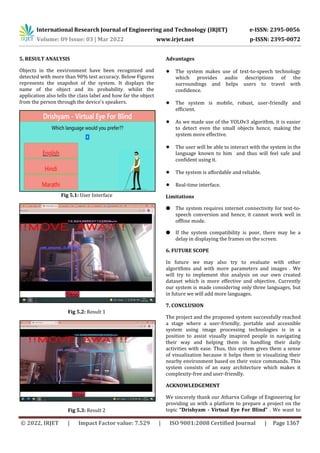
5. RESULT ANALYSIS
Objects in the environment have been recognized and
detected with more than 90% test accuracy. Below Figures
represents the snapshot of the system. It displays the
name of the object and its probability. whilst the
application also tells the class label and how far the object
from the person through the device's speakers.
Fig 5.1: User Interface
Fig 5.2: Result 1
Fig 5.3: Result 2
Advantages
● The system makes use of text-to-speech technology
which provides audio descriptions of the
surroundings and helps users to travel with
confidence.
● The system is mobile, robust, user-friendly and
efficient.
● As we made use of the YOLOv3 algorithm, it is easier
to detect even the small objects hence, making the
system more effective.
● The user will be able to interact with the system in the
language known to him and thus will feel safe and
confident using it.
● The system is affordable and reliable.
● Real-time interface.
Limitations
● The system requires internet connectivity for text-to-
speech conversion and hence, it cannot work well in
offline mode.
● If the system compatibility is poor, there may be a
delay in displaying the frames on the screen.
6. FUTURE SCOPE
In future we may also try to evaluate with other
algorithms and with more parameters and images . We
will try to implement this analysis on our own created
dataset which is more effective and objective. Currently
our system is made considering only three languages, but
in future we will add more languages.
7. CONCLUSION
The project and the proposed system successfully reached
a stage where a user-friendly, portable and accessible
system using image processing technologies is in a
position to assist visually imapired people in navigating
their way and helping them in handling their daily
activities with ease. Thus, this system gives them a sense
of visualization because it helps them in visualizing their
nearby environment based on their voice commands. This
system consists of an easy architecture which makes it
complexity-free and user-friendly.
ACKNOWLEDGEMENT
We sincerely thank our Atharva College of Engineering for
providing us with a platform to prepare a project on the
topic “Drishyam - Virtual Eye For Blind” . We want to
International Research Journal of Engineering and Technology (IRJET) e-ISSN: 2395-0056
Volume: 09 Issue: 03 | Mar 2022 www.irjet.net p-ISSN: 2395-0072
© 2022, IRJET | Impact Factor value: 7.529 | ISO 9001:2008 Certified Journal | Page 1368
appreciate all the help and support we have received from
the organization and would like to thank them for
instilling in us the need for this research and to give us the
opportunity and time to conduct and present research on
the topic. We are also grateful for having Prof. Mahendra
Patil as our guide and Dr. Suvarna Pansambal, Head of
Computer Engineering Department for the motivation and
constant support. Moreover, completion of the project
would have been impossible without the cooperation,
suggestions and help of our family and friends.
REFERENCES
[1] Leo Abraham, Nikita Sara Mathew, Liza George, Shebin
Sam Sajan, “VISION- Wearable Speech Based Feedback
System for the Visually Impaired using Computer Vision”,
IEEE Xplore Part Number: CFP20J32-ART; ISBN: 978-1-
7281-5518-0
[2] “You Only Look Once: Unified, Real-Time Object
Detection.” J Redmon, S Divvala, R Girshick, A Farhadi,
IEEE transactions, May 2016.
[3] COCO - Common Objects in Context (cocodataset.org)
[4] M. Mahendru and S. K. Dubey, "Real Time Object
Detection with Audio Feedback using Yolo vs. Yolo_v3,"
2021 11th International Conference on Cloud Computing,
Data Science & Engineering (Confluence), 2021, pp. 734-
740, doi: 10.1109/Confluence51648.2021.9377064.
[5] T. Guo, J. Dong, H. Li and Y. Gao, "Simple convolutional
neural network on image classification," 2017 IEEE 2nd
International Conference on Big Data Analysis (ICBDA),
Beijing, 2017, pp. 721-724.
[6] Sumitra A. Jakhete, Avanti Dorle, Piyush Pimplikar,
”Object Recognition App for Visually Impaired”, 2019 IEEE
Pune Section International Conference (PuneCon) MIT
World Peace University, Pune, India. Dec 18-20, 2019
[7] Rahman, Ferdousi & Jahan, Israt & Farhin, Nafisa &
Uddin, Jia. (2019). An assistive model for visually impaired
people using YOLO and MTCNN. ICCSP '19: Proceedings of
the 3rd International Conference on Cryptography,
Security and Privacy. 225-230.
10.1145/3309074.3309114.
[8] Handalage, Upulie & Kuganandamurthy, Lakshini.
(2021). Real-Time Object Detection Using YOLO: A Review.
10.13140/RG.2.2.24367.66723.
[9] Shifa Shaikh & Vrushali Karale & Gaurav
Tawde,”Assistive Object Recognition System for Visually
Impaired “International Journal of Engineering Research &
Technology (IJERT) ISSN: 2278-0181 IJERTV9IS090382
Vol. 9 Issue 09, September-2020
[10] A. Dionisi, E. Sardini and M. Serpelloni, "Wearable
object detection system for the blind," 2012 IEEE
International Instrumentation and Measurement
Technology Conference Proceedings, 2012, pp. 1255-1258,
doi: 10.1109/I2MTC.2012.6229180.
[11] Z. Shi, "Object Detection Models and Research
Directions," 2021 IEEE International Conference on
Consumer Electronics and Computer Engineering
(ICCECE), 2021, pp.546-550, doi:
10.1109/ICCECE51280.2021.9342049.
[12] D. P. Khairnar, R. B. Karad, A. Kapse, G. Kale and P.
Jadhav, "PARTHA: A Visually Impaired Assistance System,"
2020 3rd International Conference on Communication
System, Computing and IT Applications (CSCITA), 2020,
pp. 32-37, doi: 10.1109/CSCITA47329.2020.9137791.
[13] S.Mahalakshmi, Veena N, Anisha Kumari ,”Visual
Assistance for Blind using Image Processing”,
International Research Journal of Engineering and
Technology (IRJET) , Volume: 07 Issue: 07 | July 2020
[14] H. Jeong, K. Park and YHa, "Image Preprocessing for
Efficient Training of YOLO Deep Learning Networks," 2018
IEEE International Conference on Big Data and Smart
Computing (BigComp), Shanghai, 2018, pp. 635-637.

Drishyam - Virtual Eye for Blind

  • 1.
    International Research Journalof Engineering and Technology (IRJET) e-ISSN: 2395-0056 Volume: 09 Issue: 03 | Mar 2022 www.irjet.net p-ISSN: 2395-0072 © 2022, IRJET | Impact Factor value: 7.529 | ISO 9001:2008 Certified Journal | Page 1365 Drishyam - Virtual Eye for Blind Manasi Bhagwat1, Ashwika Ghumate2, Siddhi Kharawade3, Prof. Mahendra Patil4 [1],[2],[3]Student, Department of Computer Engineering, Atharva College of Engineering, Mumbai, Maharashtra,India [4]Professor, Department of Computer Engineering, Atharva College of Engineering, Mumbai, Maharashtra, India ---------------------------------------------------------------------***---------------------------------------------------------------------- Abstract - In our society, we do find some people who are visually impaired. They may face difficulties while doing their daily activities and hence need someone to rely on for help. Till date many technologies for assistance of visually blind people have been developed. Among the various technologies, this project made use of Artificial Intelligence technology and proposed a helpful system for visually impaired people. The project performs classification on real- time images or videos using the webcam. With the use of such emerging advanced technology, blind people can interact with their surroundings. We are able to utilize the facilities of technology for the betterment of the society by developing helpful, affordable, transportable and economical systems. Key Words: Image Recognition, Visually imapired, Object Detection, YOLO, Tensorflow, Python. 1. INTRODUCTION Artificial Intelligence systems have various applications and one such application is the Blind Assistance System which is built for helping the visually impaired. It not only assists them through voice commands but also does image recognition of the photographs captured or with the help of a camera it recognizes the object and describes it in audio. Such systems have made navigation easier for visually impaired people. Even if the person is blind, partially sighted or with progressive loss of vision, this system can help him to travel through familiar or unfamiliar places assisting him with voice commands. The fundamental concept is to develop a valuable framework for the disabled individuals. The framework assists them through the YOLO (You Only Look Once) algorithm which detects the objects in the surrounding and lets the user know through speech recognition. Sometimes, it happens that the blind person fails to judge the distance of the obstacle ahead of him resulting in falling down and getting hurt. So, such a person needs an assistance or device that can inform him about the position of the objects situated ahead[1]. Thus, the object detection tool becomes the most used blind assistance tool for visually impaired people. Also, they need to be assisted through voice commands for proper navigation. 2. BASIC CONCEPT The main idea is to develop a useful and efficient framework for the disabled individuals. The framework assists them by using the YOLO (You Only Look Once) algorithm which detects the nearby objects in the surrounding and informs the user via speech recognition.These features can be combined into a single device or system that is user-friendly and simple to operate. For proper navigation, they require assistance from voice instructions. Applications: 1. Indoor navigation can be done efficiently. 2. Foundations and NGOs can make use of this system for the visually impaired. 3. Can be used by individuals when they need to travel to unknown places alone. 3. OVERVIEW OF ALGORITHM 3.1 YOLO ALGORITHM YOLO algorithm is an algorithm that uses convolution neural networks to detect objects in real-time. This algorithm is based on a regression problem where it detects the object and provides the class probabilities of the detected objects. The prediction of objects in an image takes place in a single run of an algorithm. Among the various different variants of YOLO, YOLOv3 and tiny YOLO are the most commonly used[2]. The pre-trained Common Objects in Context(COCO) dataset is used in the implementation[3].
  • 2.
    International Research Journalof Engineering and Technology (IRJET) e-ISSN: 2395-0056 Volume: 09 Issue: 03 | Mar 2022 www.irjet.net p-ISSN: 2395-0072 © 2022, IRJET | Impact Factor value: 7.529 | ISO 9001:2008 Certified Journal | Page 1366 Fig 3.1: YOLO Algorithm Advantages of YOLO algorithm: ● Speed: As this algorithm is fast, it is ideal for real- time processing. ● High accuracy: Predictions are made from one single network. ● Range: It is better than any other methods when generalizing from natural images to even artworks. Thus, it is more generalized. 4. PROPOSED SYSTEM Fig 4.1: Proposed System 1. The aim is to build a system that can detect, classify and identify objects that are captured by the camera. 2. The camera module takes in the image as input from the ongoing video and stores the captured image for further preprocessing. 3. After that, feature extraction is done on the image and is further compared with the already trained dataset. It detects the object from the frame and recognizes the object to which category it belongs to. 4. After recognition, it then calculates the distance between the object and user. And also alerts whether it is at a safe distance or not. 5. It makes use of an audio synthesizer to generate speech commands thereby alerting the user about the object and its distance. With such a framework being able to detect objects and being able to provide the correct distance, the user will feel more secure and will be more aware of his/her surroundings. The postponement between the detected object and the audio output to the user is made less and the audio output is clarified enough for the user to perceive[4]. Also the audio will be in the language understood by the user. 4.1 PSEUDO CODE: 1. Import required dependencies like opencv, numpy 2. Import training dataset (COCO) 3. Import darknet framework 4. Import suitable convolutional weights 5. Input data(image or video) is fetched from the webcam that captures the object. 6. Feature Extraction of the image is done in the next step, where the splitting of frames into 13x13 cells takes place along with Blob generation (stores images as bytes) and Bounding box construction. 7. The next step involves Object Classification where the confidence (X, Y, W, H) is updated and the relative position is found – Mid, Top, Bottom. 8. Once the features have been extracted and the objects are classified, the corresponding text descriptions are sent to the gTTS API where the text is analyzed and the letter to sound conversion takes place. 9. The output is predicted correctly from the results of the classification and the object is recognised with the audio.
  • 3.
    International Research Journalof Engineering and Technology (IRJET) e-ISSN: 2395-0056 Volume: 09 Issue: 03 | Mar 2022 www.irjet.net p-ISSN: 2395-0072 © 2022, IRJET | Impact Factor value: 7.529 | ISO 9001:2008 Certified Journal | Page 1367 5. RESULT ANALYSIS Objects in the environment have been recognized and detected with more than 90% test accuracy. Below Figures represents the snapshot of the system. It displays the name of the object and its probability. whilst the application also tells the class label and how far the object from the person through the device's speakers. Fig 5.1: User Interface Fig 5.2: Result 1 Fig 5.3: Result 2 Advantages ● The system makes use of text-to-speech technology which provides audio descriptions of the surroundings and helps users to travel with confidence. ● The system is mobile, robust, user-friendly and efficient. ● As we made use of the YOLOv3 algorithm, it is easier to detect even the small objects hence, making the system more effective. ● The user will be able to interact with the system in the language known to him and thus will feel safe and confident using it. ● The system is affordable and reliable. ● Real-time interface. Limitations ● The system requires internet connectivity for text-to- speech conversion and hence, it cannot work well in offline mode. ● If the system compatibility is poor, there may be a delay in displaying the frames on the screen. 6. FUTURE SCOPE In future we may also try to evaluate with other algorithms and with more parameters and images . We will try to implement this analysis on our own created dataset which is more effective and objective. Currently our system is made considering only three languages, but in future we will add more languages. 7. CONCLUSION The project and the proposed system successfully reached a stage where a user-friendly, portable and accessible system using image processing technologies is in a position to assist visually imapired people in navigating their way and helping them in handling their daily activities with ease. Thus, this system gives them a sense of visualization because it helps them in visualizing their nearby environment based on their voice commands. This system consists of an easy architecture which makes it complexity-free and user-friendly. ACKNOWLEDGEMENT We sincerely thank our Atharva College of Engineering for providing us with a platform to prepare a project on the topic “Drishyam - Virtual Eye For Blind” . We want to
  • 4.
    International Research Journalof Engineering and Technology (IRJET) e-ISSN: 2395-0056 Volume: 09 Issue: 03 | Mar 2022 www.irjet.net p-ISSN: 2395-0072 © 2022, IRJET | Impact Factor value: 7.529 | ISO 9001:2008 Certified Journal | Page 1368 appreciate all the help and support we have received from the organization and would like to thank them for instilling in us the need for this research and to give us the opportunity and time to conduct and present research on the topic. We are also grateful for having Prof. Mahendra Patil as our guide and Dr. Suvarna Pansambal, Head of Computer Engineering Department for the motivation and constant support. Moreover, completion of the project would have been impossible without the cooperation, suggestions and help of our family and friends. REFERENCES [1] Leo Abraham, Nikita Sara Mathew, Liza George, Shebin Sam Sajan, “VISION- Wearable Speech Based Feedback System for the Visually Impaired using Computer Vision”, IEEE Xplore Part Number: CFP20J32-ART; ISBN: 978-1- 7281-5518-0 [2] “You Only Look Once: Unified, Real-Time Object Detection.” J Redmon, S Divvala, R Girshick, A Farhadi, IEEE transactions, May 2016. [3] COCO - Common Objects in Context (cocodataset.org) [4] M. Mahendru and S. K. Dubey, "Real Time Object Detection with Audio Feedback using Yolo vs. Yolo_v3," 2021 11th International Conference on Cloud Computing, Data Science & Engineering (Confluence), 2021, pp. 734- 740, doi: 10.1109/Confluence51648.2021.9377064. [5] T. Guo, J. Dong, H. Li and Y. Gao, "Simple convolutional neural network on image classification," 2017 IEEE 2nd International Conference on Big Data Analysis (ICBDA), Beijing, 2017, pp. 721-724. [6] Sumitra A. Jakhete, Avanti Dorle, Piyush Pimplikar, ”Object Recognition App for Visually Impaired”, 2019 IEEE Pune Section International Conference (PuneCon) MIT World Peace University, Pune, India. Dec 18-20, 2019 [7] Rahman, Ferdousi & Jahan, Israt & Farhin, Nafisa & Uddin, Jia. (2019). An assistive model for visually impaired people using YOLO and MTCNN. ICCSP '19: Proceedings of the 3rd International Conference on Cryptography, Security and Privacy. 225-230. 10.1145/3309074.3309114. [8] Handalage, Upulie & Kuganandamurthy, Lakshini. (2021). Real-Time Object Detection Using YOLO: A Review. 10.13140/RG.2.2.24367.66723. [9] Shifa Shaikh & Vrushali Karale & Gaurav Tawde,”Assistive Object Recognition System for Visually Impaired “International Journal of Engineering Research & Technology (IJERT) ISSN: 2278-0181 IJERTV9IS090382 Vol. 9 Issue 09, September-2020 [10] A. Dionisi, E. Sardini and M. Serpelloni, "Wearable object detection system for the blind," 2012 IEEE International Instrumentation and Measurement Technology Conference Proceedings, 2012, pp. 1255-1258, doi: 10.1109/I2MTC.2012.6229180. [11] Z. Shi, "Object Detection Models and Research Directions," 2021 IEEE International Conference on Consumer Electronics and Computer Engineering (ICCECE), 2021, pp.546-550, doi: 10.1109/ICCECE51280.2021.9342049. [12] D. P. Khairnar, R. B. Karad, A. Kapse, G. Kale and P. Jadhav, "PARTHA: A Visually Impaired Assistance System," 2020 3rd International Conference on Communication System, Computing and IT Applications (CSCITA), 2020, pp. 32-37, doi: 10.1109/CSCITA47329.2020.9137791. [13] S.Mahalakshmi, Veena N, Anisha Kumari ,”Visual Assistance for Blind using Image Processing”, International Research Journal of Engineering and Technology (IRJET) , Volume: 07 Issue: 07 | July 2020 [14] H. Jeong, K. Park and YHa, "Image Preprocessing for Efficient Training of YOLO Deep Learning Networks," 2018 IEEE International Conference on Big Data and Smart Computing (BigComp), Shanghai, 2018, pp. 635-637.