International Research Journal of Engineering and Technology (IRJET) e-ISSN: 2395-0056
Volume: 09 Issue: 05 | May 2022 www.irjet.net p-ISSN: 2395-0072
© 2022, IRJET | Impact Factor value: 7.529 | ISO 9001:2008 Certified Journal | Page 2389
Smart Navigation Assistance System for Blind People
Sumukha S Puranik1, Tejas S2, Vaishnavi P3, Vivek A Arcot4, Paramesh R5
1,2,3,4 Student, Computer Science and Engineering, Global Academy of Technology, Karnataka, India
5Associate Professor, Computer Science and Engineering, Global Academy of Technology, Karnataka, India
---------------------------------------------------------------------***---------------------------------------------------------------------
Abstract - Real time object detection is a diverse and complex area of computer vision. If there is a single object to be detected in
an image, it is known as Image Localization and if there are multiple objects in an image, then it is Object Detection. This detects
the semantic objects of a class in digital images and videos. The applications of real time object detection includetrackingobjects,
video surveillance, pedestrian detection, people counting, self- driving cars, face detection, ball tracking in sportsandmanymore.
Convolution Neural Networks is a representative tool of Deep learning to detect objects using OpenCV (Opensource Computer
Vision), which is a library of programming functions mainly aimed at real time computer vision. This project proposes an
integrated guidance system involving computer vision and natural language processing. A system equipped withvision, language
and intelligence capabilities is attached to the blind person in order to capture surrounding images and is then connected to a
central server programmed with a faster region convolutional neural network algorithm and an image detection algorithm to
recognize images and multiple obstacles. The server sends the results back to the smart phone which are then converted into
speech for blind person’s guidance. The existing system helps the visually impaired people, but they are not effective enough and
are also expensive. We aim to provide more effective and cost-efficient system which will not only maketheirliveseasyandsimple,
but also enhance mobility in unfamiliar terrain.
Key Words: OpenCV, Artificial Intelligence, YOLO V3, Convoluted neural network
1.INTRODUCTION
Vision impairment is one of the major health problems in the world. Vision impairment or vision loss reduces seeing or
perceiving ability, which cannot be cured through wearing glasses. Nearly about 37 million people across the globe are blind
whereas over 15 million are from India. People with visual disabilities are often dependentmainlyonhumans,traineddogs,or
special electronic devices as support systems for making their decisions. Navigation becomes more difficult around places or
places that are not familiar. Surviving devices, the objects that are at a sudden depth or obstacles above waist level or stairs
create considerable risks. Thus, we were motivated to develop a smart system to overcome these limitations.
2. LITERATURE REVIEW
A few recent works on real-time object detection were recently reported. The report's contents are weighed in terms of their
benefits and drawbacks. Blind people's movements are traditionally led by a walking stickand guide dogs, whichrequirealong
time to become used to. There are a few smart systems on the market that use electronic sensors put on the cane, but these
systems have several drawbacks. Smart jackets and walking sticks have been investigated as technology advances, including
sensors embedded in the walking sticks. The model is a simple jacket that must be worn by the blind person. Any obstruction
notification is supplied via sensor-specific voice messages. The messages are tailored to the recipient. [4]
Researchers andauthors have also worked on a prototype,smartrehabilitativeshoesandspectaclesthathas beendesignedand
developed to facilitate safenavigationandmobilityofblindindividuals.Thesystemhasbeendesignedforindividualswithvisual
loss requiring enhancement and substitution aids. Three pairs of ultrasonic transducers (transmitter and receiver) are
positioned on the medial, central, and lateral portions of the toe cap of each shoe. A microcontroller-based belt pack device
powered by a 12 V, 2500 mAh NiMH battery controls the transmitted signal of each of the three transducers and relays the
reflected signal through an activation signal to the associated tactile output. Detecting obstructions at head level is done with
Ray-Ban (Luxottica Group S.p.A., Milan, Italy) spectacles. They are equipped with a pair of ultrasonictransducerspositionedin
the center of the bridge, as well as a buzzer mounted on one of the temples.
The University of Michigan is working on the creation of a sophisticated computerizedElectronicTravelAid(ETA)forblindand
visually impaired people. A belt containing a smallcomputer, ultrasonicandothersensors,andsupportelectronicswillmakeup
the device. The signals from the sensors will be processed by a proprietary algorithm before being communicatedtotheuser
via headphones. The NavBelt device will allow a blind person to walk across unfamiliar, obstacle-filled situations quickly
and securely.
International Research Journal of Engineering and Technology (IRJET) e-ISSN: 2395-0056
Volume: 09 Issue: 05 | May 2022 www.irjet.net p-ISSN: 2395-0072
© 2022, IRJET | Impact Factor value: 7.529 | ISO 9001:2008 Certified Journal | Page 2390
Fig -1: Ultrasonic sensor-based guidance system for blind people
The three R's, or reconstruction, recognition, and rearrangement, can be used to summarize computer vision (CV) activities.
Reconstruction entailscalculating the three-dimensional(3D) scenariothatproducedacertainvisualrepresentation.Objectsin
the image are labelled as a consequence of recognition. [2]
Fig -2: The 3R’s of Computer vision
An android Smartphone is connected to a Linux server, and image identification is performed using a deep learning algorithm.
When the system is in operation, the smart phone sends images of the scene in front of the user to a server over a 4G or Wi-Fi
network. Following that, the server runs the recognition process and sends the final findingstothesmartphone.Throughaudio
notifications, the system would notify the user of the location of obstacles and how to avoid them. The disadvantage of this
system is continuous need of internet and cost of hosting an advanced and high computing server. [2]
There is another researchthatfocusmainlyoncreatinganartificiallyintelligent,fullyautomatedassistivetechnologythatallows
visually impaired people to sense items in their environment and provide obstacle-aware navigation by providing real- time
auditory outputs. Sensors and computer vision algorithms are combined to give a practical travel aid for visually impaired
persons that allows them to view various things, detect impediments, and prevent collisions. The entire framework is self-
contained and built for low-cost processors,allowing visually impaired people touseitwithouttheneedforinternetaccess.The
detected output is also designed for faster frame processing and more information extraction i.e., item countingashortertime
period. In comparison to previously developed methods, which were primarily focused on obstacle identification and location
tracking with the use of simple sensors anddidnotincorporatedeeplearning,theproposedmethodologycanmakeasubstantial
contribution to assisting visually impaired persons. [1]
International Research Journal of Engineering and Technology (IRJET) e-ISSN: 2395-0056
Volume: 09 Issue: 05 | May 2022 www.irjet.net p-ISSN: 2395-0072
© 2022, IRJET | Impact Factor value: 7.529 | ISO 9001:2008 Certified Journal | Page 2391
Fig -3: Feature learning process of convoluted neural network
A novel approach to object detection called YOLO. Classifiers have been repurposed to do detection in previous work on object
detection. Instead, think of object detection as a regression issue with geographically separated bounding boxes and class
probabilities. In a singleassessment,asingle neuralnetworkpredictsboundingboxesandclassprobabilitiesdirectlyfromentire
images. Because the entire detection pipeline is a single network, it can be optimized directly on detection performance from
beginning to end. Our unified architecture is lightning quick. The YOLO model's base model processes images at 45 frames per
second in real time. Fast YOLO, a smaller variant of the network, processes 155 frames per second while maintaining twice the
mAP of other real-time detectors. A network with 24 convolutional layers and two fully connected layers makes up the
architecture. The features space fromprecedinglayersisreducedbyalternating1X1convolutionallayers.Ituseshalfresolution
(224 X 224 input picture) to train the convolutional layers on the ImageNet classification task, then doubles the resolution for
detection. [7] The provided image was segmented into grids of S X S in theYOLO-basedobjectdetection[34],withSdenotingthe
number of grid cells in each axis.
Each grid unit was responsible for detecting any targets that entered the grid. Then, for the B number of bounding boxes, each
of the grid units projected a matching confidence score. The highest probability represents a greater confidence score of the
associated object, while the confidence score represents similarity with the sought object. [1] Darknet-53 which is madeupof
53 convolutional layers serves as a feature extractor for YOLO-v3. It has the fastest measured floating-point operation speed,
implying that the network performs better when GPU resources are used. The framework was linked to a live video feed, and
image frames were collected as a result. The captured frames were pre-processed and fed into the trained model, and if any
object that had been previously trained with the model was spotted, a bounding box was created around it and a label was
generated for it. Following the detection of all objects, the textlabel wastransformedinto voice,oranaudiolabel recordingwas
played, and the following frame was processed.
3. EXISTING SYSTEM
The existing systems that are currently available for the visually impaired comes at their own cost. Mostofthesystemsarenot
integrated to wearable products. There are other systems which consists of expensive camera and sensors which are not
affordable by everyone.
A blind stick is an advanced stick that allows visually challenged people to navigate with ease using advanced technologies,
integrated with ultrasonic sensor along with light, water and many more sensors. If the obstacle is not that close, the circuit
does nothing. If the obstacle is close to the microcontroller, then it sends a signal tosound.Theblindstick wouldnot becapable
of telling what object is in the front. It is something which is not a wearable, and it must be carried by hand.
4. PROPOSED SYSTEM
Our system is designed in a way to provide better efficiency and accuracy which can be embedded to a wearable device. It
provides a real time three-dimensional object detection if any obstacle is detected within the specified distance. The outputof
the object detected is supported by a text to voice google API, where notifications are sent throughvoicemessages.Todevelop
a scientific application or model that can be embedded to a daily wearable and provide accurate real-time three- dimensional
object detection that is supported by notifications through voice messages if any obstacle is detected within the distance.
International Research Journal of Engineering and Technology (IRJET) e-ISSN: 2395-0056
Volume: 09 Issue: 05 | May 2022 www.irjet.net p-ISSN: 2395-0072
© 2022, IRJET | Impact Factor value: 7.529 | ISO 9001:2008 Certified Journal | Page 2392
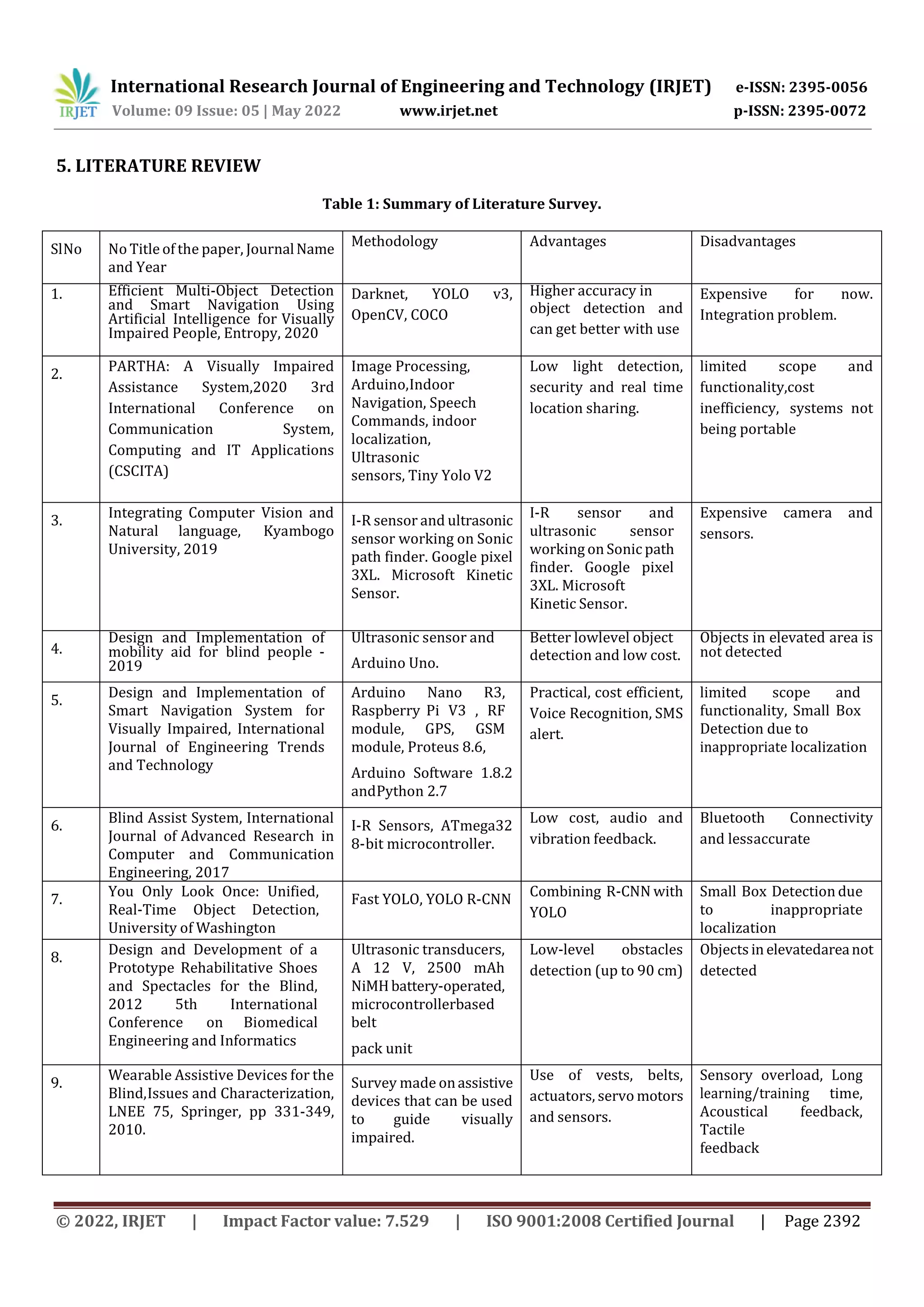
5. LITERATURE REVIEW
Table 1: Summary of Literature Survey.
SlNo No Title of the paper, JournalName
and Year
Methodology Advantages Disadvantages
1. Efficient Multi-Object Detection
and Smart Navigation Using
Artificial Intelligence for Visually
Impaired People, Entropy, 2020
Darknet, YOLO v3,
OpenCV, COCO
Higher accuracy in
object detection and
can get better with use
Expensive for now.
Integration problem.
2.
PARTHA: A Visually Impaired
Assistance System,2020 3rd
International Conference on
Communication System,
Computing and IT Applications
(CSCITA)
Image Processing,
Arduino,Indoor
Navigation, Speech
Commands, indoor
localization,
Ultrasonic
sensors, Tiny Yolo V2
Low light detection,
security and real time
location sharing.
limited scope and
functionality,cost
inefficiency, systems not
being portable
3.
Integrating Computer Vision and
Natural language, Kyambogo
University, 2019
I-R sensor and ultrasonic
sensor working on Sonic
path finder. Google pixel
3XL. Microsoft Kinetic
Sensor.
I-R sensor and
ultrasonic sensor
working on Sonic path
finder. Google pixel
3XL. Microsoft
Kinetic Sensor.
Expensive camera and
sensors.
4.
Design and Implementation of
mobility aid for blind people -
2019
Ultrasonic sensor and
Arduino Uno.
Better lowlevel object
detection and low cost.
Objects in elevated area is
not detected
5.
Design and Implementation of
Smart Navigation System for
Visually Impaired, International
Journal of Engineering Trends
and Technology
Arduino Nano R3,
Raspberry Pi V3 , RF
module, GPS, GSM
module, Proteus 8.6,
Arduino Software 1.8.2
andPython 2.7
Practical, cost efficient,
Voice Recognition, SMS
alert.
limited scope and
functionality, Small Box
Detection due to
inappropriate localization
6.
Blind Assist System, International
Journal of Advanced Research in
Computer and Communication
Engineering, 2017
I-R Sensors, ATmega32
8-bit microcontroller.
Low cost, audio and
vibration feedback.
Bluetooth Connectivity
and lessaccurate
7.
You Only Look Once: Unified,
Real-Time Object Detection,
University of Washington
Fast YOLO, YOLO R-CNN
Combining R-CNN with
YOLO
Small Box Detection due
to inappropriate
localization
8.
Design and Development of a
Prototype Rehabilitative Shoes
and Spectacles for the Blind,
2012 5th International
Conference on Biomedical
Engineering and Informatics
Ultrasonic transducers,
A 12 V, 2500 mAh
NiMHbattery-operated,
microcontrollerbased
belt
pack unit
Low-level obstacles
detection (up to 90 cm)
Objects in elevatedareanot
detected
9.
Wearable Assistive Devices for the
Blind,Issues and Characterization,
LNEE 75, Springer, pp 331-349,
2010.
Survey made onassistive
devices that can be used
to guide visually
impaired.
Use of vests, belts,
actuators, servo motors
and sensors.
Sensory overload, Long
learning/training time,
Acoustical feedback,
Tactile
feedback
International Research Journal of Engineering and Technology (IRJET) e-ISSN: 2395-0056
Volume: 09 Issue: 05 | May 2022 www.irjet.net p-ISSN: 2395-0072
© 2022, IRJET | Impact Factor value: 7.529 | ISO 9001:2008 Certified Journal | Page 2393
6. METHODOLOGY
Considering all the other literature, we have come up with our methodologywhere weaimtoprovidea scientificapplicationor
model that can be embedded to a daily wearable. A real-world object is live fed with the help of a webcam where it provides
accurate real-time three-dimensional object detection. The processed output is thenfurthergivenasoutputintheformof text,
where this processed text is converted into speech API that is supported by notifications through voice messages, if any
obstacle is detected within specific distance. The messages are made specific so that the user can track the position and
distance of obstacle properly and avoid any inconvenience while doing their daily activities. This speech is given as an audio
output to the user.
7. CONCLUSION
This project proposes a system to assist blind people in their navigation. With the proposed design and architecture, the blind
and the visually impaired will be able to independently travel in unfamiliar environments. Deep learning-based object
detection, in assistance with various distance sensors, is used to make the user 222222aware of obstacles, to provide safe
navigation where all information is provided to the user in the form of audio. The proposed system is moreuseful andefficient
than the conventional ones and can provide information about the surrounding information. It is practical, cost efficient and
extremely useful. To sum up, the system provides numerous additional features which the competing systems do not provide
fully and can be an alternative or a very good enhancement to the conventional ones.
REFERENCES
[1] Rakesh Chandra Joshi, Saumya Yadav: EfficientMultiObjectDetectionandSmartNavigationusingArtificial Intelligencefor
Visually Impaired people, Year 2020, Journal: Entropy
[2] Devashish Pradeep Khairnar, Apurva Kapse: A Visually impaired assistance system, Year: 2020
[3] Lenard Nkalubo: Integrating Computer Vision and Natural language, Position Papers of the Federated Conference on
Computer Science and Information Systems, Volume 19, Year: 2019
[4] B.S.Sourab, Sachith D’Souza: Design and Implementation of Mobility aid for Blind people, International Association for
Pattern Recognition, Year: 2019.
[5] Md. Mohsinur Rahman Adnan: DesignandImplementationofSmartNavigationSystemforVisuallyImpaired, International
Journal of Engineering Trends and Technology, Year: 2018, Volume:18
[6] Deepak Gaikwad, Tejas Ladage: Blind Assist System, International Journal of Advanced Research in Computer and
Communication engineering, Volume 6 Issue 3, Year:2017, Page No: 442-444
[7] Joseph Redmon, Santosh Divvala: You Only Look Once: Unified, Real-Time Object Detection, University of Washington,
Allen Institute for AI, Year: 2016
[8] Paul Ibrahim, Anthony Ghaoui: Design and Development of a prototype Rehabilitative Shoes and Spectacles for the Blind,
International Conference on Biomedical Engineering and Informatics, Year 2012
[9] R Velazquez, Wearable Assistive Devices for the Blind, LNEE 75, Springer, pp 331-349, Year: 2010

Smart Navigation Assistance System for Blind People

  • 1.
    International Research Journalof Engineering and Technology (IRJET) e-ISSN: 2395-0056 Volume: 09 Issue: 05 | May 2022 www.irjet.net p-ISSN: 2395-0072 © 2022, IRJET | Impact Factor value: 7.529 | ISO 9001:2008 Certified Journal | Page 2389 Smart Navigation Assistance System for Blind People Sumukha S Puranik1, Tejas S2, Vaishnavi P3, Vivek A Arcot4, Paramesh R5 1,2,3,4 Student, Computer Science and Engineering, Global Academy of Technology, Karnataka, India 5Associate Professor, Computer Science and Engineering, Global Academy of Technology, Karnataka, India ---------------------------------------------------------------------***--------------------------------------------------------------------- Abstract - Real time object detection is a diverse and complex area of computer vision. If there is a single object to be detected in an image, it is known as Image Localization and if there are multiple objects in an image, then it is Object Detection. This detects the semantic objects of a class in digital images and videos. The applications of real time object detection includetrackingobjects, video surveillance, pedestrian detection, people counting, self- driving cars, face detection, ball tracking in sportsandmanymore. Convolution Neural Networks is a representative tool of Deep learning to detect objects using OpenCV (Opensource Computer Vision), which is a library of programming functions mainly aimed at real time computer vision. This project proposes an integrated guidance system involving computer vision and natural language processing. A system equipped withvision, language and intelligence capabilities is attached to the blind person in order to capture surrounding images and is then connected to a central server programmed with a faster region convolutional neural network algorithm and an image detection algorithm to recognize images and multiple obstacles. The server sends the results back to the smart phone which are then converted into speech for blind person’s guidance. The existing system helps the visually impaired people, but they are not effective enough and are also expensive. We aim to provide more effective and cost-efficient system which will not only maketheirliveseasyandsimple, but also enhance mobility in unfamiliar terrain. Key Words: OpenCV, Artificial Intelligence, YOLO V3, Convoluted neural network 1.INTRODUCTION Vision impairment is one of the major health problems in the world. Vision impairment or vision loss reduces seeing or perceiving ability, which cannot be cured through wearing glasses. Nearly about 37 million people across the globe are blind whereas over 15 million are from India. People with visual disabilities are often dependentmainlyonhumans,traineddogs,or special electronic devices as support systems for making their decisions. Navigation becomes more difficult around places or places that are not familiar. Surviving devices, the objects that are at a sudden depth or obstacles above waist level or stairs create considerable risks. Thus, we were motivated to develop a smart system to overcome these limitations. 2. LITERATURE REVIEW A few recent works on real-time object detection were recently reported. The report's contents are weighed in terms of their benefits and drawbacks. Blind people's movements are traditionally led by a walking stickand guide dogs, whichrequirealong time to become used to. There are a few smart systems on the market that use electronic sensors put on the cane, but these systems have several drawbacks. Smart jackets and walking sticks have been investigated as technology advances, including sensors embedded in the walking sticks. The model is a simple jacket that must be worn by the blind person. Any obstruction notification is supplied via sensor-specific voice messages. The messages are tailored to the recipient. [4] Researchers andauthors have also worked on a prototype,smartrehabilitativeshoesandspectaclesthathas beendesignedand developed to facilitate safenavigationandmobilityofblindindividuals.Thesystemhasbeendesignedforindividualswithvisual loss requiring enhancement and substitution aids. Three pairs of ultrasonic transducers (transmitter and receiver) are positioned on the medial, central, and lateral portions of the toe cap of each shoe. A microcontroller-based belt pack device powered by a 12 V, 2500 mAh NiMH battery controls the transmitted signal of each of the three transducers and relays the reflected signal through an activation signal to the associated tactile output. Detecting obstructions at head level is done with Ray-Ban (Luxottica Group S.p.A., Milan, Italy) spectacles. They are equipped with a pair of ultrasonictransducerspositionedin the center of the bridge, as well as a buzzer mounted on one of the temples. The University of Michigan is working on the creation of a sophisticated computerizedElectronicTravelAid(ETA)forblindand visually impaired people. A belt containing a smallcomputer, ultrasonicandothersensors,andsupportelectronicswillmakeup the device. The signals from the sensors will be processed by a proprietary algorithm before being communicatedtotheuser via headphones. The NavBelt device will allow a blind person to walk across unfamiliar, obstacle-filled situations quickly and securely.
  • 2.
    International Research Journalof Engineering and Technology (IRJET) e-ISSN: 2395-0056 Volume: 09 Issue: 05 | May 2022 www.irjet.net p-ISSN: 2395-0072 © 2022, IRJET | Impact Factor value: 7.529 | ISO 9001:2008 Certified Journal | Page 2390 Fig -1: Ultrasonic sensor-based guidance system for blind people The three R's, or reconstruction, recognition, and rearrangement, can be used to summarize computer vision (CV) activities. Reconstruction entailscalculating the three-dimensional(3D) scenariothatproducedacertainvisualrepresentation.Objectsin the image are labelled as a consequence of recognition. [2] Fig -2: The 3R’s of Computer vision An android Smartphone is connected to a Linux server, and image identification is performed using a deep learning algorithm. When the system is in operation, the smart phone sends images of the scene in front of the user to a server over a 4G or Wi-Fi network. Following that, the server runs the recognition process and sends the final findingstothesmartphone.Throughaudio notifications, the system would notify the user of the location of obstacles and how to avoid them. The disadvantage of this system is continuous need of internet and cost of hosting an advanced and high computing server. [2] There is another researchthatfocusmainlyoncreatinganartificiallyintelligent,fullyautomatedassistivetechnologythatallows visually impaired people to sense items in their environment and provide obstacle-aware navigation by providing real- time auditory outputs. Sensors and computer vision algorithms are combined to give a practical travel aid for visually impaired persons that allows them to view various things, detect impediments, and prevent collisions. The entire framework is self- contained and built for low-cost processors,allowing visually impaired people touseitwithouttheneedforinternetaccess.The detected output is also designed for faster frame processing and more information extraction i.e., item countingashortertime period. In comparison to previously developed methods, which were primarily focused on obstacle identification and location tracking with the use of simple sensors anddidnotincorporatedeeplearning,theproposedmethodologycanmakeasubstantial contribution to assisting visually impaired persons. [1]
  • 3.
    International Research Journalof Engineering and Technology (IRJET) e-ISSN: 2395-0056 Volume: 09 Issue: 05 | May 2022 www.irjet.net p-ISSN: 2395-0072 © 2022, IRJET | Impact Factor value: 7.529 | ISO 9001:2008 Certified Journal | Page 2391 Fig -3: Feature learning process of convoluted neural network A novel approach to object detection called YOLO. Classifiers have been repurposed to do detection in previous work on object detection. Instead, think of object detection as a regression issue with geographically separated bounding boxes and class probabilities. In a singleassessment,asingle neuralnetworkpredictsboundingboxesandclassprobabilitiesdirectlyfromentire images. Because the entire detection pipeline is a single network, it can be optimized directly on detection performance from beginning to end. Our unified architecture is lightning quick. The YOLO model's base model processes images at 45 frames per second in real time. Fast YOLO, a smaller variant of the network, processes 155 frames per second while maintaining twice the mAP of other real-time detectors. A network with 24 convolutional layers and two fully connected layers makes up the architecture. The features space fromprecedinglayersisreducedbyalternating1X1convolutionallayers.Ituseshalfresolution (224 X 224 input picture) to train the convolutional layers on the ImageNet classification task, then doubles the resolution for detection. [7] The provided image was segmented into grids of S X S in theYOLO-basedobjectdetection[34],withSdenotingthe number of grid cells in each axis. Each grid unit was responsible for detecting any targets that entered the grid. Then, for the B number of bounding boxes, each of the grid units projected a matching confidence score. The highest probability represents a greater confidence score of the associated object, while the confidence score represents similarity with the sought object. [1] Darknet-53 which is madeupof 53 convolutional layers serves as a feature extractor for YOLO-v3. It has the fastest measured floating-point operation speed, implying that the network performs better when GPU resources are used. The framework was linked to a live video feed, and image frames were collected as a result. The captured frames were pre-processed and fed into the trained model, and if any object that had been previously trained with the model was spotted, a bounding box was created around it and a label was generated for it. Following the detection of all objects, the textlabel wastransformedinto voice,oranaudiolabel recordingwas played, and the following frame was processed. 3. EXISTING SYSTEM The existing systems that are currently available for the visually impaired comes at their own cost. Mostofthesystemsarenot integrated to wearable products. There are other systems which consists of expensive camera and sensors which are not affordable by everyone. A blind stick is an advanced stick that allows visually challenged people to navigate with ease using advanced technologies, integrated with ultrasonic sensor along with light, water and many more sensors. If the obstacle is not that close, the circuit does nothing. If the obstacle is close to the microcontroller, then it sends a signal tosound.Theblindstick wouldnot becapable of telling what object is in the front. It is something which is not a wearable, and it must be carried by hand. 4. PROPOSED SYSTEM Our system is designed in a way to provide better efficiency and accuracy which can be embedded to a wearable device. It provides a real time three-dimensional object detection if any obstacle is detected within the specified distance. The outputof the object detected is supported by a text to voice google API, where notifications are sent throughvoicemessages.Todevelop a scientific application or model that can be embedded to a daily wearable and provide accurate real-time three- dimensional object detection that is supported by notifications through voice messages if any obstacle is detected within the distance.
  • 4.
    International Research Journalof Engineering and Technology (IRJET) e-ISSN: 2395-0056 Volume: 09 Issue: 05 | May 2022 www.irjet.net p-ISSN: 2395-0072 © 2022, IRJET | Impact Factor value: 7.529 | ISO 9001:2008 Certified Journal | Page 2392 5. LITERATURE REVIEW Table 1: Summary of Literature Survey. SlNo No Title of the paper, JournalName and Year Methodology Advantages Disadvantages 1. Efficient Multi-Object Detection and Smart Navigation Using Artificial Intelligence for Visually Impaired People, Entropy, 2020 Darknet, YOLO v3, OpenCV, COCO Higher accuracy in object detection and can get better with use Expensive for now. Integration problem. 2. PARTHA: A Visually Impaired Assistance System,2020 3rd International Conference on Communication System, Computing and IT Applications (CSCITA) Image Processing, Arduino,Indoor Navigation, Speech Commands, indoor localization, Ultrasonic sensors, Tiny Yolo V2 Low light detection, security and real time location sharing. limited scope and functionality,cost inefficiency, systems not being portable 3. Integrating Computer Vision and Natural language, Kyambogo University, 2019 I-R sensor and ultrasonic sensor working on Sonic path finder. Google pixel 3XL. Microsoft Kinetic Sensor. I-R sensor and ultrasonic sensor working on Sonic path finder. Google pixel 3XL. Microsoft Kinetic Sensor. Expensive camera and sensors. 4. Design and Implementation of mobility aid for blind people - 2019 Ultrasonic sensor and Arduino Uno. Better lowlevel object detection and low cost. Objects in elevated area is not detected 5. Design and Implementation of Smart Navigation System for Visually Impaired, International Journal of Engineering Trends and Technology Arduino Nano R3, Raspberry Pi V3 , RF module, GPS, GSM module, Proteus 8.6, Arduino Software 1.8.2 andPython 2.7 Practical, cost efficient, Voice Recognition, SMS alert. limited scope and functionality, Small Box Detection due to inappropriate localization 6. Blind Assist System, International Journal of Advanced Research in Computer and Communication Engineering, 2017 I-R Sensors, ATmega32 8-bit microcontroller. Low cost, audio and vibration feedback. Bluetooth Connectivity and lessaccurate 7. You Only Look Once: Unified, Real-Time Object Detection, University of Washington Fast YOLO, YOLO R-CNN Combining R-CNN with YOLO Small Box Detection due to inappropriate localization 8. Design and Development of a Prototype Rehabilitative Shoes and Spectacles for the Blind, 2012 5th International Conference on Biomedical Engineering and Informatics Ultrasonic transducers, A 12 V, 2500 mAh NiMHbattery-operated, microcontrollerbased belt pack unit Low-level obstacles detection (up to 90 cm) Objects in elevatedareanot detected 9. Wearable Assistive Devices for the Blind,Issues and Characterization, LNEE 75, Springer, pp 331-349, 2010. Survey made onassistive devices that can be used to guide visually impaired. Use of vests, belts, actuators, servo motors and sensors. Sensory overload, Long learning/training time, Acoustical feedback, Tactile feedback
  • 5.
    International Research Journalof Engineering and Technology (IRJET) e-ISSN: 2395-0056 Volume: 09 Issue: 05 | May 2022 www.irjet.net p-ISSN: 2395-0072 © 2022, IRJET | Impact Factor value: 7.529 | ISO 9001:2008 Certified Journal | Page 2393 6. METHODOLOGY Considering all the other literature, we have come up with our methodologywhere weaimtoprovidea scientificapplicationor model that can be embedded to a daily wearable. A real-world object is live fed with the help of a webcam where it provides accurate real-time three-dimensional object detection. The processed output is thenfurthergivenasoutputintheformof text, where this processed text is converted into speech API that is supported by notifications through voice messages, if any obstacle is detected within specific distance. The messages are made specific so that the user can track the position and distance of obstacle properly and avoid any inconvenience while doing their daily activities. This speech is given as an audio output to the user. 7. CONCLUSION This project proposes a system to assist blind people in their navigation. With the proposed design and architecture, the blind and the visually impaired will be able to independently travel in unfamiliar environments. Deep learning-based object detection, in assistance with various distance sensors, is used to make the user 222222aware of obstacles, to provide safe navigation where all information is provided to the user in the form of audio. The proposed system is moreuseful andefficient than the conventional ones and can provide information about the surrounding information. It is practical, cost efficient and extremely useful. To sum up, the system provides numerous additional features which the competing systems do not provide fully and can be an alternative or a very good enhancement to the conventional ones. REFERENCES [1] Rakesh Chandra Joshi, Saumya Yadav: EfficientMultiObjectDetectionandSmartNavigationusingArtificial Intelligencefor Visually Impaired people, Year 2020, Journal: Entropy [2] Devashish Pradeep Khairnar, Apurva Kapse: A Visually impaired assistance system, Year: 2020 [3] Lenard Nkalubo: Integrating Computer Vision and Natural language, Position Papers of the Federated Conference on Computer Science and Information Systems, Volume 19, Year: 2019 [4] B.S.Sourab, Sachith D’Souza: Design and Implementation of Mobility aid for Blind people, International Association for Pattern Recognition, Year: 2019. [5] Md. Mohsinur Rahman Adnan: DesignandImplementationofSmartNavigationSystemforVisuallyImpaired, International Journal of Engineering Trends and Technology, Year: 2018, Volume:18 [6] Deepak Gaikwad, Tejas Ladage: Blind Assist System, International Journal of Advanced Research in Computer and Communication engineering, Volume 6 Issue 3, Year:2017, Page No: 442-444 [7] Joseph Redmon, Santosh Divvala: You Only Look Once: Unified, Real-Time Object Detection, University of Washington, Allen Institute for AI, Year: 2016 [8] Paul Ibrahim, Anthony Ghaoui: Design and Development of a prototype Rehabilitative Shoes and Spectacles for the Blind, International Conference on Biomedical Engineering and Informatics, Year 2012 [9] R Velazquez, Wearable Assistive Devices for the Blind, LNEE 75, Springer, pp 331-349, Year: 2010