What are they, What is their purpose and What do
they mean?
Dreaming
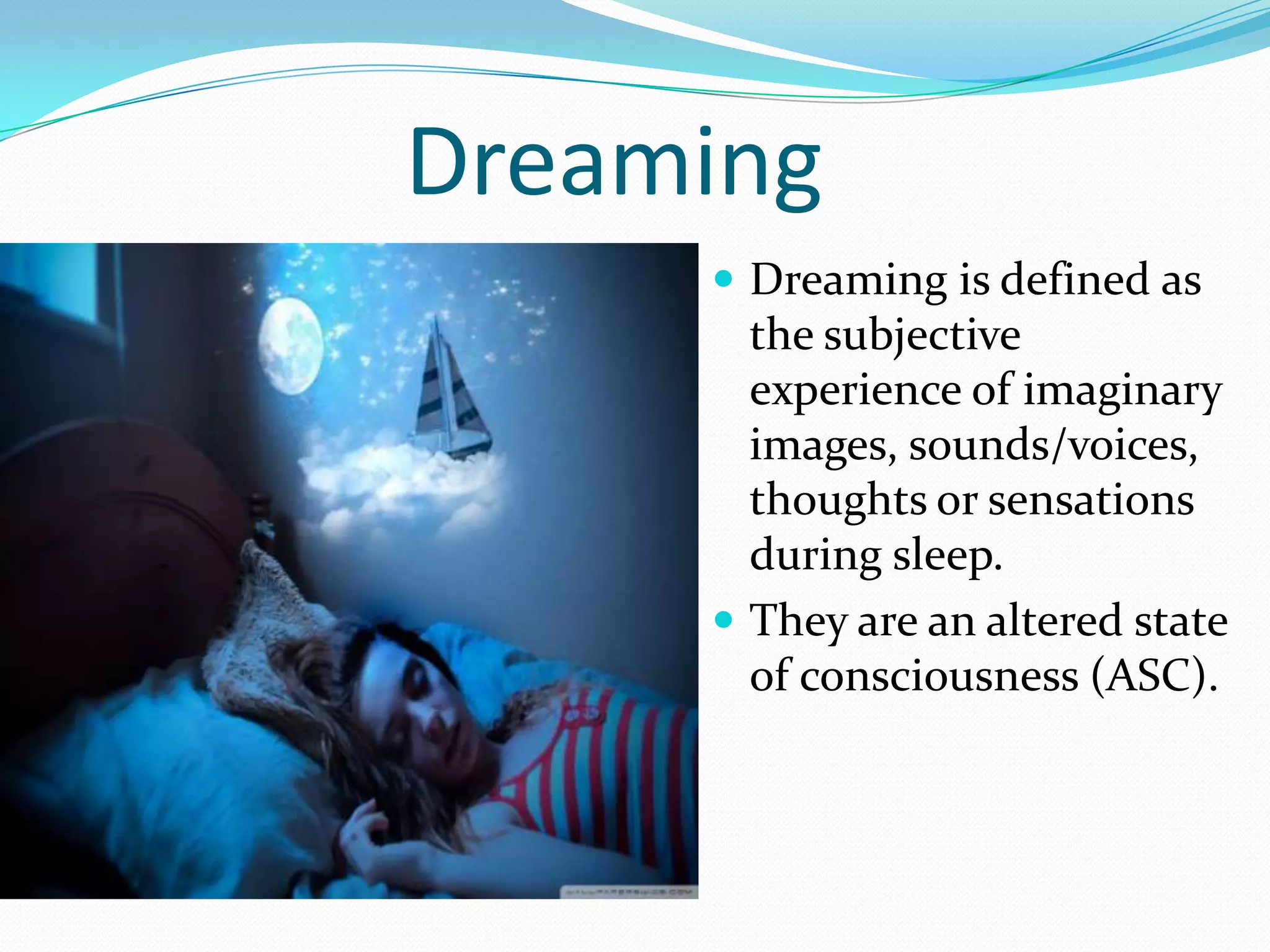
 Dreaming is defined as
the subjective
experience of imaginary
images, sounds/voices,
thoughts or sensations
during sleep.
 They are an altered state
of consciousness (ASC).
What Happens When We Dream?
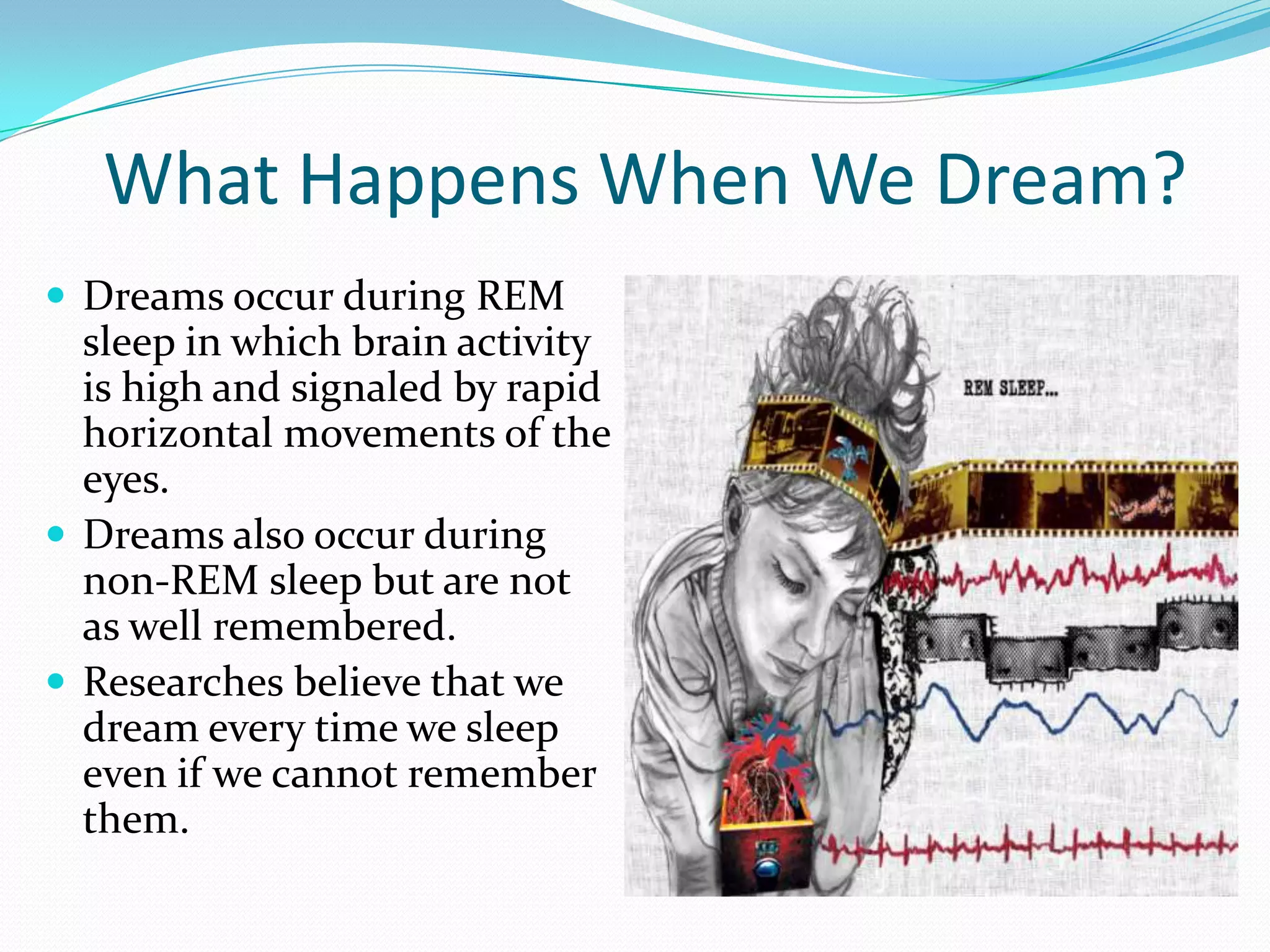
 Dreams occur during REM
sleep in which brain activity
is high and signaled by rapid
horizontal movements of the
eyes.
 Dreams also occur during
non-REM sleep but are not
as well remembered.
 Researches believe that we
dream every time we sleep
even if we cannot remember
them.
What Are Dreams?
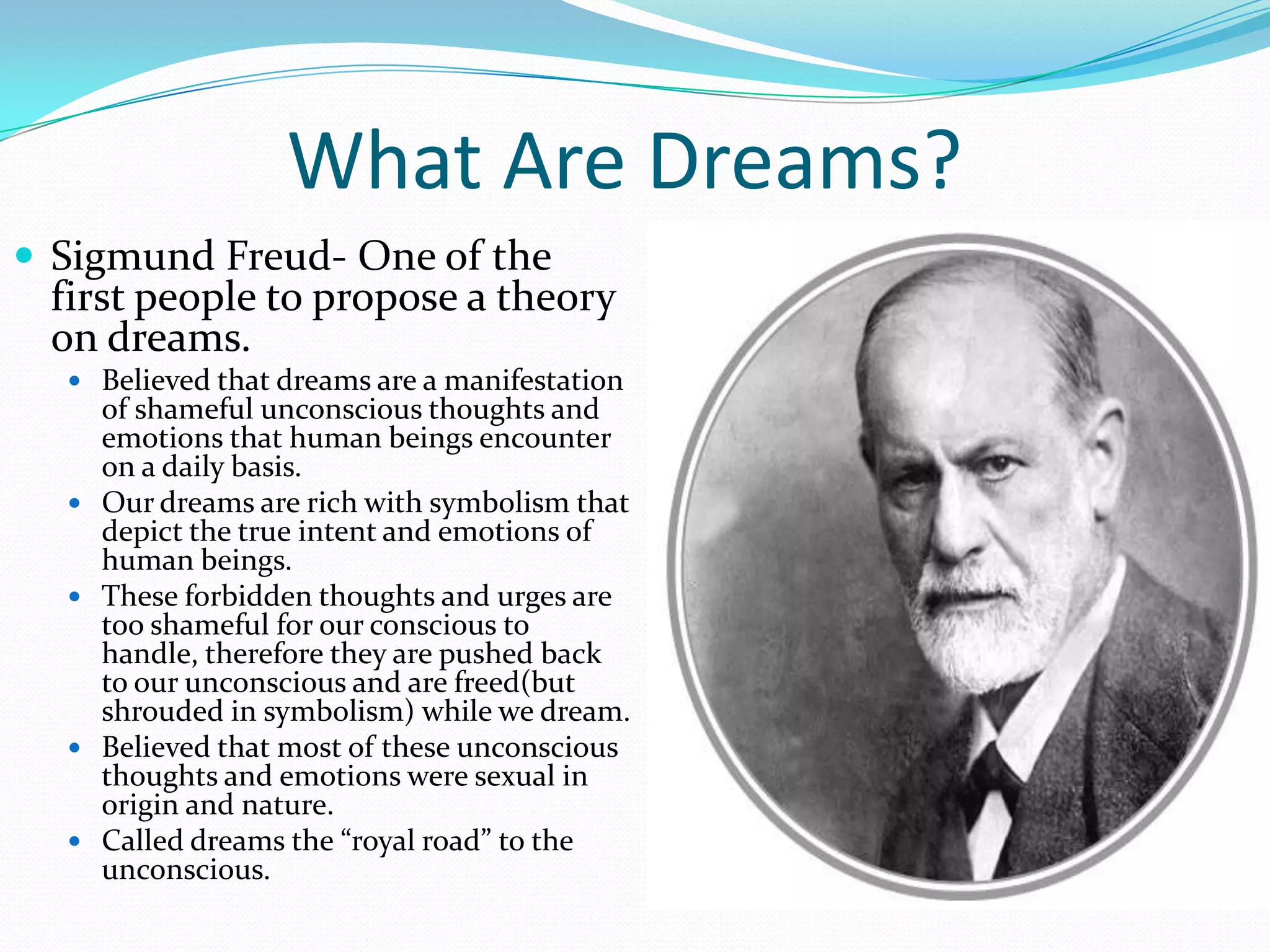
 Sigmund Freud- One of the
first people to propose a theory
on dreams.
 Believed that dreams are a manifestation
of shameful unconscious thoughts and
emotions that human beings encounter
on a daily basis.
 Our dreams are rich with symbolism that
depict the true intent and emotions of
human beings.
 These forbidden thoughts and urges are
too shameful for our conscious to
handle, therefore they are pushed back
to our unconscious and are freed(but
shrouded in symbolism) while we dream.
 Believed that most of these unconscious
thoughts and emotions were sexual in
origin and nature.
 Called dreams the “royal road” to the
unconscious.
More Common Dream Theories
 Dreams are still thought of as unconscious emotions
but they do not necessarily have to revolve around sex.
 Dreams are the brains way of making sense of all the
images and feelings we come across and experience
during our everyday waking lives.
 It is also believed that dreams helps us reinforce
actions or ideas.
 Dreams are a product of our evolutionary
development.
Evolutionary Theory of Dreams
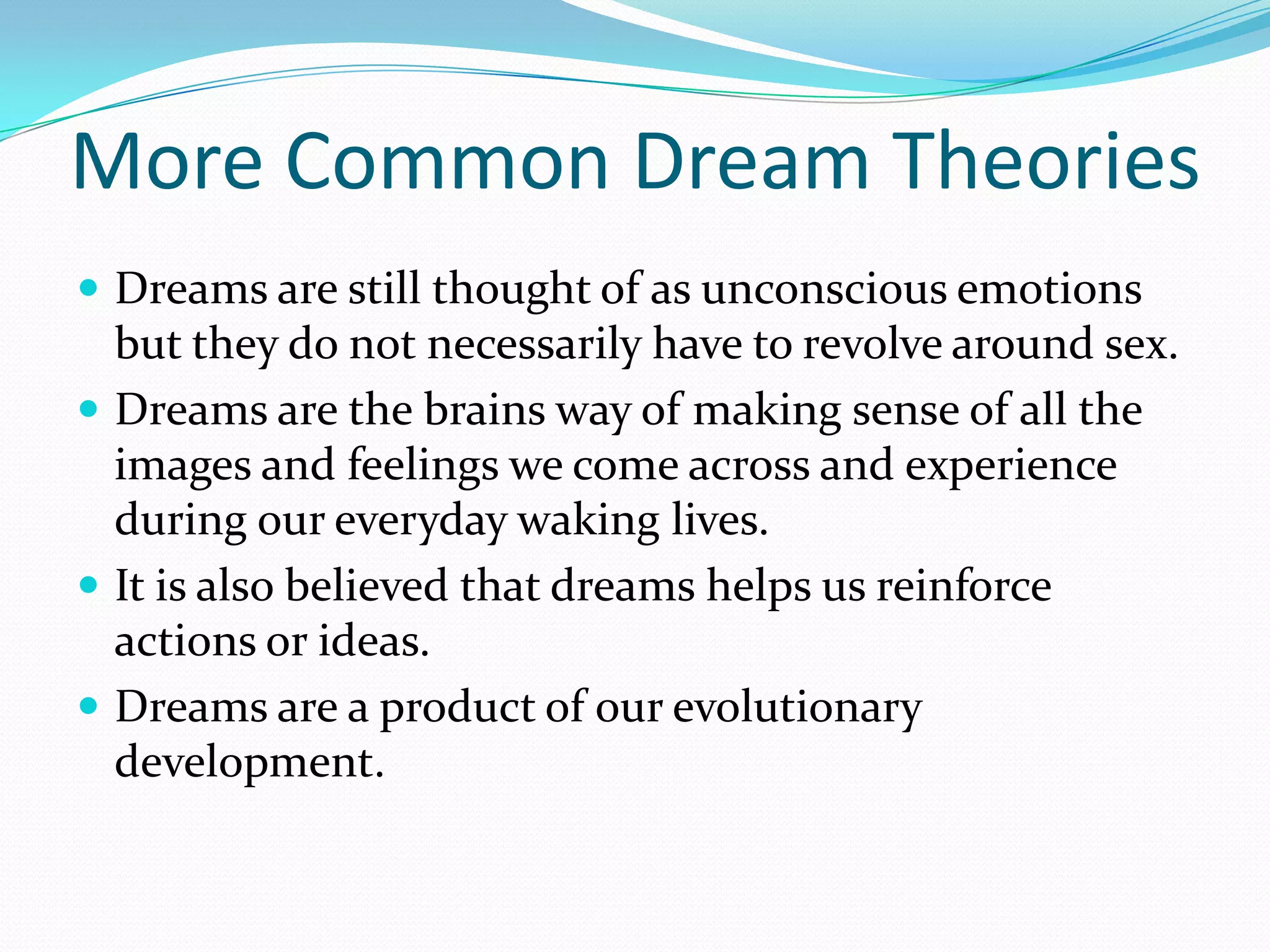
 Dreams served as a way to
enhance our future survival
as a species.
 It is theorized that our
nightmares are products of
our ancestors’ nightmares
and their way of living.
 Many of the dreams we
have today are similar to
those our ancestors had,
though they do differ
greatly.
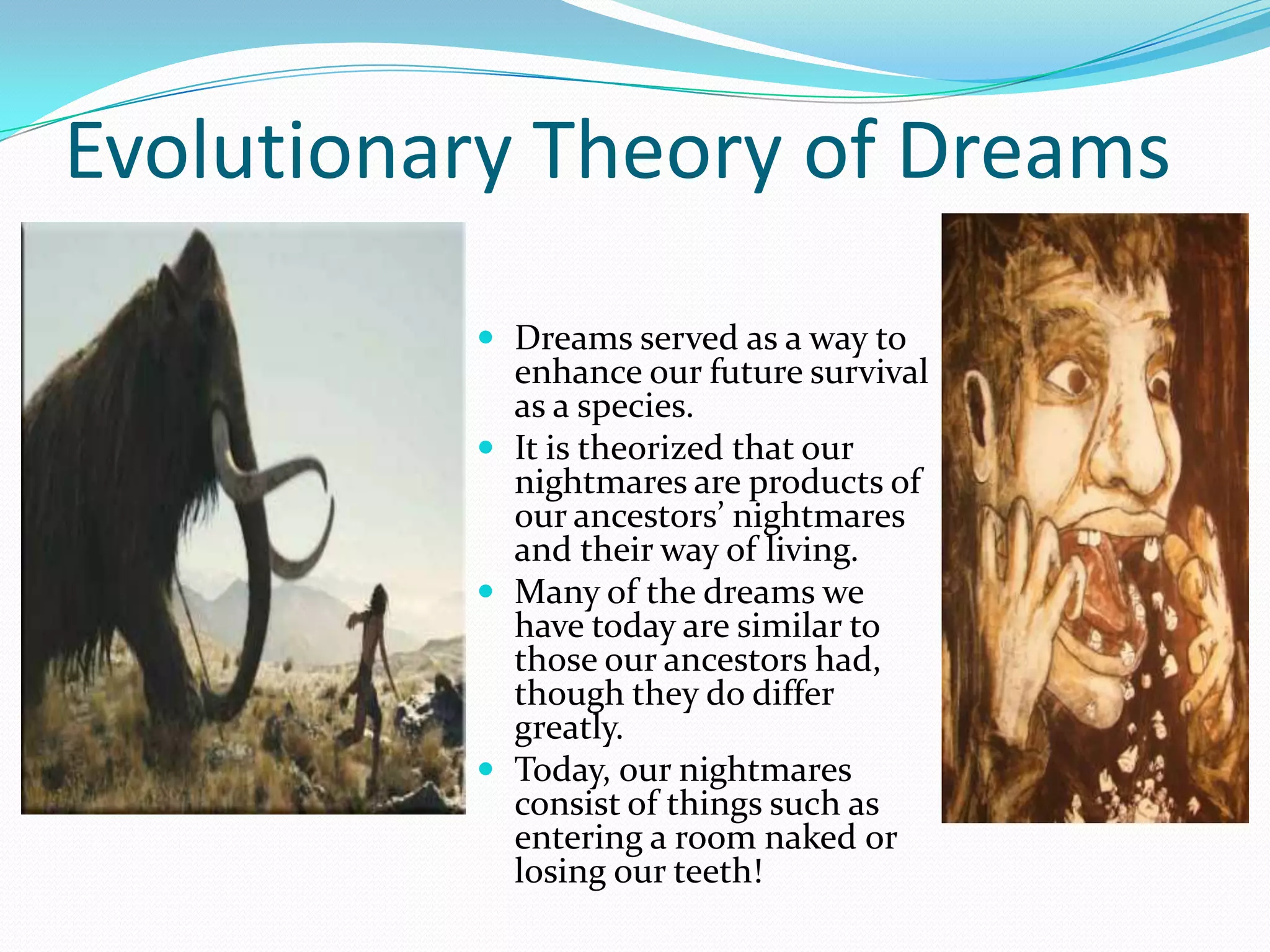
 Today, our nightmares
consist of things such as
entering a room naked or
losing our teeth!
Types of Dreams
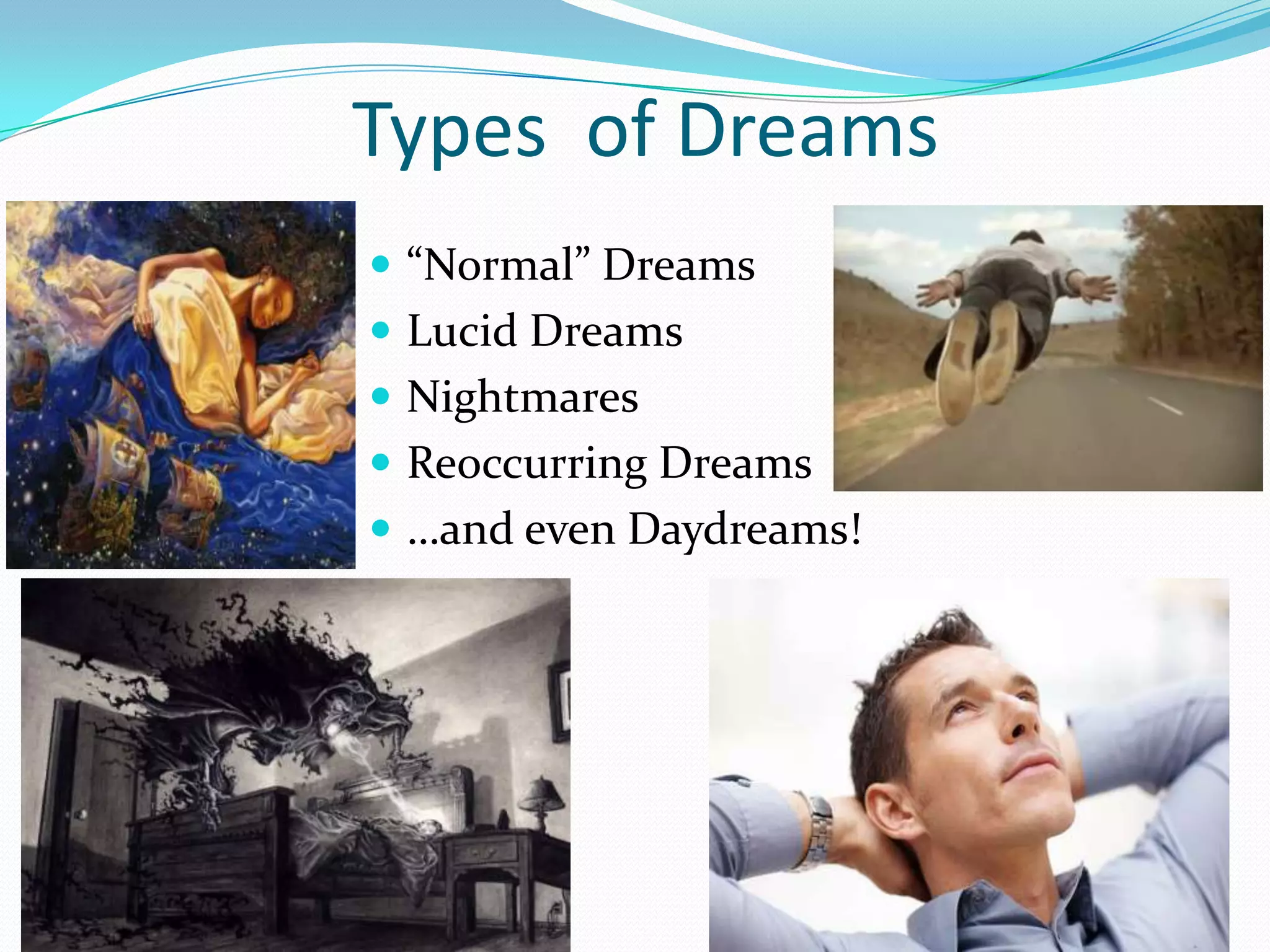
 “Normal” Dreams
 Lucid Dreams
 Nightmares
 Reoccurring Dreams
 …and even Daydreams!
Daydreaming
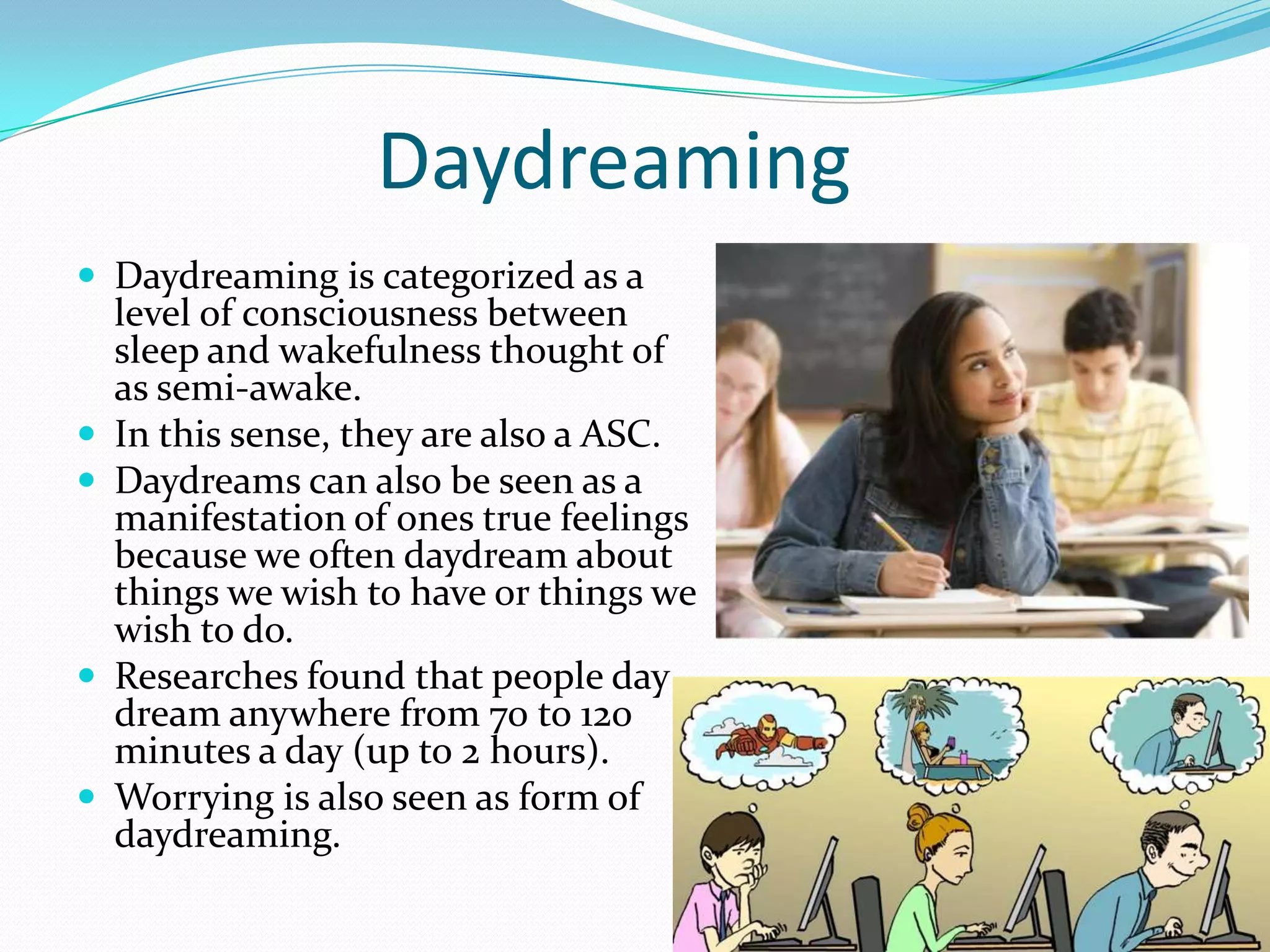
 Daydreaming is categorized as a
level of consciousness between
sleep and wakefulness thought of
as semi-awake.
 In this sense, they are also a ASC.
 Daydreams can also be seen as a
manifestation of ones true feelings
because we often daydream about
things we wish to have or things we
wish to do.
 Researches found that people day
dream anywhere from 70 to 120
minutes a day (up to 2 hours).
 Worrying is also seen as form of
daydreaming.
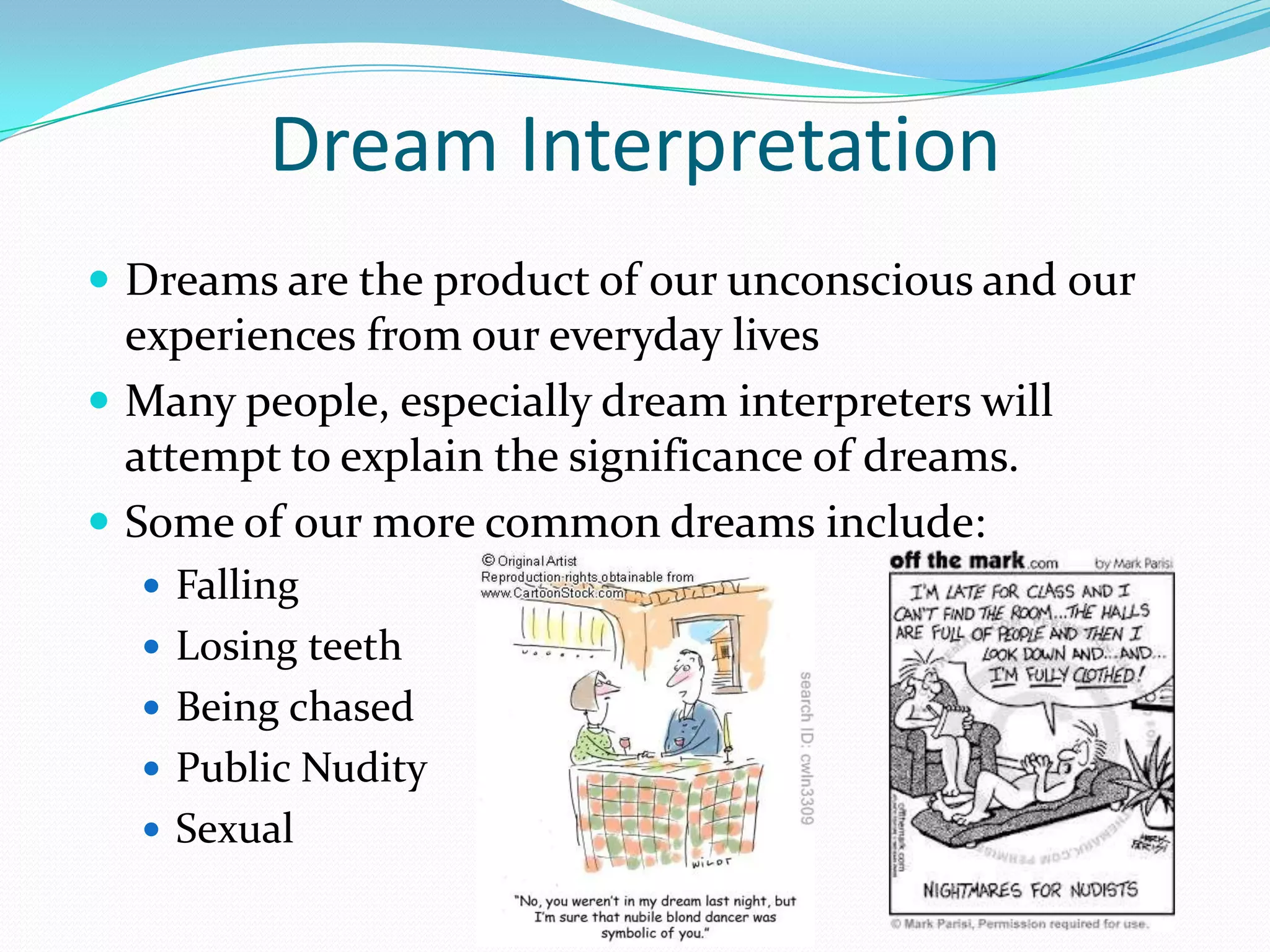
Dream Interpretation
 Dreams are the product of our unconscious and our
experiences from our everyday lives
 Many people, especially dream interpreters will
attempt to explain the significance of dreams.
 Some of our more common dreams include:
 Falling
 Losing teeth
 Being chased
 Public Nudity
 Sexual

Dreams

  • 1.
    What are they,What is their purpose and What do they mean?
  • 2.
    Dreaming  Dreaming isdefined as the subjective experience of imaginary images, sounds/voices, thoughts or sensations during sleep.  They are an altered state of consciousness (ASC).
  • 3.
    What Happens WhenWe Dream?  Dreams occur during REM sleep in which brain activity is high and signaled by rapid horizontal movements of the eyes.  Dreams also occur during non-REM sleep but are not as well remembered.  Researches believe that we dream every time we sleep even if we cannot remember them.
  • 4.
    What Are Dreams? Sigmund Freud- One of the first people to propose a theory on dreams.  Believed that dreams are a manifestation of shameful unconscious thoughts and emotions that human beings encounter on a daily basis.  Our dreams are rich with symbolism that depict the true intent and emotions of human beings.  These forbidden thoughts and urges are too shameful for our conscious to handle, therefore they are pushed back to our unconscious and are freed(but shrouded in symbolism) while we dream.  Believed that most of these unconscious thoughts and emotions were sexual in origin and nature.  Called dreams the “royal road” to the unconscious.
  • 5.
    More Common DreamTheories  Dreams are still thought of as unconscious emotions but they do not necessarily have to revolve around sex.  Dreams are the brains way of making sense of all the images and feelings we come across and experience during our everyday waking lives.  It is also believed that dreams helps us reinforce actions or ideas.  Dreams are a product of our evolutionary development.
  • 6.
    Evolutionary Theory ofDreams  Dreams served as a way to enhance our future survival as a species.  It is theorized that our nightmares are products of our ancestors’ nightmares and their way of living.  Many of the dreams we have today are similar to those our ancestors had, though they do differ greatly.  Today, our nightmares consist of things such as entering a room naked or losing our teeth!
  • 7.
    Types of Dreams “Normal” Dreams  Lucid Dreams  Nightmares  Reoccurring Dreams  …and even Daydreams!
  • 8.
    Daydreaming  Daydreaming iscategorized as a level of consciousness between sleep and wakefulness thought of as semi-awake.  In this sense, they are also a ASC.  Daydreams can also be seen as a manifestation of ones true feelings because we often daydream about things we wish to have or things we wish to do.  Researches found that people day dream anywhere from 70 to 120 minutes a day (up to 2 hours).  Worrying is also seen as form of daydreaming.
  • 9.
    Dream Interpretation  Dreamsare the product of our unconscious and our experiences from our everyday lives  Many people, especially dream interpreters will attempt to explain the significance of dreams.  Some of our more common dreams include:  Falling  Losing teeth  Being chased  Public Nudity  Sexual

Editor's Notes

  • #3 Dreaming is defined as the subjective experience of imaginary images, sounds/voices, thoughts or sensations during sleep. Dreams are considered an altered state of consciousness because they are a major variation of what we consider to be normal waking awareness.