

FORMATION,     FUNCTION,     AND
INTERPRETATION OF A SUBJECT’S
DREAM AT WORKPLACE CONFLICTUAL
SITUATION DURING 2004-2011: A
LONGITUDINAL CASE STUDY REPORT.
   A partial fulfilment of the Doctorate of Philosophy
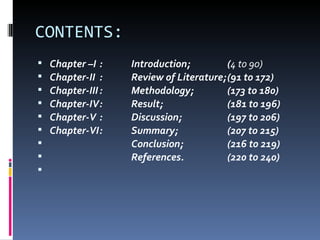
CONTENTS:
   Chapter –I :    Introduction;        (4 to 90)
   Chapter-II :    Review of Literature;(91 to 172)
   Chapter-III :   Methodology;         (173 to 180)
   Chapter-IV:     Result;              (181 to 196)
   Chapter-V :     Discussion;          (197 to 206)
   Chapter-VI:     Summary;             (207 to 215)
                   Conclusion;          (216 to 219)
                   References.          (220 to 240)

Acknowledgement
 I,Naorem Binita Devi,earlier adoc-lecturer at
  Zakir Husain College,D.U., now at present
  assistant       professor,        dept.       of
  psychology,Mizoram University, is pleased to
  inform you all that I can able to self-supervise
  for my Ph.d. thesis based on field study. Now I
  am keeping it in slide share n read it n give
  feedback to me. I really very thankful to my
  case narrative person and her sharing nature
  of each and every detail of the report.
Continue:1
 I am very pleased to thank to those institute
  where my case narrative person is working.
  Without        these institutions and their
  cooperation such work is not possible. Thanks
  you,all so much those who become a part of
  my study. Next time also I really need help for
  you,all. Again I am very thankful for those
  person who makes the investigator to make
  her complete work. If I am using some
  unethical statement in my thesis please just
  ignore. It is just a field study and in the field
  study, many observations are needed.
Continue:2
 I am using symbols in my study. Thanks to
 those who played such bullied attitude
 because that makes me to develop
 something. Thanks to Z institution
 especially,latter M institution, in the M
 institution repeating the procedures but
 already prepared by the subject so less
 warning dream n can able to prepare.
INTRODUCTION:
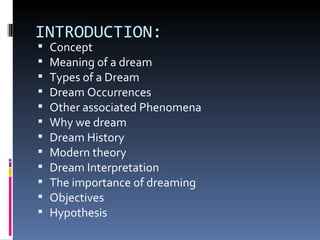
   Concept
   Meaning of a dream
   Types of a Dream
   Dream Occurrences
   Other associated Phenomena
   Why we dream
   Dream History
   Modern theory
   Dream Interpretation
   The importance of dreaming
   Objectives
   Hypothesis
Concept:
 Dreams have fascinated people since ancient times.
  The Mesopotamians, Hebrews, Babylonians, Chinese,
  Greeks, and Romans all valued dream interpretation
  (Van De Castle, 1994), and early psychologists (Freud,
  1900/1970; Jung, 1945/1993) wrote of the value of
  dream interpretation in spurring client insight.
 Dreams are a succession of images, thoughts, or
  emotions passing through the mind during sleep. The
  content and purposes of dreams are not fully
  understood, though they have been a topic of
  speculation and interest throughout recorded history.
  The scientific study of dreams is known as
  “oneirology”.
Continue 1
 Dreams are unique. No other individual can have
  your background, your emotions, or your
  experiences. Every dream is connected with your
  own “reality”. Thus, in interpreting someone’s
  dream, it is important to draw from your personal
  life and experiences. A dream unifies the body,
  mind, and spirit. It provides you with insight
  ourselves and a means for self-exploration. In
  understanding your dreams, you will have a better
  understanding and discovery of your true self.
 A dream is some sort of mental activity during sleep,
  usually reported as perceived in a visually
  imaginative manner ( Webb and Cart weight,1978).
MEANING OF A DREAM

 Finding out what dreams mean has been of
  intense interest to philosophers for
  thousands of years - one of the first "dream
  dictionaries" was the ancient Greek
  Oneirocritica of Artemidus.
 It seems a universal human trait to want to
  crack the "code" and find out what your
  dream was about and what, if anything, it
  meant.
Continue-1
 According to Domhoff (2005) dreaming is
  defined as “a sequence of perceptions, thoughts
  and emotions during sleep that is experienced as
  a series of actual events. The nature of these
  events, the dream content, can be known to the
  interviewers only in the form of a verbal or
  written report”. .
 Dement and Kleitman (1957) observed that
  subjects reported dreams 80% of the time when
  awakened during REM sleep, dreams were
  reported during NREM sleep only 20% of the
  time (Hartman,1967).
Continue-2
 Research findings have revealed that the occurrence
  of recurrent dreams, nightmares and unpleasant
  everyday dreams is related to one’s psychological
  well-being (Blagrove, Farmer,& Williams, 2004;
  Zadra & Donderi, 2000). Further data demonstrate
  that the dream reports of people suffering from
  certain psychopathologies can differ from those of
  normal control subjects (Kramer, 2000; Schredl &
  Engelhardt, 2001), and that certain personality
  dimensions such as extroversion (Bernstein &
  Roberts, 1995), neuroticism (Schredl, Landgraf, &
  Zeiler, 2003), and psychological boundaries (Schredl,
  Schäfer, Hofmann,& Jacob, 1999) are extensively
  associated to dream content.
Continue-3
 More recent developments suggest that dreams
  are more similar than different because they
  dramatize people’s conceptions and concerns in
  relation to personal issues, which probably does
  not vary much from country to country as culture
  does. In particular, the continuity hypothesis
  postulates that the content of everyday dreams
  reflects the dreamer’s waking states and
  concerns. In other words, elements from
  people’s dreams can be related to corresponding
  waking or psychological variables (Domhoff,
  2005).
Continue-4
 The ancient Greeks constructed temples they called
  Asclepieions, where sick people were sent to be
  cured. It was believed that cures would be effected
  through divine grace by incubating dreams within
  the confines of the temple. Dreams were also
  considered prophetic or omens of particular
  significance. In ancient Egypt, priests also acted as
  dream interpreters. Joseph and Daniel are recorded
  as having interpreted dreams sent from God, and
  indeed the Bible describes many incidents of dreams
  as divine revelation. Hieroglyphics depicting dreams
  and their interpretations are evident. Dreams have
  been held in considerable importance through
  history by most cultures.
Continue-5

 The two most well known (relatively) modern
  schools of psychological dream analysis are
  those of Sigmund Freud and Carl Jung who
  attempted to discover the hidden meaning he
  believed lay behind the dreams of his
  patients. Other dream interpertation
  approaches which build on these include
  depth psychology, neurocognitive theory,
  activation-synthesis                   and
  Fritz Perls' gestalt theory.
Continue-6

 Freud stated that "the interpretation of dreams
  is the royal road to a knowledge of the
  unconscious activities of the mind" (p. 647), and
  Jung viewed dreams as being a source of
  personal knowledge and guidance. Despite the
  attention given to dream interpretation by these
  and other theorists, and the fascination with
  dreams by people in a variety of cultures and
  times, only 10 to 15% of mental health
  professionals work with dreams (Davis, 2002).
Continue-7

 What is Lucid dreaming and nightmares?
 The basic definition of lucid dreaming is
  becoming aware that you are dreaming. Yet,
  the quality of lucidity varies.
 A nightmare is a dream which causes a
  strong unpleasant emotional response from
  the sleeper, typically fear or horror, being in
  situations of extreme danger, or the
  sensations of pain, falling, drowning or death.
Continue-8

 There are three fundamental psychological
  questions to be answered:
 Formation
  Where do our dreams come from?
 Function
  What purpose - if any - do they serve?
 Interpretation
  What - if anything - do they mean?
TYPES OF A DREAM:
   Daydreams;
   False awakening dreams;
   Lucid dreams;
   Nightmares;
   Recurring dreams;
   Healing dreams;
   Prophetic dreams;
   Signal dreams;
   Epic dreams.

Continue 1

 Daydreaming is classified as a level of
 consciousness      between      sleep    and
 wakefulness. Studies show that we all have
 the tendency to daydream an average of
 70-120 minutes a day. It occurs during our
 waking hours when we let our imagination
 carry us away. As our minds begin to wander
 and our level of awareness decreases, we lose
 ourselves in our imagined scenario and
 fantasy.
Continue-2

 False Awakening Dreams:
  Ever thought you were awake and going
  about your morning routine of getting up,
  brushing your teeth, eating breakfast and
  going to work only to wake up "again" and
  realize that was just a dream. That sensation
  is referred to as a false awakening.
 Lucid Dreams :
  Lucid dreams occurs when you realize you are
  dreaming.
Continue-3
 Nightmares:
  A nightmare is a disturbing dream that causes the
  dreamer to wake up feeling anxious and frightened.
  Nightmares may be a response to real life trauma and
  situations. These type of nightmares fall under a special
  category called Post-traumatic Stress Nightmare (PSN).
 Recurring Dreams:
  Recurring dreams repeat themselves with little variation
  in story or theme. Dreams may recur because a conflict
  depicted in the dream remains unresolved or ignored.
  Once you have found a resolution to the problem, your
  recurring dreams will cease.
Continue-4
 Healing Dreams:
  Healing dreams serve as messages for the
  dreamer in regards to their health. Many dream
  experts believe that dreams can help us avoid
  potential health problems and help us to heal
  when we are ill. Our bodies are able to
  communicate to us through our dreams to "tell"
  us that something is not quite right with our
  bodies even before any physical symptoms show
  up. Dreams of this nature may be telling the
  dreamer that he/she needs to go to the dentist or
  doctor.
Continue-5

 Prophetic Dreams:
  Prophetic dreams, also referred to as
  precognitive or psychic dreams, are dreams that
  seemingly foretell the future. One rational
  theory to explain this phenomenon is that our
  dreaming mind is able to piece together bits of
  information and observation that we normally
  overlook or that we do not seriously consider. In
  other words, our unconscious mind knows what
  is coming before we consciously piece together
  the same information.
Continue-6
 Signal Dreams :
  Signal dreams help you how to solve problems or make
  decisions in your waking life.
 Epic Dreams :
  Epic dreams (also known as Great Dreams or Cosmic
  Dreams) are so huge, so compelling, and so vivid that you
  cannot ignore them. The details of such dreams remain
  with you for years, as if your dreamt it last night. These
  dreams possess much beauty and contain many archetypal
  symbology. When you wake up from such a dream, you
  feel that you have discovered something profound or
  amazing about yourself or about the world. It feels like a
  life-changing experience .
DREAM OCCURRENCES:

 Hypnogogic Images
 Recurring Dreams
 Nightmares
 Dreams In Series
 Out of Body Experiences (OBE'S)
 ESP In Dreams
Continue-1

 Hypnogogic Images:
 Between being awake and falling asleep, your
 mind enters the hypnogogic phase. In this
 stage you begin to lose touch with the world
 around you without showing the
 physiological stages of sleep. Pictures form
 inside our heads like still photographs and
 although you may have never noticed them,
 they are there.
Continue-2
 Recurring Dreams:
  It is safe to assume that a recurring dream will have
  something important to say to us about the way we are
  conducting our waking lives, so it will be worth trying to
  discover what its message is.
  Nightmares :
   Nightmares are the way in which our subconscious scolds
  us and says, "pay attention!" Anyone who has had a vivid
  nightmare, knows it is very difficult to forget it once you
  awaken.
  If a nightmare occurs, your subconscious is trying to tell you
  something very important, perhaps something you have
  been ignoring or refusing to accept as a truth within your
  life situation.
Continue-3

 Dreams In Series:
  Dreams tend to come in a series. After you
  have recorded a significant amount of
  dreams, you will begin to see that a certain
  dream theme was being dealt with for several
  nights in a row. Consider this like a school
  course, and each dream a lesson pertaining to
  your life. If you learn from the dream theme,
  and alter your behavior or belief system, the
  series will end.
Continue-4
 Out of Body Experiences (OBE'S):
  What is an OBE and how does it differ from
  dreaming? An OBE is quite different from any of the
  other dream experiences. The only difficulties is
  studying these phenomenons, since no one has had
  one under the study of a dream psychologist. It is
  similar to lucid dreaming only in the fact that
  consciousness is present. It is not uncommon to see
  the body, as we drift upward and out of it, sleeping
  upon the bed. Most everyone has heard of people
  who have been clinically pronounced "dead" but
  then return to their body. This is referred to as a
  NDE or Near Death Experience.
Continue-5

 ESP In Dreams:
  Extrasensory perception, better known as ESP, is
  response to external stimuli without any known
  sensory contact. Many people have claimed to
  have dreams in which they have predicted future
  events, learned about a subject that they had no
  previous knowledge of, or even met up with a
  friend in a dream only to find upon awakening
  that their friend also dreamt about the meeting.
  These are all cases of ESP in dreams.
Continue-6

 Types of ESP:
 Precognition
 Dream Psychometry
 Synchronous
Continue-7
 Precognition –
  This is one of the most common types of dream ESP people
  talk about. Apparently, they seem to dream about an
  event before it happens in reality, and in startlingly
  accurate detail. Some do not even realize that their dream
  are precognitive until the event starts to happen in real life
  exactly as they had in the dream. If these dreams really do
  predict future events, this could have great implications. It
  may be that they future has already been decided and that
  we are just following a set path in our life. There are people
  without a precognitive dreaming background that believe
  this as well, but even though it may sound a bit strange, it
  could confirm their beliefs if ESP in dreams in found to be
  factual.
Continue-8
 Dream Psychometry –
  This is the most uncommon of the three areas of dream
  ESP. These too, are accounts that cannot be proved
  because they are based purely on what the dreamer
  experiences. Dream psychometry is gaining information
  about an object in your dreams of which you know
  nothing about in waking life. The easiest way to do this
  would be to take a picture of a person you don't know
  and think about this person before you go to sleep at
  night. Then, when you wake up in the morning, record
  your dream and analyze them for any meaning that
  could relate to the picture. You may even want to try this
  with a book, such as calculus, the night before you have a
  test on the subject and see if you learn anything. This is
  not suggested unless you have no other options, this is
  referred to as osmosis, when you aren't in the dreaming
  state.
Continue-9
 Synchronous –
  These are dreams in which the dreamer encounters
  another familiar character in a dream, and upon
  awakening and talking to that person they also recount
  the same dream experience during the night. If shared
  dreams are possible, it could prove the astral projection
  theory that goes along with OBE's. Even though most
  people are skeptical about this idea, that is the way we
  have been brought up, especially in western culture,
  which is not believing something unless there is sufficient
  scientific evidence to back it up. We may never be sure
  whether any of these theories will be proven, since the
  study of these rare occurrences is very difficult, so the
  only thing we can do is keep dreaming and know what
  we believe for ourselves.
OTHER ASSOCIATED PHENOMENA:

 Rapid eye movement (REM)
 False awakening
 Sleep paralysis
 Out-of-body experience
 Rarity
Continue-1

 Rapid eye movement:
 When a person is dreaming, the eyes move
 rapidly. Scientific research has found that
 these eye movements correspond to the
 direction in which the dreamer is "looking" in
 his/her dreamscape; this has enabled trained
 lucid dreamers to communicate whilst
 dreaming to researchers by using eye
 movement signals.
Continue-2

 False awakening:
  In a false awakening, one suddenly dreams of
  having been awakened. Commonly in a false
  awakening, the room is similar to the room in
  which the person fell asleep.
 Sleep paralysis:
  During REM sleep the body is paralyzed by a
  mechanism in the brain in order to prevent
  the movements which occur in the dream
  from causing the physical body to move.
Continue-3

 Out-of-body experience:
  An out-of-body experience (OBE or sometimes
  OOBE) is an experience that typically involves a
  sensation of floating outside of one's body and,
  in some cases, perceiving one's physical body
  from a place outside one's body (autoscopy).
  About one in ten people have had an out-of-
  body experience at some time in their
  lives.Scientists are starting to learn about the
  phenomenon.
Continue-4
 Rarity:
  Given the frequent bizarreness, illogic and dislocation of
  dreams, some researchers have questioned why dreamers
  are not lucid all of the time. How can our dreaming selves
  accept as real so many settings, images and events that in
  waking life, we assume, would immediately jolt us into
  disbelief? The answer to this has been approached in three
  categories of investigation.
Depth psychology suggests that the unconscious “dream-
  work” is repressing or inhibiting critical evaluation of the
  dream in order to perform its salutary function. “Belief” in
  the dream symbols and experience is required for healing,
  personality integration or catharsis to take place. Lucidity
  can only arise if a person is relatively free of un-reconciled
  conflicts which form barriers.
WHY WE DREAM?

 There is no proven fact on why we dream, which is
  why there are so many theories on the topic.
 There is Freud’s theory that dreams carry our hidden
  desires and there is Jung’s theory that dreams carry
  meaning, although not always of desires, and these
  dreams can be interpreted by the dreamer.
 After these theories, others continued such as the
  Cayce theory in that dreams are our bodies means of
  building up of the mental, spiritual and physical well-
  being. Finally came the argument between Evans’
  theory and the Crick and Mitchinson theory.
Continue:

 Evans states that dreaming is our bodies way
  of storing the vast array of information
  gained during the day, whereas Crick and
  MItchinson say that this information is being
  dumped rather than stored. Whichever
  theory is true, we may never know, but from
  these following theories we can decide for
  ourselves what we believe to be true and
  further help us into understanding our
  dreams.
DREAM HISTORY:

 Ancient Dreamers:
 Early Greek Thinking:
 Roman Theories:
 Biblical Visions:
 Middle-Eastern Ideas:
 European Attitudes:
 Modern Thinking:
Continue-1

 Dream interpretations dates back to 3000—
 4000 B.C., where they were documented on
 clay tablets. People in some primal societies
 were unable to distinguish between the
 dream world and waking world or they simply
 choose not to make such a distinction. They
 saw that the dream world was not only an
 extension of reality, but that it was a more
 powerful world.
Continue-2
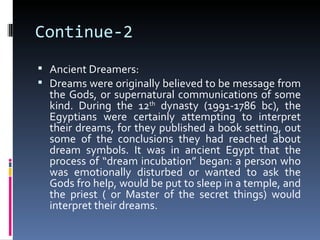
 Ancient Dreamers:
 Dreams were originally believed to be message from
  the Gods, or supernatural communications of some
  kind. During the 12th dynasty (1991-1786 bc), the
  Egyptians were certainly attempting to interpret
  their dreams, for they published a book setting, out
  some of the conclusions they had reached about
  dream symbols. It was in ancient Egypt that the
  process of “dream incubation” began: a person who
  was emotionally disturbed or wanted to ask the
  Gods fro help, would be put to sleep in a temple, and
  the priest ( or Master of the secret things) would
  interpret their dreams.
Continue-3
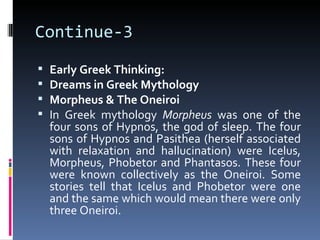
   Early Greek Thinking:
   Dreams in Greek Mythology
   Morpheus & The Oneiroi
   In Greek mythology Morpheus was one of the
    four sons of Hypnos, the god of sleep. The four
    sons of Hypnos and Pasithea (herself associated
    with relaxation and hallucination) were Icelus,
    Morpheus, Phobetor and Phantasos. These four
    were known collectively as the Oneiroi. Some
    stories tell that Icelus and Phobetor were one
    and the same which would mean there were only
    three Oneiroi.
Continue-4
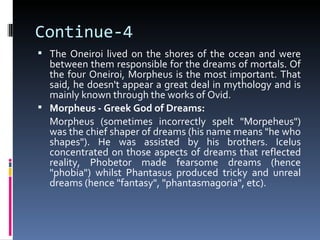
 The Oneiroi lived on the shores of the ocean and were
  between them responsible for the dreams of mortals. Of
  the four Oneiroi, Morpheus is the most important. That
  said, he doesn't appear a great deal in mythology and is
  mainly known through the works of Ovid.
 Morpheus - Greek God of Dreams:
  Morpheus (sometimes incorrectly spelt "Morpeheus")
  was the chief shaper of dreams (his name means "he who
  shapes"). He was assisted by his brothers. Icelus
  concentrated on those aspects of dreams that reflected
  reality, Phobetor made fearsome dreams (hence
  "phobia") whilst Phantasus produced tricky and unreal
  dreams (hence "fantasy", "phantasmagoria", etc).
Continue-5
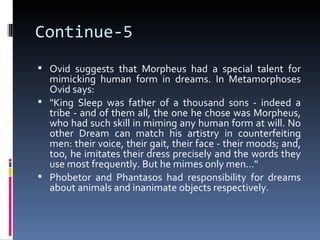
 Ovid suggests that Morpheus had a special talent for
  mimicking human form in dreams. In Metamorphoses
  Ovid says:
 "King Sleep was father of a thousand sons - indeed a
  tribe - and of them all, the one he chose was Morpheus,
  who had such skill in miming any human form at will. No
  other Dream can match his artistry in counterfeiting
  men: their voice, their gait, their face - their moods; and,
  too, he imitates their dress precisely and the words they
  use most frequently. But he mimes only men..."
 Phobetor and Phantasos had responsibility for dreams
  about animals and inanimate objects respectively.
Continue-6

 Morpheus also had special responsiblity for the
  dreams of kings and heroes. For these reasons
  Morpheus is often referred to as "Morpheus the
  Greek god of dreams" in superiority to his
  brothers.
 Morpheus himself was said to sleep in a rather
  unusual bedroom - a dark cave decorated with
  poppy flowers. This is perhaps a reference to the
  opium poppy; morphine was named after
  Morpheus (initially morphine was called
  "morphium").
Continue-7
 The first step into modern Dream interpretation was
  taken in the 5th century B.C. the Greek philosopher
  Heraclitus ( c.544-483) suggested that a person’s
  dream would was peculiar to them, and was not
  necessarily a result of outside influences—even
  those of the GODS.
 Most Greek philosophers at some time concerned
  themselves with dreams and what they might mean:
 Plato (c.428-c.348 b.c.) realised how radically
  dreams could affect a personality or a life,. In the
  Phaedo Plato dercribes how Socrates studied music
  and the arts because he was instructed to do so in a
  dream.
Continue-8
 A century after the death of Heraclitus, Aristotle
  (384-322 b.c.) finally put an end to the idea of
  dreams as messages from the Gods, and tried to
  study the dreams process in a rational way. He
  points out ( in his Dedivinatione per Somnum)
  that “most so-called prophetic dreams are the to
  be classed as mere coincidences, especially all
  such as are extravagant”, and latter asserts that “
  the most skilful interpreter of dreams is he who
  has the faculty of absorbing resemblances. In his
  Parva naturalia, Aristotle suggested that dreams
  were in fact fragments of recollections of events
  of the day.
Continue-9
 He also advanced the theory that dreams were a
  reflection of the bodily state, and a doctor could
  therefore use a patient’s dream as a means of
  diagnosing an illness. This idea was supported by
  Hippocrates (c.460-357 B.C), the founder of
  modern medicine, and is prevalent today. Galen
  of Pergamum (AD 129-99),a Greaco-Roman
  physician, followed the same line.
 For example, he recorded that a man dreamed
  that his left thigh was turned into marble, and
  soon after lost the use of his left leg as a result of
  a palsy.
Continue-10
 Roman Theories:
 Although earlier documents exist ( notably the
  Egyptian dream book known as the Chester
  Beatty Papyrus), the Oneirocriticon or the
  interpretation of dreams by the Roman
  Artemidorus      (c.A.D.150)     is    the   first
  comprehensive book on the interpretation of
  dreams.
 Artemidorus argued that dreams were unique to
  the dreamer: the person’s occupation, social
  status, and health would all affect the symbols in
  a dream.
Continue-11

 A   second oneirocriticon written by
 Astrampsychus (c.AD 350) bears some
 resemblance to the dream books that the
 Victorians produced Astrampsychus’s volume
 contained statements such as “ to wear a
 purple robe threatens a long disease” and “ to
 hold or eat eggs symbolises vexation in the
 book may be accurate, for example: “sitting
 naked signifies less of property”.
Continue-12
 Biblical Visions:
 The Christians revived the beliefs that dreams were
  supernatural events. The old Testament of the Bible is full
  of dreams: the most famous is probably Jacob’s dream of a
  ladder or staircase from earth to heaven.
 St.John Chrysostom (347-407) preached that God revealed
  himself through dreams. He also made the remarkably
  modern statement that we are not responsible for our
  dreams, and should not therefore be ashamed of any
  images that appear in them. both St. Augustine (354-430)
  and St. Jerome (c.342-420) claimed that the directions of
  their lives were affected by their dreams.
 Most religions had considerable respect for dreams.
  Mohammed (c.570-632) “received” much of the text of the
  Koran in a dream, and interpreted his disciples dreams for
  them.
Continue-13

 Middle-Eastern Ideas:
  Early work on dream interpretation was not confined
  to the Egyptians, Greeks, Romans, and Christians. In
  Persia, “Sifat-i-Sirozah” ( an unidentified writer)
  devised a scheme relying on time: a dream could
  only be interpreted according to the particular day it
  occurred. The Zoroastrians were particularly
  devoted to this theory, which set out rules for each
  day of the month, for example: “ the second day is
  that of Bahman...events dreamed of will occur in
  four days, but the hopes which may be cherished will
  be disappointed.”
Continue-14
 The most notable early Arabic dream interpreter
  was Gabdorrhachaman (c.A.D. 720), whose
  theories first appeared in the west in 1664,
  published in French as L’onirocrite Mussulman.
  He considers that dreams was prophetic, and
  could only be interpreted by those who
  possessed “ a clean spirit, chaste morals, and the
  world of Truth”. Gabadarrhachaman’s aphorisms
  seem to have been based on his own instinct
  rather than on any particular understanding of
  symbolism: “he who dreams that his tongue has
  shortened immoderately will utter much folly
  and ribaldry”.
Continue-15
 European Attitudes:
 Robert Cross Smith (1795-1832) from Bristol, set up as an
  astrologer under the name “ Raphael” and became
  enormously successful. Two years before his death, he
  published “ the royal book of dreams, inwhich he devised a
  procedure for interpreting dreams by the use of “ ciphers”. “
  thy dream presages a saturnine enemy,” or “A full merry,
  and right joyful dream; it tells of banquets and feasting.”
  Modern dream interpretation may have begun with Alfred
  Maury, a French doctor who is reputed to have studied over
  3000 dreams. He believed that dreams arose from external
  stimuli. A particular dream of his own suggested to him
  that dreams might arise so quickly that they were almost
  simultaneous with the stimulus that produced them.
Continue-16
 He dreamed that it was during the Reign of Terror of the
  French revolution, and he was condemned and led to the
  guillotine. As the blade of the guillotine fell, he woke up to
  find that the top of the bed had fallen down and had struck
  the top of his spine. Just as the guillotine would actually
  have struck him.
 However, this line of thought proved to be relatively
  unimportant, and it was the development of the theory of
  the unsconscious that marked the beginning of the modern
  attitude to dream interpretation.
 Johann Fichte (1762-1814) and his disciple Friedrich
  Schelling (1775-1854) had already begun to suspect that
  dreams revealed our unconscious fears and desires, but it
  was with the publication in 1900 of Sigmund Freud’s The
  Interpretation of Dreams, that modern work on dream
  interpretation really begun.
Continue-17
 Modern Thinking:
 Freud (1865-1939) set out the theory that, although
  they may be prompted by external stimuli, wish
  fulfilment was the basis of most dreams. According
  to him, our dreams reflected our deepest desires,
  rooted in our infancy, and always held a serious
  meaning. He stressed the erotic content of dreams.
 Carl Gustav Jung (1875-1961) collaborated with
  Freud for some years, but disagreed with him on this
  very point: hidden sexual problems were not, Jung
  argued, at the root of most dreams. Jung suggested
  that dreamer, in fact important messages from
  ourselves to ourselves, and messages that we ignore
  to our loss.
Continue-18

 Other theories:
  Theories about dreams have continued to be
  developed since Freud and Jung published their
  respective views. Some psychologists, like Medard
  Boss in the Analysis of Dreams (1958), have
  suggested that it is pointless to have any theory
  about dreams—that they are simply another facet of
  life, as meaningless as waking existence. Similarly,
  some psychologists believe that dreams merely
  “wipe the tape”; they dispose of memories that
  would otherwise clutter our minds with numerous
  remembered experiences and emotions.
Continue-19

 The Gestalt Technique sees dreams as aids to
  the organization and structuring of
  information, so the dreamer should consider
  every element of the dream, which will relate
  to some “unfinished business” of the mind.
DREAM INTERPRETATION:

 Recording Your Dreams
 Interpreting Your Dreams
 Interpretation Problems
 Dream interpretation
Continue-1
 Recording Your Dreams:
    For all of those people out there who are interested in
  learning about what their dreams mean to them in their life
  need to live by one rule. Always write down your dreams
  whenever you have them, soon after you have them.
  However well you think you can remember your dreams,
  you should have a record that you can work with to help
  you see any patterns that occur in your dream. The best
  way to interpret your own dreams is to first begin with
  having your own dream journal. You should allow yourself
  an area where you can write the dreams on the left side of
  the journal and the interpretations on the right side, or
  vice-versa. By having this journal will already get your mind
  set into the idea of having dreams, since you already have
  the journal to record them in.
Continue-2
 Interpreting Your Dreams:
   The first thing you need to know about interpreting your
  dreams is that you should never use a dream dictionary
  because dreams are yours and yours only to interpret.
  You may want to start large with the dream itself and
  asking it questions, such as:
  1. What were you doing in the dream?
  2. What are the major contrasts and similarities in the
  dream and how do they relate?
  3. What are the major symbols and relationships between
  these symbols?
  4. What are the issues, conflicts, and unresolved situations
  in the dream?
  5. What relationship does this dream or the symbols in the
  dream, have to do with any other dream?
Continue-3

 After you have answered all these questions to
  yourself you can begin getting to the specifics:
  1. How am I acting in the dream?
  2. What symbols in this dream are important to me?
  3. What are the different feelings in this dream?
  4. What are the major actions in this dream?
  5. Who or what is the adversary in this dream?
  6. What is helping in this dream?
  7. What would I like to avoid in this dream?
  8. What actions might this dream be suggesting?
  9. What does this dream want from me?
  10. Why did I need this dream?
Continue-4
 Interpretation Problems:
   It's not uncommon to have problems with interpretation.
  The main thing that you have to realize is that you have the
  answer. Sometimes it's easy to see. Sometimes it isn't.
  The best approach to tackling a tough dream is to relax.
  It has been found that the more difficult the dream, the
  more important it is to your life.
  The main thing you need to realize is that the dream will
  come to you, whether it takes a few mintues, hours, or
  possibly the next day. Give it some time, because it may
  not be ready to reveal it's true meaning. All you need to do
  is make a record of the dream and one day it may make so
  much sense to you that you couldn't possibly imagine why
  it gave you so much trouble. Give it some time, because it
  may not be ready to reveal it's true meaning.
Continue-5
 Dream interpretation:
  Dream interpretation is the process of assigning meaning
  to dreams. In many of the ancient societies, including Egypt
  and Greece, dreaming was considered a supernatural
  communication or a means of divine intervention, whose
  message could be unravelled by those with certain powers.
  In modern times, various schools of psychology have
  offered theories about the meaning of dreams.
  Freud’s     book      The Interpretation of Dreams      ('Die
  Traumdeutung'; literally 'dream-interpretation'), first
  published in 1899 (but dated 1900), that Sigmund Freud
  first argued that the foundation of all dream content is
  wish-fulfilment, and that the instigation of a dream is
  always to be found in the events of the day preceding the
  dream.
Continue-6
 Freudian Dream Tools:
 According to Freud, dreams always have a manifest
  and latent content. The manifest content is what
  the dreams seems to be saying. It is often bizarre
  and nonsensical. The latent content is what the
  dream is really trying to say. Dreams gives us a look
  into our unconscious. Utilizing the technique of "free
  association", Freud believed that we can chip
  through the dream's manifest content to reveal the
  underlying significance of our dreams and its latent
  content. In this technique, you start with one dream
  symbol and then follow what comes to your mind
  next and see where it leads.
Continue-7
 To further help in interpreting the cryptic images of
  our dreams, Freud classified the images into the
  following five processes:
 1. Displacement
  This occurs when the desire for one thing or person
  is symbolized by something or someone else.

 2. Projection
  This happens when the dreamer propels their own
  desires and wants onto another person.
 3. Symbolization
  This is characterized when your repressed urges or
  suppressed desired or acted out metaphorically.
Continue-8
 4. Condensation
  This is the process in which the dreamer hides their feelings
  or urges by contracting it or underplaying it into a brief
  dream image or event. The meaning of this dream imagery
  may not be apparent or obvious.
 5. Rationalization
  This is seen as the final stage of dreamwork where the
  dreaming mind organizes an incoherent dream into one
  that is more comprehensible and logical. Also known as
  secondary revision.
  Freud was particularly preoccupied with sexual content in
  dreams. He believed that sex was the root cause of what
  was happening in your dreams. For Freud, every long
  slender or elongated objects (i.e. knives, cigars, guns, etc)
  represent the phallus, while any cavity or receptacle (bowls,
  caves, tunnels, etc) denotes the female genitalia.
Continue-9
 Jung
  Although not dismissing Freud's model of dream
  interpretation wholesale, Carl Jung believed Freud's notion
  of dreams as representations of unfulfilled wishes to be
  simplistic and naive (Freud returned the favor by publicly
  opining that Jung was fine for those who were looking for a
  prophet [Freud, "Introductory Lecutures"]). Jung was
  convinced that the scope of dream interpretation was
  larger, reflecting the richness and complexity of the entire
  unconscious, both personal and collective. Jung believed
  the psyche to be a self-regulating organism in which
  conscious attitudes were likely to be compensated for
  unconsciously (within the dream) by their opposites.[1]
Continue-10
 Jungian Dream Interpretation:
 Since dreams were a way of communicating with the
  unconscious, Jung felt that the imageries in dreams were a way
  of revealing something about ourselves, our relationships with
  others, and situations in our waking life. Dreams guided our
  personal growth and helped to self achieve our potential. He
  also believed that the dream's manifest content is just as
  significant and revealing as the latent content. Often discussing
  what is currently going on in your life, helps to interpret and
  unlock the cryptic and bizarre images of your dreams. Jung's
  method of dream interpretation is placed more confidently on
  the dreamer. He believed that we all possess the necessary tools
  to interpret our own dreams. There is no one correct way to
  interpret a dream. The meaning of your dreams is a personal
  judgment and is up to you on how to interpret them. Whatever
  interpretation felt right to you is most significant and more
  important than what someone else thinks or believes.
Continue-11
 Jung identified seven such symbols in what is referred to as the
  major archetypal characters:
 1. The Persona is the image you present to the world in
  your waking life. It is your public mask. In the dream world, the
  persona is represented by the Self. The Self may or may not
  resemble you physically or may or may not behave as your
  would. For example, the persona can appear as a scarecrow or a
  beggar in your dream. However, you still know that this "person"
  in your dream is you.
 2. The Shadow is the rejected and repressed aspects of yourself.
  It is the part of yourself that you do not want the world to see
  because it is ugly or unappealing. It symbolizes weakness, fear, or
  anger. In dreams, this figure is represented by a stalker,
  murderer, a bully, or pursuer. It can be a frightening figure or
  even a close friend or relative. Their appearance often makes
  you angry or leaves you scared. They force you to confront things
  that you don't want to see or hear. You must learn to accept the
  shadow aspect of yourself for its messages are often for your
  own good, even though it may not be immediately apparent.
Continue-12
 The Anima / Animus is the female and male aspects of
  yourself. Everyone possess both feminine and masculine
  qualities. In dreams, the anima appears as a highly
  feminized figure, while the animus appears as a hyper
  masculine form. Or you may dream that you are dressed in
  women's clothing, if you are male or that you grow a beard,
  if you are female. These dream imageries appear
  depending on how well you are able to integrate the
  feminine and masculine qualities within yourself. They
  serve as a reminder that you must learn to acknowledge or
  express your masculine (be more assertive) or feminine side
  (be more emotional).
 4. The Divine Child is your true self in its purest form. It not
  only symbolizes your innocence, your sense of
  vulnerability, and your helplessness, but it represents your
  aspirations and full potential. You are open to all
  possibilities. In the dreamscape, this figure is represented
  by a baby or young child.
Continue-13
 The Wise Old Man /Woman is the helper in your
  dreams. Represented by a teacher, father, doctor,
  priest or some other unknown authority figure, they
  serve to offer guidance and words of wisdom. They
  appear in your dream to steer and guide you into the
  right direction.
 6. The Great Mother is the nurturer. The Great
  Mother appears in your dreams as your own mother,
  grandmother, or other nurturing figure. She
  provides you with positive reassurance. Negatively,
  they may be depicted as a witch or old bag lady in
  which case they can be associated with seduction,
  dominance and death. This juxtaposition is rooted in
  the belief by some experts that the real mother who
  is the giver of life is also at the same time jealous of
  our growth away from her.
Continue-14
 The Trickster, as the name implies, plays jokes to keep you
  from taking yourself too seriously. The trickster may appear
  in your dream when you have overreach or misjudge a
  situation. Or he could find himself in your dream when you
  are uncertain about a decision or about where you want to
  go in life. The trickster often makes you feel uncomfortable
  or embarrassed, sometimes mocking you or exposing you
  to your vulnerabilities. He may take on subtle forms,
  sometimes even changing its shape.
 Archetypal dreams, also referred to as "mythic dreams" or
  "grand dreams", usually occur at significant times or
  transitional periods in your life. They often leave you with a
  sense of awe or that you have learned something important
  about yourself. Such dreams have a cosmic quality or an
  element of impossibility if occurred in reality. They are
  often extremely vivid and stay in your mind long after you
  had the dream.
Continue-15
 Jung believed that archetypes such as the animus,
  the anima, the shadow and others manifested
  themselves in dreams, as dream symbols or figures.
  Such figures could take the form of an old man, a
  young maiden or a giant spider as the case may be.
  Each represents an unconscious attitude that is
  largely hidden to the conscious mind. Although an
  integral part of the dreamers psyche, these
  manifestations were largely autonomous and were
  perceived by the dreamer to be external personages.
  Acquaintance with the archetypes as manifested by
  these symbols serve to increase one's awareness of
  unconscious attitudes, integrating seemingly
  disparate parts of the psyche and contributing to the
  process of holistic self understanding he considered
  paramount.[2]
Continue-16
 Jung stressed that the dream was not merely a devious
  puzzle invented by the unconscious to be deciphered, so
  that the 'true' causal factors behind it may be elicited.
  Dreams were not to serve as lie detectors, with which to
  reveal the insincerity behind conscious thought processes.
  Dreams, like the unconscious, had their own language. As
  representations of the unconscious, dream images have
  their own primacy and logic.
 Jung believed that dreams may contain ineluctable truths,
  philosophical pronouncements, illusions, wild fantasies,
  memories, plans, irrational experiences and even telepathic
  visions.[3] Just as the psyche has a diurnal side which we
  experience as conscious life, it has an unconscious
  nocturnal side which we apprehend as dreamlike fantasy.
  Jung would argue that just as we do not doubt the
  importance of our conscious experience, then we ought not
  to second guess the value of our unconscious lives.
Continue-17
 Alfred Adler
 Alfred Adler (1870 -1937) believed that dreams were
  an important vehicle to mastering control over our
  waking lives. They were problem solving devices.
  Dreams need to be brought to conscious light and
  interpreted so that we can better understand and
  solve our problems. It is important to learn from our
  dreams and incorporate them into our waking life.
  Because of Adler's belief that dreams were
  correlated with the problems in our daily life, he
  further went on to say that the more dreams we
  have, then the more problems we are likely to have.
  And thus the less dreams we have, then the less
  problems we have and more psychologically healthy
  we are.
Continue-18
 Unlike Freud, Adler believed that control, power and
  motivation were the driving force behind behavior, not
  sexual impulses. Furthermore, he did not think that our
  actions and behavior or ruled by our unconscious, but
  rather the strive for perfection and need for control is what
  cause us to do the things we do. In fact, Adler did not
  believe that the conscious and unconscious functioned
  against each other. We acted the same way whether we are
  awake or sleeping.
 Adler's view of dreams was that they were an open
  pathway toward our true thoughts, emotions and actions.
  In our dreams, we are able to clearly see our aggressive
  impulses and desires. Adler saw dreams as a way of
  overcompensating for the shortcomings in our waking life.
  For example, if a person is unable to stand up to their boss,
  then he or she may feel more comfortable (and safely) to
  lash out their anger at the boss in a dream. Dreams offer
  some sort of satisfaction that may be more socially
  acceptable.
Continue-19
 Frederick Perls
 Frederick Perls (1893-1970) was the founder of
  Gestalt therapy. Gestalt therapy seeks to fill
  your emotional voids so that you can then
  become a unified whole. Perls believed that
  dreams contain the rejected, disowned parts of
  the Self. Every character and every object in a
  dream represents an aspect of the Self. You are
  the tornado, you are the attacker, you are the
  broken down car and you are the dusty book.
  Perls rejected the notion that dreams were part
  of a universal symbolic language. He believed
  that each dream is unique to the individual who
  dreams it.
Continue-20
 In order to discover what aspect of yourself is
  being disowned, Perls believed that it is
  important to retell your dream in the present
  tense and act it out. It is important to verbalize
  how each and every component in your dream
  feels, even inanimate objects. Reenact the
  dream and take on the role of the different
  characters and objects. Start a dialogue with the
  dream object and express how you feel toward
  each other. By taking on a different role within
  your dream and reenact it, you may then be able
  to acknowledge and realize feelings that you
  may have overlooked or buried.
Continue-21
 In 1954, Calvin S. Hall developed a theory of dreams
  in which dreaming is considered to be a cognitive
  process.[4] Hall argued that a dream was simply a
  thought or sequence of thoughts that occurred
  during sleep, and that dream images are visual
  representations of personal conceptions. For
  example, if one dreams of being attacked by friends,
  this may be a manifestation of fear of friendship; a
  more complicated example, which requires a cultural
  metaphor, is that a cat within a dream symbolizes a
  need to use one's intuition. For English speakers, it
  may suggest that the dreamer must recognise that
  there is "more than one way to skin a cat", or in
  other words, more than one way to do something.
Continue-22
 Faraday, et al.
 In the 1970s, Ann Faraday and others helped bring dream
  interpretation into the mainstream by publishing books on
  do-it-yourself dream interpretation and forming groups to
  share and analyze dreams. Faraday focused on the
  application of dreams to situations occurring in one's life.
  For instance, some dreams are warnings of something
  about to happen – e.g. a dream of failing an examination, if
  one is a student, may be a literal warning of
  unpreparedness. Outside of such context, it could relate to
  failing some other kind of test. Or it could even have a "
  punny" nature, e.g. that one has failed to examine some
  aspect of his life adequately.
 Faraday noted that "one finding has emerged pretty firmly
  from modern research, namely that the majority of dreams
  seem in some way to reflect things that have preoccupied
  our minds during the previous day or two."[5]
Continue-23
 New Age
 Interpretation of dreams is also a part of contemporary pop and
  new age culture. Edgar Cayce claimed that through dreaming,
  people are given access to their spirit, and further, that all
  possible questions could be answered from the inner
  consciousness given the proper awareness [6]
 A shamanistic model of dream work gained some popularity in
  the consciousness movement through the work of two dream
  researchers and authors, Ariadne Green and Stanley Krippner. In
  Ariadne Green’s model outlined in her book Ariadne’s Book of
  Dreams, dreams are viewed as coming from three interior worlds,
  the upper world, lower world and the middle world, honoring the
  indigenous shaman’s perspective on the terrain of the soul. Some
  dream characters are viewed as messengers who bring insights
  and gifts of wisdom from the divine realms while others enter the
  stage to bring new insights into the dreamer’s personality.
  Animals in dreams are viewed as powerful archetypes from the
  lower world that initiate the dreamer and lend spiritual power
  and healing potentials.
THE IMPORTANCE OF DREAMING:
 Do we dream in order to sleep or do we sleep in order to dream?
  Although that question remains debatable, researchers agree that there
  is a purpose and importance to dreaming.
 Research have shown that people who are deprived from entering the
  dream phase of sleep (i.e. REM stage), exhibit symptoms of irritability
  and anxiety. In one dream study, volunteers were woken up right before
  they entered into the dream state. Then they were allowed to fall back
  to sleep. Again, right before they enter REM sleep, they were woken up.
  This continued on through the night. The volunteers slept the same
  amount of time as they normally did. The next day, these volunteers
  went about their day. They were observed to be disoriented,
  depressed, crabby, and quick tempered. There was a general
  impairment in their daily functioning. Some ate more than usual. As
  this study continued on through several nights, subjects became more
  and more noticeably agitated. Deprivation of REM sleep causes over-
  sensitivity, lack of concentration and memory loss.
 This study shows the importance of dreaming and its role in our well-
  being and health. Some researchers believe that dreams help us tackle
  stress. It is clear that dreaming help recharge the mind and revitalize the
  body. Dreaming is a necessity.
OBJECTIVES & HYPOTHESIS
 The present objective of the study as formulated by the
  investigator is:
  Under the tense situation, the dreamer has more terrific
  dream;
  Under the calm situation, the dreamer has no more
  terrific dream.

 The Hypothesis of the study is:
  It is expected that under the tense situation (due to
  bullied attitude to the case narrative person that was
  totally unknown to the subject),the dreamer has more
  terrific dream.
  It is expected that under the calm situation( means
  already known bullied is going to happen and prepared
  by the subject in her own), the dreamer has no more
  terrific dream.
CHAPTER-II

 Review of Literature:
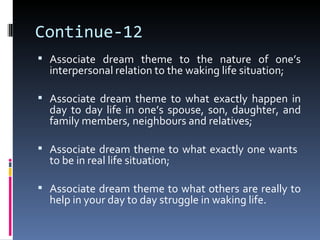
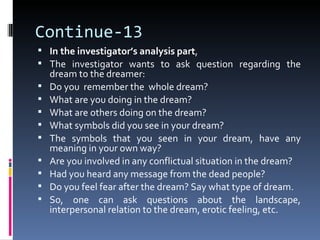
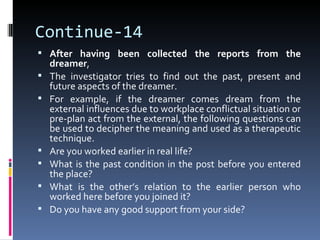
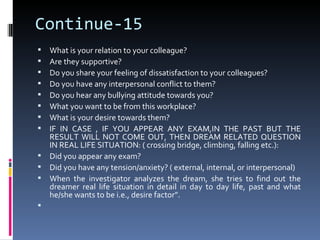
CHAPTER-III: METHODOLOGY :

 There are four sources of dream reports,
    namely,
   The sleep laboratory;
   The psychotherapy relationship;
   Personal dream journels; and
   Report written down on anonymous forms in
    group settings, of which the classroom is the
    most typical.
    In this present work, the investigators used
    dream journals as a narrative case study.
Continue-1
 Dream journals are a form of “personal document” long
  recognized in psychology as having the potential for providing
  insights into personality. They are “nonreactive” archival sources
  that have not been influenced by the purposes of the
  investigators who analyze them. dream journals have been
  extremely valuable in establishing the considerable consistency
  in what people dream about whatever the purposes of the journal
  writer.
 Dream journals are a third source of dream reports. The best
  known dream journals are those discussed by Jungian analysts,
  but journals kept for personal, artistic, or intellectual reasons
  have been studied with great profit as well.
 For all their potential usefulness, dream journals are not without
  their drawbacks. Even after showing initial willingness, some
  people may not want to provide dreams for scientific scrutiny.
  Journals may have gaps or omissions. The journal writer may not
  be willing to reply to inferences about his or her personal life
  based on a blind analysis of the journal’s contents. Dream
  journals therefore are best used selectively and into he context of
  other dream samples.
Continue-2
 Sample:
  Dream of the subject : A longitudinal case narrative
  (Neutral person assigned as case narrative person) are
  those who does not make any group system in either of the
  bi-cluster groups but he/she minutely observes the ongoing
  situation of the either of the working process of the bi-
  cluster groups and give intervention consciously or
  unconsciously on their ongoing process. These bi-cluster
  groups also observes in what way the neutral person can be
  used for their own opportunistic goal.

 Instruments:
  Deep observation
  Period of study: from 2004 to 2011 consists of two phases
 First phase of observation: 2004 to 2006
 Second phase of observation: End of 2006 to Dec.2011.
Continue-3
 Procedure:
  Bullying from bi-cluster groups ( from the investigator point of view)
  Bullying can be taken place in many forms. It is something unwanted
  things or words or statement delivered by group of person to another
  person/or a power person wants to suppress someone for in any
  reasons.
 How does bullying take place?
 Bullying can be taken place at workplace, administration, educational
  settings, corporate sector and so on.
 Here let’s discuss it in the academic Institution. In an academic
  institution, you can observe that many people having different
  educational background, having different teaching experiences, having
  different composition of age groups etc. are working together under
  one rules and regulations. It does not mean that dissimilarity does not
  happen but it happens. Another thing you can observe in such
  educational setting is, making groups i.e., ingroup and outgroup. Such
  groups may belong to different composition of ethnic groups, different
  composition of religious groups, different composition of age groups,
  sometimes they shared their values, sometimes they shared their
  subjects and so on.
Continue-4
 In each and every institution, there is a post of Head.
    Sometimes such head was supervised by groups or
    sometimes by each sections of the academic
    institution.
   In such institution, you can observe the role of
    collective responsibility and uniqueness in nature.
   So, if you look back how does bullying take place on
    such workplace or academic institution, you may
    come up similar point as I mentioned as follow:
   Unwanted candidate;
   Failed to the pre-planned act;
   Group influences;
   Trying to bring issue in larger context;
   Removing the unwanted candidate.
Continue-5
 Unwanted candidate:
  Here I (nbd) want to depict about a young person
  who never knew what is going to the workplace
  where she got selected. When she entered to the
  workplace, she might be happy because she got job
  but for the existing colleague, she became a part of
  an unwanted candidate. Because colleague wants
  another person but due to the intervention from the
  higher authority, she got selected over there. Now
  she never knew that she was the unwanted
  candidate. So she started doing her work as given by
  their senior colleague and senior colleague is
  observing minutely her due to her unwanted to the
  place. In such cases, bullying activities come from
  senior colleague, like she is not coming on time, she
  never teaches well etc..
Continue-6
   Failed to the pre-planned act:
    Using more and more bullying activities mean that it may involve that
    their pre-planned act is going to fail. Failed pre-planned act can involve
    many things like they could not able to remove the unwanted candidate,
    so, trying to remove such unwanted candidate, the following bullying
    activities may come up to the unwanted candidate:
   Students complain that they donot understand what the unwanted
    candidate is teaching ( based on language sound);
   She could not able to complete her syllabus on time;
   She does not have paper publication;
   She came late and gone early;
   She never submit the internal assessment in time;
   She never attend the departmental meeting;
   She does not know the time-table
   Informing information differently i.e. inside channel one n outside to the
    target candidate gives in different way;
   In one cultural n one ethnic groups use different activities using many
    types of malingering etc.
Continue-7
 Group Influences:
  Group influences are related to the second point. Those
  colleagues who could not succeed their plan, started
  spreading bullying activities to their own group circles
  regarding the unwanted candidate. So you can imagine
  what would happen to the unwanted candidate. Trying to
  keep her in a state of tension and confusion.

 Trying to bring issue in larger context:
  This fourth point is related to group influences. Here, the
  colleagues and group influences never take the opinion of
  the unwanted candidate. Together they try to suppress the
  unwanted candidate sothat they can remove her. So they
  try to bring it in an issue form. This issue is totally revolved
  around the unwanted candidate and the head of the
  institution never want any issue. So, the head also started
  listening to the senior colleague without investigating the
  matter carefully.
Continue-8
 Removing the unwanted candidate due to failure of their
  pre-planned act:
 Some senior colleague never stop doing another bullying
  activities; so they tried to overlap routines with the senior
  and unwanted candidate. But unwanted candidate have to
  follow whatever the other senior is saying.
 So, here, bullying nature is that unwanted candidate does
  not know the routine..sometimes fixing the classroom
  simultaneously like that…
 If you observe in bullying attitude, you will find that all the
  time senior colleague concerned to the unwanted
  candidate will do something and show it in another way. As
  you know that senior colleague have more friends circles
  and more interaction to the power people. And they know
  and use persuasive methods to bring the power people in
  their side.
Continue-9
 So, due to failure of their pre-plan act, they used
  multiple strategies how to remove the unwanted
  candidate. At last they ( ingroup and outgroup)
  come up in an stage…i.e..conditional way of
  planning.. under this conditional way of their
  plan, unwanted candidate comes up under the
  vulnerable condition, automatically have to go,
  otherwise, her future career may be lost. Under
  such conditional way of planning, involving all
  the power people, made termination letter for
  the unwanted candidate to achieve their goal
  and strategies.
Continue-10
   So, in short, the nature of bullying activities are as follows in academic
    institution to remove the unwanted candidate.
   She is not coming on time;
   She never finish the syllabus on time;
   She had gone back early;
   She could not give lecture well;
   Her language is difficult to understand…means tone are different;
   She never submit the internal assessment marks on time;
   She never respect to the seniors; not saying good morning coming
    towards them (seniors).
   She wrongly enter the class of seniors;
   She does not know where to take the class of the students;
   She never listen what the seniors are talking;
   Seniors make committee n juniors are not part of it and juniors have to
    take signature from each members of the committee before submitting
    the report to the office…while making such committee they give disturb
    to the unwanted candidate…but allow very easily for another junior…
    then they try to make some game behind such signature;
Continue-11
 Such bullying attitude are very frequently used by seniors
    to keep the unwanted person in tension, confusion and
    such things are spread to the whole institution and the
    members of the whole institution start watching to the
    unwanted person. One thing the investigator wants to
    mention is that such things is more prominent to the
    person
   Who have no support system from the institution as well as
    the outside the institution;
   Who lack interaction to the members of the whole
    institution;
   Who came from different ethnic groups;
   Who have been targeted in their pre-planned act;
   Besides this, the head of the institution is totally influenced
    by their pre-planned act that could not able to fight for the
    unwanted candidate.
Continue-12
 Bi-cluster groups different way of instrumental behaviour to the case
  narrative person as mentioned above but when such things are going on
  the case narrative person is totally unaware in the initial stage she
  remains tense and it makes dream to the case narrative person like
  warning dream to her but she neglected all the time.
 Here bi-cluster groups pre-plan work to remove the case narrative
  person or trying to keep in another place but both the situation case
  narrative was unaware in the initial stage but latter can able to associate
  with when she was out and she can recalling her dream at that period of
  time and associate to workplace conflictual situation.
 Here workplace conflictual situation means the two groups have their
  own goal but due to lack of space one group got the goal but another
  does not get the goal. But due the hailing of the another person (here
  case narrative person) another group does not get the goal. Then a
  tension or conflict situation arises on the basis of removing case
  narrative person or another group’s fulfil goal has to be targeted. While
  doing such things many things are visible. In such factors brought an
  interpersonal conflictual workplace situation.

CHAPTER—IV : RESULT
 Case profile:
 The subject who narrated her case was 31 year old at that time n
    working in one Institution. She observed systematically
    ( procedures using event sampling)whatever occurring in the
    Institution.
   CASE STUDY REPORT FROM THE SUBJECT:
   In reality situation, the subject joined as an adhoc-lecturer at one
    Institution on 8th January 2004. When she joined the post, she
    has no warning type of dream. The time when she joined the post
    lies the 3rd term.
   It is an experience of the subject which she encountered her first
    teaching experience at an academic institution designated as
    “Z.”
   she joined as a lecturer (adhoc-basis) at Z on 8th January 2004.
    She told that she is very lucky because her colleagues are very
    experienced and knowledgeable person. Besides this they are
    very much above her age. she felt that she shall learn many
    things from them and she learnt very fortunate things and
    unfortunate things from them.
Continue-1
 As she narrated to the investigator about the
  dream and spirit the investigator started
  enquiring about the situation at that time. The
  spirit she saw in her dream is very much of her
  relatives. She started seeing the spirit of three
  person; grandfather; brother and nephew. When
  I tried to associate her dream to the
  circumstances which she encountered in her real
  life is surprising. She never had such dream in her
  life. When I asked to share her feelings in real life
  she started to narrate the following
  circumstances
Continue-2
 “ the person narrated that she joined one academic institution on
   the 8th January 2004. She started dreaming about spirit from
   march 2004. In her dream she saw one day the spirit of brother
   and nephew. They told to the dreamer’s parents “ Just call back
   her, please do not join there.” Then suddenly she opened the
   eyes. After waking up if she saw such thing she called first to the
   home and narrated what the dream says in her dream and then
   taking bathe she prayed GOD. As usual she gone for her duty.
   Again twice a week such dream started coming up to the
   dreamer. One day also she saw the spirit of brother and nephew
   driving and the dreamer shouted if you drived that side we all die,
   the place is very slope. But in the dream the dreamer changed
   the direction not to fall to the slope. Then she opened the eyes.
   When she shared such things to the home and the parents
   especially mother suggested before taking meal keep away
   something separately to the outside for them. The dreamer is
   very religious. She used sing GAYATRI MANTRA and listen such
   devotional songs in the tape recorder.
Continue-3
 When the dreamer saw such thing, then something
  happened in her duty also. but when she analyze the
  situation she is under the mystery. How come such
  association happen in the dreamer side. One day also in her
  dream the spirit of brother and the spirit of nephew
  catching the dreamer’s hand not to go to that place. The
  dreamer said that she shall go that place and freed herself
  from the spirit. In reality also the colleagues of the dreamer
  wanted to remove her and she insisted that she has the
  qualification and she got the post again. Then the
  colleagues started using malpractice strategies to remove
  the dreamer. During this period the dreamer started
  listening the devotional songs too much so that she never
  see such dreams in her life. Sometimes the dreamer woke
  up along with Gayatri Mantra in her lips. Sometimes the
  situation in the reality is tense the she started seeing the
  grandfather also along with brother and nephew.
Continue-4
 Earlier such dreams gives her very much anxious
  feeling to her but latter when she saturated such
  feeling to the reality she realized that she had been
  advised by the spirit not to go that place because the
  dreamer is no more on that job. Before she got the
  termination letter she saw nightmares. The
  nightmares tried to kill the dreamer holding in the
  neck part. The dreamer in the dream fought to the
  nightmares and challenged herself how can you kill
  me. She tried to take out the hands of the
  nightmares from the neck and suddenly the dreamer
  chanted the Gaytri Mantra and as soon as the
  dreamer heard the chants the nightmares could hold
  the dreamer neck and gone from the dreamer’s life.
  Then the dreamer opened the eyes with surprise and
  fear. Sometimes she appreciated to the God for
  remembering the Gaytri Mantra.
Continue-5
 Another dream during this period is that the two
  senior colleagues, she saw in her dream. One is
  trying to catch her another is trying to send her very
  far. In reality it is during the time of interview.
 During this period many professors saw in her
  dream. Sometimes when she observes she wants
  to give her opinion regarding the dreams. Dreams
  says something for your present situation and this
  present situation gives you latter prediction for your
  future. Now she is working in some other place. She
  never seen such dream now a days. Here also
  situation is something similar just extended from the
  earlier one.
Continue-6
 Latter the investigator shall narrate such dreams.
 Interpretation associating to the earlier job:        If she
  understands earlier such meaning it would be better not to
  join the job. Instead if she does higher study it would be
  better for her as I assumed. Now it is o.k. but the place
  where she is working is only one culture. The place is a
  small town. Earlier is the metropolitan. Really surprising
  such dream. Whenever someone is planning something she
  used to see those plan in the dream. Is it a miracle?
 Sometimes the questions remains from the dream “ why
  the spirit said to the dreamer not to go there”?
 “why the brother said to the dreamer’s parents, Call back
  her from the place”?
 “Why the spirit laugh very mockery type to the dreamer?”
Continue-7
   Second longitudinal case narratives:
   From the end of 2006 to sept 2011,
   Second the case narrative person was appointed as a permanent . here the case
    narrative works along with one distinct cultural groups. In the second institution
    assigned as “M”, she worked as an external because she comes from another
    place. Her colleagues belong to one cultural groups. She works as a neutral
    viewpoint. As compared to the earlier institution (Z), M is also have some bi-
    cluster type but for common goal, they become one. One difference point
    between Z and M is that the latter is permanent point but the case narrative
    does not know what logic is going on from the Z’s side. Latter case narrative asks
    question like why they did appoint her in M but not Z. Latter it seems to her that
    there is some linkage but still not clear. Dream used to come here but not such
    warning dream but some colleagues figures come out. In the M Institution
    things are more observable how the bi-cluster are going on. One distinct cultural
    groups can suppress anyone if she could not interact to another group. When
    one group dominated, another group started reacting to the case narrative
    person n kept each and every situation in an opaque condition. With the help of
    observation, case narrative started approaching to another group, then started
    changing scenario. But when bi-cluster groups do such things if they do
    something wrong from their side, to cover up their failed plan, they took the
    name of case narrative person in front of the third person. But such tactics is still
    going on but now does not bring warning type dream. Those dreams the case
    narrative can control it to the workplace situation.
Continue-8
 The way of their bullying behaviour are more or less same.
  But under one same cultural groups, some more be added
  as the mentioned above at methodology part. In the
  second quite clear that such things will happen because
  colleagues may be influenced from either of the bi-cluster
  groups of the earlier one institution. In the second
  institution dreams come but not warning…sometimes saw
  the death brother n son (October 2011) but does not say
  anything but looking very angrily.
 Here framing the case narrative in a circle way. But it does
  not affect now because the case narrative person believes,
  it will d again and again such bullying nature.
 The investigator uses the free association n searching for
  repeated themes as an analysis for the content of the
  dream. The following the methods used for analyzing the
  dream content.
Continue-9
 METHODS FOE ANALYZING DREAM CONTENT:
 The four general methods for analyzing dream content include:
 Collecting free associations;
 Finding metaphoric meaning;
 Searching for repeated themes; and
 Quantitative analyses using either rating systems or nominal
  ( discrete) categories.
 The investigator’s picked up the thematic analysis. It is a third
  method of dream analysis, the thematic method, shades off from
  metaphoric analysis. It involves repeatedly reading through a
  dream series to see if one or more themes emerge. Sometimes
  the search is made easier by the presence of one or more
  “spotlight” dreams that seem to contain the theme or themes in
  an obvious fashion. Along with this thematic analysis the
  investigator picked up relevant case behind the dream. She did
  careful listening, observing the situation mentioned by the
  subjects. This dream analysis is the combined methods of free
  association and thematic analysis.
Continue-10
 Now the investigator analyzed the case study the following way:
 When the subject got the interview letter from the Z, she also got from
  another place. she just dropped the latter interview because at that time
  she stayed near to the Z. And she got the news that she was selected on
  adhoc-basis but in her mind she thinks that it must be permanent
  because she submitted on 2001 in S.C. category. she belonged to S.C.
  category. But she got the interview on 2004.
 she joined Z on 8th January 2004. she got her termination letter on 31st
  march 2006. During this period she learnt a lot and she learnt how to
  rectify the wrong things. Sometimes mistakes happened from every
  body but the pre-planned act she did not want if it disturbed the target
  person. Because such act goes beyond limit with the help of wrong
  strategies but the target person cannot do on that matter because those
  who involved in the pre-planned acts are very powerful person and they
  have a lot of known person in every direction. If the target person starts
  acting suddenly no truth scenario will come. The best way is to tolerate
  and observe and many rubbish things will come in your side.
 When she joined, she had no idea about the department, what is going
  on that department, why they kept her there? What is the reason behind
  that? Etc.
Continue-11
 When she analyzed her experience, she is really happy
  because she got her first teaching experience from them as
  well as she understands how to tolerate in the midst of
  politics.
 she just wants to share such feelings how she tolerates. To
  frame a person ( very young colleague) it is very easy for
  senior people if they have any pre-planned action. she
  never knows earlier such pre-planned will target her. Here
  dreams are associated with those beautiful plan and
  sometimes warning dreams come up that she is giving on
  the latter part.But latter their target is to her and latter in
  the midst of politics she got her termination letter.
  Sometimes I asked myself why they use junior lecturer
  ( adhoc) as an object. Why did they think about framing to
  the younger person? She/he is also someone who wanted
  to enhance his/her career in his/her life.
Continue-11
 The way they try to frame her is very surprising to her. The
  post which she joined in S.C. post is occupied by one female
  as she got the news from the place and designated as N.
  When she joined she did not understand anything about
  the department.
 Some of the colleagues want to bring back N in her post.
  Such things she can observe on 16th july 2004 meeting.
  Their common goal was to remove her after the third term.
  But they cannot do to her. She mentioned that if they want
  to remove her, they have to put s.c. category itself. You
  know, if you observe in any department , you shall find that
  it is very easy to provoke things about the younger
  colleague who did not part of their group. Another thing is
  that they had 20-30 years of teaching experiences. It means
  that other members of the department also have trust
  when they provoke any things about the younger one.
Continue-12
 Their plan no.

 to remove her after the 3rd term. Giving reasons like not
  coming in time, not teaching well, not submitting the
  internal assessment, etc. to remove someone is very
  difficult once it is appointed. So first try to bring in any type
  of issues such issues will come to the staff room ; such
  issues are based on the provoking about the junior
  colleague; whatever they said has been assumed by other
  colleagues of the staff members are true. As she mentioned
  they are 20-30 years of teaching experience. They used
  their Doctorate pulling their own members in the
  department without thinking the career of another
  colleague. Such things are exactly happened to her. In her
  case they want to remove her sothat they can bring back N.
  They cannot do.
Continue-13
 why they want to remove her is that in 2005 one
  general category is going to be vacant. Keeping N on
  the s.c. post till the general category is empty, is
  their second plan. If you observe one person can
  become permanent if members of the colleagues
  supported her . Exactly it happens to some other
  candidate.
 Latter they did deep plan. They think to remove
  totally to remove her from the post. Because they
  think N in the permanent post (2005 vacant post),
  thinking another adhoc named G for the post of K.
  when the vacant comes up, her s.c. post is for
  another s.c. designated S. if they want they can fix
  her in another institution, then their plan are quite
  successful.
Continue-14
 Now the s.c. post is enjoyed by the s.t. person as
  she got the news and she enquired about it and it
  is true also. Do not you feel shame? Taking out
  the s.c. person from the post and keeping s.t. is
  very disgusting. Here also she thinks some logic
  is there. Whenever she entered the college,
  issues started coming up because they did not
  want, they want S (s.c.).if they want s, why did
  not they keep earlier in the post where she
  occupied? What is the reason behind that?
  Whenever she observes any institution she can
  observe bi-polar politics. she never knew earlier
  but latter she can observe.
Continue-15
 In her understanding level this bi-polar politics have
  some agreements of keeping their own people. One
  side want S in her (subject’s) post. Now general
  category is empty; earlier they select G instead of N
  for the general adhoc basis. Another part wanted for
  N but they cannot succeed. That is why in the 27th
  March Interview 2006 N came for the post under full
  plan to remove the subject,, here their plan is that N
  becomes       permanent       on      the      general
  category(vacancy since 2005), S on the S.C. post and
  G on the temporary post ( advertise before one
  month before interview). Then they never think for
  the subject who worked since 2004. she had been
  teaching since 8th January 2004 to march 27th 2006 in
  Zakir Husain College. If they want to remove her,
  they must restore her earlier in any institution. Very
  beautiful experience whatever they did.
Continue-16
 As the subject narrated, she met HOD, designated as A in
  the 1st week of January 2006 and narrated about the reality
  of the Z but she is also under the politics. Any HOD have to
  listen story from the Junior colleague also. because in the
  midst of politics anything can happen. Those who are
  playing politics also think that if they play politics no one
  can harm us because each one think that they did not want
  to bring their department on the public.
 one day the subject calls up to HOD’s office ( earlier HOD
  designated as D) to talk to the previous HOD but she was
  absent. she talked to another colleague named CH and
  narrated him whatever going there and she told the post
  belonged to s.c. and instead of helping he put his research
  scholar designated as W in s.c. post ( he belong to s.t. post).
  Very funny, mockery of the educational institutions, Z.
Continue-17
 Before interview she met deputy registrar, designated as
  B, dealing with such Z institutions on the place, twice and
  narrated about the reality of the Z. No feedback.
  Interesting.
 Lastly she had gone to meet the highest body of such
  institution of the nation, but the full power person is out of
  station and the P.A. informed her to meet another sir,who
  is dealing with the college level. she met him and told him
  to cancel the interview on 28th March 2006. but he informed
  her that “ you shall become permanent for the S.C. post.”

 Now she understands that if you did not anyone your
  feedback it is very difficult to become permanent. Another
  thing those who involved such pre-planned action think
  that they will succeed whatever they did. But in front of her
  such things are not happened. That is why they try to see
  her negative points so that they can substantiate her.
Continue-18
 When she observes such situation she thinks that instead of
  doing research she wants to present scenario and want to
  rectify those wrong things on that part.
 Now along with such scenario she was associated the
  following dreams also.
 It is about the dream of a person who usually saw the spirit
  in her life during Jan 2004 to March 31st 2006. As she
  narrated to me about the dream and spirit I started
  enquiring about the situation at that time. The spirit she
  saw in her dream is very much of her relatives.
 She started seeing the spirit of three person;
  grandfather; brother and nephew. When she tried to
  associate her dream to the circumstances which she
  encountered in her real life is surprising.
Continue-19
   Now a days groupism in the higher levels also visible. You know if anyone
    commits the crime from their group members they try to save him/her. Here her
    suggestion is that now the time has come to reevaluate and keep him/her isolate
    from the groupism. If we do such thing we can rectify wrong doings and systems
    also can able to maintain.
   Whenever she observe any educational institutions there exists bi-polar type of
    politics. Such politics mainly used for their power gain as well so that it is easy for
    their career advancement. But she did not want to involve on such bi-polar
    politics. She wanst to give those who are sincerely working.
       In the appointment of lectureship or any type of appointment backup is now
    the most essential qualification besides their qualification. If you have backup
    from the powerful person you are not be one of the targeted person or framed
    person. Such things she can observe in during her teaching experiences.
   She thinks now a days one sided information is very harmful to the younger
    person because she/he is not given the chance to speak up.
   Another thing people do not want to bring the ugly face of the institutions. That
    is why the institutions members want to save the guilty person on this grounds.
    Here my suggested is that there is no need of worry. Instead it is good for the
    institution to rectify the wrong doers. I feel so. If such rules are kept inside the
    institutions it will improve a lot and politics is also reduced.
Continue-20
 Another observation is that please give the rules and
  regulations of the HOD of any department and please give
  one copy to the faculty members.
 As she observes sometimes the news of any department
  gave after the expiry and keep the expiry one in the notice
  board to focus that it is already in the notice board.
 When in any department giving notice to the faculty
  members the office people have to take the signature along
  with date for the record whether the notice is getting
  timely or not.
 In the second case longitudinal profile, the investigator
  reported that due to earlier exposure of such bullying
  attitude, the case narrative can able to control n she was
  caught less warning dream. In the second case profile, one
  different is visible i.e., nature of the job, is permanent.
  Earlier, nature of the job is not permanent.
Continue-21
 So insecurity may be high while bullying attitude was
    happened and such bullying is spreading to the broader
    context sothat a negative image can be formed for the case
    narrative person. When many senior people started
    focusing negative image of the someone’s career, it is
    difficult to enter in new setting because such previous work
    is highly emphasized. People never looked back the
    circumstances for becoming someone’s negative image in
    front of the others because person who ever using such
    bullying attitude also belong to the power people. And
    power people never want to lose prestige they got for a
    long period of time. That is why they started using their
    group factors, ethnic factors, religion factors n easily such
    groups can be easily influenced by the power people.

CHAPTER—V : DISCUSSION

 As she narrated to the investigator about the
  dream and spirit the investigator started
  enquiring about the situation at that time. The
  spirit she saw in her dream is very much of her
  relatives. She started seeing the spirit of three
  person; grandfather; brother and nephew. When
  the investigator tried to associate her dream to
  the circumstances which she encountered in her
  real life is surprising. She never had such dream
  in her life.
Continue-1
   Dreams says something for your present situation and this present
    situation gives you latter prediction for your future. Now she is working
    in some other place. She never seen such dream now a days. Here also
    situation is something similar just extended from the earlier one.

 Interpretation associating to the earlier job: If she understands earlier
  such meaning it would be better not to join the job. Instead if she does
  higher study it would be better for her as I assumed. Now it is o.k. but
  the place where she is working is only one culture. The place is a small
  town. Earlier is the metropolitan. Really surprising such dream.
  Whenever someone is planning something she used to see those plan in
  the dream. Is it a miracle?
 Sometimes the questions remains from the dream “ why the spirit
  said to the dreamer not to go there”?
 “why the brother said to the dreamer’s parents, Call back her from
  the place”?
 “Why the spirit laugh very mockery type to the dreamer?”
Continue-2
 Dreams are unique. No other individual can have your
  background, your emotions, or your experiences. Every dream is
  connected with your own “reality”. Thus, in interpreting
  someone’s dream, it is important to draw from your personal life
  and experiences. A dream unifies the body, mind, and spirit. It
  provides you with insight ourselves and a means for self-
  exploration. In understanding your dreams, you will have a better
  understanding and discovery of your true self.
 In the Greek and Roman eras, dreams were seen in a religious
  context and were really direct messages from the Gods or from
  the dead. The people of that time look to their dreams for
  solutions, on what to do or what course of action to take. They
  believed dreams forewarned and predicted the future. Special
  shrines were even built where people can go there to sleep and
  hope that a message could be passed to them through their
  dreams. Their belief in dreams was so strong that it even dictated
  the actions of political and military leaders. In fact, dream
  interpreters even accompanied military leaders into battle to
  help with war strategy.
Continue-3
 During the Hellenistic period, the main focus of
  dreams was centered around its ability to heal.
  Temples, called Asclepieions, were built around the
  healing power of dreams. It was believed that sick
  people who slept in these temples would be sent
  cures through their dreams. It was believed that
  dreams offered a vital clue for healers to finding
  what was wrong with the dreamer.
 In Egypt, priests also acted as dream interpreters.
  The Egyptians recorded their dreams in
  Hieroglyphics. People with particular vivid and
  significant dreams were believed to be blessed and
  were considered special. People who had the power
  to interpret dreams were looked up to and seen as
  divinely gifted.
Continue-4
 In the early 19th century, dreams were dismissed as stemming
  from anxiety, a household noise or even indigestion. Hence there
  was really no meaning to it. Later on in the 19th century, Sigmund
  Freud revived the importance of dreams and its significance and
  need for interpretation. He revolutionized the study of dreams.
 Freud’s theory was that although dreams may be prompted by
  external stimuli, wish-fulfillment was the root behind most of our
  dreams.
 According to Freud, dreams always have a manifest and Latent
  content. The manifest content is what the dreams seems to be
  saying. It is often bizarre and nonsensical.
 The latent content is what the dream is really trying to say.
  Dreams gives us a look into our unconscious. Utilizing the
  technique of “free Association”, Freud believed that we can chip
  through the dream’s manifest content to reveal the underlying
  significance of our dreams and its latent content. In this
  technique, you start with one dream symbol and then follow
  what comes to your mind next and see where it leads.
Continue-5
 The investigator never accept sex was the root cause of what was
  happening in your dreams. According to the investigator, the root cause
  of the dream may be different depending upon the circumstances. But
  the investigator believes the existence of unconscious.
 Alfred Adler (1870-1937) believed that dreams were an important vehicle
  to mastering control over our waking lives. They were problem solving
  devices. Dreams need to be brought to conscious light and interpreted
  so that we can better understand and solve our problems. It is important
  to learn from our dreams and incorporate them into our waking life.
  Because of Adler’s belief that dreams were correlated with the problems
  in our daily life, he further went on to say that the more dreams we
  have, then the more problems we are likely to have. And thus the less
  dreams we have, then the less problems we have and more
  psychologically healthy we are.
 Unlike, Freud, Adler believed that control, power, and motivation were
  the driving force behind behaviour, not sexual impulses. Furthermore,
  he didnot think that our actions and behaviour or rules by our
  unconscious, but rather the strive for perfection and need for control is
  what cause us to do the things we do. In fact, Adler did not believe that
  the conscious and unconscious functioned against each other. We acted
  the same way whether we are awake or sleeping.
Continue-6
   Adler saw dreams as a way of overcompensating for the shortcomings in our
    waking life. For example, if a person is unable to stand up to their boss, then he
    or she may feel more comfortable ( and safely) to lash out their anger at the boss
    in a dream. Dreams offer some sort of satisfaction that may be more socially
    acceptable.
   Like Freud, Carl Gustav Jung (1875-1960) believed in the existence of the
    unconscious. However, he didn’t see the unconscious as animalistic, instinctual,
    or sexual; he saw it as more spiritual. Dreams were a way of communicating and
    acquainting ourselves with the unconscious. Dreams were not attempts to
    conceal out true feelings from the waking mind, but rather they were a window
    to our unconscious. They served to guide the waking self to achieve wholeness.
    Dreams offered a solution to a problem we are facing in our waking life.
   Jung believed that archetypes such as the animus, the anima, the shadow, and
    others manifested themselves in dreams, as dream symbols or figures. Such
    figures could take the form of an old man, a young maiden or a giant spider as
    the case may be. Each represents an unconscious attitude that is largely hidden
    to the conscious mind. Although an integral part of the dreamers psyche, these
    manifestations were largely autonomous and were perceived by the dreamer to
    be external personages. Acquaintance with the archetypes as manifested by
    these symbols serve to increase one’s awareness of unconscious attitudes,
    integrating seemingly disparate parts of the psyche and contributing to the
    process of holistic self understanding he considered paramount.
Continue-7
 Since dreams were a way of communicating with the
  unconscious, Jung felt that the imageries in dreams
  were a way of revealing something about ourselves,
  our relationships with others, and situations in our
  waking life. Dreams guided our personal growth and
  helped to self achieve our potential. He also believed
  that the dream’s manifest content is just as
  significant and revealing as the latent content. Often
  discussing what is currently going on in your life,
  helps to interpret and unlock the cryptic and bizarre
  images of your dreams. The meaning of your dreams
  is a personal judgement and is up to you on how to
  interpret them. whatever interpretation felt right to
  you is most significant and more important than
  what someone else thinks or believes.
Continue-8
 Perls believed that it is important to retell your dream in
  the present tense and act it out. It is important to verbalize
  how each and every component in your dream feels, even
  inanimate objects. Re-enact the dream and take on the role
  of the different characters and objects. Start a dialogue
  with the dream object and express how you feel toward
  each other. By taking on a different role within your dream
  and re-enact it, you may then be able to acknowledge and
  realize feelings that you may have overlooked or buried.
 In 1954, Calvin S. Hall developed a theory of dreams in
  which dreaming is considered to be a cognitive process.
  Hall argued that a dream was simply a thought or sequence
  of thoughts that occurred during sleep, and that dream
  images are visual representations of personal conceptions.
  For example, if one dreams of being attacked by friends,
  this may be a manifestation of fear of friendship.
Continue-9
 Faraday, et al. (1970) focused on the application of dreams to
  situations occurring in one’s life.
 Edgar Cayce claimed that through dreaming, people are given
  access to their spirit, and further, that all possible questions could
  be answered from the inner consciousness given the proper
  awareness.
 A shamanistic model of dream work gained some popularity in
  the consciousness movement through the work of two dream
  researchers and authors, Ariadne Green and Stanley Krippner.
 In Ariadne Green’s model, dreama are viewed as coming from
  three interior worlds, the upper world, lower world and the
  middle world, honouring the indigenous shaman’s perspective on
  the terrain of the soul. Some dream characters are viewed as
  messengers who bring insights and gifts of wisdom from the
  divine realms while others enter the stage to bring new insights
  into the dreamer’s personality. Animals in dreams are viewed as
  powerful archetypes from the lower world that initiate the
  dreamer and lend spiritual power and healing potentials.
Continue-10
 In Indian psychology, dreams are considered to be presentative
  cognition during sleep, though they have no objective
  counterpart in reality. Some of them are peripherally excited and
  others are centrally excited. The peripherally excited may be
  called the dream-illusion and the centrally excited as dream-
  hallucination, after James Sully.
 According to Nagasena, Dreams is a kind of suggestion coming
  across the path of the mind.
 Barbara Vann and Neil Alperstein(Jan.,2000) exploratory study
  suggests that dream sharing is a part of everyday social
  interaction, with the primary purpose of entertainment. There
  are gender differences with regard to dream sharing, and this
  sharing involves the utilization of social practices whereby
  individuals may protect themselves and others through deciding
  whether or not to share a dream. The study describes dream
  sharing as a social act that is negotiated based on the social rules
  regarding what topics friends and other intimates share in public
  or private.
Continue-11
 Barris, Jeremy (Mar 2010) has analyzed that the contradictions
    and non sequiturs often found in dreams (or, equivalently,
    dream-narratives) are not in fact logical errors, but express and
    work with a type of logic that characterizes the deepest
    dimensions of our waking reality. These are the dimensions in
    which we deal with ourselves as a whole, our lives as a whole, or
    with the sense of reality as a whole. We do so, for example, in
    situations of deep personal transformation, or of recognition of
    deep difference of outlook. The paper argues that the logic of
    these situations is validly one of contradiction and non sequitur,
    that dreams sometimes express and work with these kinds of
    situations, and that these kinds of dreams therefore validly
    involve the same kind of logic. These kinds of dreams
    consequently also express insight into the sense that our lives or
    existence as a whole has for us. In achieving that insight, they
    actively orient, situate, or resituate us in our relation to our lives
    or existence as a whole. In this respect they are in themselves a
    practice of philosophy.

Continue-12
   DeCicco, Teresa L. (Dec 2007) research tested the storytelling method
    of dream interpretation (TSM), which expands on previously established
    methods of interpretation by adding an additional step that involves
    creating a story after word association is completed. Two studies tested
    the method, the efficacy of the method, and assessed dreamer
    discovery. Study 1 revealed a significant relationship between word
    association and discovery and between the story that was created and
    discovery. Furthermore, word association significantly predicted
    discovery in Block 1, but the story added to the prediction of discovery,
    above word association alone, in Block 2. When testing with a control
    group, there was a significant difference between the group who
    interpreted a dream with TSM and those who used the method with
    association alone. Results reveal a significant difference between the
    groups, indicating that discovery, insight, and bridging to waking-day
    circumstances was more likely with TSM when participants used their
    own dream rather than a dream that was not their own. These findings
    extend previous research and show that TSM is a brief, effective dream
    technique that shows therapeutic promise. Limitations and future
    research are discussed.

Continue-13
 Gauchat, Aline et al.(Jun 2009) show that Research
  indicates that recurrent dreams in adults are
  associated with impoverished psychological well-
  being.
 Najam, Najma et al. (Dec 2006)’s study investigated
  dream narratives as reflections of the emotional and
  psychological states of earthquake survivors.
  Findings revealed that the survivor group had more
  vivid, unpleasant, horrifying, and hostile dreams
  compared with the control group. However, there
  were no significant gender differences. The data
  suggest that a closer study of dreams can be used to
  understand the underlying trauma for effective
  interventions.
Continue-14
 Pagel et al. (Mar.,1995) had studied a questionnaire
  on dreaming was distributed to a heterogenous
  population of a Family Practice Clinic (N = 265).
  Respondents were asked how frequently they
  remembered their dreams, and described them to
  others, as well as a series of questions assessing the
  extent to which stress was associated with
  dreaming. Respondents in this sample reported
  dreams to be associated with stress, and dreams
  related to stressful experience, to a significantly
  greater extent than the original sample. These
  results indicate that stressful life events may affect
  dreaming, especially among younger individuals and
  women, and indicate that survey methods can be
  useful in studying the association of stress and
  dreaming.
Continue-15
 The      investigator after collecting all those
    information in the circumstances along with dreams
    at that period of time, yes dream predicts future.
    And one has to analyze his/her dream in their
    present, past and that can predict your future life.
    The investigator gave how does dream from, its
    function, how to interpret etc in the summary
    section. Such subjects dream reflect how the person
    died and in what condition. It reflects some pre-plan
    act to defame one’s career. May be the investigator
    finding lack something but she suggested to keep
    your eyes on your own dreams.

SUMMARY
 After analyzing the above points keeping in my mind, the investigator
  summarized how does dreams are formed? What is it’s function in real
  life setting? How does one interpret dream in workplace setting? Now
  the investigator developed the following concepts in her own.
 “Dream has a meaning. If you minutely remember your dreams to your
  waking life, you may come up one point that yes it says something.
  Dream relates to past events (based on academic institution) that leads
  to present story and again it predicts one’s future life.
 Dream is some sort of activities which can be shown to the dreamer
  with some form of symbols that are difficult to decipher but it can give
  meaningful interpersonal conflictual situation or one’s form of tension
  situation if one gets the meaning of the symbol. It gives recall
  experiences when one awakes from the sleep. Sometimes you find very
  strange situation after having been recall your dream state. You may
  forget your dream also. As i think it is one reason people neglect to
  study the dream. Researchers found that dreams which we could not
  remember belong to deep sleep. Those who can easily remember dream
  occur in REM sleep.
Continue-1
 Dream is a journey like an explorer tries to find out new things in
    unknown place. In doing so, hard work, determination, patience,
    individual’s ideas, coordination etc are needed. If you observe
    and think one moment, an explorer who wants to explore
    unknown jungle or mission to unknown place, what they do?
    Many strategies may come up to find their goal.
   They try to collect many ideas and strategies from different
    expert people or those who are very idealistic in such area.
   If you go to the jungle, on the way, you may stuck by many
    thorns but you do not allow to enter the thorn inside your body,
    why? You know the answer; give yourself.
   Likewise, if you dreamt of bad dreams,i.e.,nightmare, instead of
    remaining on bad mood, try to find out what is going on around
    your waking life situation. Please do not shallow such fear of
    nightmare you had seen last night, otherwise what happen?
   Thorn which you did not allow to stuck in your body to enable
    you work again in the jungle give a meaningful life to the person.
Continue-2
 In the same way, nightmare that you seen in last night will not
  allow to change in your mood in waking life. Instead, search it out
  what is going on around so that it gives you an interesting
  exploration in your dream.
 What the investigator wants to mean is : explore, discover, solve
  the situation, enjoy, share to other and encourage about dreams
  how to interpret it.
 The investigator accepts that dreams are unconscious state as
  given by Sigmund Freud. When you see any dream themes like
  falling down from hill, climbing, broken teeth, throwing stone to
  you, attacking you with knife or gun, chasing you, catching fish,
  seeing God, seeing death people and saying something to you,
  etc. Such themes give you a different mood when you wake up in
  the early morning. When you dreamt of very bad dream like your
  mother or father died, or you involved a major incident, what do
  you do when you open your eyes? Might be you remember you
  own God and you feel anxiety whenever you go out from the
  home.
Continue-3
 TYPES OF DREAM ACCORDING TO THE INVESTIGATOR:
 SIMPLE DREAM : sometimes dream come without any warning,
  simply seeing your friend after a long time like that.
 NAHEBA DREAM ( DREAM BEFORE DEATH) : In Meitei
  community, we used word “NAHEBA” meaning dream before
  death. Here terrible dream is associated to the dreamer. It hardly
  take place. In such dream a very different sound is associated
  from the dreamer. If she/he can remember the God’s name,
  he/she can overcome the dream. But in such dream period,
  external people knew that the dreamer is under the period of
  “NAHEBA.” The person who heard such sound, he/she has to
  wake up the dreamer by touching the dreamer’s body. If you
  observe, the moment you touch the body and bring the dreamer
  in the waking sate, he/ she used the word of God. ( hey Ishwar). I
  encountered such dream in my mother. i wake up her from such
  dream period by touching the body.
Continue-4
   MANGLONTABA DREAM ( DREAM WITHIN THE DREAM):
    Manglontaba dream is also associated in the Meitei community dream.
    Here sometimes we ourselves narrate our own dream to ourselves while
    sleeping. It is considered a bad thing in our community.
   LAUGHING DREAM : Laughing dream is related to the someone tries to
    laugh you when you are facing a problematic situation in real life and it
    also shows that there is another way which the dreamer want to go in
    another path if the problematic situation is very tense.
   EROTIC DREAM : It is related to someone’s fantasy towards their love
    one in real life situation but express such desires in one’s dream for wish
    fulfilment.
   WARNING DREAM : It relates to dreamer’s real life is entering in wrong
    way which can lead him/her in a vulnerable position but the dreamer
    does not know what is going on in their real life. In such case, the
    dreamer dreamt of “do not go that place.””or call him/her back from
    that place.” Etc.
   INTERPERSONAL DREAM : Interpersonal dream is related to the one’s
    working with others in real life situation. Here the dreamer dreamt of
    their relation in bad or good ways.
Continue-5
 FORMATION OF THE DREAM ACCORDING TO
  INVESTIGATOR:
 Where do our dream come from?
 Anxiety, tension, and stressful situation in one’s
  life :

 According to the investigator, anxiety, tension and
  stressful situation is a source of dream. Under such
  situation, a dreamer dreamt of attacking you,
  throwing stone to you, unable to climb up, seeing
  nightmare etc. When you are such situation, you
  have a sense of insecurity in your relation, worry
  with someone etc.
Continue-6
 Pre-plan activities imposed by the external to the target
  person unconsciously :

  Pre-plan activities is associated in the workplace
  relationship. When a new employee enters to the
  workplace but other already worked their never want
  him/her. In such situation they plan some act to remove the
  young employee. In doing such activities they kept young
  employee as a target person for their goal. But the target
  person remains all the time in tension situation. He/she
  unconsciously react toward them. then, they started doing
  bullying attitude toward him/her. Whenever such act done
  by them it happen in front of others. So the target
  understand that he/she is wrong but she/he could do
  anything. Such condition gave him/her an anxiety arousing
  situation that leads to dream. It is partly associated with
  the first one but different intensity.
Continue-7
 Cluster effects to the target person :
   It is same as above. Here forming two groups but it is unknown to
   the target person; here sometimes giving moral support and at
   the last moment the two groups become one to gain their own
   separate goal; in such withdrawing and attaching nature gives
   the target a tense situation and it leads to dream.

 Realising one’s problem in real life situation and ready to give
   guidance to him/her:
   When someone face the real life situation that brought a wide
   known regarding the problem, people started talking in the real
   life situation to solve the problem. Because the problem is
   associated to someone. Sometimes you see different figure in
   your dream it means that the problem what the person is facing
   is understood by the other people. That is why such things are
   also a source of dream; because they want to help you.
Continue-8
 Interpersonal conflictual situation focused to the
  dreamer :
  Interpersonal problem is a problem in day to day life at the
  workplace at the form of politics. When your are under the
  politics, you are just like a football. People tries to use you
  to gain their opportunity. If you do not speak out also, it
  shows that you are speaking. Such politics brought you a
  headache and sometimes you aggressively react to them.
  such confusion, headache,chaose, belief system etc.
  brought you a source of dream.

 Desire to wish fulfilment:
  sometimes the source of the dream relate to wish
  fulfilment. You want something in real life but you did not
  get it ; it shows in your dream.
Continue-9
 FUNCTION:
 THEORY    OF        DREAM      ACCORDING        TO     THE
  INVESTIGATOR:
 INTERPERSONAL PRE-PLAN THEORY TO THE TARGET
  PERSON:
 At the workplace, people possessing different educational
  background, different age-group, different status, different
  cultural aspects etc, working together under one rule and
  regulation. In such working atmosphere, minor sector of
  the workplace kept themselves their policies and strategies
  under common understanding to bring welfare of the
  workplace. Their common understanding was kept
  objectively by other minor sector of the workplace and if in
  case found, they together try to bring in true way.
Continue-10
 While doing such process, many conflictual situation was
  involved i.e., not wanting to bring true way, wanting to bring
  their own opinion on the way that leads to crisis situation to the
  another one. If in case, now, imagine, true way came and kept
  someone at the workplace disregarding their opinion. But those
  opinion was neglected, then they together tried to make shaping
  the someone on true way. In trying to shape, they may form
  cluster group and such cluster group keep someone in
  anxiety/tension situation. If someone is under tension/anxiety
  situation then dreams of fear factor was associated to the
  someone ( here as a target by the neglected people). So,
  according to me, the dream is shaped by the external pre-plan
  act by the bi-cluster groups to the target person; here the pre-
  plan act involve to remove the target person but the target never
  knew their plan; he/she unconsciously react toward the pre-plan
  act people. On the other hand, pre-plan act people kept him/her
  in an anxiety/tension situation through the help of bullying
  attitude.
Continue-11
 INTERPRETATION:
 RELATING DREAM TO WAKINING LIFE ACCORDING TO THE
  INVESTIGATOR:
 Associate dream to the earlier existing situation at the workplace or
  other in one’s life;

   Associate dream to the present existing situation that is related to the
    past situation at the workplace or other in one’s life;

   Associate dream message or dream content to the future in one’s life at
    the workplace or other;

   Associate dream theme to the nature of struggle in one’s waking life;

   Associate dream symbol to the past deed or work you put but fruit shall
    come later in one’s waking life;
Continue-12
 Associate dream theme to the nature of one’s
  interpersonal relation to the waking life situation;

 Associate dream theme to what exactly happen in
  day to day life in one’s spouse, son, daughter, and
  family members, neighbours and relatives;

 Associate dream theme to what exactly one wants
  to be in real life situation;

 Associate dream theme to what others are really to
  help in your day to day struggle in waking life.
Continue-13
 In the investigator’s analysis part,
 The investigator wants to ask question regarding the
    dream to the dreamer:
   Do you remember the whole dream?
   What are you doing in the dream?
   What are others doing on the dream?
   What symbols did you see in your dream?
   The symbols that you seen in your dream, have any
    meaning in your own way?
   Are you involved in any conflictual situation in the dream?
   Had you heard any message from the dead people?
   Do you feel fear after the dream? Say what type of dream.
   So, one can ask questions about the landscape,
    interpersonal relation to the dream, erotic feeling, etc.
Continue-14
 After having been collected the reports from the
    dreamer,
   The investigator tries to find out the past, present and
    future aspects of the dreamer.
   For example, if the dreamer comes dream from the
    external influences due to workplace conflictual situation or
    pre-plan act from the external, the following questions can
    be used to decipher the meaning and used as a therapeutic
    technique.
   Are you worked earlier in real life?
   What is the past condition in the post before you entered
    the place?
   What is the other’s relation to the earlier person who
    worked here before you joined it?
   Do you have any good support from your side?
Continue-15
 What is your relation to your colleague?
 Are they supportive?
 Do you share your feeling of dissatisfaction to your colleagues?
 Do you have any interpersonal conflict to them?
 Do you hear any bullying attitude towards you?
 What you want to be from this workplace?
 What is your desire towards them?
 IF IN CASE , IF YOU APPEAR ANY EXAM,IN THE PAST BUT THE
  RESULT WILL NOT COME OUT, THEN DREAM RELATED QUESTION
  IN REAL LIFE SITUATION: ( crossing bridge, climbing, falling etc.):
 Did you appear any exam?
 Did you have any tension/anxiety? ( external, internal, or interpersonal)
 When the investigator analyzes the dream, she tries to find out the
  dreamer real life situation in detail in day to day life, past and what
  he/she wants to be i.e., desire factor”.

CONCLUSION
 In conclusion part.,In my (NBD)viewpoint dreams come from
  the following point
 Anxiety, tension, and stressful situation in one’s life,Pre-plan
  activities imposed by the external to the target person
  unconsciously ,Cluster effects to the target person,Realising
  one’s problem in real life situation and ready to give guidance
  to him/her,Interpersonal conflictual situation focused to the
  dreamer,Desire to wish fulfilment.
  When dreams come with regards to such point, one can predict
  about their real life circumstances by associating his/her dreams
  to the current circumstances,past and future using the following
  points.

 Associate dream to the earlier existing situation at the workplace
   or other in one’s life;
Continue-1
 Associate dream to the present existing situation that is
  related to the past situation at the workplace or other in
  one’s life;

 Associate dream message or dream content to the future in
  one’s life at the workplace or other;

 Associate dream theme to the nature of struggle in one’s
  waking life;

 Associate dream symbol to the past deed or work you put
  but fruit shall come later in one’s waking life;
Continue-2
 Associate dream theme to the nature of one’s
  interpersonal relation to the waking life situation;

 Associate dream theme to what exactly happen in
  day to day life in one’s spouse, son, daughter, and
  family members, neighbours and relatives;

 Associate dream theme to what exactly one wants
  to be in real life situation;

 Associate dream theme to what others are really to
  help in your day to day struggle in waking life.
Continue-3
 In the investigator’s analysis part,
 The investigator wants to ask question regarding the dream to
    the dreamer:
   Do you remember the whole dream?
   What are you doing in the dream?
   What are others doing on the dream?
   What symbols did you see in your dream?
   The symbols that you seen in your dream, have any meaning in
    your own way?
   Are you involved in any conflictual situation in the dream?
   Had you heard any message from the dead people?
   Do you feel fear after the dream? Say what type of dream.
   So, one can ask questions about the landscape, interpersonal
    relation to the dream, erotic feeling, etc.
Continue-4

 After having been collected the reports from the dreamer,
 The investigator tries to find out the past, present and future
    aspects of the dreamer.
   For example, if the dreamer comes dream from the external
    influences due to workplace conflictual situation or pre-plan act
    from the external, the following questions can be used to
    decipher the meaning and used as a therapeutic technique.
   Are you worked earlier in real life?
   What is the past condition in the post before you entered the
    place?
   What is the other’s relation to the earlier person who worked
    here before you joined it?
   Do you have any good support from your side?
   What is your relation to your colleague?
Continue-5
 Are they supportive?
 Do you share your feeling of dissatisfaction to your colleagues?
 Do you have any interpersonal conflict to them?
 Do you hear any bullying attitude towards you?
 What you want to be from this workplace?
 What is your desire towards them?
 IF IN CASE , IF YOU APPEAR ANY EXAM,IN THE PAST BUT THE
  RESULT WILL NOT COME OUT, THEN DREAM RELATED QUESTION
  IN REAL LIFE SITUATION: ( crossing bridge, climbing, falling etc.):
 Did you appear any exam?
 Did you have any tension/anxiety? ( external, internal, or interpersonal)
 When the investigator analyzes the dream, she tries to find out the
  dreamer real life situation in detail in day to day life, past and what
  he/she wants to be i.e., desire factor.

References
   Adams,Kate (2005,sept), Voices in my Dream: children’s Interpretation of Auditory Message in Divine dreams.
    Dreaming, vol 15 (3),195-204.
   Adams, Kate; Hyde, Brendan(Mar 2008). Children's grief dreams and the theory of spiritual intelligence. Dreaming,
    Vol 18(1),58-67.


   Abramovitch, Henry; Lange, Tsila(1994,june). Dreaming about my patient: A case illustration of a therapist's initial
    dream.Dreaming: Journal of the Association for the Study of Dreams. Vol 4(2) 105-113.

   Bryson, W. Jeff; Mastin, David F.; Pilgreen, Kenneth L.; Bryson, Temple L. (Jun 2008). Dream Lab: An experiential
    pedagogic approach to dream theories and characteristics. Dreaming, Vol 18(2),122-126.

   Baumann, Ellen; Hill, Clara E. (Jun2008). The attainment of insight in the insight stage of the Hill dream model:
    The influence of client reactance and therapist interventions. Dreaming, Vol 18(2),127-137.

   Bulkeley, Kelly (Mar 2009). Mystical dreaming: Patterns in form, content, and meaning. Dreaming, Vol 19(1), 30-41.

   Bulkeley, Kelly (Sep 2006). Sleep and dream patterns of political liberals and conservatives. Dreaming, Vol
    16(3),223-235.

   Beaulieu-Prévost, Dominic; Charneau Simard, Catherine; Zadra, Antonio (Sep 2009). Making sense of dream
    experiences: A multidimensional approach to beliefs about dreams. Dreaming, Vol 19(3),119-134.
Continue-1
   Blagrove, Mark; Wilkinson, Amy (Jun 2010). Lucid dreaming frequency and change blindness performance. Dreaming, Vol 20(2),130-135.

   Barcaro, Umberto; Rizzi, Pietro (Jun 2010). Preliminary description of a self-similarity phenomenon in the connection patterns of dreams. Dreaming, Vol 20(2),136-148.

   Barris, Jeremy (Mar 2010). The logical structure of dreams and their relation to reality. Dreaming, Vol 20(1),1-18

   Bulkeley, Kelly; Domhoff, G. William (Jun 2010). Detecting meaning in dream reports: An extension of a word search approach. Dreaming, Vol 20(2),77-95.

   Blume-Marcovici, Amy (Sep 2010). Gender differences in dreams: Applications to dream work with male clients. Dreaming, Vol 20(3),199-210.

   Boerger, Elizabeth A. (Sep 2009). Associations among boundary structure, gender, and beliefs about control of dreams. Dreaming, Vol 19(3),172-186.

   Bilsborrow, Glenn; Davidson, John; Scott, Jennifer (Sep 2009). Exploratory factor analysis of Hartmann’s Scale for Central Imagery and its relationship to dreamer emotion.
    Dreaming, Vol 19(3), Sep 2009, 187-205.

   Blagrove, Mark; Fisher, Sam (Jun 2009). Trait–state interactions in the etiology of nightmares. Dreaming, Vol 19(2),65-74.

   Barcaro, Umberto; Cavallero, Corrado; Navona, Carlo (2005 Dec). A Method for recognizing and describing the links among dream sources. Dreaming, vol. 15(4) 271-287.
   Barrett, Deirdre(Jun 1993). The "committee of sleep": A study of dream incubation for problem solving.Dreaming: Journal of the Association for the Study of Dreams. Vol 3(2)
    115-122.
   Barrett, Deirdre (Sept.1994). Dreams in dissociative disorders.Dreaming: Journal of the Association for the Study of Dreams. Vol 4(3) 165-175.
Continue-2
   Bernstein, Daniel M.; Roberts, Brent(Mar.,1995). Assessing dreams through self-report questionnaires: Relations with past research and personality.Dreaming: Journal of
    the Association for the Study of Dreams. Vol 5(1) 13-27.

   Barbara Vann and Neil Alperstein( June,2000).Dream Sharing as Social Interaction.Dreaming: Journal of the Association for the Study of Dreams. Vol 10(2) 111-119.

   Bert O. States (Dec.,2000).Dream Bizarreness and Inner Thought. Dreaming: Journal of the Association for the
   Study of Dreams. Vol 10(4) 179-192.

   Bulkeley, Kelly; Hartmann, Ernest (Sep 2011). Big dreams: An analysis using central image intensity, content analysis, and word searches. Dreaming, Vol 21(3), Sep 2011,
    157-167.

   Blagrove, Mark; Bell, Emma; Wilkinson, Amy (Dec 2010). Association of lucid dreaming frequency with Stroop task performance. Dreaming, Vol 20(4), 280-287.

   Barcaro, Umberto; Rizzi, Pietro (sep 2008). Usefulness of the analysis of links among dream sources in therapy. Dreaming, Vol 18(3),139-157.

   Cariola, Laura Annamaria (2008 Mar). A structural and functional analysis of dream narratives. Dreaming. Vol 18(1) 16-26.
   Cheniaux, E. (2006). Dreams: integrating psychoanalytic and neuroscientific views. Revista de Psiquiatria do Rio Grande do Sul, 28(2):169-177
   Cook, Roger F.(Jun 2011). Correspondences in visual imaging and spatial orientation in dreaming and film viewing. Dreaming, Vol 21(2), 89-104.
   Cukrowicz, Kelly C.; Otamendi, Ainhoa; Pinto, Jennifer V.; Bernert, Rebecca A.; Krakow, Barry; Joiner, Thomas E., Jr. (Mar 2006). The impact of insomnia and sleep
    disturbances on depression and suicidality.Dreaming, Vol 16(1),1-10.
   Cariola, Laura Annamaria (Mar 2008). A structural and functional analysis of dream narratives. Dreaming, Vol 18(1),16-26.
   Crugnola, Cristina Riva; Maggiolini, Alfio; Caprin, Claudia; Martini, Cinzia De; Giudici, Federica (Sep 2008). Dream content of 10- to 11-year-old preadolescent boys and
    girls. Dreaming, Vol 18(3),201-216.

   Dreisbach, Christopher (Dec 2008). Dreams and revelations: A critical look at Kelsey. Dreaming, Vol 18(4),257-266.

   Davis, Joanne L.; Byrd, Patricia; Rhudy, Jamie L.; Wright, David C. (Dec.2007). Characteristics of chronic nightmares in a trauma-exposed treatment-seeking sample.
    Dreaming, Vol 17(4),187-198.
   DeCicco, Teresa L. (Dec 2007). What is the story telling? Examining discovery with the storytelling method (TSM) and testing with a control group. Dreaming, Vol
    17(4),227-238.
Continue-3
   Davis, Joanne L.; Pruiksma, Kristi E.; Rhudy, Jamie L.; Byrd, Patricia(Mar 2011). A comparison of lifelong and posttrauma nightmares in a
    civilian trauma sample: Nightmare characteristics, psychopathology, and treatment outcome.
   Dreaming, Vol 21(1), 70-80.


   Domhoff, G. William (Mar 2011). Content analysis does not belong in any theoretical category: A comment on Hartmann's "meteorite–
    gemstone" continuum.
   Dreaming, Vol 21(1), 81-84.

   DeCicco, Teresa L. (2007 Dec). What is the story telling? Examining discovery with storytelling method (TSM) and testing with a control
    group. Dreaming, vol 17(4) 227-238.
   Davidson, John; Lee-Archer, Sanders, Gretchen (2005 Mar). Dream Imagery and emotion. Dreaming. Vol 15(1) 33-47.
   Domhoff, G. William; Nishikawa, Nitsuko; Brubaker, Lowell (2004 Mar). A Research note on the Male/Female percentage in the Dreams of
    Japanese women; A failed attempt at Replication. Dreaming. Vol14(1) 50-53.
   Domhoff G. William (2004 Mar), Why did empirical Dream researchers reject Freud? A critique of historical claims by Mark Solms.
    Dreaming. Vol 14(1) 3-17.
   Dombeck, Mary-Therese B (Mar.1994). Contexts of dream interpretation among American therapists and pastoral counselors.Dreaming:
    Journal of the Association for the Study of Dreams. Vol 4(1) 29-42.
   Deslauriers, Daniel; Cordts, John (Dec.,1995).Dreams and current concerns: A narrative co-constitutive approach.Dreaming: Journal of the
    Association for the Study of Dreams. Vol 5(4) 247-265.

   Daniella David, M.D. and Thomas A. Mellman, M.D(Sep 1997). Dreams Following Hurricane Andrew.Dreaming: Journal of the Association
    for the Study of Dreams. Vol 7(3) 209-214.
    Dante Picchioni, Brandy Goeltzenleucher, Del N. Green, Mary J. Convento, Rebecca Crittenden, Michelle Hallgreen, and Robert A. Hicks
    (Sep 2002).Nightmares as a Coping Mechanism for Stress.Dreaming: Journal of the Association for the Study of Dreams. Vol 12(3) 155-169.
   Delorme, Marie-Annick; Lortie-Lussier, Monique; and De Koninck, Joseph (Dec.,2002). Stress and Coping in the Waking and Dreaming
    States During an Examination Period Dreaming: Journal of the Association for the Study of Dreams. Vol 12(4) 171-183.
Continue-4
   DeCicco, Teresa L. (Jun 2007). Dreams of female university students: Content analysis and the relationship to discovery via the Ullman method.
   Dreaming, Vol 17(2),98-112.

   Dumont, Mathieu; Braun, Claude M. J.; Guimond, Anik (Mar 2007). Dreaming and unilateral brain lesions: A multiple lesion case analysis. Dreaming, Vol 17(1), 20-34.

   Erlacher, Daniel; Schredl, Michael( Jun 2008). Cardiovascular responses to dreamed physical exercise during REM lucid dreaming. Dreaming, Vol 18(2),112-121.

   Ernest Hartmann, Rachel Rosen, William Rand (Mar 1998). Personality and Dreaming: Boundary Structure and Dream Content.Dreaming: Journal of the Association for the
    Study of Dreams. Vol 8(1) 31-39.

   Freud, "Introductory Lectures" 1966, W.W. Norton, p.334
   Freud, Sigmund, The Interpretation of Dreams.
   Freud, Sigmund, A general introduction to psychoanalysis, New York: Boni & Liveright, 1920.

   Fedyszyn, Isabella E.; Conduit, Russell (Mar 2007). Tone induction of ocular activity and dream imagery from stage 2 sleep. Dreaming, Vol 17(1), 35-47.

   Furuya, Hirokazu; Ikezoe, Koji; Shigeto, Hiroshi; Ohyagi, Yasumasa; Arahata, Hajime; Araki, Ei-ichi; Fujii, Naoki (Dec 2009). Sleep- and non-sleep-related hallucinations—
    Relationship to ghost tales and their classifications. Dreaming, Vol 19(4),232-238.
   Gackenbach, Jayne; Kuruvilla, Beena; Dopko, Raelyne (Dec 2009). Video game play and dream bizarreness. Dreaming, Vol 19(4),218-231.
   Montangero, Jacques(Dec 2009). Using dreams in cognitive behavioral psychotherapy: Theory, method, and examples. Dreaming, Vol 19(4),239-254.

   Gackenbach, Jayne; Kuruvilla, Beena (Dec 2008). The relationship between video game play and threat simulation dreams. Dreaming, Vol 18(4),236-256.

   George-Joseph, Gizelle; Smith, Edward W. L. (Sep 2008). The dream world in Dominica. Dreaming, Vol 18(3),167-174.

   Gackenbach, Jayne (Mar 2009). Electronic media and lucid-control dreams: Morning after reports. Dreaming, Vol 19(1),1-6.

   Gackenbach, Jayne (Jun 2006). Video game play and lucid dreams: Implications for the development of consciousness. Dreaming, Vol 16(2), 96-110.

   Gauchat, Aline; Zadra, Antonio; Tremblay, Richard E.; Zelazo, Philip David; Séguin, Jean R. (Jun 2009). Recurrent dreams and psychosocial adjustment in preteenaged
    children. Dreaming, Vol 19(2),75-84.
Continue-5
   Gackenbach, Jayne; Sample, Tyler; Mandel, Gabriel; Tomashewsky, Misty (Jun 2011). Dream and blog content analysis of a long term diary of a video game player with
    obsessive compulsive disorder. Dreaming, Vol 21(2), 124-147.

   Gackenbach, Jayne; Rosie, Matthew; Bown, Johnathan; Sample, Tyler (Mar 2011). Dream incorporation of video-game play as a function of interactivity and fidelity.
    Dreaming, Vol 21(1), 32-50.

   Goelitz, Ann (Sep 2007). Exploring dream work at end of life. Dreaming, Vol 17(3),159-171.

   Gilchrist, Sue; Davidson, John; Shakespeare-Finch, Jane (Sep 2007). Dream emotions, waking emotions, personality characteristics and well-being--A positive psychology
    approach. Dreaming, Vol 17(3),172-185.

   Gilliland, Jeffrey; Stone, Mark (Mar 2007). Color and communication in the dreams of hearing and deaf persons. Dreaming, Vol 17(1),48-56.

   Hill, Clara E.; Diemer, Roberta; Hess, Shirley; Hillyer, Ann; Seeman, Robyn (Dec.,1993). Are the effects of dream interpretation on session quality, insight, and emotions due
    to the dream itself, to projection, or to the interpretation process?Dreaming: Journal of the Association for the Study of Dreams. Vol 3(4) 269-280.
   Hall, Linda J (Dec 1994). Experiential dream group work from a lay perspective.Dreaming: Journal of the Association for the Study of Dreams. Vol 4(4) 231-236.
   Hollan, Douglas (2004 Jun-Sep). The Anthropology of dreaming: selfscape Dreams. Dreaming.Vol 14(2-3) 170-182.
   Hill, Clara E.; Crook-Lyon, Rachel E.; Hess, Shirley A.; Goates-Jones, Melissa; Roffman, Melissa; Stahl, Jessica; Sim, Wonjin; Johnson, Mark (Sep 2006). Prediction of session
    process and outcome in the Hill dream model: Contributions of client characteristics and the process of the three stages. Dreaming, Vol 16(3), 159-185.

   Hill, Clara E.; Spangler, Patricia; Sim, Wonjin; Baumann, Ellen (Mar 2007). Interpersonal content of dreams in relation to the process and outcome of single sessions using
    the Hill Dream Model. Dreaming, Vol 17(1), 1-19.

   Hoffman, Curtiss (2004 Dec). Dumuzi’s Dream: Dream Analysis in Ancient Mesopotamia. Dreaming, Vol 14(4) 240-251.
   Hartmann, Ernest (Sep 2010). Meteorite or gemstone? Dreaming as one end of a continuum of functioning: Implications for research and for the use of dreams in therapy
    and self-knowledge.Dreaming, Vol 20(3), 149-168.

   Halliday, G. (dec 2010). Reflections on the meanings of dreams prompted by reading Stekel. Dreaming, Vol 20(4), 219-226.

Continue-6
   Hartmann, Ernest (Mar 2011). Response to William Domhoff's comments on "Meteorite or gemstone?…". Dreaming, Vol 21(1), 85-88.

   Hobson, J. Allan; Sangsanguan, Suchada; Arantes, Henry; Kahn, David ( Mar 2011). Dream logic—The inferential reasoning paradigm. Dreaming, Vol 21(1), 1-15.

   Hopko, Derek R.; Armento, Maria E. A.; Robertson, Sarah M. C.; Ryba, Marlena M.; Carvalho, John P.; Colman, Lindsey K.; Mullane, Christen; Gawrysiak, Michael; Bell, John
    L.; McNulty, James K.; Lejuez, Carl W.(Oct 10,2011). Brief behavioral activation and problem-solving therapy for depressed breast cancer patients: Randomized trial.
    Journal of Consulting and Clinical Psychology, No Pagination Specified

   Horton, Caroline L.(Sep 2011). Rehearsal of dreams and waking events similarly improves the quality but not the quantity of autobiographical recall. Dreaming, Vol 21(3),
    181-196.

   Hill, Clara E.; Tien, Hsiu-Lan S.; Sheu, Hung-Bin; Sim, Wonjin; Ma, Yueh-er; Choi, Keum-Hyeong; Tashiro, Ty (Dec 2007). Predictors of outcome of dream work for East
    Asian volunteer clients: Dream factors, attachment anxiety, Asian values, and therapist input. Dreaming, Vol 17(4),208-226.

   Holzinger, Brigitte; LaBerge, Stephen; Levitan, Lynne (Jun 2006). Psychophysiological correlates of lucid dreaming. Dreaming, Vol 16(2),88-95.

   Hartmann, Ernest (Mar 2008). The central image makes "big" dreams big: The central image as the emotional heart of the dream. Dreaming, Vol 18(1), 44-57.

   Huermann, Rosalia; Crook Lyon, Rachel E.; Heath, Melissa Allen; Fischer, Lane; Potkar, Kirti (Jun 2009). Dream work with children: Perceptions and practices of school
    mental health professionals. Dreaming, Vol 19(2),85-96.

   J. Donald Hughes (Mar 2000).Dream Interpretation in Ancient Times. Dreaming Journal of the Association for the Study of Dreams. Vol 10(1) 7-18.
   James A. Hall, Jungian Dream Interpretation: A Handbook of Theory and Practice, Inner City Books, 1983, ISBN 0-919123-12-0.
   J. F. Pagel, M. Blagrove, R. Levin, B. States, B. Stickgold, and S. White (Dec2001).Definitions of Dream: A Paradigm for Comparing Field Descriptive Specific Studies of
    Dream. Dreaming: Journal of the Association for the Study of Dreams. Vol 11(4) 195-202.
   Jacques Montangero, Pascale Pasche, and Pierre Willequet (Jun 1996). Remembering and Communicating the Dream Experience: What Does a Complementary Morning
    Report Add to the Night Report?Dreaming: Journal of the Association for the Study of Dreams. Vol 6(2) 131-145.
   Jung, Carl (1934). The Practice of Psychotherapy. "The Practical Use of Dream-analysis". pp. 147. ISBN 071001645X.

   Kuiken, Don (Sep 1995). Dreams and feeling realization.Dreaming: Journal of the Association for the Study of Dreams. Vol 5(3) 129-157.
Continue-7
   Kahn, David; Hobson, J. Allan(Sep 1993) Self-organization theory of dreaming.Dreaming: Journal of the Association for the Study of Dreams. Vol 3(3) 151-178.

    Kahn, David; Hobson, Allan (2005 Mar). Theory of mind in Dreaming: Awareness of feelings and thoughts of others in Dreams. Dreaming. Vol 15(1) 48-57.
   Kozmova, Miloslava; Wolman, Richard N. (2006 sep). Self Awareness in dreaming. Dreaming, Vol 16(3) 196-214.
   Kuiken, Don; Lee, Ming-Ni; Eng, Tracy; Singh, Terry (Dec 2006). The influence of impactful dreams on self-perceptual depth and spiritual transformation. Dreaming, Vol
    16(4),258-279.

   King, David B.; DeCicco, Teresa L.(Sep 2007). The relationships between dream content and physical health, mood, and self-construal. Dreaming, Vol 17(3),127-139.

   Kuiken, Don; Chudleigh, Michelle; Racher, Devon (Dec 2010). Bilateral Eye Movements, Attentional Flexibility and Metaphor Comprehension: The Substrate of REM
    Dreaming? Dreaming, Vol 20(4), 227-247.

   Kuiken, Don; Dunn, Shelagh; LoVerso, Tatiana (Jun 2008). Expressive writing about dreams that follow trauma and loss. Dreaming, Vol 18(2),77-93.

   Kozmová, Miloslava; Wolman, Richard N. (Sep 2006). Self-awareness in dreaming.
   Dreaming, Vol 16(3),196-214.

   Knudson, Roger M.; Adame, Alexandra L.; Finocan, Gillian M.(Sep 2006). Significant dreams: Repositioning the self narrative.Dreaming, Vol 16(3),215-222.
   Koet, Bart J. (Dec 2008). It started with a dream: Paul's dream (Acts 16,9?10) and Aeneas as a biblical example of dreams as intercultural legitimation strategy. Dreaming,
    Vol 18(4),267-279.

   King, David B.; DeCicco, Teresa L. (Dec 2009). Dream relevance and the continuity hypothesis: Believe it or not? Dreaming, Vol 19(4),207-217.

   Kookoolis, Anna; Pace-Schott, Edward F.; McNamara, Patrick (Sep 2010). Dream content and memory processing: Dream lag effects within a single night and across
    several nights: A pilot study. Dreaming, Vol 20(3),211-217.

   Lewis, Jacquie E. (Sep 2008). Dream reports of animal rights activists. Dreaming, Vol 18(3),181-200.

   Lee, Raymond L. M.( Dec 2010). Forgotten fantasies? Modernity, reenchantment, and dream consciousness. Dreaming, Vol 20(4), 288-304.

Continue-8
   Bernstein, D.M., & Roberts, B. (1995). Assessing dreams through self-report questionnaires: Relations with past research and personality. Dreaming, 5, 13–27.
   Blagrove, M., Farmer, L., & Williams, E. (2004). The relationship of nightmare frequency and nightmare distress to well-being. Journal of Sleep Research, 13, 129–136.
   Cartwright, R. D.., Tipton, L. W., & Wicklund, J. (1980). Focusing on dreams: A preparation program for psychotherapy. Archives of general Psychiatry, 37, 275- 277.
   Dement (Eds.), Principles and Practices of Sleep Medicine (4th Ed., pp. 522-534). Philadelphia: W. B. Saunders.
   Derr, B. B., & Zimpfer, D. G. (1996). Dreams in group therapy: A review of models. International Journal of Group Psychotherapy, 46, 501-515.
   Diemer, R. A., Lobell, L. K., Vivino, B. L., & Hill, C.E. (1996). Comparison of dream interpretation, event interpretation, and unstructured sessions in brief therapy. Journal of
    Counselling Psychology, 43, 99-112.
   Domhoff, G. W. (2005). Refocusing the neurocognitive approach to dreams: A critique of the Hobson versus Solms debate. Dreaming, 15, 3-20.
   Domhoff, G. W. (2005). The content of dreams: Methodologic and theoretical implications. In M. H. Kryger, T. Roth, & W. C.
   Domhoff, G. W., Meyer-Gomes, K., & Schredl, M. (2006). Dreams as the expression of conceptions and concerns: A comparison of German and American college students.
    Imagination, Cognition and Personality, 25(3), 269-282.
   Elliot, R., Sharpino, D. A., Firth-Cozens, J., Stiles, W. B., Hardy, G. E., Llewelyn, S. P., & , F. R. (1994). Comprehensive process analysis of insight events in cognitive-
    behavioural and psychodynamic-interpersonals psychotherapies. Journal of Counseling Psychology, 41, 449-463.
   Ellman, S. (2000). Dreams: commentary on paper by Hazel Ipp. Psychoanalytic Dialogues, 10(1), 143–157.
   Fosshage, J. (2000). The organizing functions of dreaming—a contemporary psychoanalytic model: Commentary on paper by Hazel Ipp. Psychoanalytic Dialogues, 10(1),
    103–117.
   Freud, S. (1900). The interpretation of dreams. Standard Edition. London: Hogarth Press, 1953.
   Glucksman, M. L. (1988). The use of successive dreams to facilitate and document change during treatment. Journal of the American Academy of Psychoanalysis, 16, 47-70.
   Gottesmann, C. (2002). Dreaming: Monoaminergic disinhibition hypothesis. In E. Perry, H. Ashton, & A. Young (Eds.), Neurochemistry of consciousness (pp. 133-146).
    Philadelphia: John Benjamins.
   Hartmann E. (1998, 2001). Dreams and Nightmares Perseus. Website: www.tufts.edu/~ehartm01
   Hill, C. E. (1996). Working with dreams in psychotherapy. New york: Guildford Press.
   Hill, C. E., Zack, J. S., Wonnel, T. L., Hoffman, M. A., Rochlen, A. B., Goldberg, J. L., Nakayama, E. E., Heaton, K. J., Kelley, F. A., Eiche, K., Tomlinson, M. J., & Hess, S.
    (2000). Structured brief therapy with a focus on dreams or loss for clients with troubling dreams and recent loss. Journal of Counseling Psychology, 47, 90-101.
   Etc.
THANK YOU,ALL

Thesis power point dream

  • 1.
    FORMATION, FUNCTION, AND INTERPRETATION OF A SUBJECT’S DREAM AT WORKPLACE CONFLICTUAL SITUATION DURING 2004-2011: A LONGITUDINAL CASE STUDY REPORT. A partial fulfilment of the Doctorate of Philosophy
  • 2.
    CONTENTS:  Chapter –I : Introduction; (4 to 90)  Chapter-II : Review of Literature;(91 to 172)  Chapter-III : Methodology; (173 to 180)  Chapter-IV: Result; (181 to 196)  Chapter-V : Discussion; (197 to 206)  Chapter-VI: Summary; (207 to 215)  Conclusion; (216 to 219)  References. (220 to 240) 
  • 3.
    Acknowledgement  I,Naorem BinitaDevi,earlier adoc-lecturer at Zakir Husain College,D.U., now at present assistant professor, dept. of psychology,Mizoram University, is pleased to inform you all that I can able to self-supervise for my Ph.d. thesis based on field study. Now I am keeping it in slide share n read it n give feedback to me. I really very thankful to my case narrative person and her sharing nature of each and every detail of the report.
  • 4.
    Continue:1  I amvery pleased to thank to those institute where my case narrative person is working. Without these institutions and their cooperation such work is not possible. Thanks you,all so much those who become a part of my study. Next time also I really need help for you,all. Again I am very thankful for those person who makes the investigator to make her complete work. If I am using some unethical statement in my thesis please just ignore. It is just a field study and in the field study, many observations are needed.
  • 5.
    Continue:2  I amusing symbols in my study. Thanks to those who played such bullied attitude because that makes me to develop something. Thanks to Z institution especially,latter M institution, in the M institution repeating the procedures but already prepared by the subject so less warning dream n can able to prepare.
  • 6.
    INTRODUCTION:  Concept  Meaning of a dream  Types of a Dream  Dream Occurrences  Other associated Phenomena  Why we dream  Dream History  Modern theory  Dream Interpretation  The importance of dreaming  Objectives  Hypothesis
  • 7.
    Concept:  Dreams havefascinated people since ancient times. The Mesopotamians, Hebrews, Babylonians, Chinese, Greeks, and Romans all valued dream interpretation (Van De Castle, 1994), and early psychologists (Freud, 1900/1970; Jung, 1945/1993) wrote of the value of dream interpretation in spurring client insight.  Dreams are a succession of images, thoughts, or emotions passing through the mind during sleep. The content and purposes of dreams are not fully understood, though they have been a topic of speculation and interest throughout recorded history. The scientific study of dreams is known as “oneirology”.
  • 8.
    Continue 1  Dreamsare unique. No other individual can have your background, your emotions, or your experiences. Every dream is connected with your own “reality”. Thus, in interpreting someone’s dream, it is important to draw from your personal life and experiences. A dream unifies the body, mind, and spirit. It provides you with insight ourselves and a means for self-exploration. In understanding your dreams, you will have a better understanding and discovery of your true self.  A dream is some sort of mental activity during sleep, usually reported as perceived in a visually imaginative manner ( Webb and Cart weight,1978).
  • 9.
    MEANING OF ADREAM  Finding out what dreams mean has been of intense interest to philosophers for thousands of years - one of the first "dream dictionaries" was the ancient Greek Oneirocritica of Artemidus.  It seems a universal human trait to want to crack the "code" and find out what your dream was about and what, if anything, it meant.
  • 10.
    Continue-1  According toDomhoff (2005) dreaming is defined as “a sequence of perceptions, thoughts and emotions during sleep that is experienced as a series of actual events. The nature of these events, the dream content, can be known to the interviewers only in the form of a verbal or written report”. .  Dement and Kleitman (1957) observed that subjects reported dreams 80% of the time when awakened during REM sleep, dreams were reported during NREM sleep only 20% of the time (Hartman,1967).
  • 11.
    Continue-2  Research findingshave revealed that the occurrence of recurrent dreams, nightmares and unpleasant everyday dreams is related to one’s psychological well-being (Blagrove, Farmer,& Williams, 2004; Zadra & Donderi, 2000). Further data demonstrate that the dream reports of people suffering from certain psychopathologies can differ from those of normal control subjects (Kramer, 2000; Schredl & Engelhardt, 2001), and that certain personality dimensions such as extroversion (Bernstein & Roberts, 1995), neuroticism (Schredl, Landgraf, & Zeiler, 2003), and psychological boundaries (Schredl, Schäfer, Hofmann,& Jacob, 1999) are extensively associated to dream content.
  • 12.
    Continue-3  More recentdevelopments suggest that dreams are more similar than different because they dramatize people’s conceptions and concerns in relation to personal issues, which probably does not vary much from country to country as culture does. In particular, the continuity hypothesis postulates that the content of everyday dreams reflects the dreamer’s waking states and concerns. In other words, elements from people’s dreams can be related to corresponding waking or psychological variables (Domhoff, 2005).
  • 13.
    Continue-4  The ancientGreeks constructed temples they called Asclepieions, where sick people were sent to be cured. It was believed that cures would be effected through divine grace by incubating dreams within the confines of the temple. Dreams were also considered prophetic or omens of particular significance. In ancient Egypt, priests also acted as dream interpreters. Joseph and Daniel are recorded as having interpreted dreams sent from God, and indeed the Bible describes many incidents of dreams as divine revelation. Hieroglyphics depicting dreams and their interpretations are evident. Dreams have been held in considerable importance through history by most cultures.
  • 14.
    Continue-5  The twomost well known (relatively) modern schools of psychological dream analysis are those of Sigmund Freud and Carl Jung who attempted to discover the hidden meaning he believed lay behind the dreams of his patients. Other dream interpertation approaches which build on these include depth psychology, neurocognitive theory, activation-synthesis and Fritz Perls' gestalt theory.
  • 15.
    Continue-6  Freud statedthat "the interpretation of dreams is the royal road to a knowledge of the unconscious activities of the mind" (p. 647), and Jung viewed dreams as being a source of personal knowledge and guidance. Despite the attention given to dream interpretation by these and other theorists, and the fascination with dreams by people in a variety of cultures and times, only 10 to 15% of mental health professionals work with dreams (Davis, 2002).
  • 16.
    Continue-7  What isLucid dreaming and nightmares?  The basic definition of lucid dreaming is becoming aware that you are dreaming. Yet, the quality of lucidity varies.  A nightmare is a dream which causes a strong unpleasant emotional response from the sleeper, typically fear or horror, being in situations of extreme danger, or the sensations of pain, falling, drowning or death.
  • 17.
    Continue-8  There arethree fundamental psychological questions to be answered:  Formation Where do our dreams come from?  Function What purpose - if any - do they serve?  Interpretation What - if anything - do they mean?
  • 18.
    TYPES OF ADREAM:  Daydreams;  False awakening dreams;  Lucid dreams;  Nightmares;  Recurring dreams;  Healing dreams;  Prophetic dreams;  Signal dreams;  Epic dreams. 
  • 19.
    Continue 1  Daydreamingis classified as a level of consciousness between sleep and wakefulness. Studies show that we all have the tendency to daydream an average of 70-120 minutes a day. It occurs during our waking hours when we let our imagination carry us away. As our minds begin to wander and our level of awareness decreases, we lose ourselves in our imagined scenario and fantasy.
  • 20.
    Continue-2  False AwakeningDreams: Ever thought you were awake and going about your morning routine of getting up, brushing your teeth, eating breakfast and going to work only to wake up "again" and realize that was just a dream. That sensation is referred to as a false awakening.  Lucid Dreams : Lucid dreams occurs when you realize you are dreaming.
  • 21.
    Continue-3  Nightmares: A nightmare is a disturbing dream that causes the dreamer to wake up feeling anxious and frightened. Nightmares may be a response to real life trauma and situations. These type of nightmares fall under a special category called Post-traumatic Stress Nightmare (PSN).  Recurring Dreams: Recurring dreams repeat themselves with little variation in story or theme. Dreams may recur because a conflict depicted in the dream remains unresolved or ignored. Once you have found a resolution to the problem, your recurring dreams will cease.
  • 22.
    Continue-4  Healing Dreams: Healing dreams serve as messages for the dreamer in regards to their health. Many dream experts believe that dreams can help us avoid potential health problems and help us to heal when we are ill. Our bodies are able to communicate to us through our dreams to "tell" us that something is not quite right with our bodies even before any physical symptoms show up. Dreams of this nature may be telling the dreamer that he/she needs to go to the dentist or doctor.
  • 23.
    Continue-5  Prophetic Dreams: Prophetic dreams, also referred to as precognitive or psychic dreams, are dreams that seemingly foretell the future. One rational theory to explain this phenomenon is that our dreaming mind is able to piece together bits of information and observation that we normally overlook or that we do not seriously consider. In other words, our unconscious mind knows what is coming before we consciously piece together the same information.
  • 24.
    Continue-6  Signal Dreams: Signal dreams help you how to solve problems or make decisions in your waking life.  Epic Dreams : Epic dreams (also known as Great Dreams or Cosmic Dreams) are so huge, so compelling, and so vivid that you cannot ignore them. The details of such dreams remain with you for years, as if your dreamt it last night. These dreams possess much beauty and contain many archetypal symbology. When you wake up from such a dream, you feel that you have discovered something profound or amazing about yourself or about the world. It feels like a life-changing experience .
  • 25.
    DREAM OCCURRENCES:  HypnogogicImages  Recurring Dreams  Nightmares  Dreams In Series  Out of Body Experiences (OBE'S)  ESP In Dreams
  • 26.
    Continue-1  Hypnogogic Images: Between being awake and falling asleep, your mind enters the hypnogogic phase. In this stage you begin to lose touch with the world around you without showing the physiological stages of sleep. Pictures form inside our heads like still photographs and although you may have never noticed them, they are there.
  • 27.
    Continue-2  Recurring Dreams: It is safe to assume that a recurring dream will have something important to say to us about the way we are conducting our waking lives, so it will be worth trying to discover what its message is. Nightmares : Nightmares are the way in which our subconscious scolds us and says, "pay attention!" Anyone who has had a vivid nightmare, knows it is very difficult to forget it once you awaken. If a nightmare occurs, your subconscious is trying to tell you something very important, perhaps something you have been ignoring or refusing to accept as a truth within your life situation.
  • 28.
    Continue-3  Dreams InSeries: Dreams tend to come in a series. After you have recorded a significant amount of dreams, you will begin to see that a certain dream theme was being dealt with for several nights in a row. Consider this like a school course, and each dream a lesson pertaining to your life. If you learn from the dream theme, and alter your behavior or belief system, the series will end.
  • 29.
    Continue-4  Out ofBody Experiences (OBE'S): What is an OBE and how does it differ from dreaming? An OBE is quite different from any of the other dream experiences. The only difficulties is studying these phenomenons, since no one has had one under the study of a dream psychologist. It is similar to lucid dreaming only in the fact that consciousness is present. It is not uncommon to see the body, as we drift upward and out of it, sleeping upon the bed. Most everyone has heard of people who have been clinically pronounced "dead" but then return to their body. This is referred to as a NDE or Near Death Experience.
  • 30.
    Continue-5  ESP InDreams: Extrasensory perception, better known as ESP, is response to external stimuli without any known sensory contact. Many people have claimed to have dreams in which they have predicted future events, learned about a subject that they had no previous knowledge of, or even met up with a friend in a dream only to find upon awakening that their friend also dreamt about the meeting. These are all cases of ESP in dreams.
  • 31.
    Continue-6  Types ofESP:  Precognition  Dream Psychometry  Synchronous
  • 32.
    Continue-7  Precognition – This is one of the most common types of dream ESP people talk about. Apparently, they seem to dream about an event before it happens in reality, and in startlingly accurate detail. Some do not even realize that their dream are precognitive until the event starts to happen in real life exactly as they had in the dream. If these dreams really do predict future events, this could have great implications. It may be that they future has already been decided and that we are just following a set path in our life. There are people without a precognitive dreaming background that believe this as well, but even though it may sound a bit strange, it could confirm their beliefs if ESP in dreams in found to be factual.
  • 33.
    Continue-8  Dream Psychometry– This is the most uncommon of the three areas of dream ESP. These too, are accounts that cannot be proved because they are based purely on what the dreamer experiences. Dream psychometry is gaining information about an object in your dreams of which you know nothing about in waking life. The easiest way to do this would be to take a picture of a person you don't know and think about this person before you go to sleep at night. Then, when you wake up in the morning, record your dream and analyze them for any meaning that could relate to the picture. You may even want to try this with a book, such as calculus, the night before you have a test on the subject and see if you learn anything. This is not suggested unless you have no other options, this is referred to as osmosis, when you aren't in the dreaming state.
  • 34.
    Continue-9  Synchronous – These are dreams in which the dreamer encounters another familiar character in a dream, and upon awakening and talking to that person they also recount the same dream experience during the night. If shared dreams are possible, it could prove the astral projection theory that goes along with OBE's. Even though most people are skeptical about this idea, that is the way we have been brought up, especially in western culture, which is not believing something unless there is sufficient scientific evidence to back it up. We may never be sure whether any of these theories will be proven, since the study of these rare occurrences is very difficult, so the only thing we can do is keep dreaming and know what we believe for ourselves.
  • 35.
    OTHER ASSOCIATED PHENOMENA: Rapid eye movement (REM)  False awakening  Sleep paralysis  Out-of-body experience  Rarity
  • 36.
    Continue-1  Rapid eyemovement: When a person is dreaming, the eyes move rapidly. Scientific research has found that these eye movements correspond to the direction in which the dreamer is "looking" in his/her dreamscape; this has enabled trained lucid dreamers to communicate whilst dreaming to researchers by using eye movement signals.
  • 37.
    Continue-2  False awakening: In a false awakening, one suddenly dreams of having been awakened. Commonly in a false awakening, the room is similar to the room in which the person fell asleep.  Sleep paralysis: During REM sleep the body is paralyzed by a mechanism in the brain in order to prevent the movements which occur in the dream from causing the physical body to move.
  • 38.
    Continue-3  Out-of-body experience: An out-of-body experience (OBE or sometimes OOBE) is an experience that typically involves a sensation of floating outside of one's body and, in some cases, perceiving one's physical body from a place outside one's body (autoscopy). About one in ten people have had an out-of- body experience at some time in their lives.Scientists are starting to learn about the phenomenon.
  • 39.
    Continue-4  Rarity: Given the frequent bizarreness, illogic and dislocation of dreams, some researchers have questioned why dreamers are not lucid all of the time. How can our dreaming selves accept as real so many settings, images and events that in waking life, we assume, would immediately jolt us into disbelief? The answer to this has been approached in three categories of investigation. Depth psychology suggests that the unconscious “dream- work” is repressing or inhibiting critical evaluation of the dream in order to perform its salutary function. “Belief” in the dream symbols and experience is required for healing, personality integration or catharsis to take place. Lucidity can only arise if a person is relatively free of un-reconciled conflicts which form barriers.
  • 40.
    WHY WE DREAM? There is no proven fact on why we dream, which is why there are so many theories on the topic.  There is Freud’s theory that dreams carry our hidden desires and there is Jung’s theory that dreams carry meaning, although not always of desires, and these dreams can be interpreted by the dreamer.  After these theories, others continued such as the Cayce theory in that dreams are our bodies means of building up of the mental, spiritual and physical well- being. Finally came the argument between Evans’ theory and the Crick and Mitchinson theory.
  • 41.
    Continue:  Evans statesthat dreaming is our bodies way of storing the vast array of information gained during the day, whereas Crick and MItchinson say that this information is being dumped rather than stored. Whichever theory is true, we may never know, but from these following theories we can decide for ourselves what we believe to be true and further help us into understanding our dreams.
  • 42.
    DREAM HISTORY:  AncientDreamers:  Early Greek Thinking:  Roman Theories:  Biblical Visions:  Middle-Eastern Ideas:  European Attitudes:  Modern Thinking:
  • 43.
    Continue-1  Dream interpretationsdates back to 3000— 4000 B.C., where they were documented on clay tablets. People in some primal societies were unable to distinguish between the dream world and waking world or they simply choose not to make such a distinction. They saw that the dream world was not only an extension of reality, but that it was a more powerful world.
  • 44.
    Continue-2  Ancient Dreamers: Dreams were originally believed to be message from the Gods, or supernatural communications of some kind. During the 12th dynasty (1991-1786 bc), the Egyptians were certainly attempting to interpret their dreams, for they published a book setting, out some of the conclusions they had reached about dream symbols. It was in ancient Egypt that the process of “dream incubation” began: a person who was emotionally disturbed or wanted to ask the Gods fro help, would be put to sleep in a temple, and the priest ( or Master of the secret things) would interpret their dreams.
  • 45.
    Continue-3  Early Greek Thinking:  Dreams in Greek Mythology  Morpheus & The Oneiroi  In Greek mythology Morpheus was one of the four sons of Hypnos, the god of sleep. The four sons of Hypnos and Pasithea (herself associated with relaxation and hallucination) were Icelus, Morpheus, Phobetor and Phantasos. These four were known collectively as the Oneiroi. Some stories tell that Icelus and Phobetor were one and the same which would mean there were only three Oneiroi.
  • 46.
    Continue-4  The Oneiroilived on the shores of the ocean and were between them responsible for the dreams of mortals. Of the four Oneiroi, Morpheus is the most important. That said, he doesn't appear a great deal in mythology and is mainly known through the works of Ovid.  Morpheus - Greek God of Dreams: Morpheus (sometimes incorrectly spelt "Morpeheus") was the chief shaper of dreams (his name means "he who shapes"). He was assisted by his brothers. Icelus concentrated on those aspects of dreams that reflected reality, Phobetor made fearsome dreams (hence "phobia") whilst Phantasus produced tricky and unreal dreams (hence "fantasy", "phantasmagoria", etc).
  • 47.
    Continue-5  Ovid suggeststhat Morpheus had a special talent for mimicking human form in dreams. In Metamorphoses Ovid says:  "King Sleep was father of a thousand sons - indeed a tribe - and of them all, the one he chose was Morpheus, who had such skill in miming any human form at will. No other Dream can match his artistry in counterfeiting men: their voice, their gait, their face - their moods; and, too, he imitates their dress precisely and the words they use most frequently. But he mimes only men..."  Phobetor and Phantasos had responsibility for dreams about animals and inanimate objects respectively.
  • 48.
    Continue-6  Morpheus alsohad special responsiblity for the dreams of kings and heroes. For these reasons Morpheus is often referred to as "Morpheus the Greek god of dreams" in superiority to his brothers.  Morpheus himself was said to sleep in a rather unusual bedroom - a dark cave decorated with poppy flowers. This is perhaps a reference to the opium poppy; morphine was named after Morpheus (initially morphine was called "morphium").
  • 49.
    Continue-7  The firststep into modern Dream interpretation was taken in the 5th century B.C. the Greek philosopher Heraclitus ( c.544-483) suggested that a person’s dream would was peculiar to them, and was not necessarily a result of outside influences—even those of the GODS.  Most Greek philosophers at some time concerned themselves with dreams and what they might mean:  Plato (c.428-c.348 b.c.) realised how radically dreams could affect a personality or a life,. In the Phaedo Plato dercribes how Socrates studied music and the arts because he was instructed to do so in a dream.
  • 50.
    Continue-8  A centuryafter the death of Heraclitus, Aristotle (384-322 b.c.) finally put an end to the idea of dreams as messages from the Gods, and tried to study the dreams process in a rational way. He points out ( in his Dedivinatione per Somnum) that “most so-called prophetic dreams are the to be classed as mere coincidences, especially all such as are extravagant”, and latter asserts that “ the most skilful interpreter of dreams is he who has the faculty of absorbing resemblances. In his Parva naturalia, Aristotle suggested that dreams were in fact fragments of recollections of events of the day.
  • 51.
    Continue-9  He alsoadvanced the theory that dreams were a reflection of the bodily state, and a doctor could therefore use a patient’s dream as a means of diagnosing an illness. This idea was supported by Hippocrates (c.460-357 B.C), the founder of modern medicine, and is prevalent today. Galen of Pergamum (AD 129-99),a Greaco-Roman physician, followed the same line.  For example, he recorded that a man dreamed that his left thigh was turned into marble, and soon after lost the use of his left leg as a result of a palsy.
  • 52.
    Continue-10  Roman Theories: Although earlier documents exist ( notably the Egyptian dream book known as the Chester Beatty Papyrus), the Oneirocriticon or the interpretation of dreams by the Roman Artemidorus (c.A.D.150) is the first comprehensive book on the interpretation of dreams.  Artemidorus argued that dreams were unique to the dreamer: the person’s occupation, social status, and health would all affect the symbols in a dream.
  • 53.
    Continue-11  A second oneirocriticon written by Astrampsychus (c.AD 350) bears some resemblance to the dream books that the Victorians produced Astrampsychus’s volume contained statements such as “ to wear a purple robe threatens a long disease” and “ to hold or eat eggs symbolises vexation in the book may be accurate, for example: “sitting naked signifies less of property”.
  • 54.
    Continue-12  Biblical Visions: The Christians revived the beliefs that dreams were supernatural events. The old Testament of the Bible is full of dreams: the most famous is probably Jacob’s dream of a ladder or staircase from earth to heaven.  St.John Chrysostom (347-407) preached that God revealed himself through dreams. He also made the remarkably modern statement that we are not responsible for our dreams, and should not therefore be ashamed of any images that appear in them. both St. Augustine (354-430) and St. Jerome (c.342-420) claimed that the directions of their lives were affected by their dreams.  Most religions had considerable respect for dreams. Mohammed (c.570-632) “received” much of the text of the Koran in a dream, and interpreted his disciples dreams for them.
  • 55.
    Continue-13  Middle-Eastern Ideas: Early work on dream interpretation was not confined to the Egyptians, Greeks, Romans, and Christians. In Persia, “Sifat-i-Sirozah” ( an unidentified writer) devised a scheme relying on time: a dream could only be interpreted according to the particular day it occurred. The Zoroastrians were particularly devoted to this theory, which set out rules for each day of the month, for example: “ the second day is that of Bahman...events dreamed of will occur in four days, but the hopes which may be cherished will be disappointed.”
  • 56.
    Continue-14  The mostnotable early Arabic dream interpreter was Gabdorrhachaman (c.A.D. 720), whose theories first appeared in the west in 1664, published in French as L’onirocrite Mussulman. He considers that dreams was prophetic, and could only be interpreted by those who possessed “ a clean spirit, chaste morals, and the world of Truth”. Gabadarrhachaman’s aphorisms seem to have been based on his own instinct rather than on any particular understanding of symbolism: “he who dreams that his tongue has shortened immoderately will utter much folly and ribaldry”.
  • 57.
    Continue-15  European Attitudes: Robert Cross Smith (1795-1832) from Bristol, set up as an astrologer under the name “ Raphael” and became enormously successful. Two years before his death, he published “ the royal book of dreams, inwhich he devised a procedure for interpreting dreams by the use of “ ciphers”. “ thy dream presages a saturnine enemy,” or “A full merry, and right joyful dream; it tells of banquets and feasting.” Modern dream interpretation may have begun with Alfred Maury, a French doctor who is reputed to have studied over 3000 dreams. He believed that dreams arose from external stimuli. A particular dream of his own suggested to him that dreams might arise so quickly that they were almost simultaneous with the stimulus that produced them.
  • 58.
    Continue-16  He dreamedthat it was during the Reign of Terror of the French revolution, and he was condemned and led to the guillotine. As the blade of the guillotine fell, he woke up to find that the top of the bed had fallen down and had struck the top of his spine. Just as the guillotine would actually have struck him.  However, this line of thought proved to be relatively unimportant, and it was the development of the theory of the unsconscious that marked the beginning of the modern attitude to dream interpretation.  Johann Fichte (1762-1814) and his disciple Friedrich Schelling (1775-1854) had already begun to suspect that dreams revealed our unconscious fears and desires, but it was with the publication in 1900 of Sigmund Freud’s The Interpretation of Dreams, that modern work on dream interpretation really begun.
  • 59.
    Continue-17  Modern Thinking: Freud (1865-1939) set out the theory that, although they may be prompted by external stimuli, wish fulfilment was the basis of most dreams. According to him, our dreams reflected our deepest desires, rooted in our infancy, and always held a serious meaning. He stressed the erotic content of dreams.  Carl Gustav Jung (1875-1961) collaborated with Freud for some years, but disagreed with him on this very point: hidden sexual problems were not, Jung argued, at the root of most dreams. Jung suggested that dreamer, in fact important messages from ourselves to ourselves, and messages that we ignore to our loss.
  • 60.
    Continue-18  Other theories: Theories about dreams have continued to be developed since Freud and Jung published their respective views. Some psychologists, like Medard Boss in the Analysis of Dreams (1958), have suggested that it is pointless to have any theory about dreams—that they are simply another facet of life, as meaningless as waking existence. Similarly, some psychologists believe that dreams merely “wipe the tape”; they dispose of memories that would otherwise clutter our minds with numerous remembered experiences and emotions.
  • 61.
    Continue-19  The GestaltTechnique sees dreams as aids to the organization and structuring of information, so the dreamer should consider every element of the dream, which will relate to some “unfinished business” of the mind.
  • 62.
    DREAM INTERPRETATION:  RecordingYour Dreams  Interpreting Your Dreams  Interpretation Problems  Dream interpretation
  • 63.
    Continue-1  Recording YourDreams: For all of those people out there who are interested in learning about what their dreams mean to them in their life need to live by one rule. Always write down your dreams whenever you have them, soon after you have them. However well you think you can remember your dreams, you should have a record that you can work with to help you see any patterns that occur in your dream. The best way to interpret your own dreams is to first begin with having your own dream journal. You should allow yourself an area where you can write the dreams on the left side of the journal and the interpretations on the right side, or vice-versa. By having this journal will already get your mind set into the idea of having dreams, since you already have the journal to record them in.
  • 64.
    Continue-2  Interpreting YourDreams: The first thing you need to know about interpreting your dreams is that you should never use a dream dictionary because dreams are yours and yours only to interpret. You may want to start large with the dream itself and asking it questions, such as: 1. What were you doing in the dream? 2. What are the major contrasts and similarities in the dream and how do they relate? 3. What are the major symbols and relationships between these symbols? 4. What are the issues, conflicts, and unresolved situations in the dream? 5. What relationship does this dream or the symbols in the dream, have to do with any other dream?
  • 65.
    Continue-3  After youhave answered all these questions to yourself you can begin getting to the specifics: 1. How am I acting in the dream? 2. What symbols in this dream are important to me? 3. What are the different feelings in this dream? 4. What are the major actions in this dream? 5. Who or what is the adversary in this dream? 6. What is helping in this dream? 7. What would I like to avoid in this dream? 8. What actions might this dream be suggesting? 9. What does this dream want from me? 10. Why did I need this dream?
  • 66.
    Continue-4  Interpretation Problems: It's not uncommon to have problems with interpretation. The main thing that you have to realize is that you have the answer. Sometimes it's easy to see. Sometimes it isn't. The best approach to tackling a tough dream is to relax. It has been found that the more difficult the dream, the more important it is to your life. The main thing you need to realize is that the dream will come to you, whether it takes a few mintues, hours, or possibly the next day. Give it some time, because it may not be ready to reveal it's true meaning. All you need to do is make a record of the dream and one day it may make so much sense to you that you couldn't possibly imagine why it gave you so much trouble. Give it some time, because it may not be ready to reveal it's true meaning.
  • 67.
    Continue-5  Dream interpretation: Dream interpretation is the process of assigning meaning to dreams. In many of the ancient societies, including Egypt and Greece, dreaming was considered a supernatural communication or a means of divine intervention, whose message could be unravelled by those with certain powers. In modern times, various schools of psychology have offered theories about the meaning of dreams. Freud’s book The Interpretation of Dreams ('Die Traumdeutung'; literally 'dream-interpretation'), first published in 1899 (but dated 1900), that Sigmund Freud first argued that the foundation of all dream content is wish-fulfilment, and that the instigation of a dream is always to be found in the events of the day preceding the dream.
  • 68.
    Continue-6  Freudian DreamTools:  According to Freud, dreams always have a manifest and latent content. The manifest content is what the dreams seems to be saying. It is often bizarre and nonsensical. The latent content is what the dream is really trying to say. Dreams gives us a look into our unconscious. Utilizing the technique of "free association", Freud believed that we can chip through the dream's manifest content to reveal the underlying significance of our dreams and its latent content. In this technique, you start with one dream symbol and then follow what comes to your mind next and see where it leads.
  • 69.
    Continue-7  To furtherhelp in interpreting the cryptic images of our dreams, Freud classified the images into the following five processes:  1. Displacement This occurs when the desire for one thing or person is symbolized by something or someone else.  2. Projection This happens when the dreamer propels their own desires and wants onto another person.  3. Symbolization This is characterized when your repressed urges or suppressed desired or acted out metaphorically.
  • 70.
    Continue-8  4. Condensation This is the process in which the dreamer hides their feelings or urges by contracting it or underplaying it into a brief dream image or event. The meaning of this dream imagery may not be apparent or obvious.  5. Rationalization This is seen as the final stage of dreamwork where the dreaming mind organizes an incoherent dream into one that is more comprehensible and logical. Also known as secondary revision. Freud was particularly preoccupied with sexual content in dreams. He believed that sex was the root cause of what was happening in your dreams. For Freud, every long slender or elongated objects (i.e. knives, cigars, guns, etc) represent the phallus, while any cavity or receptacle (bowls, caves, tunnels, etc) denotes the female genitalia.
  • 71.
    Continue-9  Jung Although not dismissing Freud's model of dream interpretation wholesale, Carl Jung believed Freud's notion of dreams as representations of unfulfilled wishes to be simplistic and naive (Freud returned the favor by publicly opining that Jung was fine for those who were looking for a prophet [Freud, "Introductory Lecutures"]). Jung was convinced that the scope of dream interpretation was larger, reflecting the richness and complexity of the entire unconscious, both personal and collective. Jung believed the psyche to be a self-regulating organism in which conscious attitudes were likely to be compensated for unconsciously (within the dream) by their opposites.[1]
  • 72.
    Continue-10  Jungian DreamInterpretation:  Since dreams were a way of communicating with the unconscious, Jung felt that the imageries in dreams were a way of revealing something about ourselves, our relationships with others, and situations in our waking life. Dreams guided our personal growth and helped to self achieve our potential. He also believed that the dream's manifest content is just as significant and revealing as the latent content. Often discussing what is currently going on in your life, helps to interpret and unlock the cryptic and bizarre images of your dreams. Jung's method of dream interpretation is placed more confidently on the dreamer. He believed that we all possess the necessary tools to interpret our own dreams. There is no one correct way to interpret a dream. The meaning of your dreams is a personal judgment and is up to you on how to interpret them. Whatever interpretation felt right to you is most significant and more important than what someone else thinks or believes.
  • 73.
    Continue-11  Jung identifiedseven such symbols in what is referred to as the major archetypal characters:  1. The Persona is the image you present to the world in your waking life. It is your public mask. In the dream world, the persona is represented by the Self. The Self may or may not resemble you physically or may or may not behave as your would. For example, the persona can appear as a scarecrow or a beggar in your dream. However, you still know that this "person" in your dream is you.  2. The Shadow is the rejected and repressed aspects of yourself. It is the part of yourself that you do not want the world to see because it is ugly or unappealing. It symbolizes weakness, fear, or anger. In dreams, this figure is represented by a stalker, murderer, a bully, or pursuer. It can be a frightening figure or even a close friend or relative. Their appearance often makes you angry or leaves you scared. They force you to confront things that you don't want to see or hear. You must learn to accept the shadow aspect of yourself for its messages are often for your own good, even though it may not be immediately apparent.
  • 74.
    Continue-12  The Anima/ Animus is the female and male aspects of yourself. Everyone possess both feminine and masculine qualities. In dreams, the anima appears as a highly feminized figure, while the animus appears as a hyper masculine form. Or you may dream that you are dressed in women's clothing, if you are male or that you grow a beard, if you are female. These dream imageries appear depending on how well you are able to integrate the feminine and masculine qualities within yourself. They serve as a reminder that you must learn to acknowledge or express your masculine (be more assertive) or feminine side (be more emotional).  4. The Divine Child is your true self in its purest form. It not only symbolizes your innocence, your sense of vulnerability, and your helplessness, but it represents your aspirations and full potential. You are open to all possibilities. In the dreamscape, this figure is represented by a baby or young child.
  • 75.
    Continue-13  The WiseOld Man /Woman is the helper in your dreams. Represented by a teacher, father, doctor, priest or some other unknown authority figure, they serve to offer guidance and words of wisdom. They appear in your dream to steer and guide you into the right direction.  6. The Great Mother is the nurturer. The Great Mother appears in your dreams as your own mother, grandmother, or other nurturing figure. She provides you with positive reassurance. Negatively, they may be depicted as a witch or old bag lady in which case they can be associated with seduction, dominance and death. This juxtaposition is rooted in the belief by some experts that the real mother who is the giver of life is also at the same time jealous of our growth away from her.
  • 76.
    Continue-14  The Trickster,as the name implies, plays jokes to keep you from taking yourself too seriously. The trickster may appear in your dream when you have overreach or misjudge a situation. Or he could find himself in your dream when you are uncertain about a decision or about where you want to go in life. The trickster often makes you feel uncomfortable or embarrassed, sometimes mocking you or exposing you to your vulnerabilities. He may take on subtle forms, sometimes even changing its shape.  Archetypal dreams, also referred to as "mythic dreams" or "grand dreams", usually occur at significant times or transitional periods in your life. They often leave you with a sense of awe or that you have learned something important about yourself. Such dreams have a cosmic quality or an element of impossibility if occurred in reality. They are often extremely vivid and stay in your mind long after you had the dream.
  • 77.
    Continue-15  Jung believedthat archetypes such as the animus, the anima, the shadow and others manifested themselves in dreams, as dream symbols or figures. Such figures could take the form of an old man, a young maiden or a giant spider as the case may be. Each represents an unconscious attitude that is largely hidden to the conscious mind. Although an integral part of the dreamers psyche, these manifestations were largely autonomous and were perceived by the dreamer to be external personages. Acquaintance with the archetypes as manifested by these symbols serve to increase one's awareness of unconscious attitudes, integrating seemingly disparate parts of the psyche and contributing to the process of holistic self understanding he considered paramount.[2]
  • 78.
    Continue-16  Jung stressedthat the dream was not merely a devious puzzle invented by the unconscious to be deciphered, so that the 'true' causal factors behind it may be elicited. Dreams were not to serve as lie detectors, with which to reveal the insincerity behind conscious thought processes. Dreams, like the unconscious, had their own language. As representations of the unconscious, dream images have their own primacy and logic.  Jung believed that dreams may contain ineluctable truths, philosophical pronouncements, illusions, wild fantasies, memories, plans, irrational experiences and even telepathic visions.[3] Just as the psyche has a diurnal side which we experience as conscious life, it has an unconscious nocturnal side which we apprehend as dreamlike fantasy. Jung would argue that just as we do not doubt the importance of our conscious experience, then we ought not to second guess the value of our unconscious lives.
  • 79.
    Continue-17  Alfred Adler Alfred Adler (1870 -1937) believed that dreams were an important vehicle to mastering control over our waking lives. They were problem solving devices. Dreams need to be brought to conscious light and interpreted so that we can better understand and solve our problems. It is important to learn from our dreams and incorporate them into our waking life. Because of Adler's belief that dreams were correlated with the problems in our daily life, he further went on to say that the more dreams we have, then the more problems we are likely to have. And thus the less dreams we have, then the less problems we have and more psychologically healthy we are.
  • 80.
    Continue-18  Unlike Freud,Adler believed that control, power and motivation were the driving force behind behavior, not sexual impulses. Furthermore, he did not think that our actions and behavior or ruled by our unconscious, but rather the strive for perfection and need for control is what cause us to do the things we do. In fact, Adler did not believe that the conscious and unconscious functioned against each other. We acted the same way whether we are awake or sleeping.  Adler's view of dreams was that they were an open pathway toward our true thoughts, emotions and actions. In our dreams, we are able to clearly see our aggressive impulses and desires. Adler saw dreams as a way of overcompensating for the shortcomings in our waking life. For example, if a person is unable to stand up to their boss, then he or she may feel more comfortable (and safely) to lash out their anger at the boss in a dream. Dreams offer some sort of satisfaction that may be more socially acceptable.
  • 81.
    Continue-19  Frederick Perls Frederick Perls (1893-1970) was the founder of Gestalt therapy. Gestalt therapy seeks to fill your emotional voids so that you can then become a unified whole. Perls believed that dreams contain the rejected, disowned parts of the Self. Every character and every object in a dream represents an aspect of the Self. You are the tornado, you are the attacker, you are the broken down car and you are the dusty book. Perls rejected the notion that dreams were part of a universal symbolic language. He believed that each dream is unique to the individual who dreams it.
  • 82.
    Continue-20  In orderto discover what aspect of yourself is being disowned, Perls believed that it is important to retell your dream in the present tense and act it out. It is important to verbalize how each and every component in your dream feels, even inanimate objects. Reenact the dream and take on the role of the different characters and objects. Start a dialogue with the dream object and express how you feel toward each other. By taking on a different role within your dream and reenact it, you may then be able to acknowledge and realize feelings that you may have overlooked or buried.
  • 83.
    Continue-21  In 1954,Calvin S. Hall developed a theory of dreams in which dreaming is considered to be a cognitive process.[4] Hall argued that a dream was simply a thought or sequence of thoughts that occurred during sleep, and that dream images are visual representations of personal conceptions. For example, if one dreams of being attacked by friends, this may be a manifestation of fear of friendship; a more complicated example, which requires a cultural metaphor, is that a cat within a dream symbolizes a need to use one's intuition. For English speakers, it may suggest that the dreamer must recognise that there is "more than one way to skin a cat", or in other words, more than one way to do something.
  • 84.
    Continue-22  Faraday, etal.  In the 1970s, Ann Faraday and others helped bring dream interpretation into the mainstream by publishing books on do-it-yourself dream interpretation and forming groups to share and analyze dreams. Faraday focused on the application of dreams to situations occurring in one's life. For instance, some dreams are warnings of something about to happen – e.g. a dream of failing an examination, if one is a student, may be a literal warning of unpreparedness. Outside of such context, it could relate to failing some other kind of test. Or it could even have a " punny" nature, e.g. that one has failed to examine some aspect of his life adequately.  Faraday noted that "one finding has emerged pretty firmly from modern research, namely that the majority of dreams seem in some way to reflect things that have preoccupied our minds during the previous day or two."[5]
  • 85.
    Continue-23  New Age Interpretation of dreams is also a part of contemporary pop and new age culture. Edgar Cayce claimed that through dreaming, people are given access to their spirit, and further, that all possible questions could be answered from the inner consciousness given the proper awareness [6]  A shamanistic model of dream work gained some popularity in the consciousness movement through the work of two dream researchers and authors, Ariadne Green and Stanley Krippner. In Ariadne Green’s model outlined in her book Ariadne’s Book of Dreams, dreams are viewed as coming from three interior worlds, the upper world, lower world and the middle world, honoring the indigenous shaman’s perspective on the terrain of the soul. Some dream characters are viewed as messengers who bring insights and gifts of wisdom from the divine realms while others enter the stage to bring new insights into the dreamer’s personality. Animals in dreams are viewed as powerful archetypes from the lower world that initiate the dreamer and lend spiritual power and healing potentials.
  • 86.
    THE IMPORTANCE OFDREAMING:  Do we dream in order to sleep or do we sleep in order to dream? Although that question remains debatable, researchers agree that there is a purpose and importance to dreaming.  Research have shown that people who are deprived from entering the dream phase of sleep (i.e. REM stage), exhibit symptoms of irritability and anxiety. In one dream study, volunteers were woken up right before they entered into the dream state. Then they were allowed to fall back to sleep. Again, right before they enter REM sleep, they were woken up. This continued on through the night. The volunteers slept the same amount of time as they normally did. The next day, these volunteers went about their day. They were observed to be disoriented, depressed, crabby, and quick tempered. There was a general impairment in their daily functioning. Some ate more than usual. As this study continued on through several nights, subjects became more and more noticeably agitated. Deprivation of REM sleep causes over- sensitivity, lack of concentration and memory loss.  This study shows the importance of dreaming and its role in our well- being and health. Some researchers believe that dreams help us tackle stress. It is clear that dreaming help recharge the mind and revitalize the body. Dreaming is a necessity.
  • 87.
    OBJECTIVES & HYPOTHESIS The present objective of the study as formulated by the investigator is: Under the tense situation, the dreamer has more terrific dream; Under the calm situation, the dreamer has no more terrific dream.  The Hypothesis of the study is: It is expected that under the tense situation (due to bullied attitude to the case narrative person that was totally unknown to the subject),the dreamer has more terrific dream. It is expected that under the calm situation( means already known bullied is going to happen and prepared by the subject in her own), the dreamer has no more terrific dream.
  • 88.
  • 89.
    CHAPTER-III: METHODOLOGY : There are four sources of dream reports, namely,  The sleep laboratory;  The psychotherapy relationship;  Personal dream journels; and  Report written down on anonymous forms in group settings, of which the classroom is the most typical. In this present work, the investigators used dream journals as a narrative case study.
  • 90.
    Continue-1  Dream journalsare a form of “personal document” long recognized in psychology as having the potential for providing insights into personality. They are “nonreactive” archival sources that have not been influenced by the purposes of the investigators who analyze them. dream journals have been extremely valuable in establishing the considerable consistency in what people dream about whatever the purposes of the journal writer.  Dream journals are a third source of dream reports. The best known dream journals are those discussed by Jungian analysts, but journals kept for personal, artistic, or intellectual reasons have been studied with great profit as well.  For all their potential usefulness, dream journals are not without their drawbacks. Even after showing initial willingness, some people may not want to provide dreams for scientific scrutiny. Journals may have gaps or omissions. The journal writer may not be willing to reply to inferences about his or her personal life based on a blind analysis of the journal’s contents. Dream journals therefore are best used selectively and into he context of other dream samples.
  • 91.
    Continue-2  Sample: Dream of the subject : A longitudinal case narrative (Neutral person assigned as case narrative person) are those who does not make any group system in either of the bi-cluster groups but he/she minutely observes the ongoing situation of the either of the working process of the bi- cluster groups and give intervention consciously or unconsciously on their ongoing process. These bi-cluster groups also observes in what way the neutral person can be used for their own opportunistic goal.  Instruments: Deep observation Period of study: from 2004 to 2011 consists of two phases  First phase of observation: 2004 to 2006  Second phase of observation: End of 2006 to Dec.2011.
  • 92.
    Continue-3  Procedure: Bullying from bi-cluster groups ( from the investigator point of view) Bullying can be taken place in many forms. It is something unwanted things or words or statement delivered by group of person to another person/or a power person wants to suppress someone for in any reasons.  How does bullying take place?  Bullying can be taken place at workplace, administration, educational settings, corporate sector and so on.  Here let’s discuss it in the academic Institution. In an academic institution, you can observe that many people having different educational background, having different teaching experiences, having different composition of age groups etc. are working together under one rules and regulations. It does not mean that dissimilarity does not happen but it happens. Another thing you can observe in such educational setting is, making groups i.e., ingroup and outgroup. Such groups may belong to different composition of ethnic groups, different composition of religious groups, different composition of age groups, sometimes they shared their values, sometimes they shared their subjects and so on.
  • 93.
    Continue-4  In eachand every institution, there is a post of Head. Sometimes such head was supervised by groups or sometimes by each sections of the academic institution.  In such institution, you can observe the role of collective responsibility and uniqueness in nature.  So, if you look back how does bullying take place on such workplace or academic institution, you may come up similar point as I mentioned as follow:  Unwanted candidate;  Failed to the pre-planned act;  Group influences;  Trying to bring issue in larger context;  Removing the unwanted candidate.
  • 94.
    Continue-5  Unwanted candidate: Here I (nbd) want to depict about a young person who never knew what is going to the workplace where she got selected. When she entered to the workplace, she might be happy because she got job but for the existing colleague, she became a part of an unwanted candidate. Because colleague wants another person but due to the intervention from the higher authority, she got selected over there. Now she never knew that she was the unwanted candidate. So she started doing her work as given by their senior colleague and senior colleague is observing minutely her due to her unwanted to the place. In such cases, bullying activities come from senior colleague, like she is not coming on time, she never teaches well etc..
  • 95.
    Continue-6  Failed to the pre-planned act: Using more and more bullying activities mean that it may involve that their pre-planned act is going to fail. Failed pre-planned act can involve many things like they could not able to remove the unwanted candidate, so, trying to remove such unwanted candidate, the following bullying activities may come up to the unwanted candidate:  Students complain that they donot understand what the unwanted candidate is teaching ( based on language sound);  She could not able to complete her syllabus on time;  She does not have paper publication;  She came late and gone early;  She never submit the internal assessment in time;  She never attend the departmental meeting;  She does not know the time-table  Informing information differently i.e. inside channel one n outside to the target candidate gives in different way;  In one cultural n one ethnic groups use different activities using many types of malingering etc.
  • 96.
    Continue-7  Group Influences: Group influences are related to the second point. Those colleagues who could not succeed their plan, started spreading bullying activities to their own group circles regarding the unwanted candidate. So you can imagine what would happen to the unwanted candidate. Trying to keep her in a state of tension and confusion.  Trying to bring issue in larger context: This fourth point is related to group influences. Here, the colleagues and group influences never take the opinion of the unwanted candidate. Together they try to suppress the unwanted candidate sothat they can remove her. So they try to bring it in an issue form. This issue is totally revolved around the unwanted candidate and the head of the institution never want any issue. So, the head also started listening to the senior colleague without investigating the matter carefully.
  • 97.
    Continue-8  Removing theunwanted candidate due to failure of their pre-planned act:  Some senior colleague never stop doing another bullying activities; so they tried to overlap routines with the senior and unwanted candidate. But unwanted candidate have to follow whatever the other senior is saying.  So, here, bullying nature is that unwanted candidate does not know the routine..sometimes fixing the classroom simultaneously like that…  If you observe in bullying attitude, you will find that all the time senior colleague concerned to the unwanted candidate will do something and show it in another way. As you know that senior colleague have more friends circles and more interaction to the power people. And they know and use persuasive methods to bring the power people in their side.
  • 98.
    Continue-9  So, dueto failure of their pre-plan act, they used multiple strategies how to remove the unwanted candidate. At last they ( ingroup and outgroup) come up in an stage…i.e..conditional way of planning.. under this conditional way of their plan, unwanted candidate comes up under the vulnerable condition, automatically have to go, otherwise, her future career may be lost. Under such conditional way of planning, involving all the power people, made termination letter for the unwanted candidate to achieve their goal and strategies.
  • 99.
    Continue-10  So, in short, the nature of bullying activities are as follows in academic institution to remove the unwanted candidate.  She is not coming on time;  She never finish the syllabus on time;  She had gone back early;  She could not give lecture well;  Her language is difficult to understand…means tone are different;  She never submit the internal assessment marks on time;  She never respect to the seniors; not saying good morning coming towards them (seniors).  She wrongly enter the class of seniors;  She does not know where to take the class of the students;  She never listen what the seniors are talking;  Seniors make committee n juniors are not part of it and juniors have to take signature from each members of the committee before submitting the report to the office…while making such committee they give disturb to the unwanted candidate…but allow very easily for another junior… then they try to make some game behind such signature;
  • 100.
    Continue-11  Such bullyingattitude are very frequently used by seniors to keep the unwanted person in tension, confusion and such things are spread to the whole institution and the members of the whole institution start watching to the unwanted person. One thing the investigator wants to mention is that such things is more prominent to the person  Who have no support system from the institution as well as the outside the institution;  Who lack interaction to the members of the whole institution;  Who came from different ethnic groups;  Who have been targeted in their pre-planned act;  Besides this, the head of the institution is totally influenced by their pre-planned act that could not able to fight for the unwanted candidate.
  • 101.
    Continue-12  Bi-cluster groupsdifferent way of instrumental behaviour to the case narrative person as mentioned above but when such things are going on the case narrative person is totally unaware in the initial stage she remains tense and it makes dream to the case narrative person like warning dream to her but she neglected all the time.  Here bi-cluster groups pre-plan work to remove the case narrative person or trying to keep in another place but both the situation case narrative was unaware in the initial stage but latter can able to associate with when she was out and she can recalling her dream at that period of time and associate to workplace conflictual situation.  Here workplace conflictual situation means the two groups have their own goal but due to lack of space one group got the goal but another does not get the goal. But due the hailing of the another person (here case narrative person) another group does not get the goal. Then a tension or conflict situation arises on the basis of removing case narrative person or another group’s fulfil goal has to be targeted. While doing such things many things are visible. In such factors brought an interpersonal conflictual workplace situation. 
  • 102.
    CHAPTER—IV : RESULT Case profile:  The subject who narrated her case was 31 year old at that time n working in one Institution. She observed systematically ( procedures using event sampling)whatever occurring in the Institution.  CASE STUDY REPORT FROM THE SUBJECT:  In reality situation, the subject joined as an adhoc-lecturer at one Institution on 8th January 2004. When she joined the post, she has no warning type of dream. The time when she joined the post lies the 3rd term.  It is an experience of the subject which she encountered her first teaching experience at an academic institution designated as “Z.”  she joined as a lecturer (adhoc-basis) at Z on 8th January 2004. She told that she is very lucky because her colleagues are very experienced and knowledgeable person. Besides this they are very much above her age. she felt that she shall learn many things from them and she learnt very fortunate things and unfortunate things from them.
  • 103.
    Continue-1  As shenarrated to the investigator about the dream and spirit the investigator started enquiring about the situation at that time. The spirit she saw in her dream is very much of her relatives. She started seeing the spirit of three person; grandfather; brother and nephew. When I tried to associate her dream to the circumstances which she encountered in her real life is surprising. She never had such dream in her life. When I asked to share her feelings in real life she started to narrate the following circumstances
  • 104.
    Continue-2  “ theperson narrated that she joined one academic institution on the 8th January 2004. She started dreaming about spirit from march 2004. In her dream she saw one day the spirit of brother and nephew. They told to the dreamer’s parents “ Just call back her, please do not join there.” Then suddenly she opened the eyes. After waking up if she saw such thing she called first to the home and narrated what the dream says in her dream and then taking bathe she prayed GOD. As usual she gone for her duty. Again twice a week such dream started coming up to the dreamer. One day also she saw the spirit of brother and nephew driving and the dreamer shouted if you drived that side we all die, the place is very slope. But in the dream the dreamer changed the direction not to fall to the slope. Then she opened the eyes. When she shared such things to the home and the parents especially mother suggested before taking meal keep away something separately to the outside for them. The dreamer is very religious. She used sing GAYATRI MANTRA and listen such devotional songs in the tape recorder.
  • 105.
    Continue-3  When thedreamer saw such thing, then something happened in her duty also. but when she analyze the situation she is under the mystery. How come such association happen in the dreamer side. One day also in her dream the spirit of brother and the spirit of nephew catching the dreamer’s hand not to go to that place. The dreamer said that she shall go that place and freed herself from the spirit. In reality also the colleagues of the dreamer wanted to remove her and she insisted that she has the qualification and she got the post again. Then the colleagues started using malpractice strategies to remove the dreamer. During this period the dreamer started listening the devotional songs too much so that she never see such dreams in her life. Sometimes the dreamer woke up along with Gayatri Mantra in her lips. Sometimes the situation in the reality is tense the she started seeing the grandfather also along with brother and nephew.
  • 106.
    Continue-4  Earlier suchdreams gives her very much anxious feeling to her but latter when she saturated such feeling to the reality she realized that she had been advised by the spirit not to go that place because the dreamer is no more on that job. Before she got the termination letter she saw nightmares. The nightmares tried to kill the dreamer holding in the neck part. The dreamer in the dream fought to the nightmares and challenged herself how can you kill me. She tried to take out the hands of the nightmares from the neck and suddenly the dreamer chanted the Gaytri Mantra and as soon as the dreamer heard the chants the nightmares could hold the dreamer neck and gone from the dreamer’s life. Then the dreamer opened the eyes with surprise and fear. Sometimes she appreciated to the God for remembering the Gaytri Mantra.
  • 107.
    Continue-5  Another dreamduring this period is that the two senior colleagues, she saw in her dream. One is trying to catch her another is trying to send her very far. In reality it is during the time of interview.  During this period many professors saw in her dream. Sometimes when she observes she wants to give her opinion regarding the dreams. Dreams says something for your present situation and this present situation gives you latter prediction for your future. Now she is working in some other place. She never seen such dream now a days. Here also situation is something similar just extended from the earlier one.
  • 108.
    Continue-6  Latter theinvestigator shall narrate such dreams.  Interpretation associating to the earlier job: If she understands earlier such meaning it would be better not to join the job. Instead if she does higher study it would be better for her as I assumed. Now it is o.k. but the place where she is working is only one culture. The place is a small town. Earlier is the metropolitan. Really surprising such dream. Whenever someone is planning something she used to see those plan in the dream. Is it a miracle?  Sometimes the questions remains from the dream “ why the spirit said to the dreamer not to go there”?  “why the brother said to the dreamer’s parents, Call back her from the place”?  “Why the spirit laugh very mockery type to the dreamer?”
  • 109.
    Continue-7  Second longitudinal case narratives:  From the end of 2006 to sept 2011,  Second the case narrative person was appointed as a permanent . here the case narrative works along with one distinct cultural groups. In the second institution assigned as “M”, she worked as an external because she comes from another place. Her colleagues belong to one cultural groups. She works as a neutral viewpoint. As compared to the earlier institution (Z), M is also have some bi- cluster type but for common goal, they become one. One difference point between Z and M is that the latter is permanent point but the case narrative does not know what logic is going on from the Z’s side. Latter case narrative asks question like why they did appoint her in M but not Z. Latter it seems to her that there is some linkage but still not clear. Dream used to come here but not such warning dream but some colleagues figures come out. In the M Institution things are more observable how the bi-cluster are going on. One distinct cultural groups can suppress anyone if she could not interact to another group. When one group dominated, another group started reacting to the case narrative person n kept each and every situation in an opaque condition. With the help of observation, case narrative started approaching to another group, then started changing scenario. But when bi-cluster groups do such things if they do something wrong from their side, to cover up their failed plan, they took the name of case narrative person in front of the third person. But such tactics is still going on but now does not bring warning type dream. Those dreams the case narrative can control it to the workplace situation.
  • 110.
    Continue-8  The wayof their bullying behaviour are more or less same. But under one same cultural groups, some more be added as the mentioned above at methodology part. In the second quite clear that such things will happen because colleagues may be influenced from either of the bi-cluster groups of the earlier one institution. In the second institution dreams come but not warning…sometimes saw the death brother n son (October 2011) but does not say anything but looking very angrily.  Here framing the case narrative in a circle way. But it does not affect now because the case narrative person believes, it will d again and again such bullying nature.  The investigator uses the free association n searching for repeated themes as an analysis for the content of the dream. The following the methods used for analyzing the dream content.
  • 111.
    Continue-9  METHODS FOEANALYZING DREAM CONTENT:  The four general methods for analyzing dream content include:  Collecting free associations;  Finding metaphoric meaning;  Searching for repeated themes; and  Quantitative analyses using either rating systems or nominal ( discrete) categories.  The investigator’s picked up the thematic analysis. It is a third method of dream analysis, the thematic method, shades off from metaphoric analysis. It involves repeatedly reading through a dream series to see if one or more themes emerge. Sometimes the search is made easier by the presence of one or more “spotlight” dreams that seem to contain the theme or themes in an obvious fashion. Along with this thematic analysis the investigator picked up relevant case behind the dream. She did careful listening, observing the situation mentioned by the subjects. This dream analysis is the combined methods of free association and thematic analysis.
  • 112.
    Continue-10  Now theinvestigator analyzed the case study the following way:  When the subject got the interview letter from the Z, she also got from another place. she just dropped the latter interview because at that time she stayed near to the Z. And she got the news that she was selected on adhoc-basis but in her mind she thinks that it must be permanent because she submitted on 2001 in S.C. category. she belonged to S.C. category. But she got the interview on 2004.  she joined Z on 8th January 2004. she got her termination letter on 31st march 2006. During this period she learnt a lot and she learnt how to rectify the wrong things. Sometimes mistakes happened from every body but the pre-planned act she did not want if it disturbed the target person. Because such act goes beyond limit with the help of wrong strategies but the target person cannot do on that matter because those who involved in the pre-planned acts are very powerful person and they have a lot of known person in every direction. If the target person starts acting suddenly no truth scenario will come. The best way is to tolerate and observe and many rubbish things will come in your side.  When she joined, she had no idea about the department, what is going on that department, why they kept her there? What is the reason behind that? Etc.
  • 113.
    Continue-11  When sheanalyzed her experience, she is really happy because she got her first teaching experience from them as well as she understands how to tolerate in the midst of politics.  she just wants to share such feelings how she tolerates. To frame a person ( very young colleague) it is very easy for senior people if they have any pre-planned action. she never knows earlier such pre-planned will target her. Here dreams are associated with those beautiful plan and sometimes warning dreams come up that she is giving on the latter part.But latter their target is to her and latter in the midst of politics she got her termination letter. Sometimes I asked myself why they use junior lecturer ( adhoc) as an object. Why did they think about framing to the younger person? She/he is also someone who wanted to enhance his/her career in his/her life.
  • 114.
    Continue-11  The waythey try to frame her is very surprising to her. The post which she joined in S.C. post is occupied by one female as she got the news from the place and designated as N. When she joined she did not understand anything about the department.  Some of the colleagues want to bring back N in her post. Such things she can observe on 16th july 2004 meeting. Their common goal was to remove her after the third term. But they cannot do to her. She mentioned that if they want to remove her, they have to put s.c. category itself. You know, if you observe in any department , you shall find that it is very easy to provoke things about the younger colleague who did not part of their group. Another thing is that they had 20-30 years of teaching experiences. It means that other members of the department also have trust when they provoke any things about the younger one.
  • 115.
    Continue-12  Their planno.  to remove her after the 3rd term. Giving reasons like not coming in time, not teaching well, not submitting the internal assessment, etc. to remove someone is very difficult once it is appointed. So first try to bring in any type of issues such issues will come to the staff room ; such issues are based on the provoking about the junior colleague; whatever they said has been assumed by other colleagues of the staff members are true. As she mentioned they are 20-30 years of teaching experience. They used their Doctorate pulling their own members in the department without thinking the career of another colleague. Such things are exactly happened to her. In her case they want to remove her sothat they can bring back N. They cannot do.
  • 116.
    Continue-13  why theywant to remove her is that in 2005 one general category is going to be vacant. Keeping N on the s.c. post till the general category is empty, is their second plan. If you observe one person can become permanent if members of the colleagues supported her . Exactly it happens to some other candidate.  Latter they did deep plan. They think to remove totally to remove her from the post. Because they think N in the permanent post (2005 vacant post), thinking another adhoc named G for the post of K. when the vacant comes up, her s.c. post is for another s.c. designated S. if they want they can fix her in another institution, then their plan are quite successful.
  • 117.
    Continue-14  Now thes.c. post is enjoyed by the s.t. person as she got the news and she enquired about it and it is true also. Do not you feel shame? Taking out the s.c. person from the post and keeping s.t. is very disgusting. Here also she thinks some logic is there. Whenever she entered the college, issues started coming up because they did not want, they want S (s.c.).if they want s, why did not they keep earlier in the post where she occupied? What is the reason behind that? Whenever she observes any institution she can observe bi-polar politics. she never knew earlier but latter she can observe.
  • 118.
    Continue-15  In herunderstanding level this bi-polar politics have some agreements of keeping their own people. One side want S in her (subject’s) post. Now general category is empty; earlier they select G instead of N for the general adhoc basis. Another part wanted for N but they cannot succeed. That is why in the 27th March Interview 2006 N came for the post under full plan to remove the subject,, here their plan is that N becomes permanent on the general category(vacancy since 2005), S on the S.C. post and G on the temporary post ( advertise before one month before interview). Then they never think for the subject who worked since 2004. she had been teaching since 8th January 2004 to march 27th 2006 in Zakir Husain College. If they want to remove her, they must restore her earlier in any institution. Very beautiful experience whatever they did.
  • 119.
    Continue-16  As thesubject narrated, she met HOD, designated as A in the 1st week of January 2006 and narrated about the reality of the Z but she is also under the politics. Any HOD have to listen story from the Junior colleague also. because in the midst of politics anything can happen. Those who are playing politics also think that if they play politics no one can harm us because each one think that they did not want to bring their department on the public.  one day the subject calls up to HOD’s office ( earlier HOD designated as D) to talk to the previous HOD but she was absent. she talked to another colleague named CH and narrated him whatever going there and she told the post belonged to s.c. and instead of helping he put his research scholar designated as W in s.c. post ( he belong to s.t. post). Very funny, mockery of the educational institutions, Z.
  • 120.
    Continue-17  Before interviewshe met deputy registrar, designated as B, dealing with such Z institutions on the place, twice and narrated about the reality of the Z. No feedback. Interesting.  Lastly she had gone to meet the highest body of such institution of the nation, but the full power person is out of station and the P.A. informed her to meet another sir,who is dealing with the college level. she met him and told him to cancel the interview on 28th March 2006. but he informed her that “ you shall become permanent for the S.C. post.”   Now she understands that if you did not anyone your feedback it is very difficult to become permanent. Another thing those who involved such pre-planned action think that they will succeed whatever they did. But in front of her such things are not happened. That is why they try to see her negative points so that they can substantiate her.
  • 121.
    Continue-18  When sheobserves such situation she thinks that instead of doing research she wants to present scenario and want to rectify those wrong things on that part.  Now along with such scenario she was associated the following dreams also.  It is about the dream of a person who usually saw the spirit in her life during Jan 2004 to March 31st 2006. As she narrated to me about the dream and spirit I started enquiring about the situation at that time. The spirit she saw in her dream is very much of her relatives.  She started seeing the spirit of three person; grandfather; brother and nephew. When she tried to associate her dream to the circumstances which she encountered in her real life is surprising.
  • 122.
    Continue-19  Now a days groupism in the higher levels also visible. You know if anyone commits the crime from their group members they try to save him/her. Here her suggestion is that now the time has come to reevaluate and keep him/her isolate from the groupism. If we do such thing we can rectify wrong doings and systems also can able to maintain.  Whenever she observe any educational institutions there exists bi-polar type of politics. Such politics mainly used for their power gain as well so that it is easy for their career advancement. But she did not want to involve on such bi-polar politics. She wanst to give those who are sincerely working.  In the appointment of lectureship or any type of appointment backup is now the most essential qualification besides their qualification. If you have backup from the powerful person you are not be one of the targeted person or framed person. Such things she can observe in during her teaching experiences.  She thinks now a days one sided information is very harmful to the younger person because she/he is not given the chance to speak up.  Another thing people do not want to bring the ugly face of the institutions. That is why the institutions members want to save the guilty person on this grounds. Here my suggested is that there is no need of worry. Instead it is good for the institution to rectify the wrong doers. I feel so. If such rules are kept inside the institutions it will improve a lot and politics is also reduced.
  • 123.
    Continue-20  Another observationis that please give the rules and regulations of the HOD of any department and please give one copy to the faculty members.  As she observes sometimes the news of any department gave after the expiry and keep the expiry one in the notice board to focus that it is already in the notice board.  When in any department giving notice to the faculty members the office people have to take the signature along with date for the record whether the notice is getting timely or not.  In the second case longitudinal profile, the investigator reported that due to earlier exposure of such bullying attitude, the case narrative can able to control n she was caught less warning dream. In the second case profile, one different is visible i.e., nature of the job, is permanent. Earlier, nature of the job is not permanent.
  • 124.
    Continue-21  So insecuritymay be high while bullying attitude was happened and such bullying is spreading to the broader context sothat a negative image can be formed for the case narrative person. When many senior people started focusing negative image of the someone’s career, it is difficult to enter in new setting because such previous work is highly emphasized. People never looked back the circumstances for becoming someone’s negative image in front of the others because person who ever using such bullying attitude also belong to the power people. And power people never want to lose prestige they got for a long period of time. That is why they started using their group factors, ethnic factors, religion factors n easily such groups can be easily influenced by the power people. 
  • 125.
    CHAPTER—V : DISCUSSION As she narrated to the investigator about the dream and spirit the investigator started enquiring about the situation at that time. The spirit she saw in her dream is very much of her relatives. She started seeing the spirit of three person; grandfather; brother and nephew. When the investigator tried to associate her dream to the circumstances which she encountered in her real life is surprising. She never had such dream in her life.
  • 126.
    Continue-1  Dreams says something for your present situation and this present situation gives you latter prediction for your future. Now she is working in some other place. She never seen such dream now a days. Here also situation is something similar just extended from the earlier one.   Interpretation associating to the earlier job: If she understands earlier such meaning it would be better not to join the job. Instead if she does higher study it would be better for her as I assumed. Now it is o.k. but the place where she is working is only one culture. The place is a small town. Earlier is the metropolitan. Really surprising such dream. Whenever someone is planning something she used to see those plan in the dream. Is it a miracle?  Sometimes the questions remains from the dream “ why the spirit said to the dreamer not to go there”?  “why the brother said to the dreamer’s parents, Call back her from the place”?  “Why the spirit laugh very mockery type to the dreamer?”
  • 127.
    Continue-2  Dreams areunique. No other individual can have your background, your emotions, or your experiences. Every dream is connected with your own “reality”. Thus, in interpreting someone’s dream, it is important to draw from your personal life and experiences. A dream unifies the body, mind, and spirit. It provides you with insight ourselves and a means for self- exploration. In understanding your dreams, you will have a better understanding and discovery of your true self.  In the Greek and Roman eras, dreams were seen in a religious context and were really direct messages from the Gods or from the dead. The people of that time look to their dreams for solutions, on what to do or what course of action to take. They believed dreams forewarned and predicted the future. Special shrines were even built where people can go there to sleep and hope that a message could be passed to them through their dreams. Their belief in dreams was so strong that it even dictated the actions of political and military leaders. In fact, dream interpreters even accompanied military leaders into battle to help with war strategy.
  • 128.
    Continue-3  During theHellenistic period, the main focus of dreams was centered around its ability to heal. Temples, called Asclepieions, were built around the healing power of dreams. It was believed that sick people who slept in these temples would be sent cures through their dreams. It was believed that dreams offered a vital clue for healers to finding what was wrong with the dreamer.  In Egypt, priests also acted as dream interpreters. The Egyptians recorded their dreams in Hieroglyphics. People with particular vivid and significant dreams were believed to be blessed and were considered special. People who had the power to interpret dreams were looked up to and seen as divinely gifted.
  • 129.
    Continue-4  In theearly 19th century, dreams were dismissed as stemming from anxiety, a household noise or even indigestion. Hence there was really no meaning to it. Later on in the 19th century, Sigmund Freud revived the importance of dreams and its significance and need for interpretation. He revolutionized the study of dreams.  Freud’s theory was that although dreams may be prompted by external stimuli, wish-fulfillment was the root behind most of our dreams.  According to Freud, dreams always have a manifest and Latent content. The manifest content is what the dreams seems to be saying. It is often bizarre and nonsensical.  The latent content is what the dream is really trying to say. Dreams gives us a look into our unconscious. Utilizing the technique of “free Association”, Freud believed that we can chip through the dream’s manifest content to reveal the underlying significance of our dreams and its latent content. In this technique, you start with one dream symbol and then follow what comes to your mind next and see where it leads.
  • 130.
    Continue-5  The investigatornever accept sex was the root cause of what was happening in your dreams. According to the investigator, the root cause of the dream may be different depending upon the circumstances. But the investigator believes the existence of unconscious.  Alfred Adler (1870-1937) believed that dreams were an important vehicle to mastering control over our waking lives. They were problem solving devices. Dreams need to be brought to conscious light and interpreted so that we can better understand and solve our problems. It is important to learn from our dreams and incorporate them into our waking life. Because of Adler’s belief that dreams were correlated with the problems in our daily life, he further went on to say that the more dreams we have, then the more problems we are likely to have. And thus the less dreams we have, then the less problems we have and more psychologically healthy we are.  Unlike, Freud, Adler believed that control, power, and motivation were the driving force behind behaviour, not sexual impulses. Furthermore, he didnot think that our actions and behaviour or rules by our unconscious, but rather the strive for perfection and need for control is what cause us to do the things we do. In fact, Adler did not believe that the conscious and unconscious functioned against each other. We acted the same way whether we are awake or sleeping.
  • 131.
    Continue-6  Adler saw dreams as a way of overcompensating for the shortcomings in our waking life. For example, if a person is unable to stand up to their boss, then he or she may feel more comfortable ( and safely) to lash out their anger at the boss in a dream. Dreams offer some sort of satisfaction that may be more socially acceptable.  Like Freud, Carl Gustav Jung (1875-1960) believed in the existence of the unconscious. However, he didn’t see the unconscious as animalistic, instinctual, or sexual; he saw it as more spiritual. Dreams were a way of communicating and acquainting ourselves with the unconscious. Dreams were not attempts to conceal out true feelings from the waking mind, but rather they were a window to our unconscious. They served to guide the waking self to achieve wholeness. Dreams offered a solution to a problem we are facing in our waking life.  Jung believed that archetypes such as the animus, the anima, the shadow, and others manifested themselves in dreams, as dream symbols or figures. Such figures could take the form of an old man, a young maiden or a giant spider as the case may be. Each represents an unconscious attitude that is largely hidden to the conscious mind. Although an integral part of the dreamers psyche, these manifestations were largely autonomous and were perceived by the dreamer to be external personages. Acquaintance with the archetypes as manifested by these symbols serve to increase one’s awareness of unconscious attitudes, integrating seemingly disparate parts of the psyche and contributing to the process of holistic self understanding he considered paramount.
  • 132.
    Continue-7  Since dreamswere a way of communicating with the unconscious, Jung felt that the imageries in dreams were a way of revealing something about ourselves, our relationships with others, and situations in our waking life. Dreams guided our personal growth and helped to self achieve our potential. He also believed that the dream’s manifest content is just as significant and revealing as the latent content. Often discussing what is currently going on in your life, helps to interpret and unlock the cryptic and bizarre images of your dreams. The meaning of your dreams is a personal judgement and is up to you on how to interpret them. whatever interpretation felt right to you is most significant and more important than what someone else thinks or believes.
  • 133.
    Continue-8  Perls believedthat it is important to retell your dream in the present tense and act it out. It is important to verbalize how each and every component in your dream feels, even inanimate objects. Re-enact the dream and take on the role of the different characters and objects. Start a dialogue with the dream object and express how you feel toward each other. By taking on a different role within your dream and re-enact it, you may then be able to acknowledge and realize feelings that you may have overlooked or buried.  In 1954, Calvin S. Hall developed a theory of dreams in which dreaming is considered to be a cognitive process. Hall argued that a dream was simply a thought or sequence of thoughts that occurred during sleep, and that dream images are visual representations of personal conceptions. For example, if one dreams of being attacked by friends, this may be a manifestation of fear of friendship.
  • 134.
    Continue-9  Faraday, etal. (1970) focused on the application of dreams to situations occurring in one’s life.  Edgar Cayce claimed that through dreaming, people are given access to their spirit, and further, that all possible questions could be answered from the inner consciousness given the proper awareness.  A shamanistic model of dream work gained some popularity in the consciousness movement through the work of two dream researchers and authors, Ariadne Green and Stanley Krippner.  In Ariadne Green’s model, dreama are viewed as coming from three interior worlds, the upper world, lower world and the middle world, honouring the indigenous shaman’s perspective on the terrain of the soul. Some dream characters are viewed as messengers who bring insights and gifts of wisdom from the divine realms while others enter the stage to bring new insights into the dreamer’s personality. Animals in dreams are viewed as powerful archetypes from the lower world that initiate the dreamer and lend spiritual power and healing potentials.
  • 135.
    Continue-10  In Indianpsychology, dreams are considered to be presentative cognition during sleep, though they have no objective counterpart in reality. Some of them are peripherally excited and others are centrally excited. The peripherally excited may be called the dream-illusion and the centrally excited as dream- hallucination, after James Sully.  According to Nagasena, Dreams is a kind of suggestion coming across the path of the mind.  Barbara Vann and Neil Alperstein(Jan.,2000) exploratory study suggests that dream sharing is a part of everyday social interaction, with the primary purpose of entertainment. There are gender differences with regard to dream sharing, and this sharing involves the utilization of social practices whereby individuals may protect themselves and others through deciding whether or not to share a dream. The study describes dream sharing as a social act that is negotiated based on the social rules regarding what topics friends and other intimates share in public or private.
  • 136.
    Continue-11  Barris, Jeremy(Mar 2010) has analyzed that the contradictions and non sequiturs often found in dreams (or, equivalently, dream-narratives) are not in fact logical errors, but express and work with a type of logic that characterizes the deepest dimensions of our waking reality. These are the dimensions in which we deal with ourselves as a whole, our lives as a whole, or with the sense of reality as a whole. We do so, for example, in situations of deep personal transformation, or of recognition of deep difference of outlook. The paper argues that the logic of these situations is validly one of contradiction and non sequitur, that dreams sometimes express and work with these kinds of situations, and that these kinds of dreams therefore validly involve the same kind of logic. These kinds of dreams consequently also express insight into the sense that our lives or existence as a whole has for us. In achieving that insight, they actively orient, situate, or resituate us in our relation to our lives or existence as a whole. In this respect they are in themselves a practice of philosophy. 
  • 137.
    Continue-12  DeCicco, Teresa L. (Dec 2007) research tested the storytelling method of dream interpretation (TSM), which expands on previously established methods of interpretation by adding an additional step that involves creating a story after word association is completed. Two studies tested the method, the efficacy of the method, and assessed dreamer discovery. Study 1 revealed a significant relationship between word association and discovery and between the story that was created and discovery. Furthermore, word association significantly predicted discovery in Block 1, but the story added to the prediction of discovery, above word association alone, in Block 2. When testing with a control group, there was a significant difference between the group who interpreted a dream with TSM and those who used the method with association alone. Results reveal a significant difference between the groups, indicating that discovery, insight, and bridging to waking-day circumstances was more likely with TSM when participants used their own dream rather than a dream that was not their own. These findings extend previous research and show that TSM is a brief, effective dream technique that shows therapeutic promise. Limitations and future research are discussed. 
  • 138.
    Continue-13  Gauchat, Alineet al.(Jun 2009) show that Research indicates that recurrent dreams in adults are associated with impoverished psychological well- being.  Najam, Najma et al. (Dec 2006)’s study investigated dream narratives as reflections of the emotional and psychological states of earthquake survivors. Findings revealed that the survivor group had more vivid, unpleasant, horrifying, and hostile dreams compared with the control group. However, there were no significant gender differences. The data suggest that a closer study of dreams can be used to understand the underlying trauma for effective interventions.
  • 139.
    Continue-14  Pagel etal. (Mar.,1995) had studied a questionnaire on dreaming was distributed to a heterogenous population of a Family Practice Clinic (N = 265). Respondents were asked how frequently they remembered their dreams, and described them to others, as well as a series of questions assessing the extent to which stress was associated with dreaming. Respondents in this sample reported dreams to be associated with stress, and dreams related to stressful experience, to a significantly greater extent than the original sample. These results indicate that stressful life events may affect dreaming, especially among younger individuals and women, and indicate that survey methods can be useful in studying the association of stress and dreaming.
  • 140.
    Continue-15  The investigator after collecting all those information in the circumstances along with dreams at that period of time, yes dream predicts future. And one has to analyze his/her dream in their present, past and that can predict your future life. The investigator gave how does dream from, its function, how to interpret etc in the summary section. Such subjects dream reflect how the person died and in what condition. It reflects some pre-plan act to defame one’s career. May be the investigator finding lack something but she suggested to keep your eyes on your own dreams. 
  • 141.
    SUMMARY  After analyzingthe above points keeping in my mind, the investigator summarized how does dreams are formed? What is it’s function in real life setting? How does one interpret dream in workplace setting? Now the investigator developed the following concepts in her own.  “Dream has a meaning. If you minutely remember your dreams to your waking life, you may come up one point that yes it says something. Dream relates to past events (based on academic institution) that leads to present story and again it predicts one’s future life.  Dream is some sort of activities which can be shown to the dreamer with some form of symbols that are difficult to decipher but it can give meaningful interpersonal conflictual situation or one’s form of tension situation if one gets the meaning of the symbol. It gives recall experiences when one awakes from the sleep. Sometimes you find very strange situation after having been recall your dream state. You may forget your dream also. As i think it is one reason people neglect to study the dream. Researchers found that dreams which we could not remember belong to deep sleep. Those who can easily remember dream occur in REM sleep.
  • 142.
    Continue-1  Dream isa journey like an explorer tries to find out new things in unknown place. In doing so, hard work, determination, patience, individual’s ideas, coordination etc are needed. If you observe and think one moment, an explorer who wants to explore unknown jungle or mission to unknown place, what they do? Many strategies may come up to find their goal.  They try to collect many ideas and strategies from different expert people or those who are very idealistic in such area.  If you go to the jungle, on the way, you may stuck by many thorns but you do not allow to enter the thorn inside your body, why? You know the answer; give yourself.  Likewise, if you dreamt of bad dreams,i.e.,nightmare, instead of remaining on bad mood, try to find out what is going on around your waking life situation. Please do not shallow such fear of nightmare you had seen last night, otherwise what happen?  Thorn which you did not allow to stuck in your body to enable you work again in the jungle give a meaningful life to the person.
  • 143.
    Continue-2  In thesame way, nightmare that you seen in last night will not allow to change in your mood in waking life. Instead, search it out what is going on around so that it gives you an interesting exploration in your dream.  What the investigator wants to mean is : explore, discover, solve the situation, enjoy, share to other and encourage about dreams how to interpret it.  The investigator accepts that dreams are unconscious state as given by Sigmund Freud. When you see any dream themes like falling down from hill, climbing, broken teeth, throwing stone to you, attacking you with knife or gun, chasing you, catching fish, seeing God, seeing death people and saying something to you, etc. Such themes give you a different mood when you wake up in the early morning. When you dreamt of very bad dream like your mother or father died, or you involved a major incident, what do you do when you open your eyes? Might be you remember you own God and you feel anxiety whenever you go out from the home.
  • 144.
    Continue-3  TYPES OFDREAM ACCORDING TO THE INVESTIGATOR:  SIMPLE DREAM : sometimes dream come without any warning, simply seeing your friend after a long time like that.  NAHEBA DREAM ( DREAM BEFORE DEATH) : In Meitei community, we used word “NAHEBA” meaning dream before death. Here terrible dream is associated to the dreamer. It hardly take place. In such dream a very different sound is associated from the dreamer. If she/he can remember the God’s name, he/she can overcome the dream. But in such dream period, external people knew that the dreamer is under the period of “NAHEBA.” The person who heard such sound, he/she has to wake up the dreamer by touching the dreamer’s body. If you observe, the moment you touch the body and bring the dreamer in the waking sate, he/ she used the word of God. ( hey Ishwar). I encountered such dream in my mother. i wake up her from such dream period by touching the body.
  • 145.
    Continue-4  MANGLONTABA DREAM ( DREAM WITHIN THE DREAM): Manglontaba dream is also associated in the Meitei community dream. Here sometimes we ourselves narrate our own dream to ourselves while sleeping. It is considered a bad thing in our community.  LAUGHING DREAM : Laughing dream is related to the someone tries to laugh you when you are facing a problematic situation in real life and it also shows that there is another way which the dreamer want to go in another path if the problematic situation is very tense.  EROTIC DREAM : It is related to someone’s fantasy towards their love one in real life situation but express such desires in one’s dream for wish fulfilment.  WARNING DREAM : It relates to dreamer’s real life is entering in wrong way which can lead him/her in a vulnerable position but the dreamer does not know what is going on in their real life. In such case, the dreamer dreamt of “do not go that place.””or call him/her back from that place.” Etc.  INTERPERSONAL DREAM : Interpersonal dream is related to the one’s working with others in real life situation. Here the dreamer dreamt of their relation in bad or good ways.
  • 146.
    Continue-5  FORMATION OFTHE DREAM ACCORDING TO INVESTIGATOR:  Where do our dream come from?  Anxiety, tension, and stressful situation in one’s life :  According to the investigator, anxiety, tension and stressful situation is a source of dream. Under such situation, a dreamer dreamt of attacking you, throwing stone to you, unable to climb up, seeing nightmare etc. When you are such situation, you have a sense of insecurity in your relation, worry with someone etc.
  • 147.
    Continue-6  Pre-plan activitiesimposed by the external to the target person unconsciously : Pre-plan activities is associated in the workplace relationship. When a new employee enters to the workplace but other already worked their never want him/her. In such situation they plan some act to remove the young employee. In doing such activities they kept young employee as a target person for their goal. But the target person remains all the time in tension situation. He/she unconsciously react toward them. then, they started doing bullying attitude toward him/her. Whenever such act done by them it happen in front of others. So the target understand that he/she is wrong but she/he could do anything. Such condition gave him/her an anxiety arousing situation that leads to dream. It is partly associated with the first one but different intensity.
  • 148.
    Continue-7  Cluster effectsto the target person : It is same as above. Here forming two groups but it is unknown to the target person; here sometimes giving moral support and at the last moment the two groups become one to gain their own separate goal; in such withdrawing and attaching nature gives the target a tense situation and it leads to dream.  Realising one’s problem in real life situation and ready to give guidance to him/her: When someone face the real life situation that brought a wide known regarding the problem, people started talking in the real life situation to solve the problem. Because the problem is associated to someone. Sometimes you see different figure in your dream it means that the problem what the person is facing is understood by the other people. That is why such things are also a source of dream; because they want to help you.
  • 149.
    Continue-8  Interpersonal conflictualsituation focused to the dreamer : Interpersonal problem is a problem in day to day life at the workplace at the form of politics. When your are under the politics, you are just like a football. People tries to use you to gain their opportunity. If you do not speak out also, it shows that you are speaking. Such politics brought you a headache and sometimes you aggressively react to them. such confusion, headache,chaose, belief system etc. brought you a source of dream.  Desire to wish fulfilment: sometimes the source of the dream relate to wish fulfilment. You want something in real life but you did not get it ; it shows in your dream.
  • 150.
    Continue-9  FUNCTION:  THEORY OF DREAM ACCORDING TO THE INVESTIGATOR:  INTERPERSONAL PRE-PLAN THEORY TO THE TARGET PERSON:  At the workplace, people possessing different educational background, different age-group, different status, different cultural aspects etc, working together under one rule and regulation. In such working atmosphere, minor sector of the workplace kept themselves their policies and strategies under common understanding to bring welfare of the workplace. Their common understanding was kept objectively by other minor sector of the workplace and if in case found, they together try to bring in true way.
  • 151.
    Continue-10  While doingsuch process, many conflictual situation was involved i.e., not wanting to bring true way, wanting to bring their own opinion on the way that leads to crisis situation to the another one. If in case, now, imagine, true way came and kept someone at the workplace disregarding their opinion. But those opinion was neglected, then they together tried to make shaping the someone on true way. In trying to shape, they may form cluster group and such cluster group keep someone in anxiety/tension situation. If someone is under tension/anxiety situation then dreams of fear factor was associated to the someone ( here as a target by the neglected people). So, according to me, the dream is shaped by the external pre-plan act by the bi-cluster groups to the target person; here the pre- plan act involve to remove the target person but the target never knew their plan; he/she unconsciously react toward the pre-plan act people. On the other hand, pre-plan act people kept him/her in an anxiety/tension situation through the help of bullying attitude.
  • 152.
    Continue-11  INTERPRETATION:  RELATINGDREAM TO WAKINING LIFE ACCORDING TO THE INVESTIGATOR:  Associate dream to the earlier existing situation at the workplace or other in one’s life;  Associate dream to the present existing situation that is related to the past situation at the workplace or other in one’s life;  Associate dream message or dream content to the future in one’s life at the workplace or other;  Associate dream theme to the nature of struggle in one’s waking life;  Associate dream symbol to the past deed or work you put but fruit shall come later in one’s waking life;
  • 153.
    Continue-12  Associate dreamtheme to the nature of one’s interpersonal relation to the waking life situation;  Associate dream theme to what exactly happen in day to day life in one’s spouse, son, daughter, and family members, neighbours and relatives;  Associate dream theme to what exactly one wants to be in real life situation;  Associate dream theme to what others are really to help in your day to day struggle in waking life.
  • 154.
    Continue-13  In theinvestigator’s analysis part,  The investigator wants to ask question regarding the dream to the dreamer:  Do you remember the whole dream?  What are you doing in the dream?  What are others doing on the dream?  What symbols did you see in your dream?  The symbols that you seen in your dream, have any meaning in your own way?  Are you involved in any conflictual situation in the dream?  Had you heard any message from the dead people?  Do you feel fear after the dream? Say what type of dream.  So, one can ask questions about the landscape, interpersonal relation to the dream, erotic feeling, etc.
  • 155.
    Continue-14  After havingbeen collected the reports from the dreamer,  The investigator tries to find out the past, present and future aspects of the dreamer.  For example, if the dreamer comes dream from the external influences due to workplace conflictual situation or pre-plan act from the external, the following questions can be used to decipher the meaning and used as a therapeutic technique.  Are you worked earlier in real life?  What is the past condition in the post before you entered the place?  What is the other’s relation to the earlier person who worked here before you joined it?  Do you have any good support from your side?
  • 156.
    Continue-15  What isyour relation to your colleague?  Are they supportive?  Do you share your feeling of dissatisfaction to your colleagues?  Do you have any interpersonal conflict to them?  Do you hear any bullying attitude towards you?  What you want to be from this workplace?  What is your desire towards them?  IF IN CASE , IF YOU APPEAR ANY EXAM,IN THE PAST BUT THE RESULT WILL NOT COME OUT, THEN DREAM RELATED QUESTION IN REAL LIFE SITUATION: ( crossing bridge, climbing, falling etc.):  Did you appear any exam?  Did you have any tension/anxiety? ( external, internal, or interpersonal)  When the investigator analyzes the dream, she tries to find out the dreamer real life situation in detail in day to day life, past and what he/she wants to be i.e., desire factor”. 
  • 157.
    CONCLUSION  In conclusionpart.,In my (NBD)viewpoint dreams come from the following point  Anxiety, tension, and stressful situation in one’s life,Pre-plan activities imposed by the external to the target person unconsciously ,Cluster effects to the target person,Realising one’s problem in real life situation and ready to give guidance to him/her,Interpersonal conflictual situation focused to the dreamer,Desire to wish fulfilment. When dreams come with regards to such point, one can predict about their real life circumstances by associating his/her dreams to the current circumstances,past and future using the following points.  Associate dream to the earlier existing situation at the workplace or other in one’s life;
  • 158.
    Continue-1  Associate dreamto the present existing situation that is related to the past situation at the workplace or other in one’s life;  Associate dream message or dream content to the future in one’s life at the workplace or other;  Associate dream theme to the nature of struggle in one’s waking life;  Associate dream symbol to the past deed or work you put but fruit shall come later in one’s waking life;
  • 159.
    Continue-2  Associate dreamtheme to the nature of one’s interpersonal relation to the waking life situation;  Associate dream theme to what exactly happen in day to day life in one’s spouse, son, daughter, and family members, neighbours and relatives;  Associate dream theme to what exactly one wants to be in real life situation;  Associate dream theme to what others are really to help in your day to day struggle in waking life.
  • 160.
    Continue-3  In theinvestigator’s analysis part,  The investigator wants to ask question regarding the dream to the dreamer:  Do you remember the whole dream?  What are you doing in the dream?  What are others doing on the dream?  What symbols did you see in your dream?  The symbols that you seen in your dream, have any meaning in your own way?  Are you involved in any conflictual situation in the dream?  Had you heard any message from the dead people?  Do you feel fear after the dream? Say what type of dream.  So, one can ask questions about the landscape, interpersonal relation to the dream, erotic feeling, etc.
  • 161.
    Continue-4   After havingbeen collected the reports from the dreamer,  The investigator tries to find out the past, present and future aspects of the dreamer.  For example, if the dreamer comes dream from the external influences due to workplace conflictual situation or pre-plan act from the external, the following questions can be used to decipher the meaning and used as a therapeutic technique.  Are you worked earlier in real life?  What is the past condition in the post before you entered the place?  What is the other’s relation to the earlier person who worked here before you joined it?  Do you have any good support from your side?  What is your relation to your colleague?
  • 162.
    Continue-5  Are theysupportive?  Do you share your feeling of dissatisfaction to your colleagues?  Do you have any interpersonal conflict to them?  Do you hear any bullying attitude towards you?  What you want to be from this workplace?  What is your desire towards them?  IF IN CASE , IF YOU APPEAR ANY EXAM,IN THE PAST BUT THE RESULT WILL NOT COME OUT, THEN DREAM RELATED QUESTION IN REAL LIFE SITUATION: ( crossing bridge, climbing, falling etc.):  Did you appear any exam?  Did you have any tension/anxiety? ( external, internal, or interpersonal)  When the investigator analyzes the dream, she tries to find out the dreamer real life situation in detail in day to day life, past and what he/she wants to be i.e., desire factor. 
  • 163.
    References  Adams,Kate (2005,sept), Voices in my Dream: children’s Interpretation of Auditory Message in Divine dreams. Dreaming, vol 15 (3),195-204.  Adams, Kate; Hyde, Brendan(Mar 2008). Children's grief dreams and the theory of spiritual intelligence. Dreaming, Vol 18(1),58-67.  Abramovitch, Henry; Lange, Tsila(1994,june). Dreaming about my patient: A case illustration of a therapist's initial dream.Dreaming: Journal of the Association for the Study of Dreams. Vol 4(2) 105-113.   Bryson, W. Jeff; Mastin, David F.; Pilgreen, Kenneth L.; Bryson, Temple L. (Jun 2008). Dream Lab: An experiential pedagogic approach to dream theories and characteristics. Dreaming, Vol 18(2),122-126.   Baumann, Ellen; Hill, Clara E. (Jun2008). The attainment of insight in the insight stage of the Hill dream model: The influence of client reactance and therapist interventions. Dreaming, Vol 18(2),127-137.   Bulkeley, Kelly (Mar 2009). Mystical dreaming: Patterns in form, content, and meaning. Dreaming, Vol 19(1), 30-41.   Bulkeley, Kelly (Sep 2006). Sleep and dream patterns of political liberals and conservatives. Dreaming, Vol 16(3),223-235.   Beaulieu-Prévost, Dominic; Charneau Simard, Catherine; Zadra, Antonio (Sep 2009). Making sense of dream experiences: A multidimensional approach to beliefs about dreams. Dreaming, Vol 19(3),119-134.
  • 164.
    Continue-1  Blagrove, Mark; Wilkinson, Amy (Jun 2010). Lucid dreaming frequency and change blindness performance. Dreaming, Vol 20(2),130-135.   Barcaro, Umberto; Rizzi, Pietro (Jun 2010). Preliminary description of a self-similarity phenomenon in the connection patterns of dreams. Dreaming, Vol 20(2),136-148.   Barris, Jeremy (Mar 2010). The logical structure of dreams and their relation to reality. Dreaming, Vol 20(1),1-18   Bulkeley, Kelly; Domhoff, G. William (Jun 2010). Detecting meaning in dream reports: An extension of a word search approach. Dreaming, Vol 20(2),77-95.   Blume-Marcovici, Amy (Sep 2010). Gender differences in dreams: Applications to dream work with male clients. Dreaming, Vol 20(3),199-210.   Boerger, Elizabeth A. (Sep 2009). Associations among boundary structure, gender, and beliefs about control of dreams. Dreaming, Vol 19(3),172-186.   Bilsborrow, Glenn; Davidson, John; Scott, Jennifer (Sep 2009). Exploratory factor analysis of Hartmann’s Scale for Central Imagery and its relationship to dreamer emotion. Dreaming, Vol 19(3), Sep 2009, 187-205.   Blagrove, Mark; Fisher, Sam (Jun 2009). Trait–state interactions in the etiology of nightmares. Dreaming, Vol 19(2),65-74.   Barcaro, Umberto; Cavallero, Corrado; Navona, Carlo (2005 Dec). A Method for recognizing and describing the links among dream sources. Dreaming, vol. 15(4) 271-287.  Barrett, Deirdre(Jun 1993). The "committee of sleep": A study of dream incubation for problem solving.Dreaming: Journal of the Association for the Study of Dreams. Vol 3(2) 115-122.  Barrett, Deirdre (Sept.1994). Dreams in dissociative disorders.Dreaming: Journal of the Association for the Study of Dreams. Vol 4(3) 165-175.
  • 165.
    Continue-2  Bernstein, Daniel M.; Roberts, Brent(Mar.,1995). Assessing dreams through self-report questionnaires: Relations with past research and personality.Dreaming: Journal of the Association for the Study of Dreams. Vol 5(1) 13-27.  Barbara Vann and Neil Alperstein( June,2000).Dream Sharing as Social Interaction.Dreaming: Journal of the Association for the Study of Dreams. Vol 10(2) 111-119.  Bert O. States (Dec.,2000).Dream Bizarreness and Inner Thought. Dreaming: Journal of the Association for the  Study of Dreams. Vol 10(4) 179-192.   Bulkeley, Kelly; Hartmann, Ernest (Sep 2011). Big dreams: An analysis using central image intensity, content analysis, and word searches. Dreaming, Vol 21(3), Sep 2011, 157-167.   Blagrove, Mark; Bell, Emma; Wilkinson, Amy (Dec 2010). Association of lucid dreaming frequency with Stroop task performance. Dreaming, Vol 20(4), 280-287.   Barcaro, Umberto; Rizzi, Pietro (sep 2008). Usefulness of the analysis of links among dream sources in therapy. Dreaming, Vol 18(3),139-157.   Cariola, Laura Annamaria (2008 Mar). A structural and functional analysis of dream narratives. Dreaming. Vol 18(1) 16-26.  Cheniaux, E. (2006). Dreams: integrating psychoanalytic and neuroscientific views. Revista de Psiquiatria do Rio Grande do Sul, 28(2):169-177  Cook, Roger F.(Jun 2011). Correspondences in visual imaging and spatial orientation in dreaming and film viewing. Dreaming, Vol 21(2), 89-104.  Cukrowicz, Kelly C.; Otamendi, Ainhoa; Pinto, Jennifer V.; Bernert, Rebecca A.; Krakow, Barry; Joiner, Thomas E., Jr. (Mar 2006). The impact of insomnia and sleep disturbances on depression and suicidality.Dreaming, Vol 16(1),1-10.  Cariola, Laura Annamaria (Mar 2008). A structural and functional analysis of dream narratives. Dreaming, Vol 18(1),16-26.  Crugnola, Cristina Riva; Maggiolini, Alfio; Caprin, Claudia; Martini, Cinzia De; Giudici, Federica (Sep 2008). Dream content of 10- to 11-year-old preadolescent boys and girls. Dreaming, Vol 18(3),201-216.   Dreisbach, Christopher (Dec 2008). Dreams and revelations: A critical look at Kelsey. Dreaming, Vol 18(4),257-266.   Davis, Joanne L.; Byrd, Patricia; Rhudy, Jamie L.; Wright, David C. (Dec.2007). Characteristics of chronic nightmares in a trauma-exposed treatment-seeking sample. Dreaming, Vol 17(4),187-198.  DeCicco, Teresa L. (Dec 2007). What is the story telling? Examining discovery with the storytelling method (TSM) and testing with a control group. Dreaming, Vol 17(4),227-238.
  • 166.
    Continue-3  Davis, Joanne L.; Pruiksma, Kristi E.; Rhudy, Jamie L.; Byrd, Patricia(Mar 2011). A comparison of lifelong and posttrauma nightmares in a civilian trauma sample: Nightmare characteristics, psychopathology, and treatment outcome.  Dreaming, Vol 21(1), 70-80.    Domhoff, G. William (Mar 2011). Content analysis does not belong in any theoretical category: A comment on Hartmann's "meteorite– gemstone" continuum.  Dreaming, Vol 21(1), 81-84.   DeCicco, Teresa L. (2007 Dec). What is the story telling? Examining discovery with storytelling method (TSM) and testing with a control group. Dreaming, vol 17(4) 227-238.  Davidson, John; Lee-Archer, Sanders, Gretchen (2005 Mar). Dream Imagery and emotion. Dreaming. Vol 15(1) 33-47.  Domhoff, G. William; Nishikawa, Nitsuko; Brubaker, Lowell (2004 Mar). A Research note on the Male/Female percentage in the Dreams of Japanese women; A failed attempt at Replication. Dreaming. Vol14(1) 50-53.  Domhoff G. William (2004 Mar), Why did empirical Dream researchers reject Freud? A critique of historical claims by Mark Solms. Dreaming. Vol 14(1) 3-17.  Dombeck, Mary-Therese B (Mar.1994). Contexts of dream interpretation among American therapists and pastoral counselors.Dreaming: Journal of the Association for the Study of Dreams. Vol 4(1) 29-42.  Deslauriers, Daniel; Cordts, John (Dec.,1995).Dreams and current concerns: A narrative co-constitutive approach.Dreaming: Journal of the Association for the Study of Dreams. Vol 5(4) 247-265.  Daniella David, M.D. and Thomas A. Mellman, M.D(Sep 1997). Dreams Following Hurricane Andrew.Dreaming: Journal of the Association for the Study of Dreams. Vol 7(3) 209-214. Dante Picchioni, Brandy Goeltzenleucher, Del N. Green, Mary J. Convento, Rebecca Crittenden, Michelle Hallgreen, and Robert A. Hicks (Sep 2002).Nightmares as a Coping Mechanism for Stress.Dreaming: Journal of the Association for the Study of Dreams. Vol 12(3) 155-169.  Delorme, Marie-Annick; Lortie-Lussier, Monique; and De Koninck, Joseph (Dec.,2002). Stress and Coping in the Waking and Dreaming States During an Examination Period Dreaming: Journal of the Association for the Study of Dreams. Vol 12(4) 171-183.
  • 167.
    Continue-4  DeCicco, Teresa L. (Jun 2007). Dreams of female university students: Content analysis and the relationship to discovery via the Ullman method.  Dreaming, Vol 17(2),98-112.   Dumont, Mathieu; Braun, Claude M. J.; Guimond, Anik (Mar 2007). Dreaming and unilateral brain lesions: A multiple lesion case analysis. Dreaming, Vol 17(1), 20-34.   Erlacher, Daniel; Schredl, Michael( Jun 2008). Cardiovascular responses to dreamed physical exercise during REM lucid dreaming. Dreaming, Vol 18(2),112-121.   Ernest Hartmann, Rachel Rosen, William Rand (Mar 1998). Personality and Dreaming: Boundary Structure and Dream Content.Dreaming: Journal of the Association for the Study of Dreams. Vol 8(1) 31-39.   Freud, "Introductory Lectures" 1966, W.W. Norton, p.334  Freud, Sigmund, The Interpretation of Dreams.  Freud, Sigmund, A general introduction to psychoanalysis, New York: Boni & Liveright, 1920.   Fedyszyn, Isabella E.; Conduit, Russell (Mar 2007). Tone induction of ocular activity and dream imagery from stage 2 sleep. Dreaming, Vol 17(1), 35-47.   Furuya, Hirokazu; Ikezoe, Koji; Shigeto, Hiroshi; Ohyagi, Yasumasa; Arahata, Hajime; Araki, Ei-ichi; Fujii, Naoki (Dec 2009). Sleep- and non-sleep-related hallucinations— Relationship to ghost tales and their classifications. Dreaming, Vol 19(4),232-238.  Gackenbach, Jayne; Kuruvilla, Beena; Dopko, Raelyne (Dec 2009). Video game play and dream bizarreness. Dreaming, Vol 19(4),218-231.  Montangero, Jacques(Dec 2009). Using dreams in cognitive behavioral psychotherapy: Theory, method, and examples. Dreaming, Vol 19(4),239-254.   Gackenbach, Jayne; Kuruvilla, Beena (Dec 2008). The relationship between video game play and threat simulation dreams. Dreaming, Vol 18(4),236-256.   George-Joseph, Gizelle; Smith, Edward W. L. (Sep 2008). The dream world in Dominica. Dreaming, Vol 18(3),167-174.   Gackenbach, Jayne (Mar 2009). Electronic media and lucid-control dreams: Morning after reports. Dreaming, Vol 19(1),1-6.   Gackenbach, Jayne (Jun 2006). Video game play and lucid dreams: Implications for the development of consciousness. Dreaming, Vol 16(2), 96-110.   Gauchat, Aline; Zadra, Antonio; Tremblay, Richard E.; Zelazo, Philip David; Séguin, Jean R. (Jun 2009). Recurrent dreams and psychosocial adjustment in preteenaged children. Dreaming, Vol 19(2),75-84.
  • 168.
    Continue-5  Gackenbach, Jayne; Sample, Tyler; Mandel, Gabriel; Tomashewsky, Misty (Jun 2011). Dream and blog content analysis of a long term diary of a video game player with obsessive compulsive disorder. Dreaming, Vol 21(2), 124-147.   Gackenbach, Jayne; Rosie, Matthew; Bown, Johnathan; Sample, Tyler (Mar 2011). Dream incorporation of video-game play as a function of interactivity and fidelity. Dreaming, Vol 21(1), 32-50.   Goelitz, Ann (Sep 2007). Exploring dream work at end of life. Dreaming, Vol 17(3),159-171.   Gilchrist, Sue; Davidson, John; Shakespeare-Finch, Jane (Sep 2007). Dream emotions, waking emotions, personality characteristics and well-being--A positive psychology approach. Dreaming, Vol 17(3),172-185.   Gilliland, Jeffrey; Stone, Mark (Mar 2007). Color and communication in the dreams of hearing and deaf persons. Dreaming, Vol 17(1),48-56.   Hill, Clara E.; Diemer, Roberta; Hess, Shirley; Hillyer, Ann; Seeman, Robyn (Dec.,1993). Are the effects of dream interpretation on session quality, insight, and emotions due to the dream itself, to projection, or to the interpretation process?Dreaming: Journal of the Association for the Study of Dreams. Vol 3(4) 269-280.  Hall, Linda J (Dec 1994). Experiential dream group work from a lay perspective.Dreaming: Journal of the Association for the Study of Dreams. Vol 4(4) 231-236.  Hollan, Douglas (2004 Jun-Sep). The Anthropology of dreaming: selfscape Dreams. Dreaming.Vol 14(2-3) 170-182.  Hill, Clara E.; Crook-Lyon, Rachel E.; Hess, Shirley A.; Goates-Jones, Melissa; Roffman, Melissa; Stahl, Jessica; Sim, Wonjin; Johnson, Mark (Sep 2006). Prediction of session process and outcome in the Hill dream model: Contributions of client characteristics and the process of the three stages. Dreaming, Vol 16(3), 159-185.   Hill, Clara E.; Spangler, Patricia; Sim, Wonjin; Baumann, Ellen (Mar 2007). Interpersonal content of dreams in relation to the process and outcome of single sessions using the Hill Dream Model. Dreaming, Vol 17(1), 1-19.   Hoffman, Curtiss (2004 Dec). Dumuzi’s Dream: Dream Analysis in Ancient Mesopotamia. Dreaming, Vol 14(4) 240-251.  Hartmann, Ernest (Sep 2010). Meteorite or gemstone? Dreaming as one end of a continuum of functioning: Implications for research and for the use of dreams in therapy and self-knowledge.Dreaming, Vol 20(3), 149-168.   Halliday, G. (dec 2010). Reflections on the meanings of dreams prompted by reading Stekel. Dreaming, Vol 20(4), 219-226. 
  • 169.
    Continue-6  Hartmann, Ernest (Mar 2011). Response to William Domhoff's comments on "Meteorite or gemstone?…". Dreaming, Vol 21(1), 85-88.   Hobson, J. Allan; Sangsanguan, Suchada; Arantes, Henry; Kahn, David ( Mar 2011). Dream logic—The inferential reasoning paradigm. Dreaming, Vol 21(1), 1-15.   Hopko, Derek R.; Armento, Maria E. A.; Robertson, Sarah M. C.; Ryba, Marlena M.; Carvalho, John P.; Colman, Lindsey K.; Mullane, Christen; Gawrysiak, Michael; Bell, John L.; McNulty, James K.; Lejuez, Carl W.(Oct 10,2011). Brief behavioral activation and problem-solving therapy for depressed breast cancer patients: Randomized trial. Journal of Consulting and Clinical Psychology, No Pagination Specified   Horton, Caroline L.(Sep 2011). Rehearsal of dreams and waking events similarly improves the quality but not the quantity of autobiographical recall. Dreaming, Vol 21(3), 181-196.   Hill, Clara E.; Tien, Hsiu-Lan S.; Sheu, Hung-Bin; Sim, Wonjin; Ma, Yueh-er; Choi, Keum-Hyeong; Tashiro, Ty (Dec 2007). Predictors of outcome of dream work for East Asian volunteer clients: Dream factors, attachment anxiety, Asian values, and therapist input. Dreaming, Vol 17(4),208-226.   Holzinger, Brigitte; LaBerge, Stephen; Levitan, Lynne (Jun 2006). Psychophysiological correlates of lucid dreaming. Dreaming, Vol 16(2),88-95.   Hartmann, Ernest (Mar 2008). The central image makes "big" dreams big: The central image as the emotional heart of the dream. Dreaming, Vol 18(1), 44-57.   Huermann, Rosalia; Crook Lyon, Rachel E.; Heath, Melissa Allen; Fischer, Lane; Potkar, Kirti (Jun 2009). Dream work with children: Perceptions and practices of school mental health professionals. Dreaming, Vol 19(2),85-96.   J. Donald Hughes (Mar 2000).Dream Interpretation in Ancient Times. Dreaming Journal of the Association for the Study of Dreams. Vol 10(1) 7-18.  James A. Hall, Jungian Dream Interpretation: A Handbook of Theory and Practice, Inner City Books, 1983, ISBN 0-919123-12-0.  J. F. Pagel, M. Blagrove, R. Levin, B. States, B. Stickgold, and S. White (Dec2001).Definitions of Dream: A Paradigm for Comparing Field Descriptive Specific Studies of Dream. Dreaming: Journal of the Association for the Study of Dreams. Vol 11(4) 195-202.  Jacques Montangero, Pascale Pasche, and Pierre Willequet (Jun 1996). Remembering and Communicating the Dream Experience: What Does a Complementary Morning Report Add to the Night Report?Dreaming: Journal of the Association for the Study of Dreams. Vol 6(2) 131-145.  Jung, Carl (1934). The Practice of Psychotherapy. "The Practical Use of Dream-analysis". pp. 147. ISBN 071001645X.  Kuiken, Don (Sep 1995). Dreams and feeling realization.Dreaming: Journal of the Association for the Study of Dreams. Vol 5(3) 129-157.
  • 170.
    Continue-7  Kahn, David; Hobson, J. Allan(Sep 1993) Self-organization theory of dreaming.Dreaming: Journal of the Association for the Study of Dreams. Vol 3(3) 151-178.  Kahn, David; Hobson, Allan (2005 Mar). Theory of mind in Dreaming: Awareness of feelings and thoughts of others in Dreams. Dreaming. Vol 15(1) 48-57.  Kozmova, Miloslava; Wolman, Richard N. (2006 sep). Self Awareness in dreaming. Dreaming, Vol 16(3) 196-214.  Kuiken, Don; Lee, Ming-Ni; Eng, Tracy; Singh, Terry (Dec 2006). The influence of impactful dreams on self-perceptual depth and spiritual transformation. Dreaming, Vol 16(4),258-279.   King, David B.; DeCicco, Teresa L.(Sep 2007). The relationships between dream content and physical health, mood, and self-construal. Dreaming, Vol 17(3),127-139.   Kuiken, Don; Chudleigh, Michelle; Racher, Devon (Dec 2010). Bilateral Eye Movements, Attentional Flexibility and Metaphor Comprehension: The Substrate of REM Dreaming? Dreaming, Vol 20(4), 227-247.   Kuiken, Don; Dunn, Shelagh; LoVerso, Tatiana (Jun 2008). Expressive writing about dreams that follow trauma and loss. Dreaming, Vol 18(2),77-93.   Kozmová, Miloslava; Wolman, Richard N. (Sep 2006). Self-awareness in dreaming.  Dreaming, Vol 16(3),196-214.   Knudson, Roger M.; Adame, Alexandra L.; Finocan, Gillian M.(Sep 2006). Significant dreams: Repositioning the self narrative.Dreaming, Vol 16(3),215-222.  Koet, Bart J. (Dec 2008). It started with a dream: Paul's dream (Acts 16,9?10) and Aeneas as a biblical example of dreams as intercultural legitimation strategy. Dreaming, Vol 18(4),267-279.   King, David B.; DeCicco, Teresa L. (Dec 2009). Dream relevance and the continuity hypothesis: Believe it or not? Dreaming, Vol 19(4),207-217.   Kookoolis, Anna; Pace-Schott, Edward F.; McNamara, Patrick (Sep 2010). Dream content and memory processing: Dream lag effects within a single night and across several nights: A pilot study. Dreaming, Vol 20(3),211-217.   Lewis, Jacquie E. (Sep 2008). Dream reports of animal rights activists. Dreaming, Vol 18(3),181-200.   Lee, Raymond L. M.( Dec 2010). Forgotten fantasies? Modernity, reenchantment, and dream consciousness. Dreaming, Vol 20(4), 288-304. 
  • 171.
    Continue-8  Bernstein, D.M., & Roberts, B. (1995). Assessing dreams through self-report questionnaires: Relations with past research and personality. Dreaming, 5, 13–27.  Blagrove, M., Farmer, L., & Williams, E. (2004). The relationship of nightmare frequency and nightmare distress to well-being. Journal of Sleep Research, 13, 129–136.  Cartwright, R. D.., Tipton, L. W., & Wicklund, J. (1980). Focusing on dreams: A preparation program for psychotherapy. Archives of general Psychiatry, 37, 275- 277.  Dement (Eds.), Principles and Practices of Sleep Medicine (4th Ed., pp. 522-534). Philadelphia: W. B. Saunders.  Derr, B. B., & Zimpfer, D. G. (1996). Dreams in group therapy: A review of models. International Journal of Group Psychotherapy, 46, 501-515.  Diemer, R. A., Lobell, L. K., Vivino, B. L., & Hill, C.E. (1996). Comparison of dream interpretation, event interpretation, and unstructured sessions in brief therapy. Journal of Counselling Psychology, 43, 99-112.  Domhoff, G. W. (2005). Refocusing the neurocognitive approach to dreams: A critique of the Hobson versus Solms debate. Dreaming, 15, 3-20.  Domhoff, G. W. (2005). The content of dreams: Methodologic and theoretical implications. In M. H. Kryger, T. Roth, & W. C.  Domhoff, G. W., Meyer-Gomes, K., & Schredl, M. (2006). Dreams as the expression of conceptions and concerns: A comparison of German and American college students. Imagination, Cognition and Personality, 25(3), 269-282.  Elliot, R., Sharpino, D. A., Firth-Cozens, J., Stiles, W. B., Hardy, G. E., Llewelyn, S. P., & , F. R. (1994). Comprehensive process analysis of insight events in cognitive- behavioural and psychodynamic-interpersonals psychotherapies. Journal of Counseling Psychology, 41, 449-463.  Ellman, S. (2000). Dreams: commentary on paper by Hazel Ipp. Psychoanalytic Dialogues, 10(1), 143–157.  Fosshage, J. (2000). The organizing functions of dreaming—a contemporary psychoanalytic model: Commentary on paper by Hazel Ipp. Psychoanalytic Dialogues, 10(1), 103–117.  Freud, S. (1900). The interpretation of dreams. Standard Edition. London: Hogarth Press, 1953.  Glucksman, M. L. (1988). The use of successive dreams to facilitate and document change during treatment. Journal of the American Academy of Psychoanalysis, 16, 47-70.  Gottesmann, C. (2002). Dreaming: Monoaminergic disinhibition hypothesis. In E. Perry, H. Ashton, & A. Young (Eds.), Neurochemistry of consciousness (pp. 133-146). Philadelphia: John Benjamins.  Hartmann E. (1998, 2001). Dreams and Nightmares Perseus. Website: www.tufts.edu/~ehartm01  Hill, C. E. (1996). Working with dreams in psychotherapy. New york: Guildford Press.  Hill, C. E., Zack, J. S., Wonnel, T. L., Hoffman, M. A., Rochlen, A. B., Goldberg, J. L., Nakayama, E. E., Heaton, K. J., Kelley, F. A., Eiche, K., Tomlinson, M. J., & Hess, S. (2000). Structured brief therapy with a focus on dreams or loss for clients with troubling dreams and recent loss. Journal of Counseling Psychology, 47, 90-101.  Etc.
  • 172.