DREAMS
Connor Gray
English
Period 5
1
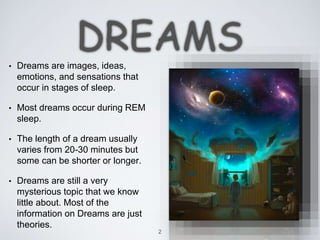
DREAMS• Dreams are images, ideas,
emotions, and sensations that
occur in stages of sleep.
• Most dreams occur during REM
sleep.
• The length of a dream usually
varies from 20-30 minutes but
some can be shorter or longer.
• Dreams are still a very
mysterious topic that we know
little about. Most of the
information on Dreams are just
theories.
2
NIGHTMARE
S• Nightmares are bad dreams that
cause a strong negative emotional
response from the mind, usually
fear but sometimes despair,
anxiety, and sadness.
• Nightmares mostly consist of
stresses you have during the time
you’re awake.
• Nightmares are mostly common
among young children. During
teenage and adult years,
nightmares tend to be rare or less
common.
3
LUCID DREAMING
• Lucid Dreaming is when a
person is aware that they are
dreaming.
• Usually during a Lucid Dream,
the dreamer has some or all
control over what occurs.
• Studies have shown that
during a Lucid Dream, there is
an increased amount of
activity in the parietal lobes of
the brain, making the dream a
conscious process.
4
ARTICLE -
WHY DO WE DREAM?• http://www.scientificamerican.com/article/why-do-we-dream/
• This article has Dr. Ernest Hartman, a professor of psychiatry, explore
the theory of why we dream.
• The article presents a theory that dreams are our minds making
connections to our awake lives. Many believe that these connections
are meaningless but they are actually controlled by your emotions and
experiences. So, when there is a clear-cut emotion present, the dream
is simple, but when the emotional state is less clear or there are many
emotions at once, the dream is more complicated.
• There is no proven explanation to why we dream though, they are all
theories.
6
SITES ABOUT DREAMING
• http://www.world-of-lucid-dreaming.com/
- all about lucid dreaming & how to
• http://www.dreammoods.com/
- explore what your dreams mean (only theories)
• http://www.reddit.com/r/dreams
- an online community where people discuss their dreams
• http://dreamstudies.org/
- all about dreams, offers a lot of information on the topic
7
QUESTIONS
• When do most dreams occur?
• How long does a dream last?
• What age group are nightmares most
common?
8
REFERENCES
• "Dream". The American Heritage Dictionary of the English Language,
Fourth Edition. 2000.
• Hobson, J.A. (2009) REM sleep and dreaming: towards a theory of
protoconsciousness, Nature Reviews
• Ann, Lee (2005-01-27). "HowStuffWorks "Dreams: Stages of Sleep"".
science.howstuffworks.com.
• Andreas Mavrematis (1987). Hypnogogia: The Unique State of
Consciousness Between Wakefullness and Sleep. Routledge, Chapman &
Hall, Incorporated. p. 96. ISBN 978-0-7102-0282-6.
9

Gray Dreams

  • 1.
  • 2.
    DREAMS• Dreams areimages, ideas, emotions, and sensations that occur in stages of sleep. • Most dreams occur during REM sleep. • The length of a dream usually varies from 20-30 minutes but some can be shorter or longer. • Dreams are still a very mysterious topic that we know little about. Most of the information on Dreams are just theories. 2
  • 3.
    NIGHTMARE S• Nightmares arebad dreams that cause a strong negative emotional response from the mind, usually fear but sometimes despair, anxiety, and sadness. • Nightmares mostly consist of stresses you have during the time you’re awake. • Nightmares are mostly common among young children. During teenage and adult years, nightmares tend to be rare or less common. 3
  • 4.
    LUCID DREAMING • LucidDreaming is when a person is aware that they are dreaming. • Usually during a Lucid Dream, the dreamer has some or all control over what occurs. • Studies have shown that during a Lucid Dream, there is an increased amount of activity in the parietal lobes of the brain, making the dream a conscious process. 4
  • 6.
    ARTICLE - WHY DOWE DREAM?• http://www.scientificamerican.com/article/why-do-we-dream/ • This article has Dr. Ernest Hartman, a professor of psychiatry, explore the theory of why we dream. • The article presents a theory that dreams are our minds making connections to our awake lives. Many believe that these connections are meaningless but they are actually controlled by your emotions and experiences. So, when there is a clear-cut emotion present, the dream is simple, but when the emotional state is less clear or there are many emotions at once, the dream is more complicated. • There is no proven explanation to why we dream though, they are all theories. 6
  • 7.
    SITES ABOUT DREAMING •http://www.world-of-lucid-dreaming.com/ - all about lucid dreaming & how to • http://www.dreammoods.com/ - explore what your dreams mean (only theories) • http://www.reddit.com/r/dreams - an online community where people discuss their dreams • http://dreamstudies.org/ - all about dreams, offers a lot of information on the topic 7
  • 8.
    QUESTIONS • When domost dreams occur? • How long does a dream last? • What age group are nightmares most common? 8
  • 9.
    REFERENCES • "Dream". TheAmerican Heritage Dictionary of the English Language, Fourth Edition. 2000. • Hobson, J.A. (2009) REM sleep and dreaming: towards a theory of protoconsciousness, Nature Reviews • Ann, Lee (2005-01-27). "HowStuffWorks "Dreams: Stages of Sleep"". science.howstuffworks.com. • Andreas Mavrematis (1987). Hypnogogia: The Unique State of Consciousness Between Wakefullness and Sleep. Routledge, Chapman & Hall, Incorporated. p. 96. ISBN 978-0-7102-0282-6. 9