RELIEF LINE
PROJECT ASSESSMENT
Evaluation Process and Criteria
DRAFT
March 2015
RELIEF LINE PROJECT ASSESSMENT
Evaluation Process and Criteria
March 2015 – DRAFT 2
Evaluation Process
The proposedevaluationprocessforthe Relief LineProjectAssessmenthasfour mainsteps. First,
potential stationareaoptions will be identified. Next,potentialstationarea options will be assessed
againstevaluationcriteria. Then, preliminary corridors forthe Relief Line willbe developed,connecting
the best-performingstationareas. Finally, alignmentsandstationlocationswithin the preferred
corridorwill be evaluatedingreaterdetailandrefined inordertoidentifyapreferredalignment.
At all stagesof the Relief LineProjectAssessmentEvaluation,potential stationsandalignmentswill be
evaluatedusingthe evaluationframeworkdevelopedaspart of the Review of the City'sOfficial Plan
TransportationPolicies ("FeelingCongested?") assummarizedin Table 1. The evaluationframework
capturesthe many aspectsof city-building,all of whichare importanttothe future of Toronto.
The evaluationprocessandcriteriawill be refinedandfinalizedbasedonfeedbackreceivedfrom
stakeholdersandthe publicthroughPhase 1B/2 consultation.
RELIEF LINE PROJECT ASSESSMENT
Evaluation Process and Criteria
March 2015 – DRAFT 3
Table 1 – Evaluation Framework *
Principles Objectives
ServingPeople Choice Developanintegratednetworkthatconnectsdifferent
modestoprovide formore travel options
Experience Capacityto ease crowding/congestion;reduce travel times;
make travel more reliable,safe andenjoyable
Social Equity Do not favouranygroup or communityoverothers;allow
everyone goodaccesstowork,school and otheractivities
Strengthening
Places
Shaping the City Use the transportationnetworkasa tool to shape the
residentialdevelopmentof the City
Healthy
Neighbourhoods
Changesinthe transportationnetworkshouldstrengthen
and enhance existingneighbourhoods;promote safe walking
and cyclingwithinandbetweenneighbourhoods
PublicHealth and
Environment
Supportand enhance natural areas;encourage peopleto
reduce how far theydrive;mitigate negativeimpacts
Supporting
Prosperity
Affordability Improvementstothe transportationsystemshouldbe
affordable tobuild,maintainandoperate
Supports Growth Investmentinpublictransportationshouldsupporteconomic
development:allow workerstogetto jobsmore easily;allow
goodsto get to marketsmore efficiently
* Evaluation Framework developed as partof the review of the
City's Official Plan Transportation Policies ("FeelingCongested?).
Evaluation Criteria
1. Identifying Potential Station Areas
A longlistof potential stationareaoptionshasbeenidentifiedwithinthe studyarea,withthree areasof
focus: within downtown, alongthe Danforth,andkeyactivityareaswithinthe restof the studyarea.
Primaryconsiderationsforpotential stationlocationswithindowntownandalongthe Danforthare the
abilitytosupportfuture connectionsof the Relief Line westandnorthandto provide connectionstothe
existingandplannedtransitsystem.
The full range of citybuildingcriteriawere alsotakenintoaccount,includingthe abilitytosupportthe
planningpolicyframeworkassetoutin the City’sOfficial Plan,the potential toserve existingandfuture
populationandemployment,andconsiderationof opportunitiesforredevelopmentandintensification.
RELIEF LINE PROJECT ASSESSMENT
Evaluation Process and Criteria
March 2015 – DRAFT 4
2. Assessment of Potential Station Areas
Each of the potential stationareaswill be assessed forabilitytomeet evaluation criteriaoutlined in
Table 2. The resultsof thisevaluationwill informthe developmentof potential corridors.
Table 2 – Evaluation Criteria for Assessment of Potential Station Areas
Principles Evaluation Criteria
Choice  Connectivitytosurface transitroutes
 Suitabilityof future extensiontothe north (Danforth) andtothe west
(Downtown)
 Downtownpedestriannetworkimpactsabove andbelow grade
(Downtown)
 Directnessof the transferfromthe Bloor-Danforthsubwayline andRelief
Line (Danforth)
 Directnessof the transferfromthe Yonge-University-Spadinasubwayline
and Relief Line (Danforth)
Experience  Proximitytokeydestinationsincludingcommunityservicesandfacilities
such as libraries,schoolsandcommunitycentres
 Relief toYonge Subwayline andYonge-BloorStation(abilitytodivert
riders) (Danforth, Downtown)
 Relief tosurface transitnetwork (Inline)
Social Equity  Improvingservice toNeighbourhoodImprovementAreas
Shaping the City  Servingareasof existingpopulation
 Servingareasof plannedpopulationgrowth
 SupportingCity-Buildingopportunitiesbyenhancingsiteswithhigh
developmentpotential
Healthy
Neighbourhoods
 Improvingexistingneighbourhoodsandminimizingimpactsonproperties,
local businesses,parksandfacilities
 Opportunitiesforcontext-sensitive integrationof the stationfacilitieswith
adjacentpropertiesandsurroundingneighbourhoods
 Minimize propertyimpacts
 Improve accessto communityservicesandfacilities
PublicHealth and
Environment
 Improvingthe natural environment
 Abilitytomitigate negativeimpacts
Affordability  Cost andconstructabilityof interchangestations
 Minimize propertyacquisitioncosts
 Ease of providingconnectiontostorage facility (Danforth Stations)
Supports Growth  Servingareasof existingemployment
 Servingareasof plannedemploymentgrowth
RELIEF LINE PROJECT ASSESSMENT
Evaluation Process and Criteria
March 2015 – DRAFT 5
3. Developing and Evaluating Corridors and Stations
Followingevaluationof potential stationareas, potential corridors toconnectthe stationareas having
the bestoverall potentialtoaddressthe evaluationcriteria will be identified. Thiswill include
considerationof the ability toserve expansion of the Relief Line tothe westandnorthinthe future.
The potential stationlocations associatedwitheachcorridorwillbe analyzed basedonthe evaluation
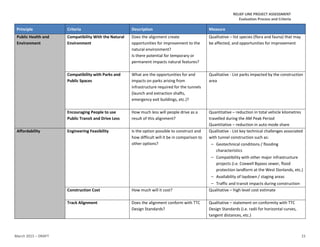
criteriaoutline in Table 3. Additional considerationsforthe potential stationsin downtownandalong
the Danforthare outlinedin Table 4.
As part of the evaluation,the potential corridorswill be assessed interms of potentialtransitridership
and the abilitytoreduce crowdingandcongestiononthe Yonge line,atthe Bloor-Yonge Stationandon
the surface transitroutes.In addition,feasibilityof optionsforcrossingthe DonRiverValleywill be
considered. The criteriaforassessmentof the potentialcorridorsare outlinedin Table 5.
4. Developing and Evaluating Alignments and Stations
Potential alignmentsandstationlocationswithinthe preferredcorridorwill be developedtoa finerlevel
of detail toconsiderbothphysical andoperationalconstraintsand/orfeatures. The criteriainTables3,
4 and 5 will be usedtoguide evaluationof potential alignmentsandstationlocations.
The evaluationprocesswillleadtoapreferred alignmentandstations forthe ReliefLine.
RELIEF LINE PROJECT ASSESSMENT
Evaluation Process and Criteria
March 2015 – DRAFT 6
Table 3 – Evaluation Criteria for Station Locations
Principle Criteria Description Measure
Choice Connectivityto Surface Transit
Routes
What isthe abilitytoconnecttoexistingand
plannedbusandstreetcarroutes?
Quantitative –numberof connectionstoexisting
and plannedsurface transitroutes
Quantitative –numberof people whouse the
stationto transfertoand from surface routes
where modelingresultsare available;where
modelingresultsare notavailable,numberof
transitriderspassingbythe potential station
location
Connectivityto Walkingand
CyclingRoutes
What isthe abilitytoconnecttoexistingand
plannedwalkingandcyclingroutes?
Qualitative –Describe opportunitiestoconnect
withexistingandplannedwalkingandcycling
routes
CompatibilitywithMetrolinx
Rapid Transit Planning
What isthe ability toserve orcomplement
Metrolinx plannedrapidtransitprojectssuchas
Regional ExpressRail?
Qualitative - potential forconnectivitywith
Metrolinx services
Experience Proximityto Key Destinations
includingcommunityservices
and facilitiessuchas libraries,
schools,community centres
and care facilities
What isthe abilitytoprovide transitservicetokey
destinations(hospitals,daycare centres,seniors/
retirementhomes,othercare facilities,education
facilities,libraries,communitycentres,recreation
centres,majoremploymentcentres,shopping
malls,attractions,governmentoffices,social
service centres,transithubs,etc.)?
Quantitative - Numberof keydestinationswithin
500 m radiusof the station
List the keydestinationsservedanddescribe their
scale
Social Equity Improving Service to
NeighbourhoodImprovement
Areas
What isthe ability toserve the City's
disadvantagedresidents?
Quantitative –Cityof TorontoNeighbourhood
EquityScore
RELIEF LINE PROJECT ASSESSMENT
Evaluation Process and Criteria
March 2015 – DRAFT 7
Principle Criteria Description Measure
Draw Publicand Private
Investmentto Neighbourhood
ImprovementAreas
What isthe ability of the projecttoattract public
and private investmenttoNeighbourhood
ImprovementAreas?
Qualitative –describe the likelihoodof further
publicor private investmenttobe attractedto
NeighbourhoodImprovementAreasasa resultof
the station'sconstruction
Supporting Gender,Racial,
Class,Family Status, and Age
Equity
Doesthe option improve transitaccessand
supportthe transitneedsof all genders,racial
groups,classes,familystatusesandagesin
considerationof the objective toimprove equity
for all groups?
Quantitative –demographicanalysiscomparingthe
percentage of populationinthe stationareafitting
each social variable (gender,race,class,family
status,age group) withthe percentage of
populationfittingthe same variable inthe study
area as a whole;includinginterrelationsbetween
groupsof social variablestoidentifypopulationsor
communitiessuchascaregivers
Qualitative –beyondthe identificationof
concentrationsof social groups,describe howthe
inclusionof astationat thislocationmaysupport
greaterequityintermsof gender,racial,class,
family statusandage groups
Opportunitiesfor Community
BenefitsAgreements
Doesthe optioncreate opportunitiesfor
communitybenefitstodisadvantagedresidents?
Qualitative –describe the kindsof opportunitiesto
make short- and long-termcommitmentstolocal
communitybenefitssuchasemploymentthat
constructionandoperationof a stationat this
locationmaycreate for disadvantagedresidents
livinginthe local stationarea
Shaping the City ServingAreas of Existing
Population
What isthe abilitytoserve peoplewithinstation
area?
Quantitative - numberof peoplewithin500 m
radiusof eachstation(reflectingphysical barriers)
ServingAreas of Planned
PopulationGrowth
What isthe abilitytoserve areasof planned
populationgrowth?
Quantitative –forecastfuture numberof people
within500 m radiusof each station(reflecting
physical barriers)
RELIEF LINE PROJECT ASSESSMENT
Evaluation Process and Criteria
March 2015 – DRAFT 8
Principle Criteria Description Measure
CompatibilitywithCity
PlanningPolicies
Doesthe optionsupportthe city’splanning
policies?
Qualitative –Descriptiveof whetherthe option
supportsthe growthintentionsof the official plan
or relevantplanningstudieswithinthe stationarea
(i.e.isthe stationlocatedwithinthe Downtown,
Central Waterfront,ora Centre,Avenue or
EmploymentDistrictinthe urbanstructure?)
Quantitative –percentage of landwithin500 m
radiusof stationsdesignatedasmixed-use area
ExistingPhysical Barriers Are there any physical barriers(suchas highways,
valleys,rail corridors) thatimpactconnectivityor
limitthe future abilitytoimplementtransit-
orienteddevelopmentaroundthe station?
Qualitative –Discussionof potential barriers,%of
walk-upcatchmentarea(i.e.500 m radiusof
stations) lost,barrierstostationentrancesfrom
people/jobs
Supporting City-Building
Opportunities
Doesthe optionsupportnew,plannedor
proposeddevelopmentoropportunitiesforplace-
making?
Qualitative –Describe opportunitiestosupport
developmentareas,improve connectivityor
enhance sense of place,withconsiderationfor
builtformand developmentpotential,areaof
potential opportunitysites
Healthy
Neighbourhoods
CompatibilitywithExisting
Neighbourhoods
Are there opportunitiestoenhance existing
neighbourhoodsthroughimprovedconnectivityor
place-making?
Are there potential impactsonexisting
neighbourhoods?
Qualitative –Describe opportunitiesfor
neighbourhoodimprovementwithin500 m radius
of rapidtransitstation,withconsiderationfor
transitionareasandintegrationof the station
facilitieswithadjacentpropertiesandsurrounding
neighbourhoods.
List private residencespotentiallyimpactedby
constructionandlong-termoperations
RELIEF LINE PROJECT ASSESSMENT
Evaluation Process and Criteria
March 2015 – DRAFT 9
Principle Criteria Description Measure
Improving Accessto
CommunityServicesand
Facilities
Doesthe optionimprove accesstoschools,places
of worship,andcommunityservice providers?
Doesthe optionimpactschools,placesof worship
and othercommunityservice providers?
Qualitative –Listthe key institutionsandservices
to whichaccesswill be improved;
List the institutionsandservicespotentially
impactedbythe constructionor longterm
operations
Impacts on Cultural / Heritage
/ Archaeological Features
Are there cultural / heritage / archaeological
featuresthatmightbe affected?
Qualitative –Describe the potential impactsor
benefitstocultural/heritageorarchaeological
featuresif any
PublicHealth
and
Environment
Compatibilitywith the
Natural Environment
Doesthe optioncreate opportunitiesfor
improvementtothe natural environment?
Is there potential fortemporaryorpermanent
impactsnatural features?
Qualitative –listspecies(floraandfauna) thatmay
be affectedbythe optionandopportunitiesfor
environmental improvement
CompatibilitywithParks and
PublicSpaces
Doesthe optioncreate an opportunitytoenhance
parks andpublicspaces?
Is there potential fortemporaryorpermanent
impactsto parks?
Qualitative –Describe the opportunitiesto
enhance parksand publicspaces;
List parkspotentiallyimpactedbythe construction
or longterm operations
Affordability EngineeringFeasibility Is the optionpossibletoconstructand how
difficultwill itbe incomparisontootheroptions?
Qualitative - Listkey technical challenges
associatedwithstationconstructionsuchas:
 Geotechnicalconditions/floodingcharacteristics
 Compatibilitywithothermajorinfrastructure
projects(i.e.Coxwell Bypasssewer,flood
protectionlandformattheWestDonlands,etc.)
 Availabilityof laydown/stagingareas
 Trafficandtransitimpactsduringconstruction
ConstructionCost How expensivewillthe optionbe? Qualitative –highlevel costestimate(high/
medium/low) basedoncomplexity
RELIEF LINE PROJECT ASSESSMENT
Evaluation Process and Criteria
March 2015 – DRAFT 10
Principle Criteria Description Measure
UtilityImpacts Are there potential conflictswithexistingutilities,
challengesinre-locatingutilities(temporarilyor
permanently)orschedulingconstraints?
Qualitative –statementonextentof utilityimpacts
Minimize PropertyAcquisition
Costs
How manypropertieswillbe impactedorneedto
be purchasedto supportthe option?
Qualitative –General descriptionof property
impacts(High/ Medium/ Low),withconsideration
for platforms,primaryandsecondary
access/egress,vertical circulationelements(VCE’s),
and service rooms
Supports
Growth
ServingAreas of Existing
Employment
What isthe abilitytoconnecttoemployment
areas?
Quantitative –numberof existingjobswithin500
m radiusof station(reflectingphysical barriers)
ServingAreas of Planned
EmploymentGrowth
What isthe abilityforstationtoserve areasof
new,plannedandproposedcommercialand
employmentdevelopment?
Quantitative –forecastnumberof potential jobs
within500 m radiusof station
Supporting and Strengthening
ExistingBusinessesand
Industry
Doesthe optionsupportexistinglocal businesses
and industrybyimprovingaccessibility?
Is there potential fortemporaryorpermanent
impactson businesses,suchasdisplacementand
reductionsinparking?
Qualitative –Describe the nature of businesses
within500 m radiusof rapidtransitstation;
List businessespotentiallyimpactedbythe
constructionor longtermoperations
RELIEF LINE PROJECT ASSESSMENT
Evaluation Process and Criteria
March 2015 – DRAFT 11
Table 4 – Additional Evaluation Criteria for Specific Locations
Principle Criteria Description Measure
Danforth Station Locations
Choice FlexibilityforFuture Northern
Extensionto Don Mills
What isthe future abilitytoserve customersand
keydestinationssuchasThorncliffe Parkand
FlemingdonPark?
Qualitative –commentonthe abilitytoprovide
stationsonthe future alignmentwhichwouldserve
people anddestinationsnorthof the Danforth,
basedon populationandemployment
Directnessof Transfer to the
Bloor/Danforth Subway
How directisthe connectiontothe
Bloor/DanforthSubwayLine?
Quantitative –Approximatedistance andjourney
time betweenexistingBloor-Danforthsubway
stationandproposednewReliefLine station
Experience RelieftoExisting Subway
Network
How muchrelief will the optionprovidetothe
Yonge SubwayLine,Yonge-BloorStationandthe
Bloor/Danforthsubway,comparedtoother
options?
Qualitative - ProximitytoBloor-YongeStation,
representingcatchmentareafordiversion
Quantitative –Numberof existingdailyriders
enteringthe station
Affordability Ease of ProvidingConnection
to Storage Facility
How manypropertieswillbe affectedtoconnect
to a storage facility?
Quantitative –Identifythe approximatenumberof
propertiesaffected
Qualitative –Commentonconstructabilityand
impactto TTC operationsfromengineering
perspective
Ease of ConstructingFuture
Northern Extension
How possible will itbe tocrossthe DonValleyto
the north incomparisonto otheroptions?
Qualitative –Commentonfuture potential
extensionacrossthe DonValleyfrom
constructabilityperspective,withconsiderationfor
propertyimpacts
Impact on Existing
DanforthSubway
How muchdisruptionwill the optioncause tothe
existingDanforthSubway?
Qualitative –commentonextentof disruptionand
modificationsthatwouldbe requiredtoDanforth
subwaystationsandtunnels
RELIEF LINE PROJECT ASSESSMENT
Evaluation Process and Criteria
March 2015 – DRAFT 12
Principle Criteria Description Measure
Downtown Stations
Choice Compatibilitywiththe PATH
network
What isthe abilitytosupportthe expansion
and/orintegrate withthe downtownPATH
network?
What isthe abilitytoimprove pedestrianflow
withinthe PATHnetwork?
Qualitative –commentonconnectivitytoPATH
and potential forimprovedpedestrianflow
Downtown Pedestrian
Network Impacts
What isthe abilityto reduce pedestriancrowding
at existingdowntownstationsandat streetlevel?
Qualitative –commentonconnectivityand
potential forimprovedorworsenedpedestrian
flowat existingdowntownstationsandatsidewalk
level
FlexibilityforFuture Western
Extension
What isthe future abilitytoserve customersand
destinationswestof the downtownsuchas
LibertyVillage,ParkdaleandRoncesvalles?
Qualitative –commentonthe abilitytoprovide
stationsonthe future alignmentwhichwouldserve
people anddestinationswestof the downtown,
basedon populationandemployment
Directnessof Transfer to the
Yonge-University-Spadina
Subway
How directisthe connectiontothe Yonge-
University-SpadinaSubwayLine?
Quantitative –Approximatedistance andjourney
time betweenexistingYonge-University-Spadina
subwaystationandproposednewRelief Line
station
Experience RelieftoExisting Subway
Network
How muchrelief will the optionprovidetothe
Yonge SubwayLine,Yonge-BloorStation,Union
Stationandthe Bloor/Danforthsubway,
comparedto otheroptions?
Qualitative –Proximitytothe centroid of
employmentdensity,representingabilitytodivert
tripsfrom existingsubwaynetwork
Quantitative –existingboardingsandalightingsat
downtownsubwaystations,servingasan indicator
of transitdemand
Affordability Impact on ExistingDowntown
Subway Stations
How muchdisruptionwill the optioncause to
downtownstations?
Qualitative –commentonextentof modifications
that wouldbe requiredtodowntownsubway
stationsandthe disruptionof service thatmay
result
RELIEF LINE PROJECT ASSESSMENT
Evaluation Process and Criteria
March 2015 – DRAFT 13
Principle Criteria Description Measure
Ease of ConstructingFuture
WesternExtension
Are there constructabilityconstraintsassociated
withextendingthe Relief Line westof downtown?
Qualitative –commentonfuture potential
extensionfromconstructabilityperspective,with
considerationforpropertyimpacts
Table 5 – Evaluation Criteria for Corridors/Alignments
Principle Criteria Description Measure
Choice Rapid Transit Network
Connectivityand Flexibility
How goodare the connectionsbetween
thisalignmentandthe existingsubway
lines?
How well willthisalignmentbe able to
handle shutdownsof the
Bloor/DanforthorYonge line?
Qualitative statementonthe abilitytoconnectto
the existingsubwaynetworkandflexibilityof the RL
to handle shutdownsof the BDsubwayand/or
Yonge subway.
Experience Travel Time How longwill ittake toget fromthe
Danforthto the downtown?
Quantitative –Estimatedtravel time fromDanforth
to Downtown,whichwillvarybasedondistance,
numberof stationsandalignment
RelieftoYonge Subway Line How muchrelief will the alignment
provide tothe Yonge Subwayline?
Quantitative - ReductioninAMpeakhourridership
southboundonYonge Subwaysouthof Bloor
RelieftoYonge-BloorStation How muchrelief will the alignment
provide tothe Bloor/Yonge Station?
Quantitative - Reductioninpassengerstransferring
inAM peakhourbetweenBDSubway(westbound)
and Yonge Subway(southbound)
RelieftoUnion Station How muchrelief will the alignment
provide toUnionStation?
Quantitative - ReductioninpassengersusingUnion
StationinAMpeak hour
RelieftoBloor-Danforth Subway
Line
How muchrelief will the alignment
provide tothe Bloor/Danforthline?
Quantitative - ReductioninAMpeakhourridership
westboundonBDSubwaywestof Sherbourne
RELIEF LINE PROJECT ASSESSMENT
Evaluation Process and Criteria
March 2015 – DRAFT 14
Principle Criteria Description Measure
RelieftoSurface Transit Routes How muchrelief will the optionprovide
to surface routes?
Quantitative –Improvementtosurface routeswith
capacitydeficiencies(measuredbyimprovementto
volume-to-capacityratiosforrouteswithcapacity
deficiencies)
ReliefLine Ridership How muchridershipwill thisalignment
attract?
Quantitative - AMpeakperiodtotal boardingson
the Relief Line
Total Transit Ridership How muchtotal ridershipcanbe
expectedontransit routeswiththis
alignment?
Quantitative - Total transitridershipwithinmodel
area duringthe AMPeakPeriod
Healthy
Neighbourhoods
CompatibilitywithExisting
Neighbourhoods
What are the opportunitiesandimpacts
on the neighbourhood arisingfrom
infrastructure requiredforthe tunnels
(launchandextractionshafts,
emergencyexitbuildings,etc.)?
Qualitative –Listresidential propertiesimpactedby
the constructionarea
Improving Accessto Institutions
and Services
What are the opportunitiesforand
impactson institutionsandservices
arisingfrominfrastructure requiredfor
the tunnels(launchandextraction
shafts,emergencyexitbuildings,etc.)?
Qualitative –Listinstitutionsandservicesimpacted
by the constructionarea
Impacts on Cultural / Heritage /
Archaeological Features
What are the opportunitiesforand
impactson cultural /heritage /
archaeological featuresarisingfrom
infrastructure requiredforthe tunnels
(launchandextractionshafts,
emergencyexitbuildings,etc.)?
Qualitative –Descriptiveanalysisof potential
impacts
EliminatingBarriers within
Neighbourhoods
Will the alignmenteliminateexistingor
resultinnewbarriersinexisting
neighbourhoods?
Qualitative - Discusspotential barriersoradditional
permeabilitycreatedbyalignment
RELIEF LINE PROJECT ASSESSMENT
Evaluation Process and Criteria
March 2015 – DRAFT 15
Principle Criteria Description Measure
PublicHealth and
Environment
CompatibilityWiththe Natural
Environment
Doesthe alignmentcreate
opportunitiesforimprovementtothe
natural environment?
Is there potential fortemporaryor
permanentimpacts natural features?
Qualitative –listspecies(floraandfauna) thatmay
be affected,andopportunitiesforimprovement
CompatibilitywithParks and
PublicSpaces
What are the opportunitiesforand
impactson parksarisingfrom
infrastructure required forthe tunnels
(launchandextractionshafts,
emergencyexitbuildings,etc.)?
Qualitative - Listparksimpactedbythe construction
area
Encouraging People to use
PublicTransit and Drive Less
How muchlesswill peopledrive asa
resultof thisalignment?
Quantitative –reductionintotal vehicle kilometres
travelledduringthe AMPeakPeriod
Quantitative –reductioninautomode share
Affordability EngineeringFeasibility Is the option possibletoconstructand
howdifficultwill itbe incomparisonto
otheroptions?
Qualitative - Listkeytechnical challengesassociated
withtunnel constructionsuchas:
 Geotechnical conditions/flooding
characteristics
 Compatibilitywithothermajorinfrastructure
projects(i.e.Coxwell Bypasssewer,flood
protectionlandformatthe WestDonlands,etc.)
 Availabilityof laydown/stagingareas
 Trafficand transitimpactsduringconstruction
ConstructionCost How muchwill itcost? Qualitative –highlevel costestimate
Track Alignment Doesthe alignmentconformwithTTC
DesignStandards?
Qualitative –statementonconformitywithTTC
DesignStandards (i.e.radii forhorizontal curves,
tangentdistances,etc.)
RELIEF LINE PROJECT ASSESSMENT
Evaluation Process and Criteria
March 2015 – DRAFT 16
Principle Criteria Description Measure
UtilityImpacts Are there any potential conflictswith
existingutilities,challengesforre-
locatingutilities(temporarilyor
permanently)orschedulingconstraints?
Qualitative –statementonextentof utilityimpacts
Minimize PropertyAcquisition
Costs
What are the propertyimpacts
associatedwiththisalignment?
Quantitative –General descriptionof property
impacts(High/ Medium/ Low),requiredfortunnel
and associatedinfrastructure (launchandextraction
shafts,emergencyexitbuildings,etc.),numberof
propertyacquisitionsrequiredorcostof
acquisitions
Connectingto the Storage
Facility
How easywill itbe to connectto a
storage facility?
Quantitative –General descriptionof property
requirementsandconstructioncomplexityfor
providingconnectiontoa Storage Facility,beyond
those establishedinthe evaluationof the
Bloor/DanforthStationlocation
Supports Growth Supporting and Strengthening
ExistingBusinessesand Industry
What are the opportunitiesforand
impactson businessesarisingfrom
infrastructure requiredforthe tunnels
(launchandextractionshafts,
emergencyexitbuildings,etc.)?
Qualitative –Listbusinessesimpactedbythe
constructionarea

Relief Line - Draft Evaluation Process and Criteria

  • 1.
    RELIEF LINE PROJECT ASSESSMENT EvaluationProcess and Criteria DRAFT March 2015
  • 2.
    RELIEF LINE PROJECTASSESSMENT Evaluation Process and Criteria March 2015 – DRAFT 2 Evaluation Process The proposedevaluationprocessforthe Relief LineProjectAssessmenthasfour mainsteps. First, potential stationareaoptions will be identified. Next,potentialstationarea options will be assessed againstevaluationcriteria. Then, preliminary corridors forthe Relief Line willbe developed,connecting the best-performingstationareas. Finally, alignmentsandstationlocationswithin the preferred corridorwill be evaluatedingreaterdetailandrefined inordertoidentifyapreferredalignment. At all stagesof the Relief LineProjectAssessmentEvaluation,potential stationsandalignmentswill be evaluatedusingthe evaluationframeworkdevelopedaspart of the Review of the City'sOfficial Plan TransportationPolicies ("FeelingCongested?") assummarizedin Table 1. The evaluationframework capturesthe many aspectsof city-building,all of whichare importanttothe future of Toronto. The evaluationprocessandcriteriawill be refinedandfinalizedbasedonfeedbackreceivedfrom stakeholdersandthe publicthroughPhase 1B/2 consultation.
  • 3.
    RELIEF LINE PROJECTASSESSMENT Evaluation Process and Criteria March 2015 – DRAFT 3 Table 1 – Evaluation Framework * Principles Objectives ServingPeople Choice Developanintegratednetworkthatconnectsdifferent modestoprovide formore travel options Experience Capacityto ease crowding/congestion;reduce travel times; make travel more reliable,safe andenjoyable Social Equity Do not favouranygroup or communityoverothers;allow everyone goodaccesstowork,school and otheractivities Strengthening Places Shaping the City Use the transportationnetworkasa tool to shape the residentialdevelopmentof the City Healthy Neighbourhoods Changesinthe transportationnetworkshouldstrengthen and enhance existingneighbourhoods;promote safe walking and cyclingwithinandbetweenneighbourhoods PublicHealth and Environment Supportand enhance natural areas;encourage peopleto reduce how far theydrive;mitigate negativeimpacts Supporting Prosperity Affordability Improvementstothe transportationsystemshouldbe affordable tobuild,maintainandoperate Supports Growth Investmentinpublictransportationshouldsupporteconomic development:allow workerstogetto jobsmore easily;allow goodsto get to marketsmore efficiently * Evaluation Framework developed as partof the review of the City's Official Plan Transportation Policies ("FeelingCongested?). Evaluation Criteria 1. Identifying Potential Station Areas A longlistof potential stationareaoptionshasbeenidentifiedwithinthe studyarea,withthree areasof focus: within downtown, alongthe Danforth,andkeyactivityareaswithinthe restof the studyarea. Primaryconsiderationsforpotential stationlocationswithindowntownandalongthe Danforthare the abilitytosupportfuture connectionsof the Relief Line westandnorthandto provide connectionstothe existingandplannedtransitsystem. The full range of citybuildingcriteriawere alsotakenintoaccount,includingthe abilitytosupportthe planningpolicyframeworkassetoutin the City’sOfficial Plan,the potential toserve existingandfuture populationandemployment,andconsiderationof opportunitiesforredevelopmentandintensification.
  • 4.
    RELIEF LINE PROJECTASSESSMENT Evaluation Process and Criteria March 2015 – DRAFT 4 2. Assessment of Potential Station Areas Each of the potential stationareaswill be assessed forabilitytomeet evaluation criteriaoutlined in Table 2. The resultsof thisevaluationwill informthe developmentof potential corridors. Table 2 – Evaluation Criteria for Assessment of Potential Station Areas Principles Evaluation Criteria Choice  Connectivitytosurface transitroutes  Suitabilityof future extensiontothe north (Danforth) andtothe west (Downtown)  Downtownpedestriannetworkimpactsabove andbelow grade (Downtown)  Directnessof the transferfromthe Bloor-Danforthsubwayline andRelief Line (Danforth)  Directnessof the transferfromthe Yonge-University-Spadinasubwayline and Relief Line (Danforth) Experience  Proximitytokeydestinationsincludingcommunityservicesandfacilities such as libraries,schoolsandcommunitycentres  Relief toYonge Subwayline andYonge-BloorStation(abilitytodivert riders) (Danforth, Downtown)  Relief tosurface transitnetwork (Inline) Social Equity  Improvingservice toNeighbourhoodImprovementAreas Shaping the City  Servingareasof existingpopulation  Servingareasof plannedpopulationgrowth  SupportingCity-Buildingopportunitiesbyenhancingsiteswithhigh developmentpotential Healthy Neighbourhoods  Improvingexistingneighbourhoodsandminimizingimpactsonproperties, local businesses,parksandfacilities  Opportunitiesforcontext-sensitive integrationof the stationfacilitieswith adjacentpropertiesandsurroundingneighbourhoods  Minimize propertyimpacts  Improve accessto communityservicesandfacilities PublicHealth and Environment  Improvingthe natural environment  Abilitytomitigate negativeimpacts Affordability  Cost andconstructabilityof interchangestations  Minimize propertyacquisitioncosts  Ease of providingconnectiontostorage facility (Danforth Stations) Supports Growth  Servingareasof existingemployment  Servingareasof plannedemploymentgrowth
  • 5.
    RELIEF LINE PROJECTASSESSMENT Evaluation Process and Criteria March 2015 – DRAFT 5 3. Developing and Evaluating Corridors and Stations Followingevaluationof potential stationareas, potential corridors toconnectthe stationareas having the bestoverall potentialtoaddressthe evaluationcriteria will be identified. Thiswill include considerationof the ability toserve expansion of the Relief Line tothe westandnorthinthe future. The potential stationlocations associatedwitheachcorridorwillbe analyzed basedonthe evaluation criteriaoutline in Table 3. Additional considerationsforthe potential stationsin downtownandalong the Danforthare outlinedin Table 4. As part of the evaluation,the potential corridorswill be assessed interms of potentialtransitridership and the abilitytoreduce crowdingandcongestiononthe Yonge line,atthe Bloor-Yonge Stationandon the surface transitroutes.In addition,feasibilityof optionsforcrossingthe DonRiverValleywill be considered. The criteriaforassessmentof the potentialcorridorsare outlinedin Table 5. 4. Developing and Evaluating Alignments and Stations Potential alignmentsandstationlocationswithinthe preferredcorridorwill be developedtoa finerlevel of detail toconsiderbothphysical andoperationalconstraintsand/orfeatures. The criteriainTables3, 4 and 5 will be usedtoguide evaluationof potential alignmentsandstationlocations. The evaluationprocesswillleadtoapreferred alignmentandstations forthe ReliefLine.
  • 6.
    RELIEF LINE PROJECTASSESSMENT Evaluation Process and Criteria March 2015 – DRAFT 6 Table 3 – Evaluation Criteria for Station Locations Principle Criteria Description Measure Choice Connectivityto Surface Transit Routes What isthe abilitytoconnecttoexistingand plannedbusandstreetcarroutes? Quantitative –numberof connectionstoexisting and plannedsurface transitroutes Quantitative –numberof people whouse the stationto transfertoand from surface routes where modelingresultsare available;where modelingresultsare notavailable,numberof transitriderspassingbythe potential station location Connectivityto Walkingand CyclingRoutes What isthe abilitytoconnecttoexistingand plannedwalkingandcyclingroutes? Qualitative –Describe opportunitiestoconnect withexistingandplannedwalkingandcycling routes CompatibilitywithMetrolinx Rapid Transit Planning What isthe ability toserve orcomplement Metrolinx plannedrapidtransitprojectssuchas Regional ExpressRail? Qualitative - potential forconnectivitywith Metrolinx services Experience Proximityto Key Destinations includingcommunityservices and facilitiessuchas libraries, schools,community centres and care facilities What isthe abilitytoprovide transitservicetokey destinations(hospitals,daycare centres,seniors/ retirementhomes,othercare facilities,education facilities,libraries,communitycentres,recreation centres,majoremploymentcentres,shopping malls,attractions,governmentoffices,social service centres,transithubs,etc.)? Quantitative - Numberof keydestinationswithin 500 m radiusof the station List the keydestinationsservedanddescribe their scale Social Equity Improving Service to NeighbourhoodImprovement Areas What isthe ability toserve the City's disadvantagedresidents? Quantitative –Cityof TorontoNeighbourhood EquityScore
  • 7.
    RELIEF LINE PROJECTASSESSMENT Evaluation Process and Criteria March 2015 – DRAFT 7 Principle Criteria Description Measure Draw Publicand Private Investmentto Neighbourhood ImprovementAreas What isthe ability of the projecttoattract public and private investmenttoNeighbourhood ImprovementAreas? Qualitative –describe the likelihoodof further publicor private investmenttobe attractedto NeighbourhoodImprovementAreasasa resultof the station'sconstruction Supporting Gender,Racial, Class,Family Status, and Age Equity Doesthe option improve transitaccessand supportthe transitneedsof all genders,racial groups,classes,familystatusesandagesin considerationof the objective toimprove equity for all groups? Quantitative –demographicanalysiscomparingthe percentage of populationinthe stationareafitting each social variable (gender,race,class,family status,age group) withthe percentage of populationfittingthe same variable inthe study area as a whole;includinginterrelationsbetween groupsof social variablestoidentifypopulationsor communitiessuchascaregivers Qualitative –beyondthe identificationof concentrationsof social groups,describe howthe inclusionof astationat thislocationmaysupport greaterequityintermsof gender,racial,class, family statusandage groups Opportunitiesfor Community BenefitsAgreements Doesthe optioncreate opportunitiesfor communitybenefitstodisadvantagedresidents? Qualitative –describe the kindsof opportunitiesto make short- and long-termcommitmentstolocal communitybenefitssuchasemploymentthat constructionandoperationof a stationat this locationmaycreate for disadvantagedresidents livinginthe local stationarea Shaping the City ServingAreas of Existing Population What isthe abilitytoserve peoplewithinstation area? Quantitative - numberof peoplewithin500 m radiusof eachstation(reflectingphysical barriers) ServingAreas of Planned PopulationGrowth What isthe abilitytoserve areasof planned populationgrowth? Quantitative –forecastfuture numberof people within500 m radiusof each station(reflecting physical barriers)
  • 8.
    RELIEF LINE PROJECTASSESSMENT Evaluation Process and Criteria March 2015 – DRAFT 8 Principle Criteria Description Measure CompatibilitywithCity PlanningPolicies Doesthe optionsupportthe city’splanning policies? Qualitative –Descriptiveof whetherthe option supportsthe growthintentionsof the official plan or relevantplanningstudieswithinthe stationarea (i.e.isthe stationlocatedwithinthe Downtown, Central Waterfront,ora Centre,Avenue or EmploymentDistrictinthe urbanstructure?) Quantitative –percentage of landwithin500 m radiusof stationsdesignatedasmixed-use area ExistingPhysical Barriers Are there any physical barriers(suchas highways, valleys,rail corridors) thatimpactconnectivityor limitthe future abilitytoimplementtransit- orienteddevelopmentaroundthe station? Qualitative –Discussionof potential barriers,%of walk-upcatchmentarea(i.e.500 m radiusof stations) lost,barrierstostationentrancesfrom people/jobs Supporting City-Building Opportunities Doesthe optionsupportnew,plannedor proposeddevelopmentoropportunitiesforplace- making? Qualitative –Describe opportunitiestosupport developmentareas,improve connectivityor enhance sense of place,withconsiderationfor builtformand developmentpotential,areaof potential opportunitysites Healthy Neighbourhoods CompatibilitywithExisting Neighbourhoods Are there opportunitiestoenhance existing neighbourhoodsthroughimprovedconnectivityor place-making? Are there potential impactsonexisting neighbourhoods? Qualitative –Describe opportunitiesfor neighbourhoodimprovementwithin500 m radius of rapidtransitstation,withconsiderationfor transitionareasandintegrationof the station facilitieswithadjacentpropertiesandsurrounding neighbourhoods. List private residencespotentiallyimpactedby constructionandlong-termoperations
  • 9.
    RELIEF LINE PROJECTASSESSMENT Evaluation Process and Criteria March 2015 – DRAFT 9 Principle Criteria Description Measure Improving Accessto CommunityServicesand Facilities Doesthe optionimprove accesstoschools,places of worship,andcommunityservice providers? Doesthe optionimpactschools,placesof worship and othercommunityservice providers? Qualitative –Listthe key institutionsandservices to whichaccesswill be improved; List the institutionsandservicespotentially impactedbythe constructionor longterm operations Impacts on Cultural / Heritage / Archaeological Features Are there cultural / heritage / archaeological featuresthatmightbe affected? Qualitative –Describe the potential impactsor benefitstocultural/heritageorarchaeological featuresif any PublicHealth and Environment Compatibilitywith the Natural Environment Doesthe optioncreate opportunitiesfor improvementtothe natural environment? Is there potential fortemporaryorpermanent impactsnatural features? Qualitative –listspecies(floraandfauna) thatmay be affectedbythe optionandopportunitiesfor environmental improvement CompatibilitywithParks and PublicSpaces Doesthe optioncreate an opportunitytoenhance parks andpublicspaces? Is there potential fortemporaryorpermanent impactsto parks? Qualitative –Describe the opportunitiesto enhance parksand publicspaces; List parkspotentiallyimpactedbythe construction or longterm operations Affordability EngineeringFeasibility Is the optionpossibletoconstructand how difficultwill itbe incomparisontootheroptions? Qualitative - Listkey technical challenges associatedwithstationconstructionsuchas:  Geotechnicalconditions/floodingcharacteristics  Compatibilitywithothermajorinfrastructure projects(i.e.Coxwell Bypasssewer,flood protectionlandformattheWestDonlands,etc.)  Availabilityof laydown/stagingareas  Trafficandtransitimpactsduringconstruction ConstructionCost How expensivewillthe optionbe? Qualitative –highlevel costestimate(high/ medium/low) basedoncomplexity
  • 10.
    RELIEF LINE PROJECTASSESSMENT Evaluation Process and Criteria March 2015 – DRAFT 10 Principle Criteria Description Measure UtilityImpacts Are there potential conflictswithexistingutilities, challengesinre-locatingutilities(temporarilyor permanently)orschedulingconstraints? Qualitative –statementonextentof utilityimpacts Minimize PropertyAcquisition Costs How manypropertieswillbe impactedorneedto be purchasedto supportthe option? Qualitative –General descriptionof property impacts(High/ Medium/ Low),withconsideration for platforms,primaryandsecondary access/egress,vertical circulationelements(VCE’s), and service rooms Supports Growth ServingAreas of Existing Employment What isthe abilitytoconnecttoemployment areas? Quantitative –numberof existingjobswithin500 m radiusof station(reflectingphysical barriers) ServingAreas of Planned EmploymentGrowth What isthe abilityforstationtoserve areasof new,plannedandproposedcommercialand employmentdevelopment? Quantitative –forecastnumberof potential jobs within500 m radiusof station Supporting and Strengthening ExistingBusinessesand Industry Doesthe optionsupportexistinglocal businesses and industrybyimprovingaccessibility? Is there potential fortemporaryorpermanent impactson businesses,suchasdisplacementand reductionsinparking? Qualitative –Describe the nature of businesses within500 m radiusof rapidtransitstation; List businessespotentiallyimpactedbythe constructionor longtermoperations
  • 11.
    RELIEF LINE PROJECTASSESSMENT Evaluation Process and Criteria March 2015 – DRAFT 11 Table 4 – Additional Evaluation Criteria for Specific Locations Principle Criteria Description Measure Danforth Station Locations Choice FlexibilityforFuture Northern Extensionto Don Mills What isthe future abilitytoserve customersand keydestinationssuchasThorncliffe Parkand FlemingdonPark? Qualitative –commentonthe abilitytoprovide stationsonthe future alignmentwhichwouldserve people anddestinationsnorthof the Danforth, basedon populationandemployment Directnessof Transfer to the Bloor/Danforth Subway How directisthe connectiontothe Bloor/DanforthSubwayLine? Quantitative –Approximatedistance andjourney time betweenexistingBloor-Danforthsubway stationandproposednewReliefLine station Experience RelieftoExisting Subway Network How muchrelief will the optionprovidetothe Yonge SubwayLine,Yonge-BloorStationandthe Bloor/Danforthsubway,comparedtoother options? Qualitative - ProximitytoBloor-YongeStation, representingcatchmentareafordiversion Quantitative –Numberof existingdailyriders enteringthe station Affordability Ease of ProvidingConnection to Storage Facility How manypropertieswillbe affectedtoconnect to a storage facility? Quantitative –Identifythe approximatenumberof propertiesaffected Qualitative –Commentonconstructabilityand impactto TTC operationsfromengineering perspective Ease of ConstructingFuture Northern Extension How possible will itbe tocrossthe DonValleyto the north incomparisonto otheroptions? Qualitative –Commentonfuture potential extensionacrossthe DonValleyfrom constructabilityperspective,withconsiderationfor propertyimpacts Impact on Existing DanforthSubway How muchdisruptionwill the optioncause tothe existingDanforthSubway? Qualitative –commentonextentof disruptionand modificationsthatwouldbe requiredtoDanforth subwaystationsandtunnels
  • 12.
    RELIEF LINE PROJECTASSESSMENT Evaluation Process and Criteria March 2015 – DRAFT 12 Principle Criteria Description Measure Downtown Stations Choice Compatibilitywiththe PATH network What isthe abilitytosupportthe expansion and/orintegrate withthe downtownPATH network? What isthe abilitytoimprove pedestrianflow withinthe PATHnetwork? Qualitative –commentonconnectivitytoPATH and potential forimprovedpedestrianflow Downtown Pedestrian Network Impacts What isthe abilityto reduce pedestriancrowding at existingdowntownstationsandat streetlevel? Qualitative –commentonconnectivityand potential forimprovedorworsenedpedestrian flowat existingdowntownstationsandatsidewalk level FlexibilityforFuture Western Extension What isthe future abilitytoserve customersand destinationswestof the downtownsuchas LibertyVillage,ParkdaleandRoncesvalles? Qualitative –commentonthe abilitytoprovide stationsonthe future alignmentwhichwouldserve people anddestinationswestof the downtown, basedon populationandemployment Directnessof Transfer to the Yonge-University-Spadina Subway How directisthe connectiontothe Yonge- University-SpadinaSubwayLine? Quantitative –Approximatedistance andjourney time betweenexistingYonge-University-Spadina subwaystationandproposednewRelief Line station Experience RelieftoExisting Subway Network How muchrelief will the optionprovidetothe Yonge SubwayLine,Yonge-BloorStation,Union Stationandthe Bloor/Danforthsubway, comparedto otheroptions? Qualitative –Proximitytothe centroid of employmentdensity,representingabilitytodivert tripsfrom existingsubwaynetwork Quantitative –existingboardingsandalightingsat downtownsubwaystations,servingasan indicator of transitdemand Affordability Impact on ExistingDowntown Subway Stations How muchdisruptionwill the optioncause to downtownstations? Qualitative –commentonextentof modifications that wouldbe requiredtodowntownsubway stationsandthe disruptionof service thatmay result
  • 13.
    RELIEF LINE PROJECTASSESSMENT Evaluation Process and Criteria March 2015 – DRAFT 13 Principle Criteria Description Measure Ease of ConstructingFuture WesternExtension Are there constructabilityconstraintsassociated withextendingthe Relief Line westof downtown? Qualitative –commentonfuture potential extensionfromconstructabilityperspective,with considerationforpropertyimpacts Table 5 – Evaluation Criteria for Corridors/Alignments Principle Criteria Description Measure Choice Rapid Transit Network Connectivityand Flexibility How goodare the connectionsbetween thisalignmentandthe existingsubway lines? How well willthisalignmentbe able to handle shutdownsof the Bloor/DanforthorYonge line? Qualitative statementonthe abilitytoconnectto the existingsubwaynetworkandflexibilityof the RL to handle shutdownsof the BDsubwayand/or Yonge subway. Experience Travel Time How longwill ittake toget fromthe Danforthto the downtown? Quantitative –Estimatedtravel time fromDanforth to Downtown,whichwillvarybasedondistance, numberof stationsandalignment RelieftoYonge Subway Line How muchrelief will the alignment provide tothe Yonge Subwayline? Quantitative - ReductioninAMpeakhourridership southboundonYonge Subwaysouthof Bloor RelieftoYonge-BloorStation How muchrelief will the alignment provide tothe Bloor/Yonge Station? Quantitative - Reductioninpassengerstransferring inAM peakhourbetweenBDSubway(westbound) and Yonge Subway(southbound) RelieftoUnion Station How muchrelief will the alignment provide toUnionStation? Quantitative - ReductioninpassengersusingUnion StationinAMpeak hour RelieftoBloor-Danforth Subway Line How muchrelief will the alignment provide tothe Bloor/Danforthline? Quantitative - ReductioninAMpeakhourridership westboundonBDSubwaywestof Sherbourne
  • 14.
    RELIEF LINE PROJECTASSESSMENT Evaluation Process and Criteria March 2015 – DRAFT 14 Principle Criteria Description Measure RelieftoSurface Transit Routes How muchrelief will the optionprovide to surface routes? Quantitative –Improvementtosurface routeswith capacitydeficiencies(measuredbyimprovementto volume-to-capacityratiosforrouteswithcapacity deficiencies) ReliefLine Ridership How muchridershipwill thisalignment attract? Quantitative - AMpeakperiodtotal boardingson the Relief Line Total Transit Ridership How muchtotal ridershipcanbe expectedontransit routeswiththis alignment? Quantitative - Total transitridershipwithinmodel area duringthe AMPeakPeriod Healthy Neighbourhoods CompatibilitywithExisting Neighbourhoods What are the opportunitiesandimpacts on the neighbourhood arisingfrom infrastructure requiredforthe tunnels (launchandextractionshafts, emergencyexitbuildings,etc.)? Qualitative –Listresidential propertiesimpactedby the constructionarea Improving Accessto Institutions and Services What are the opportunitiesforand impactson institutionsandservices arisingfrominfrastructure requiredfor the tunnels(launchandextraction shafts,emergencyexitbuildings,etc.)? Qualitative –Listinstitutionsandservicesimpacted by the constructionarea Impacts on Cultural / Heritage / Archaeological Features What are the opportunitiesforand impactson cultural /heritage / archaeological featuresarisingfrom infrastructure requiredforthe tunnels (launchandextractionshafts, emergencyexitbuildings,etc.)? Qualitative –Descriptiveanalysisof potential impacts EliminatingBarriers within Neighbourhoods Will the alignmenteliminateexistingor resultinnewbarriersinexisting neighbourhoods? Qualitative - Discusspotential barriersoradditional permeabilitycreatedbyalignment
  • 15.
    RELIEF LINE PROJECTASSESSMENT Evaluation Process and Criteria March 2015 – DRAFT 15 Principle Criteria Description Measure PublicHealth and Environment CompatibilityWiththe Natural Environment Doesthe alignmentcreate opportunitiesforimprovementtothe natural environment? Is there potential fortemporaryor permanentimpacts natural features? Qualitative –listspecies(floraandfauna) thatmay be affected,andopportunitiesforimprovement CompatibilitywithParks and PublicSpaces What are the opportunitiesforand impactson parksarisingfrom infrastructure required forthe tunnels (launchandextractionshafts, emergencyexitbuildings,etc.)? Qualitative - Listparksimpactedbythe construction area Encouraging People to use PublicTransit and Drive Less How muchlesswill peopledrive asa resultof thisalignment? Quantitative –reductionintotal vehicle kilometres travelledduringthe AMPeakPeriod Quantitative –reductioninautomode share Affordability EngineeringFeasibility Is the option possibletoconstructand howdifficultwill itbe incomparisonto otheroptions? Qualitative - Listkeytechnical challengesassociated withtunnel constructionsuchas:  Geotechnical conditions/flooding characteristics  Compatibilitywithothermajorinfrastructure projects(i.e.Coxwell Bypasssewer,flood protectionlandformatthe WestDonlands,etc.)  Availabilityof laydown/stagingareas  Trafficand transitimpactsduringconstruction ConstructionCost How muchwill itcost? Qualitative –highlevel costestimate Track Alignment Doesthe alignmentconformwithTTC DesignStandards? Qualitative –statementonconformitywithTTC DesignStandards (i.e.radii forhorizontal curves, tangentdistances,etc.)
  • 16.
    RELIEF LINE PROJECTASSESSMENT Evaluation Process and Criteria March 2015 – DRAFT 16 Principle Criteria Description Measure UtilityImpacts Are there any potential conflictswith existingutilities,challengesforre- locatingutilities(temporarilyor permanently)orschedulingconstraints? Qualitative –statementonextentof utilityimpacts Minimize PropertyAcquisition Costs What are the propertyimpacts associatedwiththisalignment? Quantitative –General descriptionof property impacts(High/ Medium/ Low),requiredfortunnel and associatedinfrastructure (launchandextraction shafts,emergencyexitbuildings,etc.),numberof propertyacquisitionsrequiredorcostof acquisitions Connectingto the Storage Facility How easywill itbe to connectto a storage facility? Quantitative –General descriptionof property requirementsandconstructioncomplexityfor providingconnectiontoa Storage Facility,beyond those establishedinthe evaluationof the Bloor/DanforthStationlocation Supports Growth Supporting and Strengthening ExistingBusinessesand Industry What are the opportunitiesforand impactson businessesarisingfrom infrastructure requiredforthe tunnels (launchandextractionshafts, emergencyexitbuildings,etc.)? Qualitative –Listbusinessesimpactedbythe constructionarea