North Corridor Transit Project
Extending mass transit from Northgate to Lynnwood

          Sound Transit Board Briefing
             December 16, 2010
Purpose of today’s briefing
•   Explain the alternatives analysis process
•   Summarize public input to date
•   Frame the alternatives
•   Share results of the initial evaluation
•   Confirm alternatives to advance for further work
•   Next steps
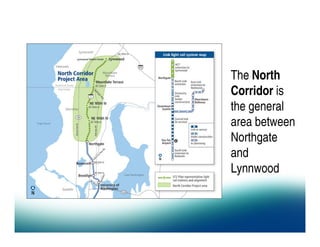
The North
Corridor is
the general
area between
Northgate
and
Lynnwood
What is the project?
• ST2 presumes light rail along I-5 open by 2023
• Competing for FTA “New Starts” grant
• Now examining multiple mode and routes consistent with
  FTA alternatives analysis (AA) requirements
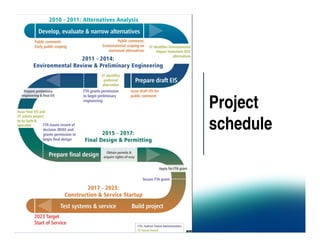
• 3-phase project development process:
   – Alternatives analysis: narrow alternatives for DEIS
   – DEIS & conceptual engineering: select locally-preferred
     alternative & obtain FTA permission to enter PE
   – FEIS & preliminary engineering: obtain ROD & FTA permission to
     enter final design
Project
schedule
Alternatives analysis process
• Identify alternatives: rail, bus, other?
• Initially assess against project purpose & need
   o Set aside those that don’t meet it
• Evaluate reasonable alternatives in detail
• Review results with public, then advance most
  promising alternatives to a DEIS
• Sound Transit Board selects the locally preferred
  alternative following DEIS
Early scoping & outreach
• Interagency technical working group
• Early AA scoping 9/27 – 10/27
• 3 public workshops: North Seattle, Shoreline, Lynnwood
    – Mailer to 130,000 households; website; ads
•   1 agency scoping meeting
•   Over 200 workshop participants
•   Over 260 responses to on-line survey
•   Over 90 comments via mail & e-mail
What did we ask?
• What activity areas should a mass transit extension
  serve?
• Is the purpose and need for the project well-
  defined?
• Are we proposing to use the right criteria to
  evaluate alternatives?
What we heard – major themes
• Light rail preferred over bus
• Access is key: parking, pedestrian, bike, E-W transit
• I-5 & SR 99 are preferred route alternatives
   – I-5 faster, more direct & efficient
   – SR 99 better land use/economic development potential
   – Less interest in 15th Avenue
• Many ideas for stations
• Desire for system to go further north in ST2
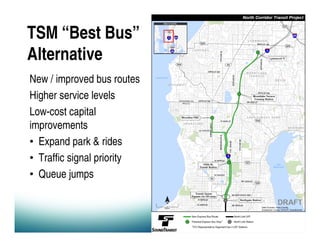
TSM “Best Bus”
Alternative
New / improved bus routes
Higher service levels
Low-cost capital
improvements
• Expand park & rides
• Traffic signal priority
• Queue jumps
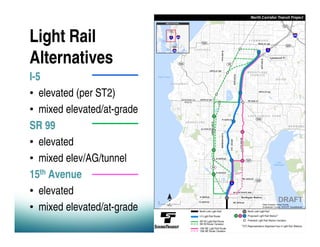
Light Rail
Alternatives
I-5
• elevated (per ST2)
• mixed elevated/at-grade
SR 99
• elevated
• mixed elev/AG/tunnel
15th Avenue
• elevated
• mixed elevated/at-grade
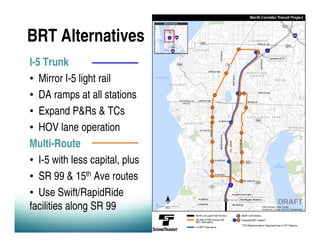
BRT Alternatives
I-5 Trunk
• Mirror I-5 light rail
• DA ramps at all stations
• Expand P&Rs & TCs
• HOV lane operation
Multi-Route
• I-5 with less capital, plus
• SR 99 & 15th Ave routes
• Use Swift/RapidRide
facilities along SR 99
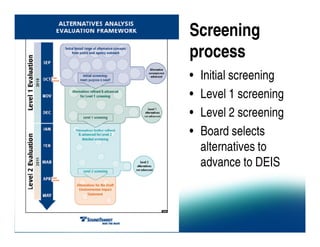
Screening
process
•   Initial screening
•   Level 1 screening
•   Level 2 screening
•   Board selects
    alternatives to
    advance to DEIS
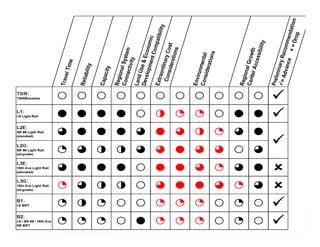
Initial screening criteria
•   Consistency with ST Long Range Plan
•   Travel time
•   Reliability
•   Capacity
•   Regional system connectivity
•   Land use & economic development compatibility
•   Extraordinary cost considerations
•   Environmental considerations
•   Regional growth center accessibility
Alternatives to move forward
•   TSM/bus baseline
•   I-5 elevated & mixed profile light rail
•   SR 99 elevated & mixed profile light rail
•   I-5 trunk BRT
•   Multi-route BRT (I-5/SR 99/15th Ave.)
Alternatives to drop now
•   Lake City Way light rail
•   15th Avenue elevated light rail
•   15th Avenue mixed profile light rail
•   SR 99 “pure” at-grade light rail
Next steps
• Drop some alternatives from further consideration and
  document - Now
• Develop more detailed information for Level 1 screening of
  remaining alternatives – Winter
   – Ridership forecasts
   – Capital & operating cost estimates
   – Environmental impact risk areas
• Evaluate against Level 1 criteria - Winter
Next steps - continued
• Possibly drop more alternatives from consideration;
  advance most promising to Level 2 evaluation – Spring
• Evaluate against Level 2 criteria - Spring
• Share results with public during EIS scoping –
  Spring/Summer
• Summarize scoping comments and AA results for Board &
  FTA - Summer
• Board selects alternatives to advance in DEIS, with FTA
  concurrence – Fall 2011

North Corridor Transit Project - December 16th Board Briefing

  • 1.
    North Corridor TransitProject Extending mass transit from Northgate to Lynnwood Sound Transit Board Briefing December 16, 2010
  • 2.
    Purpose of today’sbriefing • Explain the alternatives analysis process • Summarize public input to date • Frame the alternatives • Share results of the initial evaluation • Confirm alternatives to advance for further work • Next steps
  • 3.
    The North Corridor is thegeneral area between Northgate and Lynnwood
  • 4.
    What is theproject? • ST2 presumes light rail along I-5 open by 2023 • Competing for FTA “New Starts” grant • Now examining multiple mode and routes consistent with FTA alternatives analysis (AA) requirements • 3-phase project development process: – Alternatives analysis: narrow alternatives for DEIS – DEIS & conceptual engineering: select locally-preferred alternative & obtain FTA permission to enter PE – FEIS & preliminary engineering: obtain ROD & FTA permission to enter final design
  • 5.
  • 6.
    Alternatives analysis process •Identify alternatives: rail, bus, other? • Initially assess against project purpose & need o Set aside those that don’t meet it • Evaluate reasonable alternatives in detail • Review results with public, then advance most promising alternatives to a DEIS • Sound Transit Board selects the locally preferred alternative following DEIS
  • 7.
    Early scoping &outreach • Interagency technical working group • Early AA scoping 9/27 – 10/27 • 3 public workshops: North Seattle, Shoreline, Lynnwood – Mailer to 130,000 households; website; ads • 1 agency scoping meeting • Over 200 workshop participants • Over 260 responses to on-line survey • Over 90 comments via mail & e-mail
  • 8.
    What did weask? • What activity areas should a mass transit extension serve? • Is the purpose and need for the project well- defined? • Are we proposing to use the right criteria to evaluate alternatives?
  • 9.
    What we heard– major themes • Light rail preferred over bus • Access is key: parking, pedestrian, bike, E-W transit • I-5 & SR 99 are preferred route alternatives – I-5 faster, more direct & efficient – SR 99 better land use/economic development potential – Less interest in 15th Avenue • Many ideas for stations • Desire for system to go further north in ST2
  • 10.
    TSM “Best Bus” Alternative New/ improved bus routes Higher service levels Low-cost capital improvements • Expand park & rides • Traffic signal priority • Queue jumps
  • 11.
    Light Rail Alternatives I-5 • elevated(per ST2) • mixed elevated/at-grade SR 99 • elevated • mixed elev/AG/tunnel 15th Avenue • elevated • mixed elevated/at-grade
  • 12.
    BRT Alternatives I-5 Trunk •Mirror I-5 light rail • DA ramps at all stations • Expand P&Rs & TCs • HOV lane operation Multi-Route • I-5 with less capital, plus • SR 99 & 15th Ave routes • Use Swift/RapidRide facilities along SR 99
  • 13.
    Screening process • Initial screening • Level 1 screening • Level 2 screening • Board selects alternatives to advance to DEIS
  • 14.
    Initial screening criteria • Consistency with ST Long Range Plan • Travel time • Reliability • Capacity • Regional system connectivity • Land use & economic development compatibility • Extraordinary cost considerations • Environmental considerations • Regional growth center accessibility
  • 16.
    Alternatives to moveforward • TSM/bus baseline • I-5 elevated & mixed profile light rail • SR 99 elevated & mixed profile light rail • I-5 trunk BRT • Multi-route BRT (I-5/SR 99/15th Ave.)
  • 17.
    Alternatives to dropnow • Lake City Way light rail • 15th Avenue elevated light rail • 15th Avenue mixed profile light rail • SR 99 “pure” at-grade light rail
  • 18.
    Next steps • Dropsome alternatives from further consideration and document - Now • Develop more detailed information for Level 1 screening of remaining alternatives – Winter – Ridership forecasts – Capital & operating cost estimates – Environmental impact risk areas • Evaluate against Level 1 criteria - Winter
  • 19.
    Next steps -continued • Possibly drop more alternatives from consideration; advance most promising to Level 2 evaluation – Spring • Evaluate against Level 2 criteria - Spring • Share results with public during EIS scoping – Spring/Summer • Summarize scoping comments and AA results for Board & FTA - Summer • Board selects alternatives to advance in DEIS, with FTA concurrence – Fall 2011