SCARBOROUGH SUBWAY EXTENSION
2
Scarborough Subway Extension
Final Terms of Reference
1
SCARBOROUGH SUBWAY EXTENSION
2
1.0 Introduction and Background
1.1 Introduction
Toronto City Council recently confirmed support for an extension of the Bloor-Danforth Subway from
Kennedy Station to Scarborough Centre and Sheppard Avenue. This subway extension will replace the
aging Scarborough Rapid Transit (SRT) line. The City of Toronto with support from the Toronto Transit
Commission (TTC) is undertaking the Scarborough Subway Extension Project Assessment (SSEPA) to
determine key aspects of this rapid transit project such as route alignment, station locations, construction
methods, maximizing benefits to local communities and strategies for mitigating adverse impacts. A
recommended alignment and station locations will be presented to the TTC Board and CityCouncil for
approval at the conclusion of this study.
A Transit Project Assessment Process (TPAP) is required before the City and TTC may proceed with
implementation and construction. The TPAP is a streamlined self-assessment process for transit projects
to satisfy the requirements of the Environmental Assessment Act; which is administered by the Ministry of
the Environment and Climate Change. The TPAP is a final project review which will assess potential
environmental impacts and identify proposed mitigation strategies to be employed during the design,
construction and operation of the project.
1.2 Project Background
The SRT line opened for service in 1985 and it operates between Kennedy Station on the Bloor-
Danforth Subway and McCowan Station. After almost 30 years of continuous operation, the SRT’s
vehicles are reaching the end of their normal lifespan. The SRT would need significant rehabilitation,
new vehicles, and updated technology in order to support existing and future transit service needs and
address the problems associated with the aging SRT Line.
There has been considerable study and discussion in recent years about the preferred manner in which to
address the problems on the aging SRT line. In 2006, the TTC evaluated options to upgrade or
replace the SRT; completing the SRT Strategic Plan – a comprehensive study of options for replacing
the aging vehicles, upgrading the system’s infrastructure as necessary, and potentially expanding the
line. The initial recommendation was to purchase larger, new generation SRT vehicles, and make the
physical modifications at SRT stations that were necessary to accommodate the new, longer vehicles.
In 2007, one year after the SRT Strategic Plan – the Transit City Light Rail Plan was introduced, which
called for the implementation of seven light rail lines throughout the City of Toronto. In that context, it was
recommended that the SRT rehabilitation adopt light-rail technology in order to take advantage of the
economies-of-scale cost savings which would result from the acquisition of a large fleet of light-rail
vehicles to operate on the proposed City-wide network.
An Environmental Assessment (EA) for the replacement of the SRT with light rail vehicles, including a
complete rehabilitation / reconstruction of the existing elevated structure, was completed in 2010. The
proposal was to extend the new line beyond its current terminus – at McCowan Station – to Centennial
College and then north to Sheppard Avenue. The EA also addressed a second, future extension north of
Sheppard Avenue, to the Malvern Town Centre.
Most recently, in 2013, the TTC Board, and subsequently, City Council, confirmed support for replacing
the SRT with an extension of the Bloor-Danforth Subway, with stations at Lawrence Avenue,
2
SCARBOROUGH SUBWAY EXTENSION
2
Scarborough Centre and Sheppard Avenue – where the subway would interconnect with the future
Sheppard East LRT line. Council’s decision to extend the Bloor-Danforth subway north and east into
Scarborough is based on the following benefits:
• Higher speed;
• Most-reliable, highest-quality rapid transit service;
• Elimination of the transfer at Kennedy Station;
• Higher ridership; and
• Consideration of alignments other than the existing SRT routing, which would then not
require shutting down the SRT during construction of a subway extension.
All decisions relating to the alignment and station locations are subject to a further EA.
The SRT service has been very successful in attracting ridership and has been operating over-
capacity for a decade. For many years its peak-period passenger volumes have been maxed-out at 4,000
passengers per hour, with no ability to improve the capacity because of the limited number of vehicles in
the fleet and limited station size. Analysis to date has shown if the SRT were replaced by a continuation
and extension of the Bloor-Danforth Subway north to Sheppard Avenue, it would carry passenger
volumes of upwards of 9,500 passengers per hour per direction (pphpd) in the busiest hour of travel. The
additional ridership results from the higher operating speeds between the key points of Sheppard Avenue,
the Scarborough Centre and Kennedy Road. The elimination of the existing SRT/subway transfer at
Kennedy Station also contributes to increased passenger convenience which in turns increases trip
attractiveness and ridership.
1.3 Planning Context
The planning framework for the Study Area is established under the Province’s Growth Plan for the
Greater Golden Horseshoe, The Big Move regional transportation plan by Metrolinx and the Toronto
Official Plan. Key growth areas within the Study Area include Scarborough Centre, sections of Lawrence
Avenue and Sheppard Avenue, and existing and planned transit stations.
• Locally and provincially, Scarborough Centre is identified as a major focal point for growth. It
is a locally-designated Centre under the Toronto Official Plan, and a provincially-
designated urban growth centre under the Growth Plan. Scarborough Centre is targeted to
achieve a minimum density of 400 residents and jobs per hectare by 2031, and is subject
to a Secondary Plan and complementary precinct-level plans that provide direction for
future development.
• Major transit station areas are also identified under the Growth Plan for the Greater Golden
Horseshoe as important nodes where transit supportive development will be encouraged.
The most important station areas are identified as Mobility Hubs under The Big Move.
Within the study area, the area around Kennedy Station is identified as a Gateway Mobility
Hub and Scarborough Centre as an Anchor Mobility Hub.
• Under the Toronto Official Plan, the designated Avenues in the Study Area are also
intended to accommodate significant growth. These areas include sections of
Lawrence Avenue and Sheppard Avenue East.
3
SCARBOROUGH SUBWAY EXTENSION
2
1.4 Transit Planning in Toronto
A comprehensive, high quality, affordable transit system that lets people move quickly and conveniently
throughout the City is key to high quality of life as envisioned in the Toronto Official Plan.
The Scarborough Subway Extension is being planned in the context of the overall transit network. As part
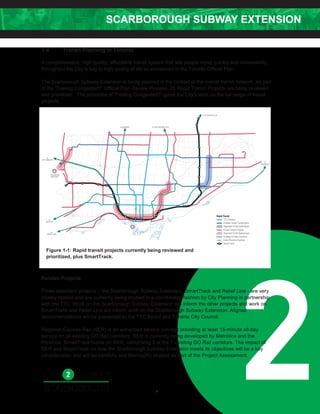
of the “Feeling Congested?” Official Plan Review Process, 25 Rapid Transit Projects are being reviewed
and prioritized. The principles of "Feeling Congested?" guide the City's work on the full range of transit
projects.
Related Projects
Three important projects – the Scarborough Subway Extension, SmartTrack and Relief Line - are very
closely related and are currently being studied in a coordinated fashion by City Planning in partnership
with the TTC. Work on the Scarborough Subway Extension will inform the other projects and work on
SmartTrack and Relief Line will inform work on the Scarborough Subway Extension. Aligned
recommendations will be presented to the TTC Board and Toronto City Council.
Regional Express Rail (RER) is an enhanced service concept providing at least 15-minute all-day
service on all existing GO Rail corridors. RER is currently being developed by Metrolinx and the
Province. SmartTrack builds on RER, comprising 3 of the 7 existing GO Rail corridors. The impact of
RER and SmartTrack on how the Scarborough Subway Extension meets its objectives will be a key
consideration and will be carefully and thoroughly studied as part of the Project Assessment.
Figure 1-1: Rapid transit projects currently being reviewed and
prioritized, plus SmartTrack.
4
SCARBOROUGH SUBWAY EXTENSION
2
1.5 Purpose of This Document
This Terms of Reference document has been prepared to publicly outline the framework for completing
this study. The Terms of Reference outlines the study purpose, objectives, and approach to the technical
analysis and public involvement, as well as o t h e r p l a n n i n g work that the City of Toronto and
TTC will undertake, all leading to the preparation of the environmental assessment under the TPAP.
This document outlines the Study Team’s approach to determine the recommended alignment and
station locations for the Scarborough Subway Extension.
Enhancements and modifications to the process and work tasks will be confirmed as the study
progresses to reflect new information, study findings and the consultation input received throughout the
study.
1.6 Study Team Organization
A Study Team has been formed to direct and lead the project. The Study Team will be led by the City of
Toronto's City Planning Division and the TTC, and will include key staff from both organizations. The
SSEPA is guided by the Transit Executive Committee, which is co-chaired by the City Manager and the
TTC CEO. A team of external technical experts has been selected to provide advice and expertise to the
City and the TTC.
A Technical Advisory Committee (TAC) comprised of staff from relevant City Divisions and TTC groups
will advise the Study Team and ensure cross-Division cooperation leading to the successful completion of
the planning phase of the project. The City will also work closely with Metrolinx and other agencies to
ensure the SSEPA achieves its objectives in a timely manner.
2.0 Project Description
2.1 Purpose of the Study
The purpose of the SSEPA is to identify the preliminary design of the preferred alignment and station
locations for the extension of the Bloor-Danforth Subway from Kennedy Station through Scarborough
Centre to Sheppard Avenue. The recommended subway extension will be documented in an
Environmental Project Report, in accordance with the Province’s TPAP (Ontario Regulation 231/08).
2.2 Project Objectives
Specific objectives to guide the planning process in determining a recommended plan for the subway
extension are:
1. Support the City-building principles outlined in the City’s Official Plan and
Provincial Policy Statement:
A. Design and integrate subway stations to complement the existing and planned land
uses.
B. Use high quality transit as a catalyst for economic development, intensification and
new transit-supportive development in designated growth areas.
C. Encourage transit oriented development in the vicinity of all station sites.
5
SCARBOROUGH SUBWAY EXTENSION
2
D. Improve the public realm at access points and within subway station areas.
2. Make transit as attractive a travel option as practically possible in this area of
Scarborough:
A. Provide fast, efficient, reliable, safe and enjoyable subway service to address
existing and future travel demands and enhance transit service.
B. Locate and design subway stations in a manner that improves access and
integration with the existing and planned transportation network including local and
regional bus services, and other rapid transit planned for the area.
C. Locate and design subway stations in a manner that promote seamless pedestrian
connections (including below-ground, at surface, and/or above ground pedestrian
connections).
D. Locate and design subway stations in a manner that promotes seamless
connections for customers cycling to the stations.
3. Minimize Adverse Environmental Impacts:
A. Identify positive effects on or opportunities for the natural, socio-economic and
cultural environments associated with the construction and operation of the project.
B. Identify and to the extent possible, mitigate, any adverse effects on the natural,
socio-economic and cultural environments associated with the construction and
operations of the project.
4. Achieve Cost-Effectiveness
A. Optimize cost effectiveness in terms of both capital and operating costs.
2.3 Study Area
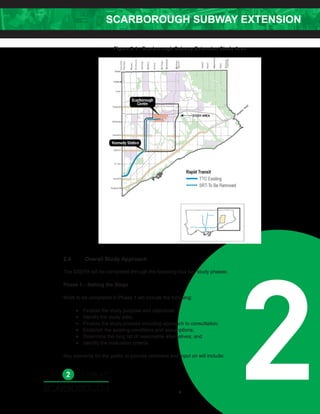
The Study Area is illustrated in Figure 2-1. A wide range of reasonable alternatives to be considered will
fall within this area.
The SSEPA will consider all effects on the entire transit network. Potential impacts outside of the primary
Study Area are also very important and will be examined as part of this study (where appropriate). The
full suite of potential impacts that will be carefully considered by the SSEPA, which include but are not
limited to: effects on the natural environment, existing and planned infrastructure, and built form and
neighbourhoods within the Study Area.
6
SCARBOROUGH SUBWAY EXTENSION
2
Figure 2-1: Scarborough Subway Extension Study Area
2.4 Overall Study Approach
The SSEPA will be completed through the following four key study phases:
Phase 1 – Setting the Stage
Work to be completed in Phase 1 will include the following:
• Finalize the study purpose and objectives;
• Identify the study area;
• Finalize the study process including approach to consultation;
• Establish the existing conditions and assumptions;
• Determine the long list of reasonable alternatives; and
• Identify the evaluation criteria.
Key elements for the public to provide comment and input on will include:
7
SCARBOROUGH SUBWAY EXTENSION
2
• Project objectives;
• Study process including approach to consultation;
• Existing conditions and assumptions;
• Long list of reasonable alternatives; and
• Evaluation criteria.
Following consultation on Phase 1, this document has been finalized and guides the subsequent study
phases.
Phase 2 – Choosing the Corridor
Work to be completed in Phase 2 will include the following:
• Finalize evaluation criteria;
• Apply the evaluation criteria to reasonable options to develop a short list of possible
corridors
• Within the short list of possible corridors:
− Develop alternative station location options
− Develop a list of possible alignments
• Apply the evaluation criteria to the short list of possible corridors to select a preferred
corridor
Key elements for the public to provide comment and input on will include:
• Application of the evaluation criteria to short list corridors; and
• Station location options and alternative alignments within the short list of possible corridors.
Phase 3 – Recommending the Alignment and Station Locations
Work to be completed in Phase 3 will include the following:
• Apply evaluation criteria to select preferred station locations and alignment;
• Create a functional design for the recommended alternative; and
• Identify potential impacts and appropriate mitigation strategies associated with the
recommended design.
Key elements for the public to provide comment and input on will include:
• Recommended station locations and alignment;
• Functional design of stations; and
• Potential impacts and proposed mitigation strategies.
At the end of Phase 3, a draft Environmental Project Report identifying the recommended station locations
and route will be prepared. Authority will be sought to commence the TPAP for final project review from
the TTC Board and Toronto City Council at the end of Phase 3.
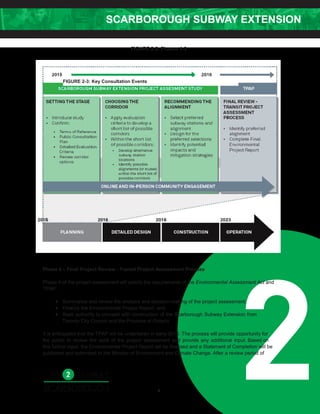
Figure 2-2 below illustrates the phased approach being used to determine the alignment and station
locations for the Scarborough Subway Extension.
8
SCARBOROUGH SUBWAY EXTENSION
2
FIGURE 2-2: Phases 1-3
Phase 4 – Final Project Review - Transit Project Assessment Process
Phase 4 of the project assessment will satisfy the requirements of the Environmental Assessment Act and
TPAP:
• Summarize and review the analysis and decision-making of the project assessment;
• Finalize the Environmental Project Report; and,
• Seek authority to proceed with construction of the Scarborough Subway Extension from
Toronto City Council and the Province of Ontario.
It is anticipated that the TPAP will be undertaken in early 2016. The process will provide opportunity for
the public to review the work of the project assessment and provide any additional input. Based on
this further input, the Environmental Project Report will be finalized and a Statement of Completion will be
published and submitted to the Minister of Environment and Climate Change. After a review period of
9
FIGURE 2-3: Key Consultation Events
SCARBOROUGH SUBWAY EXTENSION
2
approximately three months, the City will be able to proceed with implementation of the subway extension
as per direction of the Minister.
More information about Ontario's TPAP can be found by accessing the following links:
• Ontario Regulation 231/08
• Guide to Environmental Assessment Requirements for Transit Projects
2.5 Appropriate Timelines
The SSEPA will be expedited in all reasonable ways while including appropriate opportunities for
community involvement and public input. We anticipate that the planning and preliminary engineering
work (Phases 1-3) will be complete by late 2015/early 2016, but recognize that this work is partially
dependent on findings of studies related to SmartTrack and the Relief Line as per Section 1.4. Aligned
recommendations to the TTC Board and City Council are critical for effective transit planning and will
require careful coordination of all three projects.
Decisions made through the project assessment will lead to a Transit Project Assessment Process
(TPAP); a focussed and streamlined approvals process that satisfies the requirements of the
Environmental Assessment Act. The project schedule has been set up to complete the necessary work to
meet TPAP requirements. The TPAP itself will take no more than six months, and is anticipated to be
complete be the mid-2016.
The City and the TTC will seek to expedite detailed design and construction processes once authority to
construct has been received. Construction is anticipated to commence in 2018 and the subway is
expected to be in operation in 2023.
2.6 Evaluation Approach and Criteria
The development of the Evaluation Criteria is based on the City’s list of 8 decision-making criteria that
have been identified through the Official Plan review of transportation policies to guide Toronto’s
decisions on transportation investments. The intent of adopting these factors for the evaluation of the
Scarborough Subway Extension's alignment and station location options is to have an aligned vision and
to employ similar criteria in making investment decisions about transportation projects.
The evaluation of alternatives will be comprehensive (relative to the City's 8 decision-making criteria,
study objectives and Study Area), understandable, replicable, traceable and participatory (involving input
from interested and potentially affected stakeholders). The process of selecting the recommended
alignment will be based on the identification of the alternative that best serves the City's list of 8 decision-
making criteria, project objectives and sub-objectives. In order to focus the analysis, specific measurable
criteria have been created to correspond to each objective.
10
SCARBOROUGH SUBWAY EXTENSION
2
3.0 Public Consultation
3.1 Public Consultation Guiding Principles
The goal of the project’s proposed public consultation program is to generate broad participation and
solicit input from community leaders, stakeholders and the public. Participation by those with local, city-
wide and regional interests will strengthen the project and lead to the successful implementation of the
subway extension.
The public consultation will be guided by the following principles:
Inclusiveness.......engage the widest possible audience through multiple
consultation opportunities;
Timeliness............offer early and ongoing opportunities for participation well before
decisions are made;
Transparency.......participation will be widely communicated through multiple
communications channels;
Balance ................provide opportunities for a diversity of perspectives and opinions to
be raised and considered;
Flexibility..............adapt as required to meet the needs of participants; and
Traceability ..........demonstrate the impact of participant input on decision making.
3.2 Public Consultation Plan
A draft Public Consultation Plan will be developed to outline the engagement methods and approach that
will be used in all phases of the SSEPA. The plan will be finalized after receiving input from the public
during Phase 1.
The City will design a community engagement program that will work collaboratively with the
community, local businesses, agencies and other affected stakeholders to seek input throughout the
project assessment and the TPAP. While the proposed public consultation process follows a structured
approach, it will also allow for flexibility in engaging stakeholders and encouraging dialogue with the
public around key issues related to the project.
In each phase of the project, engagement will consist of four main communication approaches:
• information sharing;
• online consultation;
• live events; and
• community outreach.
1. Information Sharing
The City will share information about the project throughout the study process. Regular updates
will be shared through the project email list, City social media accounts and print material such as
project briefs. The project website will be regularly updated and will act as the hub for information
11
SCARBOROUGH SUBWAY EXTENSION
2
about the project. Key documents produced will also be made available through the project website.
The Study Team will look to translate key documents when appropriate throughout the study.
2. Online Consultation
The City will solicit comments and feedback on key decisions during each phase of the project
through the website. Online consultation will be one of the primary foci of consultation because it has
the ability to engage a large number of people from many different areas in a short period of time.
3. Live Events
Open houses, public meetings, Stakeholder Advisory Group meetings and workshops will be held
at various key points in the study for interested stakeholders and residents throughout the City to
learn and provide their input into key decisions of the project.
4. Community Outreach
The City will host community group meetings to proactively educate and solicit feedback from
the community. Community outreach will focus on the local areas where the Scarborough Subway
Extension will be located.
12

Scarborough Subway Extension - Terms of Reference

  • 1.
    SCARBOROUGH SUBWAY EXTENSION 2 ScarboroughSubway Extension Final Terms of Reference 1
  • 2.
    SCARBOROUGH SUBWAY EXTENSION 2 1.0Introduction and Background 1.1 Introduction Toronto City Council recently confirmed support for an extension of the Bloor-Danforth Subway from Kennedy Station to Scarborough Centre and Sheppard Avenue. This subway extension will replace the aging Scarborough Rapid Transit (SRT) line. The City of Toronto with support from the Toronto Transit Commission (TTC) is undertaking the Scarborough Subway Extension Project Assessment (SSEPA) to determine key aspects of this rapid transit project such as route alignment, station locations, construction methods, maximizing benefits to local communities and strategies for mitigating adverse impacts. A recommended alignment and station locations will be presented to the TTC Board and CityCouncil for approval at the conclusion of this study. A Transit Project Assessment Process (TPAP) is required before the City and TTC may proceed with implementation and construction. The TPAP is a streamlined self-assessment process for transit projects to satisfy the requirements of the Environmental Assessment Act; which is administered by the Ministry of the Environment and Climate Change. The TPAP is a final project review which will assess potential environmental impacts and identify proposed mitigation strategies to be employed during the design, construction and operation of the project. 1.2 Project Background The SRT line opened for service in 1985 and it operates between Kennedy Station on the Bloor- Danforth Subway and McCowan Station. After almost 30 years of continuous operation, the SRT’s vehicles are reaching the end of their normal lifespan. The SRT would need significant rehabilitation, new vehicles, and updated technology in order to support existing and future transit service needs and address the problems associated with the aging SRT Line. There has been considerable study and discussion in recent years about the preferred manner in which to address the problems on the aging SRT line. In 2006, the TTC evaluated options to upgrade or replace the SRT; completing the SRT Strategic Plan – a comprehensive study of options for replacing the aging vehicles, upgrading the system’s infrastructure as necessary, and potentially expanding the line. The initial recommendation was to purchase larger, new generation SRT vehicles, and make the physical modifications at SRT stations that were necessary to accommodate the new, longer vehicles. In 2007, one year after the SRT Strategic Plan – the Transit City Light Rail Plan was introduced, which called for the implementation of seven light rail lines throughout the City of Toronto. In that context, it was recommended that the SRT rehabilitation adopt light-rail technology in order to take advantage of the economies-of-scale cost savings which would result from the acquisition of a large fleet of light-rail vehicles to operate on the proposed City-wide network. An Environmental Assessment (EA) for the replacement of the SRT with light rail vehicles, including a complete rehabilitation / reconstruction of the existing elevated structure, was completed in 2010. The proposal was to extend the new line beyond its current terminus – at McCowan Station – to Centennial College and then north to Sheppard Avenue. The EA also addressed a second, future extension north of Sheppard Avenue, to the Malvern Town Centre. Most recently, in 2013, the TTC Board, and subsequently, City Council, confirmed support for replacing the SRT with an extension of the Bloor-Danforth Subway, with stations at Lawrence Avenue, 2
  • 3.
    SCARBOROUGH SUBWAY EXTENSION 2 ScarboroughCentre and Sheppard Avenue – where the subway would interconnect with the future Sheppard East LRT line. Council’s decision to extend the Bloor-Danforth subway north and east into Scarborough is based on the following benefits: • Higher speed; • Most-reliable, highest-quality rapid transit service; • Elimination of the transfer at Kennedy Station; • Higher ridership; and • Consideration of alignments other than the existing SRT routing, which would then not require shutting down the SRT during construction of a subway extension. All decisions relating to the alignment and station locations are subject to a further EA. The SRT service has been very successful in attracting ridership and has been operating over- capacity for a decade. For many years its peak-period passenger volumes have been maxed-out at 4,000 passengers per hour, with no ability to improve the capacity because of the limited number of vehicles in the fleet and limited station size. Analysis to date has shown if the SRT were replaced by a continuation and extension of the Bloor-Danforth Subway north to Sheppard Avenue, it would carry passenger volumes of upwards of 9,500 passengers per hour per direction (pphpd) in the busiest hour of travel. The additional ridership results from the higher operating speeds between the key points of Sheppard Avenue, the Scarborough Centre and Kennedy Road. The elimination of the existing SRT/subway transfer at Kennedy Station also contributes to increased passenger convenience which in turns increases trip attractiveness and ridership. 1.3 Planning Context The planning framework for the Study Area is established under the Province’s Growth Plan for the Greater Golden Horseshoe, The Big Move regional transportation plan by Metrolinx and the Toronto Official Plan. Key growth areas within the Study Area include Scarborough Centre, sections of Lawrence Avenue and Sheppard Avenue, and existing and planned transit stations. • Locally and provincially, Scarborough Centre is identified as a major focal point for growth. It is a locally-designated Centre under the Toronto Official Plan, and a provincially- designated urban growth centre under the Growth Plan. Scarborough Centre is targeted to achieve a minimum density of 400 residents and jobs per hectare by 2031, and is subject to a Secondary Plan and complementary precinct-level plans that provide direction for future development. • Major transit station areas are also identified under the Growth Plan for the Greater Golden Horseshoe as important nodes where transit supportive development will be encouraged. The most important station areas are identified as Mobility Hubs under The Big Move. Within the study area, the area around Kennedy Station is identified as a Gateway Mobility Hub and Scarborough Centre as an Anchor Mobility Hub. • Under the Toronto Official Plan, the designated Avenues in the Study Area are also intended to accommodate significant growth. These areas include sections of Lawrence Avenue and Sheppard Avenue East. 3
  • 4.
    SCARBOROUGH SUBWAY EXTENSION 2 1.4Transit Planning in Toronto A comprehensive, high quality, affordable transit system that lets people move quickly and conveniently throughout the City is key to high quality of life as envisioned in the Toronto Official Plan. The Scarborough Subway Extension is being planned in the context of the overall transit network. As part of the “Feeling Congested?” Official Plan Review Process, 25 Rapid Transit Projects are being reviewed and prioritized. The principles of "Feeling Congested?" guide the City's work on the full range of transit projects. Related Projects Three important projects – the Scarborough Subway Extension, SmartTrack and Relief Line - are very closely related and are currently being studied in a coordinated fashion by City Planning in partnership with the TTC. Work on the Scarborough Subway Extension will inform the other projects and work on SmartTrack and Relief Line will inform work on the Scarborough Subway Extension. Aligned recommendations will be presented to the TTC Board and Toronto City Council. Regional Express Rail (RER) is an enhanced service concept providing at least 15-minute all-day service on all existing GO Rail corridors. RER is currently being developed by Metrolinx and the Province. SmartTrack builds on RER, comprising 3 of the 7 existing GO Rail corridors. The impact of RER and SmartTrack on how the Scarborough Subway Extension meets its objectives will be a key consideration and will be carefully and thoroughly studied as part of the Project Assessment. Figure 1-1: Rapid transit projects currently being reviewed and prioritized, plus SmartTrack. 4
  • 5.
    SCARBOROUGH SUBWAY EXTENSION 2 1.5Purpose of This Document This Terms of Reference document has been prepared to publicly outline the framework for completing this study. The Terms of Reference outlines the study purpose, objectives, and approach to the technical analysis and public involvement, as well as o t h e r p l a n n i n g work that the City of Toronto and TTC will undertake, all leading to the preparation of the environmental assessment under the TPAP. This document outlines the Study Team’s approach to determine the recommended alignment and station locations for the Scarborough Subway Extension. Enhancements and modifications to the process and work tasks will be confirmed as the study progresses to reflect new information, study findings and the consultation input received throughout the study. 1.6 Study Team Organization A Study Team has been formed to direct and lead the project. The Study Team will be led by the City of Toronto's City Planning Division and the TTC, and will include key staff from both organizations. The SSEPA is guided by the Transit Executive Committee, which is co-chaired by the City Manager and the TTC CEO. A team of external technical experts has been selected to provide advice and expertise to the City and the TTC. A Technical Advisory Committee (TAC) comprised of staff from relevant City Divisions and TTC groups will advise the Study Team and ensure cross-Division cooperation leading to the successful completion of the planning phase of the project. The City will also work closely with Metrolinx and other agencies to ensure the SSEPA achieves its objectives in a timely manner. 2.0 Project Description 2.1 Purpose of the Study The purpose of the SSEPA is to identify the preliminary design of the preferred alignment and station locations for the extension of the Bloor-Danforth Subway from Kennedy Station through Scarborough Centre to Sheppard Avenue. The recommended subway extension will be documented in an Environmental Project Report, in accordance with the Province’s TPAP (Ontario Regulation 231/08). 2.2 Project Objectives Specific objectives to guide the planning process in determining a recommended plan for the subway extension are: 1. Support the City-building principles outlined in the City’s Official Plan and Provincial Policy Statement: A. Design and integrate subway stations to complement the existing and planned land uses. B. Use high quality transit as a catalyst for economic development, intensification and new transit-supportive development in designated growth areas. C. Encourage transit oriented development in the vicinity of all station sites. 5
  • 6.
    SCARBOROUGH SUBWAY EXTENSION 2 D.Improve the public realm at access points and within subway station areas. 2. Make transit as attractive a travel option as practically possible in this area of Scarborough: A. Provide fast, efficient, reliable, safe and enjoyable subway service to address existing and future travel demands and enhance transit service. B. Locate and design subway stations in a manner that improves access and integration with the existing and planned transportation network including local and regional bus services, and other rapid transit planned for the area. C. Locate and design subway stations in a manner that promote seamless pedestrian connections (including below-ground, at surface, and/or above ground pedestrian connections). D. Locate and design subway stations in a manner that promotes seamless connections for customers cycling to the stations. 3. Minimize Adverse Environmental Impacts: A. Identify positive effects on or opportunities for the natural, socio-economic and cultural environments associated with the construction and operation of the project. B. Identify and to the extent possible, mitigate, any adverse effects on the natural, socio-economic and cultural environments associated with the construction and operations of the project. 4. Achieve Cost-Effectiveness A. Optimize cost effectiveness in terms of both capital and operating costs. 2.3 Study Area The Study Area is illustrated in Figure 2-1. A wide range of reasonable alternatives to be considered will fall within this area. The SSEPA will consider all effects on the entire transit network. Potential impacts outside of the primary Study Area are also very important and will be examined as part of this study (where appropriate). The full suite of potential impacts that will be carefully considered by the SSEPA, which include but are not limited to: effects on the natural environment, existing and planned infrastructure, and built form and neighbourhoods within the Study Area. 6
  • 7.
    SCARBOROUGH SUBWAY EXTENSION 2 Figure2-1: Scarborough Subway Extension Study Area 2.4 Overall Study Approach The SSEPA will be completed through the following four key study phases: Phase 1 – Setting the Stage Work to be completed in Phase 1 will include the following: • Finalize the study purpose and objectives; • Identify the study area; • Finalize the study process including approach to consultation; • Establish the existing conditions and assumptions; • Determine the long list of reasonable alternatives; and • Identify the evaluation criteria. Key elements for the public to provide comment and input on will include: 7
  • 8.
    SCARBOROUGH SUBWAY EXTENSION 2 •Project objectives; • Study process including approach to consultation; • Existing conditions and assumptions; • Long list of reasonable alternatives; and • Evaluation criteria. Following consultation on Phase 1, this document has been finalized and guides the subsequent study phases. Phase 2 – Choosing the Corridor Work to be completed in Phase 2 will include the following: • Finalize evaluation criteria; • Apply the evaluation criteria to reasonable options to develop a short list of possible corridors • Within the short list of possible corridors: − Develop alternative station location options − Develop a list of possible alignments • Apply the evaluation criteria to the short list of possible corridors to select a preferred corridor Key elements for the public to provide comment and input on will include: • Application of the evaluation criteria to short list corridors; and • Station location options and alternative alignments within the short list of possible corridors. Phase 3 – Recommending the Alignment and Station Locations Work to be completed in Phase 3 will include the following: • Apply evaluation criteria to select preferred station locations and alignment; • Create a functional design for the recommended alternative; and • Identify potential impacts and appropriate mitigation strategies associated with the recommended design. Key elements for the public to provide comment and input on will include: • Recommended station locations and alignment; • Functional design of stations; and • Potential impacts and proposed mitigation strategies. At the end of Phase 3, a draft Environmental Project Report identifying the recommended station locations and route will be prepared. Authority will be sought to commence the TPAP for final project review from the TTC Board and Toronto City Council at the end of Phase 3. Figure 2-2 below illustrates the phased approach being used to determine the alignment and station locations for the Scarborough Subway Extension. 8
  • 9.
    SCARBOROUGH SUBWAY EXTENSION 2 FIGURE2-2: Phases 1-3 Phase 4 – Final Project Review - Transit Project Assessment Process Phase 4 of the project assessment will satisfy the requirements of the Environmental Assessment Act and TPAP: • Summarize and review the analysis and decision-making of the project assessment; • Finalize the Environmental Project Report; and, • Seek authority to proceed with construction of the Scarborough Subway Extension from Toronto City Council and the Province of Ontario. It is anticipated that the TPAP will be undertaken in early 2016. The process will provide opportunity for the public to review the work of the project assessment and provide any additional input. Based on this further input, the Environmental Project Report will be finalized and a Statement of Completion will be published and submitted to the Minister of Environment and Climate Change. After a review period of 9 FIGURE 2-3: Key Consultation Events
  • 10.
    SCARBOROUGH SUBWAY EXTENSION 2 approximatelythree months, the City will be able to proceed with implementation of the subway extension as per direction of the Minister. More information about Ontario's TPAP can be found by accessing the following links: • Ontario Regulation 231/08 • Guide to Environmental Assessment Requirements for Transit Projects 2.5 Appropriate Timelines The SSEPA will be expedited in all reasonable ways while including appropriate opportunities for community involvement and public input. We anticipate that the planning and preliminary engineering work (Phases 1-3) will be complete by late 2015/early 2016, but recognize that this work is partially dependent on findings of studies related to SmartTrack and the Relief Line as per Section 1.4. Aligned recommendations to the TTC Board and City Council are critical for effective transit planning and will require careful coordination of all three projects. Decisions made through the project assessment will lead to a Transit Project Assessment Process (TPAP); a focussed and streamlined approvals process that satisfies the requirements of the Environmental Assessment Act. The project schedule has been set up to complete the necessary work to meet TPAP requirements. The TPAP itself will take no more than six months, and is anticipated to be complete be the mid-2016. The City and the TTC will seek to expedite detailed design and construction processes once authority to construct has been received. Construction is anticipated to commence in 2018 and the subway is expected to be in operation in 2023. 2.6 Evaluation Approach and Criteria The development of the Evaluation Criteria is based on the City’s list of 8 decision-making criteria that have been identified through the Official Plan review of transportation policies to guide Toronto’s decisions on transportation investments. The intent of adopting these factors for the evaluation of the Scarborough Subway Extension's alignment and station location options is to have an aligned vision and to employ similar criteria in making investment decisions about transportation projects. The evaluation of alternatives will be comprehensive (relative to the City's 8 decision-making criteria, study objectives and Study Area), understandable, replicable, traceable and participatory (involving input from interested and potentially affected stakeholders). The process of selecting the recommended alignment will be based on the identification of the alternative that best serves the City's list of 8 decision- making criteria, project objectives and sub-objectives. In order to focus the analysis, specific measurable criteria have been created to correspond to each objective. 10
  • 11.
    SCARBOROUGH SUBWAY EXTENSION 2 3.0Public Consultation 3.1 Public Consultation Guiding Principles The goal of the project’s proposed public consultation program is to generate broad participation and solicit input from community leaders, stakeholders and the public. Participation by those with local, city- wide and regional interests will strengthen the project and lead to the successful implementation of the subway extension. The public consultation will be guided by the following principles: Inclusiveness.......engage the widest possible audience through multiple consultation opportunities; Timeliness............offer early and ongoing opportunities for participation well before decisions are made; Transparency.......participation will be widely communicated through multiple communications channels; Balance ................provide opportunities for a diversity of perspectives and opinions to be raised and considered; Flexibility..............adapt as required to meet the needs of participants; and Traceability ..........demonstrate the impact of participant input on decision making. 3.2 Public Consultation Plan A draft Public Consultation Plan will be developed to outline the engagement methods and approach that will be used in all phases of the SSEPA. The plan will be finalized after receiving input from the public during Phase 1. The City will design a community engagement program that will work collaboratively with the community, local businesses, agencies and other affected stakeholders to seek input throughout the project assessment and the TPAP. While the proposed public consultation process follows a structured approach, it will also allow for flexibility in engaging stakeholders and encouraging dialogue with the public around key issues related to the project. In each phase of the project, engagement will consist of four main communication approaches: • information sharing; • online consultation; • live events; and • community outreach. 1. Information Sharing The City will share information about the project throughout the study process. Regular updates will be shared through the project email list, City social media accounts and print material such as project briefs. The project website will be regularly updated and will act as the hub for information 11
  • 12.
    SCARBOROUGH SUBWAY EXTENSION 2 aboutthe project. Key documents produced will also be made available through the project website. The Study Team will look to translate key documents when appropriate throughout the study. 2. Online Consultation The City will solicit comments and feedback on key decisions during each phase of the project through the website. Online consultation will be one of the primary foci of consultation because it has the ability to engage a large number of people from many different areas in a short period of time. 3. Live Events Open houses, public meetings, Stakeholder Advisory Group meetings and workshops will be held at various key points in the study for interested stakeholders and residents throughout the City to learn and provide their input into key decisions of the project. 4. Community Outreach The City will host community group meetings to proactively educate and solicit feedback from the community. Community outreach will focus on the local areas where the Scarborough Subway Extension will be located. 12