Lung abscess
DR. SINA AL-NOMI
Assist. prof. faculty of medicine
Taiz university
2021
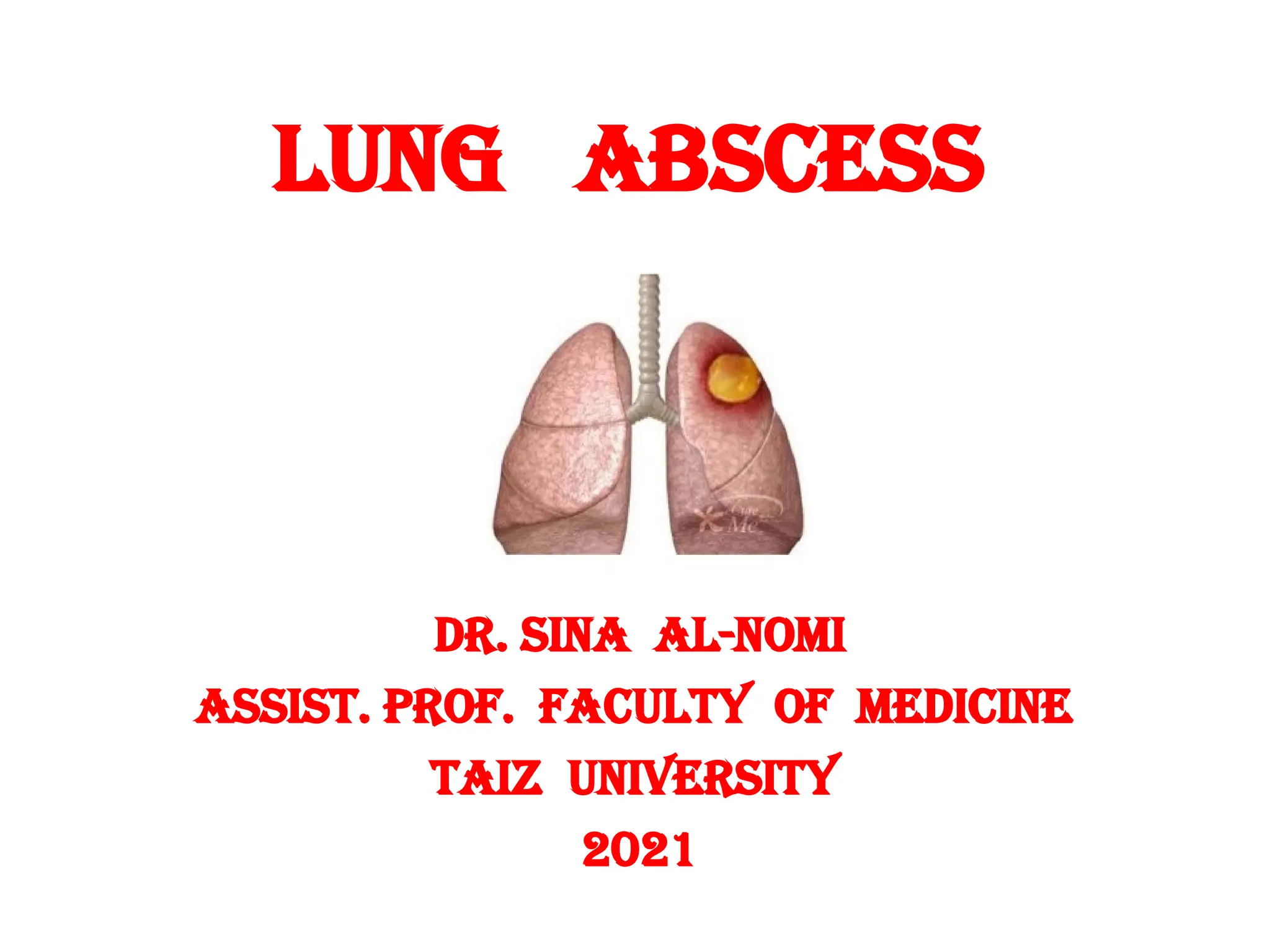
Lung abscess
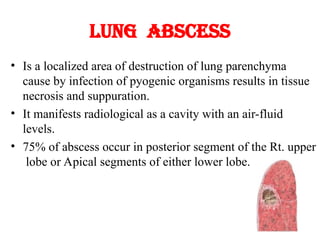
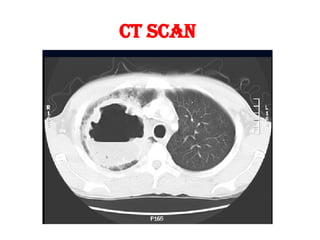
• Is a localized area of destruction of lung parenchyma
cause by infection of pyogenic organisms results in tissue
necrosis and suppuration.
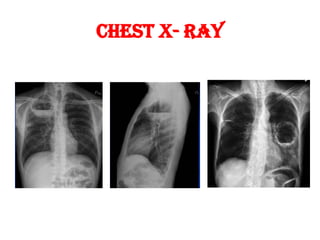
• It manifests radiological as a cavity with an air-fluid
levels.
• 75% of abscess occur in posterior segment of the Rt. upper
lobe or Apical segments of either lower lobe.
Classification
 May be primary or secondary
 Primary : abscess in previously healthy patient or
in a patient at risk for aspiration
 Secondary : associated bronchogenic neoplasm or
immunocompromised patient
Risk factors / causes
 Infectious agent generally cause lung abscess:
1) Gram negative organisms as klebsiella, S. aureus, & anaerobic
bacilli.
2) T.B
3) Parasitic
4) Fungal disease of the lung as Histoplasma capsulatum, Aspergillus,
Candida
 Actinomyces israeli –single large lung abscess:
Lung infiltrate with honey comb of small abscess cavities that may
communicate with chest wall with bony destruction and sinus
formation
 HIV infection
Risk factors / causes
1) Most lung abscess are caused by aspiration of material from the GI tract in to
the lungs
Risk factors for aspiration include:
 Alcoholism
 Seizure
 Strock-Depressed conscious level
 Neuromuscular disorders
 Drug overdose, Sedation
 General anasthesia, Impaired laryngeal closure ( cuffed endotracheal tube),
tracheostomy tube, recurrent laryngeal nerve palsy )
 Disturbances of swallowing, Delayed gastric emptying
Risk factors / causes
2) Pre existing lung disease:
 Necrotizing pneumonia
 Bronchiectasis
 Cystic fibrosis
 Bronchial obstruction as in tumour, foreign body,
 congenital abnormalitis
 Infected pulmonary infarct
 Trauma
 Immunodeficiency
Risk factors / causes
3) Poor oral health: gum disease are more likely to get an
abscess, Dental / periodontal sepsis
4) Paranasal sinus infection
5) Poor immune system : like fungi or the bacteria that
cause T.B , Strep throat, & MRSA.
Risk factors / causes
6) Blood-borne causes: It’s rare, but bacteria or infected blood clot can travel
through bloodstream to the lung, where they cause an abscess.
 Hematogenous spread from a distal site:
1. UTI
2. Abdominal sepsis
3. Pelvic sepsis
4. Infective endocarditis
5. IV drug abuse
6. Infective IV canulae
7. Septic thrombophlebitis
Clinical manifestation
 Symptoms of a lung abscess commonly come slowly over weeks
to months. They may include:
 Cough with purulent sputum
(Sputum is a mixture of saliva & mucous with pus that’s often sour-tasting, foul
smelling, or streaked with blood)
 Haemoptysis
 Fever, Chills & night sweats
 Fatigue & loss of appetite
 Pleuritic chest pain
 Dyspnoea
 Weight loss
Clinical manifestation
 On examination: No signs specific for lung abscess
 Digital clubbing – develop within a few weeks if treatment is
inadequate
 Dullness on percussion
 Decrease breath sound on auscultation over the segment of lung
involved
 Crackles
Diagnosis
 History and physical examination
 Sputum, pleural fluid and blood culture
 AFB sputum smears  3
 Bronchoscopy to get samples of sputum or lung tissue
 Chest X-Ray
 CT Scan
Chest X- Ray
CT SCAN
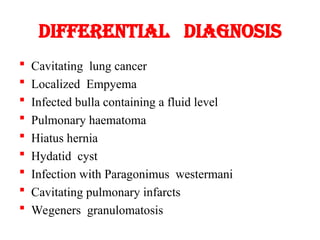
DIFFERENTIAL DIAGNOSIS
 Cavitating lung cancer
 Localized Empyema
 Infected bulla containing a fluid level
 Pulmonary haematoma
 Hiatus hernia
 Hydatid cyst
 Infection with Paragonimus westermani
 Cavitating pulmonary infarcts
 Wegeners granulomatosis
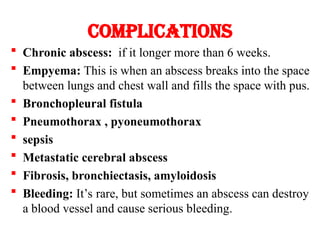
Complications
 Chronic abscess: if it longer more than 6 weeks.
 Empyema: This is when an abscess breaks into the space
between lungs and chest wall and fills the space with pus.
 Bronchopleural fistula
 Pneumothorax , pyoneumothorax
 sepsis
 Metastatic cerebral abscess
 Fibrosis, bronchiectasis, amyloidosis
 Bleeding: It’s rare, but sometimes an abscess can destroy
a blood vessel and cause serious bleeding.
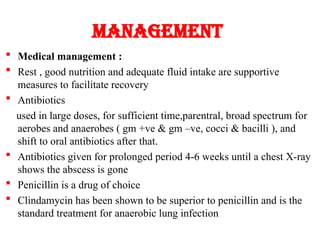
Management
 Medical management :
 Rest , good nutrition and adequate fluid intake are supportive
measures to facilitate recovery
 Antibiotics
used in large doses, for sufficient time,parentral, broad spectrum for
aerobes and anaerobes ( gm +ve & gm –ve, cocci & bacilli ), and
shift to oral antibiotics after that.
 Antibiotics given for prolonged period 4-6 weeks until a chest X-ray
shows the abscess is gone
 Penicillin is a drug of choice
 Clindamycin has been shown to be superior to penicillin and is the
standard treatment for anaerobic lung infection
Management
 Drainage: if the abscess is 6 centimeters or more in
diameter.
 Chest physiotherapy and postural drainage are helpful in
disease process.
 Bronchoscopy, for drainage (tamponade, or removal of
FB ).
 Transthoracic needle aspiration ( with toilet and local
antibiotic injection ).
 Intercostal tube drainage
Management
 Surgery:
 It’s rare, but some people need surgery to remove the part of the lung
with the abscess.
 Surgery is indicated in poor response to antibiotic therapy
 Large abscess > 6cm in diameter
 Resistance organisms as P. aeruginosa
 Massive or recurrent life threatening haemoptysis.
 Complicating Empyema.
 Suspicion of lung cancer.
 Surgery can also help to remove a foreign object
 The usual procedures is lobectomy or pneumonectomy
DR. sina lung abscess.pptوؤنؤوؤوؤزؤنؤزؤتؤنؤنزي

DR. sina lung abscess.pptوؤنؤوؤوؤزؤنؤزؤتؤنؤنزي

  • 1.
    Lung abscess DR. SINAAL-NOMI Assist. prof. faculty of medicine Taiz university 2021
  • 2.
    Lung abscess • Isa localized area of destruction of lung parenchyma cause by infection of pyogenic organisms results in tissue necrosis and suppuration. • It manifests radiological as a cavity with an air-fluid levels. • 75% of abscess occur in posterior segment of the Rt. upper lobe or Apical segments of either lower lobe.
  • 3.
    Classification  May beprimary or secondary  Primary : abscess in previously healthy patient or in a patient at risk for aspiration  Secondary : associated bronchogenic neoplasm or immunocompromised patient
  • 4.
    Risk factors /causes  Infectious agent generally cause lung abscess: 1) Gram negative organisms as klebsiella, S. aureus, & anaerobic bacilli. 2) T.B 3) Parasitic 4) Fungal disease of the lung as Histoplasma capsulatum, Aspergillus, Candida  Actinomyces israeli –single large lung abscess: Lung infiltrate with honey comb of small abscess cavities that may communicate with chest wall with bony destruction and sinus formation  HIV infection
  • 5.
    Risk factors /causes 1) Most lung abscess are caused by aspiration of material from the GI tract in to the lungs Risk factors for aspiration include:  Alcoholism  Seizure  Strock-Depressed conscious level  Neuromuscular disorders  Drug overdose, Sedation  General anasthesia, Impaired laryngeal closure ( cuffed endotracheal tube), tracheostomy tube, recurrent laryngeal nerve palsy )  Disturbances of swallowing, Delayed gastric emptying
  • 6.
    Risk factors /causes 2) Pre existing lung disease:  Necrotizing pneumonia  Bronchiectasis  Cystic fibrosis  Bronchial obstruction as in tumour, foreign body,  congenital abnormalitis  Infected pulmonary infarct  Trauma  Immunodeficiency
  • 7.
    Risk factors /causes 3) Poor oral health: gum disease are more likely to get an abscess, Dental / periodontal sepsis 4) Paranasal sinus infection 5) Poor immune system : like fungi or the bacteria that cause T.B , Strep throat, & MRSA.
  • 8.
    Risk factors /causes 6) Blood-borne causes: It’s rare, but bacteria or infected blood clot can travel through bloodstream to the lung, where they cause an abscess.  Hematogenous spread from a distal site: 1. UTI 2. Abdominal sepsis 3. Pelvic sepsis 4. Infective endocarditis 5. IV drug abuse 6. Infective IV canulae 7. Septic thrombophlebitis
  • 9.
    Clinical manifestation  Symptomsof a lung abscess commonly come slowly over weeks to months. They may include:  Cough with purulent sputum (Sputum is a mixture of saliva & mucous with pus that’s often sour-tasting, foul smelling, or streaked with blood)  Haemoptysis  Fever, Chills & night sweats  Fatigue & loss of appetite  Pleuritic chest pain  Dyspnoea  Weight loss
  • 10.
    Clinical manifestation  Onexamination: No signs specific for lung abscess  Digital clubbing – develop within a few weeks if treatment is inadequate  Dullness on percussion  Decrease breath sound on auscultation over the segment of lung involved  Crackles
  • 11.
    Diagnosis  History andphysical examination  Sputum, pleural fluid and blood culture  AFB sputum smears  3  Bronchoscopy to get samples of sputum or lung tissue  Chest X-Ray  CT Scan
  • 12.
  • 13.
  • 14.
    DIFFERENTIAL DIAGNOSIS  Cavitatinglung cancer  Localized Empyema  Infected bulla containing a fluid level  Pulmonary haematoma  Hiatus hernia  Hydatid cyst  Infection with Paragonimus westermani  Cavitating pulmonary infarcts  Wegeners granulomatosis
  • 15.
    Complications  Chronic abscess:if it longer more than 6 weeks.  Empyema: This is when an abscess breaks into the space between lungs and chest wall and fills the space with pus.  Bronchopleural fistula  Pneumothorax , pyoneumothorax  sepsis  Metastatic cerebral abscess  Fibrosis, bronchiectasis, amyloidosis  Bleeding: It’s rare, but sometimes an abscess can destroy a blood vessel and cause serious bleeding.
  • 16.
    Management  Medical management:  Rest , good nutrition and adequate fluid intake are supportive measures to facilitate recovery  Antibiotics used in large doses, for sufficient time,parentral, broad spectrum for aerobes and anaerobes ( gm +ve & gm –ve, cocci & bacilli ), and shift to oral antibiotics after that.  Antibiotics given for prolonged period 4-6 weeks until a chest X-ray shows the abscess is gone  Penicillin is a drug of choice  Clindamycin has been shown to be superior to penicillin and is the standard treatment for anaerobic lung infection
  • 17.
    Management  Drainage: ifthe abscess is 6 centimeters or more in diameter.  Chest physiotherapy and postural drainage are helpful in disease process.  Bronchoscopy, for drainage (tamponade, or removal of FB ).  Transthoracic needle aspiration ( with toilet and local antibiotic injection ).  Intercostal tube drainage
  • 18.
    Management  Surgery:  It’srare, but some people need surgery to remove the part of the lung with the abscess.  Surgery is indicated in poor response to antibiotic therapy  Large abscess > 6cm in diameter  Resistance organisms as P. aeruginosa  Massive or recurrent life threatening haemoptysis.  Complicating Empyema.  Suspicion of lung cancer.  Surgery can also help to remove a foreign object  The usual procedures is lobectomy or pneumonectomy