The Microlab experience in bridging the gap
between academia and industry

EU - Israel Seminar on Technology Transfer with an Emphasis on Clean
Tech


Tel Aviv, November 25-26, 2012
Name: Dr. Alex Bartzas
Microprocessors and Digital Systems Lab
National Technical University of Athens, Greece
Academia and Industry

                     Mainly through EC-funded research projects
                                  and HiPEAC NoE


                                 Technology
        Academia
                                  Clusters                        Industry
   (Microlab/NTUA)
                                  (Corallia)


Nov. 25, 2012                                                                2
Clusters supported by Corallia


Nano/Microelectronics
                            Space Technologies and   Gaming Technologies &
 based Systems and
                             Applications Cluster    Creative Content Cluster
 Applications Cluster


                 Microlab is a member of
                     all three clusters
                                  Members: 22
    Members: 130                                          Members: 22
                                 Initiation: 2009
   Initiation: 2004                                      Initiation: 2011
                                Turnover: > € 100
 Turnover: > € 5.7 bil.                                Turnover: > € 1.2 bil.
                                        mil.
Employment: > 5000                                     Employment: > 1000
Nov. 25, 2012                  Employment: > 600                             3
Services to Cluster Members

•   Acquisition of third party funding (R&D and non R&D projects, VCs, BAs, Banks)
•   One Stop Shop (consulting, mentoring, coaching -mainly- for founders)
•   Networking Events (networking days, user days, open days, carpe diem, webinars)
•   Internationalisation Events (trade fairs, exhibitions, roadshows, etc.)
•   Web presence (social networks, knowledge base, cluster mapping)
•   Incubation Area (office space and amenities, data centre and management)
•   Business Area (meeting rooms and amenities, printing services, telepresence etc.)
•   Exhibition Area (physical and virtual booths)
•   Job finder (career days, career matchmaker platform)
•   Public Relations (Newsletter, News-Stream, NewsWatch, branding)
•   Training events (business acceleration programme, patenting, etc.)


    Nov. 25, 2012                                                                       4
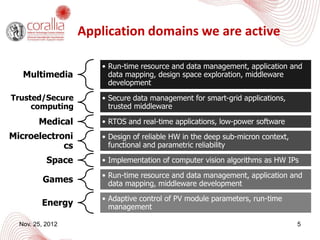
Application domains we are active

                      • Run-time resource and data management, application and
   Multimedia           data mapping, design space exploration, middleware
                        development

Trusted/Secure        • Secure data management for smart-grid applications,
     computing          trusted middleware

        Medical       • RTOS and real-time applications, low-power software
Microelectroni        • Design of reliable HW in the deep sub-micron context,
            cs          functional and parametric reliability

           Space      • Implementation of computer vision algorithms as HW IPs

                      • Run-time resource and data management, application and
          Games         data mapping, middleware development
                      • Adaptive control of PV module parameters, run-time
         Energy         management

  Nov. 25, 2012                                                                 5
Space: What is our work?
  The exploration of Mars is one of the main goals for
  both NASA and ESA, as confirmed by past and
  recent activities
  • The last 15 years there are a number of on-orbit
    and surface missions to Mars


  • Our projects are part of the ExoMars mission
    (scheduled for 2018)
Nov. 25, 2012                                            6
Collaboration with industry
• European Space Agency (ESA) Projects
    • SPARTAN
    • SEXTANT
• Develop IP kernels for computer vision algorithms targeting to
  rover navigation for Mars terrain
    • ESA-compatible VHDL
       • Mapped onto Xilinx Virtex-6 board
    • Optimized C/C++ code
       • Running onto 150MIPS processor (space-oriented device)


                                                          TRASYS
                   GMV AEROSPACE and DEFENCE                                 CNES


Nov. 25, 2012                                                                                        7
                National Technical University of Athens            Democritus University of Thrace
Medical: What is our work?
  • Tackling societal needs
      • Reduced healthcare costs as a result of reduced
        need for hospitalization, and clinician visits through
        increased remote monitoring
      • Increase access to best practice care for patients
        living in remote geographical locations
      • More efficient use of Governmental and Insurance
        healthcare resources by ensuring patient
        concordance with treatment protocols through
        remote monitoring

  • The applications we are working on aim at the
    next generation, integrated solutions for
    personalized treatment and management of
    patients
      • integrated solution for patients with chronic renal
        failure
      • integrated autonomous device for the monitoring
        and the personalized management of chronic
        wounds
Nov. 25, 2012                                                    8
Collaboration with industry
  • Collaboration through E.C. IP-Projects
      • SWAN-iCare
      • Nephron+
  • Developing real-time and low-power embedded SW applications running on
    the wearable medical devices
      • Reading data from the sensors, handling the actuators and relaying data to the
        patients and medical personnel


                                  Sensors
                  Actuators


                              Wireless
                              comm.


                Embedded real-time SW,
Nov. 25, 2012     integrated control                                                9
Energy: What is our work?
  Problem: Power loss due to partial shading of the PV array and the PV
  module
  • Conventional topologies of modules deal with partial shading by placing
    bypass diodes across group of cells
      • These bypass diodes are effective in dealing with mismatch losses between the
        groups of cells
      • A shaded group of cells is bypassed when shaded in order to allow the rest of
        the module to operate on a higher current
      • The power potentially produced by the bypassed group is lost
  • When the incident shade affects all the groups in a similar way, the entire
    module operates on a lower current since there is no option of bypassing
    the shaded cells.


Nov. 25, 2012                                                                       10
Collaboration with industry
  • Close collaboration with IMEC, vzw., Belgium
      • Partial funding of Ph.D. researchers
      • Internships
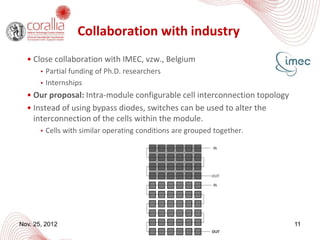
  • Our proposal: Intra-module configurable cell interconnection topology
  • Instead of using bypass diodes, switches can be used to alter the
    interconnection of the cells within the module.
      • Cells with similar operating conditions are grouped together.


Nov. 25, 2012                                                               11
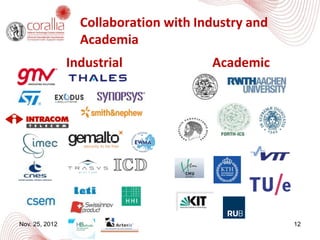
Collaboration with Industry and
                  Academia
                Industrial             Academic


Nov. 25, 2012                                       12
www.corallia.org

                                     www.microlab.ntua.gr

Thank You!
Questions?

               More information:
               Alex Bartzas, Ph.D.
         alexis@microlab.ntua.gr

Dr. alex bartzas

  • 1.
    The Microlab experiencein bridging the gap between academia and industry EU - Israel Seminar on Technology Transfer with an Emphasis on Clean Tech Tel Aviv, November 25-26, 2012 Name: Dr. Alex Bartzas Microprocessors and Digital Systems Lab National Technical University of Athens, Greece
  • 2.
    Academia and Industry Mainly through EC-funded research projects and HiPEAC NoE Technology Academia Clusters Industry (Microlab/NTUA) (Corallia) Nov. 25, 2012 2
  • 3.
    Clusters supported byCorallia Nano/Microelectronics Space Technologies and Gaming Technologies & based Systems and Applications Cluster Creative Content Cluster Applications Cluster Microlab is a member of all three clusters Members: 22 Members: 130 Members: 22 Initiation: 2009 Initiation: 2004 Initiation: 2011 Turnover: > € 100 Turnover: > € 5.7 bil. Turnover: > € 1.2 bil. mil. Employment: > 5000 Employment: > 1000 Nov. 25, 2012 Employment: > 600 3
  • 4.
    Services to ClusterMembers • Acquisition of third party funding (R&D and non R&D projects, VCs, BAs, Banks) • One Stop Shop (consulting, mentoring, coaching -mainly- for founders) • Networking Events (networking days, user days, open days, carpe diem, webinars) • Internationalisation Events (trade fairs, exhibitions, roadshows, etc.) • Web presence (social networks, knowledge base, cluster mapping) • Incubation Area (office space and amenities, data centre and management) • Business Area (meeting rooms and amenities, printing services, telepresence etc.) • Exhibition Area (physical and virtual booths) • Job finder (career days, career matchmaker platform) • Public Relations (Newsletter, News-Stream, NewsWatch, branding) • Training events (business acceleration programme, patenting, etc.) Nov. 25, 2012 4
  • 5.
    Application domains weare active • Run-time resource and data management, application and Multimedia data mapping, design space exploration, middleware development Trusted/Secure • Secure data management for smart-grid applications, computing trusted middleware Medical • RTOS and real-time applications, low-power software Microelectroni • Design of reliable HW in the deep sub-micron context, cs functional and parametric reliability Space • Implementation of computer vision algorithms as HW IPs • Run-time resource and data management, application and Games data mapping, middleware development • Adaptive control of PV module parameters, run-time Energy management Nov. 25, 2012 5
  • 6.
    Space: What isour work? The exploration of Mars is one of the main goals for both NASA and ESA, as confirmed by past and recent activities • The last 15 years there are a number of on-orbit and surface missions to Mars • Our projects are part of the ExoMars mission (scheduled for 2018) Nov. 25, 2012 6
  • 7.
    Collaboration with industry •European Space Agency (ESA) Projects • SPARTAN • SEXTANT • Develop IP kernels for computer vision algorithms targeting to rover navigation for Mars terrain • ESA-compatible VHDL • Mapped onto Xilinx Virtex-6 board • Optimized C/C++ code • Running onto 150MIPS processor (space-oriented device) TRASYS GMV AEROSPACE and DEFENCE CNES Nov. 25, 2012 7 National Technical University of Athens Democritus University of Thrace
  • 8.
    Medical: What isour work? • Tackling societal needs • Reduced healthcare costs as a result of reduced need for hospitalization, and clinician visits through increased remote monitoring • Increase access to best practice care for patients living in remote geographical locations • More efficient use of Governmental and Insurance healthcare resources by ensuring patient concordance with treatment protocols through remote monitoring • The applications we are working on aim at the next generation, integrated solutions for personalized treatment and management of patients • integrated solution for patients with chronic renal failure • integrated autonomous device for the monitoring and the personalized management of chronic wounds Nov. 25, 2012 8
  • 9.
    Collaboration with industry • Collaboration through E.C. IP-Projects • SWAN-iCare • Nephron+ • Developing real-time and low-power embedded SW applications running on the wearable medical devices • Reading data from the sensors, handling the actuators and relaying data to the patients and medical personnel Sensors Actuators Wireless comm. Embedded real-time SW, Nov. 25, 2012 integrated control 9
  • 10.
    Energy: What isour work? Problem: Power loss due to partial shading of the PV array and the PV module • Conventional topologies of modules deal with partial shading by placing bypass diodes across group of cells • These bypass diodes are effective in dealing with mismatch losses between the groups of cells • A shaded group of cells is bypassed when shaded in order to allow the rest of the module to operate on a higher current • The power potentially produced by the bypassed group is lost • When the incident shade affects all the groups in a similar way, the entire module operates on a lower current since there is no option of bypassing the shaded cells. Nov. 25, 2012 10
  • 11.
    Collaboration with industry • Close collaboration with IMEC, vzw., Belgium • Partial funding of Ph.D. researchers • Internships • Our proposal: Intra-module configurable cell interconnection topology • Instead of using bypass diodes, switches can be used to alter the interconnection of the cells within the module. • Cells with similar operating conditions are grouped together. Nov. 25, 2012 11
  • 12.
    Collaboration with Industryand Academia Industrial Academic Nov. 25, 2012 12
  • 13.
    www.corallia.org www.microlab.ntua.gr Thank You! Questions? More information: Alex Bartzas, Ph.D. alexis@microlab.ntua.gr