CHAPTER 3  4-BIT PREFETCH


                                     CHAPTER 3   4-BIT PREFETCH 


This chapter describes the 4-bit prefetch.
The 4-bit prefetch is new architecture adopted for DDR2 SDRAM. In this architecture, the internal bus width has been made
four times wider than the external bus width, so that data bus transfers can be accelerated by a factor of four without having to
change the operating speed of the internal bus (memory cell array).
When using this 4-bit prefetch architecture, DDR2 SDRAM is able to perform high-speed transfers at 400Mbps or more.


3.1  Semiconductor Processes and Acceleration Limits 

As applications become more complex, ever faster speeds are required of DRAM units. However, a DRAM unit's internal
operating speed is limited under current semiconductor processes, and further acceleration is rather difficult.
Higher speed has been realized in DDR2 SDRAM by separating the DRAM's internal operations from the I/O buffer's
operations to enable acceleration of the I/O buffer, which is much easier to accelerate than the DRAM itself.


3.2  Prefetch Operation  

The prefetch operation fetches and latches in advance data that will be output from DRAM (memory cell array) to an I/O buffer.
When the operating speed of the I/O buffer is faster than that of the memory cell array, DDR SDRAM is able to increase the
amount of data it can transfer in one clock cycle of a prefetch operation, which enables a data transfer area to be secured.
Two prefetch methods (4-bit prefetch and 2-bit prefetch) are provided for the prefetch operation, according to the different
amounts of data that can be transferred per clock cycle. DDR2 SDRAM uses the 4-bit prefetch method.


3.2.1  Operations of DDR2 SDRAM, DDR SDRAM, and SDR SDRAM 

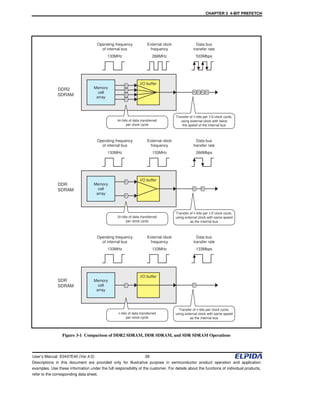
SDR SDRAM transfers data in synchronization with the rising edge of an external clock signal.
A data transfer area is secured by transferring data with 1×n bit width (I/O width) from the memory cell array to the I/O buffer at
the same frequency as the external clock signal.
DDR SDRAM transfers data in synchronization with the rising and falling edges of an external clock signal. This means that
DDR SDRAM is able to transfer data at twice the speed of SDR SDRAM, even though both SDRAM types have the same
operating frequency.
In addition, DDR SDRAM uses its prefetch function to latch data in 2×n-bit width from the memory cell array to the I/O buffer
at the same operating frequency as the external clock, and is thus able to secure a data transfer area without requiring a higher
internal bus frequency.
DDR2 SDRAM can operate at twice the frequency of DDR SDRAM. Thus, DDR2 SDRAM is able to prefetch data in 4×n-bit
width (4-bit prefetch) without requiring a higher internal bus frequency.


User’s Manual  E0437E40 (Ver.4.0)                                   27 
Descriptions  in  this  document  are  provided  only  for  illustrative  purpose  in  semiconductor  product  operation  and  application 
examples. Use these information under the full responsibility of the customer. For details about the functions of individual products, 
refer to the corresponding data sheet. 
CHAPTER 3  4-BIT PREFETCH


                                       Operating frequency              External clock                 Data bus
                                         of internal bus                 frequency                   transfer rate
                                             133MHz                         266MHz                    533Mbps


                                                                   I/O buffer
               DDR2                  Memory
                                       cell
               SDRAM
                                      array


                                                                                         Transfer of n bits per 1/2-clock cycle,
                                                   4n bits of data transferred              using external clock with twice
                                                         per clock cycle                     the speed of the internal bus


                                       Operating frequency              External clock                 Data bus
                                         of internal bus                 frequency                   transfer rate
                                             133MHz                         133MHz                    266Mbps


                                                                   I/O buffer
               DDR                   Memory
               SDRAM                   cell
                                      array


                                                                                         Transfer of n bits per 1/2 clock cycle,
                                                   2n bits of data transferred           using external clock with same speed
                                                         per clock cycle                          as the internal bus


                                       Operating frequency              External clock                 Data bus
                                         of internal bus                 frequency                   transfer rate
                                             133MHz                         133MHz                    133Mbps


                                                                   I/O buffer
               SDR                   Memory
               SDRAM                   cell
                                      array


                                                                                           Transfer of n bits per clock cycle,
                                                    n bits of data transferred           using external clock with same speed
                                                          per clock cycle                         as the internal bus


                  Figure 3-1  Comparison of DDR2 SDRAM, DDR SDRAM, and SDR SDRAM Operations 


User’s Manual  E0437E40 (Ver.4.0)                                     28 
Descriptions  in  this  document  are  provided  only  for  illustrative  purpose  in  semiconductor  product  operation  and  application 
examples. Use these information under the full responsibility of the customer. For details about the functions of individual products, 
refer to the corresponding data sheet. 
CHAPTER 3  4-BIT PREFETCH


3.3  Operating Speeds of DDR2 SDRAM, DDR SDRAM, and SDR SDRAM  

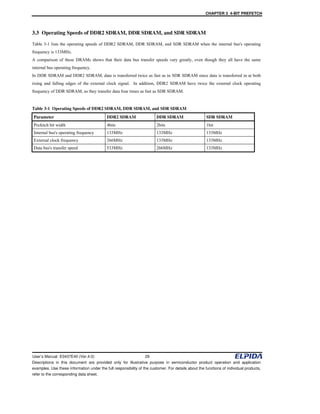
Table 3-1 lists the operating speeds of DDR2 SDRAM, DDR SDRAM, and SDR SDRAM when the internal bus's operating
frequency is 133MHz.
A comparison of these DRAMs shows that their data bus transfer speeds vary greatly, even though they all have the same
internal bus operating frequency.
In DDR SDRAM and DDR2 SDRAM, data is transferred twice as fast as in SDR SDRAM since data is transferred in at both
rising and falling edges of the external clock signal. In addition, DDR2 SDRAM have twice the external clock operating
frequency of DDR SDRAM, so they transfer data four times as fast as SDR SDRAM.


Table 3-1  Operating Speeds of DDR2 SDRAM, DDR SDRAM, and SDR SDRAM  
 Parameter                                   DDR2 SDRAM                    DDR SDRAM                     SDR SDRAM 
 Prefetch bit width                          4bits                         2bits                         1bit
 Internal bus's operating frequency          133MHz                        133MHz                        133MHz
 External clock frequency                    266MHz                        133MHz                        133MHz
 Data bus's transfer speed                   533MHz                        266MHz                        133MHz


User’s Manual  E0437E40 (Ver.4.0)                                   29 
Descriptions  in  this  document  are  provided  only  for  illustrative  purpose  in  semiconductor  product  operation  and  application 
examples. Use these information under the full responsibility of the customer. For details about the functions of individual products, 
refer to the corresponding data sheet. 

DDR2_versus_DDR

  • 1.
    CHAPTER 3  4-BIT PREFETCH   CHAPTER 3   4-BIT PREFETCH  This chapter describes the 4-bit prefetch. The 4-bit prefetch is new architecture adopted for DDR2 SDRAM. In this architecture, the internal bus width has been made four times wider than the external bus width, so that data bus transfers can be accelerated by a factor of four without having to change the operating speed of the internal bus (memory cell array). When using this 4-bit prefetch architecture, DDR2 SDRAM is able to perform high-speed transfers at 400Mbps or more. 3.1  Semiconductor Processes and Acceleration Limits  As applications become more complex, ever faster speeds are required of DRAM units. However, a DRAM unit's internal operating speed is limited under current semiconductor processes, and further acceleration is rather difficult. Higher speed has been realized in DDR2 SDRAM by separating the DRAM's internal operations from the I/O buffer's operations to enable acceleration of the I/O buffer, which is much easier to accelerate than the DRAM itself. 3.2  Prefetch Operation   The prefetch operation fetches and latches in advance data that will be output from DRAM (memory cell array) to an I/O buffer. When the operating speed of the I/O buffer is faster than that of the memory cell array, DDR SDRAM is able to increase the amount of data it can transfer in one clock cycle of a prefetch operation, which enables a data transfer area to be secured. Two prefetch methods (4-bit prefetch and 2-bit prefetch) are provided for the prefetch operation, according to the different amounts of data that can be transferred per clock cycle. DDR2 SDRAM uses the 4-bit prefetch method. 3.2.1  Operations of DDR2 SDRAM, DDR SDRAM, and SDR SDRAM  SDR SDRAM transfers data in synchronization with the rising edge of an external clock signal. A data transfer area is secured by transferring data with 1×n bit width (I/O width) from the memory cell array to the I/O buffer at the same frequency as the external clock signal. DDR SDRAM transfers data in synchronization with the rising and falling edges of an external clock signal. This means that DDR SDRAM is able to transfer data at twice the speed of SDR SDRAM, even though both SDRAM types have the same operating frequency. In addition, DDR SDRAM uses its prefetch function to latch data in 2×n-bit width from the memory cell array to the I/O buffer at the same operating frequency as the external clock, and is thus able to secure a data transfer area without requiring a higher internal bus frequency. DDR2 SDRAM can operate at twice the frequency of DDR SDRAM. Thus, DDR2 SDRAM is able to prefetch data in 4×n-bit width (4-bit prefetch) without requiring a higher internal bus frequency. User’s Manual  E0437E40 (Ver.4.0)  27  Descriptions  in  this  document  are  provided  only  for  illustrative  purpose  in  semiconductor  product  operation  and  application  examples. Use these information under the full responsibility of the customer. For details about the functions of individual products,  refer to the corresponding data sheet. 
  • 2.
    CHAPTER 3  4-BIT PREFETCH   Operating frequency External clock Data bus of internal bus frequency transfer rate 133MHz 266MHz 533Mbps I/O buffer DDR2 Memory cell SDRAM array Transfer of n bits per 1/2-clock cycle, 4n bits of data transferred using external clock with twice per clock cycle the speed of the internal bus Operating frequency External clock Data bus of internal bus frequency transfer rate 133MHz 133MHz 266Mbps I/O buffer DDR Memory SDRAM cell array Transfer of n bits per 1/2 clock cycle, 2n bits of data transferred using external clock with same speed per clock cycle as the internal bus Operating frequency External clock Data bus of internal bus frequency transfer rate 133MHz 133MHz 133Mbps I/O buffer SDR Memory SDRAM cell array Transfer of n bits per clock cycle, n bits of data transferred using external clock with same speed per clock cycle as the internal bus Figure 3-1  Comparison of DDR2 SDRAM, DDR SDRAM, and SDR SDRAM Operations  User’s Manual  E0437E40 (Ver.4.0)  28  Descriptions  in  this  document  are  provided  only  for  illustrative  purpose  in  semiconductor  product  operation  and  application  examples. Use these information under the full responsibility of the customer. For details about the functions of individual products,  refer to the corresponding data sheet. 
  • 3.
    CHAPTER 3  4-BIT PREFETCH   3.3  Operating Speeds of DDR2 SDRAM, DDR SDRAM, and SDR SDRAM   Table 3-1 lists the operating speeds of DDR2 SDRAM, DDR SDRAM, and SDR SDRAM when the internal bus's operating frequency is 133MHz. A comparison of these DRAMs shows that their data bus transfer speeds vary greatly, even though they all have the same internal bus operating frequency. In DDR SDRAM and DDR2 SDRAM, data is transferred twice as fast as in SDR SDRAM since data is transferred in at both rising and falling edges of the external clock signal. In addition, DDR2 SDRAM have twice the external clock operating frequency of DDR SDRAM, so they transfer data four times as fast as SDR SDRAM. Table 3-1  Operating Speeds of DDR2 SDRAM, DDR SDRAM, and SDR SDRAM   Parameter  DDR2 SDRAM  DDR SDRAM   SDR SDRAM  Prefetch bit width 4bits 2bits 1bit Internal bus's operating frequency 133MHz 133MHz 133MHz External clock frequency 266MHz 133MHz 133MHz Data bus's transfer speed 533MHz 266MHz 133MHz User’s Manual  E0437E40 (Ver.4.0)  29  Descriptions  in  this  document  are  provided  only  for  illustrative  purpose  in  semiconductor  product  operation  and  application  examples. Use these information under the full responsibility of the customer. For details about the functions of individual products,  refer to the corresponding data sheet.