

By the end of this presentation, the goal
is to gain a basic understanding of Down
Syndrome through:
› What Downs Syndrome Is
› Possible Causes of Downs
› How to Identify It
› Some Teaching Strategies
› A Few Interesting Statistics
› Family/Community Resources
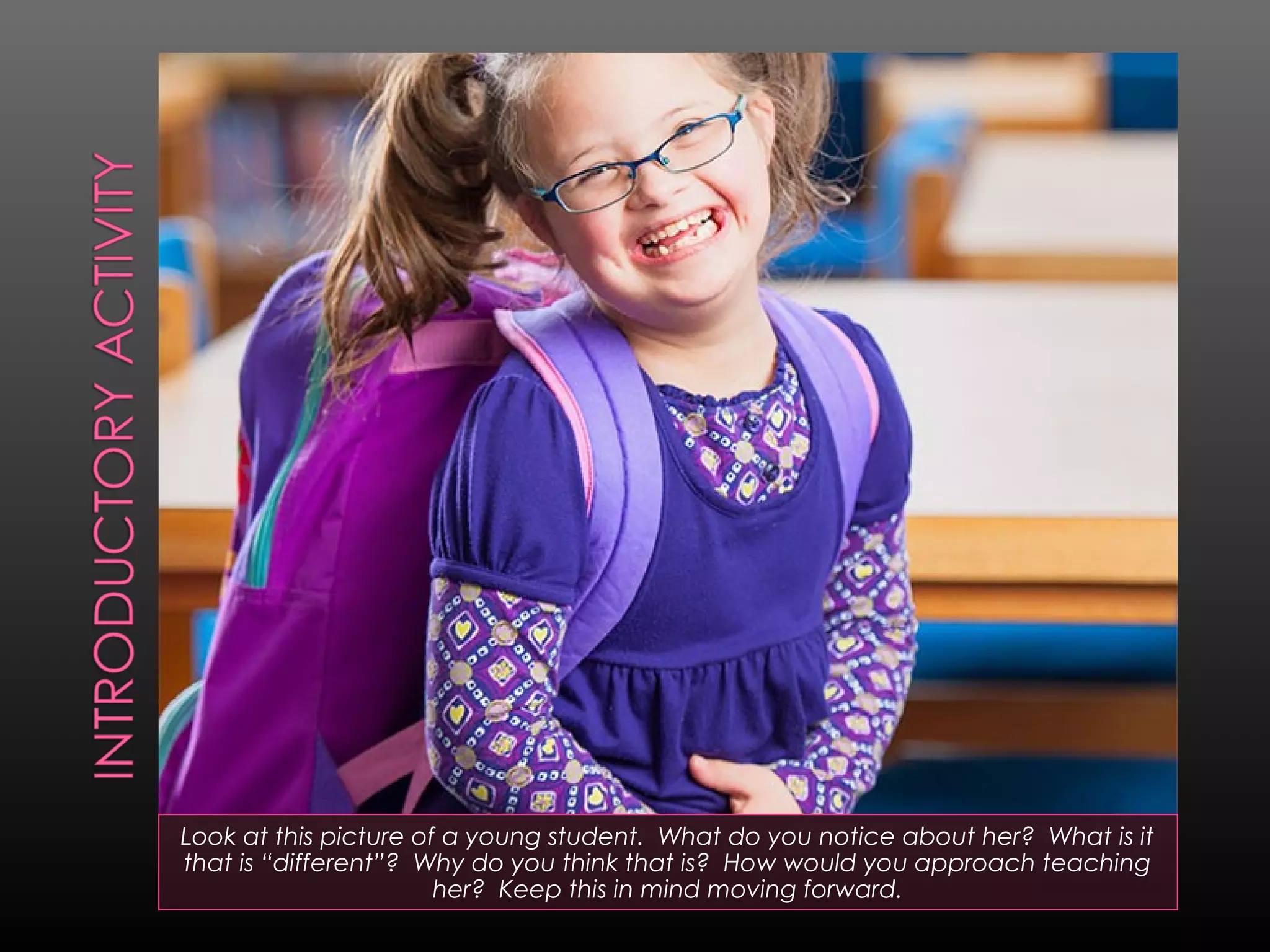
Look at this picture of a young student. What do you notice about her? What is it
that is “different”? Why do you think that is? How would you approach teaching
her? Keep this in mind moving forward.
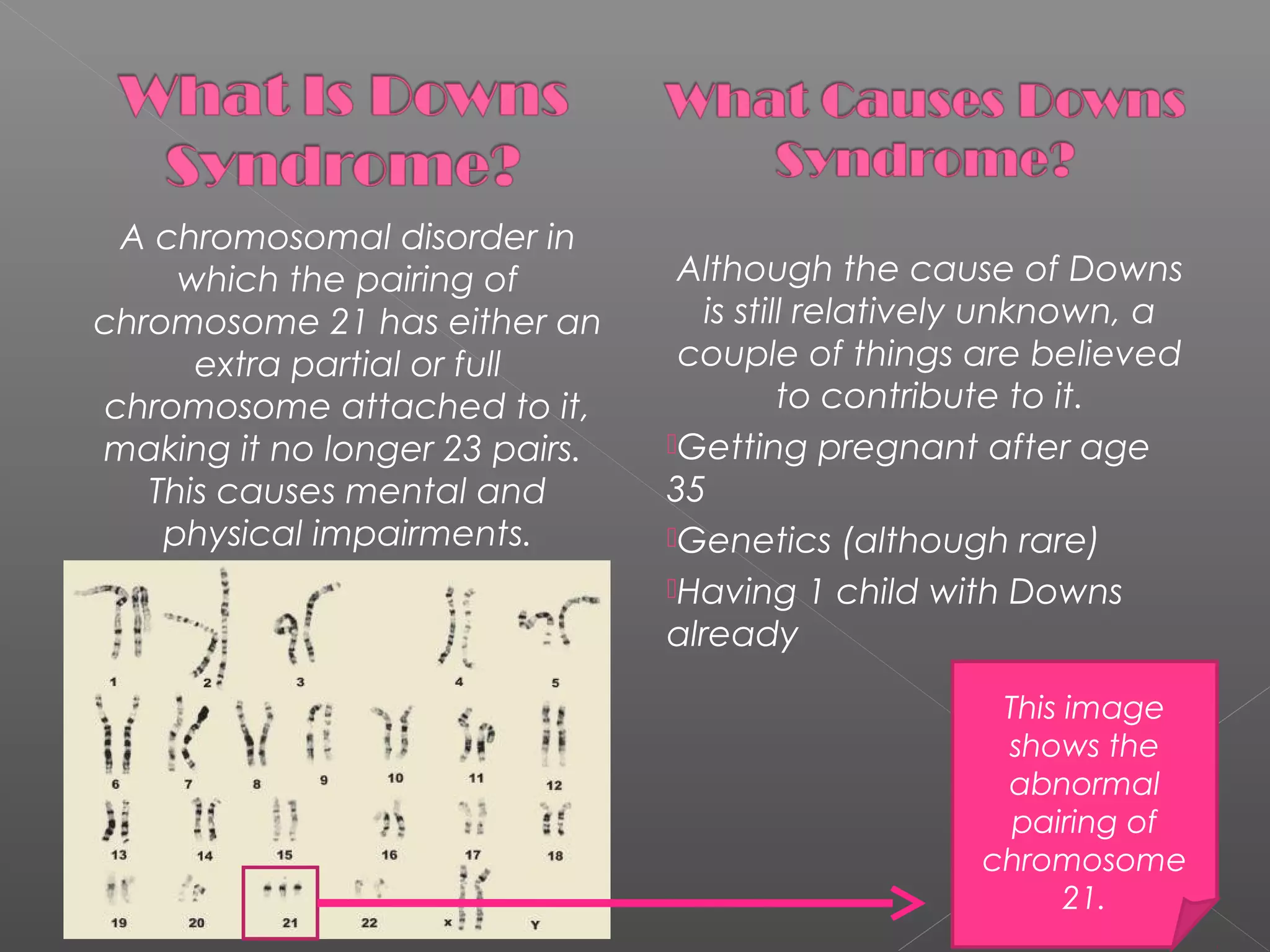
A chromosomal disorder in
which the pairing of
chromosome 21 has either an
extra partial or full
chromosome attached to it,
making it no longer 23 pairs.
This causes mental and
physical impairments.

Although the cause of Downs
is still relatively unknown, a
couple of things are believed
to contribute to it.
Getting pregnant after age
35
Genetics (although rare)
Having 1 child with Downs
already
This image
shows the
abnormal
pairing of
chromosome
21.











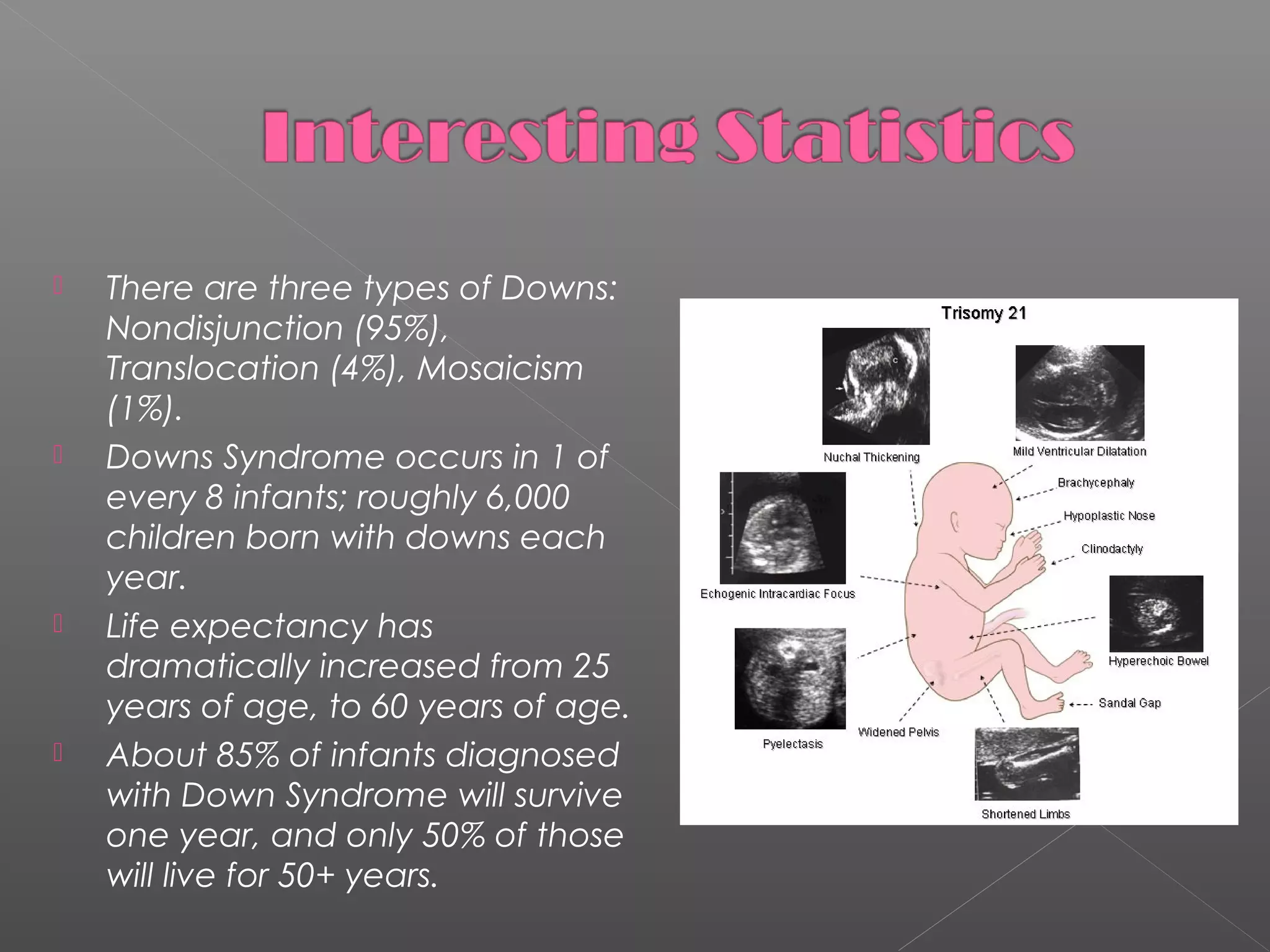
Short stature
Round face
Almond-shaped eyes
Upward slanting eyes
Decreased muscle tone
Short neck w/ extra skin
on back of neck
Brushfield spots
Wide short hands w/
short fingers
Deep groove between
first and second toe
Single, deep crease
along palm of hand








Short attention span
Poor judgment
Impulsive behavior
Slow learning
Delayed language
development
Delayed speech
development










The teachers consult with the special education teacher and
generally have an aide in the classroom with them.
The students were involved in speech therapy, occupational
therapy, and physical therapy for “treatment”.
In the classrooms computer and technology are a key tool used.
Peer tutors and group teaching proved to be effective.
Individual instruction is much more effective than large group.
Most effective place of instruction is the student's desk area.
The best education materials are hands-on & "real-life" scenarios.
Praise is the best behavior management tool/ motivator.
Keeping the educators educated about Downs is the MOST
important strategy of all!








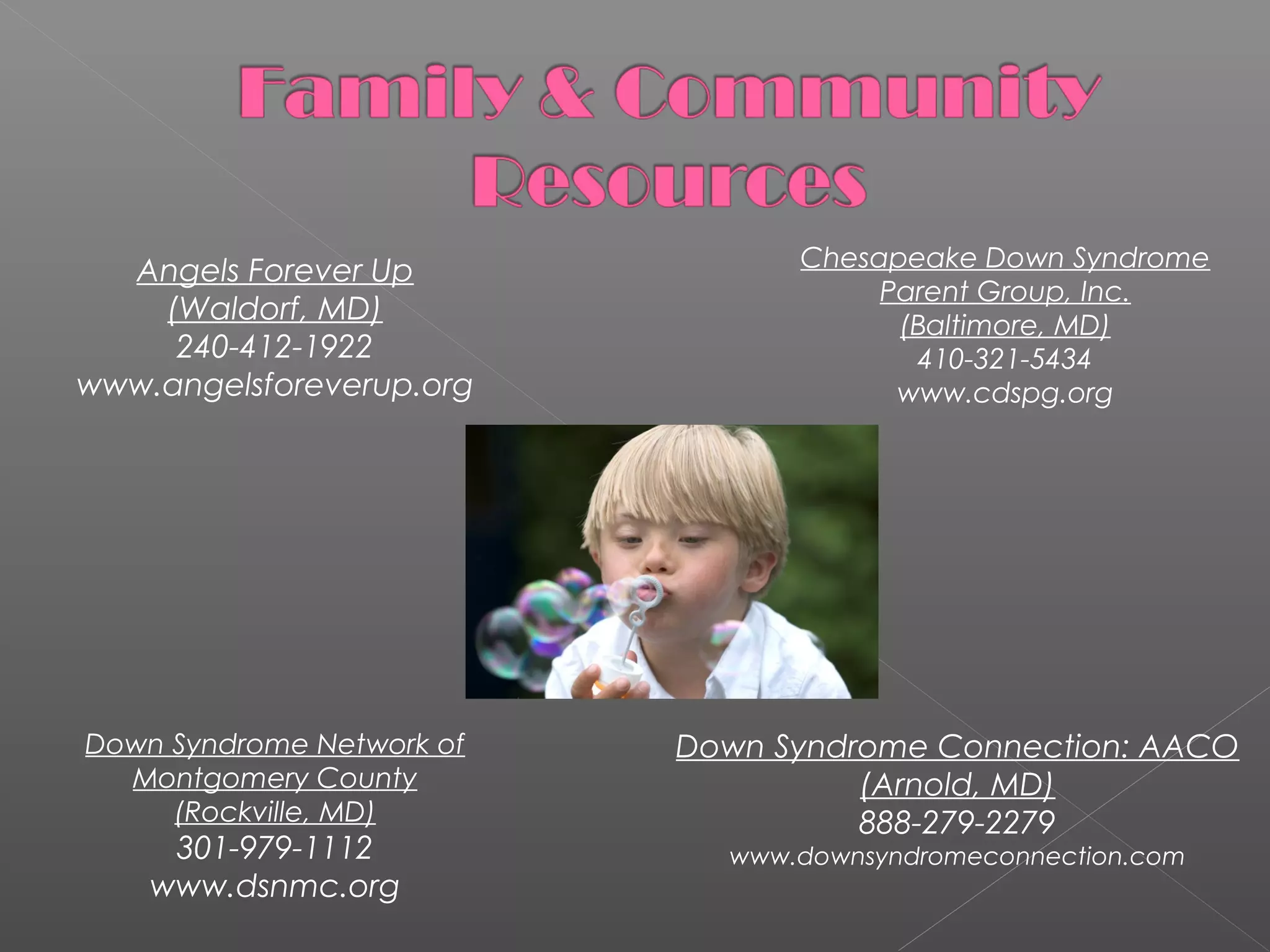
There are three types of Downs:
Nondisjunction (95%),
Translocation (4%), Mosaicism
(1%).
Downs Syndrome occurs in 1 of
every 8 infants; roughly 6,000
children born with downs each
year.
Life expectancy has
dramatically increased from 25
years of age, to 60 years of age.
About 85% of infants diagnosed
with Down Syndrome will survive
one year, and only 50% of those
will live for 50+ years.
Angels Forever Up
(Waldorf, MD)
240-412-1922
www.angelsforeverup.org

Down Syndrome Network of
Montgomery County
(Rockville, MD)

301-979-1112
www.dsnmc.org

Chesapeake Down Syndrome
Parent Group, Inc.
(Baltimore, MD)
410-321-5434
www.cdspg.org

Down Syndrome Connection: AACO
(Arnold, MD)
888-279-2279
www.downsyndromeconnection.com


Now that you are aware of what Down
Syndrome is, consider the following:
› How has your view of those with Down

Syndrome changed?
› What did you learn?
› How will you apply this to your life and/ or
your classroom?










American Pregnancy Association. (2014). Down Syndrome: Trisomy 21. Retrieved
from American Pregnancy Assocication: http://
americanpregnancy.org/birthdefects/downsyndrome.html
Global Down Syndrome Foundation. (2011). Facts and FAQ About Down
Syndrome. Retrieved from Global Down Syndrome Foundation:
http://www.globaldownsyndrome.org/about-down-syndrome/facts-about-down-syndrom
facts
National Down Syndrome Society. (2012). What Is Down Syndrome? Retrieved
from National Down Syndrome Society:
http://www.ndss.og/Down-Syndrome/What-Is-Down-Syndrome/
National Institute of Health. (2012, November 30). What are the common
symptoms of down sydrome? Retrieved from National Institute of Child Health and
Human Development:
http://www.nichd.nih.gov/health/topics/down/conditioninfo/pages/symptoms.as
px
Wolpert, G. (2001). What general educators have to say about successfully
including students with down syndrome in their classes. Journal of Research in
Childhood Education, 16(1), 28-38. Retrieved from http://ezproxy.aacc.edu/login?
url=http://search.proquest.com/docview/203877315?accountid=40680

Downs Syndrome Presentation

  • 2.
     By the endof this presentation, the goal is to gain a basic understanding of Down Syndrome through: › What Downs Syndrome Is › Possible Causes of Downs › How to Identify It › Some Teaching Strategies › A Few Interesting Statistics › Family/Community Resources
  • 3.
    Look at thispicture of a young student. What do you notice about her? What is it that is “different”? Why do you think that is? How would you approach teaching her? Keep this in mind moving forward.
  • 4.
    A chromosomal disorderin which the pairing of chromosome 21 has either an extra partial or full chromosome attached to it, making it no longer 23 pairs. This causes mental and physical impairments. Although the cause of Downs is still relatively unknown, a couple of things are believed to contribute to it. Getting pregnant after age 35 Genetics (although rare) Having 1 child with Downs already This image shows the abnormal pairing of chromosome 21.
  • 5.
              Short stature Round face Almond-shapedeyes Upward slanting eyes Decreased muscle tone Short neck w/ extra skin on back of neck Brushfield spots Wide short hands w/ short fingers Deep groove between first and second toe Single, deep crease along palm of hand       Short attention span Poor judgment Impulsive behavior Slow learning Delayed language development Delayed speech development
  • 6.
             The teachers consultwith the special education teacher and generally have an aide in the classroom with them. The students were involved in speech therapy, occupational therapy, and physical therapy for “treatment”. In the classrooms computer and technology are a key tool used. Peer tutors and group teaching proved to be effective. Individual instruction is much more effective than large group. Most effective place of instruction is the student's desk area. The best education materials are hands-on & "real-life" scenarios. Praise is the best behavior management tool/ motivator. Keeping the educators educated about Downs is the MOST important strategy of all!
  • 7.
        There are threetypes of Downs: Nondisjunction (95%), Translocation (4%), Mosaicism (1%). Downs Syndrome occurs in 1 of every 8 infants; roughly 6,000 children born with downs each year. Life expectancy has dramatically increased from 25 years of age, to 60 years of age. About 85% of infants diagnosed with Down Syndrome will survive one year, and only 50% of those will live for 50+ years.
  • 8.
    Angels Forever Up (Waldorf,MD) 240-412-1922 www.angelsforeverup.org Down Syndrome Network of Montgomery County (Rockville, MD) 301-979-1112 www.dsnmc.org Chesapeake Down Syndrome Parent Group, Inc. (Baltimore, MD) 410-321-5434 www.cdspg.org Down Syndrome Connection: AACO (Arnold, MD) 888-279-2279 www.downsyndromeconnection.com
  • 9.
     Now that youare aware of what Down Syndrome is, consider the following: › How has your view of those with Down Syndrome changed? › What did you learn? › How will you apply this to your life and/ or your classroom?
  • 10.
         American Pregnancy Association.(2014). Down Syndrome: Trisomy 21. Retrieved from American Pregnancy Assocication: http:// americanpregnancy.org/birthdefects/downsyndrome.html Global Down Syndrome Foundation. (2011). Facts and FAQ About Down Syndrome. Retrieved from Global Down Syndrome Foundation: http://www.globaldownsyndrome.org/about-down-syndrome/facts-about-down-syndrom facts National Down Syndrome Society. (2012). What Is Down Syndrome? Retrieved from National Down Syndrome Society: http://www.ndss.og/Down-Syndrome/What-Is-Down-Syndrome/ National Institute of Health. (2012, November 30). What are the common symptoms of down sydrome? Retrieved from National Institute of Child Health and Human Development: http://www.nichd.nih.gov/health/topics/down/conditioninfo/pages/symptoms.as px Wolpert, G. (2001). What general educators have to say about successfully including students with down syndrome in their classes. Journal of Research in Childhood Education, 16(1), 28-38. Retrieved from http://ezproxy.aacc.edu/login? url=http://search.proquest.com/docview/203877315?accountid=40680