HUL
Submitted by
Mayank Lalwani
DOVE SHAMPOO
DM17MA34
Table of Contents
SECTORAL INFORMATION ...............................................................................................................................................2
Introduction.........................................................................................................................................................................2
Historical Growth of the sector observed in the last 5 years.................................................................2
Reasons for the Growth observed in the sector.............................................................................................3
Government initiatives ..................................................................................................................................................3
Porter’s Five Forces Model for the sector..........................................................................................................4
COMPANY INFORMATION................................................................................................................................................6
Company snapshot...........................................................................................................................................................6
SWOT analysis of Hindustan Unilever – HUL SWOT analysis...............................................................6
Product offered by the company.............................................................................................................................8
Competitor Analysis.....................................................................................................................................................10
News (Last 12 month) incl. corporate announcement...........................................................................11
MARKETING STRATEGY .................................................................................................................................................13
DOVE Shampoo................................................................................................................................................................14
SWOT analysis of DOVE Shampoo.......................................................................................................................14
Analyze marketing mix 4P’s of DOVE Shampoo..........................................................................................15
STP of DOVE Shampoo................................................................................................................................................17
PLC of DOVE Shampoo................................................................................................................................................17
Sales Forecast...................................................................................................................................................................18
DISTRIBUTION CHANNEL/NETWORK.............................................................................................................19
Intuitional Selling...........................................................................................................................................................21
Digital Marketing Strategy........................................................................................................................................22
Survey....................................................................................................................................................................................24
Factor Analysis...........................................................................................................................................................24
Conclusion................................................................................................................................................................................25
SECTORALINFORMATIONi
Introduction
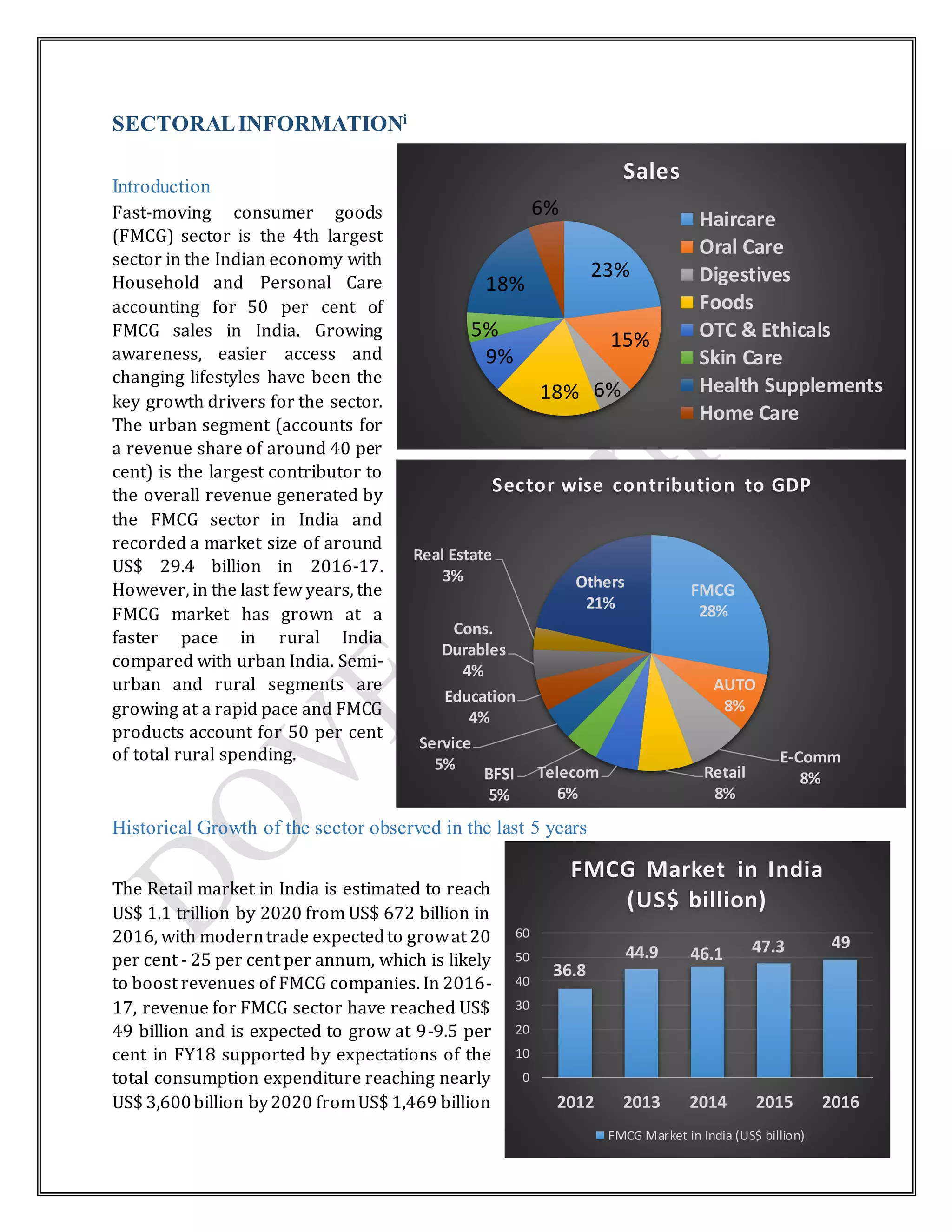
Fast-moving consumer goods
(FMCG) sector is the 4th largest
sector in the Indian economy with
Household and Personal Care
accounting for 50 per cent of
FMCG sales in India. Growing
awareness, easier access and
changing lifestyles have been the
key growth drivers for the sector.
The urban segment (accounts for
a revenue share of around 40 per
cent) is the largest contributor to
the overall revenue generated by
the FMCG sector in India and
recorded a market size of around
US$ 29.4 billion in 2016-17.
However, in the last few years, the
FMCG market has grown at a
faster pace in rural India
compared with urban India. Semi-
urban and rural segments are
growing at a rapid pace and FMCG
products account for 50 per cent
of total rural spending.
Historical Growth of the sector observed in the last 5 years
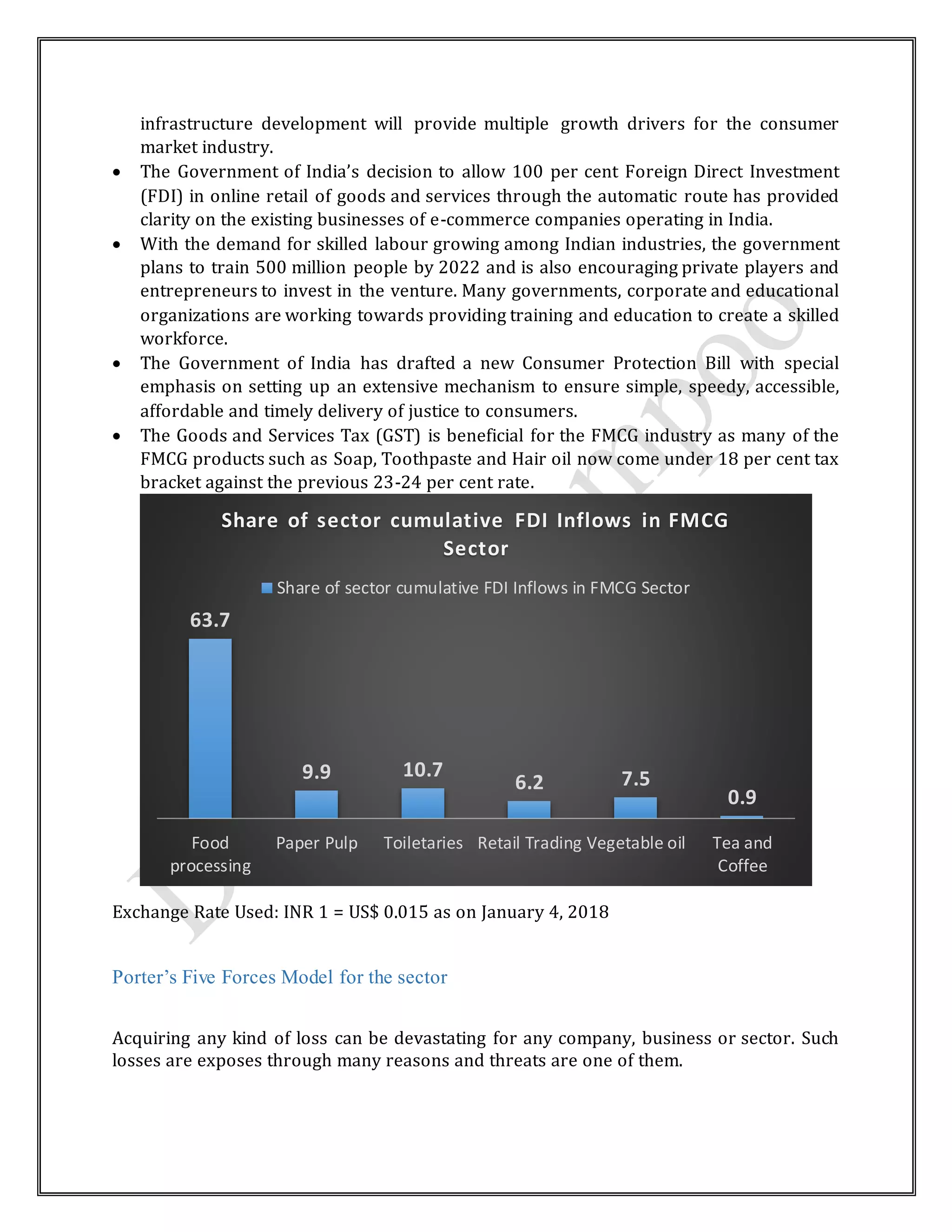
The Retail market in India is estimated to reach
US$ 1.1 trillion by 2020 from US$ 672 billion in
2016, with moderntrade expectedto growat 20
per cent - 25 per cent per annum, which is likely
to boost revenues of FMCG companies. In 2016-
17, revenue for FMCG sector have reached US$
49 billion and is expected to grow at 9-9.5 per
cent in FY18 supported by expectations of the
total consumption expenditure reaching nearly
US$ 3,600billion by2020 fromUS$ 1,469 billion
23%
15%
6%18%
9%
5%
18%
6%
Sales
Haircare
Oral Care
Digestives
Foods
OTC & Ethicals
Skin Care
Health Supplements
Home Care
36.8
44.9 46.1 47.3 49
0
10
20
30
40
50
60
2012 2013 2014 2015 2016
FMCG Market in India
(US$ billion)
FMCG Market in India (US$ billion)
FMCG
28%
AUTO
8%
E-Comm
8%Retail
8%
Telecom
6%
BFSI
5%
Service
5%
Education
4%
Cons.
Durables
4%
Real Estate
3% Others
21%
Sector wise contribution to GDP
in 2015. Direct selling sector in India is expected to reach Rs 159.3 billion (US$ 2.5 billion)
by 2021, if provided with a conducive environment through reforms and regulation.
Reasons for the Growth observed in the sector
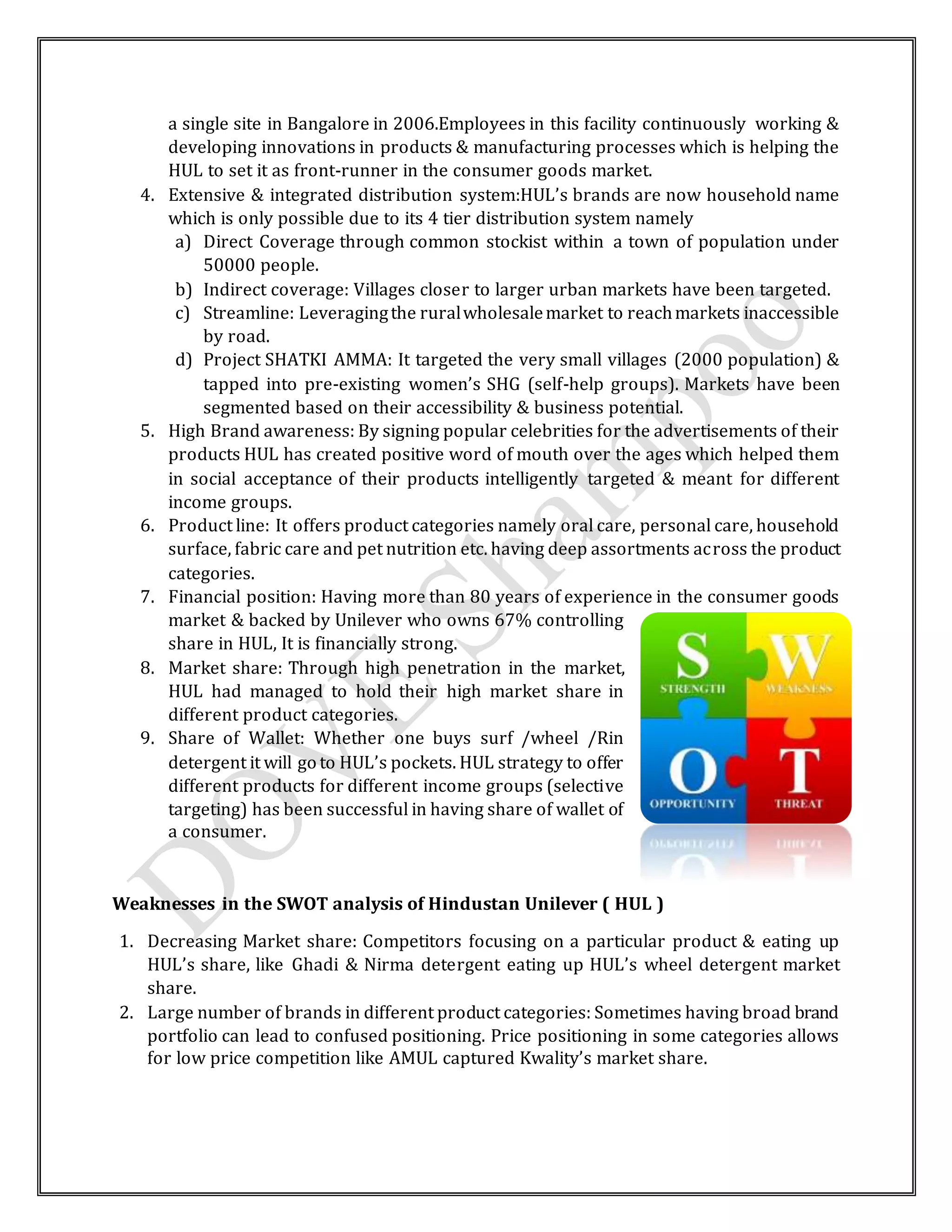
The government has allowed 100 per cent Foreign Direct Investment (FDI) in food
processing and single-brand retail and 51 per cent in multi-brand retail. This would bolster
employment and supply chains, and also provide high visibility for FMCG brands in
organised retail markets, bolstering consumer spending and encouraging more product
launches. The sector witnessed healthy FDI inflows of US$ 13.07 billion, during April 2000
to December 2017. Some of the recent developments in the FMCG sector are as follows:
 The Hershey Co plans to invest US$ 50 million over the next five years in India, its fastest
growing core market outside
of US.
 As a part of its Rs 25,000
crore (US$ 3.88 billion)
investment package, ITC will
invest Rs 10,000 crore (US$
1.55 billion) to expand its
food processing segment.
 The bottling arm of Coca-
Cola India, Hindustan Coca-
Cola Beverages (HCCB) is
planning to increase its retail
reach by one million new
outlets and is targeting a
revenue of US$ 2.5 billion by
2020.
 Future Retail will acquire
Hyper City, which is owned
by Shoppers Stop for Rs 911
crore (US$ 139.7 million) to further consolidate its business and have a better footing in
the hypermarket segment.
Government initiatives
Some of the major initiatives taken by the government to promote the FMCG sector in India
are as follows:
 In the Union Budget 2017-18, the Government of India has proposed to spend more on
the rural side with an aim to double the farmer’s income in five years; as well as the cut
in income tax rate targeting mainly the small tax payers, focus on affordable housing and
60%
40%
Urban – Rural industry
Breakup (FY2016-17)
Urban
Rural
US$ 49
billion
infrastructure development will provide multiple growth drivers for the consumer
market industry.
 The Government of India’s decision to allow 100 per cent Foreign Direct Investment
(FDI) in online retail of goods and services through the automatic route has provided
clarity on the existing businesses of e-commerce companies operating in India.
 With the demand for skilled labour growing among Indian industries, the government
plans to train 500 million people by 2022 and is also encouraging private players and
entrepreneurs to invest in the venture. Many governments, corporate and educational
organizations are working towards providing training and education to create a skilled
workforce.
 The Government of India has drafted a new Consumer Protection Bill with special
emphasis on setting up an extensive mechanism to ensure simple, speedy, accessible,
affordable and timely delivery of justice to consumers.
 The Goods and Services Tax (GST) is beneficial for the FMCG industry as many of the
FMCG products such as Soap, Toothpaste and Hair oil now come under 18 per cent tax
bracket against the previous 23-24 per cent rate.
Exchange Rate Used: INR 1 = US$ 0.015 as on January 4, 2018
Porter’s Five Forces Model for the sector
Acquiring any kind of loss can be devastating for any company, business or sector. Such
losses are exposes through many reasons and threats are one of them.
63.7
9.9 10.7
6.2 7.5
0.9
Food
processing
Paper Pulp Toiletaries Retail Trading Vegetable oil Tea and
Coffee
Share of sector cumulative FDI Inflows in FMCG
Sector
Share of sector cumulative FDI Inflows in FMCG Sector
The FMCG market in India is expected to grow at a CAGR of 20.6 per cent and is expected to
reach US$ 103.7 billion by 2020.The growth in sales of major FMCG companies like Dabur,
HUL, Marico, is signaling the revival of consumer demand in India. As the market continues
to grow at a rapid pace, Indian Retailer takes a look at Porter’s five force threats that may
affect the FMCG industry.
Threat of substitutes
With high presence of multiple brands in the market, it is not a challenge for consumers to
switch from one product to another. Strategic decisions like price point and quality play key
roles in attracting consumers. With narrow product differentiation under many brands, it’s
rather easy for a consumer to switch to another brand. The threat of substitutes is informed
by switching costs, both immediate and long-term, as well as a buyer's inclination to change.
Competitive rivalry
Many players are expanding into new geographies and categories and modern retail share is
expectedto be valued $180billion in 2020. The FMCG industry hasbeen a highly fragmented
industry as more companies enter the market. If Wipro is diversifying and expanding its
product range in energy drinks, detergents and fabric conditioners, Patanjali will spend
US$743.72 million in various food parks across the country. Also, launch of private label
brands by big retailers, which are competitively priced with offers and discounts, will limit
competition for weak brands.
Bargaining power of buyers
While rising incomes and growing youth population have been key growth drivers of the
sector, brand consciousness has also aided demand. With low switching cost inducing
customers to shift to other products, there will only be more demand for new products. Also,
the availability of same or similar alternatives, backed by strong influence of marketing
strategies will help the sector. India’s consumer spending is expected to increase to US$ 3.6
trillion by 2020.
Threat of new entrants
Any new competition in the market poses threat to the existing players in the industry. With
investment approvals of up to 100 per cent foreign equity in single brand retail and 51 per
cent in multi-brand retail, the market is expected to be crowded. Also, companies will be
forced to spend aggressively on advertisement, which will only hurt the business in the long
run.
Bargaining power of suppliers
Big FMCG companies are often in a position to dictate prices through local sourcing from a
fragmented group or key commodity suppliers. Suppliers can exert pressure on businesses
and even buyers by raising prices, lowering quality or reducing product availability. Such
decisions mostly affect the buyers.
COMPANYINFORMATIONii
Company snapshot
Hindustan Unilever Limited (HUL) is India's largest Fast Moving Consumer Goods company
with a heritage of over 80 years in India. On any given day, nine out of ten Indian households
use our products to feel good, look good and get more out of life – giving us a unique
opportunity to build a brighter future.
HUL works to create a better future every day and helps people feel good, look good and get
more out of life with brands and services that are good for them and good for others.
Hindustan Unilever Limited is engaged in fast-moving consumer goods business comprising
home and personal care, foods and refreshments. The Company's segments are Soaps and
Detergents, which includes soaps, detergent bars, detergent powders, detergent liquids and
scourers; Personal Products, which includes products in categories of oral care, skin care
(excluding soaps), hair care, deodorants, talcum powder, color cosmetics and salon services;
Beverages, which includes tea and coffee; Packaged Foods.
With over 35 brands spanning 20 distinct categories such as soaps, detergents, shampoos,
skin care, toothpastes, deodorants, cosmetics, tea, coffee, packaged foods, ice cream, and
water purifiers, the Company is a part of the everyday life of millions of consumers across
India. Its portfolio includes leading household brands such as Lux, Lifebuoy, Surf Excel, Rin,
Wheel, Fair& Lovely, Pond’s, Vaseline, Lakmé, Dove, Clinic Plus, Sunsilk, Pepsodent, Closeup,
Axe, Brooke Bond, Bru, Knorr, Kissan, Kwality Wall’s and Pureit.
The Company hasabout 18,000employees andhas a net salesof INR 33895crores(financial
year 2016-17). HUL is a subsidiary of Unilever, one of the world’s leading suppliers of Food,
Home Care, Personal Care and Refreshment products with sales in over 190 countries and
an annual sales turnover of €52.7 billion in 2016. Unilever has over 67% shareholding in
HUL
SWOT analysis of Hindustan Unilever – HUL SWOT analysis
Strengths in the SWOT analysis of Hindustan Unilever ( HUL )
1. Brand visibility – From soap to mineral water, HUL is shaping the life of 1.3 billion
people daily. Being in consumer goods market with its 20 consumer categories such
as soap, tea, detergents, shampoo etc. & each having large assortments, helped HUL
in occupying the large shelf space of Grocery /departmental stores which itself
explains the acceptance/demand of their products in the market.
2. Market leader in consumer goods: According to Nielsen data 2 out of three Indian
consumers use HUL products. HUL used selective targeting strategy to emerge as a
market leader in the Indian market.
3. Innovative FMCG Company: Hindustan Unilever Research center (HURC),Mumbai &
Unilever Research India, Bangalore ,both research facilities were bought together in
a single site in Bangalore in 2006.Employees in this facility continuously working &
developing innovations in products & manufacturing processes which is helping the
HUL to set it as front-runner in the consumer goods market.
4. Extensive & integrated distribution system:HUL’s brands are now household name
which is only possible due to its 4 tier distribution system namely
a) Direct Coverage through common stockist within a town of population under
50000 people.
b) Indirect coverage: Villages closer to larger urban markets have been targeted.
c) Streamline: Leveragingthe ruralwholesalemarket to reachmarkets inaccessible
by road.
d) Project SHATKI AMMA: It targeted the very small villages (2000 population) &
tapped into pre-existing women’s SHG (self-help groups). Markets have been
segmented based on their accessibility & business potential.
5. High Brand awareness: By signing popular celebrities for the advertisements of their
products HUL has created positive word of mouth over the ages which helped them
in social acceptance of their products intelligently targeted & meant for different
income groups.
6. Product line: It offers product categories namely oral care, personal care, household
surface, fabric care and pet nutrition etc. having deep assortments across the product
categories.
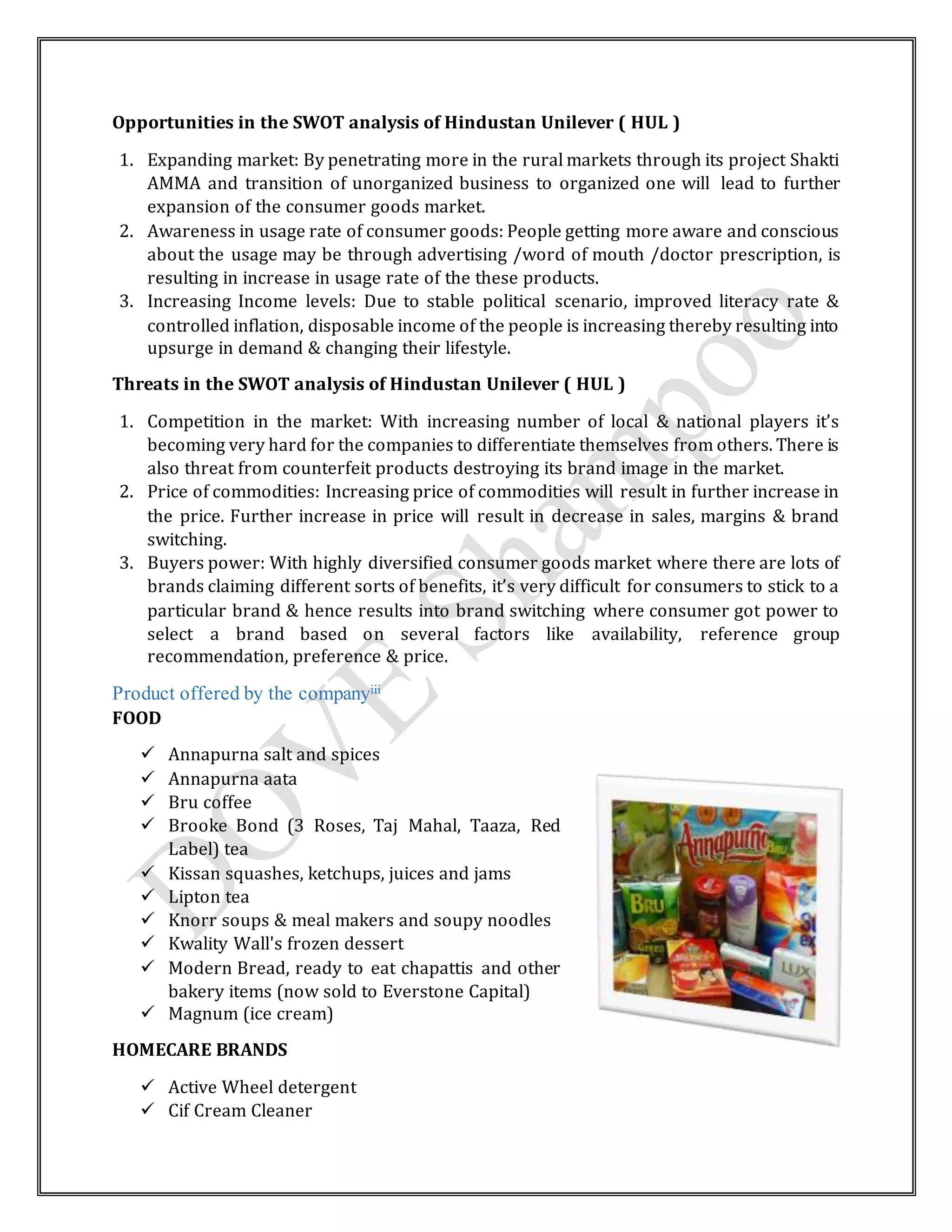
7. Financial position: Having more than 80 years of experience in the consumer goods
market & backed by Unilever who owns 67% controlling
share in HUL, It is financially strong.
8. Market share: Through high penetration in the market,
HUL had managed to hold their high market share in
different product categories.
9. Share of Wallet: Whether one buys surf /wheel /Rin
detergent it will go to HUL’s pockets. HUL strategy to offer
different products for different income groups (selective
targeting) has been successful in having share of wallet of
a consumer.
Weaknesses in the SWOT analysis of Hindustan Unilever ( HUL )
1. Decreasing Market share: Competitors focusing on a particular product & eating up
HUL’s share, like Ghadi & Nirma detergent eating up HUL’s wheel detergent market
share.
2. Large number of brands in different product categories: Sometimes having broad brand
portfolio can lead to confused positioning. Price positioning in some categories allows
for low price competition like AMUL captured Kwality’s market share.
Opportunities in the SWOT analysis of Hindustan Unilever ( HUL )
1. Expanding market: By penetrating more in the rural markets through its project Shakti
AMMA and transition of unorganized business to organized one will lead to further
expansion of the consumer goods market.
2. Awareness in usage rate of consumer goods: People getting more aware and conscious
about the usage may be through advertising /word of mouth /doctor prescription, is
resulting in increase in usage rate of the these products.
3. Increasing Income levels: Due to stable political scenario, improved literacy rate &
controlled inflation, disposable income of the people is increasing thereby resulting into
upsurge in demand & changing their lifestyle.
Threats in the SWOT analysis of Hindustan Unilever ( HUL )
1. Competition in the market: With increasing number of local & national players it’s
becoming very hard for the companies to differentiate themselves from others. There is
also threat from counterfeit products destroying its brand image in the market.
2. Price of commodities: Increasing price of commodities will result in further increase in
the price. Further increase in price will result in decrease in sales, margins & brand
switching.
3. Buyers power: With highly diversified consumer goods market where there are lots of
brands claiming different sorts of benefits, it’s very difficult for consumers to stick to a
particular brand & hence results into brand switching where consumer got power to
select a brand based on several factors like availability, reference group
recommendation, preference & price.
Product offered by the companyiii
FOOD
 Annapurna salt and spices
 Annapurna aata
 Bru coffee
 Brooke Bond (3 Roses, Taj Mahal, Taaza, Red
Label) tea
 Kissan squashes, ketchups, juices and jams
 Lipton tea
 Knorr soups & meal makers and soupy noodles
 Kwality Wall's frozen dessert
 Modern Bread, ready to eat chapattis and other
bakery items (now sold to Everstone Capital)
 Magnum (ice cream)
HOMECARE BRANDS
 Active Wheel detergent
 Cif Cream Cleaner
 Comfort fabric softeners
 Domex disinfectant/toilet
cleaner
 Rin detergents andbleach
 Sunlight detergent and
colour care
 Surf Excel detergent and
gentle wash
 Vim dishwasher
 Magic – Water Saver
Personal Care Brands
 Aviance Beauty Solutions
 Axe deodorant and after shaving lotion and soap
 LEVER Ayush Therapy ayurvedic health care and personal care products
 Breeze beauty soap
 Brylcreem hair cream and hair gel
 Clear anti-dandruff hair products
 Clinic Plus shampoo and oil
 Close Up toothpaste
 Dove skin cleansing & hair care range: bar, lotions, creams and anti-perspirant
deodorants
 Denim shaving products
 Fair& Lovely skin-lightening products
 Hamam
 Indulekha ayurvedic hair oil
 Lakmé beauty products and salons
 Lifebuoy soaps and handwash range
 Liril 2000 soap
 Lux soap, body wash and deodorant
 Pears soap, body wash
 Pepsodent toothpaste
 Pond's talcs and creams
 Rexona
 Sunsilk shampoo
 Sure anti-perspirant
 Vaseline petroleum jelly, skin care lotions
 TRESemmé
 TIGI
Water Purifier Brand
 Pureit Water Purifier
Competitor Analysis
According to the market survey done by BUSINESS TODAY the top 10 companies of FMCG
sector are given below.
1. Hindustan Unilever Ltd.
2. ITC (Indian Tobacco Company)
3. Nestlé India
4. GCMMF (AMUL)
5. Dabur India
6. Asian Paints (India)
7. Cadbury India
8. Britannia Industries
9. Procter & Gamble Hygiene and Health Care
10. Marico Industries
THE COMPARATIVE DATA OF % MARKET SHARE OF HUL AND ITS COMPETITOR
INQUARTER ENDED JUN’17
(Above graph showing %age Market share of HUL and its competitor in different categories
of FMCG products)
As mentioned in the above graph, HUL is enjoying the leader position in the market and is
having highest market shares which are followed by the market challengers like Dabur India
Ltd, Nestle India Ltd, and ITC LTD, ETC…. In different categories of FMCG products like
shampoo, skincare, deo, jams, coffee, etc
(Above graph showing the two category of products in which HUL percentage market share
is less than its competitor in Quarter ended JUN’17)
So we can see that in overall FMCG business HUL is distantly ahead of rest of the companies
as far as market share of different products are concerned.
News (Last 12 month) incl. corporate announcementiv
 Hindustan Unilever drags 3 former employees to court for data theft
 HUL has taken its three former employees to Bombay High Court for allegedly
stealing confidential data
 11/10/2017 Interim Dividend 800% Rs.8.0000 per share (800%)Interim
 Hindustan Unilever L - Board Meeting-Outcome of Board Meeting 12-Apr-2018
 Sanjiv Mehta, managing director at Hindustan Unilever has been appointed as
executive Chairman of the company, succeeding Harish Manwani who will retire as
non-executive Chairman by June end.
 Entered into the list of the top-5 most valuable companies by market capitalisation
(m-cap) as the stock price of the company hit a new high on Wednesday.
 With an m-cap of Rs 3.06 trillion, HUL now features at fifth position in the list by
replacing India’s largest mortgage financier, Housing Development Finance
Corporation (HDFC) in this prestigious club
30
24.5
47.9
27.6
TOOTH PASTE KETCHUP
Chart Title
HUL (Market Share%) Competitor (Market Share %)
 FMCG major HUL on Wednesday said it has offered another tranche of Rs 360 million
of GST benefits for January to the government, taking the total to Rs 1.55 billion since
the tax rates were revised on November 15 last year.
 HUL’s better-than-anticipated volume growth of 11 per cent versus estimates of 8-9
per cent increase, and operating profit margins suggests that demonetisation is a
thing of the past and industry has tackled the hiccups of the goods and services tax or
GST quite in its stride.
 Hindustan Unilever Ltd posted a 28% rise in its third-quarter profit on Wednesday,
underpinned by higher sales from its personal care business.
 Profit came in at Rs 13.26 billion in the quarter ended Dec. 31, from Rs 10.38 a year
ago, the diversified consumer goods maker said.
 Total income during the quarter under review stood at Rs 87.42 billion as against Rs
84 billion in the year-ago period, up 4 per cent, it added.
MARKETING STRATEGY
Dove is a personal care brand of Unilever. It is one of the most valuable brand with sales of
over €1 billion. Dove was introduced in 1957 and provides high quality personal care
products across more than 80 countries. Dove provides products for both women and men.
It is No 4 most trusted brand in India and has high growth potential. It is positioned as a high
quality brand at affordable prices. Dovehad started with beauty soap which became popular
in 1970’s as a mild soap. Dove now has a wide range of personal products. Dove competes
with L’oreal and Olay. Dove is known for its revolutionary marketing campaign ‘Campaign
for real beauty’.
Dovegrewfrom amoisturising Beauty Barinto a globalbrandwith a rangeofproducts:body
washes, hand and body lotions, facial cleansers, deodorants, shampoos, conditioners and
hair styling.
Dove bar & skin cleansing
Dove got women to experience the ‘real’ Dove difference, with the Face Test campaign.
Thousands of women across the country put their soap, and Dove, to the test. They all had
the same answer – Dove made their skin soft.
Dove hair care range
Dove launched its hair care range in India in 2007, and became the fastest growing shampoo
brand in the country. It’s highly conditioned formulation delivers the moisture promise of
Dove. The range includes Daily Shine, Dryness Care, Dandruff Care, Hair Fall Rescue, Intense
Repair Therapy, Nourishing Oil Care and Color Rescue.
Dove anti-perspirant deodorants
Your delicate underarms need tender care. Try the New Dove Deodorants with ¼
moisturising cream. Choose from 3 variants – Original, Silk Dry and Clear Touch, for visibly
softer, smoother underarms, 24-hr protection from sweat and odour.
Dove lotions & creams
Pamper your skin with the unique rich moisturisers and pure silk formula of Dove Lotions
and Creams.
DOVE Shampoov
There’s so much more to shampoo than just ‘getting clean’. That’s
why with Dove shampoos, hair gets the nourishing care it needs,
along with gentle cleansing power.
There’s power in beautiful hair. We all know how great hair can
make you feel: when it’s glossy and healthy-looking, you can step
out feeling confident and proud. To achieve that feeling every day,
we’ve ensured that our shampoos nourish and restore hair from
within, wash after wash, making hair healthier in the long run.
Fordayto day, ourDailyShine Shampoo protectsnormalhair from
the daily wear and tear of life, and nourishes to leave it softer and
5x smoother*. Looking for an anti-dandruff shampoo? Dove
Dandruff Care Shampoo will help you keep those white flakes
away.
Andevery nowandthen, we’reall left fighting hair’snaturalenemy
– hair fall. Start tackling it right from the foundations with a
shampoo for hair fall like our Hair Fall Rescue Shampoo.
SWOT analysis of DOVE Shampoo
Dove SWOT Analysis
Strengths
1. Dove contains 1/4 moisturizing cream
2. Dove has got an excellent market presence owing to string
advertising and marketing exercises
3. Flagship product of Unilever with strong brand awareness
through advertising and branding
4. Promises not to leave any residue on the skin
5. Dove products are available in more than 80 countries
worldwide
6. Apart from soaps, products like bathing gel, shampoos,
conditioners, creams, deodorants are also a part of the product line
7. Dove products are available through an extensive supply chain
network of Unilever at leading supermarkets, stores & even online
Weaknesses
1. Intense competition for Dove in the FMCG market means limited
growth in market share
2. Targets primarily only the female segment & products not to
popular with men
Opportunities
1. Can target male audience more purposefully
2. Dove can increasing its reach by further geographic expansion
3. Involvement of students from colleges & tieup with corporates
can open a new opporunity
Threats
1. Increased Competition in this market segment can affect
business of Dove
2. Global business can be affected by government policies and
fluctuating economies
3. Fake imitations of the brand can affect Dove's image
Analyze marketing mix 4P’s of DOVE Shampoo
Product:
Dove provides high quality products.
Categories of products in the marketing mix
of Dove are skin care, washing & bathing,
deodorants and hair care. Dove soap
positions itself as something better than soap
and that it itself is not a soap but a beauty bar.
The point of difference being moisturization
and softener and cleansing cream. Dove is
also well known for its haircare products
which are recommended by dermatologists.
New products are being regularly introduced.
In deodorants Dove introduced the Dry Spray
deodorant. In hair products Dove has
introduced Advanced Hair Series globally.
Dove has also launched the Dove DermaSpa
range in Europe which brings spa experience
and hair care at one place. Dove has recently
forayed into baby care products with products ranging from moisturizer, baby lotion to
diaper cream and wipes.
Price:
Dove uses competitive pricing. Dove products were initially premium priced however due to
low demand dove reduced the price. The products are priced slightly higher than
competitors. But dueto high quality andunique featuresofmoisturizer andsoftenerdemand
is high. Thus, the price strategy in the market mix mostly is governed by the competition
prices because of the several number of competitor products available.
Place:
Dove products are sold in more than 80 countries. Dove uses distribution channels of its
parent company Unilever. Products are transported from factory to warehouse from where
C&F agent sells to stockists and stockist to retailer. Dove products are available in
supermarkets, general stores, , chemists and wholesellers. Dove products can be bought
from ecommerce sites as well.
Promotion:
Beauty product companies have for decades focused on an ideal image which everyone
should aspire to become using that company’s product. Dove has unique and completely
different marketing campaign. The promotional strategy in the marketing mix of Dove is
aspirational for women. Its ‘Campaign for real beauty’ focuses on women self-esteem. The
brandsuccessfullycommunicated that peopleofall agesandall coloursareequallybeautiful.
It celebrates diversity in each individual. Dove uses non models in all its advertising
campaigns. Dove uses people of all body sizes, age and colour in its advertisements. Dove
also promotesits brandsthroughvideosand shortfilms andits ad films are someofthe most
widely downloaded.Dovehaslaunched acampaign to combat the negative media campaigns
which exploit women’s insecurity and self-esteem. It used curvy women to fight the ideal
body shape image created and also released a video showing the editing process of models.
Dove’s Ad Makeover campaign is social media based wherein negative ads can be replaced
by positive messages designed by Dove which boost women’s self-esteem. Dove uses
magazines such as cosmopolitan which women regularly read to advertise. Dove established
a self-esteem fundwhich aims to educate girls, help them overcomebeauty relatedproblems
online bullying and raise self-esteem. It uses evidence based programmes and online
resources for children as well as parents and teachers. The Dove Self-Esteem Project has
reached more than 19 million young people in 115 countries. Dove also uses promotional
methods such as coupons and exclusive offers. All these campaigns have created a very
positive and trust worthy brandimage of Dove.Hence, this coversthe entire Dovemarketing
mix.
STP of DOVE Shampoo
Dove STP
Segment Personal Health Care – Soap , Hair Care & Deodrants
Target Group Targets women of all ages from the urban households
Positioning Dove is committed to help all women realise their personal
beauty potential by creating products that deliver real care.
PLC of DOVE Shampoo
INTRODUCTION
Dove is a personal care brand owned by HUL having a wide range of products (soaps, body
wash, deodrants, lotions, hair care etc.) When the dove soap was introduced in the Indian
market it was priced at a
slightly higher range and
this they did so as to
maintain the 'premium' tag
of the brand. However,
initially the sales were not
up to the mark considering
the highly marked prices.
Dove then came up with
their ad campaign's to
promote the products and
attract customers. Hence,
Dove shampoo also
followed same strategy.
GROWTH
The Dove's 'Real Beauty' Campaign: This was launched after viewing the results of a survey
which showedthat only 2% of the women consideredthemselves to be beautiful. During this
they put up billboards with portraits of regular women and allowed the viewers to vote on
how they perceived the portrayed model as (see picture attached below), and with its report
aimed at creating a whole new definition of the word 'beauty'. Their mission was primarily
focused on spreading an awareness that beauty is a source of confidence.
As a result, they received a very positive response from the population and also a very
significant media coverage. With this response they then decided to broaden the media
exposure by releasing print advertisements, television ads and much more.
MATURITY
The brand is now in the maturity stage and has been here for a very long time now. It is also
considered among the top personal care brands. The continuing innovations, the campaigns
and the large number of satisfied and loyal customers have helped the brand remain at this
stage for so long and if Dove continues to maintain its relationships with existing customers
andcarry outevents so as to gain new customers, it wouldnot bewrong to say that the brand
will continue to be safe in terms of its market share.
DECILINE STAGE
Hindustan Unilever’s fiscal first-quarter results underscores a warning by its parent, Anglo-
Dutch consumer conglomerate Unilever (ULVR.L) (UNc.AS), that growth in emerging
markets was no longer immune to the global economic weakness.
“We are seeing a slowdown in market growth in both volume and value terms, and over the
next 2-3 quarters these challenges will continue,” he added. Shares fell 5.7 percent on the
disappointing sales figures.
Sales Forecast
Based on historical data, forecast expected sales figures of the company for the next 4
quarters.
Particulars Year
ended
31st
March
2017
Year
ended
30th
JUNE
2017
Year
ended
30th
September
2017
Year
ended
31st
December
2017
Year
ended
2017
Revenue from operations
Sale of products
(including excise duty)
8,773 9,094 8,199 8,323 34,389
CHANGE IN SALES % - 3.66% -9.84% 1.51%
Personal Care 4,075 4,368 3,910 4,090 16,443
CHANGE IN PERSONAL
CARE SALES %
- 7.19% -10.49% 4.60%
CONTRIBUTION TO
TOTAL SALES
46.45% 48.03% 47.69% 49.14% 47.81%
Considering fallinsales dueto demonetizationthis affects the whole sales for last year
(2017-18)
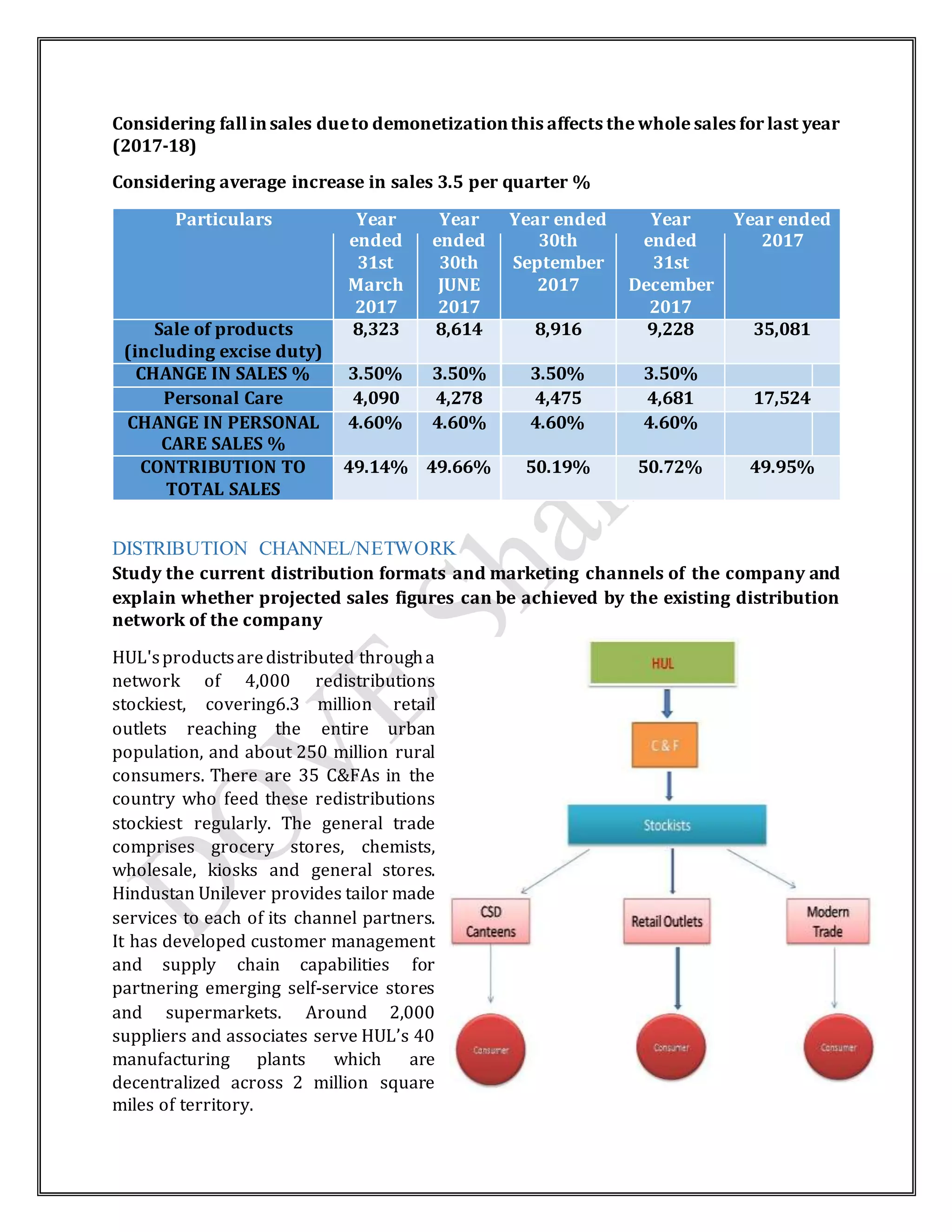
Considering average increase in sales 3.5 per quarter %
Particulars Year
ended
31st
March
2017
Year
ended
30th
JUNE
2017
Year ended
30th
September
2017
Year
ended
31st
December
2017
Year ended
2017
Sale of products
(including excise duty)
8,323 8,614 8,916 9,228 35,081
CHANGE IN SALES % 3.50% 3.50% 3.50% 3.50%
Personal Care 4,090 4,278 4,475 4,681 17,524
CHANGE IN PERSONAL
CARE SALES %
4.60% 4.60% 4.60% 4.60%
CONTRIBUTION TO
TOTAL SALES
49.14% 49.66% 50.19% 50.72% 49.95%
DISTRIBUTION CHANNEL/NETWORK
Study the current distribution formats and marketing channels of the company and
explain whether projected sales figures can be achieved by the existing distribution
network of the company
HUL'sproductsaredistributed througha
network of 4,000 redistributions
stockiest, covering6.3 million retail
outlets reaching the entire urban
population, and about 250 million rural
consumers. There are 35 C&FAs in the
country who feed these redistributions
stockiest regularly. The general trade
comprises grocery stores, chemists,
wholesale, kiosks and general stores.
Hindustan Unilever provides tailor made
services to each of its channel partners.
It has developed customer management
and supply chain capabilities for
partnering emerging self‐service stores
and supermarkets. Around 2,000
suppliers and associates serve HUL’s 40
manufacturing plants which are
decentralized across 2 million square
miles of territory.
Distribution at the Villages:
The company has brought all markets with populations of below 50,000 under one rural
sales organization. The team comprises an exclusive sales force and exclusive redistribution
stockiest. The team focuses on building superior availability of products. In rural India, the
network directly covers about 50,000 villages, reaching 250 million consumers, through
6000 sub‐stockiest.
HUL approachedtherural market with two criteria ‐ the accessibility and viability. To service
this segment, HUL appointed a Redistribution stockiest who was responsible for all outlets
and all business within his particular town. In the 25% of the accessible markets with low
business potential, HUL assigned a sub stockiest who was responsible to access all the
villages at least once in a fortnight and send stocks to those markets. This sub‐stockiest
distributes the company's products to outlets in adjacent smaller villages using
transportation suitable to interconnecting roads, like cycles, scooters or the age‐old bullock
cart. Thus, Hindustan Unilever is trying to circumvent the barrier of motor able roads. The
company simultaneously uses the wholesale channel, suitably incentivizing them to
distribute company products.Themost common formoftradingremains the grassrootsbuy‐
and‐sell mode.This enablesHULto influence the retailer’sstocksand quantities soldthrough
credit extension and trade discounts. HUL launched this Indirect Coverage (IDC) in 1960s.
Under the Indirect Coverage (IDC) method, company vans were replaced by vans belonging
to Redistribution Stockiest, which serviced a select group of neighboring markets.
Distribution at the Urban centers:
Distribution of goods from the manufacturing site to C & F agents take place through either
the trucks or rail road’s depending on the time factor for delivery and cost of transportation.
Generally, themanufacturing site is located suchthat it coversabigger geographicalsegment
of India. From the C & F agents, the goods are transported to RS’s by means of trucks and the
products finally make the ‘last mile’ based on the local popular and cheap mode of transport.
New distribution channels
Project Shakti
This model creates a
symbiotic partnership
between HUL and its
consumers. Started in the
late 2000, Project Shakti
had enabled Hindustan
Lever to access 80,000 of
India's 638,000villages.
HUL's partnership with
Self Help Groups(SHGs) of rural women, is becoming an extended arm of the company's
operation in rural hinterlands. Project Shakti has already been extended to about 12 states ‐
Andhra Pradesh, Karnataka, Gujarat, Madhya Pradesh, Tamil Nadu, Chhattisgarh, Uttar
Pradesh, Orissa, Punjab, Rajasthan, Maharashtra and West Bengal. The respective state
governments and several NGO sare actively involved in the initiative. The SHGs have chosen
to partner with HUL as a business venture, armed with training from HUL and support from
government agencies concerned and NGOs. Armed with micro‐credit, women from SHGs
become direct‐to‐home distributors in rural markets
Project Streamline
To cater to the needs of the inaccessible market with high business potential HUL initiated a
Streamline initiative in 1997. Project Streamline is an innovative and effective distribution
network forruralareasthat focuseson extending distribution to villages with less than 2000
people with the help of rural sub‐stockiest/Star Sellers who are based in these very villages.
As a result, the distribution network directly covers as of now about 40per cent of the rural
population
Hindustan Lever Network (HLN)
It is the company'sarm in theDirect Selling channel,one ofthe fastest growingin India today.
It already has about several lakh consultants ‐ all independent entrepreneurs, trained and
guided by HLN's expert managers. HLN has already spread to over 1500 towns and cities,
covering 80% of the urban population, backed by 42 offices and 240 service centers across
the country. It presents a range of customized offerings in Home & Personal Care and Foods.
Achievement of sales forecast
By seeing the biggest distribution network with a wide variety of business partners and
channel partners I come to the concussion they will achieve the target of forecast sales. They
might get more than they can achieve more than target because of recession they lag behind
in sales but this upcoming quitter they will achieve more.
Intuitional Selling
Institutional sales are usually reserved for high net worth clients here also they have target
market of Hotels, Hostels, Trip organizer, Salon, Barber, beauty parlor etc.
Hotel Guest Shampoo collection includes the most popular, and needed travel size toiletries
whilst traveling. Shampoos come in mini bottles as well as in sachets, different styles, and
shapes,so thereis definitely something to fit all tastes, andbathroomdecors.Fromeconomy,
best-value, to luxurious, spa-like shampoos, you have an abundance of choice that will spoil
yourguests, and leave along-lasting, positive impression that can significantly improveyour
business image, and overall guests’ satisfaction from using your facilities. With Personal
Products - leading wholesalers of hotel guest amenities & toiletries you are guaranteed to
get top quality toiletries, at unbeatable prices, and receive quick delivery, and attentive
customerservice which arevery famousnow aday it reducesthe cost. Benefited to company
also they get the bulk order in a single order this creates a continuous sales and customer
became loyal to the product.
Digital Marketing Strategy
DOVE advertising strategy from 1950’s to 1990’s
Dove started its journey through its first advertisement in 1957 featuring its “1/4 Cleansing
Cream”. The ad encouraged users to have an experiment over themselves by cleansing half
of their face with ordinary soap and the other half with Dove soap and feel the difference in
how velvety and smooth their skin looks.
Moving ahead towards success, the TV advertisement of the brand in 1991 showed a well-
focused group moving towards target. The participants conducted an experiment by using
test strips to determine the harshness of different soaps.
In 2004, Dove’s strategy for advertisement changed. The brand launched its “Campaign for
Real Beauty” in an effort to extend the meaning of beauty after studies conducted by Dove
verified that “the definition of beauty had become restrictive and unachievable” and findings
concluded that “only two percent of women across the globe would describe themselves as
beautiful”.
A Dove TV advertisement in 2006 was launched showing the photograph of a real woman
after she has her hair and makeup done, and lighting adjusted. This ad was also a part of
Dove’s earlier Campaign for Real Beauty.
Social Media Presence Dove has the highest total fan followers over the various social
media platforms compared to other top brands like Ivory, Olay, and Suave. Dove has a large
fan following on Facebook, keeping
users actively engaged with
discount coupons and by keenly
answering to the queries and
comments posted on their page.
Dove on Facebook Dove’s social
media presence is gigantic and very
much interactive. Their Facebook
page is updated most likely which
has helped them to drive the fan following to 25.6 million over the platform. The Facebook
page is less about direct selling of the products and much about selling the brand name and
image. The posts are all about self-confidence and celebrating who you are just as you are.
Dove celebrates real women, using images of women who do not fit the orthodox
requirement of a model, and receives a lot of respect and followers for its commitment of
celebrating real women. Every comment on the Facebook page is properly and timely
responded that creates decent
customer relationship.
Dove on Twitter Dove’s Twitter page
is full of empowering posts that has
driven the fan following to over
183,300 followers over the platform.
The brand posts very little
promotional messages via Twitter
page unlike their Facebook page. Dove
highly emphasize on developing a
brand personality and defining and broadcasting their beliefs.
Dove on Website Dove’s website focuses on screening how Dove works and helps in
improving the skin. The website also contains information about social missions for which
they are working like celebrating real women, supporting positive self-esteem, and defining
beauty as confidence. The women featured in their advertisements are not any celebrity or
a model; rather they are fresh-faced, natural, and women of all ages. The Dove Insider
program encourages interaction with the brand and develops a sense of community.
Dove App in the year 2012, Dove launched its mobile campaign as a way to “capitalize on
the growth of mobile devices”. The campaign used the same idea of comparing the
advertisements through the app where users can download the app which allows them to
watch videos comparing different body washes available to Dove. The app delivers evidence
of why Dove is the best among the category.
Key targets:
1. Increase rate of sales and market share of Dove via on-pack consumer campaign across
5 product categories, including shampoo, conditioner and deodorant;
2. Create an actionable permissioned database for Women’s Day 2013;
3. Profile new andexisting Doveconsumersandgain rich insight acrossproductcategories;
4. Identify and execute cross selling opportunities through a Direct Marketing Campaign.
Mobile marketing has proven to be an effective way to engage existing and new Dove
consumers. The results highlight how mobile can create cross selling opportunities for
brands across product ranges.
Results:
 15% of Dove shampoo buyers bought Dove conditioner after receiving a targeted cross
category Direct Message;
 21% of Dove consumers repurchased (any category) after receiving a targeted
repurchase Direct Message;
 Rich database of unique permissioned consumers to target for sales and brand building
activity.
They have good presence in digital marketing where as they are using platforms like
Instagram, Facebook, website for their promotions they also get good response they are
perfect in their campaigning. Yes, they can do better in tweeter, linked in which is used by a
leaders and the young as well as adults of the society also they can create some unique
campaign for promoting they can organize quiz, games etc. for promotion which ultimately
increase the sales.
Survey
I created the google forms for the following parameters to identify the consumer behavior
for the dove shampoo.
Factor Analysis
Rotated Component Matrixa
Component
1 2
PRICE .112 .569
QUALITY -.188 .728
AVALIBALITY .136 .693
PACKAGINGLABELING .860 .150
DESIGN .908 -.074
BRANDVALUE .345 .713
VISUALSTYLE .746 .097
ADVERTISMENT .753 .223
Extraction Method: Principal Component Analysis.
Rotation Method: Varimax with Kaiser Normalization.
a. Rotation converged in 3 iterations.
OBJECTIVE OF THE STUDY
The objective of the study is to analyze the on the following parameters to finding the
purchasing behavior for Dove shampoo.
RESEARCH METHODOLOGY
This research was conducted with a sample of 54 shampoo users of all over India. Simple
random sampling technique was used for selecting the sample. A ranking scale of
preference from 1 to 5 was used to get the preference of the respondents for the different
features of Dove shampoo. In that scale 1 was considered to be the highly satisfied whereas
5 was considered as the least preferred feature of the shampoo brands. The respondents
were asked to rank the features from 1 to 5 in likert scale of their own preference. Care is
to be taken that no rank should be repeated from a single respondent while collecting data.
Graphical and tabular presentations were used for analyzing the data.
FINDINGS OF THE STUDY (USED SPSS)
Shampoo was introduced for the first time in market in the year 1955 (63 years ago)
on the basis of following are the attributes I have conducted a survey which are highly
influencing the purchasing behavior of customer for dove shampoo attributes are- price,
quality, availability, packaging labeling, design, brand value, visual style, advertisement
these are categorized on 2 of the parameters in which these are measured on highly infusing
factors are in 1(Life Style) is packaging/labeling, design, visual style, advertisement and on
2 (Focus) is price, quality, availability, brand value.
REASONS FOR USING SHAMPOO
Reasons of customers for using different products and brands vary from individual to
individual. Ten different reasons PRICE, QUALITY, AVALIBALITY, PACKAGING/LABELING,
DESIGN, BRAND VALUE, VISUAL STYLE, ADVERTISMENT, COLOU, COMFORT TO USE,
DISCOUNT/OFFER, COMPETITOR COMPARISON, FOAM/LEATHER, CLEANNESS,
DANDRUFF CONTROL, HAIR FALL CONTROL on which study is done.
CONCLUSION FOR THE SURVEY
Hair fall has come out as the top most preferred reason for using a shampoo brand whereas
Hair cleaning appears to be the most preferred expectation of customers. Quality was
considered as the least preferred reason forusing a shampoo brand.
Conclusion
Hindustan Unilever ltd. Is a leading FMCG company in India and from last three consecutive
yearshas shownaccelerated growthin FMCG portfolio.Customersin India arealso spending
more in FMCG as their standard of living is growing. HUL has placed itself successfully in the
position of market leader in FMCG products.
Though there was some downfall in sales and profit of the company in the beginning of this
decade but after that HUL has shown considerable rise in both sales and profit. The future of
the company is also looking bright as FMCG market in India is still expanding and so we can
safely conclude that HUL will be able to secure its number one position in FMCG product.
HUL has also started project SHAKTI that has provided it direct reach to rural market. This
may be considered a revolutionary step since the urban market is reaching its saturation
level and there is a huge scope exploring rural market. This will also be helpful not only
increasing its market share but also fight competition.
During the information gathering I learned many things about the sector and company got
extreme facts about the company and also the sector information which consists of personal
care for this product where Dove shampoo uses intensive distribution to reach the mass
scale in public and they provide small shechts for the lower segment of the people by using
all this they arethe well reportedbrandinthe market with a goodrveneueearningcompany.
Thankyou
REFFERENCE
i https://www.ibef.org/industry/fmcg.aspx
iihttps://www.hul.co.in/
iii https://www.hul.co.in/
ivhttps://economictimes.indiatimes.com/hindustan-unilever-ltd/infocompanydividends/companyid-
13616.cms/
v www.dove.com/in/hair-care/shampoo.html

Dove shampoo HUL REPORT

  • 1.
  • 2.
    Table of Contents SECTORALINFORMATION ...............................................................................................................................................2 Introduction.........................................................................................................................................................................2 Historical Growth of the sector observed in the last 5 years.................................................................2 Reasons for the Growth observed in the sector.............................................................................................3 Government initiatives ..................................................................................................................................................3 Porter’s Five Forces Model for the sector..........................................................................................................4 COMPANY INFORMATION................................................................................................................................................6 Company snapshot...........................................................................................................................................................6 SWOT analysis of Hindustan Unilever – HUL SWOT analysis...............................................................6 Product offered by the company.............................................................................................................................8 Competitor Analysis.....................................................................................................................................................10 News (Last 12 month) incl. corporate announcement...........................................................................11 MARKETING STRATEGY .................................................................................................................................................13 DOVE Shampoo................................................................................................................................................................14 SWOT analysis of DOVE Shampoo.......................................................................................................................14 Analyze marketing mix 4P’s of DOVE Shampoo..........................................................................................15 STP of DOVE Shampoo................................................................................................................................................17 PLC of DOVE Shampoo................................................................................................................................................17 Sales Forecast...................................................................................................................................................................18 DISTRIBUTION CHANNEL/NETWORK.............................................................................................................19 Intuitional Selling...........................................................................................................................................................21 Digital Marketing Strategy........................................................................................................................................22 Survey....................................................................................................................................................................................24 Factor Analysis...........................................................................................................................................................24 Conclusion................................................................................................................................................................................25
  • 3.
    SECTORALINFORMATIONi Introduction Fast-moving consumer goods (FMCG)sector is the 4th largest sector in the Indian economy with Household and Personal Care accounting for 50 per cent of FMCG sales in India. Growing awareness, easier access and changing lifestyles have been the key growth drivers for the sector. The urban segment (accounts for a revenue share of around 40 per cent) is the largest contributor to the overall revenue generated by the FMCG sector in India and recorded a market size of around US$ 29.4 billion in 2016-17. However, in the last few years, the FMCG market has grown at a faster pace in rural India compared with urban India. Semi- urban and rural segments are growing at a rapid pace and FMCG products account for 50 per cent of total rural spending. Historical Growth of the sector observed in the last 5 years The Retail market in India is estimated to reach US$ 1.1 trillion by 2020 from US$ 672 billion in 2016, with moderntrade expectedto growat 20 per cent - 25 per cent per annum, which is likely to boost revenues of FMCG companies. In 2016- 17, revenue for FMCG sector have reached US$ 49 billion and is expected to grow at 9-9.5 per cent in FY18 supported by expectations of the total consumption expenditure reaching nearly US$ 3,600billion by2020 fromUS$ 1,469 billion 23% 15% 6%18% 9% 5% 18% 6% Sales Haircare Oral Care Digestives Foods OTC & Ethicals Skin Care Health Supplements Home Care 36.8 44.9 46.1 47.3 49 0 10 20 30 40 50 60 2012 2013 2014 2015 2016 FMCG Market in India (US$ billion) FMCG Market in India (US$ billion) FMCG 28% AUTO 8% E-Comm 8%Retail 8% Telecom 6% BFSI 5% Service 5% Education 4% Cons. Durables 4% Real Estate 3% Others 21% Sector wise contribution to GDP
  • 4.
    in 2015. Directselling sector in India is expected to reach Rs 159.3 billion (US$ 2.5 billion) by 2021, if provided with a conducive environment through reforms and regulation. Reasons for the Growth observed in the sector The government has allowed 100 per cent Foreign Direct Investment (FDI) in food processing and single-brand retail and 51 per cent in multi-brand retail. This would bolster employment and supply chains, and also provide high visibility for FMCG brands in organised retail markets, bolstering consumer spending and encouraging more product launches. The sector witnessed healthy FDI inflows of US$ 13.07 billion, during April 2000 to December 2017. Some of the recent developments in the FMCG sector are as follows:  The Hershey Co plans to invest US$ 50 million over the next five years in India, its fastest growing core market outside of US.  As a part of its Rs 25,000 crore (US$ 3.88 billion) investment package, ITC will invest Rs 10,000 crore (US$ 1.55 billion) to expand its food processing segment.  The bottling arm of Coca- Cola India, Hindustan Coca- Cola Beverages (HCCB) is planning to increase its retail reach by one million new outlets and is targeting a revenue of US$ 2.5 billion by 2020.  Future Retail will acquire Hyper City, which is owned by Shoppers Stop for Rs 911 crore (US$ 139.7 million) to further consolidate its business and have a better footing in the hypermarket segment. Government initiatives Some of the major initiatives taken by the government to promote the FMCG sector in India are as follows:  In the Union Budget 2017-18, the Government of India has proposed to spend more on the rural side with an aim to double the farmer’s income in five years; as well as the cut in income tax rate targeting mainly the small tax payers, focus on affordable housing and 60% 40% Urban – Rural industry Breakup (FY2016-17) Urban Rural US$ 49 billion
  • 5.
    infrastructure development willprovide multiple growth drivers for the consumer market industry.  The Government of India’s decision to allow 100 per cent Foreign Direct Investment (FDI) in online retail of goods and services through the automatic route has provided clarity on the existing businesses of e-commerce companies operating in India.  With the demand for skilled labour growing among Indian industries, the government plans to train 500 million people by 2022 and is also encouraging private players and entrepreneurs to invest in the venture. Many governments, corporate and educational organizations are working towards providing training and education to create a skilled workforce.  The Government of India has drafted a new Consumer Protection Bill with special emphasis on setting up an extensive mechanism to ensure simple, speedy, accessible, affordable and timely delivery of justice to consumers.  The Goods and Services Tax (GST) is beneficial for the FMCG industry as many of the FMCG products such as Soap, Toothpaste and Hair oil now come under 18 per cent tax bracket against the previous 23-24 per cent rate. Exchange Rate Used: INR 1 = US$ 0.015 as on January 4, 2018 Porter’s Five Forces Model for the sector Acquiring any kind of loss can be devastating for any company, business or sector. Such losses are exposes through many reasons and threats are one of them. 63.7 9.9 10.7 6.2 7.5 0.9 Food processing Paper Pulp Toiletaries Retail Trading Vegetable oil Tea and Coffee Share of sector cumulative FDI Inflows in FMCG Sector Share of sector cumulative FDI Inflows in FMCG Sector
  • 6.
    The FMCG marketin India is expected to grow at a CAGR of 20.6 per cent and is expected to reach US$ 103.7 billion by 2020.The growth in sales of major FMCG companies like Dabur, HUL, Marico, is signaling the revival of consumer demand in India. As the market continues to grow at a rapid pace, Indian Retailer takes a look at Porter’s five force threats that may affect the FMCG industry. Threat of substitutes With high presence of multiple brands in the market, it is not a challenge for consumers to switch from one product to another. Strategic decisions like price point and quality play key roles in attracting consumers. With narrow product differentiation under many brands, it’s rather easy for a consumer to switch to another brand. The threat of substitutes is informed by switching costs, both immediate and long-term, as well as a buyer's inclination to change. Competitive rivalry Many players are expanding into new geographies and categories and modern retail share is expectedto be valued $180billion in 2020. The FMCG industry hasbeen a highly fragmented industry as more companies enter the market. If Wipro is diversifying and expanding its product range in energy drinks, detergents and fabric conditioners, Patanjali will spend US$743.72 million in various food parks across the country. Also, launch of private label brands by big retailers, which are competitively priced with offers and discounts, will limit competition for weak brands. Bargaining power of buyers While rising incomes and growing youth population have been key growth drivers of the sector, brand consciousness has also aided demand. With low switching cost inducing customers to shift to other products, there will only be more demand for new products. Also, the availability of same or similar alternatives, backed by strong influence of marketing strategies will help the sector. India’s consumer spending is expected to increase to US$ 3.6 trillion by 2020. Threat of new entrants Any new competition in the market poses threat to the existing players in the industry. With investment approvals of up to 100 per cent foreign equity in single brand retail and 51 per cent in multi-brand retail, the market is expected to be crowded. Also, companies will be forced to spend aggressively on advertisement, which will only hurt the business in the long run. Bargaining power of suppliers Big FMCG companies are often in a position to dictate prices through local sourcing from a fragmented group or key commodity suppliers. Suppliers can exert pressure on businesses and even buyers by raising prices, lowering quality or reducing product availability. Such decisions mostly affect the buyers.
  • 7.
    COMPANYINFORMATIONii Company snapshot Hindustan UnileverLimited (HUL) is India's largest Fast Moving Consumer Goods company with a heritage of over 80 years in India. On any given day, nine out of ten Indian households use our products to feel good, look good and get more out of life – giving us a unique opportunity to build a brighter future. HUL works to create a better future every day and helps people feel good, look good and get more out of life with brands and services that are good for them and good for others. Hindustan Unilever Limited is engaged in fast-moving consumer goods business comprising home and personal care, foods and refreshments. The Company's segments are Soaps and Detergents, which includes soaps, detergent bars, detergent powders, detergent liquids and scourers; Personal Products, which includes products in categories of oral care, skin care (excluding soaps), hair care, deodorants, talcum powder, color cosmetics and salon services; Beverages, which includes tea and coffee; Packaged Foods. With over 35 brands spanning 20 distinct categories such as soaps, detergents, shampoos, skin care, toothpastes, deodorants, cosmetics, tea, coffee, packaged foods, ice cream, and water purifiers, the Company is a part of the everyday life of millions of consumers across India. Its portfolio includes leading household brands such as Lux, Lifebuoy, Surf Excel, Rin, Wheel, Fair& Lovely, Pond’s, Vaseline, Lakmé, Dove, Clinic Plus, Sunsilk, Pepsodent, Closeup, Axe, Brooke Bond, Bru, Knorr, Kissan, Kwality Wall’s and Pureit. The Company hasabout 18,000employees andhas a net salesof INR 33895crores(financial year 2016-17). HUL is a subsidiary of Unilever, one of the world’s leading suppliers of Food, Home Care, Personal Care and Refreshment products with sales in over 190 countries and an annual sales turnover of €52.7 billion in 2016. Unilever has over 67% shareholding in HUL SWOT analysis of Hindustan Unilever – HUL SWOT analysis Strengths in the SWOT analysis of Hindustan Unilever ( HUL ) 1. Brand visibility – From soap to mineral water, HUL is shaping the life of 1.3 billion people daily. Being in consumer goods market with its 20 consumer categories such as soap, tea, detergents, shampoo etc. & each having large assortments, helped HUL in occupying the large shelf space of Grocery /departmental stores which itself explains the acceptance/demand of their products in the market. 2. Market leader in consumer goods: According to Nielsen data 2 out of three Indian consumers use HUL products. HUL used selective targeting strategy to emerge as a market leader in the Indian market. 3. Innovative FMCG Company: Hindustan Unilever Research center (HURC),Mumbai & Unilever Research India, Bangalore ,both research facilities were bought together in
  • 8.
    a single sitein Bangalore in 2006.Employees in this facility continuously working & developing innovations in products & manufacturing processes which is helping the HUL to set it as front-runner in the consumer goods market. 4. Extensive & integrated distribution system:HUL’s brands are now household name which is only possible due to its 4 tier distribution system namely a) Direct Coverage through common stockist within a town of population under 50000 people. b) Indirect coverage: Villages closer to larger urban markets have been targeted. c) Streamline: Leveragingthe ruralwholesalemarket to reachmarkets inaccessible by road. d) Project SHATKI AMMA: It targeted the very small villages (2000 population) & tapped into pre-existing women’s SHG (self-help groups). Markets have been segmented based on their accessibility & business potential. 5. High Brand awareness: By signing popular celebrities for the advertisements of their products HUL has created positive word of mouth over the ages which helped them in social acceptance of their products intelligently targeted & meant for different income groups. 6. Product line: It offers product categories namely oral care, personal care, household surface, fabric care and pet nutrition etc. having deep assortments across the product categories. 7. Financial position: Having more than 80 years of experience in the consumer goods market & backed by Unilever who owns 67% controlling share in HUL, It is financially strong. 8. Market share: Through high penetration in the market, HUL had managed to hold their high market share in different product categories. 9. Share of Wallet: Whether one buys surf /wheel /Rin detergent it will go to HUL’s pockets. HUL strategy to offer different products for different income groups (selective targeting) has been successful in having share of wallet of a consumer. Weaknesses in the SWOT analysis of Hindustan Unilever ( HUL ) 1. Decreasing Market share: Competitors focusing on a particular product & eating up HUL’s share, like Ghadi & Nirma detergent eating up HUL’s wheel detergent market share. 2. Large number of brands in different product categories: Sometimes having broad brand portfolio can lead to confused positioning. Price positioning in some categories allows for low price competition like AMUL captured Kwality’s market share.
  • 9.
    Opportunities in theSWOT analysis of Hindustan Unilever ( HUL ) 1. Expanding market: By penetrating more in the rural markets through its project Shakti AMMA and transition of unorganized business to organized one will lead to further expansion of the consumer goods market. 2. Awareness in usage rate of consumer goods: People getting more aware and conscious about the usage may be through advertising /word of mouth /doctor prescription, is resulting in increase in usage rate of the these products. 3. Increasing Income levels: Due to stable political scenario, improved literacy rate & controlled inflation, disposable income of the people is increasing thereby resulting into upsurge in demand & changing their lifestyle. Threats in the SWOT analysis of Hindustan Unilever ( HUL ) 1. Competition in the market: With increasing number of local & national players it’s becoming very hard for the companies to differentiate themselves from others. There is also threat from counterfeit products destroying its brand image in the market. 2. Price of commodities: Increasing price of commodities will result in further increase in the price. Further increase in price will result in decrease in sales, margins & brand switching. 3. Buyers power: With highly diversified consumer goods market where there are lots of brands claiming different sorts of benefits, it’s very difficult for consumers to stick to a particular brand & hence results into brand switching where consumer got power to select a brand based on several factors like availability, reference group recommendation, preference & price. Product offered by the companyiii FOOD  Annapurna salt and spices  Annapurna aata  Bru coffee  Brooke Bond (3 Roses, Taj Mahal, Taaza, Red Label) tea  Kissan squashes, ketchups, juices and jams  Lipton tea  Knorr soups & meal makers and soupy noodles  Kwality Wall's frozen dessert  Modern Bread, ready to eat chapattis and other bakery items (now sold to Everstone Capital)  Magnum (ice cream) HOMECARE BRANDS  Active Wheel detergent  Cif Cream Cleaner
  • 10.
     Comfort fabricsofteners  Domex disinfectant/toilet cleaner  Rin detergents andbleach  Sunlight detergent and colour care  Surf Excel detergent and gentle wash  Vim dishwasher  Magic – Water Saver Personal Care Brands  Aviance Beauty Solutions  Axe deodorant and after shaving lotion and soap  LEVER Ayush Therapy ayurvedic health care and personal care products  Breeze beauty soap  Brylcreem hair cream and hair gel  Clear anti-dandruff hair products  Clinic Plus shampoo and oil  Close Up toothpaste  Dove skin cleansing & hair care range: bar, lotions, creams and anti-perspirant deodorants  Denim shaving products  Fair& Lovely skin-lightening products  Hamam  Indulekha ayurvedic hair oil  Lakmé beauty products and salons  Lifebuoy soaps and handwash range  Liril 2000 soap  Lux soap, body wash and deodorant  Pears soap, body wash  Pepsodent toothpaste  Pond's talcs and creams  Rexona  Sunsilk shampoo  Sure anti-perspirant  Vaseline petroleum jelly, skin care lotions  TRESemmé  TIGI Water Purifier Brand  Pureit Water Purifier
  • 11.
    Competitor Analysis According tothe market survey done by BUSINESS TODAY the top 10 companies of FMCG sector are given below. 1. Hindustan Unilever Ltd. 2. ITC (Indian Tobacco Company) 3. Nestlé India 4. GCMMF (AMUL) 5. Dabur India 6. Asian Paints (India) 7. Cadbury India 8. Britannia Industries 9. Procter & Gamble Hygiene and Health Care 10. Marico Industries THE COMPARATIVE DATA OF % MARKET SHARE OF HUL AND ITS COMPETITOR INQUARTER ENDED JUN’17 (Above graph showing %age Market share of HUL and its competitor in different categories of FMCG products)
  • 12.
    As mentioned inthe above graph, HUL is enjoying the leader position in the market and is having highest market shares which are followed by the market challengers like Dabur India Ltd, Nestle India Ltd, and ITC LTD, ETC…. In different categories of FMCG products like shampoo, skincare, deo, jams, coffee, etc (Above graph showing the two category of products in which HUL percentage market share is less than its competitor in Quarter ended JUN’17) So we can see that in overall FMCG business HUL is distantly ahead of rest of the companies as far as market share of different products are concerned. News (Last 12 month) incl. corporate announcementiv  Hindustan Unilever drags 3 former employees to court for data theft  HUL has taken its three former employees to Bombay High Court for allegedly stealing confidential data  11/10/2017 Interim Dividend 800% Rs.8.0000 per share (800%)Interim  Hindustan Unilever L - Board Meeting-Outcome of Board Meeting 12-Apr-2018  Sanjiv Mehta, managing director at Hindustan Unilever has been appointed as executive Chairman of the company, succeeding Harish Manwani who will retire as non-executive Chairman by June end.  Entered into the list of the top-5 most valuable companies by market capitalisation (m-cap) as the stock price of the company hit a new high on Wednesday.  With an m-cap of Rs 3.06 trillion, HUL now features at fifth position in the list by replacing India’s largest mortgage financier, Housing Development Finance Corporation (HDFC) in this prestigious club 30 24.5 47.9 27.6 TOOTH PASTE KETCHUP Chart Title HUL (Market Share%) Competitor (Market Share %)
  • 13.
     FMCG majorHUL on Wednesday said it has offered another tranche of Rs 360 million of GST benefits for January to the government, taking the total to Rs 1.55 billion since the tax rates were revised on November 15 last year.  HUL’s better-than-anticipated volume growth of 11 per cent versus estimates of 8-9 per cent increase, and operating profit margins suggests that demonetisation is a thing of the past and industry has tackled the hiccups of the goods and services tax or GST quite in its stride.  Hindustan Unilever Ltd posted a 28% rise in its third-quarter profit on Wednesday, underpinned by higher sales from its personal care business.  Profit came in at Rs 13.26 billion in the quarter ended Dec. 31, from Rs 10.38 a year ago, the diversified consumer goods maker said.  Total income during the quarter under review stood at Rs 87.42 billion as against Rs 84 billion in the year-ago period, up 4 per cent, it added.
  • 14.
    MARKETING STRATEGY Dove isa personal care brand of Unilever. It is one of the most valuable brand with sales of over €1 billion. Dove was introduced in 1957 and provides high quality personal care products across more than 80 countries. Dove provides products for both women and men. It is No 4 most trusted brand in India and has high growth potential. It is positioned as a high quality brand at affordable prices. Dovehad started with beauty soap which became popular in 1970’s as a mild soap. Dove now has a wide range of personal products. Dove competes with L’oreal and Olay. Dove is known for its revolutionary marketing campaign ‘Campaign for real beauty’. Dovegrewfrom amoisturising Beauty Barinto a globalbrandwith a rangeofproducts:body washes, hand and body lotions, facial cleansers, deodorants, shampoos, conditioners and hair styling. Dove bar & skin cleansing Dove got women to experience the ‘real’ Dove difference, with the Face Test campaign. Thousands of women across the country put their soap, and Dove, to the test. They all had the same answer – Dove made their skin soft. Dove hair care range Dove launched its hair care range in India in 2007, and became the fastest growing shampoo brand in the country. It’s highly conditioned formulation delivers the moisture promise of Dove. The range includes Daily Shine, Dryness Care, Dandruff Care, Hair Fall Rescue, Intense Repair Therapy, Nourishing Oil Care and Color Rescue. Dove anti-perspirant deodorants Your delicate underarms need tender care. Try the New Dove Deodorants with ¼ moisturising cream. Choose from 3 variants – Original, Silk Dry and Clear Touch, for visibly softer, smoother underarms, 24-hr protection from sweat and odour. Dove lotions & creams Pamper your skin with the unique rich moisturisers and pure silk formula of Dove Lotions and Creams.
  • 15.
    DOVE Shampoov There’s somuch more to shampoo than just ‘getting clean’. That’s why with Dove shampoos, hair gets the nourishing care it needs, along with gentle cleansing power. There’s power in beautiful hair. We all know how great hair can make you feel: when it’s glossy and healthy-looking, you can step out feeling confident and proud. To achieve that feeling every day, we’ve ensured that our shampoos nourish and restore hair from within, wash after wash, making hair healthier in the long run. Fordayto day, ourDailyShine Shampoo protectsnormalhair from the daily wear and tear of life, and nourishes to leave it softer and 5x smoother*. Looking for an anti-dandruff shampoo? Dove Dandruff Care Shampoo will help you keep those white flakes away. Andevery nowandthen, we’reall left fighting hair’snaturalenemy – hair fall. Start tackling it right from the foundations with a shampoo for hair fall like our Hair Fall Rescue Shampoo. SWOT analysis of DOVE Shampoo Dove SWOT Analysis Strengths 1. Dove contains 1/4 moisturizing cream 2. Dove has got an excellent market presence owing to string advertising and marketing exercises 3. Flagship product of Unilever with strong brand awareness through advertising and branding 4. Promises not to leave any residue on the skin 5. Dove products are available in more than 80 countries worldwide 6. Apart from soaps, products like bathing gel, shampoos, conditioners, creams, deodorants are also a part of the product line 7. Dove products are available through an extensive supply chain network of Unilever at leading supermarkets, stores & even online
  • 16.
    Weaknesses 1. Intense competitionfor Dove in the FMCG market means limited growth in market share 2. Targets primarily only the female segment & products not to popular with men Opportunities 1. Can target male audience more purposefully 2. Dove can increasing its reach by further geographic expansion 3. Involvement of students from colleges & tieup with corporates can open a new opporunity Threats 1. Increased Competition in this market segment can affect business of Dove 2. Global business can be affected by government policies and fluctuating economies 3. Fake imitations of the brand can affect Dove's image Analyze marketing mix 4P’s of DOVE Shampoo Product: Dove provides high quality products. Categories of products in the marketing mix of Dove are skin care, washing & bathing, deodorants and hair care. Dove soap positions itself as something better than soap and that it itself is not a soap but a beauty bar. The point of difference being moisturization and softener and cleansing cream. Dove is also well known for its haircare products which are recommended by dermatologists. New products are being regularly introduced. In deodorants Dove introduced the Dry Spray deodorant. In hair products Dove has introduced Advanced Hair Series globally. Dove has also launched the Dove DermaSpa range in Europe which brings spa experience and hair care at one place. Dove has recently forayed into baby care products with products ranging from moisturizer, baby lotion to diaper cream and wipes.
  • 17.
    Price: Dove uses competitivepricing. Dove products were initially premium priced however due to low demand dove reduced the price. The products are priced slightly higher than competitors. But dueto high quality andunique featuresofmoisturizer andsoftenerdemand is high. Thus, the price strategy in the market mix mostly is governed by the competition prices because of the several number of competitor products available. Place: Dove products are sold in more than 80 countries. Dove uses distribution channels of its parent company Unilever. Products are transported from factory to warehouse from where C&F agent sells to stockists and stockist to retailer. Dove products are available in supermarkets, general stores, , chemists and wholesellers. Dove products can be bought from ecommerce sites as well. Promotion: Beauty product companies have for decades focused on an ideal image which everyone should aspire to become using that company’s product. Dove has unique and completely different marketing campaign. The promotional strategy in the marketing mix of Dove is aspirational for women. Its ‘Campaign for real beauty’ focuses on women self-esteem. The brandsuccessfullycommunicated that peopleofall agesandall coloursareequallybeautiful. It celebrates diversity in each individual. Dove uses non models in all its advertising campaigns. Dove uses people of all body sizes, age and colour in its advertisements. Dove also promotesits brandsthroughvideosand shortfilms andits ad films are someofthe most widely downloaded.Dovehaslaunched acampaign to combat the negative media campaigns which exploit women’s insecurity and self-esteem. It used curvy women to fight the ideal body shape image created and also released a video showing the editing process of models. Dove’s Ad Makeover campaign is social media based wherein negative ads can be replaced by positive messages designed by Dove which boost women’s self-esteem. Dove uses magazines such as cosmopolitan which women regularly read to advertise. Dove established a self-esteem fundwhich aims to educate girls, help them overcomebeauty relatedproblems online bullying and raise self-esteem. It uses evidence based programmes and online resources for children as well as parents and teachers. The Dove Self-Esteem Project has reached more than 19 million young people in 115 countries. Dove also uses promotional methods such as coupons and exclusive offers. All these campaigns have created a very positive and trust worthy brandimage of Dove.Hence, this coversthe entire Dovemarketing mix.
  • 18.
    STP of DOVEShampoo Dove STP Segment Personal Health Care – Soap , Hair Care & Deodrants Target Group Targets women of all ages from the urban households Positioning Dove is committed to help all women realise their personal beauty potential by creating products that deliver real care. PLC of DOVE Shampoo INTRODUCTION Dove is a personal care brand owned by HUL having a wide range of products (soaps, body wash, deodrants, lotions, hair care etc.) When the dove soap was introduced in the Indian market it was priced at a slightly higher range and this they did so as to maintain the 'premium' tag of the brand. However, initially the sales were not up to the mark considering the highly marked prices. Dove then came up with their ad campaign's to promote the products and attract customers. Hence, Dove shampoo also followed same strategy. GROWTH The Dove's 'Real Beauty' Campaign: This was launched after viewing the results of a survey which showedthat only 2% of the women consideredthemselves to be beautiful. During this they put up billboards with portraits of regular women and allowed the viewers to vote on how they perceived the portrayed model as (see picture attached below), and with its report aimed at creating a whole new definition of the word 'beauty'. Their mission was primarily focused on spreading an awareness that beauty is a source of confidence.
  • 19.
    As a result,they received a very positive response from the population and also a very significant media coverage. With this response they then decided to broaden the media exposure by releasing print advertisements, television ads and much more. MATURITY The brand is now in the maturity stage and has been here for a very long time now. It is also considered among the top personal care brands. The continuing innovations, the campaigns and the large number of satisfied and loyal customers have helped the brand remain at this stage for so long and if Dove continues to maintain its relationships with existing customers andcarry outevents so as to gain new customers, it wouldnot bewrong to say that the brand will continue to be safe in terms of its market share. DECILINE STAGE Hindustan Unilever’s fiscal first-quarter results underscores a warning by its parent, Anglo- Dutch consumer conglomerate Unilever (ULVR.L) (UNc.AS), that growth in emerging markets was no longer immune to the global economic weakness. “We are seeing a slowdown in market growth in both volume and value terms, and over the next 2-3 quarters these challenges will continue,” he added. Shares fell 5.7 percent on the disappointing sales figures. Sales Forecast Based on historical data, forecast expected sales figures of the company for the next 4 quarters. Particulars Year ended 31st March 2017 Year ended 30th JUNE 2017 Year ended 30th September 2017 Year ended 31st December 2017 Year ended 2017 Revenue from operations Sale of products (including excise duty) 8,773 9,094 8,199 8,323 34,389 CHANGE IN SALES % - 3.66% -9.84% 1.51% Personal Care 4,075 4,368 3,910 4,090 16,443 CHANGE IN PERSONAL CARE SALES % - 7.19% -10.49% 4.60% CONTRIBUTION TO TOTAL SALES 46.45% 48.03% 47.69% 49.14% 47.81%
  • 20.
    Considering fallinsales duetodemonetizationthis affects the whole sales for last year (2017-18) Considering average increase in sales 3.5 per quarter % Particulars Year ended 31st March 2017 Year ended 30th JUNE 2017 Year ended 30th September 2017 Year ended 31st December 2017 Year ended 2017 Sale of products (including excise duty) 8,323 8,614 8,916 9,228 35,081 CHANGE IN SALES % 3.50% 3.50% 3.50% 3.50% Personal Care 4,090 4,278 4,475 4,681 17,524 CHANGE IN PERSONAL CARE SALES % 4.60% 4.60% 4.60% 4.60% CONTRIBUTION TO TOTAL SALES 49.14% 49.66% 50.19% 50.72% 49.95% DISTRIBUTION CHANNEL/NETWORK Study the current distribution formats and marketing channels of the company and explain whether projected sales figures can be achieved by the existing distribution network of the company HUL'sproductsaredistributed througha network of 4,000 redistributions stockiest, covering6.3 million retail outlets reaching the entire urban population, and about 250 million rural consumers. There are 35 C&FAs in the country who feed these redistributions stockiest regularly. The general trade comprises grocery stores, chemists, wholesale, kiosks and general stores. Hindustan Unilever provides tailor made services to each of its channel partners. It has developed customer management and supply chain capabilities for partnering emerging self‐service stores and supermarkets. Around 2,000 suppliers and associates serve HUL’s 40 manufacturing plants which are decentralized across 2 million square miles of territory.
  • 21.
    Distribution at theVillages: The company has brought all markets with populations of below 50,000 under one rural sales organization. The team comprises an exclusive sales force and exclusive redistribution stockiest. The team focuses on building superior availability of products. In rural India, the network directly covers about 50,000 villages, reaching 250 million consumers, through 6000 sub‐stockiest. HUL approachedtherural market with two criteria ‐ the accessibility and viability. To service this segment, HUL appointed a Redistribution stockiest who was responsible for all outlets and all business within his particular town. In the 25% of the accessible markets with low business potential, HUL assigned a sub stockiest who was responsible to access all the villages at least once in a fortnight and send stocks to those markets. This sub‐stockiest distributes the company's products to outlets in adjacent smaller villages using transportation suitable to interconnecting roads, like cycles, scooters or the age‐old bullock cart. Thus, Hindustan Unilever is trying to circumvent the barrier of motor able roads. The company simultaneously uses the wholesale channel, suitably incentivizing them to distribute company products.Themost common formoftradingremains the grassrootsbuy‐ and‐sell mode.This enablesHULto influence the retailer’sstocksand quantities soldthrough credit extension and trade discounts. HUL launched this Indirect Coverage (IDC) in 1960s. Under the Indirect Coverage (IDC) method, company vans were replaced by vans belonging to Redistribution Stockiest, which serviced a select group of neighboring markets. Distribution at the Urban centers: Distribution of goods from the manufacturing site to C & F agents take place through either the trucks or rail road’s depending on the time factor for delivery and cost of transportation. Generally, themanufacturing site is located suchthat it coversabigger geographicalsegment of India. From the C & F agents, the goods are transported to RS’s by means of trucks and the products finally make the ‘last mile’ based on the local popular and cheap mode of transport. New distribution channels Project Shakti This model creates a symbiotic partnership between HUL and its consumers. Started in the late 2000, Project Shakti had enabled Hindustan Lever to access 80,000 of India's 638,000villages. HUL's partnership with
  • 22.
    Self Help Groups(SHGs)of rural women, is becoming an extended arm of the company's operation in rural hinterlands. Project Shakti has already been extended to about 12 states ‐ Andhra Pradesh, Karnataka, Gujarat, Madhya Pradesh, Tamil Nadu, Chhattisgarh, Uttar Pradesh, Orissa, Punjab, Rajasthan, Maharashtra and West Bengal. The respective state governments and several NGO sare actively involved in the initiative. The SHGs have chosen to partner with HUL as a business venture, armed with training from HUL and support from government agencies concerned and NGOs. Armed with micro‐credit, women from SHGs become direct‐to‐home distributors in rural markets Project Streamline To cater to the needs of the inaccessible market with high business potential HUL initiated a Streamline initiative in 1997. Project Streamline is an innovative and effective distribution network forruralareasthat focuseson extending distribution to villages with less than 2000 people with the help of rural sub‐stockiest/Star Sellers who are based in these very villages. As a result, the distribution network directly covers as of now about 40per cent of the rural population Hindustan Lever Network (HLN) It is the company'sarm in theDirect Selling channel,one ofthe fastest growingin India today. It already has about several lakh consultants ‐ all independent entrepreneurs, trained and guided by HLN's expert managers. HLN has already spread to over 1500 towns and cities, covering 80% of the urban population, backed by 42 offices and 240 service centers across the country. It presents a range of customized offerings in Home & Personal Care and Foods. Achievement of sales forecast By seeing the biggest distribution network with a wide variety of business partners and channel partners I come to the concussion they will achieve the target of forecast sales. They might get more than they can achieve more than target because of recession they lag behind in sales but this upcoming quitter they will achieve more. Intuitional Selling Institutional sales are usually reserved for high net worth clients here also they have target market of Hotels, Hostels, Trip organizer, Salon, Barber, beauty parlor etc.
  • 23.
    Hotel Guest Shampoocollection includes the most popular, and needed travel size toiletries whilst traveling. Shampoos come in mini bottles as well as in sachets, different styles, and shapes,so thereis definitely something to fit all tastes, andbathroomdecors.Fromeconomy, best-value, to luxurious, spa-like shampoos, you have an abundance of choice that will spoil yourguests, and leave along-lasting, positive impression that can significantly improveyour business image, and overall guests’ satisfaction from using your facilities. With Personal Products - leading wholesalers of hotel guest amenities & toiletries you are guaranteed to get top quality toiletries, at unbeatable prices, and receive quick delivery, and attentive customerservice which arevery famousnow aday it reducesthe cost. Benefited to company also they get the bulk order in a single order this creates a continuous sales and customer became loyal to the product. Digital Marketing Strategy DOVE advertising strategy from 1950’s to 1990’s Dove started its journey through its first advertisement in 1957 featuring its “1/4 Cleansing Cream”. The ad encouraged users to have an experiment over themselves by cleansing half of their face with ordinary soap and the other half with Dove soap and feel the difference in how velvety and smooth their skin looks. Moving ahead towards success, the TV advertisement of the brand in 1991 showed a well- focused group moving towards target. The participants conducted an experiment by using test strips to determine the harshness of different soaps. In 2004, Dove’s strategy for advertisement changed. The brand launched its “Campaign for Real Beauty” in an effort to extend the meaning of beauty after studies conducted by Dove verified that “the definition of beauty had become restrictive and unachievable” and findings concluded that “only two percent of women across the globe would describe themselves as beautiful”. A Dove TV advertisement in 2006 was launched showing the photograph of a real woman after she has her hair and makeup done, and lighting adjusted. This ad was also a part of Dove’s earlier Campaign for Real Beauty. Social Media Presence Dove has the highest total fan followers over the various social media platforms compared to other top brands like Ivory, Olay, and Suave. Dove has a large fan following on Facebook, keeping users actively engaged with discount coupons and by keenly answering to the queries and comments posted on their page. Dove on Facebook Dove’s social media presence is gigantic and very much interactive. Their Facebook page is updated most likely which
  • 24.
    has helped themto drive the fan following to 25.6 million over the platform. The Facebook page is less about direct selling of the products and much about selling the brand name and image. The posts are all about self-confidence and celebrating who you are just as you are. Dove celebrates real women, using images of women who do not fit the orthodox requirement of a model, and receives a lot of respect and followers for its commitment of celebrating real women. Every comment on the Facebook page is properly and timely responded that creates decent customer relationship. Dove on Twitter Dove’s Twitter page is full of empowering posts that has driven the fan following to over 183,300 followers over the platform. The brand posts very little promotional messages via Twitter page unlike their Facebook page. Dove highly emphasize on developing a brand personality and defining and broadcasting their beliefs. Dove on Website Dove’s website focuses on screening how Dove works and helps in improving the skin. The website also contains information about social missions for which they are working like celebrating real women, supporting positive self-esteem, and defining beauty as confidence. The women featured in their advertisements are not any celebrity or a model; rather they are fresh-faced, natural, and women of all ages. The Dove Insider program encourages interaction with the brand and develops a sense of community. Dove App in the year 2012, Dove launched its mobile campaign as a way to “capitalize on the growth of mobile devices”. The campaign used the same idea of comparing the advertisements through the app where users can download the app which allows them to watch videos comparing different body washes available to Dove. The app delivers evidence of why Dove is the best among the category. Key targets: 1. Increase rate of sales and market share of Dove via on-pack consumer campaign across 5 product categories, including shampoo, conditioner and deodorant; 2. Create an actionable permissioned database for Women’s Day 2013; 3. Profile new andexisting Doveconsumersandgain rich insight acrossproductcategories; 4. Identify and execute cross selling opportunities through a Direct Marketing Campaign. Mobile marketing has proven to be an effective way to engage existing and new Dove consumers. The results highlight how mobile can create cross selling opportunities for brands across product ranges.
  • 25.
    Results:  15% ofDove shampoo buyers bought Dove conditioner after receiving a targeted cross category Direct Message;  21% of Dove consumers repurchased (any category) after receiving a targeted repurchase Direct Message;  Rich database of unique permissioned consumers to target for sales and brand building activity. They have good presence in digital marketing where as they are using platforms like Instagram, Facebook, website for their promotions they also get good response they are perfect in their campaigning. Yes, they can do better in tweeter, linked in which is used by a leaders and the young as well as adults of the society also they can create some unique campaign for promoting they can organize quiz, games etc. for promotion which ultimately increase the sales. Survey I created the google forms for the following parameters to identify the consumer behavior for the dove shampoo. Factor Analysis Rotated Component Matrixa Component 1 2 PRICE .112 .569 QUALITY -.188 .728 AVALIBALITY .136 .693 PACKAGINGLABELING .860 .150 DESIGN .908 -.074 BRANDVALUE .345 .713 VISUALSTYLE .746 .097 ADVERTISMENT .753 .223 Extraction Method: Principal Component Analysis. Rotation Method: Varimax with Kaiser Normalization. a. Rotation converged in 3 iterations.
  • 26.
    OBJECTIVE OF THESTUDY The objective of the study is to analyze the on the following parameters to finding the purchasing behavior for Dove shampoo. RESEARCH METHODOLOGY This research was conducted with a sample of 54 shampoo users of all over India. Simple random sampling technique was used for selecting the sample. A ranking scale of preference from 1 to 5 was used to get the preference of the respondents for the different features of Dove shampoo. In that scale 1 was considered to be the highly satisfied whereas 5 was considered as the least preferred feature of the shampoo brands. The respondents were asked to rank the features from 1 to 5 in likert scale of their own preference. Care is to be taken that no rank should be repeated from a single respondent while collecting data. Graphical and tabular presentations were used for analyzing the data. FINDINGS OF THE STUDY (USED SPSS) Shampoo was introduced for the first time in market in the year 1955 (63 years ago) on the basis of following are the attributes I have conducted a survey which are highly influencing the purchasing behavior of customer for dove shampoo attributes are- price, quality, availability, packaging labeling, design, brand value, visual style, advertisement these are categorized on 2 of the parameters in which these are measured on highly infusing factors are in 1(Life Style) is packaging/labeling, design, visual style, advertisement and on 2 (Focus) is price, quality, availability, brand value. REASONS FOR USING SHAMPOO Reasons of customers for using different products and brands vary from individual to individual. Ten different reasons PRICE, QUALITY, AVALIBALITY, PACKAGING/LABELING, DESIGN, BRAND VALUE, VISUAL STYLE, ADVERTISMENT, COLOU, COMFORT TO USE, DISCOUNT/OFFER, COMPETITOR COMPARISON, FOAM/LEATHER, CLEANNESS, DANDRUFF CONTROL, HAIR FALL CONTROL on which study is done. CONCLUSION FOR THE SURVEY Hair fall has come out as the top most preferred reason for using a shampoo brand whereas Hair cleaning appears to be the most preferred expectation of customers. Quality was considered as the least preferred reason forusing a shampoo brand.
  • 27.
    Conclusion Hindustan Unilever ltd.Is a leading FMCG company in India and from last three consecutive yearshas shownaccelerated growthin FMCG portfolio.Customersin India arealso spending more in FMCG as their standard of living is growing. HUL has placed itself successfully in the position of market leader in FMCG products. Though there was some downfall in sales and profit of the company in the beginning of this decade but after that HUL has shown considerable rise in both sales and profit. The future of the company is also looking bright as FMCG market in India is still expanding and so we can safely conclude that HUL will be able to secure its number one position in FMCG product. HUL has also started project SHAKTI that has provided it direct reach to rural market. This may be considered a revolutionary step since the urban market is reaching its saturation level and there is a huge scope exploring rural market. This will also be helpful not only increasing its market share but also fight competition. During the information gathering I learned many things about the sector and company got extreme facts about the company and also the sector information which consists of personal care for this product where Dove shampoo uses intensive distribution to reach the mass scale in public and they provide small shechts for the lower segment of the people by using all this they arethe well reportedbrandinthe market with a goodrveneueearningcompany. Thankyou
  • 28.