August 2020
For updated information, please visit www.ibef.org
FAST MOVING
CONSUMER GOODS
(FMCG)
Table of Contents
Advantage India…………………..….……..4
Market Overview …………….………..…....6
Strategies Adopted……………....………..12
Growth Drivers…….………………............15
Key Industry Organisations……….….......25
Executive Summary……………….….…….3
Opportunities.....…………………………...23
Useful Information……….……….......…...27
For updated information, please visit www.ibef.org
FMCG
3
EXECUTIVE SUMMARY
Final consumption expenditure (US$ trillion)
1.82
3.60
0
1
2
3
4
2017 2020F
Rural FMCG market in India (US$ billion)
23.63 100.00
220.00
0
50
100
150
200
250
2018(FY) 2020F 2025F
FMCG market in India (US$ billion)
Source: World Bank, Emami Reports, Dabur Reports, AC Nielsen, CRISIL, Nielsen Report, 2018
Notes: F- Forecast
68.38 103.70
0
50
100
150
FY18 FY21F
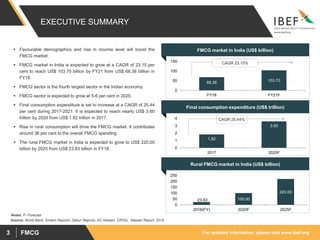
▪ Favourable demographics and rise in income level will boost the
FMCG market.
▪ FMCG market in India is expected to grow at a CAGR of 23.15 per
cent to reach US$ 103.70 billion by FY21 from US$ 68.38 billion in
FY18.
▪ FMCG sector is the fourth largest sector in the Indian economy.
▪ FMCG sector is expected to grow at 5-6 per cent in 2020.
▪ Final consumption expenditure is set to increase at a CAGR of 25.44
per cent during 2017-2021. It is expected to reach nearly US$ 3.60
trillion by 2020 from US$ 1.82 trillion in 2017.
▪ Rise in rural consumption will drive the FMCG market. It contributes
around 36 per cent to the overall FMCG spending.
▪ The rural FMCG market in India is expected to grow to US$ 220.00
billion by 2025 from US$ 23.63 billion in FY18.
CAGR 23.15%
CAGR 25.44%
FMCG
ADVANTAGE INDIA
For updated information, please visit www.ibef.org
FMCG
5
ADVANTAGE INDIA
▪ Rising income and growing youth
population have been key growth drivers
of the sector. Brand consciousness has
also aided demand.
▪ India’s contribution to global consumption
is expected to more than double to 5.8 per
cent by 2020.
▪ Rural India is witnessing increased
demand for quality goods and services
driven by upgraded distribution channels
of FMCG companies.
▪ Low penetration levels in rural market offers
room for growth.
▪ Dabur stepping-up product launches to sell
only on E-commerce platforms.
▪ Disposable income in rural India has
increased because of the direct cash transfer
scheme.
▪ Exports is another growing segment.
▪ E-commerce segment is forecast to
contribute 11 per cent to the overall FMCG
sales by 2030.
▪ RP-Sanjiv Goenka Group to invest capital
fund of US$ 14.74 million in FMCG startups.
▪ Supa Star Foods Pvt Ltd, a packaged food
and beverage maker, has received its
second investment from Roots Ventures,
which will help the company grow its
distribution network and add more products.
▪ Investment approval of up to 100 per cent
foreign equity in single brand retail and 51
per cent in multi-brand retail.
▪ Initiatives like Food Security Bill and direct
cash transfer subsidies reach about 40 per
cent of households in India.
▪ The minimum capitalisation for foreign
FMCG companies to invest in India is US$
100 million.
ADVANTAGE
INDIA
Source: Emami, BCG and CII report, Nielsen
FMCG
MARKET
OVERVIEW
For updated information, please visit www.ibef.org
FMCG
7
EVOLUTION OF FMCG IN INDIA
Source: Dabur Annual Report, Economic Times, Emami Annual Report, McKinsey Global Institute, CII, Boston Consulting Group Report, TRA's Brand Trust Report 2018
Current
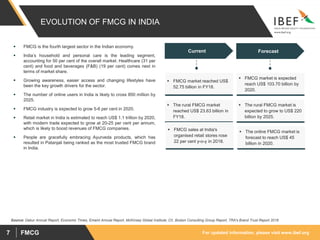
▪ FMCG market reached US$
52.75 billion in FY18.
▪ The rural FMCG market
reached US$ 23.63 billion in
FY18.
▪ FMCG sales at India's
organised retail stores rose
22 per cent y-o-y in 2018.
▪ FMCG market is expected
reach US$ 103.70 billion by
2020.
▪ The rural FMCG market is
expected to grow to US$ 220
billion by 2025.
▪ The online FMCG market is
forecast to reach US$ 45
billion in 2020.
▪ FMCG is the fourth largest sector in the Indian economy.
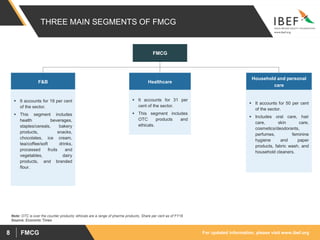
▪ India’s household and personal care is the leading segment,
accounting for 50 per cent of the overall market. Healthcare (31 per
cent) and food and beverages (F&B) (19 per cent) comes next in
terms of market share.
▪ Growing awareness, easier access and changing lifestyles have
been the key growth drivers for the sector.
▪ The number of online users in India is likely to cross 850 million by
2025.
▪ FMCG industry is expected to grow 5-6 per cent in 2020.
▪ Retail market in India is estimated to reach US$ 1.1 trillion by 2020,
with modern trade expected to grow at 20-25 per cent per annum,
which is likely to boost revenues of FMCG companies.
▪ People are gracefully embracing Ayurveda products, which has
resulted in Patanjali being ranked as the most trusted FMCG brand
in India.
Forecast
For updated information, please visit www.ibef.org
FMCG
8
THREE MAIN SEGMENTS OF FMCG
F&B Healthcare
Household and personal
care
▪ It accounts for 19 per cent
of the sector.
▪ This segment includes
health beverages,
staples/cereals, bakery
products, snacks,
chocolates, ice cream,
tea/coffee/soft drinks,
processed fruits and
vegetables, dairy
products, and branded
flour.
▪ It accounts for 31 per
cent of the sector.
▪ This segment includes
OTC products and
ethicals.
▪ It accounts for 50 per cent
of the sector.
▪ Includes oral care, hair
care, skin care,
cosmetics/deodorants,
perfumes, feminine
hygiene and paper
products, fabric wash, and
household cleaners.
FMCG
Note: OTC is over the counter products; ethicals are a range of pharma products, Share per cent as of FY18
Source: Economic Times
For updated information, please visit www.ibef.org
FMCG
9
Note: E-Estimate, F – Forecast, * - FY18
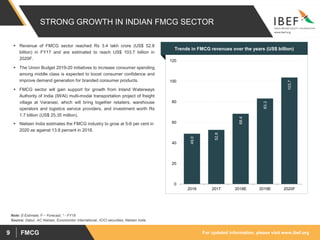
▪ Revenue of FMCG sector reached Rs 3.4 lakh crore (US$ 52.8
billion) in FY17 and are estimated to reach US$ 103.7 billion in
2020F.
▪ The Union Budget 2019-20 initiatives to increase consumer spending
among middle class is expected to boost consumer confidence and
improve demand generation for branded consumer products.
▪ FMCG sector will gain support for growth from Inland Waterways
Authority of India (IWAI) multi-modal transportation project of freight
village at Varanasi, which will bring together retailers, warehouse
operators and logistics service providers, and investment worth Rs
1.7 billion (US$ 25.35 million).
▪ Nielsen India estimates the FMCG industry to grow at 5-6 per cent in
2020 as against 13.8 percent in 2018.
Trends in FMCG revenues over the years (US$ billion)
49.0
52.8
68.4
83.3
103.7
0
20
40
60
80
100
120
2016 2017 2018E 2019E 2020F
STRONG GROWTH IN INDIAN FMCG SECTOR
Source: Dabur, AC Nielsen, Euromonitor International, ICICI securities, Nielsen India
For updated information, please visit www.ibef.org
FMCG
10
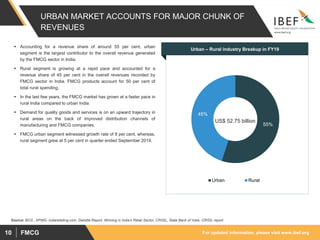
Urban – Rural industry Breakup in FY19
55%
45%
US$ 52.75 billion
Urban Rural
URBAN MARKET ACCOUNTS FOR MAJOR CHUNK OF
REVENUES
Source: BCG , KPMG- indiaretailing.com, Deloitte Report, Winning in India’s Retail Sector, CRISIL, State Bank of India, CRISIL report
▪ Accounting for a revenue share of around 55 per cent, urban
segment is the largest contributor to the overall revenue generated
by the FMCG sector in India.
▪ Rural segment is growing at a rapid pace and accounted for a
revenue share of 45 per cent in the overall revenues recorded by
FMCG sector in India. FMCG products account for 50 per cent of
total rural spending.
▪ In the last few years, the FMCG market has grown at a faster pace in
rural India compared to urban India.
▪ Demand for quality goods and services is on an upward trajectory in
rural areas on the back of improved distribution channels of
manufacturing and FMCG companies.
▪ FMCG urban segment witnessed growth rate of 8 per cent, whereas,
rural segment grew at 5 per cent in quarter ended September 2019.
For updated information, please visit www.ibef.org
FMCG
11
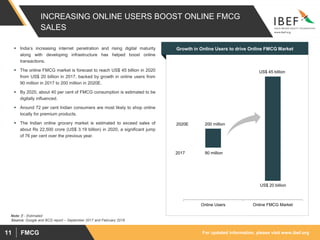
Growth in Online Users to drive Online FMCG Market
INCREASING ONLINE USERS BOOST ONLINE FMCG
SALES
Source: Google and BCG report – September 2017 and February 2018
▪ India’s increasing internet penetration and rising digital maturity
along with developing infrastructure has helped boost online
transactions.
▪ The online FMCG market is forecast to reach US$ 45 billion in 2020
from US$ 20 billion in 2017, backed by growth in online users from
90 million in 2017 to 200 million in 2020E.
▪ By 2020, about 40 per cent of FMCG consumption is estimated to be
digitally influenced.
▪ Around 72 per cent Indian consumers are most likely to shop online
locally for premium products.
▪ The Indian online grocery market is estimated to exceed sales of
about Rs 22,500 crore (US$ 3.19 billion) in 2020, a significant jump
of 76 per cent over the previous year.
Note: E - Estimated
Online Users Online FMCG Market
200 million
90 million
US$ 20 billion
US$ 45 billion
a
2017
2020E
FMCG
STRATEGIES
ADOPTED
For updated information, please visit www.ibef.org
FMCG
13
STRATEGIES
▪ FMCG companies are trying to influence consumers with intelligent deals.
▪ Firms like ITC offers combo deals to the consumers. For example, in the case of soaps and cosmetics; 4 soap cases are
offered at the price of 3, selling the range of deodorants for men and women at a discounted price.
▪ Amazon India is planning to invest significantly over the coming months for expanding its grocery and food business,
launching more products and categories and forming new partnerships with huge grocery and supermarket chains.
Promotions and
offers
▪ The internet enables consumers to make their own research on the kind of products or commodities they want to purchase.
1 in 3 FMCG shoppers goes online 1st and then to the stores.
▪ About 43 per cent of new car-buyers in cities select the model online and purchase it from dealer.
Research online
purchase offline
▪ In July 2020, Mother Dairy forayed into bread segment as part of its strategy to diversify business and announced its target
to more than double its revenue to Rs 25,000 crore (US$ 3.55 million) in the next five years.
▪ In June 2020, ITC launched Salvon Germ Protection wipes.
▪ In June 2020, Emami launched organic aloe vera gel under BoroPlus brand.
▪ In June 2020, Amul launched ginger and tulsi milk variants to boost immunity.
New product
launches
Source: AC Nielsen, News Article
▪ In May 2020, Tata Consumer Products Limited (TCPL) acquired PepsiCo’s stake in NourishCo Beverages Limited.
▪ In March 2020, Hindustan Unilever Limited (HUL) signed an agreement with Glenmark Pharmaceuticals Ltd to acquire its
intimate hygiene brand VWash.
▪ In July 2020, ITC Ltd completed the acquisition of spice-manufacturer Sunrise Foods Private Ltd at an upfront cash deal
price of Rs 2,150 crore (US$ 305.01 million).
Expansion
For updated information, please visit www.ibef.org
FMCG
14
STRATEGIES
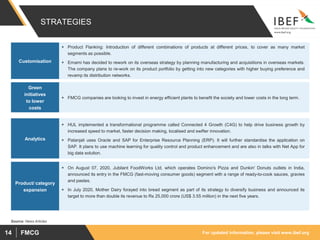
▪ Product Flanking: Introduction of different combinations of products at different prices, to cover as many market
segments as possible.
▪ Emami has decided to rework on its overseas strategy by planning manufacturing and acquisitions in overseas markets.
The company plans to re-work on its product portfolio by getting into new categories with higher buying preference and
revamp its distribution networks.
Customisation
▪ FMCG companies are looking to invest in energy efficient plants to benefit the society and lower costs in the long term.
Green
initiatives
to lower
costs
▪ On August 07, 2020, Jubilant FoodWorks Ltd, which operates Domino's Pizza and Dunkin' Donuts outlets in India,
announced its entry in the FMCG (fast-moving consumer goods) segment with a range of ready-to-cook sauces, gravies
and pastes.
▪ In July 2020, Mother Dairy forayed into bread segment as part of its strategy to diversify business and announced its
target to more than double its revenue to Rs 25,000 crore (US$ 3.55 million) in the next five years.
Product/ category
expansion
▪ HUL implemented a transformational programme called Connected 4 Growth (C4G) to help drive business growth by
increased speed to market, faster decision making, localised and swifter innovation.
▪ Patanjali uses Oracle and SAP for Enterprise Resource Planning (ERP). It will further standardise the application on
SAP. It plans to use machine learning for quality control and product enhancement and are also in talks with Net App for
big data solution.
Analytics
Source: News Articles
FMCG
GROWTH DRIVERS
For updated information, please visit www.ibef.org
FMCG
16
GROWTH DRIVERS FOR INDIA’S FMCG SECTOR
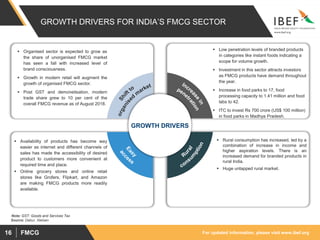
▪ Organised sector is expected to grow as
the share of unorganised FMCG market
has seen a fall with increased level of
brand consciousness.
▪ Growth in modern retail will augment the
growth of organised FMCG sector.
▪ Post GST and demonetisation, modern
trade share grew to 10 per cent of the
overall FMCG revenue as of August 2018.
▪ Low penetration levels of branded products
in categories like instant foods indicating a
scope for volume growth.
▪ Investment in this sector attracts investors
as FMCG products have demand throughout
the year.
▪ Increase in food parks to 17, food
processing capacity to 1.41 million and food
labs to 42.
▪ ITC to invest Rs 700 crore (US$ 100 million)
in food parks in Madhya Pradesh.
▪ Availability of products has become way
easier as internet and different channels of
sales has made the accessibility of desired
product to customers more convenient at
required time and place.
▪ Online grocery stores and online retail
stores like Grofers, Flipkart, and Amazon
are making FMCG products more readily
available.
▪ Rural consumption has increased, led by a
combination of increase in income and
higher aspiration levels. There is an
increased demand for branded products in
rural India.
▪ Huge untapped rural market.
GROWTH DRIVERS
Source: Dabur, Nielsen
Note: GST: Goods and Services Tax
For updated information, please visit www.ibef.org
FMCG
17
HIGHER INCOMES AID GROWTH IN URBAN AND
RURAL MARKETS
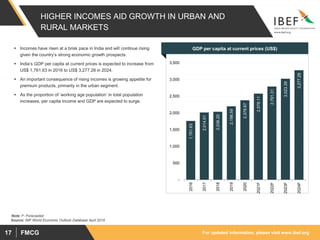
▪ Incomes have risen at a brisk pace in India and will continue rising
given the country’s strong economic growth prospects.
▪ India’s GDP per capita at current prices is expected to increase from
US$ 1,761.63 in 2016 to US$ 3,277.28 in 2024.
▪ An important consequence of rising incomes is growing appetite for
premium products, primarily in the urban segment.
▪ As the proportion of ‘working age population’ in total population
increases, per capita income and GDP are expected to surge.
Source: IMF World Economic Outlook Database April 2019
1,761.63
2,014.01
2,036.20
2,198.59
2,378.67
2,578.11
2,791.31
3,023.39
3,277.28
-
500
1,000
1,500
2,000
2,500
3,000
3,500
2016
2017
2018
2019
2020
2021F
2022F
2023F
2024F
GDP per capita at current prices (US$)
Note: F- Forecasted
For updated information, please visit www.ibef.org
FMCG
18
POLICY AND REGULATORY FRAMEWORK
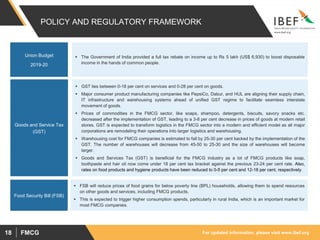
▪ GST lies between 0-18 per cent on services and 0-28 per cent on goods.
▪ Major consumer product manufacturing companies like PepsiCo, Dabur, and HUL are aligning their supply chain,
IT infrastructure and warehousing systems ahead of unified GST regime to facilitate seamless interstate
movement of goods.
▪ Prices of commodities in the FMCG sector, like soaps, shampoo, detergents, biscuits, savory snacks etc.
decreased after the implementation of GST, leading to a 3-8 per cent decrease in prices of goods at modern retail
stores. GST is expected to transform logistics in the FMCG sector into a modern and efficient model as all major
corporations are remodeling their operations into larger logistics and warehousing.
▪ Warehousing cost for FMCG companies is estimated to fall by 25-30 per cent backed by the implementation of the
GST. The number of warehouses will decrease from 45-50 to 25-30 and the size of warehouses will become
larger.
▪ Goods and Services Tax (GST) is beneficial for the FMCG industry as a lot of FMCG products like soap,
toothpaste and hair oil now come under 18 per cent tax bracket against the previous 23-24 per cent rate. Also,
rates on food products and hygiene products have been reduced to 0-5 per cent and 12-18 per cent, respectively.
Goods and Service Tax
(GST)
▪ The Government of India provided a full tax rebate on income up to Rs 5 lakh (US$ 6,930) to boost disposable
income in the hands of common people.
Union Budget
2019-20
▪ FSB will reduce prices of food grains for below poverty line (BPL) households, allowing them to spend resources
on other goods and services, including FMCG products.
▪ This is expected to trigger higher consumption spends, particularly in rural India, which is an important market for
most FMCG companies.
Food Security Bill (FSB)
For updated information, please visit www.ibef.org
FMCG
19
POLICY AND REGULATORY FRAMEWORK
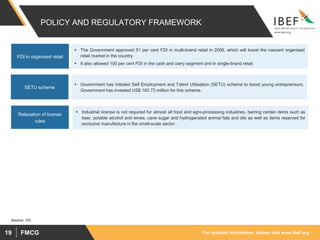
▪ The Government approved 51 per cent FDI in multi-brand retail in 2006, which will boost the nascent organised
retail market in the country.
▪ It also allowed 100 per cent FDI in the cash and carry segment and in single-brand retail.
FDI in organised retail
▪ Government has initiated Self Employment and Talent Utilisation (SETU) scheme to boost young entrepreneurs.
Government has invested US$ 163.73 million for this scheme.
SETU scheme
Source: SBI
▪ Industrial license is not required for almost all food and agro-processing industries, barring certain items such as
beer, potable alcohol and wines, cane sugar and hydrogenated animal fats and oils as well as items reserved for
exclusive manufacture in the small-scale sector.
Relaxation of license
rules
For updated information, please visit www.ibef.org
FMCG
20
NEW GOODS AND SERVICE TAX (GST) WOULD
SIMPLIFY TAX STRUCTURE
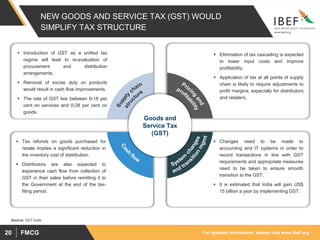
▪ Introduction of GST as a unified tax
regime will lead to re-evaluation of
procurement and distribution
arrangements.
▪ Removal of excise duty on products
would result in cash flow improvements.
▪ The rate of GST lies between 0-18 per
cent on services and 0-28 per cent on
goods.
▪ Elimination of tax cascading is expected
to lower input costs and improve
profitability.
▪ Application of tax at all points of supply
chain is likely to require adjustments to
profit margins, especially for distributors
and retailers.
▪ Tax refunds on goods purchased for
resale implies a significant reduction in
the inventory cost of distribution.
▪ Distributors are also expected to
experience cash flow from collection of
GST in their sales before remitting it to
the Government at the end of the tax-
filing period.
▪ Changes need to be made to
accounting and IT systems in order to
record transactions in line with GST
requirements and appropriate measures
need to be taken to ensure smooth
transition to the GST.
▪ It is estimated that India will gain US$
15 billion a year by implementing GST.
Goods and
Service Tax
(GST)
Source: GST India
For updated information, please visit www.ibef.org
FMCG
21
BOOSTS IN FDI INFLOWS AND INVESTMENTS
Source: DPIIT, Media articles
▪ 100 per cent FDI is allowed in food processing and single-brand
retail and 51 per cent in multi-brand retail.
▪ This would bolster employment and supply chains and provide high
visibility for FMCG brands in organised retail markets, bolstering
consumer spending and encouraging more product launches.
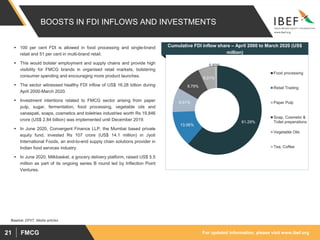
▪ The sector witnessed healthy FDI inflow of US$ 16.28 billion during
April 2000-March 2020.
▪ Investment intentions related to FMCG sector arising from paper
pulp, sugar, fermentation, food processing, vegetable oils and
vanaspati, soaps, cosmetics and toiletries industries worth Rs 19,846
crore (US$ 2.84 billion) was implemented until December 2019.
▪ In June 2020, Convergent Finance LLP, the Mumbai based private
equity fund, invested Rs 107 crore (US$ 14.1 million) in Jyoti
International Foods, an end-to-end supply chain solutions provider in
Indian food services industry.
▪ In June 2020, Milkbasket, a grocery delivery platform, raised US$ 5.5
million as part of its ongoing series B round led by Inflection Point
Ventures.
Cumulative FDI inflow share – April 2000 to March 2020 (US$
million)
61.29%
13.06%
8.91%
9.79%
6.01%
0.93%
Food processing
Retail Trading
Paper Pulp
Soap, Cosmetic &
Toilet preperations
Vegetable Oils
Tea, Coffee
For updated information, please visit www.ibef.org
FMCG
22
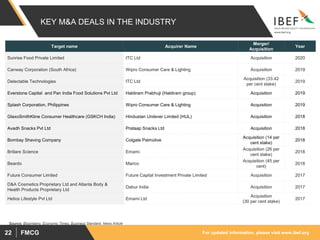
KEY M&A DEALS IN THE INDUSTRY
Target name Acquirer Name
Merger/
Acquisition
Year
Sunrise Food Private Limited ITC Ltd Acquisition 2020
Canway Corporation (South Africa) Wipro Consumer Care & Lighting Acquisition 2019
Delectable Technologies ITC Ltd
Acquisition (33.42
per cent stake)
2019
Everstone Capital and Pan India Food Solutions Pvt Ltd Haldiram Prabhuji (Haldiram group) Acquisition 2019
Splash Corporation, Philippines Wipro Consumer Care & Lighting Acquisition 2019
GlaxoSmithKline Consumer Healthcare (GSKCH India) Hindustan Unilever Limited (HUL) Acquisition 2018
Avadh Snacks Pvt Ltd Prataap Snacks Ltd Acquisition 2018
Bombay Shaving Company Colgate Palmolive
Acquisition (14 per
cent stake)
2018
Brillare Science Emami
Acquisition (26 per
cent stake)
2018
Beardo Marico
Acquisition (45 per
cent)
2018
Future Consumer Limited Future Capital Investment Private Limited Acquisition 2017
D&A Cosmetics Proprietary Ltd and Atlanta Body &
Health Products Proprietary Ltd
Dabur India Acquisition 2017
Helios Lifestyle Pvt Ltd Emami Ltd
Acquisition
(30 per cent stake)
2017
Source: Bloomberg, Economic Times, Business Standard, News Article
FMCG
OPPORTUNITIES
For updated information, please visit www.ibef.org
FMCG
24
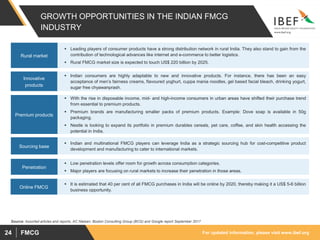
GROWTH OPPORTUNITIES IN THE INDIAN FMCG
INDUSTRY
▪ Leading players of consumer products have a strong distribution network in rural India. They also stand to gain from the
contribution of technological advances like internet and e-commerce to better logistics.
▪ Rural FMCG market size is expected to touch US$ 220 billion by 2025.
Rural market
▪ Indian consumers are highly adaptable to new and innovative products. For instance, there has been an easy
acceptance of men’s fairness creams, flavoured yoghurt, cuppa mania noodles, gel based facial bleach, drinking yogurt,
sugar free chyawanprash.
Innovative
products
▪ With the rise in disposable income, mid- and high-income consumers in urban areas have shifted their purchase trend
from essential to premium products.
▪ Premium brands are manufacturing smaller packs of premium products. Example: Dove soap is available in 50g
packaging.
▪ Nestle is looking to expand its portfolio in premium durables cereals, pet care, coffee, and skin health accessing the
potential in India.
Premium products
▪ Indian and multinational FMCG players can leverage India as a strategic sourcing hub for cost-competitive product
development and manufacturing to cater to international markets.
Sourcing base
▪ Low penetration levels offer room for growth across consumption categories.
▪ Major players are focusing on rural markets to increase their penetration in those areas.
Penetration
Source: Assorted articles and reports, AC Nielsen, Boston Consulting Group (BCG) and Google report September 2017
▪ It is estimated that 40 per cent of all FMCG purchases in India will be online by 2020, thereby making it a US$ 5-6 billion
business opportunity.
Online FMCG
FMCG
KEY INDUSTRY
ORGANISATIONS
For updated information, please visit www.ibef.org
FMCG
26
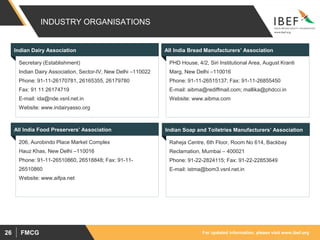
INDUSTRY ORGANISATIONS
Visakhapatnam port traffic (million tonnes)
Indian Dairy Association All India Bread Manufacturers’ Association
PHD House, 4/2, Siri Institutional Area, August Kranti
Marg, New Delhi –110016
Phone: 91-11-26515137; Fax: 91-11-26855450
E-mail: aibma@rediffmail.com; mallika@phdcci.in
Website: www.aibma.com
Secretary (Establishment)
Indian Dairy Association, Sector-IV, New Delhi –110022
Phone: 91-11-26170781, 26165355, 26179780
Fax: 91 11 26174719
E-mail: ida@nde.vsnl.net.in
Website: www.indairyasso.org
All India Food Preservers’ Association
206, Aurobindo Place Market Complex
Hauz Khas, New Delhi –110016
Phone: 91-11-26510860, 26518848; Fax: 91-11-
26510860
Website: www.aifpa.net
Indian Soap and Toiletries Manufacturers’ Association
Raheja Centre, 6th Floor, Room No 614, Backbay
Reclamation, Mumbai – 400021
Phone: 91-22-2824115; Fax: 91-22-22853649
E-mail: istma@bom3.vsnl.net.in
FMCG
USEFUL
INFORMATION
For updated information, please visit www.ibef.org
FMCG
28
GLOSSARY
▪ FDI: Foreign Direct Investment
▪ MSP: Minimum Selling Price
▪ NREGA: National Rural Employment Guarantee Act
▪ FY: Indian Financial Year (April to March); So, FY09 implies April 2008 to March 2009
▪ SEZ: Special Economic Zone
▪ MoU: Memorandum of Understanding
▪ Wherever applicable, numbers have been rounded off to the nearest whole number
For updated information, please visit www.ibef.org
FMCG
29
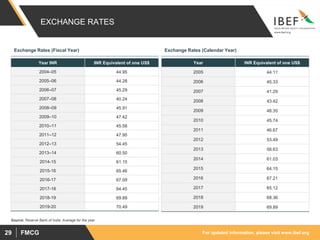
EXCHANGE RATES
Exchange Rates (Fiscal Year) Exchange Rates (Calendar Year)
Year INR INR Equivalent of one US$
2004–05 44.95
2005–06 44.28
2006–07 45.29
2007–08 40.24
2008–09 45.91
2009–10 47.42
2010–11 45.58
2011–12 47.95
2012–13 54.45
2013–14 60.50
2014-15 61.15
2015-16 65.46
2016-17 67.09
2017-18 64.45
2018-19 69.89
2019-20 70.49
Year INR Equivalent of one US$
2005 44.11
2006 45.33
2007 41.29
2008 43.42
2009 48.35
2010 45.74
2011 46.67
2012 53.49
2013 58.63
2014 61.03
2015 64.15
2016 67.21
2017 65.12
2018 68.36
2019 69.89
Source: Reserve Bank of India, Average for the year
For updated information, please visit www.ibef.org
FMCG
30
DISCLAIMER
India Brand Equity Foundation (IBEF) engaged TechSci Research to prepare this presentation and the same has been prepared by TechSci
Research in consultation with IBEF.
All rights reserved. All copyright in this presentation and related works is solely and exclusively owned by IBEF. The same may not be reproduced,
wholly or in part in any material form (including photocopying or storing it in any medium by electronic means and whether or not transiently or
incidentally to some other use of this presentation), modified or in any manner communicated to any third party except with the written approval
of IBEF.
This presentation is for information purposes only. While due care has been taken during the compilation of this presentation to ensure that the
information is accurate to the best of TechSci Research and IBEF’s knowledge and belief, the content is not to be construed in any manner
whatsoever as a substitute for professional advice.
TechSci Research and IBEF neither recommend nor endorse any specific products or services that may have been mentioned in this presentation
and nor do they assume any liability or responsibility for the outcome of decisions taken as a result of any reliance placed on this presentation.
Neither TechSci Research nor IBEF shall be liable for any direct or indirect damages that may arise due to any act or omission on the part of the user
due to any reliance placed or guidance taken from any portion of this presentation.

FMCG-August-2020.pdf........................

  • 1.
    August 2020 For updatedinformation, please visit www.ibef.org FAST MOVING CONSUMER GOODS (FMCG)
  • 2.
    Table of Contents AdvantageIndia…………………..….……..4 Market Overview …………….………..…....6 Strategies Adopted……………....………..12 Growth Drivers…….………………............15 Key Industry Organisations……….….......25 Executive Summary……………….….…….3 Opportunities.....…………………………...23 Useful Information……….……….......…...27
  • 3.
    For updated information,please visit www.ibef.org FMCG 3 EXECUTIVE SUMMARY Final consumption expenditure (US$ trillion) 1.82 3.60 0 1 2 3 4 2017 2020F Rural FMCG market in India (US$ billion) 23.63 100.00 220.00 0 50 100 150 200 250 2018(FY) 2020F 2025F FMCG market in India (US$ billion) Source: World Bank, Emami Reports, Dabur Reports, AC Nielsen, CRISIL, Nielsen Report, 2018 Notes: F- Forecast 68.38 103.70 0 50 100 150 FY18 FY21F ▪ Favourable demographics and rise in income level will boost the FMCG market. ▪ FMCG market in India is expected to grow at a CAGR of 23.15 per cent to reach US$ 103.70 billion by FY21 from US$ 68.38 billion in FY18. ▪ FMCG sector is the fourth largest sector in the Indian economy. ▪ FMCG sector is expected to grow at 5-6 per cent in 2020. ▪ Final consumption expenditure is set to increase at a CAGR of 25.44 per cent during 2017-2021. It is expected to reach nearly US$ 3.60 trillion by 2020 from US$ 1.82 trillion in 2017. ▪ Rise in rural consumption will drive the FMCG market. It contributes around 36 per cent to the overall FMCG spending. ▪ The rural FMCG market in India is expected to grow to US$ 220.00 billion by 2025 from US$ 23.63 billion in FY18. CAGR 23.15% CAGR 25.44%
  • 4.
  • 5.
    For updated information,please visit www.ibef.org FMCG 5 ADVANTAGE INDIA ▪ Rising income and growing youth population have been key growth drivers of the sector. Brand consciousness has also aided demand. ▪ India’s contribution to global consumption is expected to more than double to 5.8 per cent by 2020. ▪ Rural India is witnessing increased demand for quality goods and services driven by upgraded distribution channels of FMCG companies. ▪ Low penetration levels in rural market offers room for growth. ▪ Dabur stepping-up product launches to sell only on E-commerce platforms. ▪ Disposable income in rural India has increased because of the direct cash transfer scheme. ▪ Exports is another growing segment. ▪ E-commerce segment is forecast to contribute 11 per cent to the overall FMCG sales by 2030. ▪ RP-Sanjiv Goenka Group to invest capital fund of US$ 14.74 million in FMCG startups. ▪ Supa Star Foods Pvt Ltd, a packaged food and beverage maker, has received its second investment from Roots Ventures, which will help the company grow its distribution network and add more products. ▪ Investment approval of up to 100 per cent foreign equity in single brand retail and 51 per cent in multi-brand retail. ▪ Initiatives like Food Security Bill and direct cash transfer subsidies reach about 40 per cent of households in India. ▪ The minimum capitalisation for foreign FMCG companies to invest in India is US$ 100 million. ADVANTAGE INDIA Source: Emami, BCG and CII report, Nielsen
  • 6.
  • 7.
    For updated information,please visit www.ibef.org FMCG 7 EVOLUTION OF FMCG IN INDIA Source: Dabur Annual Report, Economic Times, Emami Annual Report, McKinsey Global Institute, CII, Boston Consulting Group Report, TRA's Brand Trust Report 2018 Current ▪ FMCG market reached US$ 52.75 billion in FY18. ▪ The rural FMCG market reached US$ 23.63 billion in FY18. ▪ FMCG sales at India's organised retail stores rose 22 per cent y-o-y in 2018. ▪ FMCG market is expected reach US$ 103.70 billion by 2020. ▪ The rural FMCG market is expected to grow to US$ 220 billion by 2025. ▪ The online FMCG market is forecast to reach US$ 45 billion in 2020. ▪ FMCG is the fourth largest sector in the Indian economy. ▪ India’s household and personal care is the leading segment, accounting for 50 per cent of the overall market. Healthcare (31 per cent) and food and beverages (F&B) (19 per cent) comes next in terms of market share. ▪ Growing awareness, easier access and changing lifestyles have been the key growth drivers for the sector. ▪ The number of online users in India is likely to cross 850 million by 2025. ▪ FMCG industry is expected to grow 5-6 per cent in 2020. ▪ Retail market in India is estimated to reach US$ 1.1 trillion by 2020, with modern trade expected to grow at 20-25 per cent per annum, which is likely to boost revenues of FMCG companies. ▪ People are gracefully embracing Ayurveda products, which has resulted in Patanjali being ranked as the most trusted FMCG brand in India. Forecast
  • 8.
    For updated information,please visit www.ibef.org FMCG 8 THREE MAIN SEGMENTS OF FMCG F&B Healthcare Household and personal care ▪ It accounts for 19 per cent of the sector. ▪ This segment includes health beverages, staples/cereals, bakery products, snacks, chocolates, ice cream, tea/coffee/soft drinks, processed fruits and vegetables, dairy products, and branded flour. ▪ It accounts for 31 per cent of the sector. ▪ This segment includes OTC products and ethicals. ▪ It accounts for 50 per cent of the sector. ▪ Includes oral care, hair care, skin care, cosmetics/deodorants, perfumes, feminine hygiene and paper products, fabric wash, and household cleaners. FMCG Note: OTC is over the counter products; ethicals are a range of pharma products, Share per cent as of FY18 Source: Economic Times
  • 9.
    For updated information,please visit www.ibef.org FMCG 9 Note: E-Estimate, F – Forecast, * - FY18 ▪ Revenue of FMCG sector reached Rs 3.4 lakh crore (US$ 52.8 billion) in FY17 and are estimated to reach US$ 103.7 billion in 2020F. ▪ The Union Budget 2019-20 initiatives to increase consumer spending among middle class is expected to boost consumer confidence and improve demand generation for branded consumer products. ▪ FMCG sector will gain support for growth from Inland Waterways Authority of India (IWAI) multi-modal transportation project of freight village at Varanasi, which will bring together retailers, warehouse operators and logistics service providers, and investment worth Rs 1.7 billion (US$ 25.35 million). ▪ Nielsen India estimates the FMCG industry to grow at 5-6 per cent in 2020 as against 13.8 percent in 2018. Trends in FMCG revenues over the years (US$ billion) 49.0 52.8 68.4 83.3 103.7 0 20 40 60 80 100 120 2016 2017 2018E 2019E 2020F STRONG GROWTH IN INDIAN FMCG SECTOR Source: Dabur, AC Nielsen, Euromonitor International, ICICI securities, Nielsen India
  • 10.
    For updated information,please visit www.ibef.org FMCG 10 Urban – Rural industry Breakup in FY19 55% 45% US$ 52.75 billion Urban Rural URBAN MARKET ACCOUNTS FOR MAJOR CHUNK OF REVENUES Source: BCG , KPMG- indiaretailing.com, Deloitte Report, Winning in India’s Retail Sector, CRISIL, State Bank of India, CRISIL report ▪ Accounting for a revenue share of around 55 per cent, urban segment is the largest contributor to the overall revenue generated by the FMCG sector in India. ▪ Rural segment is growing at a rapid pace and accounted for a revenue share of 45 per cent in the overall revenues recorded by FMCG sector in India. FMCG products account for 50 per cent of total rural spending. ▪ In the last few years, the FMCG market has grown at a faster pace in rural India compared to urban India. ▪ Demand for quality goods and services is on an upward trajectory in rural areas on the back of improved distribution channels of manufacturing and FMCG companies. ▪ FMCG urban segment witnessed growth rate of 8 per cent, whereas, rural segment grew at 5 per cent in quarter ended September 2019.
  • 11.
    For updated information,please visit www.ibef.org FMCG 11 Growth in Online Users to drive Online FMCG Market INCREASING ONLINE USERS BOOST ONLINE FMCG SALES Source: Google and BCG report – September 2017 and February 2018 ▪ India’s increasing internet penetration and rising digital maturity along with developing infrastructure has helped boost online transactions. ▪ The online FMCG market is forecast to reach US$ 45 billion in 2020 from US$ 20 billion in 2017, backed by growth in online users from 90 million in 2017 to 200 million in 2020E. ▪ By 2020, about 40 per cent of FMCG consumption is estimated to be digitally influenced. ▪ Around 72 per cent Indian consumers are most likely to shop online locally for premium products. ▪ The Indian online grocery market is estimated to exceed sales of about Rs 22,500 crore (US$ 3.19 billion) in 2020, a significant jump of 76 per cent over the previous year. Note: E - Estimated Online Users Online FMCG Market 200 million 90 million US$ 20 billion US$ 45 billion a 2017 2020E
  • 12.
  • 13.
    For updated information,please visit www.ibef.org FMCG 13 STRATEGIES ▪ FMCG companies are trying to influence consumers with intelligent deals. ▪ Firms like ITC offers combo deals to the consumers. For example, in the case of soaps and cosmetics; 4 soap cases are offered at the price of 3, selling the range of deodorants for men and women at a discounted price. ▪ Amazon India is planning to invest significantly over the coming months for expanding its grocery and food business, launching more products and categories and forming new partnerships with huge grocery and supermarket chains. Promotions and offers ▪ The internet enables consumers to make their own research on the kind of products or commodities they want to purchase. 1 in 3 FMCG shoppers goes online 1st and then to the stores. ▪ About 43 per cent of new car-buyers in cities select the model online and purchase it from dealer. Research online purchase offline ▪ In July 2020, Mother Dairy forayed into bread segment as part of its strategy to diversify business and announced its target to more than double its revenue to Rs 25,000 crore (US$ 3.55 million) in the next five years. ▪ In June 2020, ITC launched Salvon Germ Protection wipes. ▪ In June 2020, Emami launched organic aloe vera gel under BoroPlus brand. ▪ In June 2020, Amul launched ginger and tulsi milk variants to boost immunity. New product launches Source: AC Nielsen, News Article ▪ In May 2020, Tata Consumer Products Limited (TCPL) acquired PepsiCo’s stake in NourishCo Beverages Limited. ▪ In March 2020, Hindustan Unilever Limited (HUL) signed an agreement with Glenmark Pharmaceuticals Ltd to acquire its intimate hygiene brand VWash. ▪ In July 2020, ITC Ltd completed the acquisition of spice-manufacturer Sunrise Foods Private Ltd at an upfront cash deal price of Rs 2,150 crore (US$ 305.01 million). Expansion
  • 14.
    For updated information,please visit www.ibef.org FMCG 14 STRATEGIES ▪ Product Flanking: Introduction of different combinations of products at different prices, to cover as many market segments as possible. ▪ Emami has decided to rework on its overseas strategy by planning manufacturing and acquisitions in overseas markets. The company plans to re-work on its product portfolio by getting into new categories with higher buying preference and revamp its distribution networks. Customisation ▪ FMCG companies are looking to invest in energy efficient plants to benefit the society and lower costs in the long term. Green initiatives to lower costs ▪ On August 07, 2020, Jubilant FoodWorks Ltd, which operates Domino's Pizza and Dunkin' Donuts outlets in India, announced its entry in the FMCG (fast-moving consumer goods) segment with a range of ready-to-cook sauces, gravies and pastes. ▪ In July 2020, Mother Dairy forayed into bread segment as part of its strategy to diversify business and announced its target to more than double its revenue to Rs 25,000 crore (US$ 3.55 million) in the next five years. Product/ category expansion ▪ HUL implemented a transformational programme called Connected 4 Growth (C4G) to help drive business growth by increased speed to market, faster decision making, localised and swifter innovation. ▪ Patanjali uses Oracle and SAP for Enterprise Resource Planning (ERP). It will further standardise the application on SAP. It plans to use machine learning for quality control and product enhancement and are also in talks with Net App for big data solution. Analytics Source: News Articles
  • 15.
  • 16.
    For updated information,please visit www.ibef.org FMCG 16 GROWTH DRIVERS FOR INDIA’S FMCG SECTOR ▪ Organised sector is expected to grow as the share of unorganised FMCG market has seen a fall with increased level of brand consciousness. ▪ Growth in modern retail will augment the growth of organised FMCG sector. ▪ Post GST and demonetisation, modern trade share grew to 10 per cent of the overall FMCG revenue as of August 2018. ▪ Low penetration levels of branded products in categories like instant foods indicating a scope for volume growth. ▪ Investment in this sector attracts investors as FMCG products have demand throughout the year. ▪ Increase in food parks to 17, food processing capacity to 1.41 million and food labs to 42. ▪ ITC to invest Rs 700 crore (US$ 100 million) in food parks in Madhya Pradesh. ▪ Availability of products has become way easier as internet and different channels of sales has made the accessibility of desired product to customers more convenient at required time and place. ▪ Online grocery stores and online retail stores like Grofers, Flipkart, and Amazon are making FMCG products more readily available. ▪ Rural consumption has increased, led by a combination of increase in income and higher aspiration levels. There is an increased demand for branded products in rural India. ▪ Huge untapped rural market. GROWTH DRIVERS Source: Dabur, Nielsen Note: GST: Goods and Services Tax
  • 17.
    For updated information,please visit www.ibef.org FMCG 17 HIGHER INCOMES AID GROWTH IN URBAN AND RURAL MARKETS ▪ Incomes have risen at a brisk pace in India and will continue rising given the country’s strong economic growth prospects. ▪ India’s GDP per capita at current prices is expected to increase from US$ 1,761.63 in 2016 to US$ 3,277.28 in 2024. ▪ An important consequence of rising incomes is growing appetite for premium products, primarily in the urban segment. ▪ As the proportion of ‘working age population’ in total population increases, per capita income and GDP are expected to surge. Source: IMF World Economic Outlook Database April 2019 1,761.63 2,014.01 2,036.20 2,198.59 2,378.67 2,578.11 2,791.31 3,023.39 3,277.28 - 500 1,000 1,500 2,000 2,500 3,000 3,500 2016 2017 2018 2019 2020 2021F 2022F 2023F 2024F GDP per capita at current prices (US$) Note: F- Forecasted
  • 18.
    For updated information,please visit www.ibef.org FMCG 18 POLICY AND REGULATORY FRAMEWORK ▪ GST lies between 0-18 per cent on services and 0-28 per cent on goods. ▪ Major consumer product manufacturing companies like PepsiCo, Dabur, and HUL are aligning their supply chain, IT infrastructure and warehousing systems ahead of unified GST regime to facilitate seamless interstate movement of goods. ▪ Prices of commodities in the FMCG sector, like soaps, shampoo, detergents, biscuits, savory snacks etc. decreased after the implementation of GST, leading to a 3-8 per cent decrease in prices of goods at modern retail stores. GST is expected to transform logistics in the FMCG sector into a modern and efficient model as all major corporations are remodeling their operations into larger logistics and warehousing. ▪ Warehousing cost for FMCG companies is estimated to fall by 25-30 per cent backed by the implementation of the GST. The number of warehouses will decrease from 45-50 to 25-30 and the size of warehouses will become larger. ▪ Goods and Services Tax (GST) is beneficial for the FMCG industry as a lot of FMCG products like soap, toothpaste and hair oil now come under 18 per cent tax bracket against the previous 23-24 per cent rate. Also, rates on food products and hygiene products have been reduced to 0-5 per cent and 12-18 per cent, respectively. Goods and Service Tax (GST) ▪ The Government of India provided a full tax rebate on income up to Rs 5 lakh (US$ 6,930) to boost disposable income in the hands of common people. Union Budget 2019-20 ▪ FSB will reduce prices of food grains for below poverty line (BPL) households, allowing them to spend resources on other goods and services, including FMCG products. ▪ This is expected to trigger higher consumption spends, particularly in rural India, which is an important market for most FMCG companies. Food Security Bill (FSB)
  • 19.
    For updated information,please visit www.ibef.org FMCG 19 POLICY AND REGULATORY FRAMEWORK ▪ The Government approved 51 per cent FDI in multi-brand retail in 2006, which will boost the nascent organised retail market in the country. ▪ It also allowed 100 per cent FDI in the cash and carry segment and in single-brand retail. FDI in organised retail ▪ Government has initiated Self Employment and Talent Utilisation (SETU) scheme to boost young entrepreneurs. Government has invested US$ 163.73 million for this scheme. SETU scheme Source: SBI ▪ Industrial license is not required for almost all food and agro-processing industries, barring certain items such as beer, potable alcohol and wines, cane sugar and hydrogenated animal fats and oils as well as items reserved for exclusive manufacture in the small-scale sector. Relaxation of license rules
  • 20.
    For updated information,please visit www.ibef.org FMCG 20 NEW GOODS AND SERVICE TAX (GST) WOULD SIMPLIFY TAX STRUCTURE ▪ Introduction of GST as a unified tax regime will lead to re-evaluation of procurement and distribution arrangements. ▪ Removal of excise duty on products would result in cash flow improvements. ▪ The rate of GST lies between 0-18 per cent on services and 0-28 per cent on goods. ▪ Elimination of tax cascading is expected to lower input costs and improve profitability. ▪ Application of tax at all points of supply chain is likely to require adjustments to profit margins, especially for distributors and retailers. ▪ Tax refunds on goods purchased for resale implies a significant reduction in the inventory cost of distribution. ▪ Distributors are also expected to experience cash flow from collection of GST in their sales before remitting it to the Government at the end of the tax- filing period. ▪ Changes need to be made to accounting and IT systems in order to record transactions in line with GST requirements and appropriate measures need to be taken to ensure smooth transition to the GST. ▪ It is estimated that India will gain US$ 15 billion a year by implementing GST. Goods and Service Tax (GST) Source: GST India
  • 21.
    For updated information,please visit www.ibef.org FMCG 21 BOOSTS IN FDI INFLOWS AND INVESTMENTS Source: DPIIT, Media articles ▪ 100 per cent FDI is allowed in food processing and single-brand retail and 51 per cent in multi-brand retail. ▪ This would bolster employment and supply chains and provide high visibility for FMCG brands in organised retail markets, bolstering consumer spending and encouraging more product launches. ▪ The sector witnessed healthy FDI inflow of US$ 16.28 billion during April 2000-March 2020. ▪ Investment intentions related to FMCG sector arising from paper pulp, sugar, fermentation, food processing, vegetable oils and vanaspati, soaps, cosmetics and toiletries industries worth Rs 19,846 crore (US$ 2.84 billion) was implemented until December 2019. ▪ In June 2020, Convergent Finance LLP, the Mumbai based private equity fund, invested Rs 107 crore (US$ 14.1 million) in Jyoti International Foods, an end-to-end supply chain solutions provider in Indian food services industry. ▪ In June 2020, Milkbasket, a grocery delivery platform, raised US$ 5.5 million as part of its ongoing series B round led by Inflection Point Ventures. Cumulative FDI inflow share – April 2000 to March 2020 (US$ million) 61.29% 13.06% 8.91% 9.79% 6.01% 0.93% Food processing Retail Trading Paper Pulp Soap, Cosmetic & Toilet preperations Vegetable Oils Tea, Coffee
  • 22.
    For updated information,please visit www.ibef.org FMCG 22 KEY M&A DEALS IN THE INDUSTRY Target name Acquirer Name Merger/ Acquisition Year Sunrise Food Private Limited ITC Ltd Acquisition 2020 Canway Corporation (South Africa) Wipro Consumer Care & Lighting Acquisition 2019 Delectable Technologies ITC Ltd Acquisition (33.42 per cent stake) 2019 Everstone Capital and Pan India Food Solutions Pvt Ltd Haldiram Prabhuji (Haldiram group) Acquisition 2019 Splash Corporation, Philippines Wipro Consumer Care & Lighting Acquisition 2019 GlaxoSmithKline Consumer Healthcare (GSKCH India) Hindustan Unilever Limited (HUL) Acquisition 2018 Avadh Snacks Pvt Ltd Prataap Snacks Ltd Acquisition 2018 Bombay Shaving Company Colgate Palmolive Acquisition (14 per cent stake) 2018 Brillare Science Emami Acquisition (26 per cent stake) 2018 Beardo Marico Acquisition (45 per cent) 2018 Future Consumer Limited Future Capital Investment Private Limited Acquisition 2017 D&A Cosmetics Proprietary Ltd and Atlanta Body & Health Products Proprietary Ltd Dabur India Acquisition 2017 Helios Lifestyle Pvt Ltd Emami Ltd Acquisition (30 per cent stake) 2017 Source: Bloomberg, Economic Times, Business Standard, News Article
  • 23.
  • 24.
    For updated information,please visit www.ibef.org FMCG 24 GROWTH OPPORTUNITIES IN THE INDIAN FMCG INDUSTRY ▪ Leading players of consumer products have a strong distribution network in rural India. They also stand to gain from the contribution of technological advances like internet and e-commerce to better logistics. ▪ Rural FMCG market size is expected to touch US$ 220 billion by 2025. Rural market ▪ Indian consumers are highly adaptable to new and innovative products. For instance, there has been an easy acceptance of men’s fairness creams, flavoured yoghurt, cuppa mania noodles, gel based facial bleach, drinking yogurt, sugar free chyawanprash. Innovative products ▪ With the rise in disposable income, mid- and high-income consumers in urban areas have shifted their purchase trend from essential to premium products. ▪ Premium brands are manufacturing smaller packs of premium products. Example: Dove soap is available in 50g packaging. ▪ Nestle is looking to expand its portfolio in premium durables cereals, pet care, coffee, and skin health accessing the potential in India. Premium products ▪ Indian and multinational FMCG players can leverage India as a strategic sourcing hub for cost-competitive product development and manufacturing to cater to international markets. Sourcing base ▪ Low penetration levels offer room for growth across consumption categories. ▪ Major players are focusing on rural markets to increase their penetration in those areas. Penetration Source: Assorted articles and reports, AC Nielsen, Boston Consulting Group (BCG) and Google report September 2017 ▪ It is estimated that 40 per cent of all FMCG purchases in India will be online by 2020, thereby making it a US$ 5-6 billion business opportunity. Online FMCG
  • 25.
  • 26.
    For updated information,please visit www.ibef.org FMCG 26 INDUSTRY ORGANISATIONS Visakhapatnam port traffic (million tonnes) Indian Dairy Association All India Bread Manufacturers’ Association PHD House, 4/2, Siri Institutional Area, August Kranti Marg, New Delhi –110016 Phone: 91-11-26515137; Fax: 91-11-26855450 E-mail: aibma@rediffmail.com; mallika@phdcci.in Website: www.aibma.com Secretary (Establishment) Indian Dairy Association, Sector-IV, New Delhi –110022 Phone: 91-11-26170781, 26165355, 26179780 Fax: 91 11 26174719 E-mail: ida@nde.vsnl.net.in Website: www.indairyasso.org All India Food Preservers’ Association 206, Aurobindo Place Market Complex Hauz Khas, New Delhi –110016 Phone: 91-11-26510860, 26518848; Fax: 91-11- 26510860 Website: www.aifpa.net Indian Soap and Toiletries Manufacturers’ Association Raheja Centre, 6th Floor, Room No 614, Backbay Reclamation, Mumbai – 400021 Phone: 91-22-2824115; Fax: 91-22-22853649 E-mail: istma@bom3.vsnl.net.in
  • 27.
  • 28.
    For updated information,please visit www.ibef.org FMCG 28 GLOSSARY ▪ FDI: Foreign Direct Investment ▪ MSP: Minimum Selling Price ▪ NREGA: National Rural Employment Guarantee Act ▪ FY: Indian Financial Year (April to March); So, FY09 implies April 2008 to March 2009 ▪ SEZ: Special Economic Zone ▪ MoU: Memorandum of Understanding ▪ Wherever applicable, numbers have been rounded off to the nearest whole number
  • 29.
    For updated information,please visit www.ibef.org FMCG 29 EXCHANGE RATES Exchange Rates (Fiscal Year) Exchange Rates (Calendar Year) Year INR INR Equivalent of one US$ 2004–05 44.95 2005–06 44.28 2006–07 45.29 2007–08 40.24 2008–09 45.91 2009–10 47.42 2010–11 45.58 2011–12 47.95 2012–13 54.45 2013–14 60.50 2014-15 61.15 2015-16 65.46 2016-17 67.09 2017-18 64.45 2018-19 69.89 2019-20 70.49 Year INR Equivalent of one US$ 2005 44.11 2006 45.33 2007 41.29 2008 43.42 2009 48.35 2010 45.74 2011 46.67 2012 53.49 2013 58.63 2014 61.03 2015 64.15 2016 67.21 2017 65.12 2018 68.36 2019 69.89 Source: Reserve Bank of India, Average for the year
  • 30.
    For updated information,please visit www.ibef.org FMCG 30 DISCLAIMER India Brand Equity Foundation (IBEF) engaged TechSci Research to prepare this presentation and the same has been prepared by TechSci Research in consultation with IBEF. All rights reserved. All copyright in this presentation and related works is solely and exclusively owned by IBEF. The same may not be reproduced, wholly or in part in any material form (including photocopying or storing it in any medium by electronic means and whether or not transiently or incidentally to some other use of this presentation), modified or in any manner communicated to any third party except with the written approval of IBEF. This presentation is for information purposes only. While due care has been taken during the compilation of this presentation to ensure that the information is accurate to the best of TechSci Research and IBEF’s knowledge and belief, the content is not to be construed in any manner whatsoever as a substitute for professional advice. TechSci Research and IBEF neither recommend nor endorse any specific products or services that may have been mentioned in this presentation and nor do they assume any liability or responsibility for the outcome of decisions taken as a result of any reliance placed on this presentation. Neither TechSci Research nor IBEF shall be liable for any direct or indirect damages that may arise due to any act or omission on the part of the user due to any reliance placed or guidance taken from any portion of this presentation.