
FAST MOVING
CONSUMER
GOODS
(FMCG)
POWER POINT PRESENTATION BY:
DINESH KUMAR KAUNDAL
HPU BUSINESS SCHOOL, SHIMLA
FMCG: AN OVERVIEW
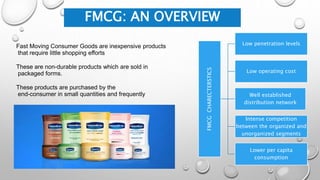
Fast Moving Consumer Goods are inexpensive products
that require little shopping efforts
These are non-durable products which are sold in
packaged forms.
These products are purchased by the
end-consumer in small quantities and frequently
FMCGCHARECTERSTICS
Low penetration levels
Low operating cost
Well established
distribution network
Intense competition
between the organized and
unorganized segments
Lower per capita
consumption
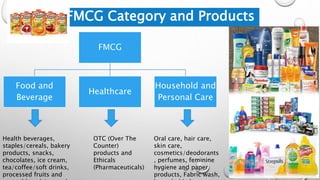
FMCG Category and Products
FMCG
Food and
Beverage
Healthcare
Household and
Personal Care
Health beverages,
staples/cereals, bakery
products, snacks,
chocolates, ice cream,
tea/coffee/soft drinks,
processed fruits and
OTC (Over The
Counter)
products and
Ethicals
(Pharmaceuticals)
Oral care, hair care,
skin care,
cosmetics/deodorants
, perfumes, feminine
hygiene and paper
products, Fabric wash,
FMCG SECTOR IN INDIA
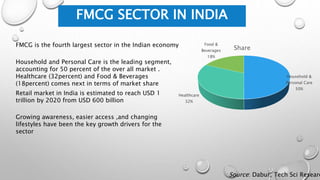
Household and Personal Care is the leading segment,
accounting for 50 percent of the over all market .
Healthcare (32percent) and Food & Beverages
(18percent) comes next in terms of market share
FMCG is the fourth largest sector in the Indian economy
Growing awareness, easier access ,and changing
lifestyles have been the key growth drivers for the
sector
Retail market in India is estimated to reach USD 1
trillion by 2020 from USD 600 billion
Household &
Personal Care
50%
Healthcare
32%
Food &
Beverages
18%
Share
Source: Dabur, Tech Sci Researc
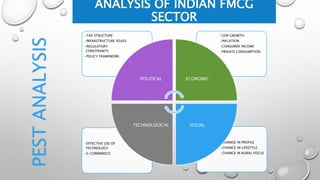
ANALYSIS OF INDIAN FMCG
SECTOR
•CHANGE IN PROFILE
•CHANGE IN LIFESTYLE
•CHANGE IN RURAL FOCUS
•EFFECTIVE USE OF
TECHNOLOGY
•E-COMMERECE
•GDP GROWTH
•INFLATION
•CONSUMER INCOME
•PRIVATE CONSUMPTION
•TAX STRUCTURE
•INFRASTRUCTURE ISSUES
•REGULATORY
CONSTRAINTS
•POLICY FRAMEWORK
POLITICAL ECONOMIC
SOCIALTECHNOLOGICAL
PESTANALYSIS
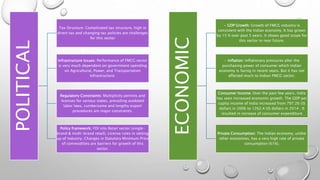
POLITICAL Tax Structure: Complicated tax structure, high in
direct tax and changing tax policies are challenges
for this sector
Infrastructure Issues: Performance of FMCG sector
is very much dependent on government spending
on Agricultural, Power, and Transportation
Infrastructure.
Regulatory Constraints: Multiplicity permits and
licenses for various states, prevailing outdated
labor laws, cumbersome and lengthy export
procedures are major constraints.
Policy framework: FDI into Retail sector (single-
brand & multi-brand retail), License rules in setting
up of Industry, Changes in Statutory Minimum Price
of commodities are barriers for growth of this
sector.
ECONOMIC
• GDP Growth: Growth of FMCG industry is
consistent with the Indian economy. It has grown
by 15 % over past 5 years. It shows good scope for
this sector in near future.
• Inflation: Inflationary pressures alter the
purchasing power of consumer which Indian
economy is facing in recent years. But it has not
affected much to Indian FMCG sector.
Consumer Income: Over the past few years, India
has seen increased economic growth. The GDP per
capita income of India increased from 797.26 US
dollars in 2006 to 1262.4 US dollars in 2014 . It
resulted in increase of consumer expenditure
Private Consumption: The Indian economy, unlike
other economies, has a very high rate of private
consumption (61%).
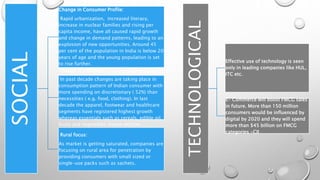
SOCIAL
Change in Consumer Profile:
Rapid urbanization, increased literacy,
increase in nuclear families and rising per
capita income, have all caused rapid growth
and change in demand patterns, leading to an
explosion of new opportunities. Around 45
per cent of the population in India is below 20
years of age and the young population is set
to rise further.
Change in Lifestyle :
In past decade changes are taking place in
consumption pattern of Indian consumer with
more spending on discretionary ( 52%) than
necessities ( e.g. food, clothing). In last
decade the apparel, footwear and healthcare
segments have registered highest growth
whereas essentials such as cereals, edible oil,
fruits and vegetables shown decline.
Rural focus:
As market is getting saturated, companies are
focusing on rural area for penetration by
providing consumers with small sized or
single-use packs such as sachets.
TECHNOLOGICAL
Effective use of technology is seen
only in leading companies like HUL,
ITC etc.
E- Commerce will boost FMCG sales
in future. More than 150 million
consumers would be influenced by
digital by 2020 and they will spend
more than $45 billion on FMCG
categories -CII
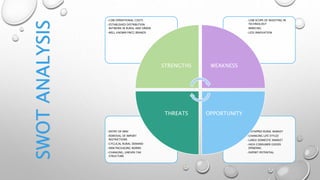
•UNTAPPED RURAL MARKET
•CHANGING LIFE STYLES
•LARGE DOMESTIC MARKET
•HIGH CONSUMER GOODS
SPENDING
•EXPORT POTENTIAL
•ENTRY OF MNC
•REMOVAL OF IMPORT
RESTRICTIONS
•CYCLICAL RURAL DEMAND
•NEW PACKAGING NORMS
•CHANGING, UNEVEN TAX
STRUCTURE
•LOW SCOPE OF INVESTING IN
TECHNOLOGY
•MIMICING
•LESS INNOVATION
•LOW OPERATIONAL COSTS
•ESTABLISHED DISTRIBUTION
NETWORK IN RURAL AND URBAN
•WELL KNOWN FMCG BRANDS
STRENGTHS WEAKNESS
OPPORTUNITYTHREATS
SWOTANALYSIS
STRENGTHS
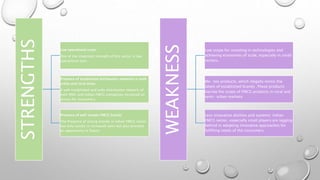
Low operational costs:
One of the important strength of this sector is low
operational cost.
Presence of established distribution networks in both
urban and rural areas.
A well established and wide distribution network of
both MNC and Indian FMCG companies increased an
access for consumers.
Presence of well-known FMCG brands
The Presence of strong brands in Indian FMCG sector
not only results in increased sales but also provides
an opportunity in future.
WEAKNESS
Low scope for investing in technologies and
achieving economies of scale, especially in small
sectors.
Me- too products, which illegally mimic the
labels of established brands .These products
narrow the scope of FMCG products in rural and
semi- urban markets
Less innovative abilities and systems: Indian
FMCG sector, especially small players are lagging
behind in adopting innovative approaches for
fulfilling needs of the consumers.
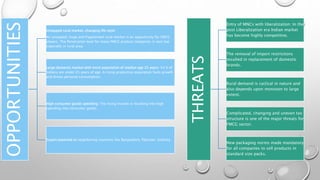
OPPORTUNITIES
Untapped rural market, changing life style:
An untapped, huge and fragmented rural market is an opportunity for FMCG
players. The Penetration level for many FMCG product categories is very low
especially in rural area.
Large domestic market with more population of median age 25 years: 54 % of
Indians are under 25 years of age. A rising productive population fuels growth
and drives personal consumption
High consumer goods spending: The rising income is resulting into high
spending into consumer goods.
Export potential to neighboring countries like Bangladesh, Pakistan, Srilanka.
THREATS
Entry of MNCs with liberalization: In the
post Liberalization era Indian market
has become highly competitive.
The removal of import restrictions
resulted in replacement of domestic
brands.
Rural demand is cyclical in nature and
also depends upon monsoon to large
extent.
Complicated, changing and uneven tax
structure is one of the major threats for
FMCG sector.
New packaging norms made mandatory
for all companies to sell products in
standard size packs.
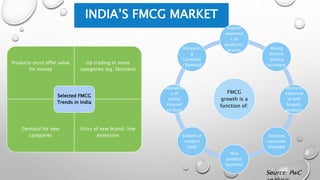
INDIA’S FMCG MARKET
Products must offer value
for money
Up trading in some
categories (eg. Skincare)
Demand for new
categories
Entry of new brand/ line
extension
Selected FMCG
Trends in India
FMCG
growth is a
function of:
Greater
awarenes
s of
products/
brands Rising
Income
driving
purchase
Desire to
experime
nt with
brands,
products
Evolving
consumer
lifestyles
New
product
launches
Growth of
modern
trade
Availabilit
y of
online
channel
to shop
Increasin
g
Consume
r Demand
Source: PwC
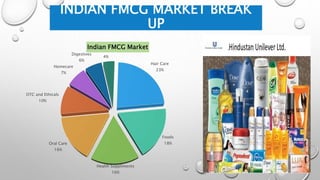
INDIAN FMCG MARKET BREAK
UP
Hair Care
23%
Foods
18%
Health Suppliments
16%
Oral Care
16%
OTC and Ethicals
10%
Homecare
7%
Digestives
6%
Skincare
4%
Indian FMCG Market
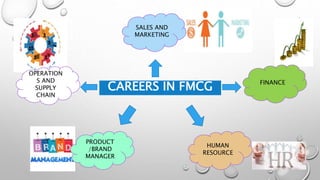
CAREERS IN FMCG
HUMAN
RESOURCE
OPERATION
S AND
SUPPLY
CHAIN
SALES AND
MARKETING
FINANCE
PRODUCT
/BRAND
MANAGER
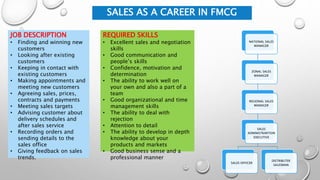
SALES AS A CAREER IN FMCG
REQUIRED SKILLS
• Excellent sales and negotiation
skills
• Good communication and
people’s skills
• Confidence, motivation and
determination
• The ability to work well on
your own and also a part of a
team
• Good organizational and time
management skills
• The ability to deal with
rejection
• Attention to detail
• The ability to develop in depth
knowledge about your
products and markets
• Good business sense and a
professional manner
JOB DESCRIPTION
• Finding and winning new
customers
• Looking after existing
customers
• Keeping in contact with
existing customers
• Making appointments and
meeting new customers
• Agreeing sales, prices,
contracts and payments
• Meeting sales targets
• Advising customer about
delivery schedules and
after sales service
• Recording orders and
sending details to the
sales office
• Giving feedback on sales
trends.
NATIONAL SALES
MANAGER
ZONAL SALES
MANAGER
REGIONAL SALES
MANAGER
SALES
ADMINISTRARTION
EXECUTIVE
SALES OFFICER
DISTRIBUTER
SALESMAN
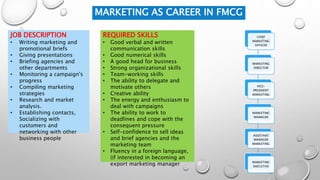
MARKETING AS CAREER IN FMCG
REQUIRED SKILLS
• Good verbal and written
communication skills
• Good numerical skills
• A good head for business
• Strong organizational skills
• Team-working skills
• The ability to delegate and
motivate others
• Creative ability
• The energy and enthusiasm to
deal with campaigns
• The ability to work to
deadlines and cope with the
consequent pressure
• Self-confidence to sell ideas
and brief agencies and the
marketing team
• Fluency in a foreign language,
(if interested in becoming an
export marketing manager
JOB DESCRIPTION
• Writing marketing and
promotional briefs
• Giving presentations
• Briefing agencies and
other departments
• Monitoring a campaign's
progress
• Compiling marketing
strategies
• Research and market
analysis.
• Establishing contacts,
Socializing with
customers and
networking with other
business people
CHIEF
MARKETING
OFFICER
MARKETING
DIRECTOR
VICE-
PRESIDENT
MARKETING
MARKETING
MANAGER
ASSISTANT
MANAGER
MARKETING
MARKETING
EXECUTIVE
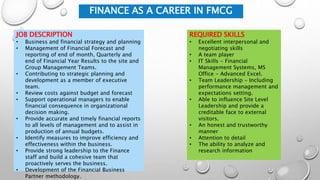
FINANCE AS A CAREER IN FMCG
JOB DESCRIPTION
• Business and financial strategy and planning
• Management of Financial Forecast and
reporting of end of month, Quarterly and
end of Financial Year Results to the site and
Group Management Teams.
• Contributing to strategic planning and
development as a member of executive
team.
• Review costs against budget and forecast
• Support operational managers to enable
financial consequence in organizational
decision making.
• Provide accurate and timely financial reports
to all levels of management and to assist in
production of annual budgets.
• Identify measures to improve efficiency and
effectiveness within the business.
• Provide strong leadership to the Finance
staff and build a cohesive team that
proactively serves the business.
• Development of the Financial Business
Partner methodology.
REQUIRED SKILLS
• Excellent interpersonal and
negotiating skills
• A team player
• IT Skills - Financial
Management Systems, MS
Office - Advanced Excel.
• Team Leadership - Including
performance management and
expectations setting.
• Able to influence Site Level
Leadership and provide a
creditable face to external
visitors.
• An honest and trustworthy
manner
• Attention to detail
• The ability to analyze and
research information
HUMAN RESOURCES AS A CAREER
IN FMCG
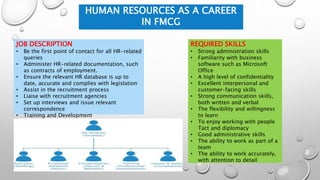
JOB DESCRIPTION
• Be the first point of contact for all HR-related
queries
• Administer HR-related documentation, such
as contracts of employment.
• Ensure the relevant HR database is up to
date, accurate and complies with legislation
• Assist in the recruitment process
• Liaise with recruitment agencies
• Set up interviews and issue relevant
correspondence
• Training and Development
• Operating pay and benefits policies
REQUIRED SKILLS
• Strong administration skills
• Familiarity with business
software such as Microsoft
Office
• A high level of confidentiality
• Excellent interpersonal and
customer-facing skills
• Strong communication skills,
both written and verbal
• The flexibility and willingness
to learn
• To enjoy working with people
Tact and diplomacy
• Good administrative skills
• The ability to work as part of a
team
• The ability to work accurately,
with attention to detail
BRAND MANAGER AS CAREER IN
FMCG
JOB DESCRIPTION
• Monitoring marketing trends
• Meeting with clients and various departments
• Carrying out consumer research
• Writing and presenting reports t clients and senior
management
• Overseeing a team of junior staff
REQUIRED SKILLS
• Calm and confident
• Organized and thorough
• Excellent communication and presenting
skills
• A great team leader
• Deep understanding of marketing
principles
• Analytical
• Strong multi-tasking skills
PRODUCT MANAGER AS A CAREER
IN FMCG
REQUIRED SKILLS
• Have thorough knowledge of technology
relating to the product
• Have the ability to organize everything
concerned with the product's development
• Have excellent verbal and written
communication skills
• Have good leadership skills to supervise
those involved with each stage in the
process
• Possess a creative way of thinking
• Have the ability to focus on specific goals
• Be energetic and passionate about your
product
• Be able to work under pressure
JOB DESCRIPTION
• Determine customers' needs and desires and to
obtain market information.
• Recommending the nature and scope of present
and future product lines
• Assesses market competition
• Providing source data for product line
communications
• Obtaining product market share.
• Assessing product market data.
• Preparing short-term and long-term product
sales forecasts and special reports and analysis
• Bringing new products to market
• Introduction and marketing new products by
developing time-integrated plans with sales,
advertising, and production.
• Determining product pricing by utilizing market
research data
• Maintaining product management staff by
recruiting, selecting, orienting, and training
employees.
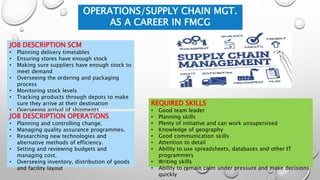
OPERATIONS/SUPPLY CHAIN MGT.
AS A CAREER IN FMCG
JOB DESCRIPTION SCM
• Planning delivery timetables
• Ensuring stores have enough stock
• Making sure suppliers have enough stock to
meet demand
• Overseeing the ordering and packaging
process
• Monitoring stock levels
• Tracking products through depots to make
sure they arrive at their destination
• Overseeing arrival of shipments
REQUIRED SKILLS
• Good team leader
• Planning skills
• Plenty of initiative and can work unsupervised
• Knowledge of geography
• Good communication skills
• Attention to detail
• Ability to use spreadsheets, databases and other IT
programmers
• Writing skills
• Ability to remain calm under pressure and make decisions
quickly
JOB DESCRIPTION OPERATIONS
• Planning and controlling change.
• Managing quality assurance programmes.
• Researching new technologies and
alternative methods of efficiency.
• Setting and reviewing budgets and
managing cost.
• Overseeing inventory, distribution of goods
and facility layout
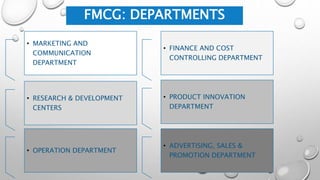
FMCG: DEPARTMENTS
• ADVERTISING, SALES &
PROMOTION DEPARTMENT
• RESEARCH & DEVELOPMENT
CENTERS
• OPERATION DEPARTMENT
• PRODUCT INNOVATION
DEPARTMENT
• FINANCE AND COST
CONTROLLING DEPARTMENT
• MARKETING AND
COMMUNICATION
DEPARTMENT
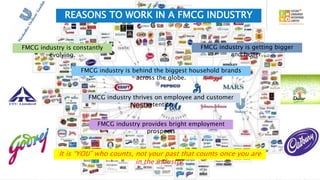
REASONS TO WORK IN A FMCG INDUSTRY
FMCG industry is behind the biggest household brands
across the globe.
FMCG industry is constantly
evolving.
FMCG industry thrives on employee and customer
retention.
FMCG industry is getting bigger
and better.
It is “YOU” who counts, not your past that counts once you are
in the industry.
FMCG industry provides bright employment
prospects
THANK
YOU

Fmcg

  • 1.
    FAST MOVING CONSUMER GOODS (FMCG) POWER POINTPRESENTATION BY: DINESH KUMAR KAUNDAL HPU BUSINESS SCHOOL, SHIMLA
  • 2.
    FMCG: AN OVERVIEW FastMoving Consumer Goods are inexpensive products that require little shopping efforts These are non-durable products which are sold in packaged forms. These products are purchased by the end-consumer in small quantities and frequently FMCGCHARECTERSTICS Low penetration levels Low operating cost Well established distribution network Intense competition between the organized and unorganized segments Lower per capita consumption
  • 3.
    FMCG Category andProducts FMCG Food and Beverage Healthcare Household and Personal Care Health beverages, staples/cereals, bakery products, snacks, chocolates, ice cream, tea/coffee/soft drinks, processed fruits and OTC (Over The Counter) products and Ethicals (Pharmaceuticals) Oral care, hair care, skin care, cosmetics/deodorants , perfumes, feminine hygiene and paper products, Fabric wash,
  • 4.
    FMCG SECTOR ININDIA Household and Personal Care is the leading segment, accounting for 50 percent of the over all market . Healthcare (32percent) and Food & Beverages (18percent) comes next in terms of market share FMCG is the fourth largest sector in the Indian economy Growing awareness, easier access ,and changing lifestyles have been the key growth drivers for the sector Retail market in India is estimated to reach USD 1 trillion by 2020 from USD 600 billion Household & Personal Care 50% Healthcare 32% Food & Beverages 18% Share Source: Dabur, Tech Sci Researc
  • 5.
    ANALYSIS OF INDIANFMCG SECTOR •CHANGE IN PROFILE •CHANGE IN LIFESTYLE •CHANGE IN RURAL FOCUS •EFFECTIVE USE OF TECHNOLOGY •E-COMMERECE •GDP GROWTH •INFLATION •CONSUMER INCOME •PRIVATE CONSUMPTION •TAX STRUCTURE •INFRASTRUCTURE ISSUES •REGULATORY CONSTRAINTS •POLICY FRAMEWORK POLITICAL ECONOMIC SOCIALTECHNOLOGICAL PESTANALYSIS
  • 6.
    POLITICAL Tax Structure:Complicated tax structure, high in direct tax and changing tax policies are challenges for this sector Infrastructure Issues: Performance of FMCG sector is very much dependent on government spending on Agricultural, Power, and Transportation Infrastructure. Regulatory Constraints: Multiplicity permits and licenses for various states, prevailing outdated labor laws, cumbersome and lengthy export procedures are major constraints. Policy framework: FDI into Retail sector (single- brand & multi-brand retail), License rules in setting up of Industry, Changes in Statutory Minimum Price of commodities are barriers for growth of this sector. ECONOMIC • GDP Growth: Growth of FMCG industry is consistent with the Indian economy. It has grown by 15 % over past 5 years. It shows good scope for this sector in near future. • Inflation: Inflationary pressures alter the purchasing power of consumer which Indian economy is facing in recent years. But it has not affected much to Indian FMCG sector. Consumer Income: Over the past few years, India has seen increased economic growth. The GDP per capita income of India increased from 797.26 US dollars in 2006 to 1262.4 US dollars in 2014 . It resulted in increase of consumer expenditure Private Consumption: The Indian economy, unlike other economies, has a very high rate of private consumption (61%).
  • 7.
    SOCIAL Change in ConsumerProfile: Rapid urbanization, increased literacy, increase in nuclear families and rising per capita income, have all caused rapid growth and change in demand patterns, leading to an explosion of new opportunities. Around 45 per cent of the population in India is below 20 years of age and the young population is set to rise further. Change in Lifestyle : In past decade changes are taking place in consumption pattern of Indian consumer with more spending on discretionary ( 52%) than necessities ( e.g. food, clothing). In last decade the apparel, footwear and healthcare segments have registered highest growth whereas essentials such as cereals, edible oil, fruits and vegetables shown decline. Rural focus: As market is getting saturated, companies are focusing on rural area for penetration by providing consumers with small sized or single-use packs such as sachets. TECHNOLOGICAL Effective use of technology is seen only in leading companies like HUL, ITC etc. E- Commerce will boost FMCG sales in future. More than 150 million consumers would be influenced by digital by 2020 and they will spend more than $45 billion on FMCG categories -CII
  • 8.
    •UNTAPPED RURAL MARKET •CHANGINGLIFE STYLES •LARGE DOMESTIC MARKET •HIGH CONSUMER GOODS SPENDING •EXPORT POTENTIAL •ENTRY OF MNC •REMOVAL OF IMPORT RESTRICTIONS •CYCLICAL RURAL DEMAND •NEW PACKAGING NORMS •CHANGING, UNEVEN TAX STRUCTURE •LOW SCOPE OF INVESTING IN TECHNOLOGY •MIMICING •LESS INNOVATION •LOW OPERATIONAL COSTS •ESTABLISHED DISTRIBUTION NETWORK IN RURAL AND URBAN •WELL KNOWN FMCG BRANDS STRENGTHS WEAKNESS OPPORTUNITYTHREATS SWOTANALYSIS
  • 9.
    STRENGTHS Low operational costs: Oneof the important strength of this sector is low operational cost. Presence of established distribution networks in both urban and rural areas. A well established and wide distribution network of both MNC and Indian FMCG companies increased an access for consumers. Presence of well-known FMCG brands The Presence of strong brands in Indian FMCG sector not only results in increased sales but also provides an opportunity in future. WEAKNESS Low scope for investing in technologies and achieving economies of scale, especially in small sectors. Me- too products, which illegally mimic the labels of established brands .These products narrow the scope of FMCG products in rural and semi- urban markets Less innovative abilities and systems: Indian FMCG sector, especially small players are lagging behind in adopting innovative approaches for fulfilling needs of the consumers.
  • 10.
    OPPORTUNITIES Untapped rural market,changing life style: An untapped, huge and fragmented rural market is an opportunity for FMCG players. The Penetration level for many FMCG product categories is very low especially in rural area. Large domestic market with more population of median age 25 years: 54 % of Indians are under 25 years of age. A rising productive population fuels growth and drives personal consumption High consumer goods spending: The rising income is resulting into high spending into consumer goods. Export potential to neighboring countries like Bangladesh, Pakistan, Srilanka. THREATS Entry of MNCs with liberalization: In the post Liberalization era Indian market has become highly competitive. The removal of import restrictions resulted in replacement of domestic brands. Rural demand is cyclical in nature and also depends upon monsoon to large extent. Complicated, changing and uneven tax structure is one of the major threats for FMCG sector. New packaging norms made mandatory for all companies to sell products in standard size packs.
  • 11.
    INDIA’S FMCG MARKET Productsmust offer value for money Up trading in some categories (eg. Skincare) Demand for new categories Entry of new brand/ line extension Selected FMCG Trends in India FMCG growth is a function of: Greater awarenes s of products/ brands Rising Income driving purchase Desire to experime nt with brands, products Evolving consumer lifestyles New product launches Growth of modern trade Availabilit y of online channel to shop Increasin g Consume r Demand Source: PwC
  • 12.
    INDIAN FMCG MARKETBREAK UP Hair Care 23% Foods 18% Health Suppliments 16% Oral Care 16% OTC and Ethicals 10% Homecare 7% Digestives 6% Skincare 4% Indian FMCG Market
  • 13.
    CAREERS IN FMCG HUMAN RESOURCE OPERATION SAND SUPPLY CHAIN SALES AND MARKETING FINANCE PRODUCT /BRAND MANAGER
  • 14.
    SALES AS ACAREER IN FMCG REQUIRED SKILLS • Excellent sales and negotiation skills • Good communication and people’s skills • Confidence, motivation and determination • The ability to work well on your own and also a part of a team • Good organizational and time management skills • The ability to deal with rejection • Attention to detail • The ability to develop in depth knowledge about your products and markets • Good business sense and a professional manner JOB DESCRIPTION • Finding and winning new customers • Looking after existing customers • Keeping in contact with existing customers • Making appointments and meeting new customers • Agreeing sales, prices, contracts and payments • Meeting sales targets • Advising customer about delivery schedules and after sales service • Recording orders and sending details to the sales office • Giving feedback on sales trends. NATIONAL SALES MANAGER ZONAL SALES MANAGER REGIONAL SALES MANAGER SALES ADMINISTRARTION EXECUTIVE SALES OFFICER DISTRIBUTER SALESMAN
  • 15.
    MARKETING AS CAREERIN FMCG REQUIRED SKILLS • Good verbal and written communication skills • Good numerical skills • A good head for business • Strong organizational skills • Team-working skills • The ability to delegate and motivate others • Creative ability • The energy and enthusiasm to deal with campaigns • The ability to work to deadlines and cope with the consequent pressure • Self-confidence to sell ideas and brief agencies and the marketing team • Fluency in a foreign language, (if interested in becoming an export marketing manager JOB DESCRIPTION • Writing marketing and promotional briefs • Giving presentations • Briefing agencies and other departments • Monitoring a campaign's progress • Compiling marketing strategies • Research and market analysis. • Establishing contacts, Socializing with customers and networking with other business people CHIEF MARKETING OFFICER MARKETING DIRECTOR VICE- PRESIDENT MARKETING MARKETING MANAGER ASSISTANT MANAGER MARKETING MARKETING EXECUTIVE
  • 16.
    FINANCE AS ACAREER IN FMCG JOB DESCRIPTION • Business and financial strategy and planning • Management of Financial Forecast and reporting of end of month, Quarterly and end of Financial Year Results to the site and Group Management Teams. • Contributing to strategic planning and development as a member of executive team. • Review costs against budget and forecast • Support operational managers to enable financial consequence in organizational decision making. • Provide accurate and timely financial reports to all levels of management and to assist in production of annual budgets. • Identify measures to improve efficiency and effectiveness within the business. • Provide strong leadership to the Finance staff and build a cohesive team that proactively serves the business. • Development of the Financial Business Partner methodology. REQUIRED SKILLS • Excellent interpersonal and negotiating skills • A team player • IT Skills - Financial Management Systems, MS Office - Advanced Excel. • Team Leadership - Including performance management and expectations setting. • Able to influence Site Level Leadership and provide a creditable face to external visitors. • An honest and trustworthy manner • Attention to detail • The ability to analyze and research information
  • 17.
    HUMAN RESOURCES ASA CAREER IN FMCG JOB DESCRIPTION • Be the first point of contact for all HR-related queries • Administer HR-related documentation, such as contracts of employment. • Ensure the relevant HR database is up to date, accurate and complies with legislation • Assist in the recruitment process • Liaise with recruitment agencies • Set up interviews and issue relevant correspondence • Training and Development • Operating pay and benefits policies REQUIRED SKILLS • Strong administration skills • Familiarity with business software such as Microsoft Office • A high level of confidentiality • Excellent interpersonal and customer-facing skills • Strong communication skills, both written and verbal • The flexibility and willingness to learn • To enjoy working with people Tact and diplomacy • Good administrative skills • The ability to work as part of a team • The ability to work accurately, with attention to detail
  • 18.
    BRAND MANAGER ASCAREER IN FMCG JOB DESCRIPTION • Monitoring marketing trends • Meeting with clients and various departments • Carrying out consumer research • Writing and presenting reports t clients and senior management • Overseeing a team of junior staff REQUIRED SKILLS • Calm and confident • Organized and thorough • Excellent communication and presenting skills • A great team leader • Deep understanding of marketing principles • Analytical • Strong multi-tasking skills
  • 19.
    PRODUCT MANAGER ASA CAREER IN FMCG REQUIRED SKILLS • Have thorough knowledge of technology relating to the product • Have the ability to organize everything concerned with the product's development • Have excellent verbal and written communication skills • Have good leadership skills to supervise those involved with each stage in the process • Possess a creative way of thinking • Have the ability to focus on specific goals • Be energetic and passionate about your product • Be able to work under pressure JOB DESCRIPTION • Determine customers' needs and desires and to obtain market information. • Recommending the nature and scope of present and future product lines • Assesses market competition • Providing source data for product line communications • Obtaining product market share. • Assessing product market data. • Preparing short-term and long-term product sales forecasts and special reports and analysis • Bringing new products to market • Introduction and marketing new products by developing time-integrated plans with sales, advertising, and production. • Determining product pricing by utilizing market research data • Maintaining product management staff by recruiting, selecting, orienting, and training employees.
  • 21.
    OPERATIONS/SUPPLY CHAIN MGT. ASA CAREER IN FMCG JOB DESCRIPTION SCM • Planning delivery timetables • Ensuring stores have enough stock • Making sure suppliers have enough stock to meet demand • Overseeing the ordering and packaging process • Monitoring stock levels • Tracking products through depots to make sure they arrive at their destination • Overseeing arrival of shipments REQUIRED SKILLS • Good team leader • Planning skills • Plenty of initiative and can work unsupervised • Knowledge of geography • Good communication skills • Attention to detail • Ability to use spreadsheets, databases and other IT programmers • Writing skills • Ability to remain calm under pressure and make decisions quickly JOB DESCRIPTION OPERATIONS • Planning and controlling change. • Managing quality assurance programmes. • Researching new technologies and alternative methods of efficiency. • Setting and reviewing budgets and managing cost. • Overseeing inventory, distribution of goods and facility layout
  • 22.
    FMCG: DEPARTMENTS • ADVERTISING,SALES & PROMOTION DEPARTMENT • RESEARCH & DEVELOPMENT CENTERS • OPERATION DEPARTMENT • PRODUCT INNOVATION DEPARTMENT • FINANCE AND COST CONTROLLING DEPARTMENT • MARKETING AND COMMUNICATION DEPARTMENT
  • 23.
    REASONS TO WORKIN A FMCG INDUSTRY FMCG industry is behind the biggest household brands across the globe. FMCG industry is constantly evolving. FMCG industry thrives on employee and customer retention. FMCG industry is getting bigger and better. It is “YOU” who counts, not your past that counts once you are in the industry. FMCG industry provides bright employment prospects
  • 24.