DOUBLESPEAK
EMOTIVE LANGUAGE
IDIOMATICEXPRESION
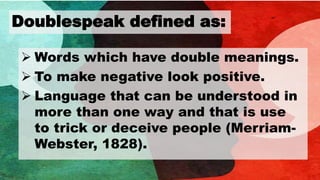
 Words which have double meanings.
 To make negative look positive.
 Language that can be understood in
more than one way and that is use
to trick or deceive people (Merriam-
Webster, 1828).
Doublespeak defined as:
1.EUPHEMISMS
2.JARGONS
3.GOBBLEDYGOOK
4.INFLATED LANGUAGE
4 BASIC TYPES OF
DOUBLESPEAK
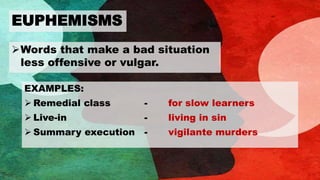
EXAMPLES:
 Remedial class - for slow learners
 Live-in - living in sin
 Summary execution - vigilante murders
EUPHEMISMS
Words that make a bad situation
less offensive or vulgar.
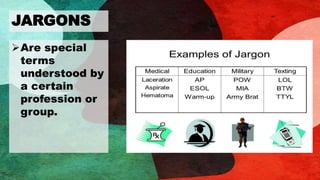
JARGONS
Are special
terms
understood by
a certain
profession or
group.
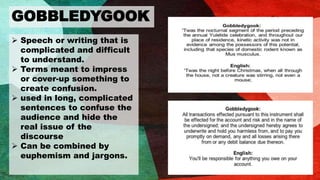
GOBBLEDYGOOK
 Speech or writing that is
complicated and difficult
to understand.
 Terms meant to impress
or cover-up something to
create confusion.
 used in long, complicated
sentences to confuse the
audience and hide the
real issue of the
discourse
 Can be combined by
euphemism and jargons.
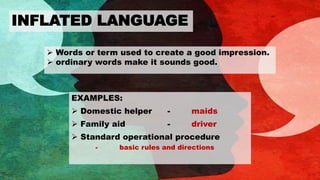
EXAMPLES:
 Domestic helper - maids
 Family aid - driver
 Standard operational procedure
- basic rules and directions
INFLATED LANGUAGE
 Words or term used to create a good impression.
 ordinary words make it sounds good.
DEFINITION
 Language that is used
to create a particular
emotional response in
the reader
 Can create strong
feelings such as anger,
guilt, joy, concern,
empathy, hope etc
 Involves the reader in
the text
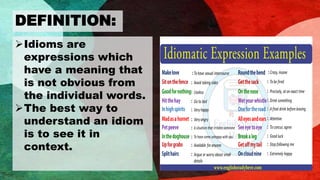
DEFINITION:
Idioms are
expressions which
have a meaning that
is not obvious from
the individual words.
The best way to
understand an idiom
is to see it in
context.

Doublespeak