
By: Dr. Ankit Gaur
M.Sc, Pharm. D, R.Ph
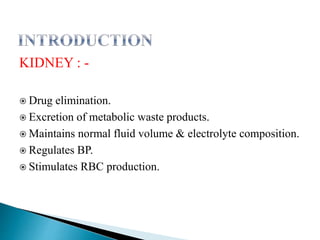
KIDNEY : -
 Drug elimination.
 Excretion of metabolic waste products.
 Maintains normal fluid volume & electrolyte composition.
 Regulates BP.
 Stimulates RBC production.
 Changes in gastrointestinal transit time
 Gastric pH
 Edema of the gastrointestinal tract
 Vomiting and diarrhoea
 Antacid administration
Drug absorption is slowed i.e the
extent of absorption is reduced as the
result
of the development of CKD.
 An increase in bioavailability has been noted
for some β-blockers - bufuralol, oxprenolol,
propranolol, and tolamolol;
dextropropoxyphene; and dihydrocodeine.
 Unexpected adverse effects have only been
demonstrated with dextropropoxyphene and
dihydrocodeine.
The volume of distribution is increased.
 Decreased protein binding - acidic drugs (e.g.,
warfarin and phenytoin)
binding of basic drugs (e.g., quinidine and
lidocaine) is normal or only slightly decreased
or increased.
 Increased tissue binding,
 Pathophysiologic alterations in body
composition.
Eg: Erythromycin, Phenytoin, Furosemide,
Gentamicin
The volume of distribution is decreased
 Decrease in tissue binding as a result of
competitive inhibition by endogenous or
exogenous substances.
Eg: Chloramphenicol, Digoxin, Ethambutol
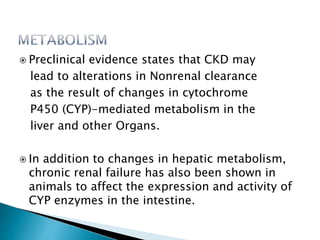
 Preclinical evidence states that CKD may
lead to alterations in Nonrenal clearance
as the result of changes in cytochrome
P450 (CYP)-mediated metabolism in the
liver and other Organs.
 In addition to changes in hepatic metabolism,
chronic renal failure has also been shown in
animals to affect the expression and activity of
CYP enzymes in the intestine.
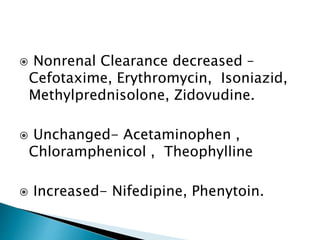
 Nonrenal Clearance decreased –
Cefotaxime, Erythromycin, Isoniazid,
Methylprednisolone, Zidovudine.
 Unchanged- Acetaminophen ,
Chloramphenicol , Theophylline
 Increased- Nifedipine, Phenytoin.
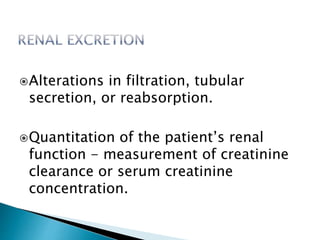
Alterations in filtration, tubular
secretion, or reabsorption.
Quantitation of the patient’s renal
function - measurement of creatinine
clearance or serum creatinine
concentration.
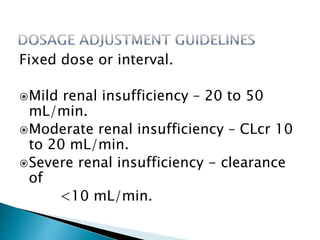
Fixed dose or interval.
Mild renal insufficiency – 20 to 50
mL/min.
Moderate renal insufficiency – CLcr 10
to 20 mL/min.
Severe renal insufficiency - clearance
of
<10 mL/min.
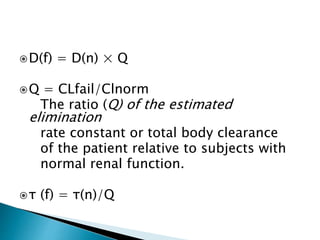
D(f) = D(n) × Q
Q = CLfail/Clnorm
The ratio (Q) of the estimated
elimination
rate constant or total body clearance
of the patient relative to subjects with
normal renal function.
τ (f) = τ(n)/Q
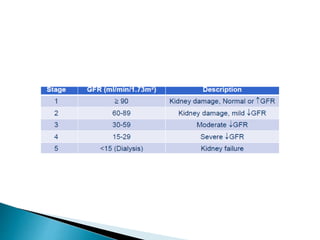
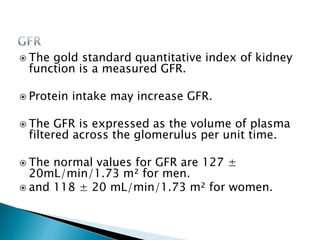
 The gold standard quantitative index of kidney
function is a measured GFR.
 Protein intake may increase GFR.
 The GFR is expressed as the volume of plasma
filtered across the glomerulus per unit time.
 The normal values for GFR are 127 ±
20mL/min/1.73 m² for men.
 and 118 ± 20 mL/min/1.73 m² for women.
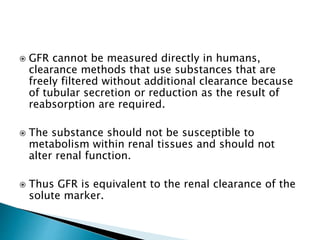
 GFR cannot be measured directly in humans,
clearance methods that use substances that are
freely filtered without additional clearance because
of tubular secretion or reduction as the result of
reabsorption are required.
 The substance should not be susceptible to
metabolism within renal tissues and should not
alter renal function.
 Thus GFR is equivalent to the renal clearance of the
solute marker.
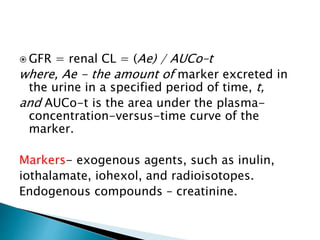
 GFR = renal CL = (Ae) / AUCo–t
where, Ae - the amount of marker excreted in
the urine in a specified period of time, t,
and AUCo-t is the area under the plasma-
concentration-versus-time curve of the
marker.
Markers- exogenous agents, such as inulin,
iothalamate, iohexol, and radioisotopes.
Endogenous compounds – creatinine.
 In adults - Cockcroft and Gault
produces consistent results in patients of
average size and build, with stable renal
function and a SCr less than 3 mg%.
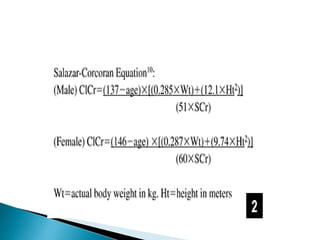
 The Salazar and Corcoran equation derived
for obese patients.
 For the estimation of GFR.
 six-variable Modification of Diet in Renal Disease
Study (MDRD6) equation:
GFR = 170 × (Pcr)-0.999 × [Age]-0.176 ×
[0.762 if patient is female] ×
[1.180 if patient is black] ×
[SUN]-0.170 × [Alb]-0.318
where , Pcr = plasma creatinine,
SUN = serum nitrogen concentration,
and Alb = serum albumin concentration.
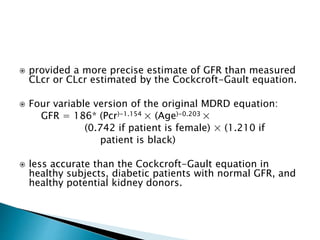
 provided a more precise estimate of GFR than measured
CLcr or CLcr estimated by the Cockcroft-Gault equation.
 Four variable version of the original MDRD equation:
GFR = 186* (Pcr)-1.154 × (Age)-0.203 ×
(0.742 if patient is female) × (1.210 if
patient is black)
 less accurate than the Cockcroft-Gault equation in
healthy subjects, diabetic patients with normal GFR, and
healthy potential kidney donors.
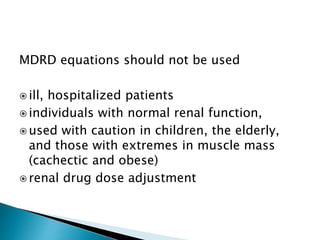
MDRD equations should not be used
 ill, hospitalized patients
 individuals with normal renal function,
 used with caution in children, the elderly,
and those with extremes in muscle mass
(cachectic and obese)
 renal drug dose adjustment
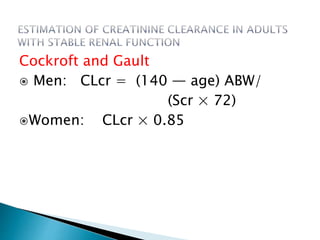
Cockroft and Gault
 Men: CLcr = (140 — age) ABW/
(Scr × 72)
Women: CLcr × 0.85
Renal function does not mature to reach adult
values until one year of age.
 rapid changes in GFR.
 Estimation of CLcr - Schwartz is dependent on the
child’s age and length:
GFR = [length (cm) × k] / Scr
where, k is defined by age group:
pre-term infants = 0.33
infant (1 to 52 weeks) = 0.45;
child(1 to 13 years) = 0.55;
adolescent male = 0.7;
and adolescent female= 0.55.
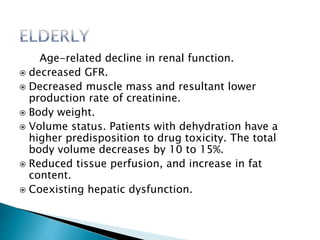
Age-related decline in renal function.
 decreased GFR.
 Decreased muscle mass and resultant lower
production rate of creatinine.
 Body weight.
 Volume status. Patients with dehydration have a
higher predisposition to drug toxicity. The total
body volume decreases by 10 to 15%.
 Reduced tissue perfusion, and increase in fat
content.
 Coexisting hepatic dysfunction.
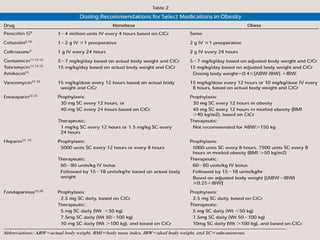
 Ideal Body Weight (IBW) is used in place of
actual body weight (ABW) in the Cockcroft-Gault
equation, where:
 IBW(kg, males) = 50 Kg + 2.3 kg for each inch
over 5 feet (Height in inches >60).
 IBW (kg, females) = 45 Kg + 2.3 kg for each
inch over 5 feet (Height in inches >60)
 An alternative approach - Salazar-Corcoran
equation
Dose adjustment in renal disorder

Dose adjustment in renal disorder

  • 1.
    By: Dr. AnkitGaur M.Sc, Pharm. D, R.Ph
  • 2.
    KIDNEY : - Drug elimination.  Excretion of metabolic waste products.  Maintains normal fluid volume & electrolyte composition.  Regulates BP.  Stimulates RBC production.
  • 3.
     Changes ingastrointestinal transit time  Gastric pH  Edema of the gastrointestinal tract  Vomiting and diarrhoea  Antacid administration Drug absorption is slowed i.e the extent of absorption is reduced as the result of the development of CKD.
  • 4.
     An increasein bioavailability has been noted for some β-blockers - bufuralol, oxprenolol, propranolol, and tolamolol; dextropropoxyphene; and dihydrocodeine.  Unexpected adverse effects have only been demonstrated with dextropropoxyphene and dihydrocodeine.
  • 5.
    The volume ofdistribution is increased.  Decreased protein binding - acidic drugs (e.g., warfarin and phenytoin) binding of basic drugs (e.g., quinidine and lidocaine) is normal or only slightly decreased or increased.  Increased tissue binding,  Pathophysiologic alterations in body composition. Eg: Erythromycin, Phenytoin, Furosemide, Gentamicin
  • 6.
    The volume ofdistribution is decreased  Decrease in tissue binding as a result of competitive inhibition by endogenous or exogenous substances. Eg: Chloramphenicol, Digoxin, Ethambutol
  • 7.
     Preclinical evidencestates that CKD may lead to alterations in Nonrenal clearance as the result of changes in cytochrome P450 (CYP)-mediated metabolism in the liver and other Organs.  In addition to changes in hepatic metabolism, chronic renal failure has also been shown in animals to affect the expression and activity of CYP enzymes in the intestine.
  • 8.
     Nonrenal Clearancedecreased – Cefotaxime, Erythromycin, Isoniazid, Methylprednisolone, Zidovudine.  Unchanged- Acetaminophen , Chloramphenicol , Theophylline  Increased- Nifedipine, Phenytoin.
  • 9.
    Alterations in filtration,tubular secretion, or reabsorption. Quantitation of the patient’s renal function - measurement of creatinine clearance or serum creatinine concentration.
  • 10.
    Fixed dose orinterval. Mild renal insufficiency – 20 to 50 mL/min. Moderate renal insufficiency – CLcr 10 to 20 mL/min. Severe renal insufficiency - clearance of <10 mL/min.
  • 11.
    D(f) = D(n)× Q Q = CLfail/Clnorm The ratio (Q) of the estimated elimination rate constant or total body clearance of the patient relative to subjects with normal renal function. τ (f) = τ(n)/Q
  • 12.
     The goldstandard quantitative index of kidney function is a measured GFR.  Protein intake may increase GFR.  The GFR is expressed as the volume of plasma filtered across the glomerulus per unit time.  The normal values for GFR are 127 ± 20mL/min/1.73 m² for men.  and 118 ± 20 mL/min/1.73 m² for women.
  • 13.
     GFR cannotbe measured directly in humans, clearance methods that use substances that are freely filtered without additional clearance because of tubular secretion or reduction as the result of reabsorption are required.  The substance should not be susceptible to metabolism within renal tissues and should not alter renal function.  Thus GFR is equivalent to the renal clearance of the solute marker.
  • 14.
     GFR =renal CL = (Ae) / AUCo–t where, Ae - the amount of marker excreted in the urine in a specified period of time, t, and AUCo-t is the area under the plasma- concentration-versus-time curve of the marker. Markers- exogenous agents, such as inulin, iothalamate, iohexol, and radioisotopes. Endogenous compounds – creatinine.
  • 15.
     In adults- Cockcroft and Gault produces consistent results in patients of average size and build, with stable renal function and a SCr less than 3 mg%.  The Salazar and Corcoran equation derived for obese patients.
  • 16.
     For theestimation of GFR.  six-variable Modification of Diet in Renal Disease Study (MDRD6) equation: GFR = 170 × (Pcr)-0.999 × [Age]-0.176 × [0.762 if patient is female] × [1.180 if patient is black] × [SUN]-0.170 × [Alb]-0.318 where , Pcr = plasma creatinine, SUN = serum nitrogen concentration, and Alb = serum albumin concentration.
  • 17.
     provided amore precise estimate of GFR than measured CLcr or CLcr estimated by the Cockcroft-Gault equation.  Four variable version of the original MDRD equation: GFR = 186* (Pcr)-1.154 × (Age)-0.203 × (0.742 if patient is female) × (1.210 if patient is black)  less accurate than the Cockcroft-Gault equation in healthy subjects, diabetic patients with normal GFR, and healthy potential kidney donors.
  • 18.
    MDRD equations shouldnot be used  ill, hospitalized patients  individuals with normal renal function,  used with caution in children, the elderly, and those with extremes in muscle mass (cachectic and obese)  renal drug dose adjustment
  • 19.
    Cockroft and Gault Men: CLcr = (140 — age) ABW/ (Scr × 72) Women: CLcr × 0.85
  • 20.
    Renal function doesnot mature to reach adult values until one year of age.  rapid changes in GFR.  Estimation of CLcr - Schwartz is dependent on the child’s age and length: GFR = [length (cm) × k] / Scr where, k is defined by age group: pre-term infants = 0.33 infant (1 to 52 weeks) = 0.45; child(1 to 13 years) = 0.55; adolescent male = 0.7; and adolescent female= 0.55.
  • 21.
    Age-related decline inrenal function.  decreased GFR.  Decreased muscle mass and resultant lower production rate of creatinine.  Body weight.  Volume status. Patients with dehydration have a higher predisposition to drug toxicity. The total body volume decreases by 10 to 15%.  Reduced tissue perfusion, and increase in fat content.  Coexisting hepatic dysfunction.
  • 22.
     Ideal BodyWeight (IBW) is used in place of actual body weight (ABW) in the Cockcroft-Gault equation, where:  IBW(kg, males) = 50 Kg + 2.3 kg for each inch over 5 feet (Height in inches >60).  IBW (kg, females) = 45 Kg + 2.3 kg for each inch over 5 feet (Height in inches >60)  An alternative approach - Salazar-Corcoran equation