D E P T. O F M E D I C I N E ,
B H A R AT I H O S PI TA L A N D R E S E A RC H C E N T R E ,
PU N E .
Role of Family Physician in the
control of chronic kidney
disease(CKD).
Problem statement.
 India is moving ahead in all fronts, especially in the
field of healthcare and in particular medicine.
 The last few decades have seen an increasing number
of infections get under control.
 There is however an increase in the number of non-
communicable diseases like DM, HTN,
Cardiovascular diseases, strokes to name a few. All of
these are eventually associated with co-morbiditiies
such as CKD.
 Data suggests that around 11-15% of the general
population has CKD.
The Problem!!!
Contributors to the problem
 Awareness of kidney diseases is relatively low in our
community including among us doctors and
healthcare workers.
 Sr. Creatinine level, though widely advised and easily
available, is a poor marker of renal function.
 Most patients are asymptomatic to begin with. This
is why they do not approach a doctor in the early
stages of the disease.
What is Chronic Kidney Disease(CKD)?
 CKD is an all inclusive term:
 The chief criteria are:
 Glomerular filtration rate(GFR) < 60 ml/min for >
months.
 Complains of persistent renal damage by pathological or
imaging tests even in presence of a normal GFR.
Why is it CKD and not Chronic Renal Failure (CRF)?
 The spectrum of the patient’s condition ranges from
being asymptomatic to being dialysis dependent.
 The term “kidney” is better understood by the lay
people.
 As mentioned earlier, Sr. Creatinine is not a reliable
marker for assessing renal function; particularly in
the elderly.
 The gold standard test for this purpose remains GFR.
GFR: The Gold Standard.
 Defintion:A kidney function test in which results are
determined from the amount of ultrafiltrate formed by
plasma flowing through the glomeruli of the kidney. The
amount is calculated from inulin and creatinine clearance,
serum creatinine, and blood urea nitrogen.
 A number of formulae have been developed for GFR
estimation. These include.
 Cockcroft-Gault formula.
 Schwartz formula
 Mayo Quadratic formula
 CKD-EPI (Chronic Kidney Disease Epidemiology Collaboration) formula
 Modification of Diet in Renal Disease (MDRD) formula
 The most commonly employed formula is the Cockcroft-
Gault formula:
 A commonly used surrogate marker for estimate of creatinine
clearance (eCCr) is the Cockcroft-Gault formula, which in turn
estimates GFR in ml/min.
(eCCr :- Estimated creatinine clearance rate)
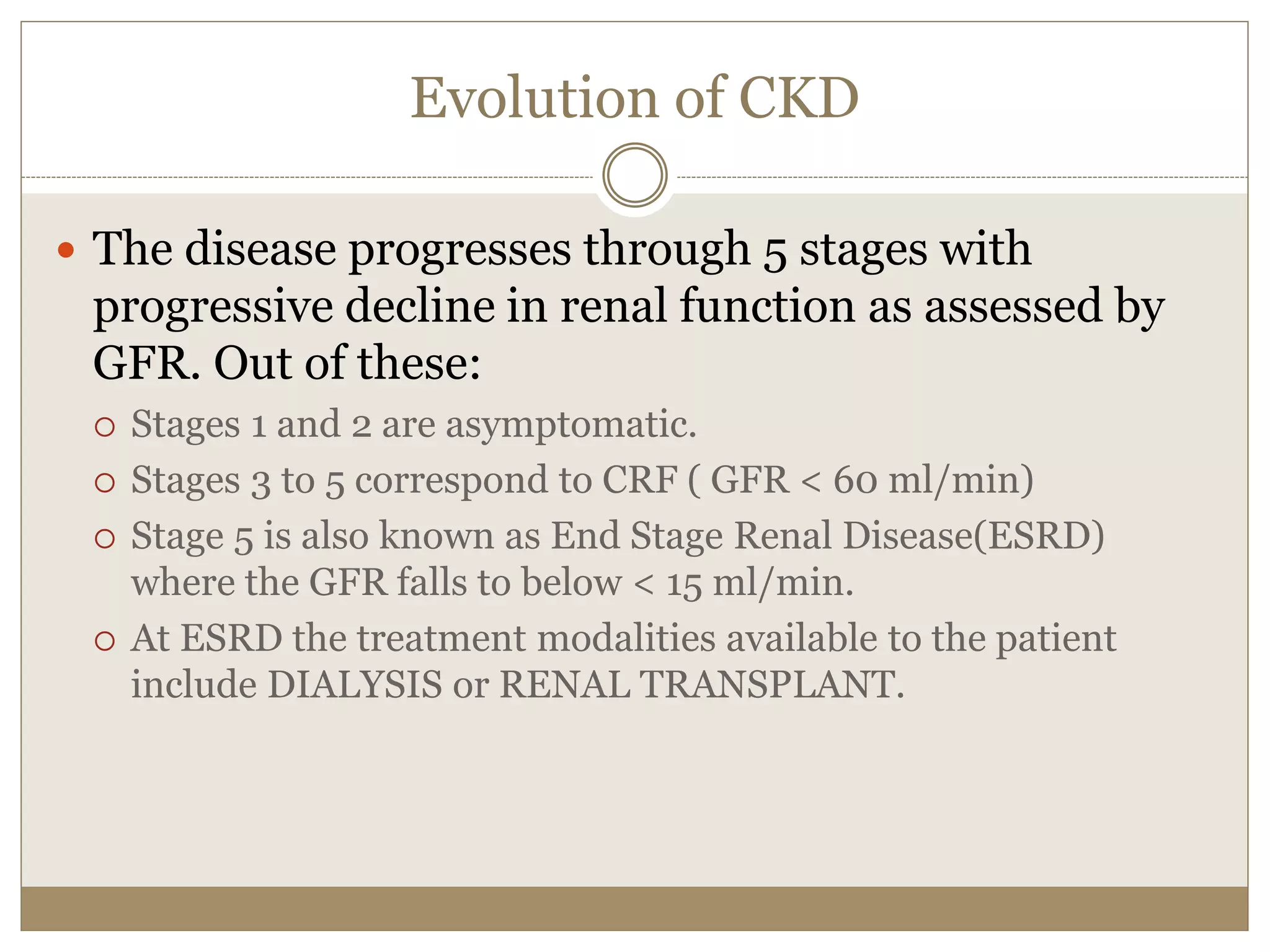
Evolution of CKD
 The disease progresses through 5 stages with
progressive decline in renal function as assessed by
GFR. Out of these:
 Stages 1 and 2 are asymptomatic.
 Stages 3 to 5 correspond to CRF ( GFR < 60 ml/min)
 Stage 5 is also known as End Stage Renal Disease(ESRD)
where the GFR falls to below < 15 ml/min.
 At ESRD the treatment modalities available to the patient
include DIALYSIS or RENAL TRANSPLANT.
Identifying the vunerable population.
 Regular screening for renal function must be done
especially for the subset of population which is at
risk. This includes:
 Elderly people, diabetics, hypertensives.
 Those with malignancy, autoimmune disease.
 Renal stones
 Recurrent UTI, family H/O CKD
 Low birth weight, reduced kidney mass
 Obese people, smokers.
 Users of Non Steroidal Anti-inflammatory Drugs(NSAIDs).
 Young hypertensives.
Role of the Doctor
 A nephrologist has a rather limited role in the early
diagnosis of CKD.
 A family physician is more substantial in the initial
stages. He should develop a high suspicion index for
renal disorders amongst his patients and look for
decline of renal function. He can do this by:
 Looking for protienuria atleast annually
 Sr. Creatinine
 USG (A+P)- for stones, cysts, hydronephrosis.
Advice on Lifestyle modification
 Pt. should target an ideal body weight, exercise
regularly, stop smoking, reduce stress.
 Diet: diet rich in fruits and vegetables are best for
health in presence of normal renal function.
 In CKD stages 3 to 5 however these can be dangerous as they
increase Sr. Potassium. This can be overcome by leaching of
the vegetable.
 Curtail salt intake to 3-4 gm/day.
 Intake-output must be monitored
 Proteins 0.69gm/kg of high biological value.
Routine chek up for all.
 Check up for even the healthy population must be
advocated.
 Every adult must have atleast a Blood Pressure
check annually.
 Out of this the at risk population must be identified
and screened.
Lab tests:
 Urine examination:
 Routine:Simple dipstick for proteinuria in the clinic
 Ideal: the Micral test to look for Microalbuminuria particularly
in the diabetic pateint.
 Microscopy: casts, RBC’s.
• GFR calculation (using Sr. Creatinine)
DM and HTN: Main constituents of the pool.
 Optimal control of BSL:
 Diabetics form 40% of dialysis patients.
 HbA1c < 7% must be targeted in this population.
 Blood pressure control : <130/80 mm of Hg
 Use the combination of correct drugs
 Correct usage of renoprotective agents like ACE Inhibitors and
ARB’s
 Monitoring RFT’s and Sr. Electrolytes while giving these
agents.
Avoiding the pitfalls:
 Advise regarding avoidance of usage of NSAIDs on a
long term basis even for chronic inflammatory
conditions.
 COX -2 Inhibitors
 Treatment of co-morbidities should be thorough.
Since the Risk of coronary events and strokes increases drugs
such as Statins and low dose aspirin should be prescribed as
needed.
Interaction between the physician and the nephrologist.
 An early referral should be done when the creatinine
level is borderline for establishing the etiology and
for treating a correctable cause.
 Patient should follow up with the family physician
regularly.
 Parameters such as BP and haemoglobin levels
(between 11-12 g/dl) should be monitored.
 Avoidance of nephrotoxic drugs.
 Regular monitoring of renal and other parameters
initially- 3 monthly.
 Transplant and dialysis education.
Take Home Message
 India is increasingly becoming renowned as the
Chronic Kidney Disease and Diabetic Capital
 An integrated approach in addition to increased
patient awareness through education can help tame
this modern epidemic.
THANK YOU.

Ckd and the family physician

  • 1.
    D E PT. O F M E D I C I N E , B H A R AT I H O S PI TA L A N D R E S E A RC H C E N T R E , PU N E . Role of Family Physician in the control of chronic kidney disease(CKD).
  • 2.
    Problem statement.  Indiais moving ahead in all fronts, especially in the field of healthcare and in particular medicine.  The last few decades have seen an increasing number of infections get under control.  There is however an increase in the number of non- communicable diseases like DM, HTN, Cardiovascular diseases, strokes to name a few. All of these are eventually associated with co-morbiditiies such as CKD.  Data suggests that around 11-15% of the general population has CKD.
  • 3.
  • 4.
    Contributors to theproblem  Awareness of kidney diseases is relatively low in our community including among us doctors and healthcare workers.  Sr. Creatinine level, though widely advised and easily available, is a poor marker of renal function.  Most patients are asymptomatic to begin with. This is why they do not approach a doctor in the early stages of the disease.
  • 5.
    What is ChronicKidney Disease(CKD)?  CKD is an all inclusive term:  The chief criteria are:  Glomerular filtration rate(GFR) < 60 ml/min for > months.  Complains of persistent renal damage by pathological or imaging tests even in presence of a normal GFR.
  • 6.
    Why is itCKD and not Chronic Renal Failure (CRF)?  The spectrum of the patient’s condition ranges from being asymptomatic to being dialysis dependent.  The term “kidney” is better understood by the lay people.  As mentioned earlier, Sr. Creatinine is not a reliable marker for assessing renal function; particularly in the elderly.  The gold standard test for this purpose remains GFR.
  • 7.
    GFR: The GoldStandard.  Defintion:A kidney function test in which results are determined from the amount of ultrafiltrate formed by plasma flowing through the glomeruli of the kidney. The amount is calculated from inulin and creatinine clearance, serum creatinine, and blood urea nitrogen.  A number of formulae have been developed for GFR estimation. These include.  Cockcroft-Gault formula.  Schwartz formula  Mayo Quadratic formula  CKD-EPI (Chronic Kidney Disease Epidemiology Collaboration) formula  Modification of Diet in Renal Disease (MDRD) formula
  • 8.
     The mostcommonly employed formula is the Cockcroft- Gault formula:  A commonly used surrogate marker for estimate of creatinine clearance (eCCr) is the Cockcroft-Gault formula, which in turn estimates GFR in ml/min. (eCCr :- Estimated creatinine clearance rate)
  • 9.
    Evolution of CKD The disease progresses through 5 stages with progressive decline in renal function as assessed by GFR. Out of these:  Stages 1 and 2 are asymptomatic.  Stages 3 to 5 correspond to CRF ( GFR < 60 ml/min)  Stage 5 is also known as End Stage Renal Disease(ESRD) where the GFR falls to below < 15 ml/min.  At ESRD the treatment modalities available to the patient include DIALYSIS or RENAL TRANSPLANT.
  • 10.
    Identifying the vunerablepopulation.  Regular screening for renal function must be done especially for the subset of population which is at risk. This includes:  Elderly people, diabetics, hypertensives.  Those with malignancy, autoimmune disease.  Renal stones  Recurrent UTI, family H/O CKD  Low birth weight, reduced kidney mass  Obese people, smokers.  Users of Non Steroidal Anti-inflammatory Drugs(NSAIDs).  Young hypertensives.
  • 11.
    Role of theDoctor  A nephrologist has a rather limited role in the early diagnosis of CKD.  A family physician is more substantial in the initial stages. He should develop a high suspicion index for renal disorders amongst his patients and look for decline of renal function. He can do this by:  Looking for protienuria atleast annually  Sr. Creatinine  USG (A+P)- for stones, cysts, hydronephrosis.
  • 12.
    Advice on Lifestylemodification  Pt. should target an ideal body weight, exercise regularly, stop smoking, reduce stress.  Diet: diet rich in fruits and vegetables are best for health in presence of normal renal function.  In CKD stages 3 to 5 however these can be dangerous as they increase Sr. Potassium. This can be overcome by leaching of the vegetable.  Curtail salt intake to 3-4 gm/day.  Intake-output must be monitored  Proteins 0.69gm/kg of high biological value.
  • 13.
    Routine chek upfor all.  Check up for even the healthy population must be advocated.  Every adult must have atleast a Blood Pressure check annually.  Out of this the at risk population must be identified and screened.
  • 14.
    Lab tests:  Urineexamination:  Routine:Simple dipstick for proteinuria in the clinic  Ideal: the Micral test to look for Microalbuminuria particularly in the diabetic pateint.  Microscopy: casts, RBC’s. • GFR calculation (using Sr. Creatinine)
  • 15.
    DM and HTN:Main constituents of the pool.  Optimal control of BSL:  Diabetics form 40% of dialysis patients.  HbA1c < 7% must be targeted in this population.  Blood pressure control : <130/80 mm of Hg  Use the combination of correct drugs  Correct usage of renoprotective agents like ACE Inhibitors and ARB’s  Monitoring RFT’s and Sr. Electrolytes while giving these agents.
  • 16.
    Avoiding the pitfalls: Advise regarding avoidance of usage of NSAIDs on a long term basis even for chronic inflammatory conditions.  COX -2 Inhibitors  Treatment of co-morbidities should be thorough. Since the Risk of coronary events and strokes increases drugs such as Statins and low dose aspirin should be prescribed as needed.
  • 17.
    Interaction between thephysician and the nephrologist.  An early referral should be done when the creatinine level is borderline for establishing the etiology and for treating a correctable cause.  Patient should follow up with the family physician regularly.  Parameters such as BP and haemoglobin levels (between 11-12 g/dl) should be monitored.  Avoidance of nephrotoxic drugs.  Regular monitoring of renal and other parameters initially- 3 monthly.  Transplant and dialysis education.
  • 18.
    Take Home Message India is increasingly becoming renowned as the Chronic Kidney Disease and Diabetic Capital  An integrated approach in addition to increased patient awareness through education can help tame this modern epidemic.
  • 19.