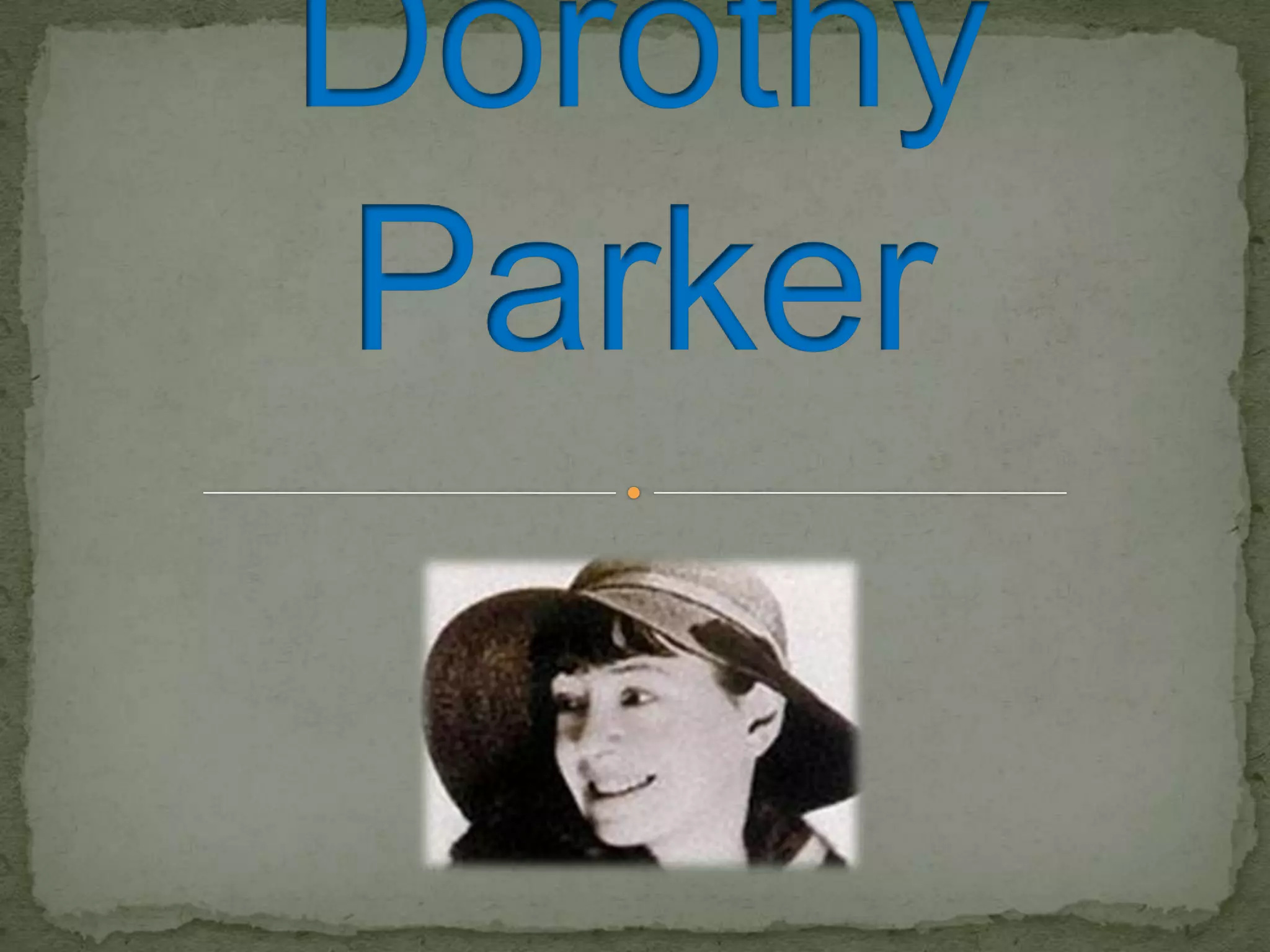
Dorothy Parker
Early LifeBorn August 22, 1893 in West End, New JerseyParents 	Father:   Jacob Henry Rothschild (Jewish)	Died in 1913 (one year after her uncle Henry died    on the Titanic) 	Mother:  Elizabeth Rothschild (Scottish)		Died when Dorothy was 4 years oldFather remarried Eleanor Lewis in 1900
Family ProblemsIt is said that Parker was “a late and unexpected arrival in a loveless family.”
Detested father and stepmother
Accused father of being physically abusive
Referred to Eleanor as “the housekeeper”Attended private schools New JerseyNew York CityFormal education ended at age 14Education
1911 moved to New York City and lived in a boarding house, playing piano at a dance school to earn wagesAt age 21 began submitting writings to various magazines and papersPoem “Any Porch” was accepted and published by Vanity FairShe was paid $12 for this poemEarly Work
Hired by Vogue, a sister publication of Vanity FairWhile working and Vogue, submissions to Vanity Fair continued to be publishedShe worked 2 years at Vogue then moved to Vanity Fair in 1917worked as drama criticWhile at Vanity Fair she became New York’s only female drama critic at the timeVogue & Vanity Fair
Parker was fired from the magazine in 1921due toincreasingly sarcastic and unfavorable reviews To earn money she began writing subtitles for a movie by D.W. GriffithVogue & Vanity Fair
In 1917 Dorothy married Edwin Parker, a New York City stock broker Dorothy was now referred to as Mrs. Dorothy ParkerMarriage
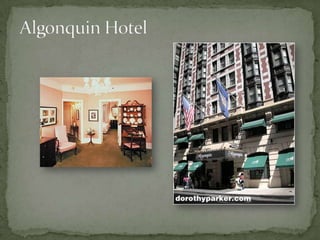
1919 invited to the Algonquin Hotel because of her connection at Vanity Fair and her reputation as a drama criticThis was the beginning of the famous Algonquin Round TableThis group was a renowned intellectual library circleknown for its “scathing with and intellectual commentary”Mrs. Parker was the only female founding memberOther members: Robert Benchley, James Thurber, Robert Sherwood, George Kaufman, Harpo Marx, and Edna Ferber among many others. Algonquin Hotel
Algonquin Hotel
In 1922 she published her 1st story, “Such a Pretty Little Picture” for Smart SetThis marked the beginning of her literary careerIn January of 1924 she moved into the Algonquin Hotel after divorcing her husband EdwinShe began writing plays“Close Harmony” was her firstLiterary Career
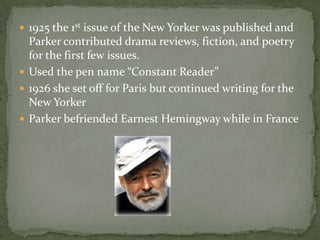
1925 the 1st issue of the New Yorker was published and Parker contributed drama reviews, fiction, and poetry for the first few issues.Used the pen name “Constant Reader”1926 she set off for Paris but continued writing for the New YorkerParker befriended Earnest Hemingway while in France
1929- Short story “The Big Blonde” publishedWon O. Henry award for the best short story of the yearBegan writing screenplays in HollywoodMoved to Hollywood because of need for money and was offered a contract by MGMWrote many screenplays over the next decade  “Laments for the Living”- 1930 collected fiction came out
1933- Once again traveled to Europe and met her 2nd husband Alan CampbellScottish-Jewish decentRumored bisexualThe two became screen writing partners and signed a contract with Paramount Pictures in 19351937- Dorothy won an Academy Award for her joint screenplay of “A Star is Born”
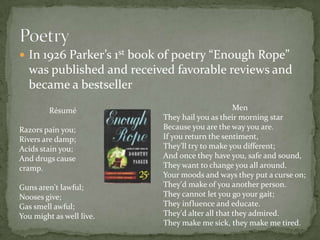
In 1926Parker’s 1st book of poetry “Enough Rope” was published and received favorable reviews and became a bestsellerPoetryMenThey hail you as their morning starBecause you are the way you are.If you return the sentiment,They'll try to make you different;And once they have you, safe and sound,They want to change you all around.Your moods and ways they put a curse on;They'd make of you another person.They cannot let you go your gait;They influence and educate.They'd alter all that they admired.They make mesick, they make me tired.                Résumé Razors pain you; Rivers are damp; Acids stain you; And drugs cause cramp. Guns aren't lawful; Nooses give; Gas smell awful; You might as well live.
Sunset Gun- 1928Death & Taxes-1931Other Collections
In 1927 she became very involved in the Sacco and Vanzetti trialTraveled to Boston to join protests against the execution of two innocent menDuring protest she was arrested but refused to travel in the “Paddy Wagon”. Parker insisted on walking to jail. She eventually pleaded guilty to charges of loitering and sauntering and paid a $5 fine. From this moment on she was a committed socialist Politics
Somewhere in the mix of Parker’s work and political problems, Dorothy and Edwin remarried. However, in 1928, the marriage once again ended in a divorceThis divorce was caused by many affairs committed by Dorothy, including that of Charles MacArthurThis affair resulted in a pregnancy that was quickly abortedParker is quoted, speaking of her love affairs, “How like me, to put all my eggs in one bastard.”The mix of these issues sparked depression for Parker which caused her 1st suicide attemptHard Times
1950sCalled before the House of un-American Activities and pleaded the first instead of the fifthRefused to name any names1952-1953, testimony was given against her before the HUAC1957-1963- worked as a book reviewer for Esquire magazine1959- inducted into the American Academy of Arts and LettersA distinguished visiting Professor of English at California State College in L.A.1964- published her final magazine piece in November’s issue of Esquire.1950s-1960s
June 7, 1967- found dead of a heart attack in her room at the Hotel Volney in New York City.Left entire literary estate to the Dr. Martin Luther King Jr. Foundation.  After his death, the estate was passed on to the NAACP.Death
 The NAACP retrieved Dorothy’s ashes from her lawyer and created a memorial garden at its national headquarters on October 20, 1988. The memorial site, a brick circular emblem lies amid a small grove of pine trees. Appropriately, the emblem cites Parker's own witty epitaph, "Excuse My Dust." The plaque reads," Here lie the ashes of Dorothy Parker (1893 - 1967) humorist, writer, critic. Defender of human and civil rights. For her epitaph she suggested, 'Excuse my dust'. This memorial garden is dedicated to her noble spirit which celebrated the oneness of humankind and to the bonds of everlasting friendship between black and Jewish people. Dedicated by the National Association for the Advancement of Colored People. October 28, 1988.”

Dorothy Parker

  • 1.
  • 2.
    Early LifeBorn August22, 1893 in West End, New JerseyParents Father: Jacob Henry Rothschild (Jewish) Died in 1913 (one year after her uncle Henry died on the Titanic) Mother: Elizabeth Rothschild (Scottish) Died when Dorothy was 4 years oldFather remarried Eleanor Lewis in 1900
  • 3.
    Family ProblemsIt issaid that Parker was “a late and unexpected arrival in a loveless family.”
  • 4.
  • 5.
    Accused father ofbeing physically abusive
  • 6.
    Referred to Eleanoras “the housekeeper”Attended private schools New JerseyNew York CityFormal education ended at age 14Education
  • 7.
    1911 moved toNew York City and lived in a boarding house, playing piano at a dance school to earn wagesAt age 21 began submitting writings to various magazines and papersPoem “Any Porch” was accepted and published by Vanity FairShe was paid $12 for this poemEarly Work
  • 8.
    Hired by Vogue,a sister publication of Vanity FairWhile working and Vogue, submissions to Vanity Fair continued to be publishedShe worked 2 years at Vogue then moved to Vanity Fair in 1917worked as drama criticWhile at Vanity Fair she became New York’s only female drama critic at the timeVogue & Vanity Fair
  • 9.
    Parker was firedfrom the magazine in 1921due toincreasingly sarcastic and unfavorable reviews To earn money she began writing subtitles for a movie by D.W. GriffithVogue & Vanity Fair
  • 10.
    In 1917 Dorothymarried Edwin Parker, a New York City stock broker Dorothy was now referred to as Mrs. Dorothy ParkerMarriage
  • 11.
    1919 invited tothe Algonquin Hotel because of her connection at Vanity Fair and her reputation as a drama criticThis was the beginning of the famous Algonquin Round TableThis group was a renowned intellectual library circleknown for its “scathing with and intellectual commentary”Mrs. Parker was the only female founding memberOther members: Robert Benchley, James Thurber, Robert Sherwood, George Kaufman, Harpo Marx, and Edna Ferber among many others. Algonquin Hotel
  • 12.
  • 13.
    In 1922 shepublished her 1st story, “Such a Pretty Little Picture” for Smart SetThis marked the beginning of her literary careerIn January of 1924 she moved into the Algonquin Hotel after divorcing her husband EdwinShe began writing plays“Close Harmony” was her firstLiterary Career
  • 14.
    1925 the 1stissue of the New Yorker was published and Parker contributed drama reviews, fiction, and poetry for the first few issues.Used the pen name “Constant Reader”1926 she set off for Paris but continued writing for the New YorkerParker befriended Earnest Hemingway while in France
  • 15.
    1929- Short story“The Big Blonde” publishedWon O. Henry award for the best short story of the yearBegan writing screenplays in HollywoodMoved to Hollywood because of need for money and was offered a contract by MGMWrote many screenplays over the next decade “Laments for the Living”- 1930 collected fiction came out
  • 16.
    1933- Once againtraveled to Europe and met her 2nd husband Alan CampbellScottish-Jewish decentRumored bisexualThe two became screen writing partners and signed a contract with Paramount Pictures in 19351937- Dorothy won an Academy Award for her joint screenplay of “A Star is Born”
  • 17.
    In 1926Parker’s 1stbook of poetry “Enough Rope” was published and received favorable reviews and became a bestsellerPoetryMenThey hail you as their morning starBecause you are the way you are.If you return the sentiment,They'll try to make you different;And once they have you, safe and sound,They want to change you all around.Your moods and ways they put a curse on;They'd make of you another person.They cannot let you go your gait;They influence and educate.They'd alter all that they admired.They make mesick, they make me tired. Résumé Razors pain you; Rivers are damp; Acids stain you; And drugs cause cramp. Guns aren't lawful; Nooses give; Gas smell awful; You might as well live.
  • 18.
    Sunset Gun- 1928Death& Taxes-1931Other Collections
  • 19.
    In 1927 shebecame very involved in the Sacco and Vanzetti trialTraveled to Boston to join protests against the execution of two innocent menDuring protest she was arrested but refused to travel in the “Paddy Wagon”. Parker insisted on walking to jail. She eventually pleaded guilty to charges of loitering and sauntering and paid a $5 fine. From this moment on she was a committed socialist Politics
  • 20.
    Somewhere in themix of Parker’s work and political problems, Dorothy and Edwin remarried. However, in 1928, the marriage once again ended in a divorceThis divorce was caused by many affairs committed by Dorothy, including that of Charles MacArthurThis affair resulted in a pregnancy that was quickly abortedParker is quoted, speaking of her love affairs, “How like me, to put all my eggs in one bastard.”The mix of these issues sparked depression for Parker which caused her 1st suicide attemptHard Times
  • 21.
    1950sCalled before theHouse of un-American Activities and pleaded the first instead of the fifthRefused to name any names1952-1953, testimony was given against her before the HUAC1957-1963- worked as a book reviewer for Esquire magazine1959- inducted into the American Academy of Arts and LettersA distinguished visiting Professor of English at California State College in L.A.1964- published her final magazine piece in November’s issue of Esquire.1950s-1960s
  • 22.
    June 7, 1967-found dead of a heart attack in her room at the Hotel Volney in New York City.Left entire literary estate to the Dr. Martin Luther King Jr. Foundation. After his death, the estate was passed on to the NAACP.Death
  • 23.
    The NAACPretrieved Dorothy’s ashes from her lawyer and created a memorial garden at its national headquarters on October 20, 1988. The memorial site, a brick circular emblem lies amid a small grove of pine trees. Appropriately, the emblem cites Parker's own witty epitaph, "Excuse My Dust." The plaque reads," Here lie the ashes of Dorothy Parker (1893 - 1967) humorist, writer, critic. Defender of human and civil rights. For her epitaph she suggested, 'Excuse my dust'. This memorial garden is dedicated to her noble spirit which celebrated the oneness of humankind and to the bonds of everlasting friendship between black and Jewish people. Dedicated by the National Association for the Advancement of Colored People. October 28, 1988.”