Don’t STRESS Me Out!
         Elaine Long Bailey
         Extension Educator
       4-H Youth Development
   University of Maryland Extension
            Calvert County
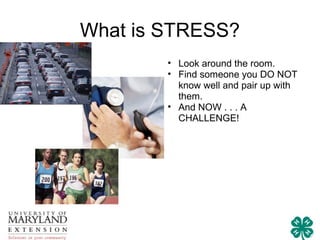
What is STRESS?
        • Look around the room.
        • Find someone you DO NOT
          know well and pair up with
          them.
        • And NOW . . . A
          CHALLENGE!
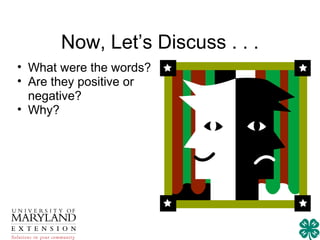
Now, Let’s Discuss . . .
• What were the words?
• Are they positive or
  negative?
• Why?
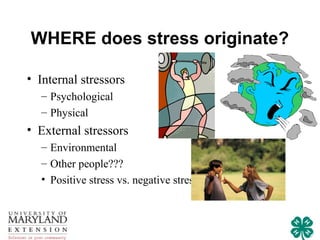
WHERE does stress originate?

• Internal stressors
  – Psychological
  – Physical
• External stressors
  – Environmental
  – Other people???
  • Positive stress vs. negative stress
Stress . . . Good, Bad, Ugly
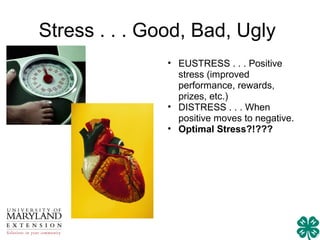
               • EUSTRESS . . . Positive
                 stress (improved
                 performance, rewards,
                 prizes, etc.)
               • DISTRESS . . . When
                 positive moves to negative.
               • Optimal Stress?!???
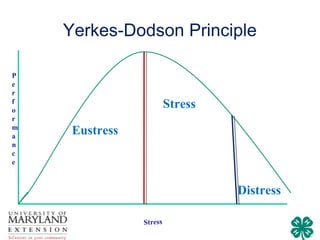
Yerkes-Dodson Principle


            Stress

 Eustress


                     Distress
Tidbits on STRESS…

1. Stress is not events; it is YOUR REACTION to
   events.
2. Stressors affect people differently, and YOU determine
   HOW you think about and approach situations.
3. STRESSOR = STIMULUS
4. STRESS (condition) = RESPONSE (or NOT)
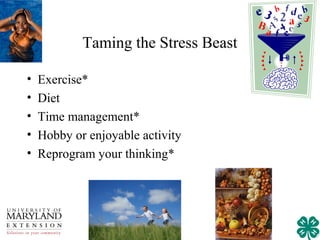
Taming the Stress Beast

•   Exercise*
•   Diet
•   Time management*
•   Hobby or enjoyable activity
•   Reprogram your thinking*
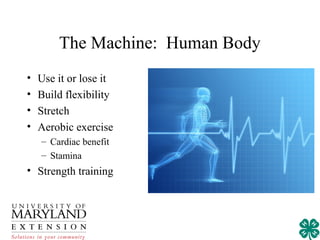
The Machine: Human Body
•   Use it or lose it
•   Build flexibility
•   Stretch
•   Aerobic exercise
    – Cardiac benefit
    – Stamina
• Strength training
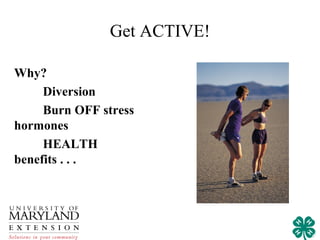
Get ACTIVE!

Why?
     Diversion
     Burn OFF stress
hormones
     HEALTH
benefits . . .
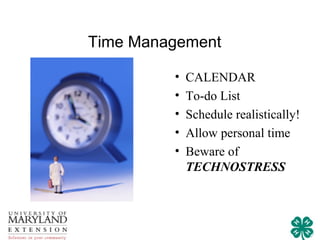
Time Management

         •   CALENDAR
         •   To-do List
         •   Schedule realistically!
         •   Allow personal time
         •   Beware of
             TECHNOSTRESS
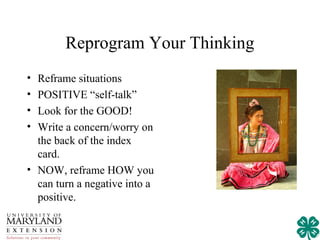
Reprogram Your Thinking
• Reframe situations
• POSITIVE “self-talk”
• Look for the GOOD!
• Write a concern/worry on
  the back of the index
  card.
• NOW, reframe HOW you
  can turn a negative into a
  positive.
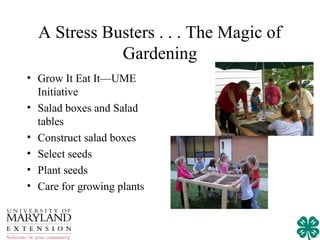
A Stress Busters . . . The Magic of
             Gardening
• Grow It Eat It—UME
  Initiative
• Salad boxes and Salad
  tables
• Construct salad boxes
• Select seeds
• Plant seeds
• Care for growing plants
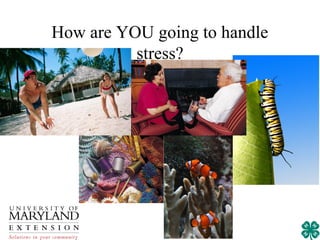
How are YOU going to handle
          stress?
Good luck!

• My email is elbailey@umd.edu
• THANKS!

Don't Stress Me Out

  • 1.
    Don’t STRESS MeOut! Elaine Long Bailey Extension Educator 4-H Youth Development University of Maryland Extension Calvert County
  • 2.
    What is STRESS? • Look around the room. • Find someone you DO NOT know well and pair up with them. • And NOW . . . A CHALLENGE!
  • 3.
    Now, Let’s Discuss. . . • What were the words? • Are they positive or negative? • Why?
  • 4.
    WHERE does stressoriginate? • Internal stressors – Psychological – Physical • External stressors – Environmental – Other people??? • Positive stress vs. negative stress
  • 5.
    Stress . .. Good, Bad, Ugly • EUSTRESS . . . Positive stress (improved performance, rewards, prizes, etc.) • DISTRESS . . . When positive moves to negative. • Optimal Stress?!???
  • 6.
    Yerkes-Dodson Principle Stress Eustress Distress
  • 7.
    Tidbits on STRESS… 1.Stress is not events; it is YOUR REACTION to events. 2. Stressors affect people differently, and YOU determine HOW you think about and approach situations. 3. STRESSOR = STIMULUS 4. STRESS (condition) = RESPONSE (or NOT)
  • 8.
    Taming the StressBeast • Exercise* • Diet • Time management* • Hobby or enjoyable activity • Reprogram your thinking*
  • 9.
    The Machine: HumanBody • Use it or lose it • Build flexibility • Stretch • Aerobic exercise – Cardiac benefit – Stamina • Strength training
  • 10.
    Get ACTIVE! Why? Diversion Burn OFF stress hormones HEALTH benefits . . .
  • 11.
    Time Management • CALENDAR • To-do List • Schedule realistically! • Allow personal time • Beware of TECHNOSTRESS
  • 12.
    Reprogram Your Thinking •Reframe situations • POSITIVE “self-talk” • Look for the GOOD! • Write a concern/worry on the back of the index card. • NOW, reframe HOW you can turn a negative into a positive.
  • 13.
    A Stress Busters. . . The Magic of Gardening • Grow It Eat It—UME Initiative • Salad boxes and Salad tables • Construct salad boxes • Select seeds • Plant seeds • Care for growing plants
  • 14.
    How are YOUgoing to handle stress?
  • 15.
    Good luck! • Myemail is elbailey@umd.edu • THANKS!

Editor's Notes

  • #3 10 MINUTES Take an index card. Write words that you associate with stress. Maybe a situation, a single word, a phrase, or perhaps a person. What similarities did you have? What differences?
  • #4 Randomly share words common to ALL members in a group Randomly share words that were NOT common to all members in a group
  • #5 Stressors (positive ones) increase performance; too MUCH stress decreases performance. Environmental stressors include smog, smoke, cold, wind, heat, chemical odors (formaldehyde, e.g., “hospital smells,” cleaners)…Can you name others? Psychological stressors (“psyche yourself out” on tests, public speaking, fear of failure, letting your brain spin the worst scenario, etc.) Physical stressors include injury, pain, repetitive motion issues, ergonomic design issues
  • #6 Stress . . . Is it good? Is it bad? Can it serve a positive purpose? Some stress is involved in LIFE each day. A stressor, for example, increases performance. Perhaps an alarm clock is a STRESSOR, reminding you to get out of bed each morning.
  • #7 Eustress is the area where we see an increase in performance, as stress gradually increases. Take a rubberband. Stretch the rubberband. We are STRESS (stretching the rubberband). The PERFORMANCE is how much the rubberband stretches. When you stretch the rubberband beyond a certain point, what happens? Is it possible to have a life with NO STRESS? Where are we if there is NO STRESS?
  • #8 Genetics and experiences often affect how each of us reacts to stimuli. BUT, WE can also CHANGE how we react. Don’t get “sucked into” other people’s drama. Drama is for the STAGE, not for LIFE!!
  • #10 Build positive habits for kids to carry through life. Sports enable us to “burn off” negative/stress hormones that build up in our bodies. Flexibility is important to build at a young age
  • #11 Join with another pair of people (pairs are from previous pairings) Send an envoy to the front table. Have them pick an item from the table. Join all members of your group and create an active game so that you all can move around, using the item you selected.
  • #12 Technostress: always being linked to cell phones, computers, constant texting, social networking, etc.
  • #13 Instead of “I can’t do that,” THINK “I will give that my best effort.” Don’t think “That person is hard to get along with,” THINK “I’ll learn some new people management skills from them.” Other Examples from you all?
  • #14 Gardening provides exercise, learning, and a “buy-in” for vegetables grown. Kids will at least TRY vegetables that they grow (Calvert School Work, ELB).
  • #15 Your coping mechanism or stress management techniques must work FOR YOU!! Examples include: exercise, sports, talking with a friend/someone you trust, get outside and look at nature, fish tank, hobby, etc. OTHER?
  • #16 Evaluations—have someone collect them and put them in the envelope provided.