Domestic Violence Act
By: Dr Rakhi Sawlani
1
Domestic Violence
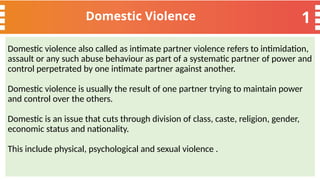
Domestic violence also called as intimate partner violence refers to intimidation,
assault or any such abuse behaviour as part of a systematic partner of power and
control perpetrated by one intimate partner against another.
Domestic violence is usually the result of one partner trying to maintain power
and control over the others.
Domestic is an issue that cuts through division of class, caste, religion, gender,
economic status and nationality.
This include physical, psychological and sexual violence .
Statistics on domestic violence
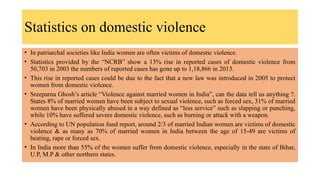
• In patriarchal societies like India women are often victims of domestic violence.
• Statistics provided by the “NCRB” show a 13% rise in reported cases of domestic violence from
50,703 in 2003 the numbers of reported cases has gone up to 1,18,866 in 2013.
• This rise in reported cases could be due to the fact that a new law was introduced in 2005 to protect
women from domestic violence.
• Sreeparna Ghosh’s article “Violence against married women in India”, can the data tell us anything ?.
States 8% of married women have been subject to sexual violence, such as forced sex, 31% of married
women have been physically abused in a way defined as “less service” such as slapping or punching,
while 10% have suffered severe domestic violence, such as burning or attack with a weapon.
• According to UN population fund report, around 2/3 of married Indian women are victims of domestic
violence & as many as 70% of married women in India between the age of 15-49 are victims of
beating, rape or forced sex.
• In India more than 55% of the women suffer from domestic violence, especially in the state of Bihar,
U.P, M.P & other northern states.
2
Domestic Violence
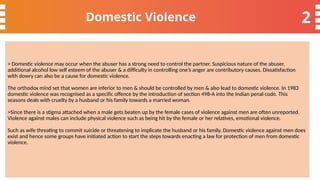
> Domestic violence may occur when the abuser has a strong need to control the partner. Suspicious nature of the abuser,
additional alcohol low self esteem of the abuser & a difficulty in controlling one’s anger are contributory causes. Dissatisfaction
with dowry can also be a cause for domestic violence.
The orthodox mind set that women are inferior to men & should be controlled by men & also lead to domestic violence. In 1983
domestic violence was recognised as a specific offence by the introduction of section 498-A into the Indian penal code. This
seasons deals with cruelty by a husband or his family towards a married woman.
>Since there is a stigma attached when a male gets beaten up by the female cases of violence against men are often unreported.
Violence against males can include physical violence such as being hit by the female or her relatives, emotional violence.
Such as wife threating to commit suicide or threatening to implicate the husband or his family. Domestic violence against men does
exist and hence some groups have initiated action to start the steps towards enacting a law for protection of men from domestic
violence.
4
Key Initiatives - ManPower
>Domestic violence whether against men or women, has serious effects on the one being abused. Besides causing physical harm, it may cause decline in self esteem, result in psychological trauma and effect one’s daily life and work.
Children in the family become indirect victims of domestic abuse and may lose their self confidence. When they grow up as they tend to imitate their parents. Thus domestic violence continues and destroys another generation.
>Domestic violence can be reduced or even eliminated if there is mutual respect for one another in the family. We should control over our emotions such as anger. Legislative reform training of the police and lawyers provision of
shelters, and the building of capacity combat violence and pursue their rights are necessary.
Since most victims of domestic violence are women there is the urgent need to educate woman about their rights and empower them with education so that they can assert themselves. Laws should be gender neutral as both men and
women can be victims of violence.
Domestic Violence 3

Domestic_violence.pptx Under the Act, th

  • 1.
    Domestic Violence Act By:Dr Rakhi Sawlani
  • 2.
    1 Domestic Violence Domestic violencealso called as intimate partner violence refers to intimidation, assault or any such abuse behaviour as part of a systematic partner of power and control perpetrated by one intimate partner against another. Domestic violence is usually the result of one partner trying to maintain power and control over the others. Domestic is an issue that cuts through division of class, caste, religion, gender, economic status and nationality. This include physical, psychological and sexual violence .
  • 3.
    Statistics on domesticviolence • In patriarchal societies like India women are often victims of domestic violence. • Statistics provided by the “NCRB” show a 13% rise in reported cases of domestic violence from 50,703 in 2003 the numbers of reported cases has gone up to 1,18,866 in 2013. • This rise in reported cases could be due to the fact that a new law was introduced in 2005 to protect women from domestic violence. • Sreeparna Ghosh’s article “Violence against married women in India”, can the data tell us anything ?. States 8% of married women have been subject to sexual violence, such as forced sex, 31% of married women have been physically abused in a way defined as “less service” such as slapping or punching, while 10% have suffered severe domestic violence, such as burning or attack with a weapon. • According to UN population fund report, around 2/3 of married Indian women are victims of domestic violence & as many as 70% of married women in India between the age of 15-49 are victims of beating, rape or forced sex. • In India more than 55% of the women suffer from domestic violence, especially in the state of Bihar, U.P, M.P & other northern states.
  • 4.
    2 Domestic Violence > Domesticviolence may occur when the abuser has a strong need to control the partner. Suspicious nature of the abuser, additional alcohol low self esteem of the abuser & a difficulty in controlling one’s anger are contributory causes. Dissatisfaction with dowry can also be a cause for domestic violence. The orthodox mind set that women are inferior to men & should be controlled by men & also lead to domestic violence. In 1983 domestic violence was recognised as a specific offence by the introduction of section 498-A into the Indian penal code. This seasons deals with cruelty by a husband or his family towards a married woman. >Since there is a stigma attached when a male gets beaten up by the female cases of violence against men are often unreported. Violence against males can include physical violence such as being hit by the female or her relatives, emotional violence. Such as wife threating to commit suicide or threatening to implicate the husband or his family. Domestic violence against men does exist and hence some groups have initiated action to start the steps towards enacting a law for protection of men from domestic violence.
  • 5.
    4 Key Initiatives -ManPower >Domestic violence whether against men or women, has serious effects on the one being abused. Besides causing physical harm, it may cause decline in self esteem, result in psychological trauma and effect one’s daily life and work. Children in the family become indirect victims of domestic abuse and may lose their self confidence. When they grow up as they tend to imitate their parents. Thus domestic violence continues and destroys another generation. >Domestic violence can be reduced or even eliminated if there is mutual respect for one another in the family. We should control over our emotions such as anger. Legislative reform training of the police and lawyers provision of shelters, and the building of capacity combat violence and pursue their rights are necessary. Since most victims of domestic violence are women there is the urgent need to educate woman about their rights and empower them with education so that they can assert themselves. Laws should be gender neutral as both men and women can be victims of violence. Domestic Violence 3