 Every 9 seconds in the US a woman is assaulted or
beaten.
 Women ages 20-24 are at the greatest risk of nonfatal
intimate partner violence.
 Victims lose nearly 8 million days of paid work per
year in the US alone—the equivalent of 32,000 full-time
jobs.
 Intimate partner violence affects people regardless of
income. However, people with lower annual income are at a
3-times higher risk of intimate partner violence than people
with higher annual income.
 Domestic violence is the leading cause of injury to
women—more than car accidents, muggings, and
rapes combined.
 Women accounted for 85% of the victims of intimate partner
violence, men for approximately 15%.
 Based on reports from 10 countries, between 55 percent
and 95 percent of women who had been physically
abused by their partners had never contacted non-
governmental organizations, shelters, or the police for
help.
 The costs of intimate partner violence in the US alone
exceed $5.8 billion per year: $4.1 billion are for direct
medical and health care services, while productivity
losses account for nearly $1.8 billion.
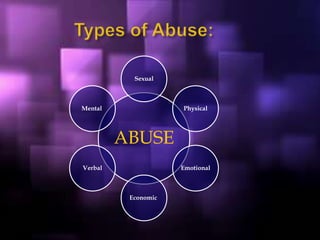
ABUSE
Sexual
Physical
Emotional
Economic
Verbal
Mental
When most people think of abuse or violence
we think of it as just being physical. But
actually, abuse and violence can happen in
different ways. Generally, there are 6 types
of abuse that can exist in a violent
relationship. Yes, physical is one of them but
sometimes the violence won't get that
far. Abuse and violence normally start with
emotional, mental and/or verbal abuse and
can eventually escalate to things like
physical, sexual and maybe even economic
abuse.
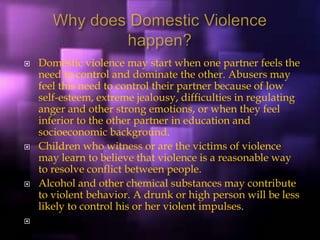
 Domestic violence may start when one partner feels the
need to control and dominate the other. Abusers may
feel this need to control their partner because of low
self-esteem, extreme jealousy, difficulties in regulating
anger and other strong emotions, or when they feel
inferior to the other partner in education and
socioeconomic background.
 Children who witness or are the victims of violence
may learn to believe that violence is a reasonable way
to resolve conflict between people.
 Alcohol and other chemical substances may contribute
to violent behavior. A drunk or high person will be less
likely to control his or her violent impulses.

I’m afraid to
come out to
family and
friends
DON’T
FORGET
ABOUT US!
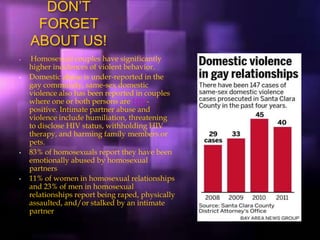
• Homosexual couples have significantly
higher incidences of violent behavior.
• Domestic abuse is under-reported in the
gay community, same-sex domestic
violence also has been reported in couples
where one or both persons are HIV-
positive. Intimate partner abuse and
violence include humiliation, threatening
to disclose HIV status, withholding HIV
therapy, and harming family members or
pets.
• 83% of homosexuals report they have been
emotionally abused by homosexual
partners
• 11% of women in homosexual relationships
and 23% of men in homosexual
relationships report being raped, physically
assaulted, and/or stalked by an intimate
partner
 http://www.youtube.com/watch?v=ppzDZsUXtVU
 http://www.youtube.com/watch?v=b1s93fTwtOQ
 http://www.youtube.com/watch?v=2AQ-_c8LdM0
 Ladies, is it ok to fight back?
 Men, are there special circumstances for hitting
women?
 What do you when someone you know is being
abused?
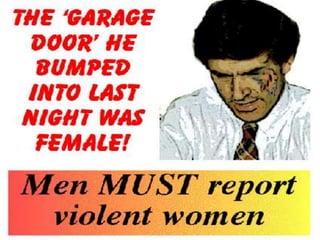
 Men how do you feel about the domestic
violence double stanard?
 About 2 in 5 of all victims of domestic violence are
men, contradicting the widespread impression.
 One in 6 men (16%) had experienced domestic
abuse since the age of 16. That is the equivalent to
an estimated 2.6 million male victims.
 4% of men reported having experienced domestic
abuse in the past year, that is 600,000 male victims.
 On average, more than three women and one man
are murdered by their intimate partners in this
country every day.
 The number of women prosecuted for domestic
violence rose from 1,575 in 2004-05 to 4,266 in
2008-09.
 http://www.youtube.com/watch?v=z4Ko23cI6oQ
 http://www.youtube.com/watch?v=MaR2MElc-SU
 http://www.youtube.com/watch?v=0OHGH2_yaS0
 http://www.youtube.com/watch?v=3PfntVGLkV8
 As a Male, how does this make you feel?
 Women, how do you perceive male domestic
violence victims?
 Men, do you fight back? What would you do?
 Ladies, are you comfortable with hitting your
partner?
 How does a male go about telling that he’s
being abused?
 Are there circumstances when its acceptable to
hit your partner?
 In a survey taken by the CDC in 2010, it was found that
40% of the victims of severe, physical domestic
violence are men.
 Despite many findings that show almost equal
amounts of abuse perpetrated against men and
women, the media and government focus the most
attention on the female victims of domestic violence.
 Those men who do report physical violence are more
likely to be ridiculed–both by law enforcement and by
the public–than women are.
 More money is spent on women’s programs despite
the fact that men are almost equally or in some cases
more likely to be victims of both physical and
psychological abuse.
 National Domestic Violence Hotline
http://www.thehotline.org/
1.800.799.SAFE(7233) or 1.800.787.3224
 Erie County Coalition Against Family Violence
http://www.eccafv.org/
1.716. 884.6000 or 1.716. 862.HELP (4357)
 Safe Horizon
http://www.safehorizon.org/index/get-help-8/for-
domestic-violence-
35.html?gclid=CMadze2ThLMCFQuk4Aodq0AADQ
1.800.621.HOPE (4673)
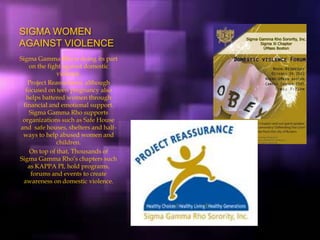
SIGMA WOMEN
AGAINST VIOLENCE
Sigma Gamma Rho is doing its part
on the fight against domestic
violence.
Project Reassurance, although
focused on teen pregnancy also
helps battered women through
financial and emotional support.
Sigma Gamma Rho supports
organizations such as Safe House
and safe houses, shelters and half-
ways to help abused women and
children.
On top of that, Thousands of
Sigma Gamma Rho’s chapters such
as KAPPA PI, hold programs,
forums and events to create
awareness on domestic violence.
OMEGA MEN
AGAINST VIOLENCE
Stop the Violence
Initiative - A Partnership
with the kNOwMORE
Campaign
In July 2007, Omega Psi Phi
Fraternity, Inc. made a
pledge to prevent all forms
of violence affecting the
African-American
community. To address
domestic, sexual, and
community violence,
Omega men are taking a
critically important step by
saying that all forms of
violence are wrong, and
that we need to mentor and
teach each other the
importance of healthy, non-
violent relationships.
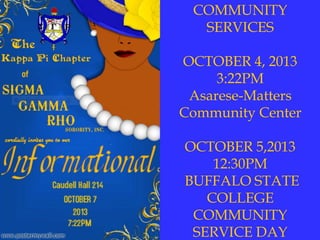
COMMUNITY
SERVICES
OCTOBER 4, 2013
3:22PM
Asarese-Matters
Community Center
OCTOBER 5,2013
12:30PM
BUFFALO STATE
COLLEGE
COMMUNITY
SERVICE DAY

Ques & sg_rho_program

  • 2.
     Every 9seconds in the US a woman is assaulted or beaten.  Women ages 20-24 are at the greatest risk of nonfatal intimate partner violence.  Victims lose nearly 8 million days of paid work per year in the US alone—the equivalent of 32,000 full-time jobs.  Intimate partner violence affects people regardless of income. However, people with lower annual income are at a 3-times higher risk of intimate partner violence than people with higher annual income.
  • 3.
     Domestic violenceis the leading cause of injury to women—more than car accidents, muggings, and rapes combined.  Women accounted for 85% of the victims of intimate partner violence, men for approximately 15%.  Based on reports from 10 countries, between 55 percent and 95 percent of women who had been physically abused by their partners had never contacted non- governmental organizations, shelters, or the police for help.  The costs of intimate partner violence in the US alone exceed $5.8 billion per year: $4.1 billion are for direct medical and health care services, while productivity losses account for nearly $1.8 billion.
  • 4.
  • 5.
    When most peoplethink of abuse or violence we think of it as just being physical. But actually, abuse and violence can happen in different ways. Generally, there are 6 types of abuse that can exist in a violent relationship. Yes, physical is one of them but sometimes the violence won't get that far. Abuse and violence normally start with emotional, mental and/or verbal abuse and can eventually escalate to things like physical, sexual and maybe even economic abuse.
  • 6.
     Domestic violencemay start when one partner feels the need to control and dominate the other. Abusers may feel this need to control their partner because of low self-esteem, extreme jealousy, difficulties in regulating anger and other strong emotions, or when they feel inferior to the other partner in education and socioeconomic background.  Children who witness or are the victims of violence may learn to believe that violence is a reasonable way to resolve conflict between people.  Alcohol and other chemical substances may contribute to violent behavior. A drunk or high person will be less likely to control his or her violent impulses. 
  • 8.
    I’m afraid to comeout to family and friends
  • 9.
    DON’T FORGET ABOUT US! • Homosexualcouples have significantly higher incidences of violent behavior. • Domestic abuse is under-reported in the gay community, same-sex domestic violence also has been reported in couples where one or both persons are HIV- positive. Intimate partner abuse and violence include humiliation, threatening to disclose HIV status, withholding HIV therapy, and harming family members or pets. • 83% of homosexuals report they have been emotionally abused by homosexual partners • 11% of women in homosexual relationships and 23% of men in homosexual relationships report being raped, physically assaulted, and/or stalked by an intimate partner
  • 10.
  • 11.
     Ladies, isit ok to fight back?  Men, are there special circumstances for hitting women?  What do you when someone you know is being abused?  Men how do you feel about the domestic violence double stanard?
  • 13.
     About 2in 5 of all victims of domestic violence are men, contradicting the widespread impression.  One in 6 men (16%) had experienced domestic abuse since the age of 16. That is the equivalent to an estimated 2.6 million male victims.  4% of men reported having experienced domestic abuse in the past year, that is 600,000 male victims.  On average, more than three women and one man are murdered by their intimate partners in this country every day.  The number of women prosecuted for domestic violence rose from 1,575 in 2004-05 to 4,266 in 2008-09.
  • 14.
     http://www.youtube.com/watch?v=z4Ko23cI6oQ  http://www.youtube.com/watch?v=MaR2MElc-SU http://www.youtube.com/watch?v=0OHGH2_yaS0  http://www.youtube.com/watch?v=3PfntVGLkV8
  • 15.
     As aMale, how does this make you feel?  Women, how do you perceive male domestic violence victims?  Men, do you fight back? What would you do?  Ladies, are you comfortable with hitting your partner?  How does a male go about telling that he’s being abused?  Are there circumstances when its acceptable to hit your partner?
  • 16.
     In asurvey taken by the CDC in 2010, it was found that 40% of the victims of severe, physical domestic violence are men.  Despite many findings that show almost equal amounts of abuse perpetrated against men and women, the media and government focus the most attention on the female victims of domestic violence.  Those men who do report physical violence are more likely to be ridiculed–both by law enforcement and by the public–than women are.  More money is spent on women’s programs despite the fact that men are almost equally or in some cases more likely to be victims of both physical and psychological abuse.
  • 17.
     National DomesticViolence Hotline http://www.thehotline.org/ 1.800.799.SAFE(7233) or 1.800.787.3224  Erie County Coalition Against Family Violence http://www.eccafv.org/ 1.716. 884.6000 or 1.716. 862.HELP (4357)  Safe Horizon http://www.safehorizon.org/index/get-help-8/for- domestic-violence- 35.html?gclid=CMadze2ThLMCFQuk4Aodq0AADQ 1.800.621.HOPE (4673)
  • 18.
    SIGMA WOMEN AGAINST VIOLENCE SigmaGamma Rho is doing its part on the fight against domestic violence. Project Reassurance, although focused on teen pregnancy also helps battered women through financial and emotional support. Sigma Gamma Rho supports organizations such as Safe House and safe houses, shelters and half- ways to help abused women and children. On top of that, Thousands of Sigma Gamma Rho’s chapters such as KAPPA PI, hold programs, forums and events to create awareness on domestic violence.
  • 19.
    OMEGA MEN AGAINST VIOLENCE Stopthe Violence Initiative - A Partnership with the kNOwMORE Campaign In July 2007, Omega Psi Phi Fraternity, Inc. made a pledge to prevent all forms of violence affecting the African-American community. To address domestic, sexual, and community violence, Omega men are taking a critically important step by saying that all forms of violence are wrong, and that we need to mentor and teach each other the importance of healthy, non- violent relationships.
  • 21.
    COMMUNITY SERVICES OCTOBER 4, 2013 3:22PM Asarese-Matters CommunityCenter OCTOBER 5,2013 12:30PM BUFFALO STATE COLLEGE COMMUNITY SERVICE DAY

Editor's Notes

  • #9 Why do women ignore the signs?
  • #11 Don’t ignore the signs
  • #15 Don’t ignore the signs