
 Domestic violence, also known as domestic
abuse, spousal abuse, battering, family violence,
and intimate partner violence (IPV), is a pattern of
behavior which involves the abuse by one partner
against another in an intimate relationship such as
marriage, cohabitation, dating or within the family.
 Domestic violence can take many forms,
including physical aggression or assault (hitting,
kicking, biting, shoving, restraining, slapping,
throwing objects, battery), or threats thereof; sexual
abuse; emotional abuse; controlling or domineering
intimidation, stalking, passive/covert abuse
Laws on domestic violence vary by country. While
it is generally outlawed in the Western World, this
not the case in many developing countries. For
instance, in 2010, the United Arab Emirates's
Supreme Court ruled that a man has the right to
physically discipline his wife and children as long
as he does not leave physical marks.
the percentage of women aged 15–49 who think
that a husband is justified in hitting or beating his
wife under certain circumstances is, for example:
90% in Jordan, 85.6% in Guinea, 85.4% in Zambia,
85% in Sierra Leone, 81.2% in Laos, and 81% in
Ethiopia.
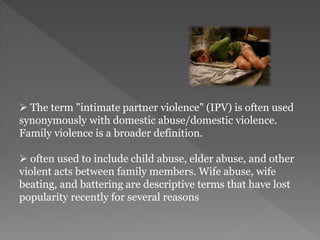
 The term "intimate partner violence" (IPV) is often used
synonymously with domestic abuse/domestic violence.
Family violence is a broader definition.
 often used to include child abuse, elder abuse, and other
violent acts between family members. Wife abuse, wife
beating, and battering are descriptive terms that have lost
popularity recently for several reasons
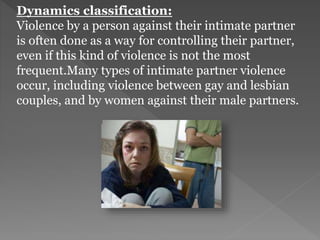
Dynamics classification:
Violence by a person against their intimate partner
is often done as a way for controlling their partner,
even if this kind of violence is not the most
frequent.Many types of intimate partner violence
occur, including violence between gay and lesbian
couples, and by women against their male partners.
OBJECTIVES OF DOMESTIC VOILENCE
•To 'break the silence' about the issue of domestic violence
in the local community, along with the
•The service runs an Education and Awareness-Raising
Service which offers training and information sessions on
the issue of domestic violence to a diverse range of local
groups including hospitals, schools, health board staff, local
community groups and women's groups.
•Primarily meant to provide protection to the wife or
female live-in partner from violence at the hands of the
husband or male live-in partner or his relatives,
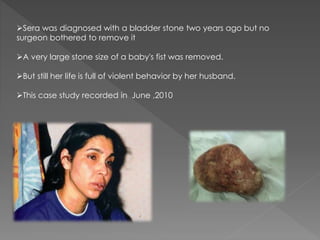
Sera was diagnosed with a bladder stone two years ago but no
surgeon bothered to remove it
A very large stone size of a baby's fist was removed.
But still her life is full of violent behavior by her husband.
This case study recorded in June ,2010
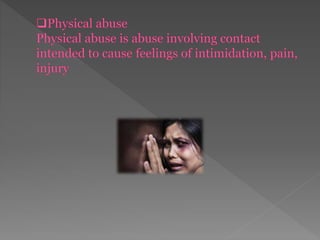
other physical suffering or bodily harm.
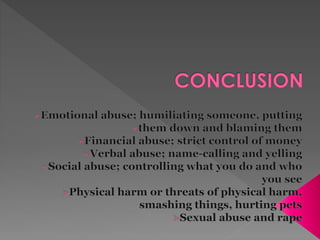
Physical abuse includes
Hitting
 slapping
Punching
Choking
Pushing
Burning
 and other types of contact that result in
physical injury to the victim
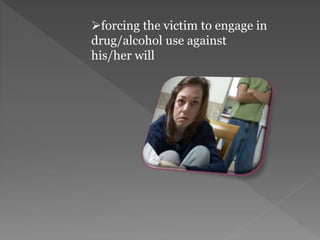
forcing the victim to engage in
drug/alcohol use against
his/her will
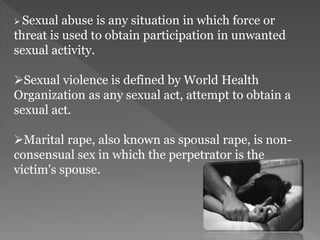
 Sexual abuse is any situation in which force or
threat is used to obtain participation in unwanted
sexual activity.
Sexual violence is defined by World Health
Organization as any sexual act, attempt to obtain a
sexual act.
Marital rape, also known as spousal rape, is non-
consensual sex in which the perpetrator is the
victim's spouse.
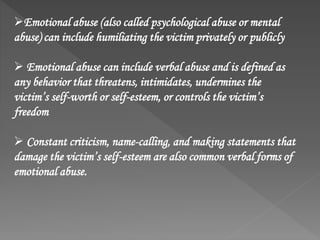
Emotional abuse (also called psychological abuse or mental
abuse) can include humiliating the victim privately or publicly
 Emotional abuse can include verbal abuse and is defined as
any behavior that threatens, intimidates, undermines the
victim’s self-worth or self-esteem, or controls the victim’s
freedom
 Constant criticism, name-calling, and making statements that
damage the victim’s self-esteem are also common verbal forms of
emotional abuse.
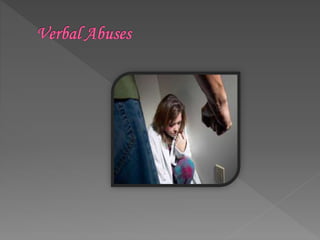
It is a form of emotionally abusive behavior
involving the use of language. Verbal abuse can also
be referred to as the act of threatening.
Verbal abuse may include aggressive actions such
as name-calling, blaming, ridicule, disrespect, and
criticism, but there are also less obviously aggressive
forms of verbal abuse
oral communication is the most common form of
verbal abuse, it includes abusive communication in
written form
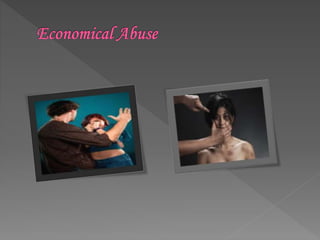
 Economic abuse is a form of abuse when one
intimate partner has control over the other
partner's access to economic resources
 The abuser may also put the victim on an
allowance, closely monitor how the victim
spends money, spend victim's money without
his/her consent and creating debt, or completely
spend victim's savings to limit available
resources.
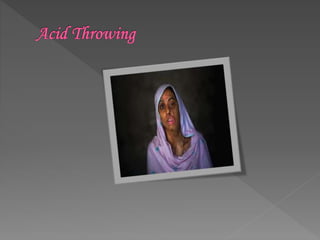
Acid throwing, also called an acid attack or
vitriolage, is a form of violent assault
It is defined as the premeditated act of throwing
acid onto the body of a person "with the intention
to disfigure, maim, torture, or kill
 At least 1500 people in 20 countries are
attacked in this way yearly, 80 percent of whom
are female and somewhere between 40 percent
and 70 percent under 18 years of age. Because
most of their victims are women, acid attacks have
been characterized as a form of gender apartheid.
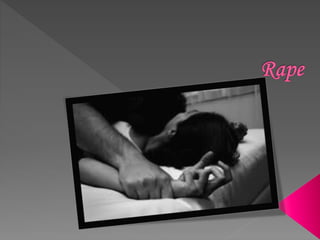
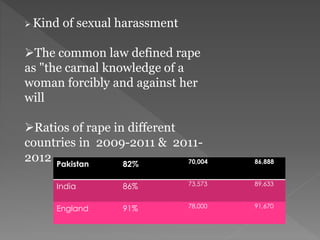
 Kind of sexual harassment
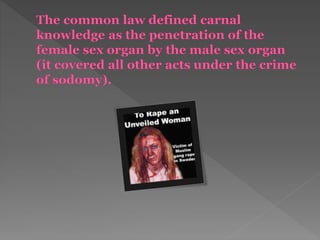
The common law defined rape
as "the carnal knowledge of a
woman forcibly and against her
will
Ratios of rape in different
countries in 2009-2011 & 2011-
2012 Pakistan 82% 70,004 86,888
India 86% 73,573 89,633
England 91% 78,000 91,670
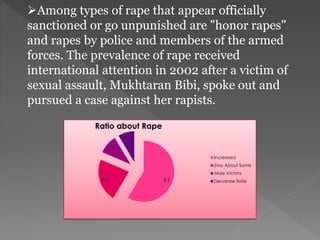
Among types of rape that appear officially
sanctioned or go unpunished are "honor rapes"
and rapes by police and members of the armed
forces. The prevalence of rape received
international attention in 2002 after a victim of
sexual assault, Mukhtaran Bibi, spoke out and
pursued a case against her rapists.
8.23.2
1.4
1.2
Ratio about Rape
Increased
Stay About Same
Male Victims
Decrease Rate
Rape in India has been described by Radha Kumar
as one of India's most common crimes against
women and by the UN’s human-rights chief as a
“national problem
 New Delhi has the highest rate of rape-reports
among Indian cities
According to the National Crime Records Bureau,
24,206 rape cases were registered in India in 2011,
although experts agree that the number of
unreported cases is much higher
 The death penalty for rape was provided by
section 16 of the Offences against the Person Act
1828. The death penalty for rape was abolished by
section 3 of the Substitution of Punishments for
Death Act 1841 which substituted transportation for
life.
In January 1982, the Government accepted an
amendment to the Criminal Justice Bill the effect of
which, if enacted, would be to compel judges to
sentence men convicted of rape to imprisonment.
This followed a case earlier that month in which a
man convicted of rape had been fined £2,000.
Who is affected by domestic violence?
Anyone can experience
domestic violence.
It happens in every community, young and old;
wealthy or poor; all cultures; people in same-sex
relationships; people with disabilities; those who
are socially successful and those who are struggling.
The majority of victims are women, although men
can also be victims.
1 Find supportive friends
Have someone you can safely talk to while
deciding and making changes. Often people in
violent relationships become isolated and cut
off. Break the isolation and reach out.
2 Let go of feeling responsible
Domestic violence and abuse is not caused by
something you have done or not done. It is a
choice by your partner to exert control over you
and it is a crime. In most cases they will not stop
the violence without professional help.
3 Know your rights
You do not have to continue living with violence
and abuse. Seek legal advice and practical and
emotional support from your local services.
4 Contact a support group
Organizations that support survivors of
domestic violence can help you connect to
others who have experienced similar situations.
This sharing can offer you direct help and hope.
5 Look after yourself
Try to find a safe place to have positive ‘time
out’. Living in a stressful situation can wear you
down.
What about the children?
Children living in a household where there is domestic
violence usually know exactly what is going on and
they may blame themselves for the violence and
tension in the household.
Some children may not have the words to tell
you how it is affecting them, but their
behaviours show you how they feel.
For example:
• Aggressive, demanding behaviour and
language
Children need:
• To know they are not forgotten and that you
notice what they are dealing with
• To feel and hear they are loved
• Protection from direct physical, sexual, emotional
and verbal abuse
• Encouragement to talk about their worries and
make sense of what is happening
• Reassurance that the violence is not their fault
• Help with making their own safety plan for where
to go when they are fearful

Domestic Violence

  • 2.
     Domestic violence,also known as domestic abuse, spousal abuse, battering, family violence, and intimate partner violence (IPV), is a pattern of behavior which involves the abuse by one partner against another in an intimate relationship such as marriage, cohabitation, dating or within the family.  Domestic violence can take many forms, including physical aggression or assault (hitting, kicking, biting, shoving, restraining, slapping, throwing objects, battery), or threats thereof; sexual abuse; emotional abuse; controlling or domineering intimidation, stalking, passive/covert abuse
  • 3.
    Laws on domesticviolence vary by country. While it is generally outlawed in the Western World, this not the case in many developing countries. For instance, in 2010, the United Arab Emirates's Supreme Court ruled that a man has the right to physically discipline his wife and children as long as he does not leave physical marks. the percentage of women aged 15–49 who think that a husband is justified in hitting or beating his wife under certain circumstances is, for example: 90% in Jordan, 85.6% in Guinea, 85.4% in Zambia, 85% in Sierra Leone, 81.2% in Laos, and 81% in Ethiopia.
  • 4.
     The term"intimate partner violence" (IPV) is often used synonymously with domestic abuse/domestic violence. Family violence is a broader definition.  often used to include child abuse, elder abuse, and other violent acts between family members. Wife abuse, wife beating, and battering are descriptive terms that have lost popularity recently for several reasons
  • 5.
    Dynamics classification: Violence bya person against their intimate partner is often done as a way for controlling their partner, even if this kind of violence is not the most frequent.Many types of intimate partner violence occur, including violence between gay and lesbian couples, and by women against their male partners.
  • 6.
    OBJECTIVES OF DOMESTICVOILENCE •To 'break the silence' about the issue of domestic violence in the local community, along with the •The service runs an Education and Awareness-Raising Service which offers training and information sessions on the issue of domestic violence to a diverse range of local groups including hospitals, schools, health board staff, local community groups and women's groups. •Primarily meant to provide protection to the wife or female live-in partner from violence at the hands of the husband or male live-in partner or his relatives,
  • 8.
    Sera was diagnosedwith a bladder stone two years ago but no surgeon bothered to remove it A very large stone size of a baby's fist was removed. But still her life is full of violent behavior by her husband. This case study recorded in June ,2010
  • 11.
    other physical sufferingor bodily harm. Physical abuse includes Hitting  slapping Punching Choking Pushing Burning  and other types of contact that result in physical injury to the victim
  • 12.
    forcing the victimto engage in drug/alcohol use against his/her will
  • 14.
     Sexual abuseis any situation in which force or threat is used to obtain participation in unwanted sexual activity. Sexual violence is defined by World Health Organization as any sexual act, attempt to obtain a sexual act. Marital rape, also known as spousal rape, is non- consensual sex in which the perpetrator is the victim's spouse.
  • 16.
    Emotional abuse (alsocalled psychological abuse or mental abuse) can include humiliating the victim privately or publicly  Emotional abuse can include verbal abuse and is defined as any behavior that threatens, intimidates, undermines the victim’s self-worth or self-esteem, or controls the victim’s freedom  Constant criticism, name-calling, and making statements that damage the victim’s self-esteem are also common verbal forms of emotional abuse.
  • 19.
    It is aform of emotionally abusive behavior involving the use of language. Verbal abuse can also be referred to as the act of threatening. Verbal abuse may include aggressive actions such as name-calling, blaming, ridicule, disrespect, and criticism, but there are also less obviously aggressive forms of verbal abuse oral communication is the most common form of verbal abuse, it includes abusive communication in written form
  • 21.
     Economic abuseis a form of abuse when one intimate partner has control over the other partner's access to economic resources  The abuser may also put the victim on an allowance, closely monitor how the victim spends money, spend victim's money without his/her consent and creating debt, or completely spend victim's savings to limit available resources.
  • 23.
    Acid throwing, alsocalled an acid attack or vitriolage, is a form of violent assault It is defined as the premeditated act of throwing acid onto the body of a person "with the intention to disfigure, maim, torture, or kill  At least 1500 people in 20 countries are attacked in this way yearly, 80 percent of whom are female and somewhere between 40 percent and 70 percent under 18 years of age. Because most of their victims are women, acid attacks have been characterized as a form of gender apartheid.
  • 25.
     Kind ofsexual harassment The common law defined rape as "the carnal knowledge of a woman forcibly and against her will Ratios of rape in different countries in 2009-2011 & 2011- 2012 Pakistan 82% 70,004 86,888 India 86% 73,573 89,633 England 91% 78,000 91,670
  • 26.
    Among types ofrape that appear officially sanctioned or go unpunished are "honor rapes" and rapes by police and members of the armed forces. The prevalence of rape received international attention in 2002 after a victim of sexual assault, Mukhtaran Bibi, spoke out and pursued a case against her rapists. 8.23.2 1.4 1.2 Ratio about Rape Increased Stay About Same Male Victims Decrease Rate
  • 27.
    Rape in Indiahas been described by Radha Kumar as one of India's most common crimes against women and by the UN’s human-rights chief as a “national problem  New Delhi has the highest rate of rape-reports among Indian cities According to the National Crime Records Bureau, 24,206 rape cases were registered in India in 2011, although experts agree that the number of unreported cases is much higher
  • 29.
     The deathpenalty for rape was provided by section 16 of the Offences against the Person Act 1828. The death penalty for rape was abolished by section 3 of the Substitution of Punishments for Death Act 1841 which substituted transportation for life. In January 1982, the Government accepted an amendment to the Criminal Justice Bill the effect of which, if enacted, would be to compel judges to sentence men convicted of rape to imprisonment. This followed a case earlier that month in which a man convicted of rape had been fined £2,000.
  • 31.
    Who is affectedby domestic violence? Anyone can experience domestic violence. It happens in every community, young and old; wealthy or poor; all cultures; people in same-sex relationships; people with disabilities; those who are socially successful and those who are struggling. The majority of victims are women, although men can also be victims.
  • 32.
    1 Find supportivefriends Have someone you can safely talk to while deciding and making changes. Often people in violent relationships become isolated and cut off. Break the isolation and reach out. 2 Let go of feeling responsible Domestic violence and abuse is not caused by something you have done or not done. It is a choice by your partner to exert control over you and it is a crime. In most cases they will not stop the violence without professional help. 3 Know your rights You do not have to continue living with violence and abuse. Seek legal advice and practical and emotional support from your local services.
  • 33.
    4 Contact asupport group Organizations that support survivors of domestic violence can help you connect to others who have experienced similar situations. This sharing can offer you direct help and hope. 5 Look after yourself Try to find a safe place to have positive ‘time out’. Living in a stressful situation can wear you down.
  • 34.
    What about thechildren? Children living in a household where there is domestic violence usually know exactly what is going on and they may blame themselves for the violence and tension in the household. Some children may not have the words to tell you how it is affecting them, but their behaviours show you how they feel. For example: • Aggressive, demanding behaviour and language
  • 35.
    Children need: • Toknow they are not forgotten and that you notice what they are dealing with • To feel and hear they are loved • Protection from direct physical, sexual, emotional and verbal abuse • Encouragement to talk about their worries and make sense of what is happening • Reassurance that the violence is not their fault • Help with making their own safety plan for where to go when they are fearful