Domain Names
What is the Internet? The  Internet  is a global system of interconnected  computer networks  that use the standardized  Internet Protocol Suite  (TCP/IP) to serve billions of users worldwide. It is a  network of networks  that consists of millions of private and public, academic, business, and government networks of local to global scope that are linked by  copper  wires,  fiber-optic  cables,  wireless  connections, and other technologies.  (http://en.wikipedia.org/wiki/Internet)
What is the Internet? A network of computers connected to each other.
How do they Connect? These computers needed to know which computer they were connecting to, so each computer was given a unique number – an IP (Internet Protocol) number.  Ex.  121.245.078.2
Greater numbers of users networking with each other created a demand for an easier system and one that was less confusing.  In the mid 1980’s the Domain Name System was implemented and the initial top-level domain names, including .com, .net, and .org, were introduced.  Suddenly 121.245.078.2 became 'company.com'.
Top Level Domain Names The initial set of top-level domains was established. These were considered "general purpose domains"  . com , . edu , . gov , . mil , . org . The . net  domain was added with the first implementation of these domains.
The Original Top Level Domains .com  -  commercial organizations, but unrestricted  . edu   -  educational establishments  . gov   –  gov’t entities within the U.S.
The Original Top Level Domains .mil  – the U.S. military .org  – organizations, now unrestricted .net  -  initially intended to be used only for network providers, now unrestricted
Parts of a Domain Name A  domain name  usually consists of two or more parts (technically  labels ), which are separated by dots, such as example.com. The rightmost label is the  top-level domain  (for example, the address www.example.com has the top-level domain com).
Various Levels of Domain Names http://www.ci.west-allis.wi.us
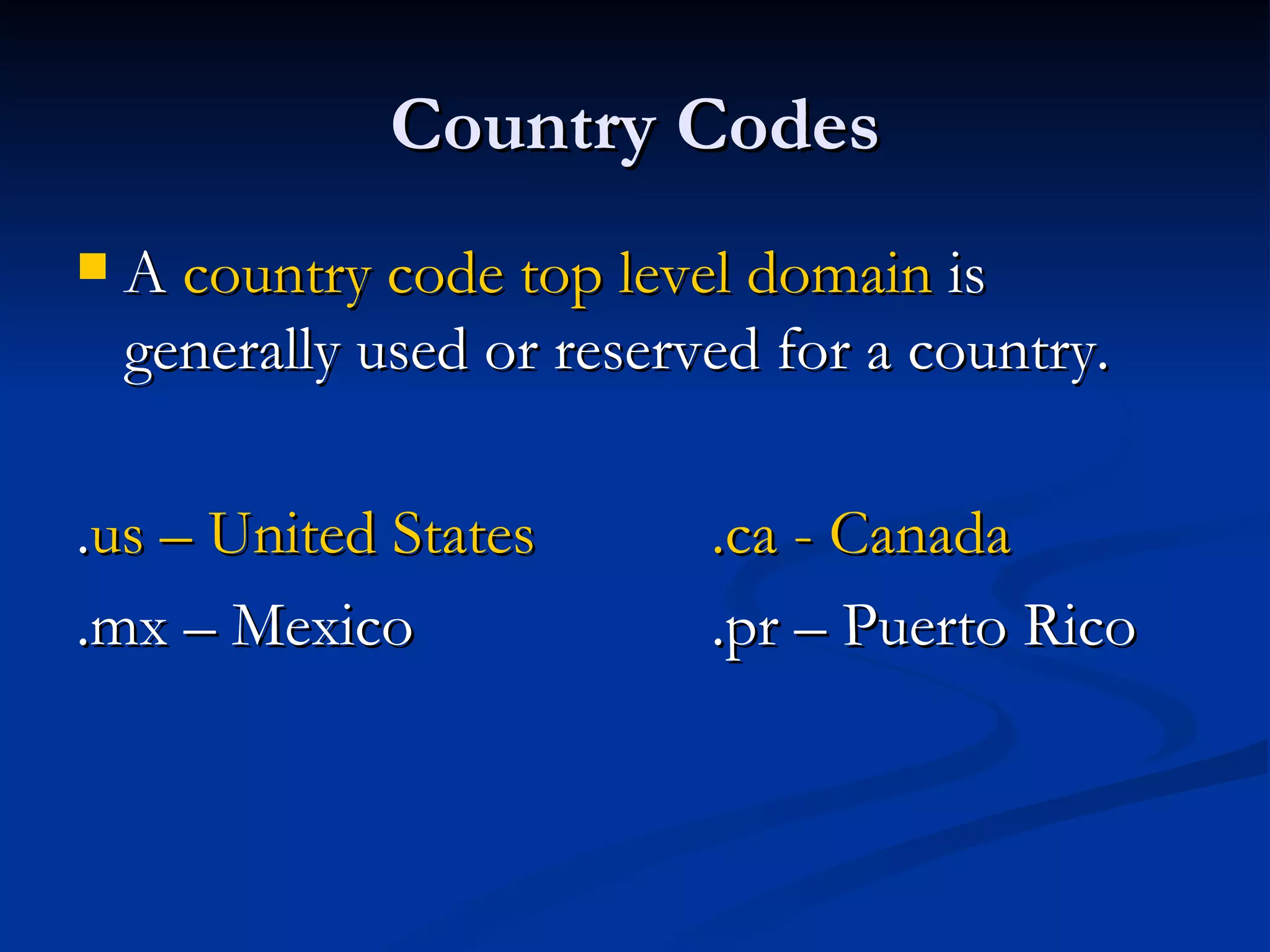
Country Codes A  country code top level domain  is generally used or reserved for a country. . us – United States  .ca - Canada .mx – Mexico .pr – Puerto Rico
Additional Domain Names With the rapid growth of the internet, additional top level domains have been added over the years. We no longer have the original 6 –  the list is much longer.

Domain Names

  • 1.
  • 2.
    What is theInternet? The Internet is a global system of interconnected computer networks that use the standardized Internet Protocol Suite (TCP/IP) to serve billions of users worldwide. It is a network of networks that consists of millions of private and public, academic, business, and government networks of local to global scope that are linked by copper wires, fiber-optic cables, wireless connections, and other technologies. (http://en.wikipedia.org/wiki/Internet)
  • 3.
    What is theInternet? A network of computers connected to each other.
  • 4.
    How do theyConnect? These computers needed to know which computer they were connecting to, so each computer was given a unique number – an IP (Internet Protocol) number. Ex. 121.245.078.2
  • 5.
    Greater numbers ofusers networking with each other created a demand for an easier system and one that was less confusing. In the mid 1980’s the Domain Name System was implemented and the initial top-level domain names, including .com, .net, and .org, were introduced. Suddenly 121.245.078.2 became 'company.com'.
  • 6.
    Top Level DomainNames The initial set of top-level domains was established. These were considered "general purpose domains" . com , . edu , . gov , . mil , . org . The . net domain was added with the first implementation of these domains.
  • 7.
    The Original TopLevel Domains .com - commercial organizations, but unrestricted . edu - educational establishments . gov – gov’t entities within the U.S.
  • 8.
    The Original TopLevel Domains .mil – the U.S. military .org – organizations, now unrestricted .net - initially intended to be used only for network providers, now unrestricted
  • 9.
    Parts of aDomain Name A domain name usually consists of two or more parts (technically labels ), which are separated by dots, such as example.com. The rightmost label is the top-level domain (for example, the address www.example.com has the top-level domain com).
  • 10.
    Various Levels ofDomain Names http://www.ci.west-allis.wi.us
  • 11.
    Country Codes A country code top level domain is generally used or reserved for a country. . us – United States .ca - Canada .mx – Mexico .pr – Puerto Rico
  • 12.
    Additional Domain NamesWith the rapid growth of the internet, additional top level domains have been added over the years. We no longer have the original 6 – the list is much longer.